
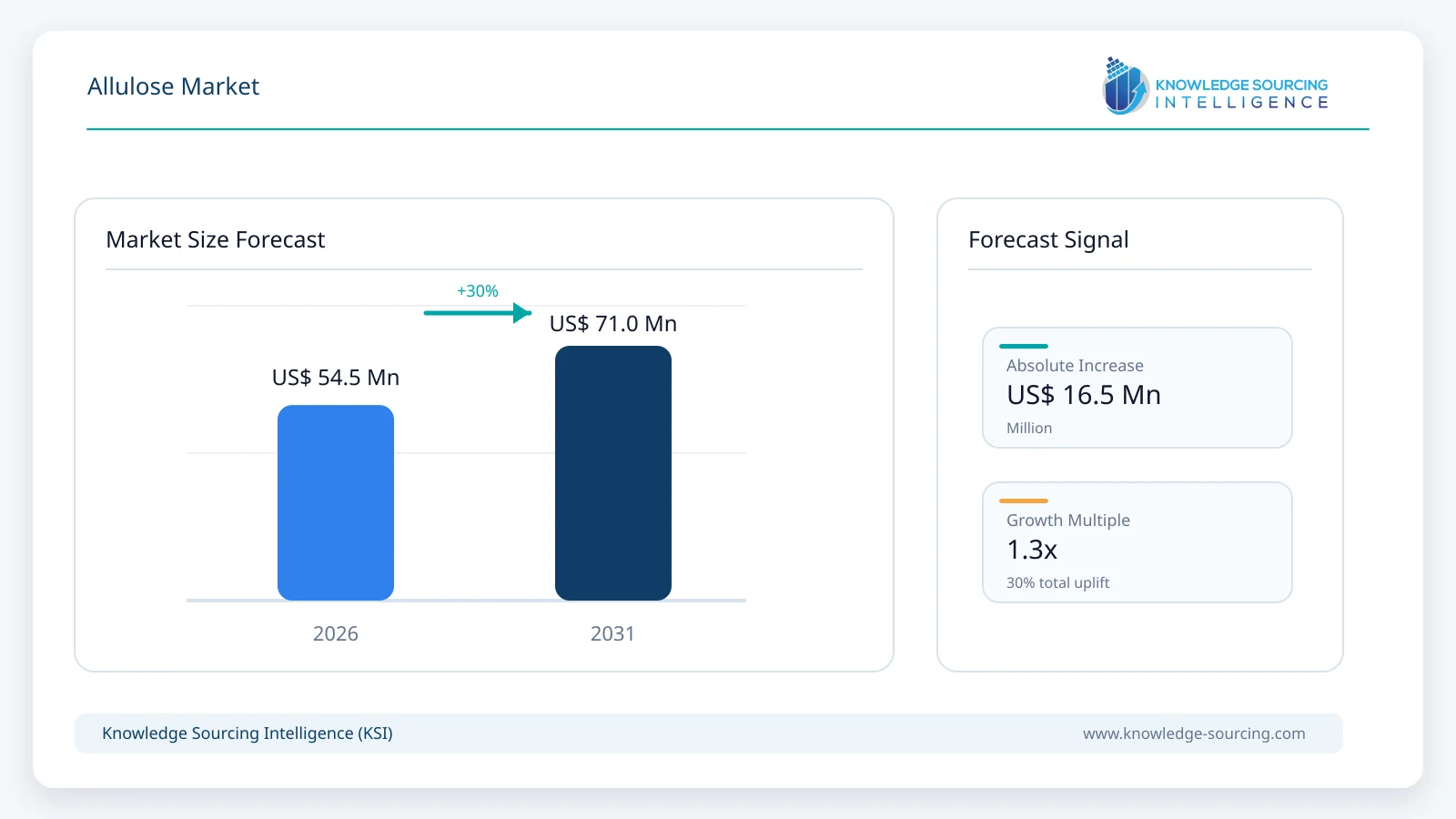
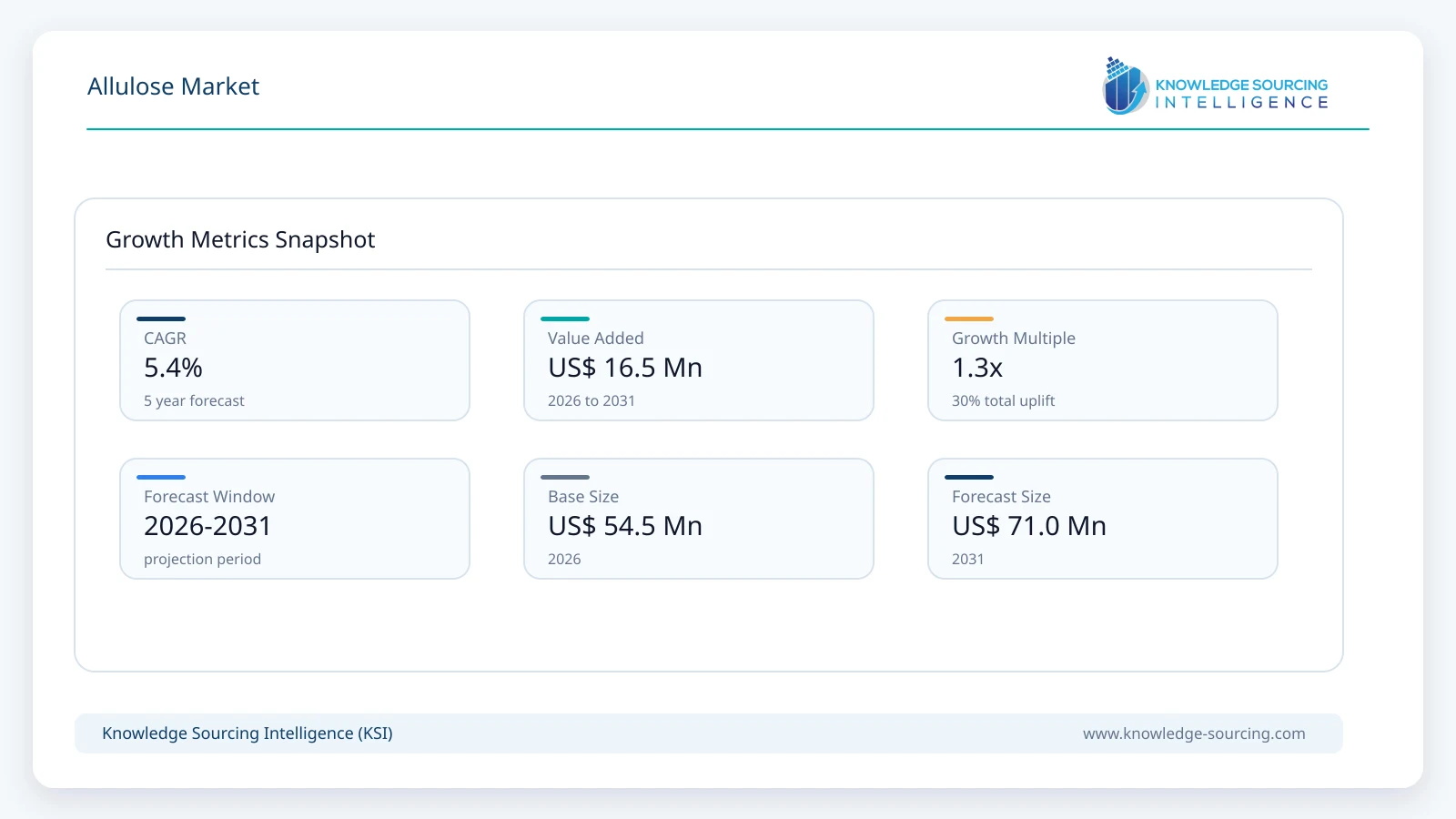
The Global Allulose Market is forecast to grow at a CAGR of 5.44%, reaching USD 71.02 million in 2031 from USD 54.50 million in 2026.
Highlights:
- 1Rising sugar-reduction initiatives across food and beverage industries continue to support commercial demand for allulose.
- 2Bakery and confectionery remain the most commercially important application because of allulose's functional similarity to sucrose.
- 3North America represents an important revenue contributor owing to favorable regulatory treatment and established food innovation ecosystems.
- 4Enzymatic production technologies continue to improve manufacturing efficiency and product consistency.
- 5Food labeling regulations and sugar-reduction policies strongly influence purchasing decisions among manufacturers.
- 6Competition centers on production technology, formulation expertise, global supply capabilities, and strategic partnerships with food manufacturers.
The allulose market comprises the production, formulation, and commercialization of allulose (D-psicose), a rare monosaccharide used as a low-calorie sweetener across food, beverage, nutraceutical, and pharmaceutical applications. Commercial interest in allulose has expanded as food manufacturers reformulate products to reduce sugar content while maintaining taste, texture, and functional performance. Unlike many high-intensity sweeteners, allulose provides bulking properties, browning characteristics, and freezing-point depression, making it particularly valuable in bakery, confectionery, dairy, and beverage formulations.
Demand is primarily driven by packaged food manufacturers, beverage producers, ingredient formulators, and dietary supplement companies seeking sugar alternatives that satisfy both nutritional targets and consumer taste expectations. Procurement decisions increasingly consider ingredient functionality, regulatory acceptance, supply reliability, and formulation compatibility rather than price alone. Large multinational food companies are incorporating rare sugars into product innovation pipelines as governments introduce sugar-reduction initiatives and consumers scrutinize nutrition labels more closely.
Production remains concentrated among a relatively limited number of manufacturers because commercial-scale allulose manufacturing requires specialized enzymatic conversion technologies, fermentation expertise, purification systems, and intellectual property. This creates relatively high entry barriers compared with conventional sweeteners such as sucrose or glucose syrup. Companies therefore compete through manufacturing efficiency, application support, ingredient consistency, regulatory approvals, and geographic distribution capabilities rather than commodity pricing.
Commercial adoption is strongest in premium and health-oriented food categories where manufacturers are willing to absorb higher ingredient costs in exchange for superior product performance. As production capacity expands and manufacturing yields improve, procurement is gradually extending beyond premium applications into mainstream food categories.
Market Drivers
Expansion of sugar-reduction strategies by food manufacturers
Food manufacturers continue reformulating products to reduce added sugar while maintaining consumer acceptance. Unlike many alternative sweeteners that primarily provide sweetness, allulose contributes bulk, mouthfeel, and browning during baking. These characteristics reduce formulation complexity and minimize the need for multiple ingredient substitutions. As a result, procurement teams increasingly evaluate allulose for premium baked goods, confectionery, frozen desserts, and beverages.
Growing demand for functional and reduced-calorie products
Consumers increasingly seek products supporting calorie management without compromising sensory quality. This purchasing behavior has encouraged manufacturers of beverages, dairy products, protein snacks, and nutritional supplements to incorporate ingredients capable of delivering conventional sugar functionality with substantially fewer calories. Companies therefore invest in formulation research to optimize product texture and shelf stability while meeting nutritional objectives.
Advancements in enzymatic production technologies
Commercial production increasingly relies on enzyme-based conversion processes that improve manufacturing efficiency and product purity. Continuous improvements in enzyme performance, downstream purification, and process optimization help reduce production costs while increasing manufacturing scalability. Investment in proprietary production technologies also strengthens competitive positioning because intellectual property remains an important differentiator within the industry.
Regulatory acceptance supporting commercialization
Regulatory recognition of allulose in several major markets has encouraged broader commercial adoption by food manufacturers. Clear labeling guidance and ingredient approvals reduce commercialization uncertainty, enabling manufacturers to introduce reduced-sugar product portfolios with greater confidence. Regulatory clarity also supports long-term investment in manufacturing capacity and product development.
Market Restraints and Challenges
High production costs compared with conventional sweeteners
Commercial allulose production remains more expensive than traditional sugar production because of specialized enzymatic conversion, purification, and quality assurance requirements. Cost-sensitive food manufacturers may therefore limit adoption to premium product categories where consumers demonstrate greater willingness to pay for nutritional benefits.
Limited production capacity
Global manufacturing remains concentrated among a relatively small number of producers. Capacity constraints can increase procurement risks for multinational food manufacturers requiring consistent long-term ingredient supply. Buyers frequently diversify supplier relationships to reduce operational risks.
Regulatory differences across countries
Although regulatory acceptance has expanded, approval status and labeling requirements continue to vary among jurisdictions. Manufacturers introducing global product portfolios must adapt formulations, packaging, and compliance documentation according to regional regulatory frameworks, increasing commercialization complexity.
Consumer awareness remains uneven
Many consumers remain unfamiliar with rare sugars compared with established sweeteners such as stevia or erythritol. Manufacturers therefore invest in educational marketing, transparent labeling, and scientific communication to improve understanding of ingredient functionality and nutritional characteristics.
Major Segment Analysis
Bakery and Confectionery represents the leading commercial application because allulose closely replicates the physical properties of sucrose during food processing. Manufacturers require ingredients capable of contributing sweetness, moisture retention, caramelization, and desirable texture without substantially increasing calorie content.
Commercial buyers prioritize formulation stability, ingredient consistency, and compatibility with existing production equipment. Allulose satisfies these requirements more effectively than many high-intensity sweeteners, reducing formulation adjustments during product development. Premium bakery products, chocolate, chewing gum, cookies, frozen desserts, and confectionery therefore account for substantial commercial demand.
Competition within this segment increasingly focuses on technical support rather than ingredient supply alone. Manufacturers offering application laboratories, formulation expertise, and customized ingredient blends gain competitive advantages because food companies seek solutions that shorten product development timelines. Continued innovation in sugar-reduced bakery products is expected to reinforce the segment's commercial importance over the forecast period.
Regional Analysis
North America remains a leading regional market due to established food innovation capabilities, consumer acceptance of reduced-sugar products, and supportive regulatory frameworks. Large packaged food manufacturers continue investing in reformulation programs, creating sustained demand for specialty sweeteners. Strong research infrastructure also supports collaboration between ingredient suppliers and food companies.
Europe demonstrates growing demand as manufacturers respond to sugar-reduction initiatives and evolving nutritional policies. Food companies increasingly evaluate ingredient functionality alongside nutritional performance, particularly within bakery, dairy, and beverage categories. However, regulatory requirements and approval timelines continue influencing commercialization strategies.
Asia Pacific combines strong manufacturing capacity with expanding food processing industries. China, Japan, and South Korea play important roles in ingredient production and technological development, while India and Australia present increasing commercial opportunities as demand for functional foods expands. Competitive manufacturing capabilities also support export-oriented production.
South America and the Middle East & Africa represent developing opportunities supported by expanding processed food industries and growing consumer interest in healthier food alternatives. Adoption remains comparatively lower because of price sensitivity, limited consumer awareness, and developing regulatory frameworks. Nevertheless, multinational food companies continue introducing reduced-sugar product portfolios across these regions.
Competitive Landscape
The competitive environment remains moderately concentrated, reflecting technological barriers associated with commercial allulose production. Companies including Matsutani Chemical Industry Co., Ltd., Tate & Lyle plc, CJ CheilJedang Corporation, Bonumose Inc., Cargill, Incorporated, Ingredion Incorporated, Samyang Corporation, Apura Ingredients Inc., Savanna Ingredients GmbH, Daesang Corporation, Baolingbao Biology Co., Ltd., and Matsutani America, Inc. compete through manufacturing technology, ingredient quality, regulatory capabilities, and customer application support.
Strategic collaboration with food manufacturers has become an important competitive approach because successful commercialization frequently depends on formulation expertise rather than ingredient availability alone. Companies continue expanding production capacity, strengthening regional distribution networks, protecting proprietary manufacturing technologies, and developing customized ingredient solutions for bakery, beverage, dairy, and nutritional applications.
Recent Developments
June 2026: Ingredion Incorporated announced a recommended $5 billion cash acquisition of Tate & Lyle PLC, combining their global portfolios to establish a unified market leader in allulose-based sugar reduction.
May 2026: Ingredion Incorporated and Tate & Lyle expanded investments supporting specialty sweetener portfolios for beverage, bakery, and dairy applications, strengthening commercial supply capabilities.
April 2026: CJ CheilJedang expanded commercialization activities for liquid allulose ingredients targeting reduced-sugar beverages and functional foods, supporting broader international market penetration.
Regulatory and Policy Environment
The regulatory environment significantly influences commercial adoption because food manufacturers require clear approval pathways before incorporating novel ingredients into mainstream product portfolios. In the United States, regulatory recognition and labeling guidance have encouraged broader utilization of allulose in food reformulation programs. Compliance requirements covering ingredient quality, manufacturing practices, food safety systems, and labeling remain central procurement considerations.
Internationally, manufacturers must comply with country-specific food safety regulations, import requirements, and ingredient authorization procedures before commercialization. Compliance with internationally recognized food safety management systems further strengthens supplier credibility among multinational food companies. Government initiatives encouraging sugar reduction and improved nutritional labeling continue supporting demand for alternative sweeteners across numerous food categories.
Outlook and Strategic Implications
Commercial prospects for the allulose market will depend on continued improvements in manufacturing efficiency, broader regulatory acceptance, and sustained investment in food product reformulation. Capital investment is expected to prioritize enzyme optimization, production scale expansion, purification technologies, and supply chain resilience.
Procurement teams will increasingly evaluate suppliers according to manufacturing reliability, technical application support, regulatory expertise, and geographic supply flexibility. Competitive differentiation is expected to shift toward integrated ingredient solutions combining formulation assistance with consistent commercial supply.
Manufacturers capable of reducing production costs while maintaining high product purity will strengthen their competitive positions as allulose adoption expands beyond premium food categories. Nevertheless, production economics, evolving regulatory requirements, and regional differences in consumer awareness will remain important strategic considerations over the coming five years.
Allulose Market Scope
| Report Metric | Details |
|---|---|
| Total Market Size in 2026 | USD 54.50 million |
| Total Market Size in 2031 | USD 71.02 million |
| Forecast Unit | Million |
| Growth Rate | 5.44% |
| Study Period | 2021 to 2031 |
| Historical Data | 2021 to 2024 |
| Base Year | 2025 |
| Forecast Period | 2026 – 2031 |
| Segmentation | Form, Application, Distribution Channel, Geography |
| Companies |
|
Market Segmentation
By Form
By Application
By Distribution Channel
By Geography
Table of Contents
1. EXECUTIVE SUMMARY
2. MARKET SNAPSHOT
2.1. Market Overview
2.2. Market Definition
2.3. Scope of the Study
2.4. Market Segmentation
3. BUSINESS LANDSCAPE
3.1. Market Drivers
3.2. Market Restraints
3.3. Market Opportunities
3.4. Porter’s Five Forces Analysis
3.5. Industry Value Chain Analysis
3.6. Policies and Regulations
3.7. Strategic Recommendations
4. TECHNOLOGICAL OUTLOOK
5. GLOBAL ALLULOSE MARKET BY FORM
5.1. Introduction
5.2. Powder
5.3. Liquid
5.4. Crystal
6. GLOBAL ALLULOSE MARKET BY APPLICATION
6.1. Introduction
6.2. Bakery and Confectionery
6.3. Dairy Products
6.4. Beverages
6.5. Dietary Supplements
6.6. Pharmaceuticals
6.7. Others
7. GLOBAL ALLULOSE MARKET BY DISTRIBUTION CHANNEL
7.1. Introduction
7.2. Offline
7.2.1. Supermarkets and Hypermarkets
7.2.2. Convenience Stores
7.2.3. Specialty Stores
7.2.4. Others
7.3. Online
8. GLOBAL ALLULOSE MARKET BY GEOGRAPHY
8.1. Introduction
8.2. North America
8.2.1. USA
8.2.2. Canada
8.2.3. Mexico
8.3. South America
8.3.1. Brazil
8.3.2. Argentina
8.3.3. Others
8.4. Europe
8.4.1. United Kingdom
8.4.2. Germany
8.4.3. France
8.4.4. Spain
8.4.5. Italy
8.4.6. Others
8.5. Middle East and Africa
8.5.1. Saudi Arabia
8.5.2. UAE
8.5.3. South Africa
8.5.4. Others
8.6. Asia Pacific
8.6.1. China
8.6.2. Japan
8.6.3. India
8.6.4. South Korea
8.6.5. Taiwan
8.6.6. Australia
8.6.7. Others
9. COMPETITIVE ENVIRONMENT AND ANALYSIS
9.1. Major Players and Strategy Analysis
9.2. Market Share Analysis
9.3. Mergers, Acquisitions, Agreements, and Collaborations
9.4. Competitive Dashboard
10. COMPANY PROFILES
10.1. Matsutani Chemical Industry Co., Ltd.
10.2. Tate & Lyle plc
10.3. CJ CheilJedang Corporation
10.4. Bonumose Inc.
10.5. Cargill, Incorporated
10.6. Ingredion Incorporated
10.7. Samyang Corporation
10.8. Apura Ingredients Inc.
10.9. Savanna Ingredients GmbH
10.10. Daesang Corporation
10.11. Baolingbao Biology Co., Ltd.
10.12. Matsutani America, Inc.
11. APPENDIX
11.1. Currency
11.2. Assumptions
11.3. Base and Forecast Years Timeline
11.4. Key Benefits for Stakeholders
11.5. Research Methodology
11.6. Abbreviations
Navigate
Trusted by the world's leading organizations











