
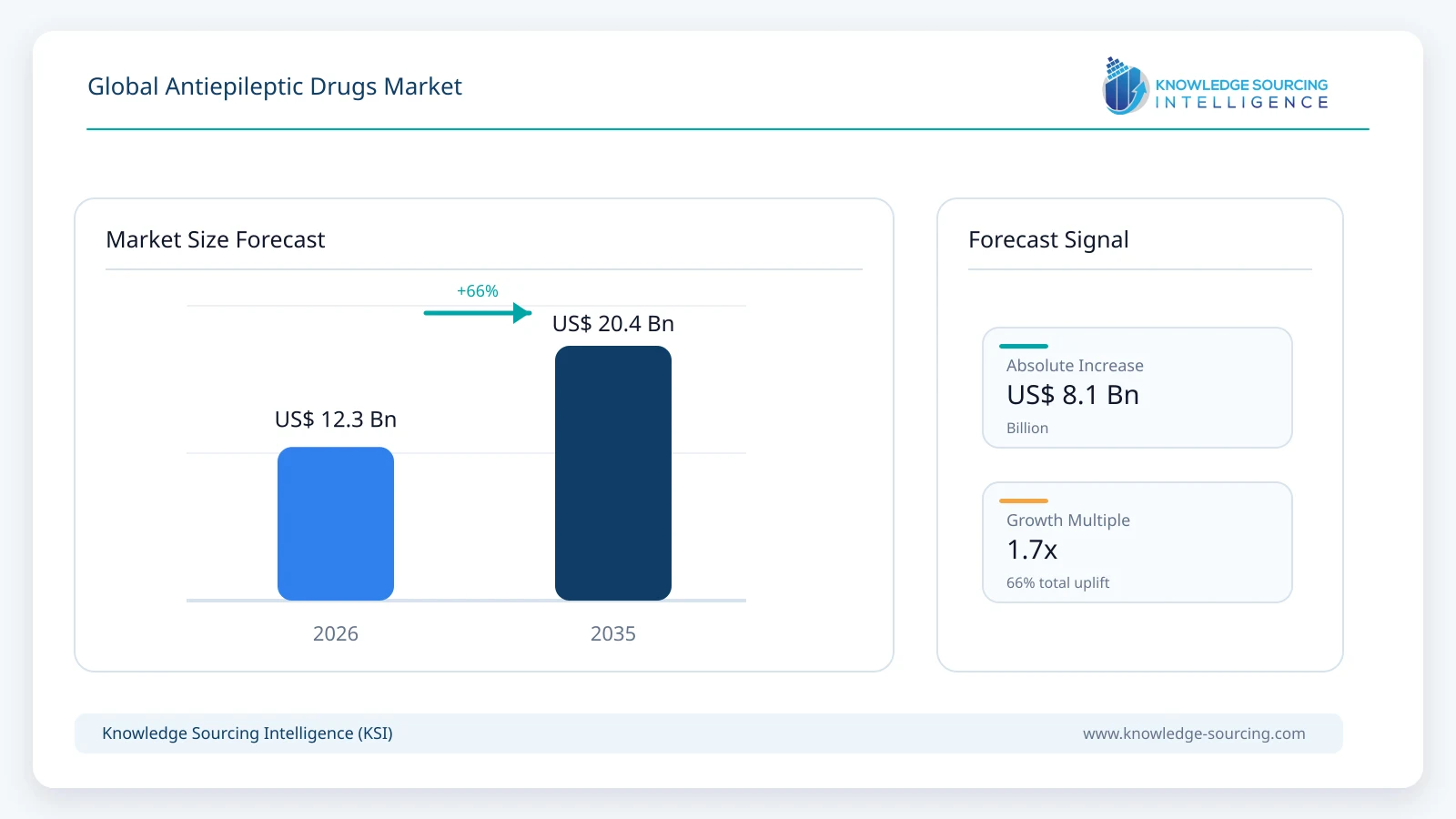
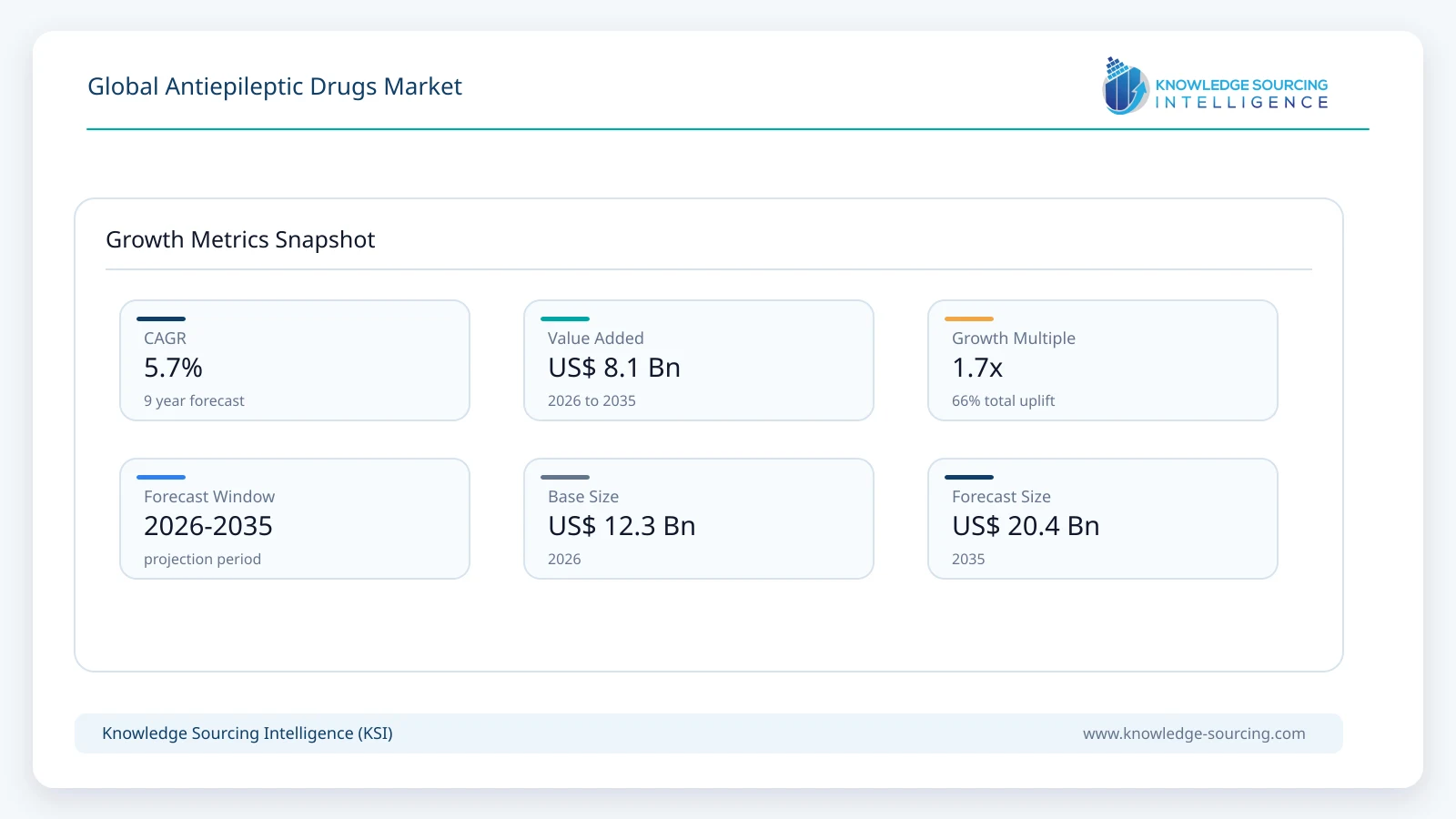
The Global Antiepileptic Drugs Market is projected to grow at a CAGR of 5.7% the forecast period, increasing from USD 12.3 billion in 2026 to USD 20.4 billion by 2035.
Highlights:
- 1Rising diagnosis rates are increasing long-term prescription demand because neurological screening capabilities continue expanding across emerging healthcare systems.
- 2Drug-resistant epilepsy populations are creating demand for advanced therapies because conventional seizure-control mechanisms often fail in refractory patients.
- 3Cannabinoid-based therapies are gaining adoption because syndrome-specific efficacy data continue supporting use in severe pediatric epilepsy.
- 4Regulatory incentives are accelerating rare disease development because orphan-drug pathways reduce commercialization barriers.
The antiepileptic drugs market represents a clinically driven pharmaceutical segment where therapeutic demand originates from persistent seizure control requirements. Epilepsy treatment requires long-duration medication exposure because seizure recurrence often returns when therapy discontinuation occurs. Demand is increasing for newer-generation therapies because physicians increasingly balance seizure reduction with quality-of-life outcomes. This shift is reducing dependence on older agents associated with cognitive impairment, drug interactions, and teratogenicity concerns.
Regulatory frameworks increasingly favor rare neurological disease innovation because severe epilepsy syndromes continue demonstrating high unmet clinical need. Drug manufacturers are concentrating development resources on refractory patient populations where differentiated efficacy can justify premium pricing. Market expansion therefore depends less on disease prevalence growth and more on improved diagnosis rates, treatment access expansion, and adoption of specialty therapies.
Market Dynamics
Market Drivers
Expanding Diagnosis and Treatment Access: Epilepsy treatment demand depends on diagnostic identification because untreated patients rarely enter prescription pathways. Healthcare systems are improving neurological care access while awareness initiatives are increasing disease recognition. Treatment penetration therefore continues expanding across developing regions. This progression strengthens long-term prescription volume growth.
Increasing Adoption of Newer-Generation AEDs: Therapy selection increasingly emphasizes tolerability because treatment discontinuation frequently undermines seizure control outcomes. Physicians are shifting toward second- and third-generation AEDs while minimizing exposure to drugs associated with significant cognitive or psychiatric adverse effects. This transition supports sustained uptake of differentiated products. Commercial competition therefore increasingly centers on long-term treatment persistence.
Growth in Rare Epilepsy Syndrome Treatment: Rare epilepsy syndromes require specialized interventions because conventional therapies often provide incomplete seizure control. Clinical development programs are targeting syndrome-specific populations while regulators continue supporting orphan-drug pathways. Innovation activity therefore remains concentrated within severe pediatric indications. This focus expands premium therapy opportunities.
Expanding Evidence Supporting Cannabinoid-Based Therapies: Cannabidiol-based treatments address highly refractory epilepsy populations because validated clinical data support seizure reduction in specific syndromes. Clinicians are integrating these therapies into treatment algorithms while payer organizations increasingly evaluate reimbursement pathways. Adoption therefore continues expanding within eligible patient populations.
Market Restraints
Generic competition reduces pricing flexibility because numerous first-generation AEDs maintain broad market availability.
Long-term safety concerns constrain utilization because psychiatric, hepatic, and teratogenic risks continue influencing prescribing behavior.
Treatment access remains uneven because reimbursement frameworks vary substantially across healthcare systems.
Market Opportunities
Precision Epilepsy Management: Drug-resistant populations create demand for targeted interventions because conventional mechanisms frequently fail to achieve seizure freedom. Precision treatment models are emerging while biomarker-driven approaches continue gaining research attention. This evolution supports differentiated innovation pathways.
Pediatric Rare Disease Expansion: Pediatric epilepsy syndromes require specialized therapies because disease burden remains severe and treatment alternatives remain limited. Companies are expanding pediatric clinical programs while regulators continue supporting accelerated review mechanisms. Commercial opportunities therefore remain significant.
Novel Mechanism Development: Traditional seizure-control pathways face efficacy limitations because refractory disease mechanisms remain heterogeneous. Research programs are pursuing innovative targets while next-generation therapies continue entering clinical evaluation. This movement broadens future treatment possibilities.
Emerging Market Penetration: Diagnosis rates remain below developed-market levels because healthcare infrastructure limitations continue restricting neurological care access. Governments are investing in neurological health services while treatment availability continues expanding. Market participation therefore increases across underserved regions.
Government Regulations
Regulatory Body | Regulatory Focus | Market Impact |
U.S. Food and Drug Administration | Drug approvals and safety monitoring | Accelerates access to innovative epilepsy therapies |
European Medicines Agency | Centralized authorization | Supports multinational commercialization |
Pharmaceuticals and Medical Devices Agency | Clinical review and post-market surveillance | Expands access in Japan |
National Medical Products Administration | Drug approval oversight | Improves market access in China |
Central Drugs Standard Control Organisation | Drug registration and compliance | Supports expanding epilepsy treatment access |
Market Segmentation
By Drug Class
Drug-class differentiation determines competitive positioning because efficacy alone no longer drives treatment selection. Sodium channel modulators maintain broad utilization while tolerability concerns continue influencing switching behavior. SV2A ligands are gaining preference because favorable neuropsychiatric profiles support long-term adherence. Cannabinoid-based therapies are expanding within rare epilepsy populations while syndrome-specific evidence continues strengthening clinical confidence. This shift increases demand for differentiated mechanisms capable of addressing refractory disease.
By Generation
Generation-based segmentation reflects evolving treatment priorities because newer therapies increasingly emphasize safety and adherence. First-generation AEDs remain widely utilized due to affordability. Second-generation products continue expanding because physicians seek reduced interaction burdens. Third-generation therapies are gaining attention while specialty indications continue supporting premium positioning. The resulting treatment hierarchy increasingly links prescribing decisions to quality-of-life outcomes.
By Seizure Type
Seizure classification influences therapy selection because clinical response varies significantly across epilepsy subtypes. Focal seizure treatment represents a substantial prescription segment while newer therapies continue targeting refractory patients. Generalized seizure management requires broader-spectrum efficacy because multiple seizure manifestations frequently coexist. Mixed seizure populations continue creating demand for flexible treatment approaches. This segmentation supports diversified product positioning.
Regional Analysis
North America
North America represents a leading epilepsy therapeutics market because specialty neurological care infrastructure supports rapid treatment adoption. Diagnosis rates remain comparatively high while advanced monitoring technologies continue improving patient identification. Demand is shifting toward differentiated therapies because refractory epilepsy management increasingly influences prescribing decisions. Payers continue evaluating value-based access frameworks while specialty products maintain premium positioning. Rare disease treatment adoption therefore remains strong. Cannabinoid-based therapies continue gaining utilization because clinical evidence supports syndrome-specific efficacy. This structure supports innovation-driven competition and sustained commercialization opportunities.
Europe
Europe maintains substantial AED utilization because neurological disease management remains integrated within public healthcare systems. Demand is increasing for newer-generation therapies while clinicians continue prioritizing tolerability and treatment persistence. Reimbursement assessments create pricing pressure because cost-effectiveness evaluation remains central to access decisions. Manufacturers are pursuing differentiated clinical positioning while rare disease programs continue receiving regulatory support. This environment encourages evidence-based adoption patterns and long-term therapeutic optimization.
Asia Pacific
Asia Pacific demonstrates expanding growth potential because diagnosis rates and healthcare investment continue increasing across major economies. Treatment penetration remains uneven while healthcare modernization initiatives continue improving neurological care access. Demand is shifting toward branded specialty therapies because urban healthcare centers increasingly adopt advanced treatment protocols. Domestic regulatory reforms continue accelerating market entry timelines. This transition strengthens opportunities for innovative AED manufacturers.
Rest of the World
Emerging healthcare systems continue expanding epilepsy treatment access because untreated patient populations remain significant. Demand is increasing as neurological awareness improves while healthcare infrastructure continues developing. Generic products maintain strong utilization because affordability remains a primary treatment determinant. Specialty therapy adoption remains selective while reimbursement constraints continue influencing prescribing behavior. This environment supports gradual market expansion driven by access improvement.
Regulatory Landscape
Regulatory oversight remains central to AED commercialization because neurological therapies require extensive efficacy and safety validation. Agencies continue emphasizing long-term safety monitoring while post-marketing surveillance requirements increasingly shape lifecycle management strategies. Rare disease pathways support accelerated development because severe epilepsy syndromes demonstrate substantial unmet need.
Orphan-drug incentives continue influencing investment allocation because regulatory exclusivity improves commercial viability. Developers are targeting pediatric epilepsy populations while agencies increasingly support specialized clinical trial frameworks. This environment encourages innovation within high-burden neurological disorders.
Pipeline Analysis
Pipeline activity increasingly targets refractory epilepsy because seizure freedom remains difficult to achieve in treatment-resistant populations. Novel mechanisms are entering development while precision approaches continue attracting investment. Companies are prioritizing differentiated efficacy profiles because generic competition limits value creation within conventional treatment categories.
Rare epilepsy syndromes continue attracting clinical development activity because regulatory incentives improve commercialization prospects. Cannabinoid-based therapies, next-generation channel modulators, and disease-modifying approaches are receiving increased attention. This pipeline evolution broadens future treatment possibilities while intensifying competition for specialty neurological markets.
Competitive Landscape
UCB
UCB remains strategically distinct because it maintains one of the industry's most comprehensive epilepsy portfolios. Products including Keppra, Vimpat, and Briviact support broad neurologist engagement while multiple mechanisms strengthen treatment flexibility. The company continues expanding neurological specialization because long-term epilepsy management remains central to commercial strategy. Prescription demand increasingly favors therapies with favorable adherence profiles, which supports continued portfolio relevance. UCB's established physician relationships and extensive clinical evidence base reinforce competitive resilience.
Jazz Pharmaceuticals
Jazz Pharmaceuticals differentiates itself through rare epilepsy specialization because severe pediatric syndromes require highly targeted treatment approaches. Epidiolex and Fintepla address refractory patient populations while clinical evidence continues supporting adoption. Demand is increasing within syndrome-specific treatment pathways because conventional therapies frequently provide insufficient control. The company continues leveraging orphan-drug expertise while expanding neurological commercialization capabilities. This positioning strengthens premium-market participation.
Eisai
Eisai maintains strategic relevance through Fycompa, which addresses epilepsy through AMPA receptor antagonism. Demand continues expanding among patients requiring alternative mechanisms because treatment resistance remains a persistent challenge. The company focuses on neurological disease specialization while strengthening clinical evidence generation. This approach supports differentiation within competitive epilepsy markets.
SK Biopharmaceuticals
SK Biopharmaceuticals gains competitive strength through XCOPRI because refractory focal seizure populations require improved seizure-control outcomes. Adoption is increasing as physicians seek therapies capable of addressing treatment-resistant disease. The company continues investing in neurological innovation while expanding global commercialization infrastructure. This strategy supports long-term specialty market growth.
Neurelis
Neurelis focuses on seizure rescue therapy because acute seizure clusters require rapid intervention. Demand is increasing for non-invasive administration options while caregivers continue seeking outpatient treatment flexibility. Valtoco strengthens the company's positioning because intranasal delivery improves accessibility. This specialization creates differentiated market opportunities.
Aquestive Therapeutics
Aquestive Therapeutics differentiates itself through film-based drug delivery technologies because administration convenience increasingly influences treatment adoption. Libervant addresses seizure emergencies while buccal delivery supports caregiver usability. Demand continues shifting toward patient-friendly formulations because treatment responsiveness remains critical during acute seizure events. This focus supports niche market expansion.
Angelini Pharma
Angelini Pharma maintains epilepsy market relevance through European neurological operations and specialized CNS commercialization capabilities. Demand is increasing for regionally optimized treatment access while healthcare systems continue emphasizing long-term disease management. The company expands neurological engagement through targeted commercial strategies. This approach strengthens regional competitive positioning.
Supernus Pharmaceuticals
Supernus Pharmaceuticals leverages Oxtellar XR to address seizure management through extended-release formulations. Demand is increasing for adherence-supporting therapies because long-term treatment persistence influences outcomes. The company continues focusing on CNS disorders while enhancing portfolio differentiation through formulation innovation. This strategy supports sustained participation in epilepsy therapeutics.
Strategic Insights and Future Market Outlook
The future epilepsy treatment landscape increasingly depends on differentiated clinical value because generic competition continues limiting growth within traditional drug classes. Manufacturers are concentrating resources on refractory populations while specialty therapies continue demonstrating stronger commercial potential. This transition supports innovation-focused competition rather than volume-driven expansion.
Rare epilepsy syndromes are attracting greater investment because regulatory incentives improve development economics. Precision medicine initiatives continue advancing while biomarker-driven treatment strategies increasingly influence research priorities. Clinical differentiation therefore remains the primary determinant of future market leadership.
Long-term market evolution favors companies capable of combining efficacy, tolerability, and targeted patient selection. Neurologists increasingly prioritize treatment persistence while healthcare systems continue evaluating value-based outcomes. These dynamics support sustained innovation across specialty epilepsy therapeutics.
The Global Antiepileptic Drugs Market remains defined by chronic disease management requirements, expanding specialty treatment adoption, and increasing focus on refractory epilepsy populations. Demand continues shifting toward differentiated mechanisms because long-term seizure control increasingly depends on individualized treatment strategies rather than broad-spectrum pharmacology alone.
Antiepileptic Drugs Market Scope:
| Report Metric | Details |
|---|---|
| Total Market Size in 2026 | USD 12.3 billion |
| Total Market Size in 2035 | USD 20.4 billion |
| Forecast Unit | USD Billion |
| Growth Rate | 5.7% |
| Study Period | 2021 to 2035 |
| Historical Data | 2021 to 2024 |
| Base Year | 2025 |
| Forecast Period | 2026 – 2035 |
| Segmentation | Drug Class, Generation, Seizure Type, Geography |
| Companies |
|
Market Segmentation
By Geography
Key Countries Analysis
Table of Contents
1. EXECUTIVE SUMMARY
1.1 Strategic Snapshot
1.1.1 Antiepileptic Drugs (AEDs) Market Overview
1.1.2 Key Commercial Insights
1.1.3 Key Clinical Insights
1.1.4 Key Regulatory Developments
1.1.5 Pipeline Highlights
1.1.6 Strategic Opportunities and Risks
1.2 Key Market Metrics
1.2.1 Global Revenue Overview
1.2.2 Prescription Volume Overview
1.2.3 Treated Patient Overview
1.2.4 Forecast Summary
1.3 Executive Conclusions
1.3.1 Market Evolution Outlook
1.3.2 Competitive Positioning Summary
1.3.3 Innovation Outlook
2. DISEASE & PATIENT POPULATION INTELLIGENCE
2.1 Epilepsy Disease Overview
2.1.1 Definition and Classification
2.1.2 Focal Epilepsy
2.1.3 Generalized Epilepsy
2.1.4 Combined Generalized and Focal Epilepsy
2.1.5 Developmental and Epileptic Encephalopathies
2.2 Disease Burden Analysis
2.2.1 Global Prevalence
2.2.2 Global Incidence
2.2.3 Mortality Burden
2.2.4 Disability Burden
2.2.5 Economic Burden
2.3 Patient Funnel Assessment
2.3.1 Total Patient Population
2.3.2 Diagnosed Population
2.3.3 Treated Population
2.3.4 Drug-Resistant Epilepsy Population
2.3.5 Advanced Therapy Eligible Population
2.3.6 Refractory Patient Population
2.4 Patient Segmentation
2.4.1 Pediatric Population
2.4.2 Adult Population
2.4.3 Geriatric Population
2.5 Severity-Based Segmentation
2.5.1 Mild Epilepsy
2.5.2 Moderate Epilepsy
2.5.3 Severe Epilepsy
2.5.4 Drug-Resistant Epilepsy
2.6 Comorbidity Assessment
2.6.1 Depression
2.6.2 Anxiety Disorders
2.6.3 Cognitive Impairment
2.6.4 Migraine
2.6.5 Sleep Disorders
2.6.6 Neurodevelopmental Disorders
2.7 Treatment Journey Analysis
2.7.1 Diagnosis Pathway
2.7.2 First-Line Therapy
2.7.3 Add-On Therapy
2.7.4 Refractory Disease Management
2.7.5 Surgical and Device-Based Interventions
3. PHARMACOLOGICAL & MECHANISTIC LANDSCAPE
3.1 Antiepileptic Drug-Class Overview
3.1.1 Historical Evolution
3.1.2 Current Treatment Paradigm
3.1.3 Future Treatment Paradigm
3.2 Mechanism of Action Landscape
3.2.1 Voltage-Gated Sodium Channel Modulators
3.2.1.1 Carbamazepine
3.2.1.2 Oxcarbazepine
3.2.1.3 Eslicarbazepine Acetate
3.2.1.4 Lamotrigine
3.2.1.5 Phenytoin
3.2.1.6 Lacosamide
3.2.2 GABAergic Modulators
3.2.2.1 Valproate
3.2.2.2 Clobazam
3.2.2.3 Diazepam
3.2.2.4 Tiagabine
3.2.2.5 Vigabatrin
3.2.3 SV2A Ligands
3.2.3.1 Levetiracetam
3.2.3.2 Brivaracetam
3.2.4 Calcium Channel Modulators
3.2.4.1 Ethosuximide
3.2.4.2 Gabapentin
3.2.4.3 Pregabalin
3.2.5 AMPA Receptor Antagonists
3.2.5.1 Perampanel
3.2.6 Carbonic Anhydrase Inhibitors
3.2.6.1 Topiramate
3.2.6.2 Zonisamide
3.2.7 Cannabinoid-Based Therapies
3.2.7.1 Cannabidiol
3.2.8 Novel Mechanistic Therapies
3.2.8.1 Fenfluramine
3.2.8.2 Stiripentol
3.3 Biological Pathway Assessment
3.3.1 Excitatory Neurotransmission
3.3.2 Inhibitory Neurotransmission
3.3.3 Synaptic Vesicle Modulation
3.3.4 Ion Channel Regulation
3.3.5 Neuroinflammation Pathways
3.4 Mechanistic Benchmarking
3.4.1 Mechanism vs Efficacy
3.4.2 Mechanism vs Safety
3.4.3 Mechanism vs Patient Adherence
3.4.4 Mechanism vs Drug Resistance
4. CLINICAL OUTCOMES & EVIDENCE BENCHMARKING
4.1 Clinical Development Framework
4.1.1 Primary Clinical Endpoints
4.1.1.1 Seizure Frequency Reduction
4.1.1.2 Seizure Freedom Rate
4.1.1.3 Responder Rate (?50%)
4.1.2 Secondary Clinical Endpoints
4.1.2.1 Quality of Life
4.1.2.2 Cognitive Outcomes
4.1.2.3 Functional Outcomes
4.2 Landmark Clinical Trial Assessment
4.2.1 Levetiracetam Clinical Program
4.2.2 Brivaracetam Clinical Program
4.2.3 Lacosamide Clinical Program
4.2.4 Perampanel Clinical Program
4.2.5 Cannabidiol Clinical Program
4.2.6 Fenfluramine Clinical Program
4.3 Syndrome-Specific Evidence Review
4.3.1 Focal Seizures
4.3.2 Generalized Tonic-Clonic Seizures
4.3.3 Lennox-Gastaut Syndrome
4.3.4 Dravet Syndrome
4.3.5 Tuberous Sclerosis Complex
4.4 Head-to-Head Clinical Benchmarking
4.4.1 Efficacy Comparison
4.4.2 Safety Comparison
4.4.3 Retention Rates
4.4.4 Treatment Persistence
4.5 Safety and Tolerability Analysis
4.5.1 CNS Adverse Events
4.5.2 Psychiatric Adverse Events
4.5.3 Hepatic Safety
4.5.4 Teratogenicity Risks
4.5.5 Drug-Drug Interactions
4.6 Real-World Evidence Assessment
4.6.1 Registry Data
4.6.2 Claims Database Studies
4.6.3 Long-Term Outcomes
4.6.4 Adherence Patterns
5. PIPELINE & INNOVATION LANDSCAPE
5.1 Pipeline Overview
5.1.1 Pipeline by Development Stage
5.1.2 Pipeline by Mechanism
5.1.3 Pipeline by Indication
5.2 Preclinical Pipeline Assessment
5.3 Phase I Pipeline Assessment
5.4 Phase II Pipeline Assessment
5.5 Phase III Pipeline Assessment
5.6 Emerging Therapeutic Modalities
5.6.1 Precision Medicine Approaches
5.6.2 Gene Therapy Approaches
5.6.3 RNA-Based Therapeutics
5.6.4 Disease-Modifying Therapies
5.7 Innovation Benchmarking
5.7.1 Novel Targets
5.7.2 Novel Delivery Platforms
5.7.3 Pediatric Innovation Trends
5.8 Probability of Success Analysis
5.9 Expected Launch Timeline Assessment
6. REGULATORY & MARKET ACCESS INTELLIGENCE
6.1 Regulatory Framework Overview
6.1.1 FDA Landscape
6.1.2 EMA Landscape
6.1.3 PMDA Landscape
6.1.4 NMPA Landscape
6.1.5 CDSCO Landscape
6.2 Approval Trends
6.3 Orphan Drug Designations
6.4 Pediatric Regulatory Incentives
6.5 Reimbursement Landscape
6.5.1 Public Reimbursement
6.5.2 Private Reimbursement
6.5.3 Health Technology Assessment Trends
6.6 Pricing and Access Assessment
6.6.1 Generic Competition Impact
6.6.2 Specialty Drug Access
6.6.3 Cost-Effectiveness Considerations
7. MARKET SIZE, UTILIZATION & FORECAST
7.1 Market Modeling Framework
7.2 Global Revenue Analysis
7.2.1 Historical Revenue
7.2.2 Current Revenue
7.2.3 Forecast Revenue
7.3 Prescription Volume Analysis
7.3.1 Historical Prescriptions
7.3.2 Current Prescriptions
7.3.3 Forecast Prescriptions
7.4 Treated Patient Analysis
7.5 Adoption Curve Analysis
7.6 Pricing Analysis
7.7 Forecast Assumptions
7.7.1 Epidemiology Assumptions
7.7.2 Clinical Assumptions
7.7.3 Commercial Assumptions
7.7.4 Regulatory Assumptions
8. SEGMENTATION ANALYSIS
8.1 By Drug Class
8.1.1 Sodium Channel Modulators
8.1.2 GABAergic Agents
8.1.3 SV2A Ligands
8.1.4 Calcium Channel Modulators
8.1.5 AMPA Antagonists
8.1.6 Cannabinoid-Based Therapies
8.1.7 Other AEDs
8.2 By Generation
8.2.1 First-Generation AEDs
8.2.2 Second-Generation AEDs
8.2.3 Third-Generation AEDs
8.3 By Seizure Type
8.3.1 Focal Seizures
8.3.2 Generalized Seizures
8.3.3 Mixed Seizures
8.4 By Treatment Setting
8.4.1 Monotherapy
8.4.2 Combination Therapy
8.5 By Route of Administration
8.5.1 Oral
8.5.2 Injectable
8.5.3 Intranasal
9. GEOGRAPHIC INTELLIGENCE (REGIONAL LEVEL ONLY)
9.1 North America
9.1.1 Market Size
9.1.2 Adoption Trends
9.1.3 Regulatory Environment
9.1.4 Pricing Dynamics
9.2 Europe
9.2.1 Market Size
9.2.2 Adoption Trends
9.2.3 Regulatory Environment
9.2.4 Pricing Dynamics
9.3 Asia-Pacific
9.3.1 Market Size
9.3.2 Adoption Trends
9.3.3 Regulatory Environment
9.3.4 Pricing Dynamics
9.4 Latin America
9.4.1 Market Size
9.4.2 Adoption Trends
9.4.3 Regulatory Environment
9.4.4 Pricing Dynamics
9.5 Middle East & Africa
9.5.1 Market Size
9.5.2 Adoption Trends
9.5.3 Regulatory Environment
9.5.4 Pricing Dynamics
10. KEY COUNTRIES ANALYSIS
10.1 United States
10.2 Canada
10.3 Germany
10.4 United Kingdom
10.5 France
10.6 Italy
10.7 Spain
10.8 China
10.9 Japan
10.10 India
10.11 South Korea
10.12 Australia
10.13 Brazil
10.14 Mexico
10.15 Saudi Arabia
10.16 South Africa
11. COMPETITIVE LANDSCAPE
11.1 Market Share Analysis
11.1.1 Company-Level Market Share
11.1.2 Molecule-Level Market Share
11.2 Competitive Benchmarking
11.2.1 Clinical Efficacy
11.2.2 Safety
11.2.3 Pricing
11.2.4 Adoption
11.3 Company Strategy Assessment
11.3.1 Portfolio Expansion
11.3.2 Licensing Agreements
11.3.3 Co-Development Partnerships
11.3.4 Mergers and Acquisitions
11.4 Key Company Profiles
11.4.1 UCB
11.4.2 Jazz Pharmaceuticals
11.4.3 Otsuka Pharmaceutical
11.4.4 Eisai
11.4.5 SK Biopharmaceuticals
11.4.6 Neurelis
11.4.7 Aquestive Therapeutics
11.4.8 Takeda Pharmaceutical
12. DRUG-LEVEL COMMERCIAL INTELLIGENCE
12.1 Briviact (Brivaracetam) – UCB
12.1.1 Product Overview
12.1.2 Mechanism of Action
12.1.3 Clinical Performance
12.1.4 Pricing and Access
12.1.5 Sales Performance
12.1.6 Forecast
12.1.7 Lifecycle Strategy
12.2 Vimpat (Lacosamide) – UCB
12.2.1 Product Overview
12.2.2 Mechanism of Action
12.2.3 Clinical Performance
12.2.4 Pricing and Access
12.2.5 Sales Performance
12.2.6 Forecast
12.2.7 Lifecycle Strategy
12.3 Keppra (Levetiracetam) – UCB
12.3.1 Product Overview
12.3.2 Mechanism of Action
12.3.3 Clinical Performance
12.3.4 Pricing and Access
12.3.5 Sales Performance
12.3.6 Forecast
12.3.7 Lifecycle Strategy
12.4 Fycompa (Perampanel) – Eisai
12.5 Epidiolex/Epidyolex (Cannabidiol) – Jazz Pharmaceuticals
12.6 Fintepla (Fenfluramine) – Jazz Pharmaceuticals
12.7 XCOPRI/Cenobamate – SK Biopharmaceuticals
12.8 Aptiom (Eslicarbazepine Acetate) – Sumitomo Pharma
12.9 Oxtellar XR (Oxcarbazepine Extended Release) – Supernus Pharmaceuticals
12.10 Valtoco (Diazepam Nasal Spray) – Neurelis
12.11 Libervant (Diazepam Buccal Film) – Aquestive Therapeutics
13. INVESTMENT & DEAL LANDSCAPE
13.1 Funding Landscape
13.1.1 Venture Capital Activity
13.1.2 Private Equity Activity
13.2 Licensing Landscape
13.2.1 Regional Licensing Deals
13.2.2 Global Licensing Deals
13.3 Partnership Landscape
13.3.1 Co-Development Agreements
13.3.2 Commercialization Partnerships
13.4 Mergers and Acquisitions
13.4.1 Historical Transactions
13.4.2 Strategic Rationale Analysis
13.5 Investment Attractiveness Assessment
14. FUTURE OUTLOOK & STRATEGIC RECOMMENDATIONS
14.1 Future Market Evolution
14.2 Clinical Innovation Outlook
14.3 Competitive Outlook
14.4 Pricing and Access Outlook
14.5 Strategic Recommendations
14.5.1 For Pharmaceutical Manufacturers
14.5.2 For Investors
14.5.3 For Healthcare Providers
14.5.4 For Payers
15. METHODOLOGY & DATA FRAMEWORK
15.1 Research Methodology
15.2 Epidemiology Modeling Methodology
15.3 Market Forecasting Methodology
15.4 Clinical Evidence Assessment Framework
15.5 Competitive Intelligence Methodology
15.6 Data Sources
15.6.1 Regulatory Agencies
15.6.2 Clinical Trial Registries
15.6.3 Company Filings
15.6.4 Scientific Literature
15.6.5 Prescription Databases
15.6.6 Pricing and Reimbursement Databases
15.7 Assumptions and Limitations
15.8 Abbreviations and Definitions
Navigate
Trusted by the world's leading organizations











