
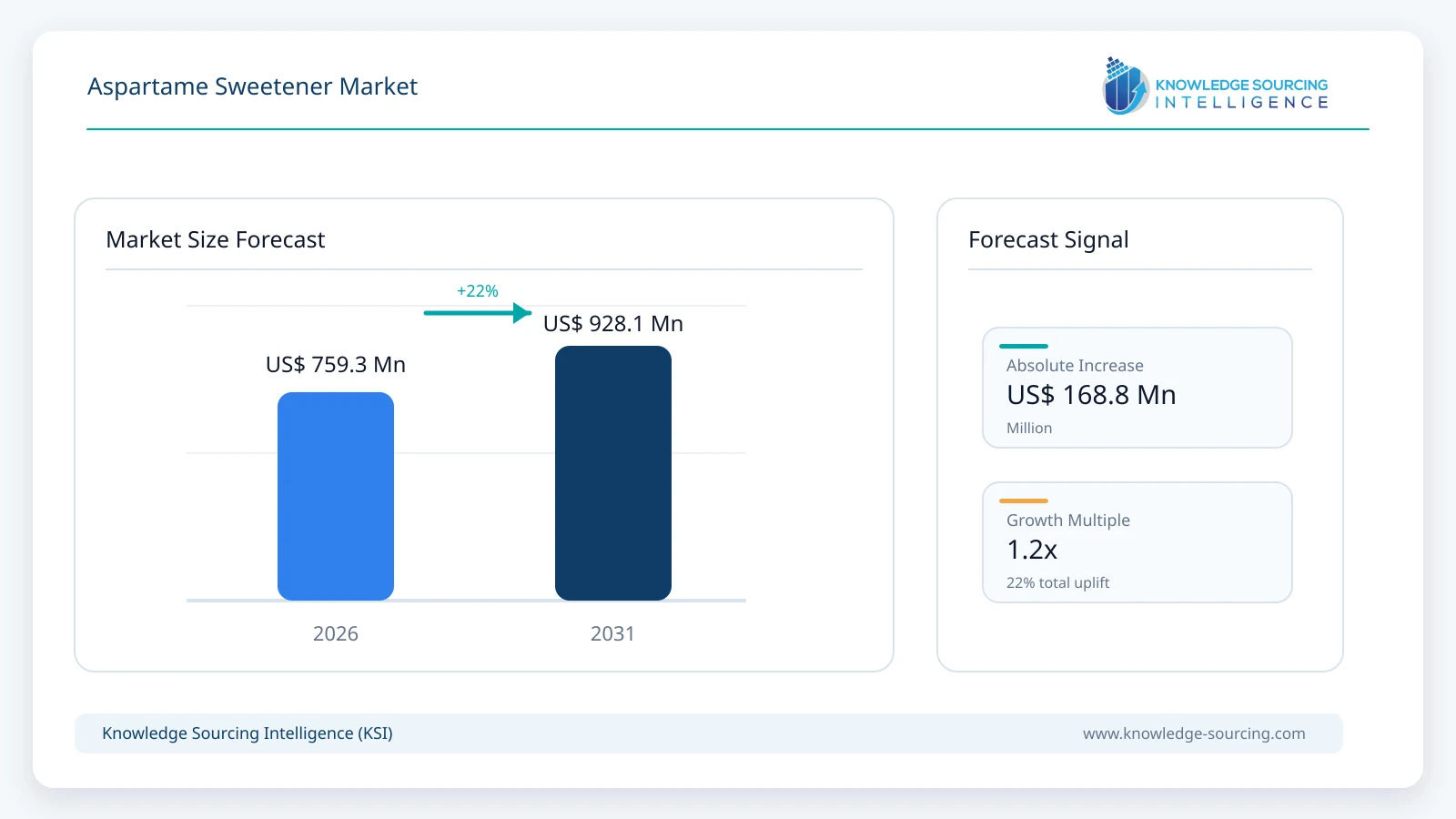
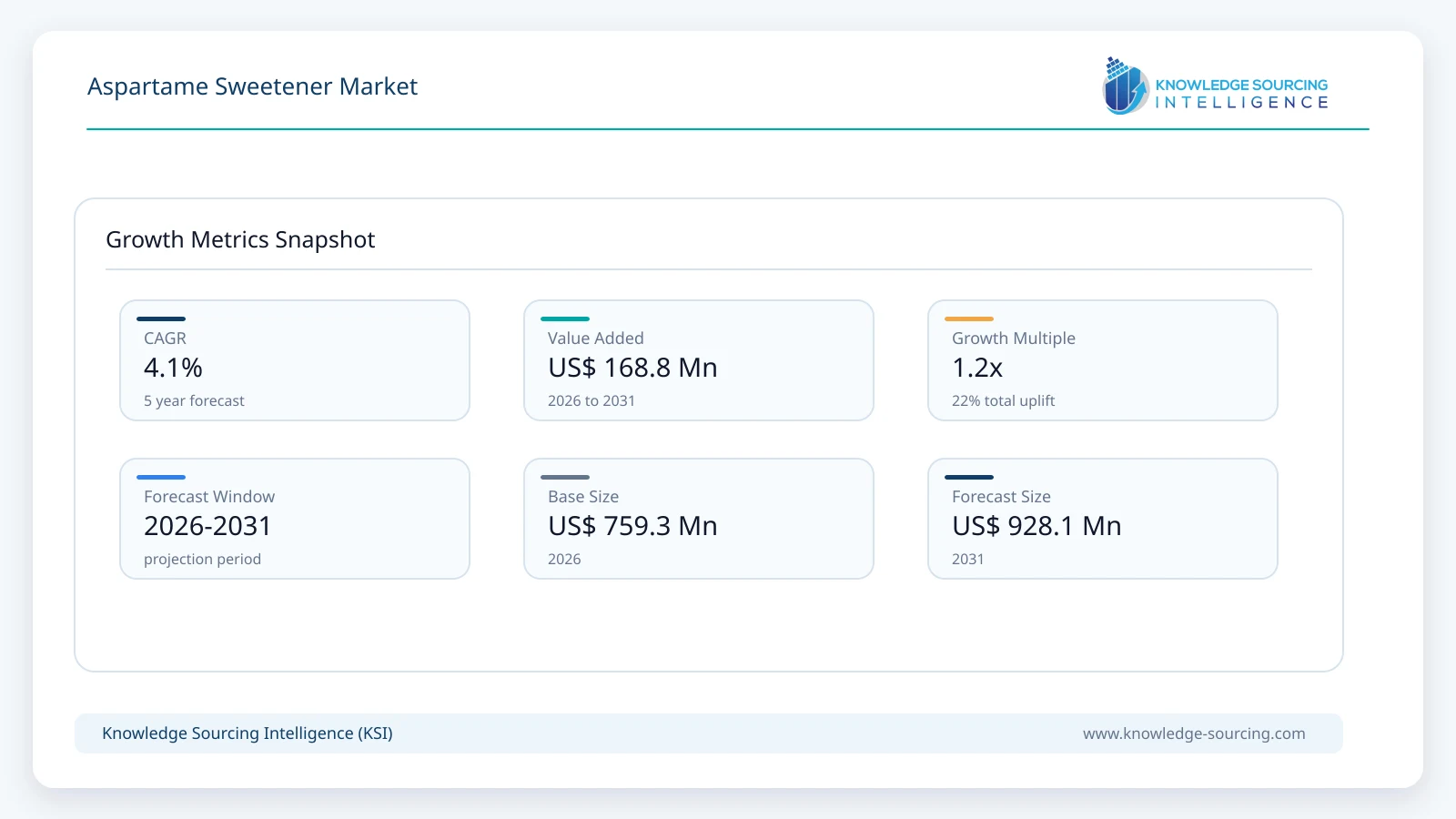
The Aspartame Sweetener Market is forecast to grow at a CAGR of 4.1%, reaching USD 928.1 million in 2031 from USD 759.3 million in 2026.
Highlights:
- 1Dominant segment by typePowder remains the preferred form in the Aspartame Sweetener Market, accounting for 61.0% of total market revenue in 2026, with an estimated market value of USD 0.463 billion, driven by its ease of handling and broad use in food and beverage formulations.
- 2Largest application areaBeverages continue to represent the core demand center for aspartame sweeteners, contributing 65.0% of the market in 2026, equivalent to approximately USD 0.494 billion, reflecting the ingredient's extensive use in low-calorie and sugar-free drinks.
- 3Regional strongholdNorth America generated USD 0.190 billion in revenue in 2026, representing 25.0% of the global market. The region is expected to maintain a significant presence, accounting for 24.1% of total market demand by 2031.
- 4Hybrid formulation shiftIngredient suppliers are actively developing customized blends of aspartame with sucralose or stevia to overcome aftertaste perceptions and meet rising demand for synergistic sweetening systems.
- 5Asia-Pacific surgeManufacturers are expanding production capacity and diversifying supply chains in the Asia-Pacific region, where urbanization, rising middle-class consumption, and government-led sugar-reduction campaigns are driving rapid adoption.
The aspartame sweetener market remains an important component of the global low- and no-calorie food and beverage landscape, supported by manufacturers’ continuing efforts to reduce added sugar while preserving sweetness and consumer acceptance. Aspartame is approximately 200 times sweeter than sugar, allowing food and beverage producers to achieve the desired sweetness using relatively small quantities. The ingredient is authorized for use across multiple food and beverage applications, including beverages, desserts, confectionery, dairy products, chewing gum, low-calorie and weight-management products, and tabletop sweeteners. The U.S. Food and Drug Administration continues to state that aspartame is safe for the general population when used under approved conditions, while the European Food Safety Authority’s February 2026 review confirms that aspartame remains authorized in the European Union under E951.
Regulatory oversight continues to be a central factor shaping market access and formulation decisions. EFSA’s latest 2026 information confirms that aspartame has undergone extensive safety assessment in Europe, while the Joint FAO/WHO Expert Committee on Food Additives maintains an acceptable daily intake of 0–40 mg per kg of body weight. This regulatory framework provides manufacturers with established parameters for using the sweetener in commercial formulations. At the same time, food companies continue to monitor consumer perceptions and evolving scientific discussions around non-sugar sweeteners.
Demand dynamics are increasingly influenced by sugar-reduction strategies across major beverage markets. In 2025, PepsiCo reported that it had converted Pepsi to lower-sugar formulations in markets including China, Egypt, Saudi Arabia, and India, contributing to progress toward its beverage added-sugar reduction objective. The company has also continued to expand and reformulate its beverage portfolio around changing consumer preferences. Coca-Cola’s 2025 reporting similarly identified aspartame among the non-nutritive sweeteners used across its beverage business and highlighted continued investment in low- and no-calorie beverage choices. Coca-Cola Zero Sugar recorded 14% growth in the company’s second-quarter 2025 operating review, demonstrating the continuing commercial importance of zero-sugar beverage formats.
However, the competitive environment is evolving beyond single-sweetener formulations. Ajinomoto’s food-ingredient portfolio describes aspartame as approximately 200 times sweeter than sugar and notes that combining it with acesulfame potassium can create sweetness synergy, improve flavor characteristics and support cost-efficient formulations. This reinforces the importance of blended sweetener systems as manufacturers seek balanced taste profiles and optimized product economics. Meanwhile, major beverage companies are also experimenting with alternative approaches to sugar reduction. PepsiCo launched Pepsi Prebiotic Cola in 2025 with 5 grams of sugar, 30 calories and no artificial sweeteners, and expanded the product nationally in 2026, illustrating how product developers are diversifying beyond conventional artificial-sweetener formulations.
Strategic opportunities are particularly relevant in markets where governments are strengthening incentives for sugar reduction. The United Kingdom, for example, confirmed in 2025 that its Soft Drinks Industry Levy threshold would be reduced from 5 grams to 4.5 grams of sugar per 100 ml, with the changes scheduled to take effect in 2028. Such policies encourage beverage manufacturers to reformulate products and maintain consumer appeal while controlling sugar content. Consequently, the aspartame market is likely to remain closely linked to regulatory developments, beverage reformulation, blended-sweetener technologies and the broader industry transition toward lower-sugar and zero-sugar products.
Market Dynamics
Drivers
Caloric Reduction Pressures: Public health initiatives in North America and Europe are targeting a 20% reduction in added sugars by 2030, which is compelling beverage giants to reformulate core brands using aspartame-heavy systems.
Production Cost Efficiencies: Aspartame provides a significantly lower cost-per-sweetness unit compared to cane sugar, which enables manufacturers to maintain price parity in price-sensitive emerging markets despite rising raw material costs.
Stability in Acidic Media: The high stability of aspartame in low-pH environments makes it the preferred choice for carbonated soft drinks and fruit-flavored beverages, which are currently expanding in the tropical regions of South Asia and Africa.
Technological Maturation: Advancements in enzymatic synthesis are currently lowering the environmental footprint of aspartame production, which is aligning the ingredient with corporate sustainability goals and reducing supply chain volatility.
Restraints and Opportunities
Natural Alternative Competition: Growing consumer distrust of synthetic additives is shifting demand toward plant-based sweeteners, which is forcing aspartame producers to improve transparency in their chemical sourcing and manufacturing processes.
Phenylketonuria (PKU) Restrictions: The mandatory "contains phenylalanine" warning label creates a permanent consumption barrier for specific demographics, which is currently limiting the total addressable market in highly regulated healthcare-centric regions.
Thermal Instability Barriers: Aspartame loses its sweetness under prolonged high-temperature exposure, which represents a structural opportunity for chemical manufacturers to develop modified aspartame salts with enhanced heat resistance.
Hybrid Formulation Trends: The increasing trend of "sweetener synergy," where aspartame is combined with sucralose or stevia, is creating new opportunities for ingredient suppliers to offer customized, pre-blended sweetening solutions.
Supply Chain Analysis
The aspartame supply chain is characterized by a high degree of vertical integration among leading Chinese and Japanese manufacturers. The process begins with the production of two primary amino acids: L-aspartic acid and L-phenylalanine. L-phenylalanine production is currently shifting toward advanced fermentation techniques using Escherichia coli or Corynebacterium glutamicum, which reduces reliance on traditional petrochemical precursors.
These amino acids undergo enzymatic or chemical coupling to form the methyl ester, followed by neutralization and crystallization. Global supply chains are currently experiencing localized disruptions due to tightening environmental regulations in China’s industrial provinces, where a significant portion of the world’s aspartame intermediates are produced. This is forcing multinational food companies to diversify their sourcing away from single-region dependencies toward European and North American suppliers. Furthermore, the logistics phase is adapting to "Just-in-Time" requirements of large-scale bottling plants, which are increasingly demanding micro-granular and liquid formats to reduce dissolution times and energy consumption during the mixing process.
Government Regulations
Regulatory Body | Status/Regulation | Impact on Demand |
U.S. FDA | Affirmation of GRAS (Generally Recognized as Safe) | Stabilizes long-term demand for diet beverage formulations in the North American market. |
EFSA (EU) | E 951 Authorization | Mandates strict labeling and specific purity criteria, ensuring high-quality supply requirements for European dairy. |
IARC / WHO | Group 2B Classification | Pressures manufacturers to implement "dual-sweetener" strategies to hedge against potential consumer backlash. |
FSSAI (India) | Standards for Caffeinated Beverages | Regulates the maximum limits of aspartame in energy drinks, shaping the formulation boundaries for local startups. |
Key Developments
May 2026: Ajinomoto’s fiscal-year results continued reporting sweeteners, including aspartame for industrial use, confirming ongoing commercial activity in its sweetener business during fiscal 2026.
May 15, 2026: PepsiCo’s Muscle Milk announced a complete protein-shake reformulation removing artificial sweeteners, reinforcing competitive pressure on conventional artificial sweeteners across functional beverage applications.
February 2026: PepsiCo announced nationwide retail expansion of Pepsi Prebiotic Cola, featuring no artificial sweeteners, 5 grams of sugar, and functional beverage positioning amid evolving sweetener preferences.
November 2025: Abbott India launched an advanced Ensure Diabetes Care formulation featuring low glycemic carbohydrate blends and reduced-sugar nutritional positioning for diabetes-focused dietary management applications.
October 2025: Herbalife India introduced Liftoff® zero-added-sugar effervescent beverage tablets, expanding functional beverage offerings targeting health-conscious consumers seeking alternatives to traditional sugar-sweetened drink formulations.
August 2025: MONIN India launched PURE, a no-added-sugar beverage flavoring range formulated using fruit and plant-based extracts for low-sugar beverage and sweetener applications across cafés and foodservice markets.
Market Segmentation
By Type
The market for aspartame is categorized into granular, powder, and liquid forms, each addressing distinct functional and handling requirements across food and beverage applications. Powdered aspartame is projected to register a CAGR of 4.1%, supported by its suitability for dry-blending operations and formulation of low-calorie food and beverage products. Its fine, readily dispersible form enables manufacturers to incorporate controlled quantities into powdered drink mixes, tabletop sweeteners, confectionery, and other processed foods.
Aspartame is approximately 200 times sweeter than sugar and is authorized for use across various food and beverage categories, including drinks, desserts, dairy products, chewing gum, and low-calorie products. Granular forms are increasingly relevant where improved handling, controlled dosing, and reduced dust generation are important during industrial processing. Liquid formulations serve applications requiring convenient incorporation into liquid food and beverage systems, although aspartame's limited heat stability influences its suitability for certain processing conditions.
Liquid aspartame formulations are gaining traction in the specialized condiment and syrup sectors, where immediate integration without mechanical agitation is required. This shift is occurring as manufacturers are seeking ways to reduce energy consumption in cold-process manufacturing. The choice of type is directly influenced by the end-user’s infrastructure; for instance, older manufacturing plants are sticking to powdered forms for compatibility, while modern, automated facilities are transitioning to granular or liquid formats to optimize throughput. Demand for specific particle sizes is also rising as food scientists are attempting to match the dissolution curves of natural sugar to ensure consistent sweetness profiles across global product lines.
By Application
The beverage segment is expected to remain the dominant application for aspartame in the Aspartame Sweetener Market, accounting for an estimated 63.6% share by 2031. Aspartame is widely used in reduced-calorie and sugar-free beverages because it provides intense sweetness at very low usage levels while contributing minimal calories. Carbonated soft drinks remain an important application, particularly across diet and zero-sugar product categories, as manufacturers seek to deliver sweetness while reducing or eliminating conventional sugar. The continued reformulation of beverage portfolios is supported by growing consumer attention toward sugar intake and by regulatory measures in several markets aimed at reducing consumption of sugar-sweetened drinks.
The beverage industry is therefore creating sustained opportunities for aspartame suppliers as manufacturers balance taste, calorie reduction, product positioning, and formulation costs. Soft drink producers are increasingly expanding low- and no-sugar offerings to respond to changing consumer preferences and public-health policies. Aspartame can also be incorporated into powdered drink mixes, ready-to-drink beverages, flavored waters, and other low-calorie formulations, broadening its application base beyond traditional carbonated drinks. Its high sweetness intensity allows manufacturers to achieve the desired sweetness profile using comparatively small quantities.
The dairy and dairy-alternative categories also contribute to demand for aspartame, particularly in products positioned around reduced sugar or calorie content. It can be used in selected flavored dairy products, light formulations, and other products where manufacturers aim to maintain sweetness while limiting the contribution from conventional sugars. This supports product development in categories such as flavored dairy beverages and certain low-calorie formulations. At the same time, manufacturers must consider formulation compatibility, labeling requirements, consumer preferences, and the sensory characteristics of individual products when selecting high-intensity sweeteners.
Overall, the strong position of beverages is closely linked to the broader shift toward sugar reduction and calorie-conscious product formulations. As food and beverage companies continue introducing products with lower sugar content, demand for high-intensity sweeteners such as aspartame can benefit from their ability to provide sweetness without the bulk and calorie contribution associated with conventional sugar. Consequently, beverages are expected to remain the principal application area for the Aspartame Sweetener Market through 2031.
The processed food segment is seeing a nuanced shift, as aspartame is being incorporated into low-calorie desserts, gelatins, and sugar-free chewing gums. However, the lack of bulk-forming properties compared to sugar means that aspartame is often paired with bulking agents like maltodextrin. This dependency on secondary ingredients is currently influencing the demand for pre-blended aspartame solutions that provide both sweetness and texture. Emerging applications in pharmaceuticals are also unfolding, as manufacturers are using aspartame to mask the bitter taste of pediatric medications and effervescent tablets, where traditional sugar is avoided due to stability and dental health concerns.
Regional Analysis
North America
The North American market is undergoing a gradual structural realignment as food and beverage manufacturers balance demand for lower-calorie products with growing consumer interest in ingredient transparency and clean-label positioning. The North American aspartame sweetener market is projected to expand at a CAGR of 3.3%, supported by the continued use of high-intensity sweeteners in beverages, tabletop products, desserts, chewing gum, and other reduced-sugar formulations. The United States remains a major market for aspartame, supported by its long-established use across the food and beverage industry and the availability of FDA-approved applications. The FDA continues to state that scientific evidence supports the safety of aspartame for the general population when it is manufactured under good manufacturing practices and used according to approved conditions. The agency's established acceptable daily intake remains protective of public health, providing regulatory continuity for manufacturers and food companies operating in the market.
Canada also contributes to regional demand through established regulatory authorization of aspartame across categories including soft drinks, desserts, breakfast cereals, chewing gum, and tabletop sweeteners. Health Canada states that aspartame has been permitted as a food additive since 1981 and continues to recognize its permitted uses under Canada's food additive framework. The agency has also noted that its assessment following the 2023 international safety reviews did not identify a need for further regulatory action, while retaining an acceptable daily intake of 40 mg/kg body weight per day.
At the same time, the competitive environment is becoming more complex as manufacturers evaluate aspartame alongside other high-intensity sweeteners and naturally derived alternatives. Clean-label expectations are encouraging product developers to reconsider ingredient portfolios, while the need for strong sweetness intensity and reduced sugar content continues to support the commercial relevance of established sweeteners. In Canada, aspartame remains included among permitted sweeteners with defined applications and maximum-use conditions, demonstrating continued regulatory acceptance across multiple food categories.
However, the "natural" movement is pressuring the market, as consumers are increasingly scrutinizing synthetic ingredients. In response, North American retailers are expanding their private-label "Zero Sugar" lines, which is sustaining the demand for bulk aspartame as a cost-effective alternative to premium natural sweeteners. The infrastructure in the U.S. and Canada is well-equipped for the handling of diverse aspartame formats, with a significant trend toward the adoption of granular types to enhance operational efficiency. Furthermore, the regional demand is being bolstered by the rapid growth of the "functional beverage" sector, where aspartame is utilized in sugar-free energy drinks and electrolyte solutions targeting fitness-conscious demographics.
Europe
Europe presents a highly fragmented but sophisticated demand landscape for aspartame, characterized by the most stringent labeling requirements in the world. The European Food Safety Authority (EFSA) provides the regulatory framework that dictates the "E 951" labeling standards, which are currently influencing how manufacturers communicate ingredient safety to a skeptical public. Demand in Western Europe is stabilizing as the market matures, but Eastern European nations are exhibiting rising consumption as their processed food sectors undergo rapid modernization.
The European market is currently leading the shift toward hybrid sweetener systems, as manufacturers are attempting to blend aspartame with stevia to achieve "reduced sugar" claims without the purely synthetic label. This transition is being accelerated by the European Commission’s "Farm to Fork" strategy, which is pressuring the food industry to improve the nutritional profile of its offerings. In the UK and France, the implementation of tiered sugar levies is directly forcing beverage companies to reduce sugar levels below specific thresholds, which is maintaining a high baseline demand for aspartame in reformulated carbonated drinks.
Asia-Pacific
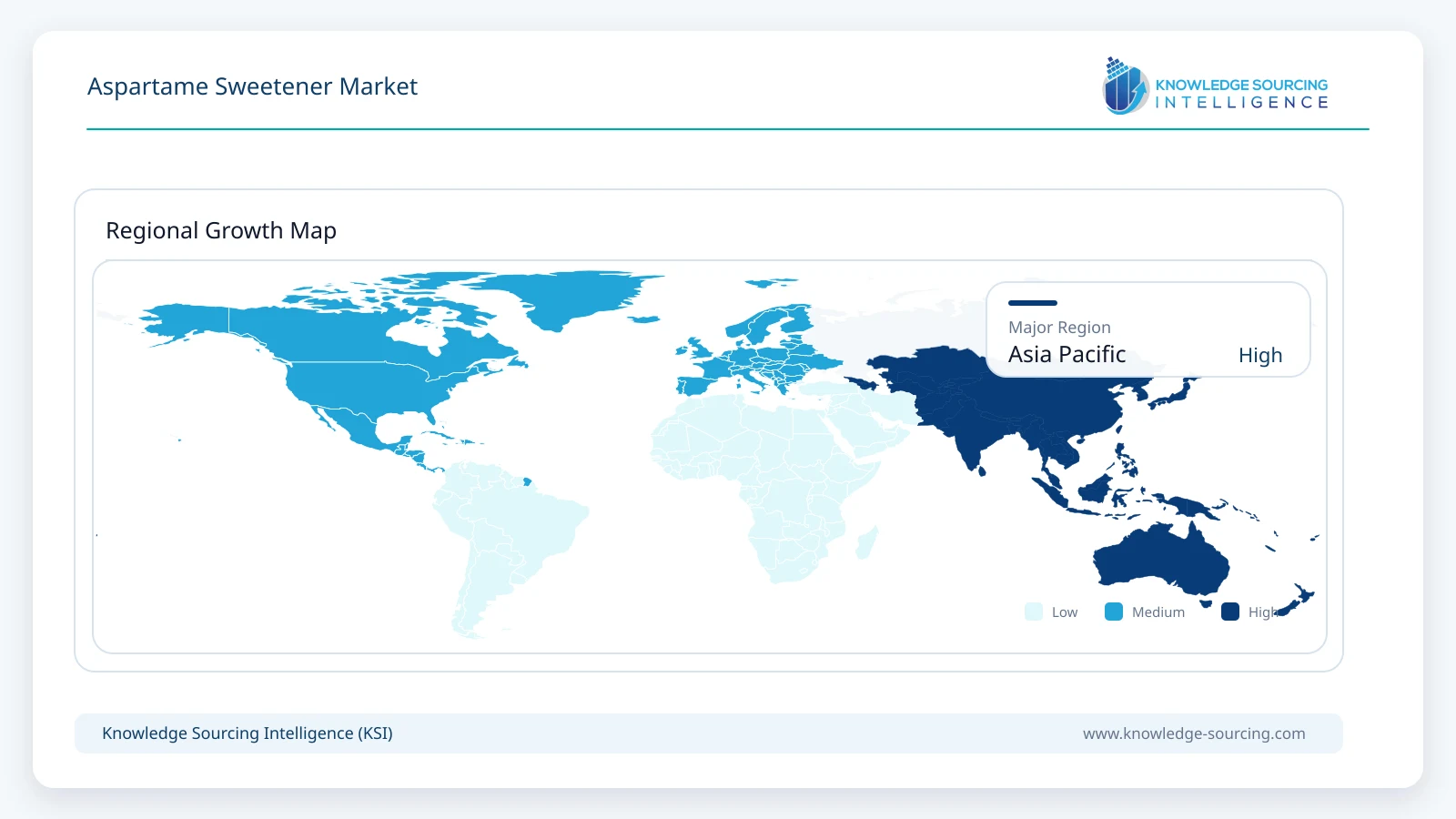
The Asia-Pacific region remains a key growth hub for the aspartame sweetener market, supported by its large consumer base, urbanization, and expanding demand for reduced-sugar food and beverage products. China remains an important manufacturing and consumption center, while countries such as India and Indonesia are experiencing greater demand for convenience foods, soft drinks, dairy products, and other packaged products containing low-calorie sweeteners. Asia-Pacific is estimated to account for 43.0% of the global aspartame sweetener market in 2026, representing a segment value of approximately USD 0.326 billion.
Regional demand is also being influenced by growing consumer awareness of sugar intake and the broader shift toward sugar-reduction and reformulation strategies among food and beverage manufacturers. In China and other major Asian economies, manufacturers are increasingly developing products positioned around lower sugar content and calorie reduction, creating opportunities for high-intensity sweeteners such as aspartame. At the same time, the expansion of the regional dairy, beverage, and processed-food industries is supporting applications in products such as flavored dairy drinks, desserts, and low-calorie beverages. Asia-Pacific's established sweetener manufacturing base and extensive food-processing supply chains further support competitive production, distribution, and access to key end-use markets.
List of Companies
HYET Sweet
Ajinomoto Group
Nantong Changhai Food Additive Co. Ltd.
Hermes Sweetener Ltd.
Merisant Company (a subsidiary of MacAndrews & Forbes Incorporated)
Foodchem International Corporation
Vitasweet Co., LTD.
NutraSweet Company
Shaoxing Marina Biotechnology Co., Ltd
Changmao Biochemical Engineering Company Limited
Company Profiles
Ajinomoto Group
Ajinomoto is strategically distinct due to its high degree of vertical integration and its pioneering role in the enzymatic synthesis of aspartame. The company is currently leveraging its "AminoScience" platform to develop high-purity aspartame that meets the rigorous standards of global pharmaceutical and high-end beverage companies. By investing in local production facilities, such as the upcoming plant in the Philippines, Ajinomoto is shortening its supply chains and insulating itself from geopolitical trade volatility. The group is focusing its strategy on providing value-added sweetening solutions rather than competing solely on commodity volume, which is allowing it to maintain premium margins in a price-sensitive market.
HYET Sweet
HYET Sweet is strategically distinct as a leading European-based supplier that emphasizes transparency and quality control within a market often dominated by low-cost Asian production. The company is currently expanding its distribution network to capitalize on the growing demand for "European-standard" ingredients in North American and Asian markets. HYET Sweet is positioning itself as a critical partner for food manufacturers who require high-consistency aspartame for complex, multi-component formulations. Their strategy involves a heavy focus on the granular aspartame segment, which is aligning with the global trend toward dust-free, automated production environments.
Nantong Changhai Food Additive Co., Ltd.
Nantong Changhai is strategically distinct for its massive production scale and its role as a price-setter in the global bulk aspartame market. The company is currently upgrading its manufacturing facilities to comply with China's increasingly strict environmental protocols, which is ensuring its long-term viability as a global supplier. By focusing on cost leadership through economies of scale, Nantong Changhai is capturing significant market share in the emerging economies of South Asia and Latin America. Their strategy revolves around the high-volume supply of powdered and granular aspartame to global beverage conglomerates that require consistent, low-cost inputs for mass-market products.
Analyst View
The aspartame market is entering a phase of "defensive innovation," where growth is driven not by new adoption, but by the mandatory reformulation of existing sugar-based products to meet global health mandates and tax thresholds.
Aspartame Sweetener Market Scope:
| Report Metric | Details |
|---|---|
| Total Market Size in 2026 | USD 759.3 million |
| Total Market Size in 2031 | USD 928.1 million |
| Forecast Unit | Million |
| Growth Rate | 4.1% |
| Study Period | 2021 to 2031 |
| Historical Data | 2021 to 2024 |
| Base Year | 2025 |
| Forecast Period | 2026 – 2031 |
| Segmentation | Type, Application, Geography |
| Companies |
|
Market Segmentation
By Type
Granular
Powder
Liquid
By Application
Dairy
Beverages
Confectionery and Bakery
Processed Food
Others
By Geography
North America
USA
Canada
Mexico
Others
South America
Brazil
Argentina
Others
Europe
Germany
France
United Kingdom
Spain
Others
Middle East and Africa
Saudi Arabia
Israel
Others
Asia Pacific
China
Japan
South Korea
India
Others
Table of Contents
1. INTRODUCTION
1.1. Market Overview
1.2. Market Definition
1.3. Scope of the Study
1.4. Currency
1.5. Assumptions
1.6. Base and Forecast Years Timeline
2. RESEARCH METHODOLOGY
2.1. Research Design
2.2. Secondary Sources
3. KEY FINDINGS
4. MARKET DYNAMICS
4.1. Market Segmentation
4.2. Market Drivers
4.3. Market Restraints
4.4. Market Opportunities
4.5. Porter’s Five Forces Analysis
4.5.1. Bargaining Power of Suppliers
4.5.2. Bargaining Power of Buyers
4.5.3. Threat of New Entrants
4.5.4. Threat of Substitutes
4.5.5. Competitive Rivalry in the Industry
4.6. Life Cycle Analysis - Regional Snapshot
4.7. Market Attractiveness
5. ASPARTAME SWEETENER MARKET BY TYPE
5.1. Granular
5.2. Powder
5.3. Liquid
6. ASPARTAME SWEETENER MARKET BY APPLICATION
6.1. Dairy
6.2. Beverages
6.3. Confectionery and Bakery
6.4. Processed Food
6.5. Others
7. ASPARTAME SWEETENER MARKET BY GEOGRAPHY
7.1. North America
7.1.1. USA
7.1.2. Canada
7.1.3. Mexico
7.1.4. Others
7.2. South America
7.2.1. Brazil
7.2.2. Argentina
7.2.3. Others
7.3. Europe
7.3.1. Germany
7.3.2. France
7.3.3. United Kingdom
7.3.4. Spain
7.3.5. Others
7.4. Middle East and Africa
7.4.1. Saudi Arabia
7.4.2. Israel
7.4.3. Others
7.5. Asia Pacific
7.5.1. China
7.5.2. Japan
7.5.3. South Korea
7.5.4. India
7.5.5. Others
8. COMPETITIVE INTELLIGENCE
8.1. Competitive Benchmarking and Analysis
8.2. Recent Investments and Deals
8.3. Strategies of Key Players
9. COMPANY PROFILES
9.1. HYET Sweet.
9.2. Ajinomoto Group
9.3. Nantong Changhai Food Additive Co. Ltd.
9.4. Hermes Sweetener Ltd.
9.5. Merisant Company (a subsidiary of MacAndrews & Forbes Incorporated)
9.6. Foodchem International Corporation
9.7. Vitasweet Co., LTD.
9.8. NutraSweet Company
9.9. Shaoxing Marina Biotechnology Co., Ltd
9.10. Changmao Biochemical Engineering Company Limited
LIST OF FIGURES
LIST OF TABLES
Navigate
Trusted by the world's leading organizations











