
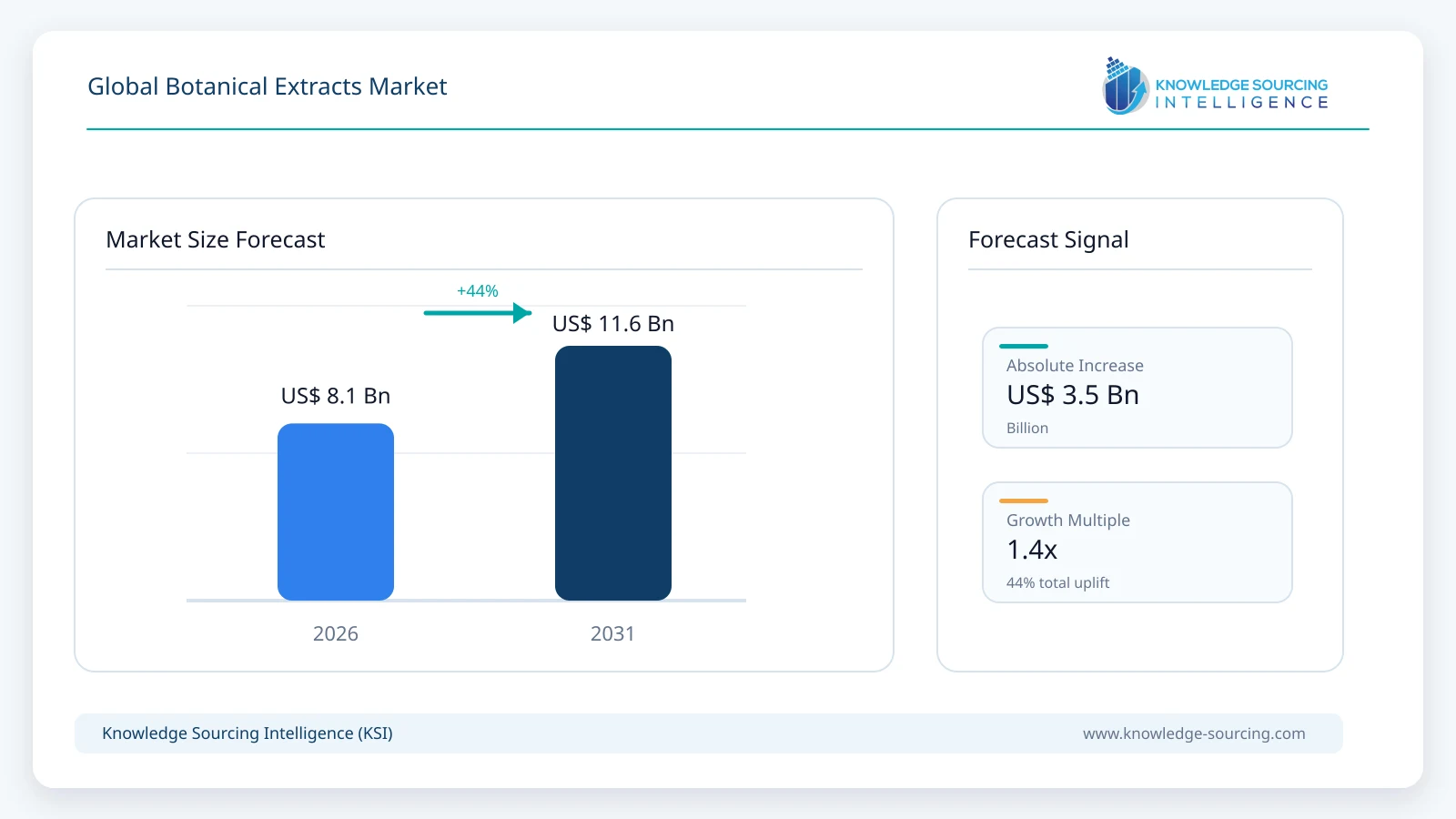
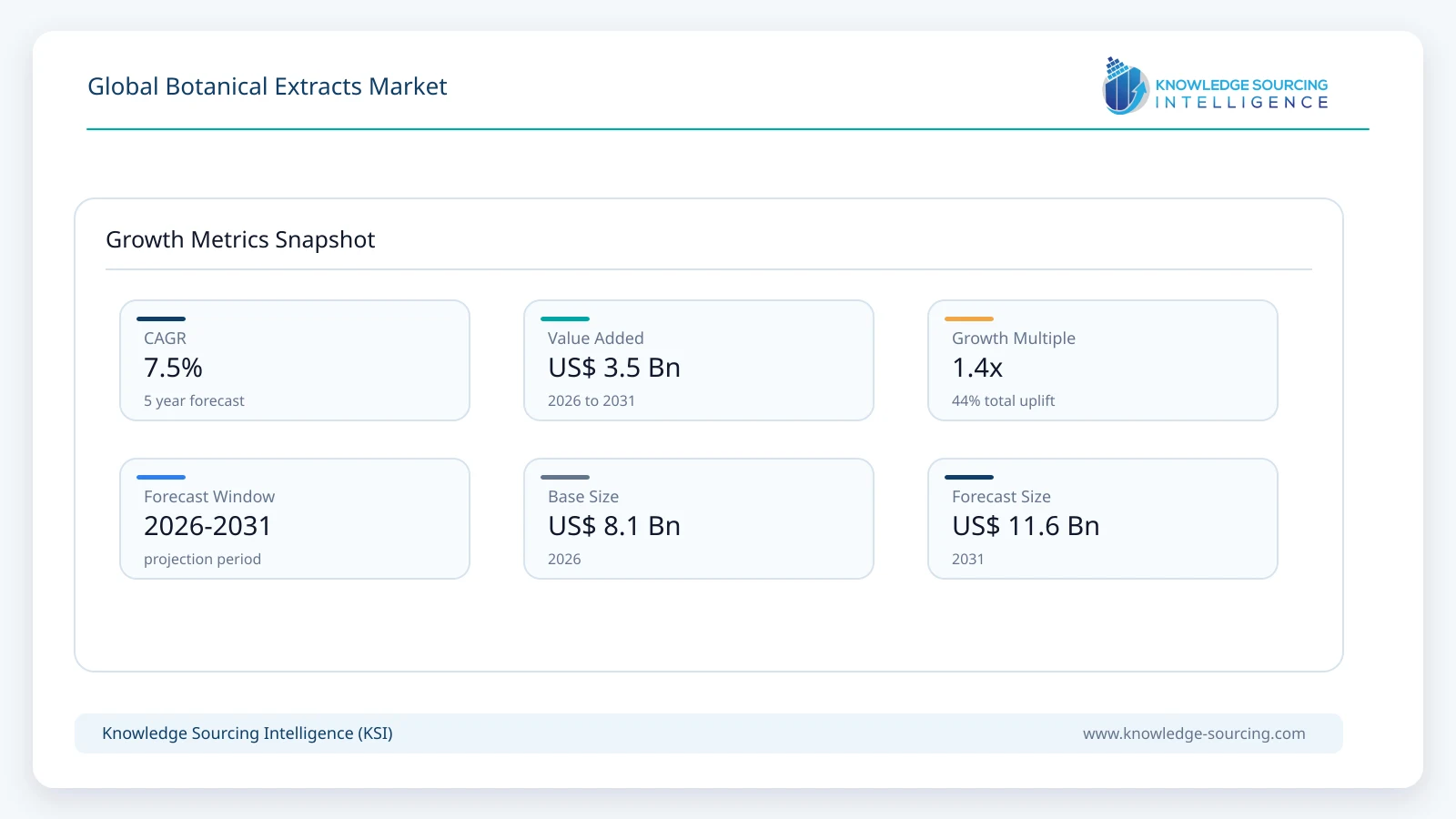
The global botanical extracts market is estimated at USD 8.05 billion in 2026 and is projected to reach USD 11.58 billion by 2031, expanding at a CAGR of 7.5% during the forecast period.
Highlights:
- 1Herb- and spice-derived extracts contribute approximately USD 3.22 billion of 2026 revenue.
- 2Powder extracts account for approximately USD 4.51 billion of global 2026 revenue.
- 3Solvent and hydroalcoholic extraction contributes approximately USD 3.78 billion of 2026 revenue.
- 4Food and beverage applications generate approximately USD 3.39 billion of 2026 demand.
- 5North America represents approximately USD 2.50 billion of global 2026 botanical-extract revenue.
The market includes concentrated plant-derived ingredients produced from herbs, spices, leaves, flowers, fruits, seeds, roots, bark and other botanical materials for use in food and beverages, dietary supplements and nutraceuticals, pharmaceuticals, personal care, cosmetics and selected animal-nutrition applications. Pure essential oils sold primarily for fragrance or aromatherapy, raw dried herbs, finished herbal medicines and highly purified commodity isolates are excluded.
Commercial value is increasingly shifting away from undifferentiated commodity extracts toward standardized, traceable and application-ready ingredients. Buyers are paying for reproducible active-marker content, low contaminant risk, documented origin, clinically supported functionality, solubility and taste performance, and regulatory dossiers rather than simply for dried extract weight. This is raising the value of branded and standardized botanicals even as bulk powder extracts remain price competitive.
The market is structurally fragmented because botanical raw materials are geographically dispersed and many species depend on local cultivation or wild collection. Supply reliability therefore depends on crop yield, harvest timing, plant-part availability, extraction ratio, solvent recovery, analytical testing and the ability to maintain phytochemical consistency across growing seasons. These operating variables directly affect gross margin and qualification risk for extract manufacturers.
The market is expected to expand steadily as standardized and application-ready extracts gain share within a much larger base of price-sensitive bulk material. Revenue growth is therefore being shaped by product mix as much as by physical volume. Suppliers that can deliver defined active-marker content, stronger documentation, formulation support and traceable sourcing are capturing higher value per kilogram, while commodity grades remain exposed to pricing pressure from large Asian production hubs.
Botanical Extracts Market Trends
Volume Growth is No Longer Translating Directly Into Revenue
China, the world's largest plant-extract production and export hub, exported USD 2.98 billion of plant extracts in 2025. Export volume reached a record 138,000 tonnes, but the average export price fell to USD 21.6 per kg after several years of price compression. This divergence between physical volume and revenue is commercially important: suppliers competing primarily on extraction capacity and commodity pricing can grow tonnes without growing value. Margin expansion therefore depends increasingly on standardized extracts, proprietary processing, clinical substantiation and application support.
Science-Backed Botanicals are Moving Into Premium Formulations
Givaudan's 2025 launch of Zensera, a lemon-balm extract designed for cognitive performance under stress at a 300 mg daily dose, illustrates the shift toward low-dose, clinically studied botanical ingredients that can be used in capsules, powders and selected beverages. These products compete less on cost per kilogram and more on dose efficiency, substantiation, formulation compatibility and consumer-facing claim potential. This favors suppliers with clinical, regulatory and applications capabilities rather than extraction capacity alone.
Traceability and Supplier Qualification are Becoming Procurement Requirements
Botanical supply chains carry higher identity and variability risk than many synthetic ingredients. Givaudan reported engagement with suppliers covering more than 200 natural-ingredient families and more than 1,400 due-diligence questionnaires by the end of 2025. Martin Bauer separately reported that botanical sourcing represents about 80% of its Scope 3.1 emissions. These disclosures show that procurement economics increasingly include farm-level traceability, audit cost, sustainability verification and supply-chain resilience, not just extract conversion cost.
Portfolio Consolidation is Reshaping the Competitive Set
In July 2026, IFF agreed to sell its botanical extracts, vitamins and minerals, and selected food-enhancement activities to SuanNutra. The activities included in the transaction generated approximately USD 170 million in 2025 revenue and operate across five manufacturing facilities. The deal demonstrates that botanical ingredients remain strategically valuable but are increasingly being consolidated into focused health-ingredient platforms rather than held inside broad diversified ingredient portfolios.
Demand Pull From Herbal Supplements Remains Strong
U.S. retail sales of herbal dietary supplements reached USD 13.23 billion in 2024, increasing 5.4% year over year according to the American Botanical Council, Nutrition Business Journal and SPINS. Finished-product retail sales are not directly comparable with extract-ingredient revenue, but the scale and continued growth of the channel provide a strong demand base for standardized botanical inputs used in stress, cognition, digestive health, healthy aging, cardiovascular support, immunity and women's health formulations.
Segment Analysis
By Source - Herbs and Spices
Herb- and spice-derived extracts are estimated at approximately USD 3.22 billion in 2026, representing about 40% of global market value. The segment combines high-volume culinary botanicals with medicinal and wellness ingredients used across supplements, functional foods, beverages and personal care. Turmeric, ginger, rosemary, ginseng, ashwagandha, basil and related botanicals are commercially attractive because they already have consumer recognition and established agricultural supply chains, reducing the education burden for finished-product brands. Value, however, is highly dependent on specification. A generic turmeric extract and a standardized curcuminoid ingredient can occupy very different price points because buyers increasingly procure against active-marker range, solvent system, pesticide and heavy-metal limits, microbiological specification, botanical identity and supporting clinical documentation rather than plant name alone.
The segment also carries some of the market's most visible sourcing risk. Crop yield, harvest timing, plant variety, origin and post-harvest handling can materially change phytochemical concentration before extraction begins. This makes raw-material contracting and incoming identity testing central to margin control. Suppliers that secure direct grower relationships, maintain multiple approved origins and blend or standardize production lots can offer more reliable year-round specifications than processors buying opportunistically on the spot market. Commercially, the result is a two-tier structure: bulk herb and spice extracts compete largely on extraction yield and price per kilogram, while standardized products compete on reproducibility, claim support, traceability and dose efficiency. The latter group is expected to capture a rising share of segment value through 2031 even if commodity tonnage remains larger.
By Form - Powder
Powder extracts account for approximately USD 4.51 billion of 2026 market value, equivalent to roughly 56% of the global market. Their lead reflects the manufacturing economics of the largest end-use formats: capsules, tablets, gummies, stick packs, premixes, sports-nutrition powders and dry functional-food systems all favor ingredients that can be weighed, blended and dosed through conventional dry-processing equipment. Bio-Botanica, for example, positions powdered extracts for capsules, tablets, gummies, stick packs, greens and protein blends, illustrating how one ingredient format can serve several high-volume finished-product categories. Powder also lowers freight weight relative to many liquid extracts and can simplify storage and inventory management where alcohol- or glycerin-based liquids create handling constraints.
The commercial value of a powder depends on much more than whether an extract has been dried. Spray-drying conditions, carrier selection, extract-to-carrier ratio, residual moisture, bulk density, particle size, hygroscopicity and flowability determine whether an ingredient runs cleanly on encapsulation and tableting lines or creates sticking, segregation and dosing variability. Carriers such as maltodextrin can improve processability but dilute native extract concentration, so customers increasingly compare active-marker content per delivered kilogram rather than headline extract ratio alone. Premium powder grades therefore command value when they combine high assay, low carrier load, rapid dispersion and batch-to-batch consistency. Liquid extracts remain preferable for tinctures, syrups and certain beverages, but powder should retain the largest market share because it fits the broadest range of industrial supplement and dry-food manufacturing formats.
By Extraction Technology - Solvent and Hydroalcoholic Extraction
Solvent and hydroalcoholic extraction is estimated at approximately USD 3.78 billion in 2026, accounting for about 47% of market value. Ethanol-water systems remain the industry workhorse because the solvent ratio can be adjusted to recover compounds with different polarity while using equipment that is already well understood at industrial scale. Water-rich systems favor more polar constituents, while higher ethanol concentrations can improve recovery of less-polar fractions. The choice is therefore not simply technical; it determines extraction yield, phytochemical profile, solvent-recovery load, energy consumption, downstream concentration time and the residual-solvent specification that the finished ingredient must meet. European regulatory guidance for herbal preparations also distinguishes standardized and quantified extracts and requires transparent declaration of extraction solvents, reinforcing the commercial importance of process documentation.
Scale economics favor manufacturers that can recover and recycle solvent efficiently, run multiple botanical campaigns without cross-contamination, and control temperature so heat-sensitive compounds are not unnecessarily degraded. A high extraction yield is not automatically the best economic outcome if it brings unwanted color, bitterness, waxes or non-target solids that require additional purification. For this reason, customers increasingly evaluate extraction technology against the final application rather than on yield alone. Hydroalcoholic processes remain the largest segment because they offer a flexible balance between recovery, cost and regulatory familiarity, while supercritical CO2, water-only and other specialized methods gain share where solvent-free positioning, selective recovery or premium sensory performance justifies higher processing cost.
By Application - Food and Beverages
Food and beverage applications contribute approximately USD 3.39 billion of 2026 demand, representing about 42% of the global botanical-extract market. The segment is broad, spanning functional beverages, teas and infusions, sports-nutrition drinks, snacks, cereals, dairy alternatives, confectionery, sauces and other products that use botanicals for flavor, color, antioxidant functionality or wellness positioning. Beverages are particularly important because they can introduce botanical functionality into a high-frequency consumption format, but they are also among the hardest applications to formulate. Nexira identifies uniformity, solubility, neutral or acceptable taste, stability and clinically backed benefits as core requirements for beverage-ready botanicals, while its 2026 sensory work demonstrates that extracts can contribute herbal, earthy, woody, bitter, fruity or umami characteristics even at relatively low use levels.
This makes formulation performance a direct commercial differentiator. A botanical that works in a capsule may fail in a clear beverage if it creates sediment, turbidity, excessive color or bitterness, or if the active marker degrades under low-pH storage or pasteurization. Suppliers are therefore developing water-soluble extracts, concentrated infusions and sensory-characterized systems rather than selling one generic grade into every application. Givaudan, for example, markets beverage-oriented botanicals around solubility, clarity and authentic taste profiles, while Nexira emphasizes stability under low-pH and pasteurization conditions. The commercial opportunity is consequently strongest for extracts that deliver function at a practical dose without forcing finished-product manufacturers to compensate with excessive sweetener, flavor masking or processing changes. Food and beverage should remain the largest application segment because it combines high product-launch frequency with strong clean-label and wellness positioning.
By Geography - North America
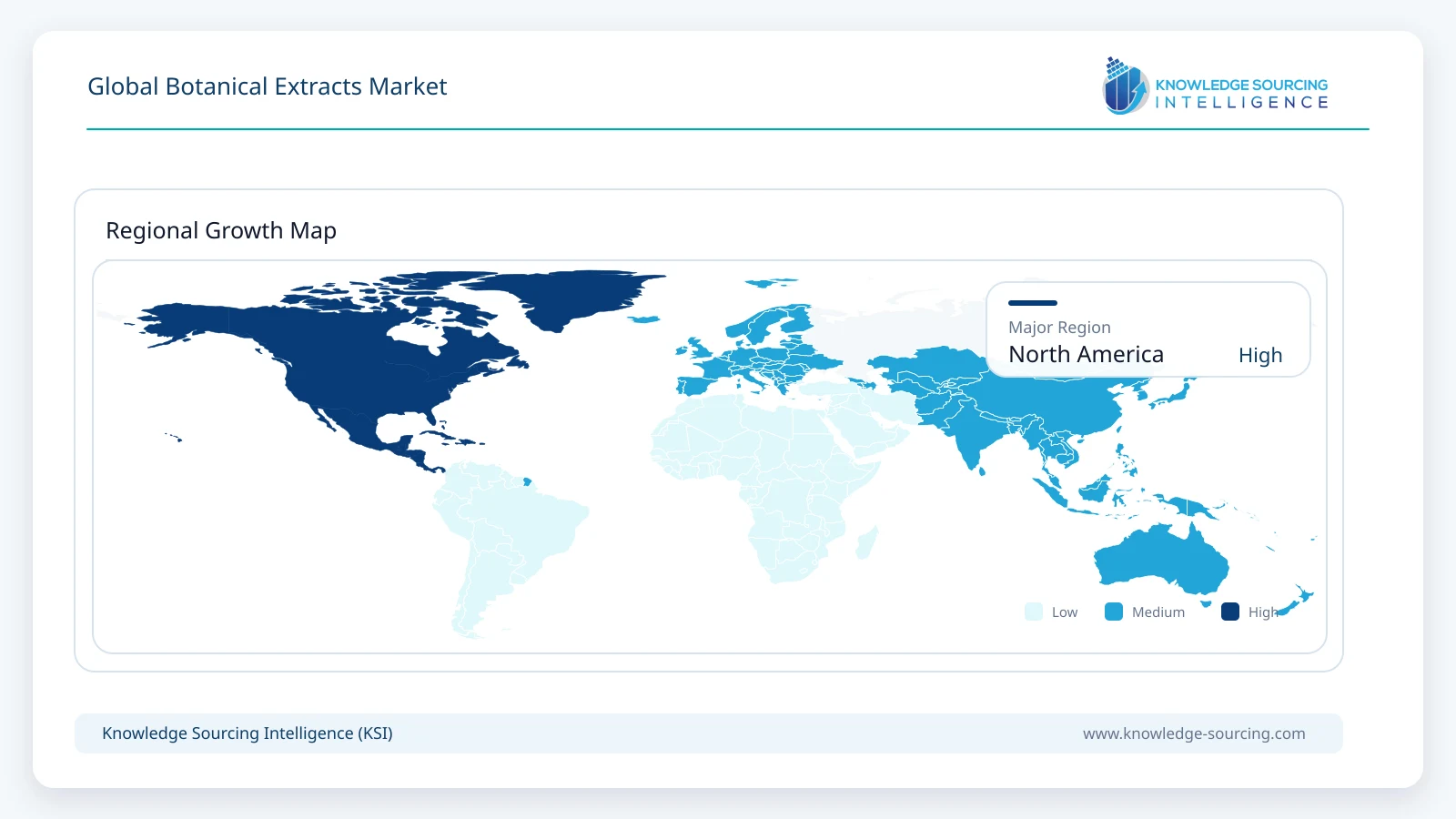
North America represents approximately USD 2.50 billion of the market in 2026, or about 31% of global botanical-extract revenue. The United States provides the region with an unusually large downstream demand base: U.S. retail sales of herbal dietary supplements reached USD 13.23 billion in 2024, while functional beverages, sports nutrition, natural personal care and wellness products create additional demand outside the supplement aisle. Ingredient revenue is only a fraction of finished-product retail value, but the size of these channels supports a deep ecosystem of brand owners, contract manufacturers, ingredient distributors and specialized formulators. North American buyers also tend to place a higher commercial premium on documentation, cGMP manufacturing, identity testing, contaminant control and branded clinical evidence, which supports higher-value standardized extracts alongside commodity imports.
Quality requirements materially shape supplier selection. FDA dietary-supplement cGMP rules require manufacturers to establish specifications and verify the identity of dietary ingredients, while FDA's risk-based inspection program specifically notes that botanical extracts can present challenges for identity and strength testing and may carry contaminant risks such as toxic elements or microbial pathogens. As a result, a low-cost extract that lacks defensible identity, assay and contaminant documentation can impose more qualification cost on a U.S. customer than a higher-priced material with a mature technical dossier. The region remains dependent on imported botanical raw materials and extracts from Asia, Latin America and other growing regions, but domestic extraction, testing, blending and formulation add value closer to the customer. North America should therefore remain the largest revenue region even as Asia Pacific continues to dominate upstream production and grows faster in consumption.
Market Drivers
Growth in herbal supplements, functional beverages and preventive-wellness formulations is expanding repeat demand for standardized botanical ingredients.
Clean-label and natural-positioning strategies are increasing botanical use in food, beverages and personal care.
Clinical substantiation and branded ingredients are raising value per kilogram for differentiated extracts.
Improved extraction, purification and analytical technologies are enabling higher active-marker consistency.
Broader use of botanicals in stress, cognition, metabolic health, healthy aging and beauty-from-within applications is diversifying demand.
Market Restraints
Crop variability, seasonality and geographically concentrated raw-material supply can cause yield and price volatility.
Adulteration, species substitution, pesticides, heavy metals and microbiological contamination increase testing and qualification costs.
Regulatory requirements differ materially between supplements, foods, cosmetics and herbal medicinal products across jurisdictions.
Highly standardized or clinically substantiated extracts require higher R&D, analytical and documentation investment.
Taste, odor, color, solubility and dosage constraints can limit botanical use in mass-market food and beverage applications.
Competitive Environment
The market is fragmented across multinational ingredient companies, specialist botanical processors and regional extract manufacturers. Givaudan, IFF, Martin Bauer, Indena, Nexira, Synthite, Kalsec, Döhler, Layn Natural Ingredients, Sabinsa and Arjuna Natural compete through different combinations of sourcing scale, standardized extract portfolios, proprietary processes, clinical substantiation and formulation support.
Competitive positioning is increasingly based on more than extraction capacity. Buyers evaluate identity testing, assay reproducibility, documentation, contaminant control, sustainability programs, application support and the ability to secure plant material over multiple crop cycles. The planned transfer of IFF's extract portfolio to SuanNutra also increases the relevance of focused ingredient groups that can combine scale with faster product development and customer-specific formulation.
Recent Developments
July 2026: IFF agreed to sell its botanical extracts, vitamins and minerals, and selected food-enhancement activities to SuanNutra; the included activities generated approximately USD 170 million in 2025 revenue.
2026: Givaudan continued commercial expansion of its Health & Nutrition botanical portfolio following the 2025 launch of Zensera lemon-balm extract for cognitive performance under stress.
2025: Givaudan launched Zensera, a clinically researched lemon-balm extract designed for use at a 300 mg daily dose in nutraceutical and selected beverage applications.
2025: Indena expanded its current standardized botanical portfolio across healthy-aging, metabolic, cardiovascular, beauty-from-within and joint-health applications.
Market Outlook
The botanical extracts market is expected to expand at a mid-to-high single-digit rate through 2031, with value creation increasingly concentrated in standardized and application-ready products rather than bulk powder alone. Commodity price pressure is likely to keep overall market growth below the rate achieved by branded, clinically substantiated botanicals. Suppliers best positioned to capture margin expansion are those that can control raw-material identity, maintain active-marker consistency, support customer claims with human data, and adapt extracts to finished-product constraints such as taste, solubility, color and dosage.
Supply-chain capability will remain equally important. Climate variability, agricultural labor risk, wild-collection pressure and tighter sustainability expectations are pushing manufacturers to work more directly with growers and to maintain multi-year sourcing programs. As a result, procurement, analytical science and agronomy are becoming as important to competitive advantage as extraction technology itself.
Botanical Extracts Market Scope
| Report Metric | Details |
|---|---|
| Total Market Size in 2026 | USD 8.05 billion |
| Total Market Size in 2031 | USD 11.58 billion |
| Forecast Unit | Billion |
| Growth Rate | 7.5% |
| Study Period | 2021 to 2031 |
| Historical Data | 2021 to 2024 |
| Base Year | 2025 |
| Forecast Period | 2026 – 2031 |
| Segmentation | Source, Form, Extraction Technology, Application, Geography |
| Companies |
|
| Customization Scope | 15% Free Customization included with purchase — Request Custom Breakdown → |
| Sample & Data Access | PDF Sample, Excel Databook & Analyst Briefing — Download Free Sample → |
Market Segmentation
By Source
Herbs and Spices
Leaves
Flowers
Fruits and Seeds
Roots and Rhizomes
Bark and Other Sources
By Form
Powder
Liquid
Semi-Solid and Other Forms
By Extraction Technology
Solvent and Hydroalcoholic Extraction
Supercritical CO2 Extraction
Steam Distillation
Cold Press and Mechanical Extraction
Water Extraction
Other Technologies
By Application
Food and Beverages
Dietary Supplements and Nutraceuticals
Pharmaceuticals and Herbal Medicines
Cosmetics and Personal Care
Animal Nutrition and Other Applications
By Geography
North America
United States
Canada
Mexico
South America
Brazil
Argentina
Others
Europe
Germany
United Kingdom
France
Italy
Spain
Others
Middle East and Africa
Saudi Arabia
UAE
South Africa
Others
Asia Pacific
China
India
Japan
South Korea
Indonesia
Thailand
Others
Table of Contents
1. INTRODUCTION
1.1. Market Overview
1.2. Market Definition and Scope
2. RESEARCH METHODOLOGY
2.1. Secondary Research
2.2. Company and Product Validation
2.3. Source Validation and Market Sizing
3. EXECUTIVE SUMMARY
3.1. Key Findings
3.2. Global Market Size, 2026-2031
4. MARKET DYNAMICS
4.1. Market Drivers
4.2. Market Restraints
4.3. Raw-Material Sourcing and Traceability
4.4. Standardization, Authentication and Quality Control
4.5. Regulatory and Formulation Considerations
5. GLOBAL BOTANICAL EXTRACTS MARKET BY SOURCE
5.1. Herbs and Spices
5.2. Leaves
5.3. Flowers
5.4. Fruits and Seeds
5.5. Roots and Rhizomes
5.6. Bark and Other Sources
6. GLOBAL BOTANICAL EXTRACTS MARKET BY FORM
6.1. Powder
6.2. Liquid
6.3. Semi-Solid and Other Forms
7. GLOBAL BOTANICAL EXTRACTS MARKET BY EXTRACTION TECHNOLOGY
7.1. Solvent and Hydroalcoholic Extraction
7.2. Supercritical CO2 Extraction
7.3. Steam Distillation
7.4. Cold Press and Mechanical Extraction
7.5. Water Extraction
7.6. Other Technologies
8. GLOBAL BOTANICAL EXTRACTS MARKET BY APPLICATION
8.1. Food and Beverages
8.2. Dietary Supplements and Nutraceuticals
8.3. Pharmaceuticals and Herbal Medicines
8.4. Cosmetics and Personal Care
8.5. Animal Nutrition and Other Applications
9. GLOBAL BOTANICAL EXTRACTS MARKET BY GEOGRAPHY
9.1. North America
9.1.1. United States
9.1.2. Canada
9.1.3. Mexico
9.2. South America
9.2.1. Brazil
9.2.2. Argentina
9.2.3. Others
9.3. Europe
9.3.1. Germany
9.3.2. United Kingdom
9.3.3. France
9.3.4. Italy
9.3.5. Spain
9.3.6. Others
9.4. Middle East and Africa
9.4.1. Saudi Arabia
9.4.2. UAE
9.4.3. South Africa
9.4.4. Others
9.5. Asia Pacific
9.5.1. China
9.5.2. India
9.5.3. Japan
9.5.4. South Korea
9.5.5. Indonesia
9.5.6. Thailand
9.5.7. Others
10. COMPETITIVE ENVIRONMENT AND ANALYSIS
10.1. Commodity vs Standardized Extract Positioning
10.2. Sourcing and Manufacturing Footprint
10.3. Branded and Clinically Substantiated Ingredients
10.4. Mergers, Acquisitions and Portfolio Changes
11. COMPANY PROFILES
11.1. Givaudan SA
11.2. International Flavors & Fragrances Inc. (IFF)
11.3. SuanNutra
11.4. Martin Bauer Group
11.5. Indena S.p.A.
11.6. Nexira
11.7. Synthite Industries Pvt. Ltd.
11.8. Kalsec Inc.
11.9. Döhler GmbH
11.10. Layn Natural Ingredients
11.11. Arjuna Natural Pvt. Ltd.
11.12. Sabinsa Corporation
11.13. Haldin Pacific Semesta
11.14. Indesso
11.15. Bio-Botanica Inc.
11.16. Blue Sky Botanics Ltd.
11.17. Vidya Herbs Pvt. Ltd.
11.18. Euromed S.A.
11.19. Finzelberg GmbH & Co. KG
12. APPENDIX
12.1. Market Definition and Exclusions
12.2. Abbreviations





Frequently asked questions
What is the projected growth of the Global Botanical Extracts Market?
The Global Botanical Extracts Market will reach $11.58 billion by 2031, growing at 7.5% CAGR.
Which application drives the most demand for botanical extracts?
Food and beverage applications generate approximately $3.39 billion demand in 2026.
Which region is the largest market for botanical extracts?
North America represents approximately $2.50 billion of global 2026 revenue.
Which extract form accounts for the largest market share?
Powder extracts account for approximately $4.51 billion of global 2026 revenue.
What is a key trend shaping the botanical extracts market?
Value is shifting towards standardized, traceable, application-ready ingredients.
What types of products are excluded from this market analysis?
Pure essential oils, raw dried herbs, and finished herbal medicines are excluded.
Cite this report
Knowledge Sourcing Intelligence. (Nov 2026). Global Botanical Extracts Market - Strategic Insights and Forecasts (2026-2031). https://www.knowledge-sourcing.com/report/global-botanical-extracts-market