
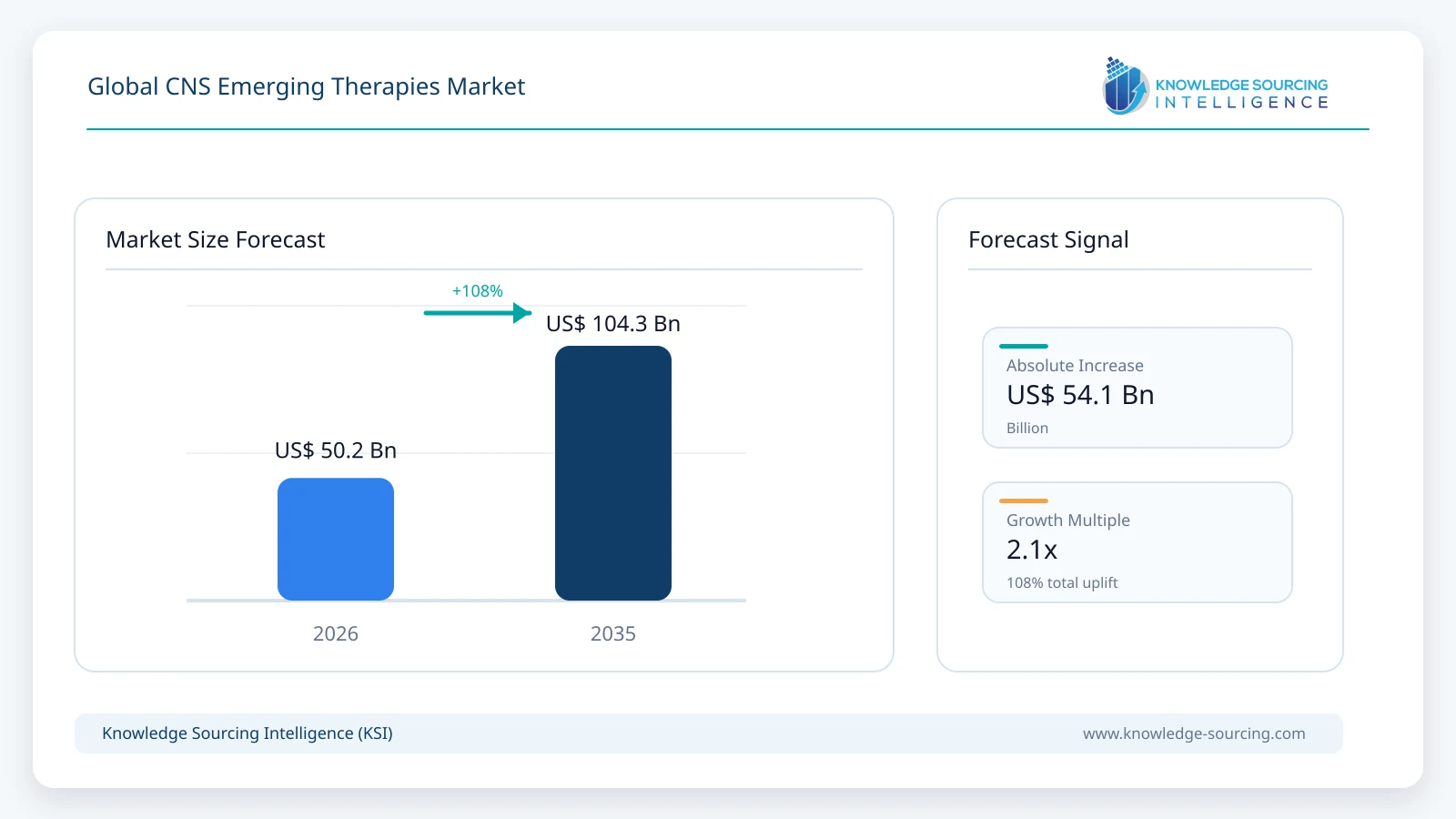
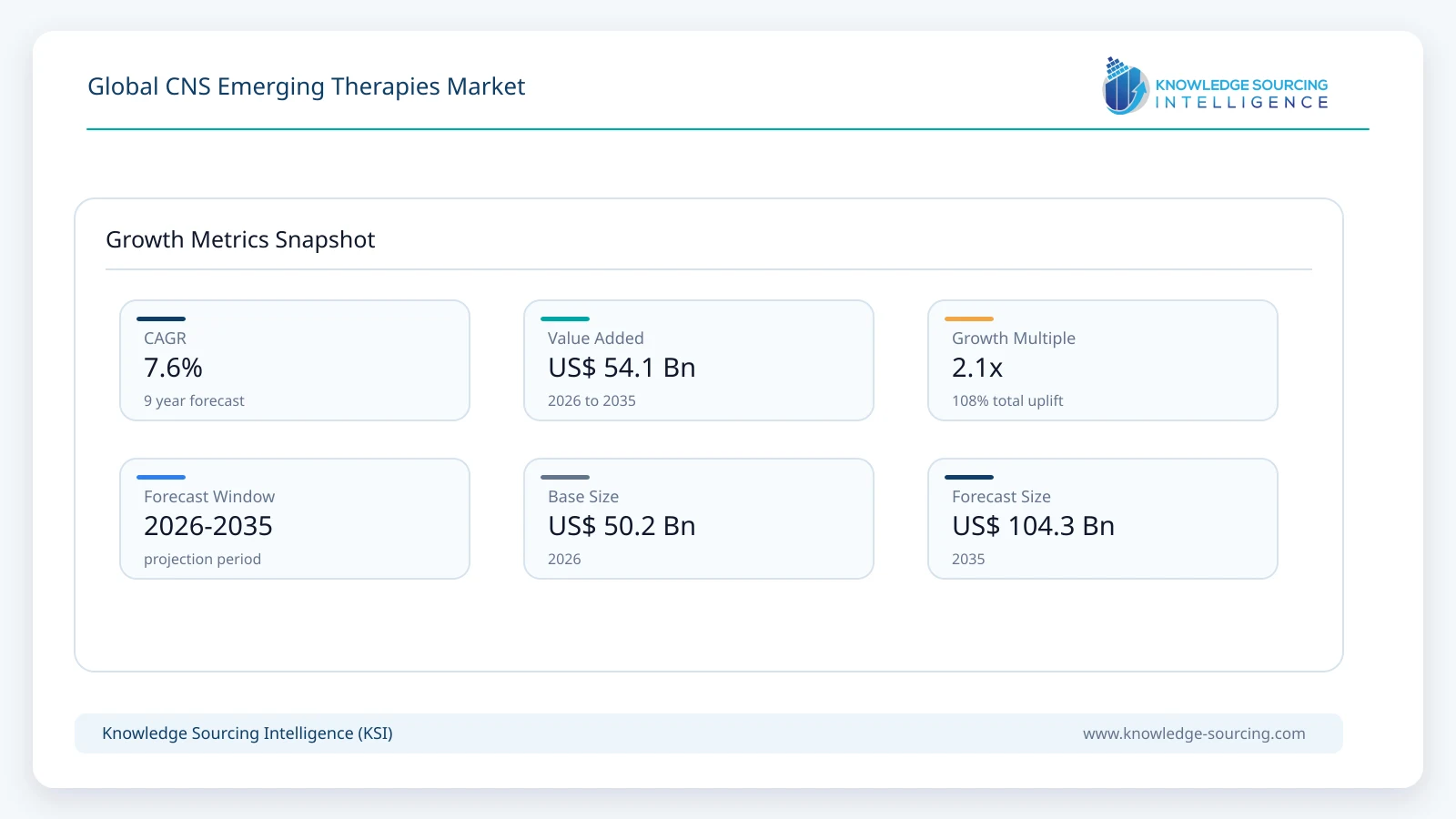
The Global CNS Emerging Therapies Market is forecast to grow at a CAGR of 7.6%, reaching USD 104.3 billion in 2035 from USD 50.2 billion in 2026.
Highlights:
- 1Rising neurodegenerative disease prevalence is increasing demand for therapies capable of slowing disease progression rather than managing symptoms.
- 2Advances in molecular biology are enabling targeted therapeutic development, which is expanding investment in gene therapies and RNA-based treatments.
- 3Growing understanding of disease mechanisms is supporting precision medicine approaches, which is improving patient stratification strategies.
- 4Regulatory emphasis on unmet neurological needs is encouraging accelerated development pathways, which supports innovation across CNS indications.
The CNS emerging therapies market exists because neurological disorders impose substantial clinical, economic, and societal burdens that current therapeutic options often fail to adequately address. Demand is increasing for disease-modifying interventions as aging populations contribute to higher prevalence of neurodegenerative diseases and longer disease management requirements. Therapeutic development faces significant scientific constraints because blood-brain barrier penetration, disease heterogeneity, and limited predictive biomarkers complicate clinical success. Pharmaceutical companies are investing in advanced platforms including gene editing, antisense oligonucleotides, targeted antibodies, and regenerative medicine technologies to overcome these limitations. The outcome is a strategic shift from symptom control toward biological intervention at earlier disease stages.
Regulatory agencies increasingly recognize the need for accelerated innovation in neurological diseases because substantial unmet medical needs persist across multiple indications. Clinical research activity is expanding across Alzheimer's disease, Parkinson's disease, ALS, epilepsy, major depressive disorder, schizophrenia, and rare neurological disorders. Development programs require extensive evidence generation because long disease progression timelines create challenges for demonstrating therapeutic value. Sponsors are incorporating digital biomarkers, imaging technologies, and molecular diagnostics to improve clinical development efficiency. This approach strengthens the strategic importance of emerging CNS therapies within global healthcare systems.
Market Dynamics
Market Drivers
Growing Demand for Disease-Modifying Neurological Treatments: The CNS treatment landscape relies heavily on symptomatic management across multiple disorders. Demand is increasing for therapies capable of altering disease progression because patients, providers, and healthcare systems seek durable clinical outcomes. Drug development remains challenging because neurological diseases involve multifactorial biological pathways. Pharmaceutical companies are advancing targeted therapies that address underlying pathology rather than symptom expression. This shift strengthens investment across emerging CNS therapeutic categories.
Expansion of Precision Medicine in Neurology: Precision medicine provides opportunities to identify patients most likely to benefit from specific therapies. Biomarker utilization is expanding across clinical development because treatment response variability remains a major challenge in neurological diseases. Clinical trial efficiency faces limitations when heterogeneous patient populations dilute therapeutic signals. Sponsors are integrating genomic, molecular, and imaging biomarkers into development programs. The result is improved therapeutic differentiation and enhanced development productivity.
Increasing Research Investment in Rare Neurological Disorders: Rare neurological disorders represent areas of substantial unmet need. Development activity is increasing because advances in genetic sequencing are identifying previously uncharacterized disease mechanisms. Small patient populations create commercial and clinical challenges for therapy development. Biopharmaceutical companies are pursuing orphan drug pathways and targeted therapeutic approaches. This trend expands opportunities for innovation across specialized CNS indications.
Market Restraints
Clinical development timelines remain lengthy because neurological diseases often require extended efficacy evaluation periods.
Blood-brain barrier penetration challenges limit therapeutic delivery efficiency across several emerging modalities.
High research and development costs increase financial risk and constrain pipeline expansion for smaller innovators.
Market Opportunities
Earlier Intervention Strategies: Neurological disease progression often begins before significant clinical symptoms emerge. Research efforts are increasingly focusing on early detection because earlier intervention may improve long-term outcomes. Diagnostic limitations reduce opportunities for timely treatment initiation. Healthcare systems are adopting advanced screening and biomarker technologies. This evolution supports demand for therapies targeting pre-symptomatic and early-stage disease populations.
Integration of Digital Biomarkers: Digital technologies create new approaches for monitoring neurological function. Adoption is increasing because traditional assessment tools may not fully capture disease progression dynamics. Data standardization challenges affect widespread implementation. Clinical developers are incorporating wearable devices and digital monitoring platforms into research programs. This approach enhances evidence generation and patient monitoring capabilities.
Expansion of Combination Therapy Development: Many CNS disorders involve multiple pathological pathways. Interest is growing in combination therapies because single-agent interventions may not adequately address disease complexity. Regulatory and development considerations increase program complexity. Companies are evaluating complementary mechanisms across therapeutic platforms. The result is broader therapeutic innovation and improved treatment strategy development.
Supply Chain Analysis
The CNS emerging therapies supply chain begins with advanced research platforms, biological materials, genetic technologies, and specialized manufacturing capabilities. Demand is increasing for high-quality biological inputs because emerging therapeutic modalities require complex production processes and stringent quality controls. Manufacturing scalability remains a constraint because many advanced therapies involve specialized production techniques. Industry participants are expanding partnerships with contract development and manufacturing organizations to improve operational flexibility. This structure supports more efficient commercialization pathways.
Clinical development represents a critical supply chain component because regulatory approval depends on extensive evidence generation. Trial recruitment challenges are increasing as sponsors target narrower patient populations and biomarker-defined cohorts. Development delays affect commercialization timelines and resource allocation. Companies are adopting decentralized trial methodologies and advanced patient identification tools. The result is improved development efficiency and stronger pipeline progression.
Government Regulations
Regulatory Area | Impact on CNS Emerging Therapies |
Clinical Trial Authorization | Requires demonstration of safety and efficacy before commercialization |
Orphan Drug Programs | Encourages development of therapies for rare neurological disorders |
Gene Therapy Oversight | Establishes requirements for advanced biological products |
Pharmacovigilance Requirements | Mandates long-term safety monitoring after approval |
Manufacturing Compliance | Ensures quality standards for biological and advanced therapeutics |
Market Segmentation
By Therapy Type
The therapy type segment includes small molecules, monoclonal antibodies, gene therapies, cell therapies, RNA-based therapeutics, peptide-based therapeutics, and combination therapies. Demand is increasing for biologically targeted interventions because disease-modifying outcomes are becoming a primary development objective. Conventional approaches face limitations when addressing complex neurological mechanisms. Pharmaceutical developers are expanding investment in advanced therapeutic modalities capable of influencing underlying disease biology. This transition supports diversification across emerging CNS treatment platforms.
By Indication
The indication segment covers Alzheimer's disease, Parkinson's disease, multiple sclerosis, epilepsy, ALS, major depressive disorder, schizophrenia, rare neurological disorders, and other CNS conditions. Alzheimer's disease continues attracting significant development activity because disease prevalence creates substantial healthcare burden. Clinical complexity affects therapeutic success rates across many neurological disorders. Companies are prioritizing indications with identifiable biological targets and measurable clinical endpoints. This focus supports continued innovation across high-need disease categories.
By Route of Administration
The route of administration segment includes oral, injectable, intravenous, intrathecal, intranasal, and other delivery approaches. Therapeutic efficacy often depends on efficient CNS delivery because biological barriers limit treatment accessibility. Advanced therapies increasingly require specialized administration methods to achieve optimal distribution. Developers are pursuing innovative delivery technologies and formulation strategies to improve therapeutic performance. This trend supports continued evolution of CNS treatment delivery models.
Regional Analysis
North America Market Analysis
North America represents a major center for CNS therapeutic innovation because the region combines advanced research infrastructure, significant pharmaceutical investment, and extensive neurological disease research capabilities. Demand is increasing for emerging therapies as healthcare systems prioritize interventions capable of reducing long-term disease burden. Clinical development remains complex because neurological disorders require extensive evidence generation and long follow-up periods. Industry participants are expanding biomarker programs, precision medicine initiatives, and advanced therapeutic platforms to improve development outcomes. The result is sustained leadership in CNS innovation and commercialization.
Europe Market Analysis
Europe maintains a strong position in CNS therapeutic development because the region combines advanced academic neuroscience research with established pharmaceutical innovation ecosystems. Demand is increasing for disease-modifying neurological therapies as aging populations contribute to rising incidence of Alzheimer's disease, Parkinson's disease, and other neurodegenerative conditions. Healthcare systems face increasing cost pressures because long-term neurological care requires substantial resource allocation across hospitals, specialty centers, and community care networks. Pharmaceutical companies are expanding collaborations with academic institutions and translational research centers to accelerate target identification and clinical validation. This environment supports continued advancement of emerging therapies across both common and rare neurological disorders.
Regulatory frameworks across Europe emphasize patient safety and clinical evidence generation, which influences development timelines and commercialization strategies. Clinical trial activity is increasing because sponsors seek access to diverse patient populations and well-established research networks. Recruitment challenges remain present because many emerging therapies require biomarker-defined cohorts and specialized diagnostic capabilities. Industry stakeholders are investing in precision medicine infrastructure and advanced diagnostic platforms to improve patient identification. The result is a more targeted and efficient CNS development landscape.
Asia Pacific Market Analysis
Asia Pacific represents a rapidly expanding opportunity for CNS emerging therapies because demographic expansion and population aging are increasing neurological disease prevalence. Demand is growing for innovative treatment options as healthcare systems improve diagnostic capabilities and expand access to specialized neurological care. Significant disparities in healthcare infrastructure create challenges across several countries because access to advanced therapies varies considerably between urban and rural settings. Governments and healthcare organizations are increasing investment in research capabilities, biotechnology development, and advanced healthcare delivery systems. This trend strengthens regional participation in global CNS innovation.
Rest of the World
The Rest of the World region includes Latin America, the Middle East, and Africa, where neurological disease management is becoming a greater healthcare priority. Demand is increasing for innovative therapies because diagnosis rates and awareness of neurological disorders continue improving. Resource limitations affect access to advanced treatments because specialized infrastructure and reimbursement mechanisms remain uneven across many healthcare systems. Governments and healthcare providers are strengthening neurological care capabilities and expanding specialist networks. These developments improve long-term opportunities for emerging CNS therapies.
Healthcare modernization efforts are increasing adoption of advanced diagnostic technologies and specialist treatment pathways. Market penetration remains constrained because many advanced therapies require significant healthcare investment and specialized clinical expertise. Industry participants are pursuing partnership-driven access strategies and targeted commercialization approaches to address these barriers. The result is gradual expansion of therapeutic availability and growing interest in innovative neurological treatments.
Regulatory Landscape
Neurological disorders frequently involve substantial unmet medical needs, which places CNS therapies among the priority areas for regulatory innovation. Regulatory agencies maintain rigorous safety and efficacy requirements because neurological interventions often involve long-term treatment exposure and complex biological mechanisms. Development programs are increasingly incorporating biomarker evidence and patient-centered outcome measures to strengthen regulatory submissions. This approach supports more robust evaluation of therapeutic benefit.
Advanced therapeutic modalities such as gene therapies, RNA-based therapeutics, and cell therapies require specialized oversight because manufacturing complexity and long-term safety considerations differ from conventional pharmaceutical products. Regulatory expectations continue evolving as scientific understanding advances and new therapeutic platforms enter clinical development. Sponsors are adapting development strategies to align with changing evidence requirements. This evolution supports responsible innovation while maintaining patient protection standards.
Pipeline Analysis
The CNS emerging therapies pipeline reflects a transition from symptomatic treatment toward biologically targeted intervention. Development activity is increasing across neurodegenerative diseases because advances in genetics, molecular biology, and biomarker science are improving understanding of disease mechanisms. Traditional development approaches often encounter high failure rates due to disease complexity and limited predictive biomarkers. Sponsors are incorporating precision medicine principles and mechanistic targeting strategies into pipeline planning. This shift increases the probability of identifying clinically meaningful therapeutic effects.
Alzheimer's disease, Parkinson's disease, ALS, and rare neurological disorders continue attracting substantial research investment because unmet clinical needs remain significant. Gene therapies and RNA-based approaches are expanding within genetically defined patient populations where disease drivers are more clearly understood. Clinical development challenges persist because therapeutic delivery, long-term efficacy, and patient heterogeneity remain important considerations. Companies are refining platform technologies and patient selection methodologies to improve outcomes. This trend supports continued diversification of the CNS therapeutic pipeline.
Competitive Landscape
Biogen
Biogen remains strategically distinct because of its longstanding specialization in neuroscience and neurological disease development. The company maintains significant expertise across neurodegenerative and neuroimmunological disorders, which strengthens its position in emerging CNS therapies. Demand is increasing for disease-modifying neurological interventions because healthcare systems seek improved long-term outcomes. Development complexity continues affecting industry-wide success rates. Biogen is expanding research efforts across neurodegeneration, biomarker-guided development, and targeted therapeutic platforms. This strategy supports continued participation in next-generation CNS innovation.
Eli Lilly and Company
Eli Lilly and Company distinguishes itself through broad research capabilities and significant investment in neurological disease innovation. The company participates across multiple therapeutic categories, which supports diversified CNS development strategies. Demand is increasing for therapies targeting underlying disease mechanisms because conventional treatment approaches often provide limited long-term benefits. Scientific complexity creates challenges for therapeutic development and validation. Lilly continues advancing programs focused on neurological and neurodegenerative conditions. This approach strengthens its strategic relevance within CNS emerging therapies.
Roche
Roche maintains strategic differentiation through its integration of diagnostics and therapeutics. The company benefits from strong biomarker and precision medicine capabilities, which support targeted neurological therapy development. Demand is increasing for personalized treatment approaches because patient populations demonstrate significant biological variability. Development challenges arise when clinical populations remain insufficiently characterized. Roche is strengthening connections between diagnostics and therapeutic decision-making. This model enhances development precision and therapeutic differentiation.
Novartis
Novartis differentiates itself through broad scientific capabilities and experience in advanced therapeutic modalities. The company participates in neurological disease research across multiple technology platforms. Demand is increasing for innovative interventions capable of addressing unmet neurological needs. Development risk remains significant because CNS disorders involve complex biological mechanisms. Novartis is pursuing diversified therapeutic strategies and advanced platform development. This approach supports long-term growth opportunities.
AbbVie
AbbVie maintains strategic relevance through ongoing investment in neuroscience research and therapeutic innovation. The company addresses neurological disorders where significant unmet medical needs persist. Demand is increasing for therapies capable of delivering durable clinical benefit. Scientific uncertainty affects development outcomes across multiple indications. AbbVie is expanding research activities and therapeutic exploration within CNS disease categories. This strategy supports portfolio diversification and future market participation.
Key Developments
April 2026: Galmed announces the breakthrough development of a brain penetrating new formulation of its SCD1 inhibitor, Aramchol
December 2025: Arrowhead Pharmaceuticals initiates phase 1/2a study of ARO-MAPT for the treatment of Alzheimer’s disease and other Tauopathies
November 2025: Aldeyra Therapeutics announces expansion of RASP platform to include central nervous system diseases and provides updates on Reproxalap at research & development webcast
May 2025: Sanofi to acquire Vigil Neuroscience, Inc., adding a new investigational medicine to treat Alzheimer’s disease to the neurology pipeline
Strategic Insights and Future Market Outlook
The future of the CNS emerging therapies market depends on the industry's ability to translate advances in molecular neuroscience into clinically meaningful interventions. Demand is increasing for therapies capable of altering disease progression because healthcare systems face growing neurological disease burdens and long-term treatment costs. Scientific complexity remains a significant constraint because many CNS disorders involve multiple biological pathways and diverse patient populations. Industry participants are expanding precision medicine initiatives, biomarker programs, and advanced therapeutic platforms to address these challenges. This evolution supports a more targeted and evidence-driven therapeutic environment.
Innovation is increasingly concentrating around biologically defined patient populations where disease mechanisms are more clearly understood. Development strategies are incorporating genomic insights, digital biomarkers, and advanced diagnostic technologies because traditional approaches often fail to capture disease heterogeneity. Regulatory frameworks continue adapting to support innovation while maintaining patient safety standards. These changes create opportunities for differentiated therapies capable of demonstrating measurable clinical benefit.
Global CNS Emerging Therapies Market Scope:
| Report Metric | Details |
|---|---|
| Total Market Size in 2026 | USD 50.2 billion |
| Total Market Size in 2035 | USD 104.3 billion |
| Forecast Unit | USD Billion |
| Growth Rate | 7.6% |
| Study Period | 2021 to 2035 |
| Historical Data | 2021 to 2024 |
| Base Year | 2025 |
| Forecast Period | 2026 – 2035 |
| Segmentation | Therapy Type, Indication , Route of Administration, Geography |
| Companies |
|
Market Segmentation
By Geography
Key Countries Analysis
Regulatory & Policy Landscape
Table of Contents
1. EXECUTIVE SUMMARY
1.1 Market Overview
1.2 Scope of the Study
1.3 Definition of CNS Emerging Therapies
1.4 Key Findings
1.5 Executive Insights by Therapy Modality
1.6 Executive Insights by Indication
1.7 Executive Insights by Region
1.8 Market Opportunity Assessment
1.9 Future Growth Outlook
2. DISEASE & EPIDEMIOLOGY ANALYSIS
2.1 Introduction to Central Nervous System (CNS) Disorders
2.2 Disease Burden and Public Health Impact
2.3 Epidemiology Methodology and Assumptions
2.4 CNS Disorders Epidemiology Overview
2.5 Neurodegenerative Disorders Epidemiology
2.5.1 Alzheimer's Disease
2.5.2 Parkinson's Disease
2.5.3 Amyotrophic Lateral Sclerosis (ALS)
2.5.4 Huntington's Disease
2.5.5 Multiple System Atrophy
2.5.6 Other Neurodegenerative Disorders
2.6 Neuroinflammatory and Demyelinating Disorders Epidemiology
2.6.1 Multiple Sclerosis
2.6.2 Neuromyelitis Optica Spectrum Disorder (NMOSD)
2.6.3 Myelin Oligodendrocyte Glycoprotein Antibody Disease (MOGAD)
2.7 Epilepsy and Seizure Disorders Epidemiology
2.7.1 Drug-Resistant Epilepsy
2.7.2 Generalized Epilepsy
2.7.3 Focal Epilepsy
2.8 Psychiatric and Neuropsychiatric Disorders Epidemiology
2.8.1 Major Depressive Disorder
2.8.2 Treatment-Resistant Depression
2.8.3 Schizophrenia
2.8.4 Bipolar Disorder
2.8.5 Anxiety Disorders
2.9 Rare CNS Disorders Epidemiology
2.9.1 Rett Syndrome
2.9.2 Fragile X Syndrome
2.9.3 Batten Disease
2.9.4 Other Rare Neurological Disorders
2.10 Patient Population Analysis by Indication
2.11 Diagnosed Population Analysis
2.12 Treated Population Analysis
2.13 Unmet Needs Assessment
3. MARKET DYNAMICS
3.1 Market Overview
3.2 Market Drivers
3.2.1 Rising CNS Disease Burden
3.2.2 Advances in Precision Medicine
3.2.3 Expansion of Gene and Cell Therapies
3.2.4 Growing Biomarker Adoption
3.2.5 Increasing CNS Clinical Trial Activity
3.3 Market Restraints
3.3.1 High Development Costs
3.3.2 Clinical Trial Complexity
3.3.3 Blood-Brain Barrier Challenges
3.3.4 Regulatory Uncertainties
3.3.5 Limited Long-Term Safety Data
3.4 Market Opportunities
3.4.1 Disease-Modifying Therapies
3.4.2 Neuroregenerative Technologies
3.4.3 RNA-Based Therapeutics
3.4.4 AI-Enabled Drug Discovery
3.4.5 Rare Neurological Diseases
3.5 Market Challenges
3.6 Porter's Five Forces Analysis
3.7 PESTLE Analysis
3.8 Value Chain Analysis
3.9 Stakeholder Ecosystem Analysis
4. COMMERCIAL & MARKET ACCESS
4.1 Commercialization Framework for CNS Therapies
4.2 Market Access Challenges
4.3 Pricing Analysis
4.4 Reimbursement Landscape
4.5 Health Technology Assessment (HTA) Considerations
4.6 Payer Perspectives
4.7 Patient Access Programs
4.8 Specialty Pharmacy Ecosystem
4.9 Commercial Launch Strategies
4.10 Real-World Evidence and Outcomes-Based Contracting
5. INNOVATION & PIPELINE LANDSCAPE
5.1 CNS Therapeutic Innovation Overview
5.2 Pipeline Landscape by Development Phase
5.2.1 Discovery Stage
5.2.2 Preclinical Stage
5.2.3 Phase I
5.2.4 Phase II
5.2.5 Phase III
5.3 Pipeline Analysis by Therapeutic Modality
5.3.1 Small Molecules
5.3.2 Monoclonal Antibodies
5.3.3 Bispecific Antibodies
5.3.4 Gene Therapies
5.3.5 Cell Therapies
5.3.6 RNA-Based Therapeutics
5.3.7 Peptide-Based Therapeutics
5.4 Pipeline Analysis by Mechanism of Action
5.4.1 Amyloid-Targeting Therapies
5.4.2 Tau-Targeting Therapies
5.4.3 Alpha-Synuclein Targeting Therapies
5.4.4 Neuroinflammation Modulators
5.4.5 Neuroprotective Therapies
5.4.6 Synaptic Function Modulators
5.4.7 Neuroregenerative Therapies
5.4.8 Gene Editing Approaches
5.5 Clinical Trial Landscape
5.6 Emerging Biomarkers and Companion Diagnostics
5.7 Licensing and Collaboration Trends
5.8 Funding and Investment Trends
5.9 Patent Landscape Analysis
5.10 Future Innovation Hotspots
6. TREATMENT LANDSCAPE
6.1 Current Standard of Care Overview
6.2 Approved CNS Therapeutics Landscape
6.3 Treatment Algorithm by Indication
6.4 Neurodegenerative Disorders Treatment Landscape
6.4.1 Alzheimer's Disease
6.4.2 Parkinson's Disease
6.4.3 ALS
6.4.4 Huntington's Disease
6.5 Neuroinflammatory Disorders Treatment Landscape
6.5.1 Multiple Sclerosis
6.5.2 NMOSD
6.5.3 MOGAD
6.6 Epilepsy Treatment Landscape
6.7 Psychiatric Disorders Treatment Landscape
6.8 Rare CNS Disorders Treatment Landscape
6.9 Emerging Therapy Positioning Analysis
6.10 Comparative Assessment of Emerging Therapies
7. MARKET SIZE & FORECAST
7.1 Market Forecast Methodology
7.2 Market Size Analysis (USD Million/Billion), 2024–2035
7.3 Market Growth Rate Analysis
7.4 Absolute Dollar Opportunity Analysis
7.5 Incremental Revenue Opportunity Analysis
7.6 Forecast by Therapy Type
7.7 Forecast by Indication
7.8 Forecast by Route of Administration
7.9 Forecast by End User
7.10 Forecast by Distribution Channel
7.11 Forecast by Region
8. MARKET SEGMENTATION
8.1 By Therapy Type
8.1.1 Small Molecules
8.1.2 Monoclonal Antibodies
8.1.3 Gene Therapies
8.1.4 Cell Therapies
8.1.5 RNA-Based Therapeutics
8.1.6 Peptide-Based Therapeutics
8.1.7 Combination Therapies
8.2 By Indication
8.2.1 Alzheimer's Disease
8.2.2 Parkinson's Disease
8.2.3 Multiple Sclerosis
8.2.4 Epilepsy
8.2.5 ALS
8.2.6 Major Depressive Disorder
8.2.7 Schizophrenia
8.2.8 Rare Neurological Disorders
8.2.9 Other CNS Disorders
8.3 By Route of Administration
8.3.1 Oral
8.3.2 Injectable
8.3.3 Intravenous
8.3.4 Intrathecal
8.3.5 Intranasal
8.3.6 Other Routes
8.4 By End User
8.4.1 Hospitals
8.4.2 Specialty Neurology Centers
8.4.3 Academic and Research Institutes
8.4.4 Ambulatory Care Centers
8.4.5 Home Care Settings
8.5 By Distribution Channel
8.5.1 Hospital Pharmacies
8.5.2 Retail Pharmacies
8.5.3 Specialty Pharmacies
8.5.4 Online Pharmacies
9. GEOGRAPHICAL ANALYSIS (REGIONAL LEVEL)
9.1 North America
9.1.1 Market Size and Forecast
9.1.2 Disease Burden and Demand Drivers
9.1.3 Regional Regulatory Overview
9.1.4 Competitive Intensity Analysis
9.2 Europe
9.2.1 Market Size and Forecast
9.2.2 Disease Burden and Demand Drivers
9.2.3 Regional Regulatory Overview
9.2.4 Competitive Intensity Analysis
9.3 Asia-Pacific
9.3.1 Market Size and Forecast
9.3.2 Disease Burden and Demand Drivers
9.3.3 Regional Regulatory Overview
9.3.4 Competitive Intensity Analysis
9.4 Latin America
9.4.1 Market Size and Forecast
9.4.2 Disease Burden and Demand Drivers
9.4.3 Regional Regulatory Overview
9.4.4 Competitive Intensity Analysis
9.5 Middle East & Africa
9.5.1 Market Size and Forecast
9.5.2 Disease Burden and Demand Drivers
9.5.3 Regional Regulatory Overview
9.5.4 Competitive Intensity Analysis
10. KEY COUNTRIES ANALYSIS
10.1 United States
10.1.1 Market Size and Forecast
10.1.2 Epidemiology Overview
10.1.3 Regulatory Framework
10.1.4 Reimbursement Environment
10.1.5 Key Companies and Product Presence
10.2 Canada
10.2.1 Market Size and Forecast
10.2.2 Epidemiology Overview
10.2.3 Regulatory Framework
10.2.4 Reimbursement Environment
10.2.5 Key Companies and Product Presence
10.3 Germany
10.3.1 Market Size and Forecast
10.3.2 Epidemiology Overview
10.3.3 Regulatory Framework
10.3.4 Reimbursement Environment
10.3.5 Key Companies and Product Presence
10.4 United Kingdom
10.4.1–10.4.5 (same structure)
10.5 France
10.5.1–10.5.5 (same structure)
10.6 Italy
10.6.1–10.6.5 (same structure)
10.7 Spain
10.7.1–10.7.5 (same structure)
10.8 China
10.8.1–10.8.5 (same structure)
10.9 Japan
10.9.1–10.9.5 (same structure)
10.10 India
10.10.1–10.10.5 (same structure)
10.11 South Korea
10.11.1–10.11.5 (same structure)
10.12 Australia
10.12.1–10.12.5 (same structure)
10.13 Brazil
10.13.1–10.13.5 (same structure)
10.14 Mexico
10.14.1–10.14.5 (same structure)
10.15 Saudi Arabia
10.15.1–10.15.5 (same structure)
10.16 South Africa
10.16.1–10.16.5 (same structure)
11. REGULATORY & POLICY LANDSCAPE
11.1 Global Regulatory Overview
11.2 United States FDA Framework
11.2.1 CNS Drug Approval Pathways
11.2.2 Accelerated Approval Programs
11.2.3 Orphan Drug Designation
11.3 European Medicines Agency (EMA) Framework
11.4 Japan PMDA Framework
11.5 India CDSCO Framework
11.6 China NMPA Framework
11.7 Cell and Gene Therapy Regulations
11.8 Clinical Trial Regulations
11.9 Pharmacovigilance Requirements
11.10 Market Access and Pricing Regulations
11.11 Emerging Regulatory Trends
12. COMPETITIVE LANDSCAPE
12.1 Market Structure Analysis
12.2 Competitive Benchmarking
12.3 Market Share Analysis (Where Applicable)
12.4 Strategic Positioning Assessment
12.5 Pipeline Competitiveness Matrix
12.6 Clinical Development Competitiveness
12.7 Licensing and Partnership Analysis
12.8 Mergers and Acquisitions Analysis
12.9 Recent Strategic Developments
12.10 Future Competitive Outlook
13. COMPANY PROFILES
13.1 Company Profiling Methodology
13.2 Company Profile Structure
13.2.1 Company Overview
13.2.2 CNS Portfolio Overview
13.2.3 Approved Products (Brand Name + Generic Name)
13.2.4 Key Approved Indications
13.2.5 CNS Pipeline Assets (Phase I/II/III Only)
13.2.6 Mechanism of Action
13.2.7 Clinical Development Status
13.2.8 Strategic Collaborations
13.2.9 Financial and R&D Highlights
13.2.10 Future CNS Strategy
13.3 Major Market Participants
13.3.1 Biogen
13.3.2 Eli Lilly and Company
13.3.3 Roche
13.3.4 Novartis
13.3.5 AbbVie
13.3.6 Bristol Myers Squibb
13.3.7 Johnson & Johnson
13.3.8 UCB
13.3.9 Otsuka Pharmaceutical
13.3.10 Neurocrine Biosciences
14. FUTURE OUTLOOK
14.1 Future Market Evolution
14.2 Emerging Therapeutic Paradigms
14.3 Gene and Cell Therapy Outlook
14.4 Precision Neurology Trends
14.5 Digital Biomarker Integration
14.6 AI-Driven CNS Drug Discovery Outlook
14.7 Investment and Funding Outlook
14.8 Scenario Analysis (Optimistic, Base, Conservative)
14.9 Strategic Recommendations
14.10 Long-Term Market Forecast Outlook
15. METHODOLOGY
15.1 Research Objectives
15.2 Market Definition and Scope
15.3 Data Collection Methodology
15.4 Secondary Research Sources
15.5 Primary Research Methodology
15.6 Epidemiology Modeling Approach
15.7 Pipeline Validation Methodology
15.8 Market Estimation Methodology
15.9 Forecasting Methodology
15.10 Data Triangulation
15.11 Quality Control Framework
15.12 Assumptions and Limitations
15.13 Abbreviations and Definitions
Navigate
Trusted by the world's leading organizations











