
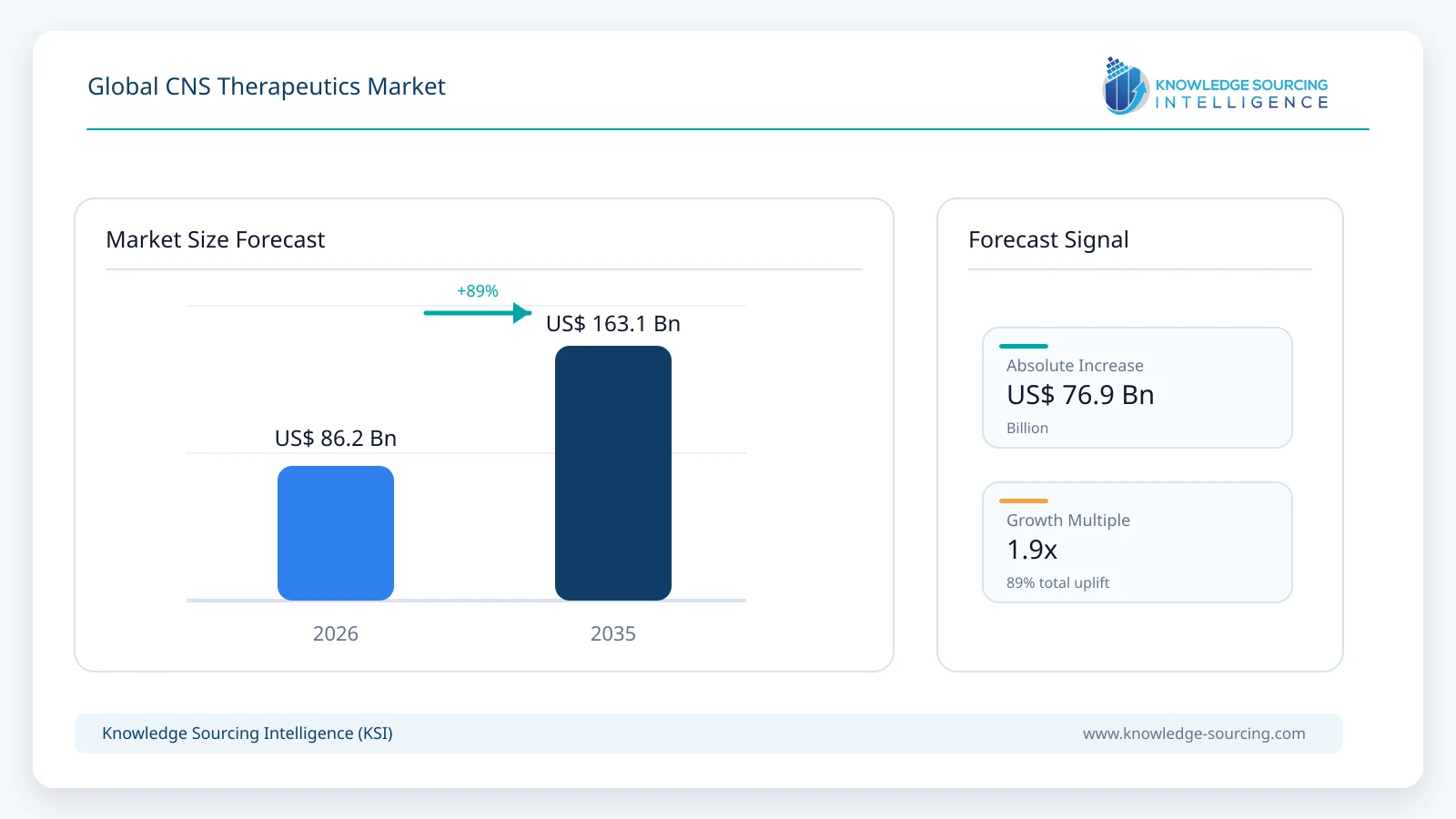
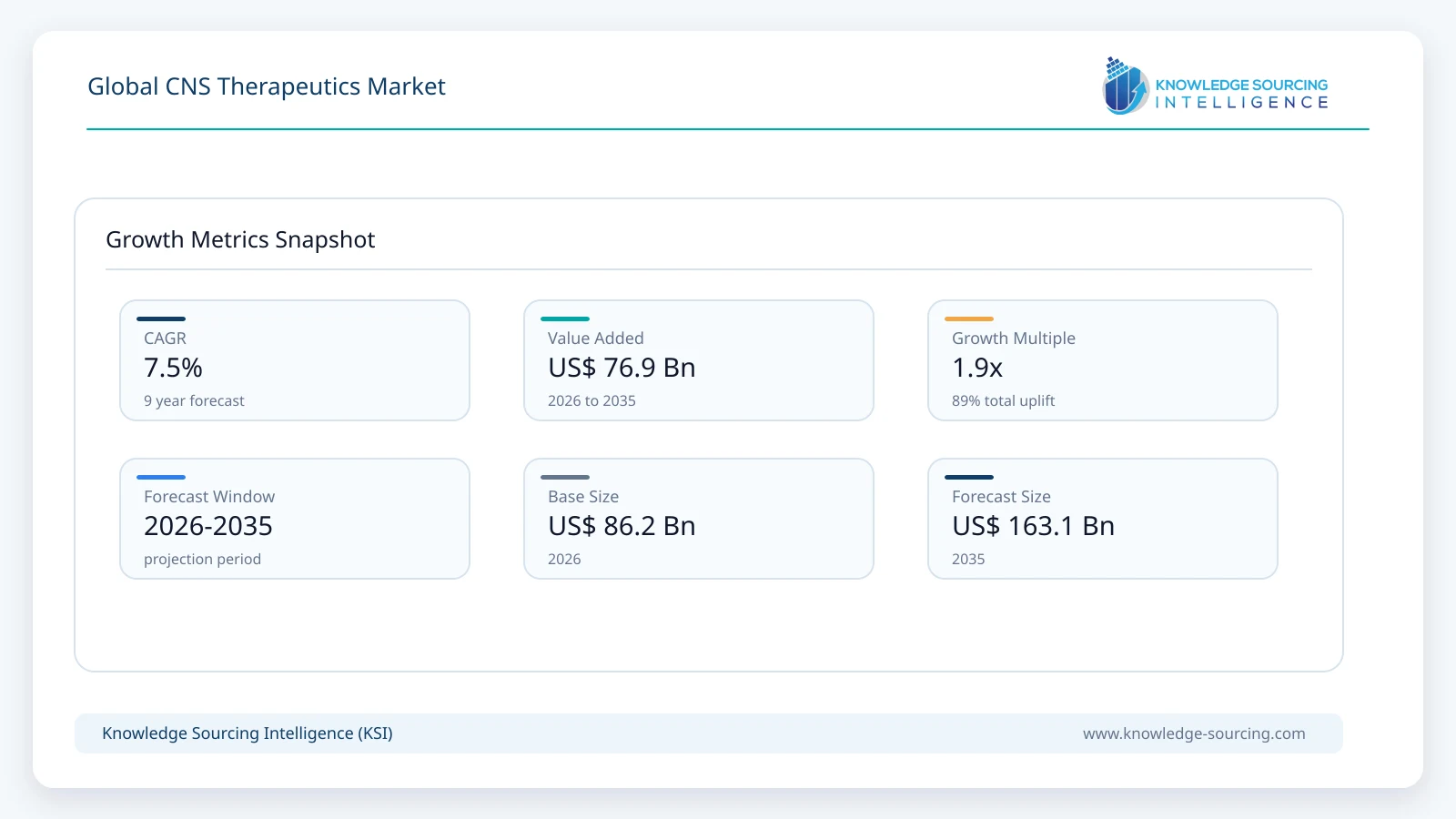
The Global CNS Therapeutics Market is projected to grow at a CAGR of 7.5% the forecast period, increasing from USD 86.2 billion in 2026 to USD 163.1 billion by 2035.
Highlights:
- 1Aging populations are increasing neurodegenerative disease prevalence, which is accelerating demand for disease-modifying CNS therapies.
- 2Biomarker-guided diagnosis is improving patient stratification, which is increasing adoption of targeted biologic therapies.
- 3Healthcare systems are expanding neurology specialty infrastructure because infusion-based CNS biologics require monitored administration.
- 4Regulatory agencies are accelerating CNS review pathways since unmet need remains high in Alzheimer’s disease and treatment-resistant depression.
The CNS therapeutics market supports treatment and management of neurological and psychiatric disorders affecting brain, spinal cord, and peripheral neural function. The market includes small molecule drugs, biologics, gene therapies, and emerging cell-based therapies targeting neurodegeneration, neuroinflammation, neurotransmitter dysregulation, and psychiatric instability. Demand is increasing because aging populations are elevating incidence rates of Alzheimer’s disease and Parkinson’s disease while stress-related psychiatric disorders continue expanding diagnosed patient pools.
Healthcare providers are prioritizing earlier neurological intervention because prolonged unmanaged disease progression increases institutional care dependency and hospitalization frequency. CNS therapeutics remain strategically important because neurodegenerative disorders are creating persistent economic burden across public healthcare systems. Governments are supporting accelerated innovation pathways because neurological disability is reducing workforce productivity and increasing long-term care expenditure.
Regulatory oversight is becoming more rigorous because safety concerns related to CNS adverse events, neuropsychiatric complications, and long-duration biologic use continue influencing approval frameworks. Drug developers are increasing investment in biomarker-based clinical development because traditional endpoint evaluation prolongs approval timelines and raises development costs. The market therefore increasingly depends on precision neurology, validated biomarkers, and scalable specialty-care infrastructure.
Market Dynamics
Market Drivers
Rising Prevalence of Neurodegenerative Disorders: Neurodegenerative diseases remain a major healthcare burden because aging populations are increasing neuronal degeneration incidence globally. Alzheimer’s disease prevalence is expanding as life expectancy rises, which is increasing long-duration treatment demand across outpatient and institutional care settings. Healthcare providers are strengthening neurological screening programs because delayed diagnosis accelerates irreversible cognitive decline. Pharmaceutical companies are therefore prioritizing disease-modifying biologics targeting amyloid beta and tau pathology.
According to the Alzheimer’s Association, nearly 7 million Americans are living with Alzheimer’s disease in 2025, while the burden is continuing increasing with population aging.
Expansion of Precision Neurology: Precision neurology is reshaping CNS therapeutic development because biomarker-driven patient identification improves treatment targeting. Clinical researchers are integrating neuroimaging and cerebrospinal biomarkers into trial enrollment because heterogeneous pathology reduces endpoint consistency. Drug manufacturers are investing in companion diagnostics since biomarker validation improves regulatory confidence and reimbursement acceptance. CNS treatment models therefore increasingly depend on individualized neurological profiling.
Growing Demand for Migraine and Psychiatric Therapies: Psychiatric disorders and migraine conditions continue increasing because stress-related disorders, sleep disruption, and lifestyle instability are affecting broader patient populations. Healthcare providers are prescribing CGRP inhibitors more frequently because traditional migraine drugs often create tolerability and relapse limitations. Mental health awareness campaigns are increasing diagnosis rates, which is expanding antidepressant and antipsychotic utilization. CNS drug manufacturers are therefore strengthening psychiatric and migraine-focused commercialization strategies.
Accelerating Regulatory Support for CNS Innovation: Regulatory agencies are increasing expedited approvals because unmet neurological need remains high across neurodegenerative and psychiatric indications. CNS developers are benefiting from fast-track and breakthrough therapy pathways since existing treatment alternatives provide limited disease modification. Pharmaceutical companies are increasing late-stage CNS investments because accelerated review mechanisms improve commercial viability. The market therefore increasingly rewards companies with advanced biologic and biomarker-enabled pipelines.
Market Restraints
Aging populations are increasing neurodegenerative disease prevalence, which is accelerating demand for disease-modifying CNS therapies.
Biomarker-guided diagnosis is improving patient stratification, which is increasing adoption of targeted biologic therapies.
Healthcare systems are expanding neurology specialty infrastructure because infusion-based CNS biologics require monitored administration.
Regulatory agencies are accelerating CNS review pathways since unmet need remains high in Alzheimer’s disease and treatment-resistant depression.
Market Opportunities
Expansion of Gene Therapy Development: Gene therapies are creating new opportunities because inherited and degenerative neurological disorders require long-term neuronal restoration strategies. Biotechnology companies are increasing CNS-focused vector research because targeted genetic modification may slow irreversible disease progression. Regulatory agencies are supporting rare neurological disease innovation since conventional therapies provide limited clinical improvement. CNS therapeutic competition therefore increasingly includes advanced genomic platforms.
AI-Enabled Drug Discovery: Artificial intelligence is improving CNS drug discovery because neurological pathways involve complex molecular interactions and prolonged target validation. Pharmaceutical companies are integrating predictive modeling systems since conventional CNS discovery timelines remain costly and inefficient. Clinical trial optimization platforms are reducing patient selection variability because AI-supported biomarker analysis improves recruitment precision. CNS R&D productivity therefore increasingly depends on computational neuroscience integration.
Emerging Market Neurology Expansion: Emerging healthcare economies are expanding neurology access because neurological disease diagnosis rates are increasing alongside healthcare infrastructure development. Governments are strengthening specialty-care investment since untreated CNS disorders increase long-term disability burden. Pharmaceutical manufacturers are increasing regional partnerships because treatment penetration remains relatively low across developing healthcare systems. CNS therapeutic access therefore continues broadening beyond mature pharmaceutical markets.
Government Regulations
Region/Country | Regulatory Authority | Regulatory Focus |
United States | FDA | Accelerated approval, CNS biologic safety, pharmacovigilance |
Europe | EMA | Neurodegenerative therapy evaluation, orphan drug pathways |
Japan | PMDA | Regenerative medicine oversight, expedited neurological review |
China | NMPA | CNS clinical trial expansion, domestic biologic development |
India | CDSCO | Neurology drug approval compliance, biosimilar regulation |
Market Segmentation
By Therapy Type
Small molecule drugs continue dominating CNS therapeutic utilization because oral administration supports broad patient accessibility and chronic treatment adherence. Antidepressants, antipsychotics, and antiepileptics remain widely prescribed since psychiatric and neurological disorders require scalable outpatient treatment models. Biologics are gaining adoption because neurodegenerative disease management increasingly prioritizes disease-modifying mechanisms over symptomatic control. Gene and cell therapies are emerging gradually since neuronal restoration strategies remain under active clinical evaluation. CNS therapeutic demand therefore increasingly balances scalable small molecules with precision-targeted biologic innovation.
By Drug Class
Antidepressants and antipsychotics maintain significant prescription volume because mental health diagnosis rates continue increasing globally. Dopaminergic agents remain strategically important since Parkinson’s disease prevalence is expanding across aging populations. Immunomodulators are gaining neurological relevance because multiple sclerosis management increasingly depends on inflammatory pathway suppression. CGRP inhibitors are rapidly expanding migraine treatment adoption because chronic migraine patients require improved tolerability and relapse prevention. CNS drug utilization therefore increasingly reflects long-term neurological stabilization requirements rather than acute symptom control alone.
By Indication
Alzheimer’s disease remains a major strategic focus because cognitive decline continues increasing institutional care dependency and healthcare expenditure. Multiple sclerosis treatment demand is expanding since early intervention improves long-term disability outcomes. Migraine disorders are driving strong outpatient pharmaceutical demand because chronic neurological pain significantly reduces productivity and quality of life. Depression and schizophrenia therapeutics continue maintaining large prescription volumes because psychiatric disease burden remains persistent across both developed and emerging healthcare systems. CNS therapeutic investment therefore increasingly prioritizes chronic disease management and progression control.
Regional Analysis
North America Market Analysis
North America maintains strong CNS therapeutics demand because aging populations and advanced neurological diagnosis infrastructure continue increasing treated patient volumes. Healthcare providers are adopting biomarker-guided Alzheimer’s therapies more aggressively because reimbursement systems increasingly recognize early disease intervention value. Pharmaceutical companies are expanding infusion center partnerships since biologic neurological therapies require monitored administration and imaging surveillance. Regulatory acceleration pathways support continued CNS innovation because unmet neurodegenerative burden remains high across the region.
The United States dominates regional commercialization because specialty neurology infrastructure supports rapid adoption of advanced therapies. Psychiatric treatment demand remains strong since mental health awareness initiatives continue increasing diagnosis rates. CNS clinical trial activity is expanding because biotechnology firms are prioritizing neurodegenerative pipeline diversification. The regional market therefore increasingly favors biologic innovation, precision diagnostics, and integrated neurological care systems.
Europe Market Analysis
Europe maintains significant CNS therapeutic demand because public healthcare systems continue prioritizing neurological disease management and disability reduction. Regulatory agencies are strengthening evaluation standards because long-term biologic safety and cost-effectiveness remain critical reimbursement considerations. Pharmaceutical companies are expanding multiple sclerosis and migraine therapeutic portfolios since outpatient neurological management continues increasing across the region.
Western European countries maintain strong biologic adoption because neurology specialty infrastructure supports infusion-based treatment delivery. Healthcare systems are negotiating stricter reimbursement frameworks since high-cost Alzheimer’s biologics are increasing payer scrutiny. CNS innovation partnerships are expanding because academic neuroscience research remains highly active across European institutions. The regional market therefore increasingly depends on value-based neurological treatment outcomes and long-duration patient monitoring systems.
Asia Pacific Market Analysis
Asia Pacific is experiencing rapid CNS therapeutic expansion because aging populations and urban stress-related psychiatric disorders are increasing neurological treatment demand. Governments are strengthening healthcare infrastructure since untreated neurodegenerative disorders are increasing long-term economic burden. Pharmaceutical companies are expanding regional manufacturing partnerships because biologic localization improves affordability and regulatory alignment.
Japan remains strategically important because advanced aging demographics continue increasing Alzheimer’s and Parkinson’s disease prevalence. China is increasing domestic CNS innovation because government healthcare modernization programs support neurological research expansion. India is improving neurological diagnosis access because urban healthcare networks are strengthening specialty-care capabilities. The regional market therefore increasingly supports both generic CNS scalability and advanced biologic adoption.
Rest of the World
Latin America, the Middle East, and Africa continue expanding CNS therapeutic access because neurological diagnosis rates are increasing alongside healthcare infrastructure investment. Governments are strengthening pharmaceutical procurement systems since untreated psychiatric and neurological disorders increase long-term social burden. Generic CNS therapies maintain significant utilization because affordability remains a primary treatment determinant across developing healthcare systems.
Biologic adoption remains comparatively limited because reimbursement capacity and specialty neurology infrastructure vary across regional markets. International pharmaceutical companies are increasing regional partnerships because neurological disease awareness is improving diagnostic penetration. Migraine and depression therapeutics continue driving outpatient demand since urbanization and stress-related disorders are expanding across metropolitan populations. The broader regional market therefore increasingly depends on affordable neurological access and healthcare infrastructure modernization.
Regulatory Landscape
The regulatory environment for CNS therapeutics is becoming more stringent because neurological biologics require extensive long-duration safety evaluation. Regulatory agencies are increasing post-market surveillance requirements since neuroinflammatory complications and imaging abnormalities remain important monitoring considerations. CNS developers are integrating biomarker-supported endpoints because conventional neurological progression measurement extends approval timelines and increases clinical uncertainty.
The U.S. FDA continues supporting accelerated CNS approvals because neurodegenerative disease burden remains clinically significant and underserved. The European Medicines Agency emphasizes pharmacovigilance and long-term efficacy because reimbursement systems require sustained neurological outcome validation. Japan’s PMDA is supporting regenerative medicine innovation since aging demographics continue increasing neurological disease prevalence. China’s NMPA is accelerating domestic neurological clinical development because national healthcare modernization priorities increasingly include advanced biologic capabilities.
Regulatory harmonization remains limited because neurological endpoint interpretation varies across jurisdictions. Pharmaceutical companies are expanding multinational trial coordination since global commercialization requires region-specific evidence generation. CNS regulatory strategy therefore increasingly depends on biomarker validation, long-duration safety monitoring, and adaptive clinical trial design.
Pipeline Analysis
The CNS pipeline is increasingly concentrating on disease-modifying therapies because symptomatic neurological management provides limited progression control. Alzheimer’s disease programs continue dominating biologic development since amyloid and tau-targeted approaches remain major therapeutic priorities. Companies are increasing monoclonal antibody investment because biomarker-supported neurodegenerative targeting improves clinical differentiation.
Gene therapies are gaining pipeline visibility because inherited neurological disorders require long-term molecular correction strategies. Biotechnology firms are advancing antisense oligonucleotide programs since targeted RNA modulation supports selective neurological intervention. Cell therapy development remains comparatively early because neuronal integration and durability challenges continue limiting large-scale commercialization readiness.
Clinical trial structures are evolving because patient stratification increasingly depends on biomarker confirmation and neuroimaging validation. CNS developers are narrowing enrollment populations since heterogeneous neurological progression reduces endpoint consistency. Pharmaceutical partnerships with AI and diagnostic companies are increasing because predictive analytics improve trial efficiency and patient selection accuracy. The pipeline landscape therefore increasingly favors precision neurology platforms with measurable biological endpoints.
Competitive Landscape
Biogen
Biogen remains strategically differentiated because the company focuses heavily on neurodegenerative biologics and biomarker-driven Alzheimer’s disease management. Aduhelm and Leqembi position the company prominently within disease-modifying Alzheimer’s therapy development because healthcare systems are increasing early neurological intervention efforts. Biogen is advancing BIIB080 because tau-targeting antisense therapies may improve progression-focused neurodegenerative treatment strategies. The company therefore increasingly depends on precision neurology commercialization and long-duration biologic monitoring capabilities.
Eli Lilly and Company
Eli Lilly maintains strong CNS positioning because the company combines migraine therapeutics with expanding Alzheimer’s biologic development. Kisunla strengthens the company’s neurodegenerative portfolio since amyloid-targeted therapies are reshaping Alzheimer’s treatment frameworks. Lilly is expanding biomarker-supported commercialization because patient stratification increasingly influences reimbursement access. The company therefore increasingly benefits from integrated neuroscience research and specialty neurology infrastructure expansion.
Novartis AG
Novartis remains strategically important because multiple sclerosis therapies continue generating sustained neurological demand globally. Kesimpta and Mayzent support strong immunomodulatory positioning since long-term relapse prevention remains critical in multiple sclerosis management. The company is advancing remibrutinib because targeted immune modulation may improve neurological tolerability and progression control. Novartis therefore increasingly focuses on precision immunology and long-duration neurological care models.
Roche Holding AG
Roche maintains competitive CNS strength because Ocrevus continues holding strong multiple sclerosis adoption across major healthcare markets. The company is advancing trontinemab because improved blood-brain barrier penetration may strengthen Alzheimer’s biologic efficacy. Roche is integrating diagnostic capabilities into neurological commercialization since biomarker-supported treatment selection increasingly influences clinical adoption. The company therefore increasingly benefits from combined diagnostic and biologic infrastructure.
AbbVie Inc.
AbbVie remains strongly positioned in migraine therapeutics because CGRP inhibitor demand continues increasing across chronic neurological pain management. Ubrelvy and Qulipta support outpatient neurological treatment expansion since migraine relapse prevention increasingly shapes prescribing patterns. The company is advancing tavapadon because Parkinson’s disease management continues requiring differentiated dopaminergic strategies. AbbVie therefore increasingly depends on chronic neurological disease management and specialty outpatient expansion.
Pfizer Inc.
Pfizer maintains CNS relevance because Nurtec ODT continues expanding within migraine management across outpatient neurology networks. The company is strengthening neurological research capabilities because CNS therapeutics increasingly require targeted biologic and biomarker integration. Pfizer continues evaluating investigational neurological programs since long-term CNS demand remains structurally significant. The company therefore increasingly aligns CNS development with precision medicine frameworks.
Teva Pharmaceutical Industries Ltd.
Teva remains strategically differentiated because the company combines branded neurological therapies with broad generic CNS capabilities. Austedo supports movement disorder management since Huntington’s disease and tardive dyskinesia require long-duration treatment continuity. Ajovy strengthens migraine positioning because CGRP-targeted therapies continue expanding outpatient neurological utilization. The company therefore increasingly benefits from balanced specialty and large-scale neurological distribution capabilities.
Johnson & Johnson
Johnson & Johnson maintains strong psychiatric positioning because Spravato is reshaping treatment-resistant depression management through rapid-acting intervention approaches. Invega continues supporting schizophrenia treatment demand since long-acting psychiatric stabilization remains clinically important. The company is advancing aticaprant because mood disorder management increasingly requires differentiated mechanistic pathways. Johnson & Johnson therefore increasingly focuses on severe psychiatric disease management and specialty mental health infrastructure.
Key Developments
May 2026: Plus Therapeutics, Inc., a clinical-stage pharmaceutical company developing targeted radiotherapeutics for central nervous system (CNS) cancers, announced that it has signed an agreement to enter into a strategic partnership with Ephemeral Technologies to deliver a unique AI execution platform for CNS oncology.
May 2026: 28bio announced the launch of the CNS-3D Induced Alzheimer's Model, a brain organoid assay enabling researchers to evaluate whether therapeutic candidates can reduce or prevent disease progression in patients.
March 2026: Oragenics, Inc., a clinical-stage biotechnology company pioneering brain-targeted therapeutics through proprietary intranasal delivery technology, announced that it is exploring discussions with third parties regarding the potential acquisition of additional assets in the central nervous system (CNS) space, with a specific focus on brain health and brain recovery indications that demonstrate strategic synergies with the Company's lead candidate ONP-002 and its proprietary intranasal drug delivery platform.
Strategic Insights and Future Market Outlook
The CNS therapeutics market is transitioning toward precision neurology because conventional symptomatic treatments provide limited long-term disease stabilization. Pharmaceutical companies are concentrating investment on biomarker-supported biologics since reimbursement systems increasingly require measurable neurological outcomes. Neurodegenerative disease management is becoming more infrastructure-dependent because infusion monitoring, imaging surveillance, and longitudinal patient assessment continue expanding across specialty neurology centers.
Gene therapies and RNA-targeted approaches are gaining strategic importance because neuronal restoration and pathway modulation remain major unmet clinical needs. CNS clinical trials are becoming narrower and more biomarker-focused since heterogeneous neurological progression increases development risk. Regulatory agencies are accelerating targeted innovation pathways because aging populations continue increasing neurological disability burden globally.
Competitive positioning increasingly depends on integrated neurological ecosystems combining diagnostics, biologics, specialty distribution, and long-term monitoring infrastructure. Companies with scalable biomarker capabilities and specialty neurology partnerships are likely strengthening commercial advantage because healthcare systems increasingly prioritize measurable treatment outcomes over broad symptomatic management.
The global CNS therapeutics market therefore continues evolving toward biologic precision, longitudinal neurological management, and outcome-based commercialization frameworks as neurodegenerative and psychiatric disease burden expands across aging populations.
Market Segmentation
By Geography
Key Countries Analysis
Regulatory & Policy Landscape
Table of Contents
1. EXECUTIVE SUMMARY
1.1 Market Snapshot
1.2 Key Findings
1.3 Strategic Insights
1.4 Therapeutic Landscape Overview
1.5 Key Growth Opportunities
1.6 Competitive Benchmarking
1.7 Pipeline Innovation Summary
1.8 Regional Market Highlights
1.9 Future Market Outlook
2. DISEASE & EPIDEMIOLOGY ANALYSIS
2.1 Overview of Central Nervous System Disorders
2.2 Disease Burden and Public Health Impact
2.3 Epidemiology by Major CNS Disorders
2.3.1 Alzheimer’s Disease
2.3.2 Parkinson’s Disease
2.3.3 Multiple Sclerosis
2.3.4 Epilepsy
2.3.5 Migraine Disorders
2.3.6 Schizophrenia
2.3.7 Major Depressive Disorder
2.3.8 Bipolar Disorder
2.3.9 Amyotrophic Lateral Sclerosis (ALS)
2.3.10 Huntington’s Disease
2.4 Prevalence Analysis
2.5 Incidence Analysis
2.6 Mortality and Disability Burden
2.7 Diagnosed and Treated Patient Population
2.8 Gender-Based Epidemiology Trends
2.9 Age-Based Epidemiology Trends
2.10 Genetic and Environmental Risk Factors
2.11 Disease Progression and Clinical Staging
2.12 Unmet Medical Needs in CNS Disorders
2.13 Epidemiology Forecast Analysis
3. MARKET DYNAMICS
3.1 Market Overview
3.2 Market Drivers
3.2.1 Rising Prevalence of Neurological Disorders
3.2.2 Increasing Geriatric Population
3.2.3 Advancements in Neurobiology and Precision Medicine
3.2.4 Growing CNS Drug Approvals
3.2.5 Expansion of Neuroimaging and Biomarker Research
3.3 Market Restraints
3.3.1 High Clinical Trial Failure Rates
3.3.2 Blood-Brain Barrier Drug Delivery Challenges
3.3.3 Adverse Effects Associated with CNS Therapies
3.3.4 Patent Expirations and Generic Competition
3.4 Market Opportunities
3.4.1 Gene and Cell Therapy Development
3.4.2 AI-Driven Drug Discovery
3.4.3 Biomarker-Guided Personalized Therapeutics
3.4.4 Expansion in Emerging Markets
3.5 Market Challenges
3.5.1 Complex Disease Pathophysiology
3.5.2 Limited Early Diagnosis
3.5.3 Reimbursement Constraints
3.6 Porter’s Five Forces Analysis
3.7 PESTLE Analysis
3.8 Value Chain Analysis
3.9 Pricing Analysis
3.10 Patent Landscape Analysis
3.11 Investment and Funding Trends
4. COMMERCIAL & MARKET ACCESS
4.1 Market Access Overview
4.2 Reimbursement Landscape
4.2.1 Public Reimbursement Programs
4.2.2 Private Insurance Coverage
4.2.3 Value-Based Reimbursement Models
4.3 Health Technology Assessment (HTA) Trends
4.4 Pricing and Cost Burden Analysis
4.5 Distribution and Supply Chain Overview
4.6 Commercialization Strategies
4.7 Patient Assistance Programs
4.8 Access Challenges in Emerging Markets
4.9 Stakeholder Analysis
4.10 Market Adoption Trends
5. INNOVATION & PIPELINE LANDSCAPE
5.1 Innovation Overview
5.2 CNS Drug Development Trends
5.3 Pipeline Analysis by Clinical Phase
5.3.1 Phase I Pipeline Candidates
5.3.2 Phase II Pipeline Candidates
5.3.3 Phase III Pipeline Candidates
5.4 Pipeline Analysis by Modality
5.4.1 Small Molecules
5.4.2 Monoclonal Antibodies
5.4.3 Gene Therapies
5.4.4 Cell Therapies
5.4.5 RNA-Based Therapeutics
5.5 Pipeline Analysis by Mechanism of Action
5.5.1 Amyloid Beta Targeting Therapies
5.5.2 Tau Protein Targeting Therapies
5.5.3 Dopamine Modulators
5.5.4 NMDA Receptor Antagonists
5.5.5 CGRP Antagonists
5.5.6 S1P Receptor Modulators
5.6 Biomarker and Companion Diagnostic Innovations
5.7 Neurotechnology and Digital Therapeutics
5.8 Clinical Trial Landscape
5.9 Licensing, Collaborations, and M&A Activities
5.10 Emerging Research Areas
6. TREATMENT LANDSCAPE
6.1 Current Treatment Paradigm
6.2 Standard of Care by Indication
6.2.1 Alzheimer’s Disease
6.2.2 Parkinson’s Disease
6.2.3 Multiple Sclerosis
6.2.4 Epilepsy
6.2.5 Migraine Disorders
6.2.6 Schizophrenia
6.2.7 Major Depressive Disorder
6.3 Approved Drug Landscape
6.3.1 Cholinesterase Inhibitors
6.3.2 NMDA Receptor Antagonists
6.3.3 Dopaminergic Therapies
6.3.4 Antiepileptic Drugs
6.3.5 Antidepressants
6.3.6 Antipsychotics
6.3.7 CGRP Inhibitors
6.3.8 Disease-Modifying Therapies for Multiple Sclerosis
6.4 Biologics and Advanced Therapies
6.5 Combination Therapy Trends
6.6 Non-Pharmacological Interventions
6.6.1 Deep Brain Stimulation
6.6.2 Cognitive Behavioral Therapy
6.6.3 Neurorehabilitation
6.7 Treatment Guidelines and Clinical Recommendations
6.8 Emerging Therapeutic Approaches
7. GLOBAL CNS THERAPEUTICS MARKET SIZE & FORECAST
7.1 Global Market Size Overview
7.2 Historical Market Analysis
7.3 Forecast Market Analysis
7.4 Market Forecast by Therapy Class
7.5 Market Forecast by Indication
7.6 Market Forecast by Route of Administration
7.7 Market Forecast by Distribution Channel
7.8 Market Forecast by Region
7.9 Market Attractiveness Analysis
7.10 Scenario Analysis
7.11 Forecast Assumptions and Methodology
8. GLOBAL CNS THERAPEUTICS MARKET SEGMENTATION
8.1 By Therapy Type
8.1.1 Small Molecule Drugs
8.1.2 Biologics
8.1.3 Gene Therapies
8.1.4 Cell Therapies
8.2 By Drug Class
8.2.1 Antidepressants
8.2.2 Antipsychotics
8.2.3 Antiepileptics
8.2.4 Dopaminergic Agents
8.2.5 Immunomodulators
8.2.6 CGRP Inhibitors
8.3 By Indication
8.3.1 Alzheimer’s Disease
8.3.2 Parkinson’s Disease
8.3.3 Multiple Sclerosis
8.3.4 Epilepsy
8.3.5 Migraine Disorders
8.3.6 Schizophrenia
8.3.7 Depression
8.3.8 Bipolar Disorder
8.4 By Route of Administration
8.4.1 Oral
8.4.2 Injectable
8.4.3 Intranasal
8.4.4 Transdermal
8.5 By Distribution Channel
8.5.1 Hospital Pharmacies
8.5.2 Retail Pharmacies
8.5.3 Online Pharmacies
8.6 By End User
8.6.1 Hospitals
8.6.2 Neurology Clinics
8.6.3 Specialty Centers
8.6.4 Homecare Settings
9. GEOGRAPHICAL ANALYSIS
9.1 North America
9.1.1 Market Size and Forecast
9.1.2 Key Demand Drivers
9.1.3 Regional Regulatory Overview
9.1.4 Competitive Landscape
9.1.5 Research and Innovation Trends
9.2 Europe
9.2.1 Market Size and Forecast
9.2.2 Key Demand Drivers
9.2.3 Regional Regulatory Overview
9.2.4 Competitive Landscape
9.2.5 Research and Innovation Trends
9.3 Asia-Pacific
9.3.1 Market Size and Forecast
9.3.2 Key Demand Drivers
9.3.3 Regional Regulatory Overview
9.3.4 Competitive Landscape
9.3.5 Research and Innovation Trends
9.4 Latin America
9.4.1 Market Size and Forecast
9.4.2 Key Demand Drivers
9.4.3 Regional Regulatory Overview
9.4.4 Competitive Landscape
9.4.5 Research and Innovation Trends
9.5 Middle East & Africa
9.5.1 Market Size and Forecast
9.5.2 Key Demand Drivers
9.5.3 Regional Regulatory Overview
9.5.4 Competitive Landscape
9.5.5 Research and Innovation Trends
10. KEY COUNTRIES ANALYSIS
10.1 United States
10.1.1 Market Size and Forecast
10.1.2 Epidemiology Overview
10.1.3 FDA Regulatory Framework
10.1.4 Reimbursement Landscape
10.1.5 Key Companies and Approved Products Presence
10.2 Canada
10.2.1 Market Size and Forecast
10.2.2 Epidemiology Overview
10.2.3 Regulatory Framework
10.2.4 Reimbursement Landscape
10.2.5 Key Companies and Approved Products Presence
10.3 Germany
10.3.1 Market Size and Forecast
10.3.2 Epidemiology Overview
10.3.3 Regulatory Framework
10.3.4 Reimbursement Landscape
10.3.5 Key Companies and Approved Products Presence
10.4 United Kingdom
10.4.1 Market Size and Forecast
10.4.2 Epidemiology Overview
10.4.3 Regulatory Framework
10.4.4 Reimbursement Landscape
10.4.5 Key Companies and Approved Products Presence
10.5 France
10.5.1 Market Size and Forecast
10.5.2 Epidemiology Overview
10.5.3 Regulatory Framework
10.5.4 Reimbursement Landscape
10.5.5 Key Companies and Approved Products Presence
10.6 Italy
10.6.1 Market Size and Forecast
10.6.2 Epidemiology Overview
10.6.3 Regulatory Framework
10.6.4 Reimbursement Landscape
10.6.5 Key Companies and Approved Products Presence
10.7 Spain
10.7.1 Market Size and Forecast
10.7.2 Epidemiology Overview
10.7.3 Regulatory Framework
10.7.4 Reimbursement Landscape
10.7.5 Key Companies and Approved Products Presence
10.8 China
10.8.1 Market Size and Forecast
10.8.2 Epidemiology Overview
10.8.3 NMPA Regulatory Framework
10.8.4 Reimbursement Landscape
10.8.5 Key Companies and Approved Products Presence
10.9 Japan
10.9.1 Market Size and Forecast
10.9.2 Epidemiology Overview
10.9.3 PMDA Regulatory Framework
10.9.4 Reimbursement Landscape
10.9.5 Key Companies and Approved Products Presence
10.10 India
10.10.1 Market Size and Forecast
10.10.2 Epidemiology Overview
10.10.3 CDSCO Regulatory Framework
10.10.4 Reimbursement Landscape
10.10.5 Key Companies and Approved Products Presence
10.11 South Korea
10.11.1 Market Size and Forecast
10.11.2 Epidemiology Overview
10.11.3 Regulatory Framework
10.11.4 Reimbursement Landscape
10.11.5 Key Companies and Approved Products Presence
10.12 Australia
10.12.1 Market Size and Forecast
10.12.2 Epidemiology Overview
10.12.3 Regulatory Framework
10.12.4 Reimbursement Landscape
10.12.5 Key Companies and Approved Products Presence
10.13 Brazil
10.13.1 Market Size and Forecast
10.13.2 Epidemiology Overview
10.13.3 Regulatory Framework
10.13.4 Reimbursement Landscape
10.13.5 Key Companies and Approved Products Presence
10.14 Mexico
10.14.1 Market Size and Forecast
10.14.2 Epidemiology Overview
10.14.3 Regulatory Framework
10.14.4 Reimbursement Landscape
10.14.5 Key Companies and Approved Products Presence
10.15 Saudi Arabia
10.15.1 Market Size and Forecast
10.15.2 Epidemiology Overview
10.15.3 Regulatory Framework
10.15.4 Reimbursement Landscape
10.15.5 Key Companies and Approved Products Presence
10.16 South Africa
10.16.1 Market Size and Forecast
10.16.2 Epidemiology Overview
10.16.3 Regulatory Framework
10.16.4 Reimbursement Landscape
10.16.5 Key Companies and Approved Products Presence
11. REGULATORY & POLICY LANDSCAPE
11.1 Regulatory Overview for CNS Therapeutics
11.2 United States FDA Framework
11.3 European Medicines Agency (EMA) Framework
11.4 Japan PMDA Framework
11.5 India CDSCO Framework
11.6 China NMPA Framework
11.7 Orphan Drug and Fast-Track Designations
11.8 CNS Clinical Trial Regulations
11.9 Pharmacovigilance and Drug Safety Monitoring
11.10 Pricing and Reimbursement Policies
11.11 Intellectual Property and Patent Exclusivity
11.12 Policy Impact Analysis
12. COMPETITIVE LANDSCAPE
12.1 Competitive Environment Overview
12.2 Market Share Analysis
12.3 Competitive Benchmarking
12.4 Strategic Initiatives
12.4.1 Mergers and Acquisitions
12.4.2 Licensing Agreements
12.4.3 Strategic Collaborations
12.4.4 Product Launches
12.5 Pipeline Competitiveness Analysis
12.6 Innovation Positioning Matrix
12.7 SWOT Analysis
12.8 Key Strategic Recommendations
13. COMPANY PROFILES
13.1 Biogen
13.1.1 Company Overview
13.1.2 CNS Portfolio Overview
13.1.3 Approved Products
13.1.3.1 Aduhelm (aducanumab) – Alzheimer’s Disease
13.1.3.2 Leqembi (lecanemab) – Alzheimer’s Disease
13.1.4 Pipeline Candidates
13.1.4.1 BIIB080 – Tau-Targeting Antisense Therapy
13.1.5 Financial and Strategic Developments
13.2 Eli Lilly and Company
13.2.1 Company Overview
13.2.2 CNS Portfolio Overview
13.2.3 Approved Products
13.2.3.1 Kisunla (donanemab) – Alzheimer’s Disease
13.2.3.2 Emgality (galcanezumab) – Migraine
13.2.4 Pipeline Candidates
13.2.4.1 Remternetug – Alzheimer’s Disease
13.2.5 Financial and Strategic Developments
13.3 Novartis AG
13.3.1 Company Overview
13.3.2 CNS Portfolio Overview
13.3.3 Approved Products
13.3.3.1 Kesimpta (ofatumumab) – Multiple Sclerosis
13.3.3.2 Mayzent (siponimod) – Multiple Sclerosis
13.3.4 Pipeline Candidates
13.3.4.1 Remibrutinib – Multiple Sclerosis
13.3.5 Financial and Strategic Developments
13.4 Roche Holding AG
13.4.1 Company Overview
13.4.2 CNS Portfolio Overview
13.4.3 Approved Products
13.4.3.1 Ocrevus (ocrelizumab) – Multiple Sclerosis
13.4.4 Pipeline Candidates
13.4.4.1 Trontinemab – Alzheimer’s Disease
13.4.5 Financial and Strategic Developments
13.5 AbbVie Inc.
13.5.1 Company Overview
13.5.2 CNS Portfolio Overview
13.5.3 Approved Products
13.5.3.1 Ubrelvy (ubrogepant) – Migraine
13.5.3.2 Qulipta (atogepant) – Migraine
13.5.4 Pipeline Candidates
13.5.4.1 Tavapadon – Parkinson’s Disease
13.5.5 Financial and Strategic Developments
13.6 Pfizer Inc.
13.6.1 Company Overview
13.6.2 CNS Portfolio Overview
13.6.3 Approved Products
13.6.3.1 Nurtec ODT (rimegepant) – Migraine
13.6.4 Pipeline Candidates
13.6.4.1 Investigational CNS Programs
13.6.5 Financial and Strategic Developments
13.7 Teva Pharmaceutical Industries Ltd.
13.7.1 Company Overview
13.7.2 CNS Portfolio Overview
13.7.3 Approved Products
13.7.3.1 Austedo (deutetrabenazine) – Huntington’s Disease and Tardive Dyskinesia
13.7.3.2 Ajovy (fremanezumab) – Migraine
13.7.4 Pipeline Candidates
13.7.4.1 Olanzapine Long-Acting Programs
13.7.5 Financial and Strategic Developments
13.8 Johnson & Johnson
13.8.1 Company Overview
13.8.2 CNS Portfolio Overview
13.8.3 Approved Products
13.8.3.1 Spravato (esketamine) – Treatment-Resistant Depression
13.8.3.2 Invega (paliperidone) – Schizophrenia
13.8.4 Pipeline Candidates
13.8.4.1 Aticaprant – Major Depressive Disorder
13.8.5 Financial and Strategic Developments
13.9 Bristol Myers Squibb
13.9.1 Company Overview
13.9.2 CNS Portfolio Overview
13.9.3 Approved Products
13.9.3.1 Zeposia (ozanimod) – Multiple Sclerosis
13.9.4 Pipeline Candidates
13.9.4.1 KarXT (xanomeline and trospium chloride) – Schizophrenia
13.9.5 Financial and Strategic Developments
13.10 UCB S.A.
13.10.1 Company Overview
13.10.2 CNS Portfolio Overview
13.10.3 Approved Products
13.10.3.1 Briviact (brivaracetam) – Epilepsy
13.10.3.2 Vimpat (lacosamide) – Epilepsy
13.10.4 Pipeline Candidates
13.10.4.1 Investigational Epilepsy Programs
13.10.5 Financial and Strategic Developments
14. FUTURE OUTLOOK
14.1 Future Market Projections
14.2 Emerging CNS Therapeutic Modalities
14.3 AI and Precision Neurology Integration
14.4 Future of Biomarker-Guided Therapy
14.5 CNS Gene Therapy Outlook
14.6 Future Regulatory Trends
14.7 Investment Outlook
14.8 Strategic Recommendations for Stakeholders
15. METHODOLOGY
15.1 Research Methodology Overview
15.2 Secondary Research Sources
15.3 Primary Research Methodology
15.4 Market Size Estimation Approach
15.5 Forecasting Methodology
15.6 Data Validation and Triangulation
15.7 Assumptions and Limitations
15.8 Abbreviations and Definitions
Navigate
Trusted by the world's leading organizations











