
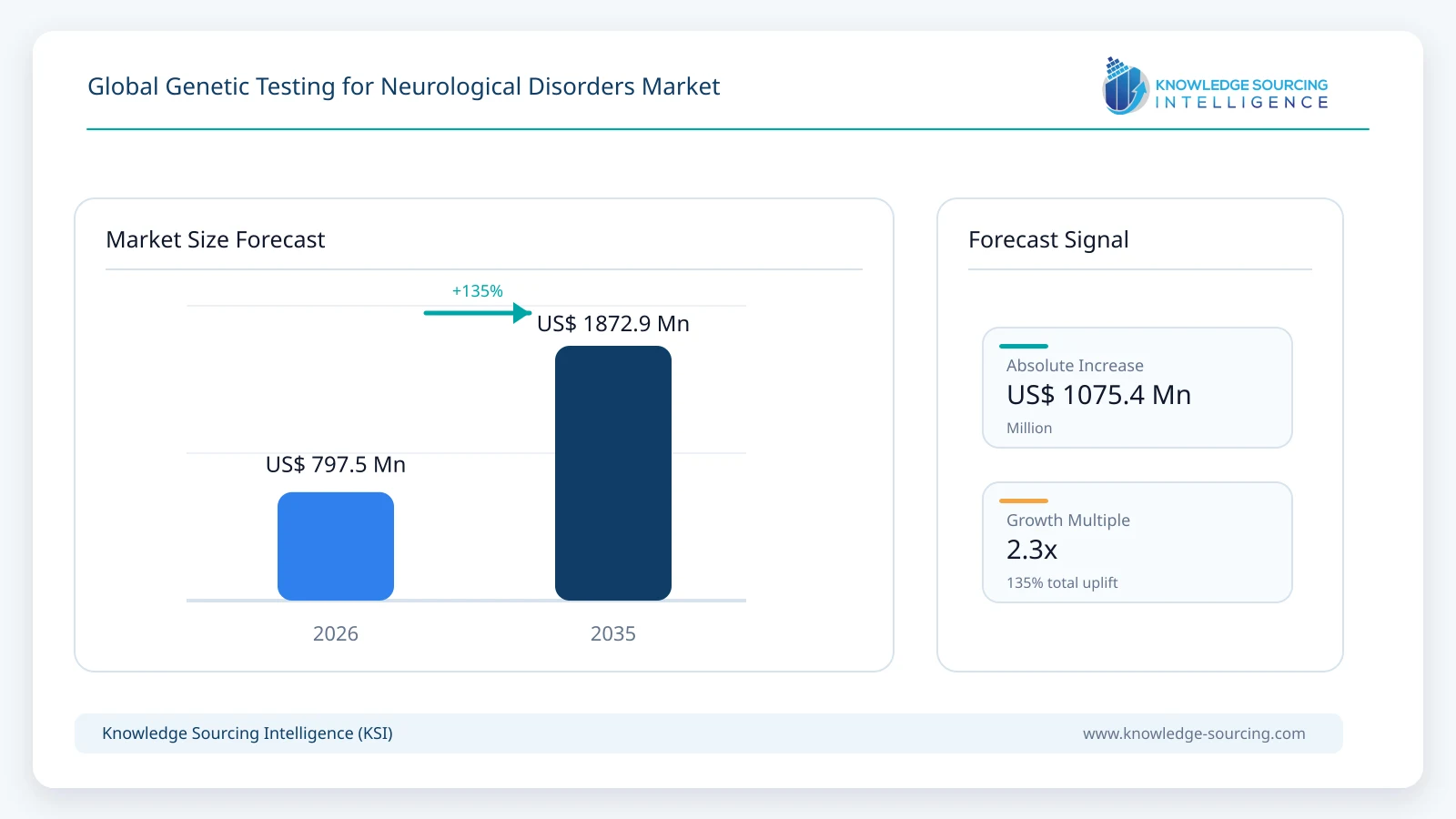
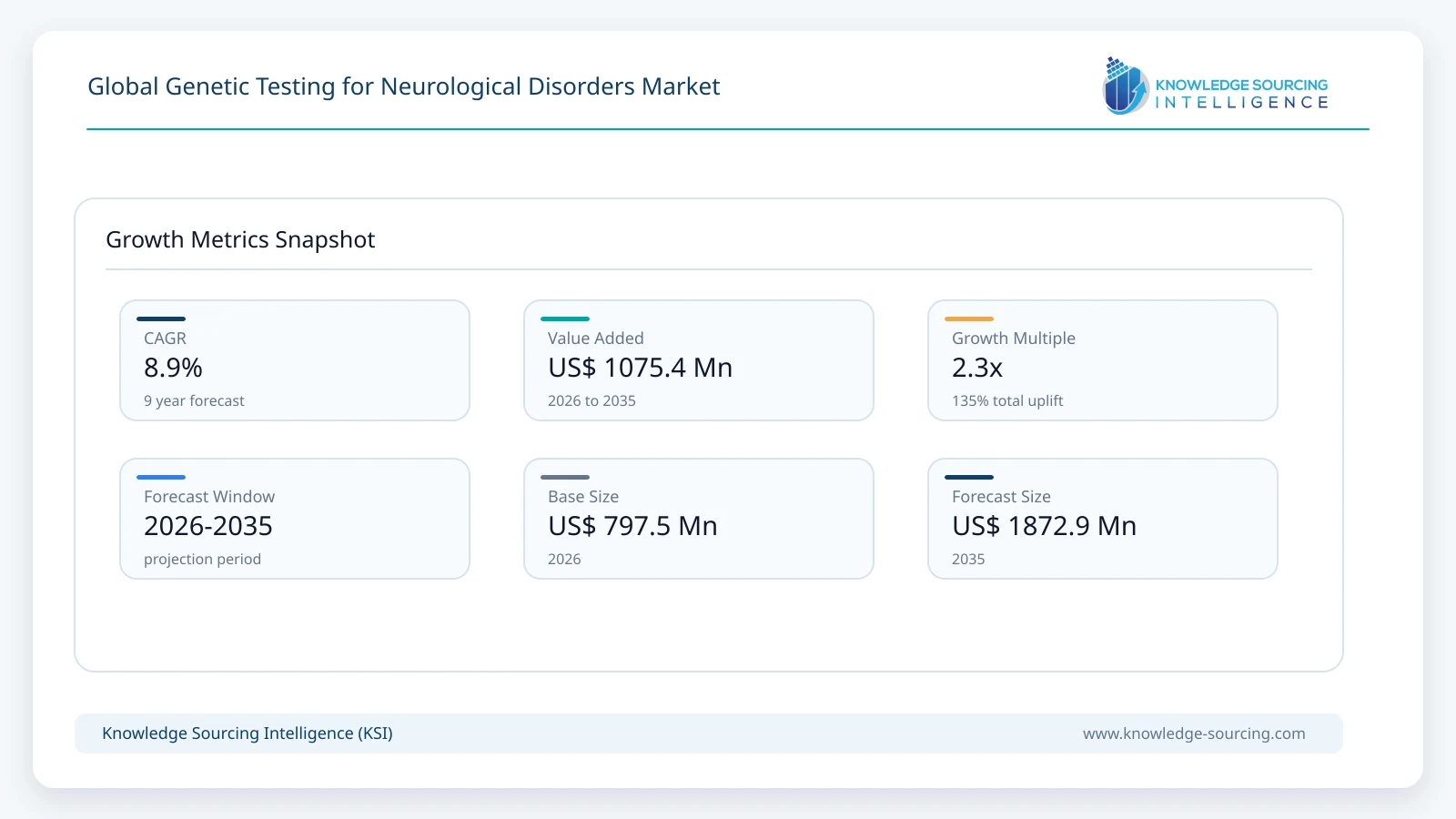
The Global Genetic Testing for Neurological Disorders Market is forecast to grow at a CAGR of 8.9%, reaching USD 1,872.94 million in 2035 from USD 797.54 million in 2026.
Highlights:
- 1Rising prevalence of inherited neurological disorders is increasing demand for early molecular diagnosis, which is accelerating adoption of sequencing-based neurology testing workflows.
- 2Expansion of precision neurology programs is increasing utilization of targeted gene panels because treatment pathways increasingly depend on mutation-specific characterization.
- 3Pediatric neurology centers are adopting whole exome sequencing to reduce diagnostic odysseys, which is strengthening demand for high-throughput genomic interpretation platforms.
- 4Regulatory oversight around genomic diagnostics is increasing validation requirements, which is encouraging laboratories to deploy clinically standardized sequencing systems.
Genetic testing for neurological disorders supports identification of inherited mutations, chromosomal abnormalities, repeat expansions, and rare genomic variants associated with neurodegenerative, neuromuscular, and neurodevelopmental conditions. The market structure includes sequencing systems, targeted assay panels, molecular diagnostics software, laboratory services, and integrated reporting platforms used across hospitals, specialty neurology clinics, and diagnostic laboratories.
Demand is increasing because neurological diseases are creating prolonged diagnostic journeys that elevate healthcare utilization and delay therapeutic intervention. Pediatric neurology departments are increasingly adopting whole exome and whole genome sequencing because rare genetic disorders often present overlapping clinical manifestations that conventional diagnostics fail to differentiate efficiently. This dependence on genomic confirmation is increasing investment in scalable sequencing infrastructure and cloud-based genomic analytics.
Regulatory influence remains significant because genomic testing workflows involve clinical validation, patient consent management, and interpretation accuracy requirements. Agencies including the U.S. Food and Drug Administration, European Medicines Agency, and national genomic medicine initiatives are supporting precision diagnostics expansion while strengthening compliance expectations surrounding clinical evidence generation and data governance.
The strategic importance of the market is increasing because neurological drug development pipelines increasingly rely on genetically stratified patient populations. Pharmaceutical companies are expanding partnerships with genomic testing firms because biomarker-guided enrollment improves trial targeting and accelerates rare disease therapy development. This integration between diagnostics and therapeutics is establishing genetic testing as a core infrastructure component within modern neurology care models.
Market Dynamics
Market Drivers
Expansion of Rare Neurological Disease Diagnosis: Rare neurological disorders require precise genomic characterization because clinical symptoms frequently overlap across multiple disease categories. Demand is increasing for whole exome sequencing and targeted neurology panels because clinicians are attempting to shorten delayed diagnosis timelines in pediatric and adult populations. This diagnostic pressure is increasing adoption of integrated genomic interpretation platforms capable of identifying pathogenic variants across heterogeneous neurological conditions. Hospitals and specialty laboratories are expanding sequencing capacity because earlier genetic confirmation improves treatment planning and patient stratification.
Growing Adoption of Precision Neurology: Precision medicine frameworks are increasing reliance on genomic profiling because neurological therapies increasingly target mutation-specific mechanisms. Demand is shifting toward high-resolution sequencing systems capable of identifying low-frequency variants, repeat expansions, and inherited mutations linked to epilepsy, Huntington disease, and hereditary ataxia. Pharmaceutical developers are integrating genomic screening into clinical trial enrollment because genetically stratified cohorts improve therapeutic targeting efficiency. This transition is strengthening long-term demand for standardized neurology-focused sequencing assays and companion diagnostics.
Increasing Sequencing Accessibility: Sequencing technology is becoming operationally scalable because automation and workflow integration are reducing turnaround complexity within clinical laboratories. Demand is increasing for next-generation sequencing platforms that support simultaneous multi-gene analysis across neurological conditions. Diagnostic laboratories are expanding throughput capacity because healthcare providers increasingly require rapid molecular reporting to support neurological intervention decisions. This operational shift is improving accessibility across mid-sized hospitals and regional diagnostic centers.
Market Restraints
High interpretation complexity limits clinical adoption because neurological variants frequently require extensive bioinformatics validation and specialist review.
Reimbursement inconsistency restricts testing accessibility because several healthcare systems lack standardized coverage frameworks for advanced neurogenetic diagnostics.
Data privacy concerns remain significant because genomic testing workflows involve large-scale storage and transfer of sensitive patient genetic information.
Market Opportunities
Expansion of Pediatric Neurology Genomics: Pediatric neurology departments are increasing genomic screening programs because developmental disorders often require early molecular confirmation to guide intervention strategies. Demand is growing for rapid exome sequencing solutions capable of supporting neonatal intensive care and pediatric epilepsy diagnostics. Testing providers are developing disease-specific pediatric panels because clinicians increasingly require focused interpretation models for early-stage neurological abnormalities. This expansion is strengthening long-term demand for integrated pediatric neurogenetic services.
Integration of AI-Based Variant Interpretation: Variant interpretation complexity is increasing because genomic datasets are expanding across rare neurological conditions. Demand is shifting toward AI-assisted interpretation systems capable of improving mutation classification efficiency and reporting accuracy. Diagnostic companies are integrating machine learning analytics into sequencing workflows because laboratories require scalable approaches for high-volume genomic analysis. This technological transition is improving operational efficiency while supporting faster neurological diagnosis timelines.
Growth of Population Genomics Programs: National genomic medicine initiatives are increasing investment in population-scale sequencing because governments are prioritizing rare disease detection and precision healthcare infrastructure. Demand is expanding for high-throughput sequencing systems capable of supporting centralized neurological screening initiatives. Testing providers are strengthening public-sector collaborations because healthcare agencies increasingly require standardized genomic workflows and data integration platforms. This institutional support is accelerating long-term market penetration.
Supply Chain Analysis
The supply chain structure depends on sequencing instrument manufacturers, reagent suppliers, software developers, clinical laboratories, and healthcare providers. Sequencing platforms form the operational foundation because neurological testing workflows require high-throughput genomic analysis with validated accuracy standards. Demand is increasing for automated sample preparation systems because diagnostic laboratories are processing larger neurological testing volumes while attempting to reduce turnaround variability.
Reagent suppliers remain strategically important because recurring consumable demand drives long-term operational continuity across sequencing laboratories. Laboratories are increasing procurement of targeted neurology assay kits because disease-specific testing panels improve workflow efficiency and interpretation relevance. This recurring consumable dependency is strengthening supplier influence across genomic diagnostics ecosystems.
Bioinformatics providers are becoming increasingly critical because neurological genomic datasets require advanced interpretation infrastructure. Demand is shifting toward cloud-enabled analytics systems capable of integrating sequencing outputs with clinical databases and variant classification models. Healthcare institutions are expanding digital genomics infrastructure because large-scale neurological testing programs require secure genomic data management and reporting integration.
Government Regulations
Region | Regulatory Body | Regulatory Focus |
United States | U.S. Food and Drug Administration (FDA) | Oversight of in vitro diagnostics, laboratory-developed tests, and genomic sequencing validation |
European Union | European Medicines Agency (EMA) and IVDR Framework | Clinical evidence requirements and diagnostic performance standards |
United Kingdom | Medicines and Healthcare products Regulatory Agency (MHRA) | Genetic testing quality assurance and genomic data governance |
China | National Medical Products Administration (NMPA) | Approval and regulation of molecular diagnostic technologies |
Japan | Pharmaceuticals and Medical Devices Agency (PMDA) | Clinical sequencing compliance and companion diagnostic oversight |
Market Segmentation
By Testing Technology
Next-generation sequencing dominates demand because neurological disorders frequently involve complex multi-gene mutation patterns requiring comprehensive genomic characterization. Hospitals and diagnostic laboratories are increasingly adopting whole exome sequencing and targeted neurogenetic panels because clinicians require scalable diagnostic workflows capable of identifying heterogeneous neurological variants. PCR and Sanger sequencing continue supporting confirmatory analysis because several neurological disorders still depend on focused mutation validation. Demand is increasing for integrated sequencing platforms because healthcare systems are attempting to reduce diagnostic delays while improving interpretation accuracy across rare neurological disease pathways.
By Disorder Type
Neurodegenerative and neurodevelopmental disorders represent major demand centers because aging populations and pediatric neurological investigations increasingly require genomic confirmation. Demand is shifting toward hereditary epilepsy, Parkinson disease, muscular dystrophy, and rare ataxia testing because therapeutic strategies increasingly depend on mutation-specific disease classification. Specialty neurology clinics are expanding neurogenetic testing utilization because earlier molecular identification improves patient stratification and long-term disease management planning. This diagnostic dependence is strengthening adoption of disease-specific genomic panels and whole-genome sequencing approaches.
By End User
Hospitals and diagnostic laboratories account for significant testing utilization because neurological diagnosis pathways increasingly integrate genomic evaluation into routine clinical workflows. Demand is increasing across specialty neurology clinics because clinicians require rapid access to sequencing-supported interpretation for complex inherited disorders. Academic and research institutes are expanding genomic collaborations because neurological disease registries depend on large-scale sequencing datasets and longitudinal patient monitoring. Genetic counseling centers are increasing operational involvement because genomic testing complexity requires structured interpretation guidance and patient education support.
Regional Analysis
North America Market Analysis
North America maintains strong market influence because the region combines advanced sequencing infrastructure with large-scale precision medicine initiatives. Demand is increasing for neurological genomic testing because healthcare providers are attempting to reduce delayed diagnosis across rare neurological diseases and pediatric developmental disorders. U.S. hospitals are expanding sequencing integration within neurology departments because reimbursement support and precision therapeutics adoption are strengthening clinical demand for genomic confirmation pathways. Pharmaceutical companies are increasing biomarker-driven neurological trial activity because genetically stratified patient enrollment improves development efficiency for targeted therapies.
Europe Market Analysis
Europe demonstrates growing demand for neurogenetic diagnostics because rare disease strategies and public healthcare genomics programs are increasing institutional sequencing adoption. National healthcare systems are integrating genomic medicine initiatives because neurological disease management increasingly requires molecular-level disease classification. Demand is increasing for targeted sequencing panels and whole-genome sequencing because clinicians require standardized testing approaches across hereditary epilepsy, neurodevelopmental disorders, and neurodegenerative conditions.
Research collaborations between academic institutions and diagnostic companies are expanding because European neurological genomics programs rely heavily on multicenter patient registries and translational medicine frameworks. This collaboration model is increasing investment in interoperable bioinformatics infrastructure and clinical genomic reporting systems. Regulatory alignment under the In Vitro Diagnostic Regulation framework is strengthening diagnostic quality expectations because healthcare systems increasingly prioritize clinically validated genomic workflows. Laboratories are therefore expanding compliance-focused sequencing infrastructure capable of supporting high-complexity neurological testing requirements across multiple healthcare jurisdictions.
Asia Pacific Market Analysis
Asia Pacific is experiencing accelerating market expansion because healthcare infrastructure modernization and rising neurological disease awareness are increasing genomic testing utilization. Demand is increasing across China, Japan, South Korea, and India because healthcare systems are expanding precision medicine initiatives and rare disease screening capabilities. Hospitals are adopting scalable sequencing technologies because neurological diagnostic demand is rising faster than specialist interpretation capacity. This operational pressure is increasing dependence on automated sequencing workflows and centralized genomic laboratories.
Government-supported genomics programs are strengthening regional adoption because population-scale sequencing initiatives increasingly support neurological disease identification and translational research. Biotechnology investment is expanding because regional companies are attempting to strengthen domestic sequencing capabilities and reduce dependence on imported molecular diagnostics technologies. Academic hospitals are increasing collaboration with international sequencing firms because advanced neurogenetic testing expertise remains concentrated within specialized centers. This evolving ecosystem is accelerating demand for integrated sequencing platforms, cloud-based analytics, and standardized genomic interpretation systems across Asia Pacific healthcare networks.
Rest of the World
The Rest of the World market is expanding gradually because genomic diagnostics accessibility remains uneven across developing healthcare systems. Demand is increasing in parts of Latin America and the Middle East because tertiary hospitals are strengthening molecular diagnostics infrastructure to support complex neurological disease diagnosis. Private healthcare providers are adopting targeted neurogenetic panels because affluent patient populations increasingly seek personalized neurological assessment services. This selective adoption pattern is strengthening demand for cost-efficient sequencing workflows and outsourced genomic interpretation services.
International healthcare collaborations are supporting regional capability expansion because several countries lack advanced neurogenetic testing infrastructure and specialist expertise. Diagnostic laboratories are partnering with global sequencing firms because outsourced genomic analysis reduces operational barriers associated with high-complexity neurological testing. Government healthcare modernization programs are gradually improving molecular diagnostics accessibility because precision medicine strategies increasingly influence long-term healthcare planning. This infrastructure transition is supporting incremental market penetration while reinforcing demand for scalable and lower-cost sequencing solutions.
Regulatory Landscape
The regulatory environment remains highly influential because neurological genetic testing requires clinically validated sequencing accuracy, standardized reporting frameworks, and secure genomic data management. Healthcare regulators are increasing scrutiny of laboratory-developed tests because neurological diagnosis increasingly depends on complex genomic interpretation workflows capable of influencing therapeutic decisions. This oversight is strengthening demand for validated sequencing systems and quality-controlled bioinformatics infrastructure.
Data governance requirements are becoming increasingly important because genomic testing programs involve long-term storage and transfer of sensitive hereditary information. Healthcare providers are expanding investment in cybersecurity and consent management systems because cross-border genomic collaboration programs require regulatory compliance across multiple jurisdictions. This operational complexity is increasing demand for integrated laboratory information management systems capable of supporting secure genomic reporting.
Companion diagnostic regulation is also evolving because neurological drug development pipelines increasingly require mutation-specific patient identification. Regulatory agencies are strengthening coordination between pharmaceutical developers and diagnostic companies because targeted neurological therapies depend on clinically reliable genomic stratification methods. This convergence is reinforcing the strategic role of clinically validated neurogenetic diagnostics within precision medicine frameworks.
Pipeline Analysis
Neurological precision medicine pipelines are expanding because biotechnology companies are increasing investment in gene therapies, RNA-targeted therapeutics, and mutation-specific neurological interventions. Demand is increasing for advanced genomic diagnostics because clinical trials increasingly require molecularly defined patient populations capable of supporting targeted efficacy evaluation. Sequencing companies are strengthening pharmaceutical collaborations because companion testing frameworks are becoming essential within neurological drug development programs.
Research pipelines increasingly focus on hereditary epilepsy, Huntington disease, spinal muscular atrophy, and rare neurodevelopmental disorders because these disease categories demonstrate strong genomic association profiles. Whole genome sequencing utilization is increasing because researchers require broader variant detection capabilities capable of identifying structural abnormalities and repeat expansion mutations linked to neurological progression. This diagnostic expansion is increasing demand for scalable sequencing infrastructure and AI-assisted variant interpretation tools.
Competitive Landscape
Illumina, Inc.
Illumina maintains strategic influence because its sequencing platforms support large-scale neurological genomics workflows across research and clinical diagnostics environments. Demand is increasing for high-throughput sequencing infrastructure because hospitals and specialty laboratories require scalable genomic analysis for inherited neurological disorders. The company is strengthening neurology-focused sequencing adoption through TruSight neurodegeneration solutions and NovaSeq systems that support comprehensive variant analysis. Its integrated sequencing ecosystem reinforces long-term positioning within precision neurology and rare disease genomic programs.
Thermo Fisher Scientific Inc.
Thermo Fisher Scientific remains competitively significant because automated sequencing workflows are becoming increasingly important within neurological diagnostics laboratories. Demand is shifting toward operationally simplified genomic platforms because healthcare institutions require faster turnaround and scalable molecular testing integration. The company is expanding adoption of Ion Torrent Genexus and Applied Biosystems solutions because laboratories increasingly prioritize workflow automation and clinical reporting efficiency. Its broad diagnostics infrastructure strengthens positioning across hospital and specialty neurology testing environments.
F. Hoffmann-La Roche Ltd
Roche maintains strong strategic positioning because neurological diagnostics increasingly depend on integrated molecular testing and biomarker analysis frameworks. Demand is increasing for clinically validated genomic workflows because neurological therapeutic development requires precise molecular stratification. The company is strengthening molecular diagnostics capabilities through Cobas and AVENIO platforms that support sequencing integration and genomic interpretation. Its pharmaceutical and diagnostics convergence supports long-term influence within precision neurology ecosystems.
QIAGEN N.V.
QIAGEN remains strategically differentiated because targeted sequencing panels and bioinformatics solutions are becoming increasingly important within neurological disease analysis. Demand is increasing for workflow-integrated genomic interpretation because healthcare providers require scalable rare disease testing capabilities. The company is expanding adoption of QIAseq panels and neurological research assays because laboratories increasingly require standardized genomic profiling solutions. Its strong bioinformatics alignment supports competitive positioning across neurogenetic diagnostics workflows.
Bio-Rad Laboratories, Inc.
Bio-Rad strengthens market relevance because digital PCR technologies continue supporting confirmatory neurological mutation analysis and rare variant detection. Demand is increasing for high-sensitivity genomic assays because neurological disease characterization frequently requires precise mutation validation. The company is expanding utilization of droplet digital PCR systems because diagnostic laboratories require accurate genomic quantification workflows supporting neurological diagnostics and translational research. Its focus on molecular precision strengthens long-term positioning within specialized neurogenetic testing applications.
Key Developments
March 2026: GeneDx to launch genetic testing program with Zevra Therapeutics to support patients with suspected Niemann-Pick Disease Type C.
September 2025: Ionis receives U.S. FDA Breakthrough Therapy designation for ION582 in Angelman syndrome
August 2025: FDA approves LEQEMBI® IQLIK™ (lecanemab-irmb) subcutaneous injection for maintenance dosing for the treatment of early alzheimer’s disease
July 2025: Roche provides regulatory update on Elevidys™ gene therapy for Duchenne muscular dystrophy in the EU
Strategic Insights and Future Market Outlook
The market outlook remains strongly linked to precision neurology expansion because neurological diagnosis pathways increasingly depend on genomic stratification and mutation-specific disease characterization. Demand is increasing for scalable sequencing infrastructure because healthcare providers are attempting to integrate molecular diagnostics into standard neurological evaluation workflows. This operational transition is strengthening the role of sequencing automation, AI-assisted interpretation, and cloud-based genomic analytics within clinical neurology ecosystems.
Healthcare systems are increasing investment in early neurological diagnosis because delayed identification of hereditary disorders elevates long-term treatment burden and resource utilization. Diagnostic laboratories are expanding sequencing partnerships because neurological testing volumes continue increasing across pediatric and adult populations. This growing dependence on genomics is reinforcing demand for standardized clinical sequencing platforms capable of supporting high-complexity variant interpretation.
Pharmaceutical and biotechnology companies are also increasing integration between therapeutics and diagnostics because neurological drug development increasingly targets genetically defined patient populations. Companion diagnostic frameworks are becoming strategically important because precision therapies require reliable mutation identification before treatment selection. This convergence between genomic testing and neurological therapeutics is expected to strengthen long-term commercial opportunities across sequencing technologies, bioinformatics systems, and specialized neurogenetic diagnostic services.
Genetic Testing for Neurological Disorders Market Scope:
| Report Metric | Details |
|---|---|
| Total Market Size in 2026 | USD 797.54 million |
| Total Market Size in 2035 | USD 1,872.94 million |
| Forecast Unit | USD Million |
| Growth Rate | 8.9% |
| Study Period | 2021 to 2035 |
| Historical Data | 2021 to 2024 |
| Base Year | 2025 |
| Forecast Period | 2026 – 2035 |
| Segmentation | Technology, Neurological Disorder Type, Sample Type, Geography |
| Companies |
|
Market Segmentation
By Geography
Key Countries Analysis
Regulatory & Policy Landscape
Table of Contents
1. EXECUTIVE SUMMARY
1.1 Market Overview
1.2 Scope of the Report
1.3 Definition of Genetic Testing for Neurological Disorders
1.4 Key Market Insights
1.5 Market Snapshot by Testing Technology
1.6 Market Snapshot by Disorder Type
1.7 Market Snapshot by End User
1.8 Key Trends and Strategic Insights
1.9 Analyst Recommendations
1.10 Future Growth Outlook
2. DISEASE & EPIDEMIOLOGY ANALYSIS
2.1 Introduction to Neurological Disorders with Genetic Basis
2.2 Genetic Architecture of Neurological Disorders
2.2.1 Monogenic Neurological Disorders
2.2.2 Polygenic Neurological Disorders
2.2.3 Mitochondrial Genetic Disorders
2.2.4 Chromosomal Abnormalities and Repeat Expansion Disorders
2.3 Epidemiology Overview
2.3.1 Global Disease Burden
2.3.2 Diagnosed Patient Population
2.3.3 Genetically Eligible Patient Population
2.3.4 Hereditary Risk Distribution
2.4 Epidemiology by Disorder Type
2.4.1 Alzheimer’s Disease
2.4.2 Parkinson’s Disease
2.4.3 Huntington’s Disease
2.4.4 Amyotrophic Lateral Sclerosis (ALS)
2.4.5 Spinal Muscular Atrophy (SMA)
2.4.6 Duchenne Muscular Dystrophy (DMD)
2.4.7 Charcot-Marie-Tooth Disease
2.4.8 Epilepsy Syndromes
2.4.9 Ataxias
2.4.10 Fragile X Syndrome
2.4.11 Rett Syndrome
2.4.12 Neurometabolic Disorders
2.5 Biomarker and Mutation Landscape
2.5.1 SNVs and CNVs
2.5.2 Repeat Expansion Mutations
2.5.3 Mitochondrial DNA Mutations
2.5.4 APOE Genotyping
2.5.5 SMN1 and SMN2 Mutations
2.5.6 HTT Gene Expansions
2.5.7 LRRK2 and GBA Mutations
2.6 Genetic Counseling and Testing Eligibility
2.7 Diagnostic Pathway and Patient Journey
2.8 Unmet Needs in Early Diagnosis
3. MARKET DYNAMICS
3.1 Market Overview
3.2 Market Drivers
3.2.1 Rising Prevalence of Neurogenetic Disorders
3.2.2 Expansion of Precision Medicine
3.2.3 Increasing Adoption of Next-Generation Sequencing (NGS)
3.2.4 Growing Availability of Companion Diagnostics
3.2.5 Increasing Awareness of Hereditary Neurological Conditions
3.2.6 Expansion of Newborn Screening Programs
3.2.7 Advancements in Bioinformatics and AI-Based Genomic Interpretation
3.3 Market Restraints
3.3.1 High Cost of Comprehensive Genetic Testing
3.3.2 Limited Reimbursement Coverage
3.3.3 Ethical and Privacy Concerns
3.3.4 Variability in Regulatory Standards
3.3.5 Limited Access to Genetic Counseling
3.4 Market Opportunities
3.4.1 Expansion of Liquid Biopsy and Non-Invasive Genomics
3.4.2 Integration of Multi-Omics Approaches
3.4.3 Growth in Direct-to-Consumer Genetic Services
3.4.4 Emerging Markets Penetration
3.4.5 Expansion of Rare Disease Screening Initiatives
3.5 Market Challenges
3.5.1 Interpretation of Variants of Uncertain Significance (VUS)
3.5.2 Data Storage and Genomic Infrastructure Requirements
3.5.3 Standardization Challenges Across Laboratories
3.5.4 Regulatory Complexity in Cross-Border Testing
3.6 Porter’s Five Forces Analysis
3.7 PESTLE Analysis
3.8 Value Chain Analysis
3.9 Pricing Analysis
3.10 Technology Adoption Trends
3.11 Investment and Funding Landscape
4. COMMERCIAL & MARKET ACCESS
4.1 Reimbursement Landscape
4.1.1 Public Reimbursement Models
4.1.2 Private Insurance Coverage
4.1.3 Coding and Billing Frameworks
4.2 Health Technology Assessment (HTA) Trends
4.3 Market Access Challenges
4.4 Commercialization Strategies
4.5 Role of Reference Laboratories
4.6 Direct-to-Consumer vs Physician-Ordered Testing
4.7 Partnerships Between Diagnostic Firms and Pharmaceutical Companies
4.8 Patient Advocacy and Awareness Programs
4.9 Distribution and Commercial Networks
4.10 Pricing and Cost-Effectiveness Analysis
5. INNOVATION & PIPELINE LANDSCAPE
5.1 Introduction to Emerging Genetic Testing Technologies
5.2 Pipeline Landscape Overview
5.3 Pipeline by Development Stage
5.3.1 Research Use Only (RUO) Assays
5.3.2 Clinical Validation Stage
5.3.3 Commercial Launch Stage
5.4 Pipeline by Testing Modality
5.4.1 Whole Genome Sequencing (WGS)
5.4.2 Whole Exome Sequencing (WES)
5.4.3 Targeted Gene Panels
5.4.4 PCR-Based Assays
5.4.5 Long-Read Sequencing
5.4.6 RNA Sequencing
5.4.7 Methylation Profiling
5.5 Innovation in Neurological Biomarker Discovery
5.6 AI and Machine Learning in Genetic Interpretation
5.7 Companion Diagnostic Development Trends
5.8 Liquid Biopsy and Cell-Free DNA Applications
5.9 Emerging CRISPR-Based Diagnostic Technologies
5.10 Strategic Collaborations and Licensing Agreements
5.11 Patent Landscape Analysis
5.12 Clinical Trial Landscape for Neurogenetic Diagnostics
6. TREATMENT LANDSCAPE
6.1 Current Treatment Paradigm for Neurological Disorders
6.2 Role of Genetic Testing in Treatment Selection
6.3 Precision Medicine and Targeted Therapy Integration
6.4 Approved Gene and Molecular Therapies Linked to Genetic Testing
6.4.1 Spinraza for SMA
6.4.2 Zolgensma for SMA
6.4.3 Evrysdi for SMA
6.4.4 Exondys 51 for DMD
6.4.5 Vyondys 53 for DMD
6.4.6 Skyclarys for Friedreich’s Ataxia
6.5 Role of Pharmacogenomics in Neurology
6.6 Genetic Counseling and Clinical Decision Support
6.7 Emerging Personalized Therapeutic Approaches
7. MARKET SIZE & FORECAST
7.1 Global Market Overview
7.2 Market Size Analysis (Historical: 2021–2024)
7.3 Market Forecast Analysis (2025–2032)
7.4 Market Growth Rate Analysis
7.5 Revenue Forecast by Testing Technology
7.6 Revenue Forecast by Disorder Type
7.7 Revenue Forecast by End User
7.8 Revenue Forecast by Region
7.9 Forecast Assumptions and Methodology
8. MARKET SEGMENTATION
8.1 By Testing Technology
8.1.1 Next-Generation Sequencing (NGS)
8.1.2 Polymerase Chain Reaction (PCR)
8.1.3 Microarray Testing
8.1.4 Sanger Sequencing
8.1.5 Fluorescence In Situ Hybridization (FISH)
8.1.6 Multiplex Ligation-Dependent Probe Amplification (MLPA)
8.1.7 Whole Genome Sequencing
8.1.8 Whole Exome Sequencing
8.2 By Disorder Type
8.2.1 Neurodegenerative Disorders
8.2.2 Neuromuscular Disorders
8.2.3 Neurodevelopmental Disorders
8.2.4 Epileptic Disorders
8.2.5 Movement Disorders
8.2.6 Rare Genetic Neurological Disorders
8.3 By Sample Type
8.3.1 Blood Samples
8.3.2 Saliva Samples
8.3.3 Buccal Swab Samples
8.3.4 Tissue Samples
8.3.5 Cerebrospinal Fluid Samples
8.4 By End User
8.4.1 Hospitals
8.4.2 Specialty Neurology Clinics
8.4.3 Diagnostic Laboratories
8.4.4 Academic and Research Institutes
8.4.5 Genetic Counseling Centers
8.5 By Distribution Channel
8.5.1 Direct Sales
8.5.2 Third-Party Distributors
8.5.3 Online Genetic Testing Platforms
9. GEOGRAPHICAL ANALYSIS
9.1 North America
9.1.1 Market Size and Forecast
9.1.2 Epidemiology and Demand Trends
9.1.3 Regional Regulatory Overview
9.1.4 Reimbursement Environment
9.1.5 Competitive Landscape
9.1.6 Technology Adoption Trends
9.2 Europe
9.2.1 Market Size and Forecast
9.2.2 Epidemiology and Demand Trends
9.2.3 Regional Regulatory Overview
9.2.4 Reimbursement Environment
9.2.5 Competitive Landscape
9.2.6 Technology Adoption Trends
9.3 Asia-Pacific
9.3.1 Market Size and Forecast
9.3.2 Epidemiology and Demand Trends
9.3.3 Regional Regulatory Overview
9.3.4 Reimbursement Environment
9.3.5 Competitive Landscape
9.3.6 Technology Adoption Trends
9.4 Latin America
9.4.1 Market Size and Forecast
9.4.2 Epidemiology and Demand Trends
9.4.3 Regional Regulatory Overview
9.4.4 Reimbursement Environment
9.4.5 Competitive Landscape
9.4.6 Technology Adoption Trends
9.5 Middle East & Africa
9.5.1 Market Size and Forecast
9.5.2 Epidemiology and Demand Trends
9.5.3 Regional Regulatory Overview
9.5.4 Reimbursement Environment
9.5.5 Competitive Landscape
9.5.6 Technology Adoption Trends
10. KEY COUNTRIES ANALYSIS
10.1 United States
10.1.1 Market Size and Forecast
10.1.2 Epidemiology Overview
10.1.3 FDA Regulatory Framework
10.1.4 Reimbursement Scenario
10.1.5 Key Companies and Product Presence
10.2 Canada
10.2.1 Market Size and Forecast
10.2.2 Epidemiology Overview
10.2.3 Regulatory Framework
10.2.4 Reimbursement Scenario
10.2.5 Key Companies and Product Presence
10.3 Germany
10.3.1 Market Size and Forecast
10.3.2 Epidemiology Overview
10.3.3 Regulatory Framework
10.3.4 Reimbursement Scenario
10.3.5 Key Companies and Product Presence
10.4 United Kingdom
10.4.1 Market Size and Forecast
10.4.2 Epidemiology Overview
10.4.3 Regulatory Framework
10.4.4 Reimbursement Scenario
10.4.5 Key Companies and Product Presence
10.5 France
10.5.1 Market Size and Forecast
10.5.2 Epidemiology Overview
10.5.3 Regulatory Framework
10.5.4 Reimbursement Scenario
10.5.5 Key Companies and Product Presence
10.6 Italy
10.6.1 Market Size and Forecast
10.6.2 Epidemiology Overview
10.6.3 Regulatory Framework
10.6.4 Reimbursement Scenario
10.6.5 Key Companies and Product Presence
10.7 Spain
10.7.1 Market Size and Forecast
10.7.2 Epidemiology Overview
10.7.3 Regulatory Framework
10.7.4 Reimbursement Scenario
10.7.5 Key Companies and Product Presence
10.8 China
10.8.1 Market Size and Forecast
10.8.2 Epidemiology Overview
10.8.3 NMPA Regulatory Framework
10.8.4 Reimbursement Scenario
10.8.5 Key Companies and Product Presence
10.9 Japan
10.9.1 Market Size and Forecast
10.9.2 Epidemiology Overview
10.9.3 PMDA Regulatory Framework
10.9.4 Reimbursement Scenario
10.9.5 Key Companies and Product Presence
10.10 India
10.10.1 Market Size and Forecast
10.10.2 Epidemiology Overview
10.10.3 CDSCO Regulatory Framework
10.10.4 Reimbursement Scenario
10.10.5 Key Companies and Product Presence
10.11 South Korea
10.11.1 Market Size and Forecast
10.11.2 Epidemiology Overview
10.11.3 Regulatory Framework
10.11.4 Reimbursement Scenario
10.11.5 Key Companies and Product Presence
10.12 Australia
10.12.1 Market Size and Forecast
10.12.2 Epidemiology Overview
10.12.3 Regulatory Framework
10.12.4 Reimbursement Scenario
10.12.5 Key Companies and Product Presence
10.13 Brazil
10.13.1 Market Size and Forecast
10.13.2 Epidemiology Overview
10.13.3 Regulatory Framework
10.13.4 Reimbursement Scenario
10.13.5 Key Companies and Product Presence
10.14 Mexico
10.14.1 Market Size and Forecast
10.14.2 Epidemiology Overview
10.14.3 Regulatory Framework
10.14.4 Reimbursement Scenario
10.14.5 Key Companies and Product Presence
10.15 Saudi Arabia
10.15.1 Market Size and Forecast
10.15.2 Epidemiology Overview
10.15.3 Regulatory Framework
10.15.4 Reimbursement Scenario
10.15.5 Key Companies and Product Presence
10.16 South Africa
10.16.1 Market Size and Forecast
10.16.2 Epidemiology Overview
10.16.3 Regulatory Framework
10.16.4 Reimbursement Scenario
10.16.5 Key Companies and Product Presence
11. REGULATORY & POLICY LANDSCAPE
11.1 Overview of Global Regulatory Environment
11.2 United States Regulatory Framework
11.2.1 FDA Oversight of Genetic Tests
11.2.2 CLIA Certification Requirements
11.2.3 Laboratory Developed Tests (LDTs)
11.3 Europe Regulatory Framework
11.3.1 In Vitro Diagnostic Regulation (IVDR)
11.3.2 CE-IVD Requirements
11.4 Japan Regulatory Framework
11.4.1 PMDA Approval Pathways
11.4.2 Reimbursement and Pricing Regulations
11.5 India Regulatory Framework
11.5.1 CDSCO Medical Device and Diagnostic Regulations
11.5.2 National Rare Disease Policy Impact
11.6 China Regulatory Framework
11.6.1 NMPA Approval Process
11.6.2 Genomic Data Governance Policies
11.7 Data Privacy and Ethical Frameworks
11.8 Genetic Counseling and Informed Consent Regulations
11.9 International Guidelines and Standards
11.10 Regulatory Challenges and Future Reforms
12. COMPETITIVE LANDSCAPE
12.1 Market Share Analysis
12.2 Competitive Benchmarking
12.3 Strategic Positioning of Key Players
12.4 Product Portfolio Analysis
12.5 Technology Competitiveness Analysis
12.6 Mergers and Acquisitions
12.7 Strategic Collaborations and Partnerships
12.8 Investment and Funding Activities
12.9 New Product Launches
12.10 SWOT Analysis
12.11 Competitive Dashboard
13. COMPANY PROFILES
13.1 Illumina, Inc.
13.1.1 Company Overview
13.1.2 Neurological Genetic Testing Portfolio
13.1.2.1 TruSight Neurodegeneration Kit
13.1.2.2 NovaSeq Sequencing Systems
13.1.3 Key Neurological Applications
13.1.4 Strategic Collaborations
13.1.5 Financial Overview
13.2 Thermo Fisher Scientific Inc.
13.2.1 Company Overview
13.2.2 Genetic Testing Platforms
13.2.2.1 Ion Torrent Genexus System
13.2.2.2 Applied Biosystems Genetic Analysis Solutions
13.2.3 Neurology-Focused Applications
13.2.4 Strategic Developments
13.2.5 Financial Overview
13.3 F. Hoffmann-La Roche Ltd
13.3.1 Company Overview
13.3.2 Molecular Diagnostics Portfolio
13.3.2.1 AVENIO Edge System
13.3.2.2 Cobas Genetic Testing Solutions
13.3.3 Neurological Testing Applications
13.3.4 Strategic Initiatives
13.3.5 Financial Overview
13.4 QIAGEN N.V.
13.4.1 Company Overview
13.4.2 Neurological Genetic Testing Portfolio
13.4.2.1 QIAseq Targeted DNA Panels
13.4.2.2 Neurological Disorder Research Panels
13.4.3 Key Applications
13.4.4 Strategic Developments
13.4.5 Financial Overview
13.5 Bio-Rad Laboratories, Inc.
13.5.1 Company Overview
13.5.2 Digital PCR and Genetic Testing Portfolio
13.5.2.1 Droplet Digital PCR Systems
13.5.2.2 Genetic Analysis Assays
13.5.3 Neurology Applications
13.5.4 Strategic Developments
13.5.5 Financial Overview
13.6 Invitae Corporation
13.6.1 Company Overview
13.6.2 Neurological Genetic Testing Panels
13.6.2.1 Comprehensive Neurological Disorders Panel
13.6.2.2 Hereditary Parkinson Disease Panel
13.6.3 Key Indications
13.6.4 Strategic Collaborations
13.6.5 Financial Overview
13.7 GeneDx Holdings Corp.
13.7.1 Company Overview
13.7.2 Neurological Genetic Testing Services
13.7.2.1 Whole Exome Sequencing Services
13.7.2.2 Pediatric Neurology Testing Portfolio
13.7.3 Key Applications
13.7.4 Strategic Initiatives
13.7.5 Financial Overview
13.8 Centogene N.V.
13.8.1 Company Overview
13.8.2 Neurogenetic Diagnostic Portfolio
13.8.2.1 Rare Neurological Disease Panels
13.8.2.2 Whole Genome Sequencing Services
13.8.3 Key Applications
13.8.4 Strategic Collaborations
13.8.5 Financial Overview
13.9 Blueprint Genetics Oy
13.9.1 Company Overview
13.9.2 Neurological Disorder Testing Portfolio
13.9.2.1 Epilepsy Panels
13.9.2.2 Neurodevelopmental Disorder Panels
13.9.3 Key Applications
13.9.4 Strategic Developments
13.9.5 Financial Overview
13.10 Eurofins Scientific
13.10.1 Company Overview
13.10.2 Neurogenetic Testing Services
13.10.2.1 Neuromuscular Disorder Panels
13.10.2.2 Hereditary Ataxia Testing
13.10.3 Key Applications
13.10.4 Strategic Initiatives
13.10.5 Financial Overview
14. FUTURE OUTLOOK
14.1 Future Market Projections
14.2 Emerging Technology Trends
14.3 AI-Driven Genomic Interpretation Outlook
14.4 Expansion of Precision Neurology
14.5 Future Regulatory Evolution
14.6 Future Reimbursement Trends
14.7 Strategic Recommendations for Stakeholders
14.8 Opportunities in Emerging Markets
14.9 Long-Term Innovation Outlook
15. METHODOLOGY
15.1 Research Methodology Overview
15.2 Secondary Research Sources
15.3 Primary Research Methodology
15.4 Market Size Estimation Models
15.5 Forecasting Methodology
15.6 Data Triangulation Approach
15.7 Assumptions and Limitations
15.8 Abbreviations and Definitions
Navigate
Trusted by the world's leading organizations











