
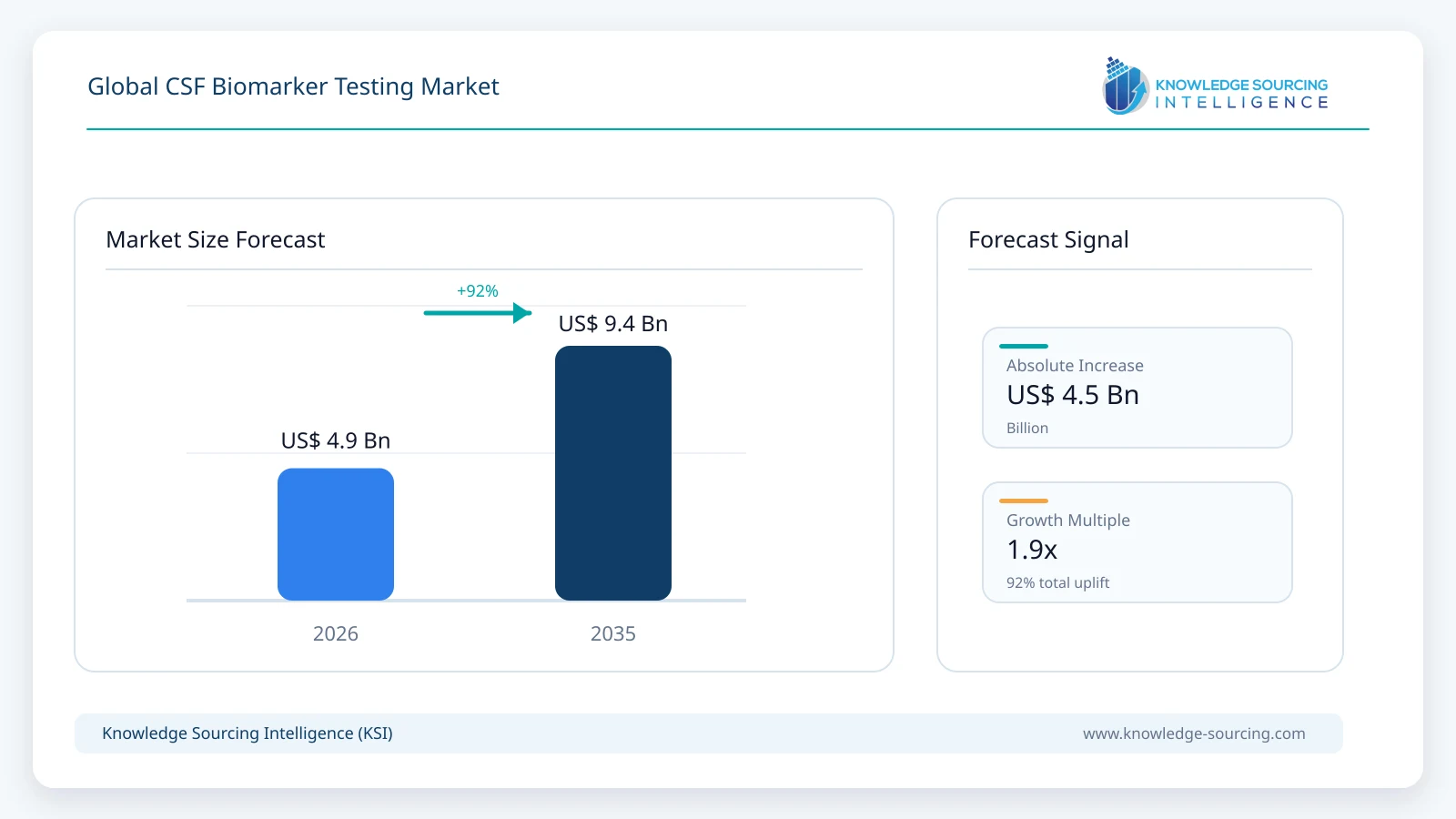
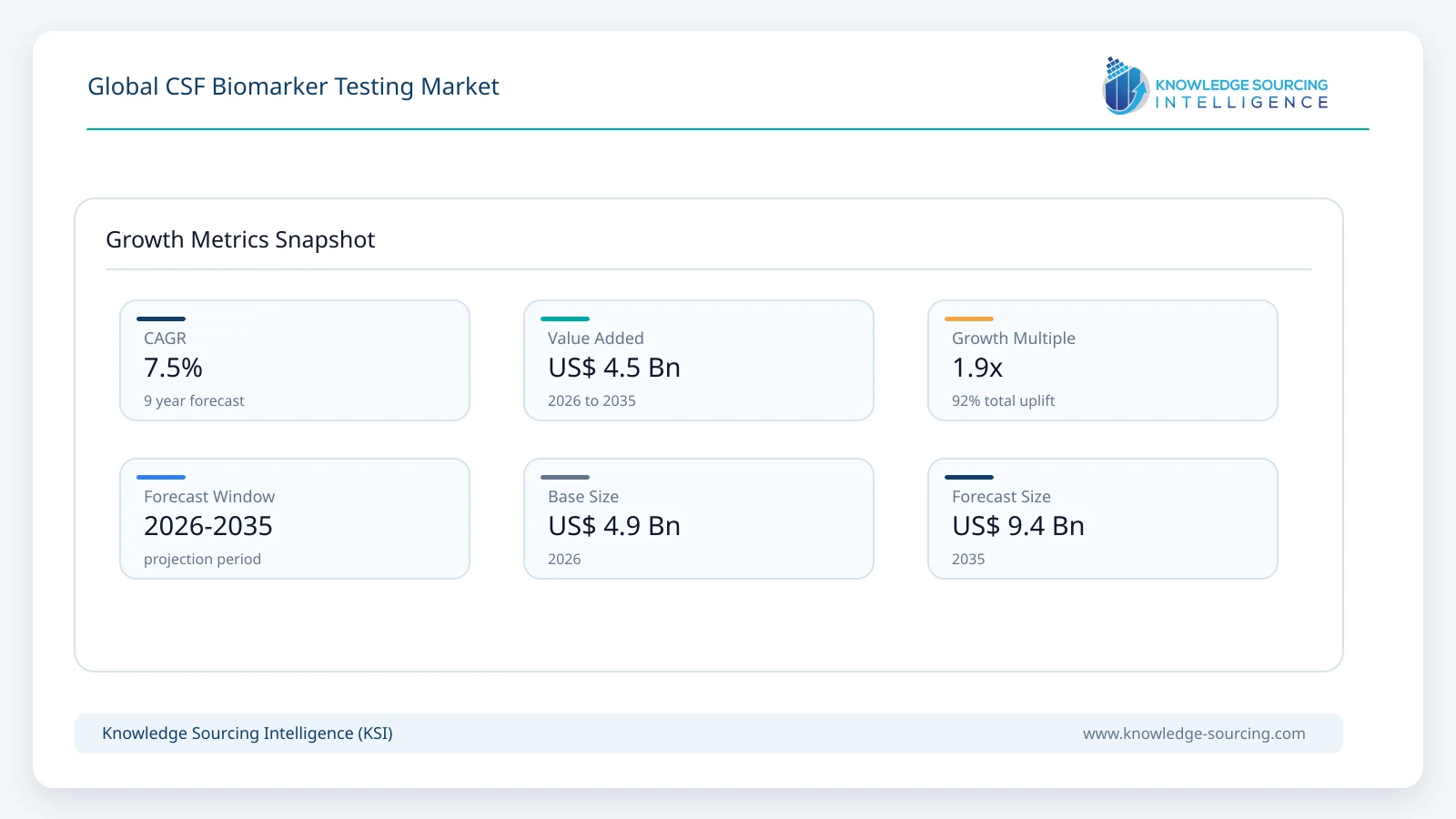
The Global CSF Biomarker Testing Market is set to reach USD 9.45 billion in 2035, growing at a CAGR of 7.5 % from USD 4.91 billion in 2026.
Highlights:
- 1Disease-modifying neurological therapies are increasing demand for biomarker-confirmed diagnoses.
- 2Alzheimer's disease testing is accelerating adoption of amyloid and tau biomarker assays.
- 3Clinical research programs are expanding utilization of CSF biomarkers for patient stratification.
- 4High-sensitivity assay technologies are improving diagnostic performance and laboratory efficiency.
CSF biomarker testing analyzes biological molecules present within cerebrospinal fluid to support diagnosis, prognosis, disease monitoring, and therapeutic decision-making across neurological disorders. Healthcare professionals utilize CSF biomarkers because pathological changes often appear within cerebrospinal fluid before extensive clinical manifestations emerge.
Neurological disease management increasingly depends on biomarker confirmation because neurodegenerative disorders frequently present with overlapping symptoms that complicate traditional diagnosis. CSF biomarker testing addresses this challenge because objective molecular evidence improves diagnostic confidence and disease characterization.
Healthcare systems are expanding biomarker-based diagnostic strategies because disease-modifying therapies increasingly require biological confirmation of pathology. Laboratories are adopting advanced testing platforms because clinicians need accurate and reproducible biomarker measurements to guide treatment decisions.
Strategic importance continues increasing because precision neurology depends on measurable indicators of disease biology. CSF biomarker testing therefore serves as a foundational component of modern neurodegenerative disease management.
Market Dynamics
Market Drivers
Expansion of Alzheimer's Disease Biomarker-Based Diagnosis
Alzheimer's disease diagnosis increasingly relies on biological confirmation because therapeutic intervention strategies require accurate identification of underlying pathology. Healthcare providers are adopting CSF biomarker testing because amyloid beta and tau measurements improve diagnostic certainty. This trend strengthens market demand.
Growth of Disease-Modifying Neurological Therapies
Neurological treatment strategies increasingly depend on biomarker validation because targeted therapies require identification of appropriate patient populations. Clinicians are expanding biomarker utilization because biological evidence improves treatment selection. This development accelerates testing adoption.
Increasing Focus on Early Disease Detection
Healthcare systems prioritize earlier neurological intervention because treatment effectiveness often declines as disease progresses. Diagnostic centers are implementing advanced biomarker testing because molecular changes frequently emerge before substantial clinical deterioration occurs. This shift supports market growth.
Advancements in Assay Sensitivity
Technology developers continue improving analytical performance because clinicians require highly accurate biomarker measurements. Laboratories are adopting advanced testing platforms because enhanced sensitivity improves disease detection capabilities. This trend supports broader implementation.
Market Restraints
Lumbar puncture requirements limit patient acceptance in some clinical settings.
Standardization challenges create variability across laboratories and testing platforms.
Reimbursement policies remain inconsistent across healthcare systems and biomarker indications.
Market Opportunities
Expansion of Precision Neurology Programs
Precision neurology increasingly depends on objective disease characterization because therapeutic decision-making requires measurable biological evidence. Healthcare organizations are expanding biomarker testing infrastructure because personalized treatment approaches continue advancing. This opportunity supports long-term growth.
Growth in Neurodegenerative Disease Research
Research organizations continue investigating novel neurological biomarkers because unmet diagnostic needs remain substantial. Pharmaceutical companies are increasing biomarker integration because clinical development programs require robust patient stratification strategies. This trend creates significant opportunities.
Adoption of Multiplex Biomarker Testing
Laboratories increasingly seek comprehensive disease assessment because multiple pathological pathways contribute to neurological disorders. Developers are introducing multiplex assays because simultaneous biomarker evaluation improves diagnostic efficiency. This development strengthens market expansion.
Increasing Biomarker Regulatory Recognition
Regulatory agencies increasingly recognize biomarker-supported diagnostics because objective disease measurement improves clinical outcomes. Diagnostic manufacturers are expanding biomarker portfolios because regulatory acceptance supports broader clinical adoption. This opportunity accelerates market development.
Disease & Epidemiology Analysis
Neurodegenerative diseases continue generating substantial demand for CSF biomarker testing because accurate diagnosis remains essential for treatment selection and disease management. Healthcare providers increasingly require biological confirmation because neurological symptoms frequently overlap across disease categories.
Alzheimer's disease represents the largest application area because amyloid beta and tau pathology play central roles in disease diagnosis and classification. Clinicians increasingly incorporate CSF biomarkers into diagnostic pathways because emerging therapies require confirmation of disease biology before treatment initiation.
Parkinson's disease, frontotemporal dementia, amyotrophic lateral sclerosis, and multiple sclerosis also contribute to testing demand because biomarker discovery efforts continue improving disease characterization. Research institutions are expanding biomarker utilization because objective measurements support therapeutic development and clinical trial efficiency.
According to the World Health Organization, dementia affects millions of individuals globally and continues representing a major public health challenge.
The Alzheimer's Association continues emphasizing biomarker-supported diagnosis because biological confirmation increasingly influences treatment planning and patient management.
Treatment Guidelines Landscape
Clinical Area | Current Direction | Demand Impact |
Alzheimer's Disease | Biomarker-confirmed diagnosis | Expands amyloid and tau testing |
Parkinson’s Disease | Biomarker discovery integration | Supports novel assay development |
Frontotemporal Dementia | Differential diagnostic assessment | Increases specialized biomarker demand |
Multiple Sclerosis | Disease activity evaluation | Strengthens inflammatory biomarker utilization |
Precision Neurology | Biomarker-guided treatment selection | Expands testing adoption |
Market Segmentation
By Biomarker Type
Amyloid beta biomarkers represent a major segment because clinicians require objective assessment of Alzheimer's disease pathology. Tau and phosphorylated tau biomarkers continue generating strong demand because they support disease classification and progression assessment. Neurofilament light chain biomarkers are gaining adoption because neuronal injury measurement provides valuable clinical information across multiple neurological disorders. Alpha-synuclein and inflammatory biomarkers continue attracting research interest because disease-specific biological characterization remains a major clinical priority.
By Disease Indication
Alzheimer's disease accounts for the largest share of testing demand because biomarker-supported diagnosis increasingly influences therapeutic decision-making. Parkinson's disease continues driving research and clinical interest because biomarker development may improve diagnostic precision. Multiple sclerosis, frontotemporal dementia, amyotrophic lateral sclerosis, and prion diseases support growing utilization because objective molecular assessment improves disease characterization and monitoring. Broader neurological disorder applications continue emerging because biomarker discovery remains highly active.
By Technology
ELISA platforms maintain substantial utilization because laboratories require reliable and established biomarker testing methodologies. Chemiluminescence immunoassays continue expanding because automation improves workflow efficiency and throughput. Mass spectrometry is gaining importance because highly specific biomarker quantification supports advanced neurological diagnostics. PCR-based technologies contribute to specialized applications because molecular testing continues evolving. Multiplex biomarker assays strengthen adoption because simultaneous analysis improves laboratory productivity and clinical utility.
Regional Analysis
North America
North America leads the CSF biomarker testing market because healthcare systems actively implement precision neurology initiatives. Academic medical centers are expanding biomarker-supported diagnostic programs because disease-modifying neurological therapies increasingly require biological confirmation. Diagnostic laboratories strengthen testing capabilities because healthcare providers demand standardized and scalable biomarker solutions. Pharmaceutical companies continue integrating biomarkers into clinical development programs because patient stratification improves therapeutic evaluation. These factors support regional market leadership.
Europe
European healthcare providers increasingly adopt biomarker-based diagnostics because neurological disease burden continues increasing across aging populations. Hospitals strengthen neurodegenerative disease assessment capabilities because earlier diagnosis improves patient management opportunities. Research institutions expand biomarker validation programs because regulatory and clinical communities increasingly recognize biological disease characterization. Diagnostic laboratories implement advanced assay technologies because healthcare systems require consistent testing performance. These developments support sustained market expansion.
Asia Pacific
Asia Pacific demonstrates strong growth potential because healthcare modernization continues accelerating across major economies. Neurology centers increase biomarker testing adoption because awareness of neurodegenerative disease diagnosis continues improving. Research organizations expand neuroscience programs because governments increasingly support innovation and precision medicine development. Diagnostic laboratories strengthen advanced testing infrastructure because healthcare demand continues rising. These trends create substantial opportunities for market participants.
Rest of the World
Healthcare systems across Latin America, the Middle East, and Africa continue improving neurological diagnostic capabilities because neurodegenerative diseases create growing healthcare challenges. Academic institutions increase biomarker research activity because disease characterization remains a strategic priority. Diagnostic providers expand specialized testing services because clinicians increasingly seek objective neurological assessment tools. These developments support gradual market advancement.
Regulatory Landscape
Regulatory agencies increasingly evaluate biomarker-based diagnostics because neurological treatment decisions increasingly depend on objective disease confirmation. Authorities focus on analytical validity, clinical utility, and laboratory performance because biomarker testing directly influences patient management.
The U.S. Food and Drug Administration continues supporting the development of innovative diagnostic technologies that improve disease characterization and treatment selection.
European regulatory authorities emphasize assay standardization, clinical validation, and quality assurance because healthcare providers require reliable biomarker measurements across diverse clinical settings. These requirements support broader adoption while maintaining diagnostic confidence.
Pipeline Analysis
Diagnostic companies continue developing next-generation biomarker assays because clinicians require earlier and more accurate neurological disease detection. Research programs increasingly focus on novel biomarkers because current diagnostic tools do not fully characterize disease heterogeneity.
Developers are advancing ultra-sensitive analytical platforms because low-abundance biomarker detection improves clinical utility. Companies continue enhancing multiplex testing capabilities because simultaneous evaluation of multiple pathological pathways supports comprehensive disease assessment.
Research institutions are validating new biomarkers associated with neurodegeneration, inflammation, and synaptic dysfunction because precision neurology increasingly depends on biological disease classification. These innovations are expanding future diagnostic opportunities across multiple neurological disorders.
Reimbursement Landscape
Healthcare payers increasingly recognize the value of biomarker-supported diagnosis because accurate disease identification improves treatment selection and healthcare resource utilization. Specialized neurological centers continue utilizing CSF biomarker testing because clinical evidence supporting diagnostic utility continues strengthening.
Coverage expansion is occurring for selected biomarker applications because disease-modifying therapies increasingly require objective confirmation of pathology before treatment initiation. Reimbursement variability nevertheless persists because healthcare systems continue evaluating evidence requirements and cost-effectiveness considerations.
Competitive Landscape
Fujirebio Holdings, Inc.
Fujirebio holds a leading position in neurological biomarker diagnostics through its extensive portfolio of Alzheimer's disease testing solutions. The company expands biomarker innovation because demand for precision neurology continues increasing.
Roche Diagnostics International AG
Roche Diagnostics leverages automated diagnostics expertise to strengthen neurological biomarker testing capabilities. The company develops scalable laboratory solutions because healthcare systems increasingly require standardized testing workflows.
Quanterix Corporation
Quanterix specializes in ultra-sensitive biomarker detection technologies that support advanced neurological research and clinical applications. The company strengthens analytical performance because early disease detection requires highly sensitive assays.
Revvity, Inc.
Revvity supports neurological biomarker development through advanced assay technologies and research-focused diagnostic solutions. The company expands neuroscience capabilities because biomarker discovery remains a major healthcare priority.
Bio-Techne Corporation
Bio-Techne provides specialized biomarker analysis tools supporting neurological research and diagnostic applications. The company strengthens assay innovation because clinicians increasingly require precise molecular characterization.
Danaher Corporation
Danaher supports neurological diagnostics through broad life sciences and diagnostic technology capabilities. The company advances biomarker testing infrastructure because precision medicine adoption continues accelerating.
Sysmex Corporation
Sysmex expands diagnostic innovation through advanced laboratory technologies supporting biomarker analysis. The company strengthens neurological testing capabilities because healthcare providers increasingly adopt biomarker-based diagnostics.
Abbott Laboratories
Abbott leverages extensive diagnostic expertise to support neurological disease assessment. The company develops advanced analytical platforms because demand for reliable and scalable biomarker testing continues increasing.
Thermo Fisher Scientific Inc.
Thermo Fisher Scientific provides comprehensive laboratory technologies supporting biomarker discovery and clinical testing. The company strengthens neuroscience-focused solutions because research activity continues expanding.
Beckman Coulter, Inc.
Beckman Coulter focuses on laboratory automation and diagnostic innovation supporting neurological biomarker workflows. The company enhances testing efficiency because healthcare systems increasingly require high-throughput diagnostic capabilities.
Key Developments
January 2026: Fujirebio expanded neurodegenerative biomarker testing capabilities supporting Alzheimer's disease diagnostics.
December 2025: Roche Diagnostics strengthened automated biomarker assay solutions for neurological disease assessment.
November 2025: Quanterix advanced ultra-sensitive biomarker detection technologies supporting precision neurology.
October 2025: Revvity expanded neuroscience research assay capabilities supporting biomarker discovery programs.
Strategic Insights and Future Market Outlook
CSF biomarker testing is becoming increasingly central to neurological disease management because precision medicine approaches require objective biological evidence. Healthcare providers continue expanding biomarker-supported diagnostics because emerging therapies depend on accurate disease characterization and patient selection.
Assay sensitivity, automation, and standardization will remain major competitive differentiators because healthcare systems require scalable and reproducible testing solutions. Diagnostic companies are strengthening analytical capabilities because broader clinical adoption depends on consistent performance across laboratories.
Neurodegenerative disease therapeutics will continue accelerating biomarker utilization because treatment eligibility increasingly depends on confirmed pathology. Research organizations and healthcare providers continue investing in biomarker infrastructure because biological classification is becoming a foundation of modern neurology.
The CSF biomarker testing market will continue evolving toward highly standardized, biomarker-driven neurological care pathways. Advanced analytical technologies, precision medicine initiatives, expanding neurodegenerative disease research, and increasing regulatory acceptance will drive long-term demand across diagnostic laboratories, academic institutions, specialty neurology centers, and pharmaceutical development programs worldwide.
Global CSF Biomarker Testing Market Scope:
| Report Metric | Details |
|---|---|
| Total Market Size in 2026 | USD 4.91 billion |
| Total Market Size in 2035 | USD 9.45 billion |
| Forecast Unit | USD Billion |
| Growth Rate | 7.5% |
| Study Period | 2021 to 2035 |
| Historical Data | 2021 to 2024 |
| Base Year | 2025 |
| Forecast Period | 2026 – 2035 |
| Segmentation | Biomarker Type, Disease Indication, Technology, Geography |
| Companies |
|
Market Segmentation
By Biomarker Type
- Amyloid Beta Biomarkers
- Tau Protein Biomarkers
- Phosphorylated Tau Biomarkers
- Neurofilament Light Chain Biomarkers
- Alpha-Synuclein Biomarkers
- Inflammatory Biomarkers
- Other CSF Biomarkers
By Disease Indication
- Alzheimer’s Disease
- Parkinson’s Disease
- Multiple Sclerosis
- Frontotemporal Dementia
- Amyotrophic Lateral Sclerosis
- Prion Diseases
- Other Neurological Disorders
By Technology
- Enzyme-Linked Immunosorbent Assay (ELISA)
- Chemiluminescence Immunoassay
- Mass Spectrometry
- Polymerase Chain Reaction-Based Testing
- Multiplex Biomarker Assays
By End User
- Hospitals
- Diagnostic Laboratories
- Academic and Research Institutes
- Specialty Neurology Centers
- Pharmaceutical and Biotechnology Companies
By Geography
- North America
- Europe
- Asia-Pacific
- Latin America
- Middle East & Africa
Table of Contents
1.EXECUTIVE SUMMARY
1.1 Global CSF Biomarker Testing Market Scope and Objectives
1.2 Key Market Insights and Strategic Highlights
1.3 CSF Biomarker Testing Volume and Adoption Trends
1.4 Market Growth Outlook and Revenue Forecast
1.5 Strategic Conclusions
2.GLOBAL CSF BIOMARKER TESTING MARKET OVERVIEW
2.1 Definition and Scope of Global CSF Biomarker Testing Market
2.2 Global CSF Biomarker Testing Market Size Analysis 2021–2024
2.3 Global CSF Biomarker Testing Market Size Forecast 2025–2035
2.4 Market Drivers
2.4.1 Rising Prevalence of Neurodegenerative Disorders
2.4.2 Growing Demand for Early and Accurate Neurological Diagnosis
2.4.3 Increasing Adoption of Biomarker-Based Precision Medicine
2.4.4 Expanding Clinical Utility of CSF Biomarker Testing
2.5 Market Restraints
2.5.1 Invasive Nature of Lumbar Puncture Procedures
2.5.2 Limited Reimbursement Coverage in Certain Regions
2.5.3 Variability in Testing Standardization and Interpretation
2.6 Market Opportunities
2.6.1 Expansion of Alzheimer's Disease Diagnostic Programs
2.6.2 Development of Novel Neurological Biomarkers
2.6.3 Growth of Companion Diagnostics and Clinical Research Applications
2.7 Global CSF Biomarker Testing Market Segmentation
2.7.1 By Biomarker Type
2.7.1.1 Amyloid Beta Biomarkers
2.7.1.2 Tau Protein Biomarkers
2.7.1.3 Phosphorylated Tau Biomarkers
2.7.1.4 Neurofilament Light Chain Biomarkers
2.7.1.5 Alpha-Synuclein Biomarkers
2.7.1.6 Inflammatory Biomarkers
2.7.1.7 Other CSF Biomarkers
2.7.2 By Disease Indication
2.7.2.1 Alzheimer's Disease
2.7.2.2 Parkinson’s Disease
2.7.2.3 Multiple Sclerosis
2.7.2.4 Frontotemporal Dementia
2.7.2.5 Amyotrophic Lateral Sclerosis
2.7.2.6 Prion Diseases
2.7.2.7 Other Neurological Disorders
2.7.3 By Technology
2.7.3.1 Enzyme-Linked Immunosorbent Assay (ELISA)
2.7.3.2 Chemiluminescence Immunoassay
2.7.3.3 Mass Spectrometry
2.7.3.4 Polymerase Chain Reaction-Based Testing
2.7.3.5 Multiplex Biomarker Assays
2.7.4 By End User
2.7.4.1 Hospitals
2.7.4.2 Diagnostic Laboratories
2.7.4.3 Academic and Research Institutes
2.7.4.4 Specialty Neurology Centers
2.7.4.5 Pharmaceutical and Biotechnology Companies
3.NEUROLOGICAL DISEASE EPIDEMIOLOGY AND BIOMARKER TESTING DEMAND ANALYSIS
3.1 Global Burden of Neurodegenerative Disorders
3.2 Alzheimer's Disease Epidemiology
3.3 Parkinson’s Disease Epidemiology
3.4 Multiple Sclerosis Epidemiology
3.5 Rare Neurological Disease Burden
3.6 Forecast of CSF Biomarker Testing Volumes
4.DISEASE AND UNMET NEED ANALYSIS
4.1 Need for Early Diagnosis of Neurodegenerative Disorders
4.2 Challenges in Differential Diagnosis of Dementias
4.3 Need for Reliable Prognostic and Predictive Biomarkers
4.4 Limitations of Conventional Diagnostic Approaches
4.5 Unmet Need in Precision Neurology
5.Technology and Innovation Landscape
5.1 Evolution of CSF Biomarker Testing Technologies
5.2 Biomarker Discovery and Validation Trends
5.3 High-Sensitivity Assay Development
5.4 Multiplex Testing Technology Analysis
5.5 Artificial Intelligence and Biomarker Analytics
5.6 Companion Diagnostic Development Trends
5.7 Comparative Performance and Clinical Utility Analysis
6.CLINICAL AND COMMERCIAL INTELLIGENCE
6.1 Clinical Guideline Positioning
6.2 CSF Biomarker Testing Utilization Trends
6.3 Comparative Effectiveness Benchmarking
6.4 Pricing Trends and Reimbursement Dynamics
6.5 Market Share Analysis by Biomarker Type
6.6 Laboratory Adoption Trends
6.7 Lifecycle Management Strategies
6.8 Regulatory Approval and Compliance Analysis
7.PRODUCT BENCHMARKING
7.1 Alzheimer's Disease Biomarker Assay Benchmarking
7.2 Parkinson’s Disease Biomarker Assay Benchmarking
7.3 Multiplex Biomarker Panel Benchmarking
7.4 Automated Testing Platform Benchmarking
7.5 Companion Diagnostic Solution Benchmarking
7.6 Competitive Differentiation Analysis
8.MARKET FORECAST AND RISK ANALYSIS
8.1 Revenue Forecast Modeling
8.2 CSF Biomarker Testing Volume Forecast
8.3 Technology Adoption Forecast
8.4 Pricing and Reimbursement Sensitivity Analysis
8.5 Key Risk Factors
8.5.1 Regulatory and Approval Risks
8.5.2 Reimbursement Risks
8.5.3 Clinical Adoption Risks
8.5.4 Testing Standardization Risks
8.6 Sensitivity and Scenario Analysis
9.COMPETITIVE LANDSCAPE
9.1 Market Share by Company
9.2 Competitive Positioning of CSF Biomarker Testing Solutions
9.3 Innovation and Patent Landscape Analysis
9.4 Product Portfolio Breadth Analysis
9.5 Strategic Collaborations and Partnerships
9.6 Mergers, Acquisitions, and Investment Activity
10.GEOGRAPHIC ANALYSIS
10.1 North America
10.2 Europe
10.3 Asia-Pacific
10.4 Latin America
10.5 Middle East and Africa
11.KEY COUNTRIES ANALYSIS
11.1 United States
11.2 Canada
11.3 Germany
11.4 United Kingdom
11.5 France
11.6 Italy
11.7 Spain
11.8 China
11.9 Japan
11.10 India
11.11 South Korea
11.12 Australia
11.13 Brazil
11.14 Mexico
11.15 Saudi Arabia
11.16 South Africa
12.COMPANY PROFILES
12.1 Fujirebio Holdings, Inc.
12.1.1 Overview
12.1.2 Financials
12.1.3 Product Portfolio
12.1.4 Recent Developments
12.2 Roche Diagnostics International AG
12.2.1 Overview
12.2.2 Financials
12.2.3 Product Portfolio
12.2.4 Recent Developments
12.3 Quanterix Corporation
12.3.1 Overview
12.3.2 Financials
12.3.3 Product Portfolio
12.3.4 Recent Developments
12.4 Revvity, Inc.
12.4.1 Overview
12.4.2 Financials
12.4.3 Product Portfolio
12.4.4 Recent Developments
12.5 Bio-Techne Corporation
12.5.1 Overview
12.5.2 Financials
12.5.3 Product Portfolio
12.5.4 Recent Developments
12.6 Danaher Corporation
12.6.1 Overview
12.6.2 Financials
12.6.3 Product Portfolio
12.6.4 Recent Developments
12.7 Sysmex Corporation
12.7.1 Overview
12.7.2 Financials
12.7.3 Product Portfolio
12.7.4 Recent Developments
12.8 Abbott Laboratories
12.8.1 Overview
12.8.2 Financials
12.8.3 Product Portfolio
12.8.4 Recent Developments
12.9 Thermo Fisher Scientific Inc.
12.9.1 Overview
12.9.2 Financials
12.9.3 Product Portfolio
12.9.4 Recent Developments
12.10 Beckman Coulter, Inc.
12.10.1 Overview
12.10.2 Financials
12.10.3 Product Portfolio
12.10.4 Recent Developments
13.FUTURE OUTLOOK AND STRATEGIC INSIGHTS
13.1 Expansion of Biomarker-Based Neurological Diagnostics
13.2 Growth of Precision Medicine in Neurodegenerative Diseases
13.3 Increasing Integration with Disease-Modifying Therapy Selection
13.4 Opportunities in Novel Biomarker Discovery and Companion Diagnostics
13.5 Strategic Recommendations
14.METHODOLOGY AND DATA FRAMEWORK
14.1 Data Sources
14.2 Epidemiology and Testing Volume Modeling Approach
14.3 Market Sizing and Forecasting Methodology
14.4 Competitive Benchmarking Framework
14.5 Assumptions and Limitations
Navigate
Trusted by the world's leading organizations











