
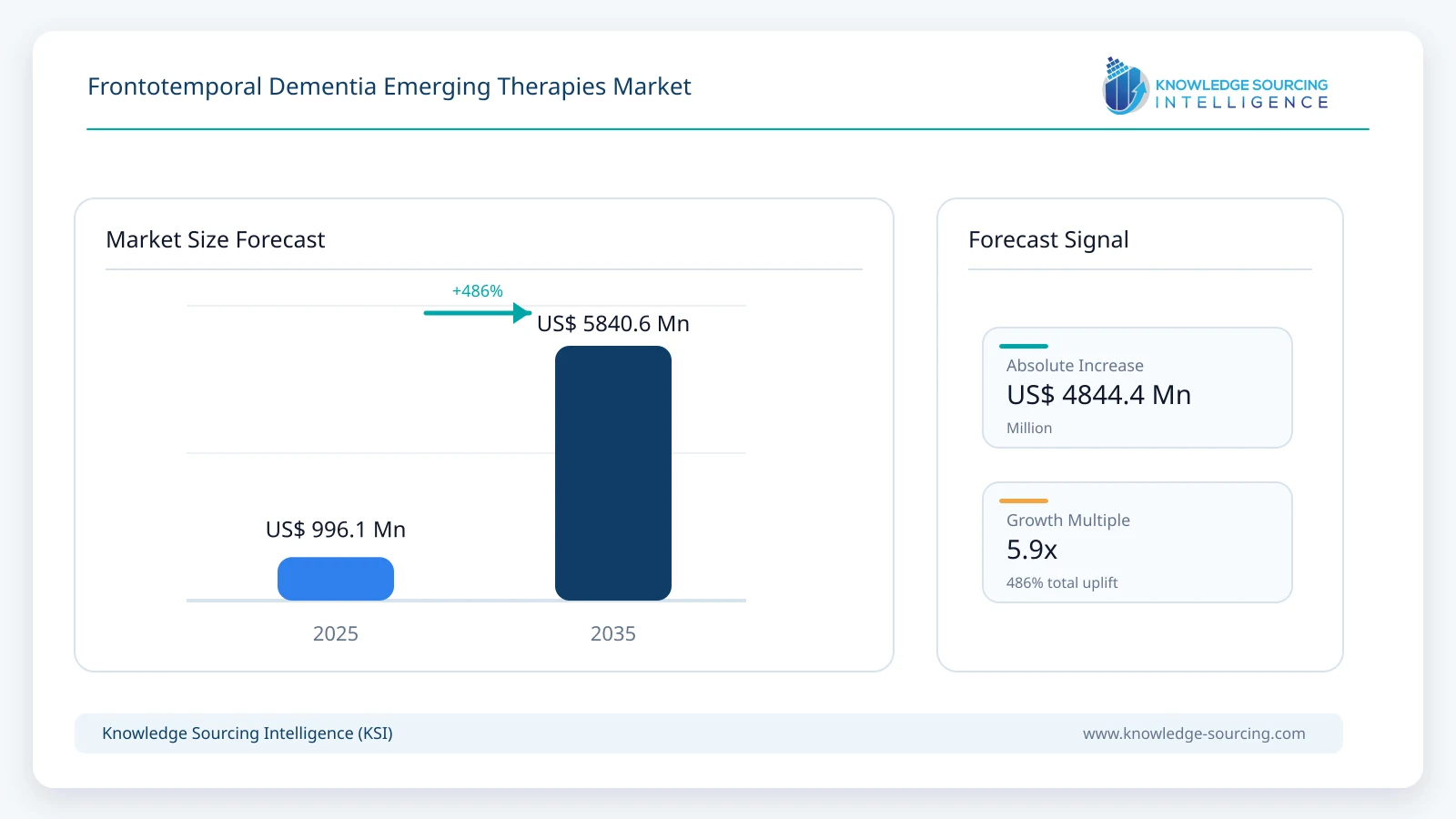
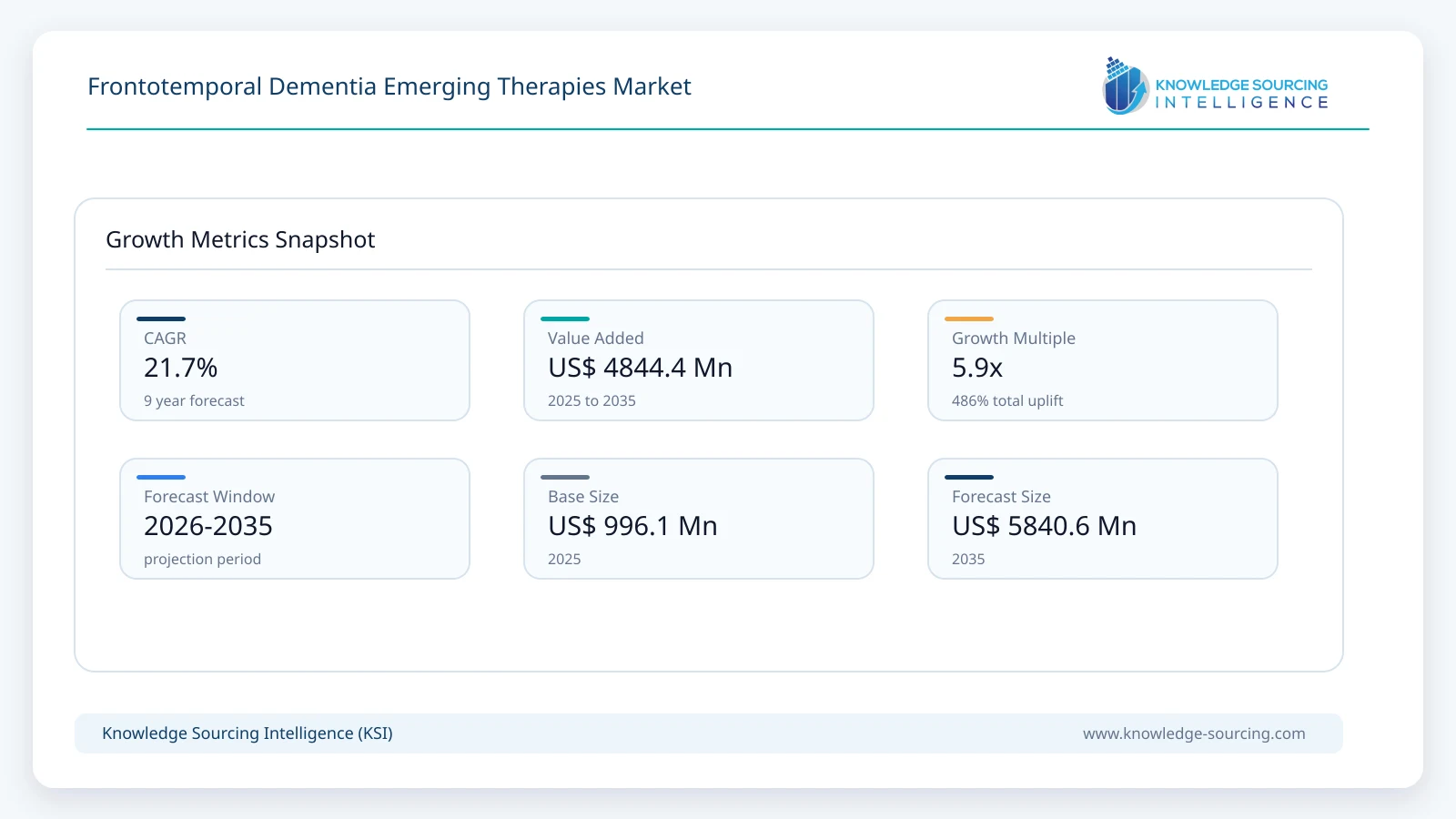
The Frontotemporal Dementia Emerging Therapies Analysis is predicted to grow from USD 996.149 million in 2026 growing at a CAGR of 21.7% making up USD 5,840.59 million in 2035.
Highlights:
- 1Expanded genetic testing is increasing identification of GRN mutation carriers, which is strengthening demand for targeted therapies.
- 2Precision medicine programs are advancing because conventional symptomatic treatments fail to address disease biology.
- 3Gene therapy development is accelerating, which is increasing investment in genetically defined FTD populations.
- 4Biomarker-driven clinical trials are expanding because developers require objective measures of disease progression.
FTD treatment demand originates from progressive neurodegeneration that causes behavioral, language, and executive function impairment. Recognition of genetic drivers is increasing because clinicians are identifying a larger proportion of familial disease cases through expanded testing programs. Conventional symptomatic management provides limited disease control, which maintains demand for disease-modifying interventions. Drug developers are directing resources toward biologically validated targets because previous neurodegenerative programs frequently failed due to inadequate target engagement. The treatment landscape consequently favors mechanism-driven development strategies.
Regulatory agencies are supporting rare neurodegenerative disease research through accelerated pathways because treatment options remain limited. Clinical development increasingly depends on biomarker validation, which creates demand for longitudinal natural history studies and genetically characterized patient registries. Healthcare systems are expanding specialist diagnostic networks to support trial recruitment and future treatment deployment. This infrastructure expansion strengthens the foundation for targeted therapeutic adoption.
Market Dynamics
Market Drivers
Expansion of Genetic Diagnosis: Genetic characterization enables precise identification of disease-causing mutations. Testing utilization is increasing because hereditary FTD populations are becoming easier to identify. Limited awareness still restricts diagnosis rates in many healthcare systems. Clinical centers are expanding genetic counseling capabilities to address this limitation. Precision treatment development therefore becomes increasingly feasible.
Demand for Disease-Modifying Therapies: Symptomatic treatment does not halt neurodegeneration. Patient advocacy groups are increasing pressure for transformative interventions. Clinical risk remains high because neurological endpoints are difficult to measure. Developers are integrating biomarkers into trial designs to improve decision-making. Therapeutic innovation therefore continues shifting toward biologically targeted approaches.
Growth of Biomarker-Based Development: Clinical outcomes often require lengthy observation periods. Biomarker adoption is increasing because developers seek earlier indications of therapeutic activity. Validation requirements remain demanding. Research institutions are expanding longitudinal studies to establish biomarker utility. Drug development efficiency consequently improves.
Regulatory Support for Rare Neurological Disorders: Rare disease frameworks create incentives for innovation. Sponsors are increasingly pursuing orphan and expedited development pathways. Scientific uncertainty remains a challenge. Regulatory agencies are supporting frequent sponsor engagement. Development timelines therefore become more predictable.
Market Restraints
Clinical endpoint variability limits confidence in therapeutic efficacy assessments.
Small genetically defined patient populations restrict recruitment speed.
High development costs create substantial financial risk for sponsors.
Market Opportunities
Progranulin Restoration Therapies: Reduced progranulin levels drive disease in FTD-GRN populations. Interest is increasing because genetic causality provides strong biological validation. Clinical proof remains limited. Developers are refining restoration strategies through antibodies and gene therapies. Targeted intervention therefore remains a major opportunity.
Gene Therapy Expansion: One-time treatment approaches offer potential long-term benefit. Investment is increasing because durable biological correction may improve outcomes. Manufacturing complexity remains significant. Companies are optimizing delivery platforms. Gene therapy therefore continues attracting strategic interest.
RNA Therapeutics: Gene regulation approaches enable targeted intervention. Research activity is increasing because RNA technologies support precision medicine. Delivery challenges remain important. Technology platforms are improving tissue targeting capabilities. Clinical applicability therefore expands.
Disease & Epidemiology Analysis
FTD creates substantial treatment demand because progressive neuronal loss causes irreversible functional decline. Earlier diagnosis is increasing as genetic testing and specialist referrals become more common. Diagnostic delays remain frequent because symptoms often resemble psychiatric disorders. Healthcare providers are adopting multidisciplinary assessment frameworks to improve identification. The diagnosed treatment-eligible population therefore continues expanding.
Behavioral variant FTD represents the largest treatment population because behavioral symptoms frequently prompt medical evaluation. Recognition is increasing among neurologists and psychiatrists. Disease heterogeneity complicates therapeutic development. Clinical researchers are focusing on genetically defined subgroups to reduce variability. Precision trials therefore become increasingly important.
Treatment Guidelines Landscape
Treatment Component | Current Practice |
Initial Evaluation | Neurological and neuropsychological assessment |
Structural Imaging | MRI |
Functional Imaging | FDG-PET when appropriate |
Genetic Assessment | Recommended for familial cases |
Market Segmentation
By Mechanism of Action
Progranulin deficiency directly contributes to FTD-GRN pathology. Development activity is increasing because the target possesses strong genetic validation. Clinical uncertainty remains after mixed outcomes from some antibody programs. Companies are expanding gene replacement and protein restoration approaches. The segment therefore remains a central focus of innovation.
Tau-targeted therapies continue attracting interest because tau pathology contributes to several FTD subtypes. Translational challenges remain significant because clinical efficacy has proven difficult to demonstrate. Developers are refining anti-tau antibodies and gene regulation strategies to improve target engagement. Precision biomarker use is increasing to support patient selection. Tau modulation therefore remains an important component of the emerging treatment landscape.
Neuroinflammation modulators are gaining prominence because microglial dysfunction influences disease progression. Research activity is increasing as immune-mediated mechanisms become better understood. Biological complexity continues creating development risk. Companies are pursuing selective immune pathway modulation to improve therapeutic specificity. Neuroimmune interventions therefore represent a growing area of innovation.
By Modality
Monoclonal antibody development remains active because biologics provide selective target engagement. Development activity expanded as progranulin restoration and neuroimmune modulation gained importance. Blood-brain barrier limitations continue constraining efficacy. Companies are improving molecular engineering strategies to enhance central nervous system penetration. Antibody-based therapies therefore remain a key modality within the pipeline.
Gene therapies are attracting increasing investment because they offer the potential for long-term correction of underlying genetic defects. Manufacturing complexity and delivery challenges remain substantial barriers. Developers are advancing viral vector technologies to improve precision targeting. Clinical programs increasingly focus on genetically defined patient populations. Gene therapy therefore continues emerging as one of the most promising modalities in FTD treatment development.
RNA therapeutics are advancing because they provide highly specific gene regulation capabilities. Delivery limitations continue affecting development feasibility. Platform innovation is improving tissue targeting and therapeutic durability. Researchers are expanding investigation of antisense oligonucleotides and RNA interference technologies. RNA-based interventions therefore are becoming increasingly relevant to future treatment strategies.
By Innovation Category
First-in-class assets continue attracting attention because they target previously unaddressed biological pathways. Scientific uncertainty remains elevated due to limited historical precedent. Developers are emphasizing biomarker validation to strengthen confidence in target engagement. Precision patient selection is becoming increasingly important for development success. Innovation therefore increasingly centers on genetically characterized disease populations.
Platform-based innovation is expanding because companies seek scalable approaches across multiple neurodegenerative diseases. Development strategies increasingly leverage shared delivery technologies and biomarker frameworks. Regulatory expectations continue evolving as novel modalities mature. Clinical programs are integrating translational evidence earlier in development. Platform technologies therefore are becoming critical competitive differentiators.
Regional Analysis
North America
North America leads FTD treatment development because the region combines advanced neuroscience infrastructure with extensive rare disease research funding. Genetic diagnosis rates are increasing as specialist centers expand testing programs. Recruitment challenges persist because eligible patient populations remain relatively small. Sponsors are strengthening collaborations with academic institutions to improve enrollment efficiency. Clinical trial density therefore remains higher than in other regions. Regulatory engagement continues supporting innovation because agencies recognize the lack of disease-modifying therapies. Biotech companies are increasingly prioritizing biomarker-driven studies to reduce development risk. This environment positions North America as the primary hub for FTD therapeutic innovation.
Europe
Europe maintains strong treatment development activity because multinational research networks support cross-border patient identification. Demand for targeted therapies is increasing as awareness of hereditary FTD expands. National reimbursement differences continue influencing diagnostic access. Research organizations are strengthening genomic medicine initiatives to improve patient stratification. Clinical recruitment therefore benefits from broader genetic screening efforts. Gene therapy development is receiving increasing attention because several European centers possess specialized neurosurgical capabilities. This concentration of expertise supports continued pipeline advancement.
Asia Pacific
Asia Pacific is experiencing rising interest in neurodegenerative disease research because healthcare systems are expanding neurological care capacity. Genetic diagnosis rates remain comparatively lower. Academic institutions are increasing investment in molecular neuroscience programs. International sponsors are expanding trial footprints to improve recruitment diversity. The region therefore is becoming more relevant to global development strategies.
Rest of the World
Emerging markets remain characterized by limited specialist infrastructure. Awareness is increasing because global advocacy organizations are improving educational outreach. Diagnostic limitations continue restricting patient identification. Healthcare providers are establishing referral networks to address access gaps. Treatment readiness therefore is gradually improving despite infrastructure constraints.
Regulatory Landscape
Regulators increasingly support rare neurological disease development because therapeutic options remain limited. Expedited pathways are becoming more important as sponsors pursue genetically targeted interventions. Clinical uncertainty still requires robust evidence generation. Developers are engaging regulators earlier in development programs. Regulatory predictability therefore improves.
Gene therapy oversight continues evolving because long-term safety monitoring remains essential. Sponsors are investing in extended follow-up programs. Manufacturing consistency remains a key requirement. Regulatory agencies are refining guidance frameworks. Development standards therefore continue maturing.
Pipeline Analysis
The FTD pipeline increasingly concentrates on progranulin restoration because GRN mutations provide one of the clearest biological targets in the disease. Antibody approaches initially attracted attention because they offered a scalable strategy for increasing progranulin levels. Clinical outcomes have remained challenging, which is redirecting interest toward gene replacement technologies. Developers are increasingly pursuing durable genetic correction approaches. Pipeline composition therefore is shifting toward advanced genetic medicines.
AVB-101 represents one of the most visible gene therapy programs because it seeks to restore GRN function through targeted brain delivery. Clinical development is progressing through ongoing studies. Long-term efficacy remains unproven. Investigators are expanding clinical evaluation to assess safety and biomarker responses. Development momentum therefore remains strong.
Emerging RNA and neuroinflammation-focused programs are gaining visibility because developers seek alternative approaches beyond traditional protein-targeting strategies. Scientific validation remains ongoing. Companies are integrating biomarker frameworks to improve development efficiency. Precision patient selection continues strengthening clinical trial design. The pipeline therefore is becoming increasingly diversified across therapeutic modalities.
Reimbursement Landscape
Current reimbursement primarily supports diagnostic services and symptomatic care because approved disease-modifying therapies remain unavailable. Genetic testing coverage is expanding as evidence supporting precision medicine grows. Budgetary constraints continue affecting adoption rates. Payers are evaluating long-term health economic implications of advanced therapies. Future reimbursement frameworks therefore are likely to depend heavily on demonstrated clinical durability and real-world outcomes.
Competitive Landscape
Alector
Alector differentiates itself through neuroimmunology-focused research. The company is emphasizing mechanisms that influence neurodegeneration and immune system interactions. Clinical development activities are supporting broader understanding of FTD biology. Biomarker integration remains a central component of its strategy. This focus positions the company as an important contributor to precision neurodegenerative medicine.
GSK
GSK maintains a strategic position through neuroscience collaborations and global development capabilities. The company is leveraging extensive clinical infrastructure to support neurodegenerative disease programs. Partnership-driven approaches strengthen access to emerging technologies. Development expertise supports large-scale clinical execution. GSK therefore remains a significant participant in future therapeutic advancement.
Passage Bio
Passage Bio focuses on genetic neurological disorders. Its strategy emphasizes gene therapy approaches that address underlying disease mechanisms rather than symptomatic management. Clinical development increasingly centers on genetically validated targets. Specialized expertise supports precision medicine initiatives. The company therefore remains strongly aligned with evolving treatment trends.
Denali Therapeutics
Denali Therapeutics concentrates on neurodegeneration with a strong emphasis on translational science. The company is developing approaches intended to improve therapeutic delivery into the central nervous system. Scientific innovation focuses on overcoming biological barriers. Precision targeting remains a strategic priority. This approach supports future participation in advanced neurological therapies.
Takeda
Takeda contributes substantial neurological research expertise. Its development capabilities support participation in rare disease and neurodegenerative therapeutic programs. Global infrastructure enables broad research collaboration. Scientific investment continues supporting innovation efforts. Takeda therefore maintains relevance within the evolving treatment landscape.
Prevail Therapeutics
Prevail Therapeutics focuses on gene therapy innovation. The company is pursuing genetically defined patient populations where precision medicine strategies may improve outcomes. Targeted intervention remains central to development efforts. Genetic disease expertise supports long-term innovation. The company therefore aligns closely with emerging therapeutic trends.
Vesper Bio
Vesper Bio emphasizes progranulin-related disease mechanisms. The company is developing targeted approaches intended to address biological pathways linked to FTD. Scientific focus remains concentrated on genetically validated targets. Development efforts seek to improve disease modification potential. This specialization strengthens its position within the emerging therapy ecosystem.
AviadoBio
AviadoBio focuses on gene therapy technologies designed for neurodegenerative diseases. Strategic differentiation stems from targeted delivery approaches and rare disease specialization. Clinical programs increasingly emphasize genetic correction strategies. Precision medicine remains central to development priorities. The company therefore occupies a prominent position within the gene therapy segment.
Strategic Insights and Future Market Outlook
The treatment landscape increasingly favors genetically targeted approaches because broad neurodegenerative interventions have produced inconsistent clinical outcomes. Patient identification is improving through expanded genetic testing. Small population sizes continue constraining recruitment. Developers are building specialized global trial networks. Precision medicine therefore becomes increasingly practical.
Gene therapy investment continues rising because durable correction of underlying genetic defects offers a compelling clinical rationale. Long-term efficacy remains uncertain. Developers are generating increasing amounts of biomarker data to strengthen confidence in biological activity. The evidence base therefore continues expanding.
Future competitive positioning will depend heavily on clinical validation of targeted mechanisms. Regulatory support remains favorable. Development risk continues influencing investment decisions. Companies capable of demonstrating durable biological correction and measurable clinical benefit are likely to shape the next phase of FTD treatment innovation.
The future FTD treatment environment is moving toward earlier diagnosis, biomarker-guided intervention, and genetically defined patient management. Clinical development challenges remain substantial, yet continued advances in gene therapy, RNA technologies, and precision neuroscience are strengthening the probability that disease-modifying treatment options will emerge during the forecast period.
Market Segmentation
Mechanism of Action
Modality
Innovation Category
Geography
- North America
- Latin America
- Europe
- Middle East and Africa
- Asia Pacific
Table of Contents
1. EXECUTIVE SUMMARY
1.1 Report Scope and Objectives
1.2 Frontotemporal Dementia Emerging Therapies Market Snapshot
1.3 Key Pipeline Intelligence Highlights
1.4 Major Innovation Trends
1.5 Emerging Therapeutic Modalities Overview
1.6 Clinical Development Outlook
1.7 Competitive Intelligence Summary
1.8 Risk-Adjusted Opportunity Assessment
1.9 Future Commercial and Clinical Outlook
2. PIPELINE OVERVIEW
2.1 Frontotemporal Dementia Therapeutic Landscape Overview
2.1.1 Disease Background
2.1.2 Current Standard of Care
2.1.3 Approved Therapy Landscape
2.1.4 Unmet Treatment Need Assessment
2.2 Emerging Therapy Pipeline Snapshot
2.2.1 Total Active Pipeline Assets
2.2.2 Active versus Discontinued Programs
2.2.3 Historical Pipeline Evolution
2.2.4 Development Stage Distribution
2.3 Pipeline Maturity Assessment
2.3.1 Early-Stage Asset Concentration
2.3.2 Mid-Stage Development Strength
2.3.3 Late-Stage Development Readiness
2.3.4 Historical Advancement Trends
2.4 Innovation Ecosystem Overview
2.4.1 Industry-Sponsored Programs
2.4.2 Academic Research Programs
2.4.3 Foundation-Supported Initiatives
2.4.4 Public–Private Collaborations
3. DISEASE AND UNMET NEED ANALYSIS
3.1 Frontotemporal Dementia Disease Overview
3.1.1 Behavioral Variant Frontotemporal Dementia (bvFTD)
3.1.2 Primary Progressive Aphasia (PPA)
3.1.3 Genetic Frontotemporal Dementia
3.1.4 FTD with Motor Neuron Disease
3.2 Disease Burden Assessment
3.2.1 Clinical Burden
3.2.2 Economic Burden
3.2.3 Caregiver Burden
3.2.4 Quality-of-Life Impact
3.3 Current Treatment Limitations
3.3.1 Symptomatic Management Constraints
3.3.2 Lack of Disease-Modifying Therapies
3.3.3 Diagnostic Challenges
3.3.4 Genetic Subpopulation Challenges
3.4 Emerging Therapy Opportunity Areas
3.4.1 Progranulin Restoration
3.4.2 Tau Modulation
3.4.3 TDP-43 Targeting
3.4.4 Neuroinflammation Regulation
3.4.5 Gene Replacement Strategies
3.4.6 RNA-Based Therapeutics
4. MECHANISM AND MODALITY LANDSCAPE
4.1 Mechanism of Action Clustering
4.1.1 Progranulin Restoration Therapies
4.1.1.1 Sortilin Inhibition
4.1.1.2 Progranulin Augmentation
4.1.1.3 GRN Gene Replacement
4.1.2 Tau-Targeted Therapies
4.1.2.1 Anti-Tau Antibodies
4.1.2.2 Tau Aggregation Inhibitors
4.1.2.3 Tau Gene Regulation Approaches
4.1.3 Neuroinflammation Modulators
4.1.3.1 Microglial Pathway Modulators
4.1.3.2 Innate Immune Regulators
4.1.3.3 Neuroimmune Signaling Targets
4.1.4 TDP-43 Pathway Modulators
4.1.4.1 Protein Homeostasis Approaches
4.1.4.2 Aggregation Prevention Strategies
4.1.5 Genetic and RNA-Based Therapies
4.1.5.1 Gene Replacement Technologies
4.1.5.2 Antisense Oligonucleotides
4.1.5.3 RNA Interference Platforms
4.2 Modality Analysis
4.2.1 Small Molecules
4.2.2 Monoclonal Antibodies
4.2.3 Gene Therapies
4.2.4 RNA Therapies
4.2.5 Other Advanced Modalities
4.3 Innovation Assessment
4.3.1 First-in-Class Emerging Assets
4.3.2 Best-in-Class Development Strategies
4.3.3 Platform-Based Innovation
4.3.4 Precision Medicine Trends
4.3.5 Biomarker-Driven Development Trends
5. CLINICAL DEVELOPMENT INTELLIGENCE
5.1 Clinical Trial Landscape Overview
5.1.1 Historical Trial Activity
5.1.2 Active Trial Distribution
5.1.3 Trial Initiation Trends
5.1.4 Trial Completion Trends
5.2 Trial Design Benchmarking
5.2.1 Sample Size Benchmarking
5.2.2 Primary Endpoint Benchmarking
5.2.3 Secondary Endpoint Benchmarking
5.2.4 Biomarker Endpoint Utilization
5.2.5 Trial Duration Benchmarking
5.3 Recruitment Intelligence
5.3.1 Enrollment Trends
5.3.2 Recruitment Challenges
5.3.3 Genetic Population Recruitment Analysis
5.3.4 Global Recruitment Patterns
5.4 Success and Failure Analysis
5.4.1 Historical Success Rates
5.4.2 Clinical Failure Drivers
5.4.3 Trial Discontinuation Trends
5.4.4 Endpoint Achievement Analysis
6. PIPELINE SEGMENTATION ANALYSIS
6.1 Pipeline by Development Phase
6.1.1 Preclinical Pipeline
6.1.1.1 Asset Count
6.1.1.2 Mechanism Distribution
6.1.1.3 Developer Participation
6.1.2 Phase I Pipeline
6.1.2.1 Asset Count
6.1.2.2 Safety Evaluation Trends
6.1.2.3 Biomarker Integration
6.1.3 Phase II Pipeline
6.1.3.1 Asset Count
6.1.3.2 Proof-of-Concept Assessment
6.1.3.3 Development Risks
6.1.4 Phase III Pipeline
6.1.4.1 Asset Count
6.1.4.2 Pivotal Study Assessment
6.1.4.3 Regulatory Readiness
6.1.5 Filed and Under Review Assets
6.1.5.1 Regulatory Status Review
6.1.5.2 Approval Readiness Assessment
6.2 Pipeline by Mechanism of Action
6.3 Pipeline by Modality
6.4 Pipeline by Genetic Target
6.5 Pipeline by Developer Type
7. EMERGING THERAPY ASSET INTELLIGENCE PROFILES
7.1 Latozinemab (AL001)
7.1.1 Developer Profile (Alector / GSK)
7.1.2 Molecule Overview
7.1.3 Mechanism of Action
7.1.4 Clinical Development History
7.1.5 Trial Design Assessment
7.1.6 Regulatory Status
7.1.7 Clinical Outcome Analysis
7.1.8 Probability of Success Assessment
7.1.9 Future Development Outlook
7.2 AVB-101
7.2.1 Developer Profile (AviadoBio)
7.2.2 Gene Therapy Platform
7.2.3 Mechanism of Action
7.2.4 Clinical Development Status
7.2.5 ASPIRE-FTD Trial Analysis
7.2.6 Regulatory Designations
7.2.7 Risk Assessment
7.2.8 Commercial Opportunity
7.3 PBFT02
7.3.1 Developer Profile (Passage Bio)
7.3.2 AAV Gene Therapy Technology
7.3.3 Mechanism of Action
7.3.4 Clinical Progress Review
7.3.5 Biomarker Evaluation
7.3.6 Development Challenges
7.3.7 Future Outlook
7.4 TPN-101
7.4.1 Developer Profile (Transposon Therapeutics)
7.4.2 Molecule Overview
7.4.3 Mechanism of Action
7.4.4 Clinical Development Status
7.4.5 Trial Assessment
7.4.6 Strategic Outlook
8. PROBABILITY OF SUCCESS AND RISK ANALYSIS
8.1 Clinical Transition Probability Modeling
8.1.1 Preclinical-to-Phase I Probability
8.1.2 Phase I-to-Phase II Probability
8.1.3 Phase II-to-Phase III Probability
8.1.4 Phase III-to-Approval Probability
8.2 Risk-Adjusted Pipeline Assessment
8.2.1 Asset Risk Weighting
8.2.2 Mechanism-Based Risk Analysis
8.2.3 Platform Technology Risk
8.2.4 Regulatory Risk Analysis
8.3 Attrition Intelligence
8.3.1 Historical Attrition Rates
8.3.2 Neurodegeneration Benchmark Comparison
8.3.3 FTD-Specific Failure Patterns
8.4 Scenario Analysis
8.4.1 Base Case Scenario
8.4.2 Optimistic Scenario
8.4.3 Conservative Scenario
9. LAUNCH TIMELINE AND COMMERCIAL POTENTIAL
9.1 Expected Approval Timeline Assessment
9.2 Launch Sequence Forecasting
9.3 Competitive Entry Timing
9.4 Adoption Curve Assessment
9.5 Market Access Preparedness
9.6 Peak Sales Opportunity Analysis
9.7 Probability-Weighted Revenue Modeling
9.8 Genetic Subpopulation Opportunity Assessment
10. COMPETITIVE PIPELINE LANDSCAPE
10.1 Pipeline Strength Ranking
10.2 Company-Wise Asset Concentration
10.3 Development Stage Leadership Analysis
10.4 Innovation Leadership Assessment
10.5 Leader versus Challenger Positioning
10.6 Company Intelligence Profiles
10.6.1 Alector
10.6.2 GSK
10.6.3 AviadoBio
10.6.4 Passage Bio
10.6.5 Transposon Therapeutics
10.6.6 Denali Therapeutics
10.6.7 Takeda
10.6.8 Prevail Therapeutics
10.6.9 Vesper Bio
10.6.10 Eli Lilly and Company
11. GEOGRAPHIC ANALYSIS
11.1 North America
11.2 Europe
11.3 Asia-Pacific
11.4 Latin America
11.5 Middle East & Africa
12. KEY COUNTRIES ANALYSIS
12.1 United States
12.2 Canada
12.3 Germany
12.4 United Kingdom
12.5 France
12.6 Italy
12.7 Spain
12.8 China
12.9 Japan
12.10 India
12.11 South Korea
12.12 Australia
12.13 Brazil
12.14 Mexico
12.15 Saudi Arabia
12.16 South Africa
13. DEALS AND INVESTMENT LANDSCAPE
13.1 Licensing Transactions
13.1.1 Regional Licensing Deals
13.1.2 Global Licensing Agreements
13.2 Co-Development Partnerships
13.2.1 Strategic Collaborations
13.2.2 Research Alliances
13.3 Mergers and Acquisitions
13.3.1 Pipeline Asset Acquisitions
13.3.2 Platform Acquisitions
13.4 Funding Landscape
13.4.1 Venture Capital Funding
13.4.2 Private Equity Activity
13.4.3 Public Financing Events
13.4.4 Foundation and Non-Profit Funding
14. FUTURE OUTLOOK AND STRATEGIC INSIGHTS
14.1 Future Pipeline Evolution
14.2 Emerging Mechanism Trends
14.3 Gene Therapy Outlook
14.4 RNA Therapeutics Outlook
14.5 Precision Medicine Evolution
14.6 Biomarker Integration Outlook
14.7 Regulatory Environment Evolution
14.8 Competitive Landscape Forecast
14.9 Strategic Recommendations for Developers
14.10 Strategic Recommendations for Investors
14.11 Long-Term Probability-Adjusted Opportunity Outlook
15. METHODOLOGY AND DATA FRAMEWORK
15.1 Research Methodology
15.2 Data Sources and Validation Framework
15.3 Clinical Trial Registry Review Methodology
15.4 Asset Inclusion and Exclusion Criteria
15.5 Phase Classification Methodology
15.6 Mechanism Classification Framework
15.7 Probability Modeling Methodology
15.8 Revenue Forecasting Framework
15.9 Competitive Benchmarking Methodology
15.10 Limitations and Assumptions
15.11 Glossary of Terms
15.12 Abbreviations
Navigate
Trusted by the world's leading organizations











