
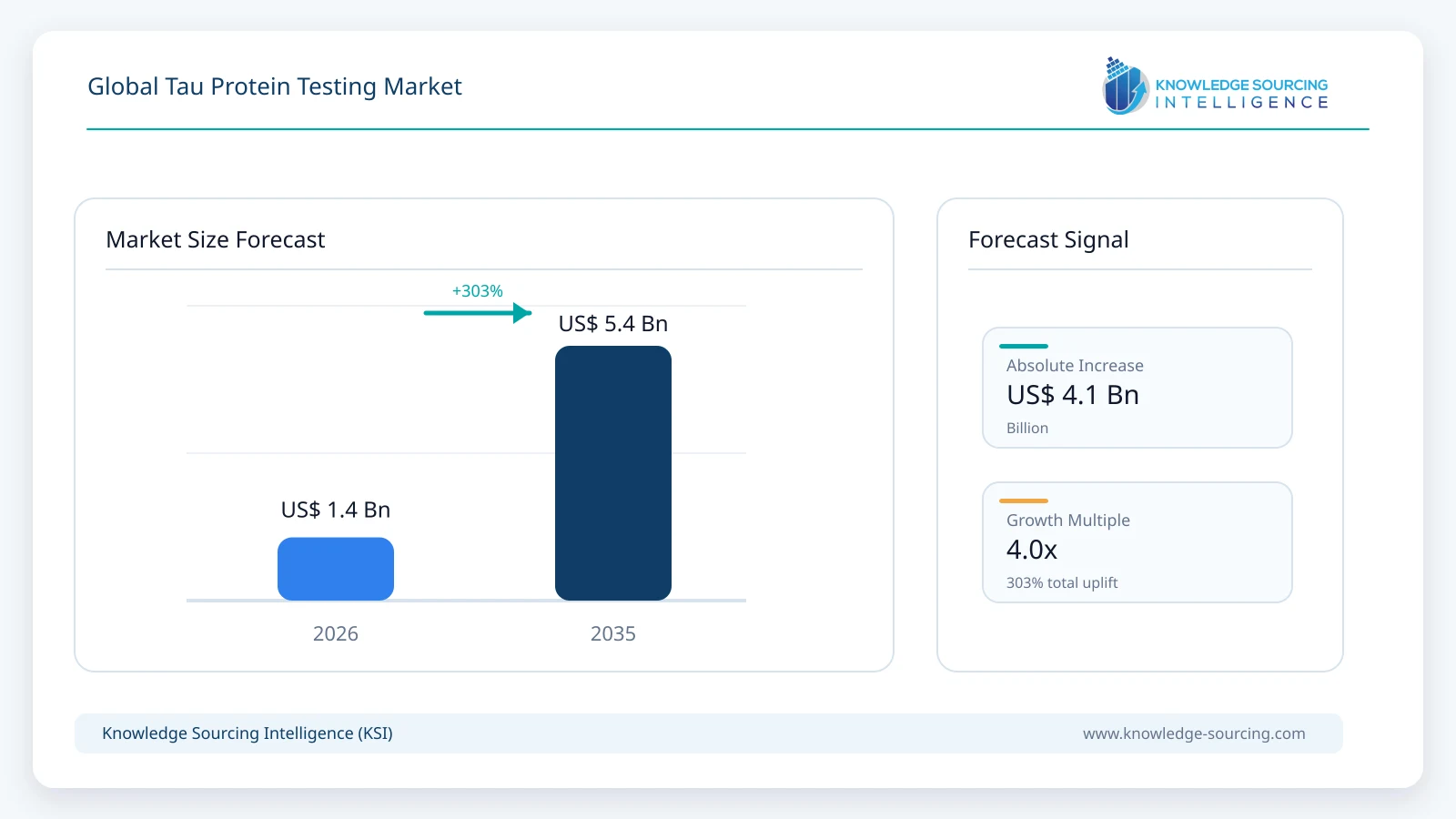
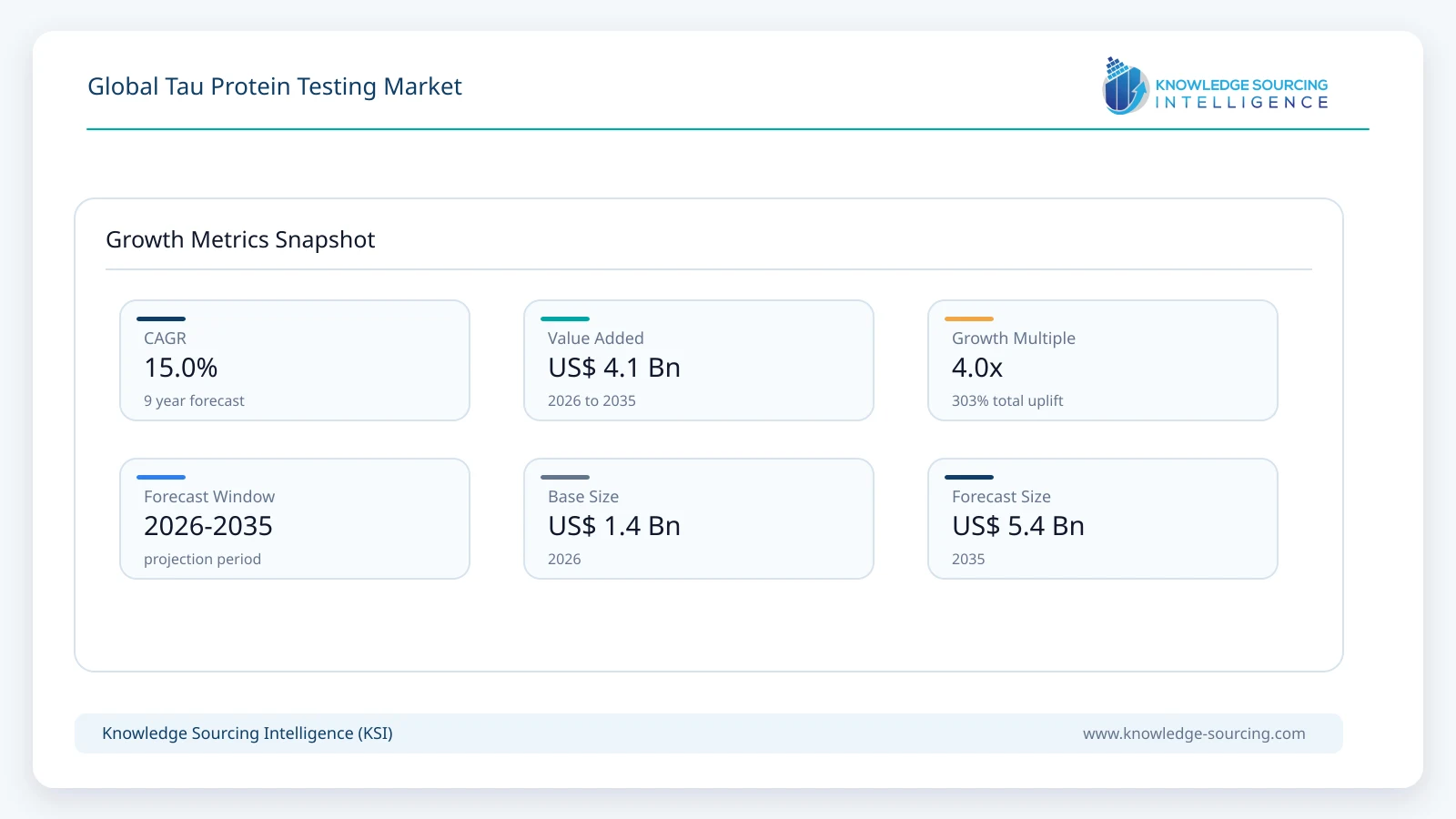
The Global Tau Protein Testing Market is projected to grow at a CAGR of 15.0% the forecast period, increasing from USD 1.35 billion in 2026 to USD 5.44 billion by 2035.
Highlights:
- 1Growing adoption of biomarker-guided neurology is increasing demand for tau testing because clinicians require objective pathological evidence before treatment planning.
- 2Expansion of blood-based diagnostics is improving testing accessibility because healthcare systems require scalable alternatives to invasive procedures.
- 3Rising prevalence of neurodegenerative disorders is increasing patient evaluation volumes, which strengthens demand for early diagnostic assessment.
- 4Advances in assay sensitivity are improving clinical confidence because low-concentration biomarkers require accurate quantification.
Tau protein testing enables biological assessment of neuronal degeneration and tau pathology associated with Alzheimer's disease and related neurodegenerative disorders. Demand exists because conventional neurological assessment often identifies disease after substantial pathological progression has already occurred. Healthcare providers are incorporating biomarker-based evaluation into diagnostic pathways because earlier pathological detection supports improved clinical management and treatment planning.
The emergence of disease-modifying neurological therapies is increasing demand for biological confirmation because patient selection increasingly depends on validated biomarker evidence. This dependency is encouraging healthcare systems to expand diagnostic infrastructure while manufacturers are advancing highly sensitive plasma and cerebrospinal fluid assays. The outcome is a stronger connection between therapeutic adoption and biomarker utilization.
Regulatory agencies are strengthening diagnostic evaluation requirements because biomarker results increasingly influence treatment access and reimbursement decisions. Diagnostic developers are expanding clinical validation activities because broader adoption depends on demonstrating analytical performance and clinical utility. This process supports long-term integration of tau testing into routine neurological care.
Market Dynamics
Market Drivers
Growing Demand for Early Neurodegenerative Disease Detection: Early pathological identification supports improved clinical decision-making and patient management. Demand is increasing because healthcare providers seek diagnostic methods capable of detecting disease-related changes before significant neurological decline occurs. Traditional symptom-based assessment creates limitations because pathology often develops years before clinical manifestation. Diagnostic developers are strengthening biomarker technologies to support earlier identification. This trend increases utilization of tau testing across neurological care pathways.
Expansion of Blood-Based Biomarker Testing: Blood-based diagnostics improve accessibility because sample collection integrates more easily into routine clinical workflows. Demand is shifting toward plasma-based testing because healthcare systems require scalable solutions capable of supporting broader patient populations. Specialized diagnostic infrastructure limits accessibility in many regions. Manufacturers are advancing highly sensitive assay platforms to improve analytical performance. This development supports wider adoption of tau biomarker testing.
Increasing Precision Neurology Adoption: Precision neurology depends on biological characterization because treatment selection increasingly requires objective evidence of disease pathology. Healthcare providers are incorporating biomarker assessment into patient evaluation because molecular insights improve disease classification. Clinical uncertainty constrains therapeutic optimization. Diagnostic laboratories are expanding advanced neurological testing services to address this requirement. The outcome is stronger demand for tau-based diagnostic solutions.
Growth in Neurodegenerative Disease Burden: Neurodegenerative disorders create increasing healthcare demand because aging populations continue expanding globally. Patient evaluation volumes are increasing as awareness of cognitive disorders grows. Healthcare systems face pressure to improve diagnostic efficiency because delayed identification increases long-term disease burden. Diagnostic providers are expanding testing capacity to support growing demand. This demographic trend strengthens market expansion.
Market Restraints
Limited reimbursement coverage restricts routine testing adoption because payer policies vary across healthcare systems.
Clinical standardization challenges persist because biomarker thresholds and testing methodologies continue evolving.
High validation requirements slow commercialization because diagnostic accuracy directly influences clinical decision-making.
Market Opportunities
Expansion of Community-Based Neurological Testing: Specialized neurological centers currently conduct a significant portion of advanced biomarker assessment. Demand is shifting toward decentralized healthcare settings because patient volumes continue increasing. Access limitations constrain early disease identification. Laboratory service providers are expanding blood-based testing capabilities to support community-level adoption. This shift broadens market accessibility.
Integration of Artificial Intelligence: Advanced biomarker datasets require sophisticated interpretation because neurological disease progression demonstrates significant biological variability. Healthcare providers are increasing interest in AI-supported diagnostic analysis because integrated evaluation improves clinical confidence. Traditional interpretation approaches create scalability challenges. Technology developers are expanding AI-enabled solutions to address this need. The result supports broader utilization of tau testing.
Companion Diagnostic Development: Targeted neurological therapies increasingly require biological confirmation before treatment initiation. Demand is increasing because therapeutic effectiveness depends on appropriate patient selection. Diagnostic uncertainty limits treatment optimization. Developers are strengthening companion diagnostic programs to improve clinical utility. This trend creates new commercialization opportunities.
Emerging Market Expansion: Developing healthcare systems are strengthening neurological diagnostic infrastructure because awareness of cognitive disorders continues to rise. Resource constraints limit immediate adoption. Governments and healthcare providers are increasing investment in advanced diagnostics to improve disease management. Diagnostic manufacturers are expanding regional partnerships to support accessibility. This process creates long-term growth opportunities.
Government Regulations
Region | Regulatory Authority | Regulatory Focus |
United States | FDA | In vitro diagnostic approvals, laboratory-developed test oversight, clinical validation requirements |
Europe | IVDR Framework / EMA | Diagnostic performance evaluation, post-market surveillance, clinical evidence requirements |
Japan | PMDA | Diagnostic review, safety monitoring, effectiveness evaluation |
China | NMPA | Product registration, quality management, clinical validation |
India | CDSCO | Medical device regulation, diagnostic approvals, compliance oversight |
Market Segmentation
By Biomarker Type
Total tau testing maintains clinical relevance because neuronal injury assessment continues supporting neurological disease evaluation across multiple care settings. Demand is shifting toward phosphorylated tau biomarkers because disease-specific pathological characterization increasingly supports earlier and more accurate diagnosis. Phosphorylated Tau 181 testing remains widely utilized because extensive clinical validation supports integration into neurological assessment pathways. Phosphorylated Tau 217 adoption is increasing because emerging evidence continues to demonstrate a strong correlation with Alzheimer's disease pathology. Phosphorylated Tau 231 testing is gaining attention because earlier pathological changes require increasingly sensitive biomarkers for detection. The market therefore increasingly favors phosphorylated tau assays that improve disease differentiation and patient stratification.
By Test Type
Blood-based tau testing is expanding rapidly because minimally invasive sample collection improves accessibility and supports broader population screening. Cerebrospinal fluid testing remains clinically important because established diagnostic performance continues to support pathological confirmation in specialized neurological evaluation. Diagnostic scalability remains constrained because lumbar puncture procedures require specialized expertise, and patient acceptance remains variable. Healthcare systems are increasing investment in plasma-based testing because broader adoption requires more accessible diagnostic pathways. Tau PET imaging maintains strategic relevance because direct visualization of pathological processes supports complex diagnostic investigations. The market therefore increasingly balances accessibility, diagnostic confidence, and operational scalability across testing modalities.
By Technology
Immunoassays maintain substantial demand because automated laboratory workflows support routine implementation across high-volume diagnostic environments. Mass spectrometry adoption is increasing because enhanced analytical sensitivity improves quantification accuracy for low-abundance tau biomarkers. Traditional laboratory methodologies face limitations because expanding clinical utilization requires greater reproducibility and standardization. Diagnostic developers are strengthening advanced analytical platforms because healthcare providers increasingly require highly sensitive neurological testing solutions. Imaging technologies continue supporting comprehensive disease characterization because molecular visualization complements laboratory-based assessment. The market therefore increasingly depends on technological innovation that improves sensitivity, throughput, and clinical reliability.
Regional Analysis
North America
North America maintains leadership in the tau protein testing market because healthcare systems increasingly incorporate biomarker-guided neurological assessment into clinical decision-making. Demand is increasing for blood-based tau testing because disease-modifying therapeutic development continues emphasizing earlier pathological detection and patient stratification. Advanced neurological care infrastructure supports adoption because diagnostic laboratories and academic institutions maintain strong biomarker research capabilities. Healthcare providers are expanding utilization of plasma-based testing because scalable diagnostic solutions improve patient accessibility and workflow efficiency. Regulatory support for neurological biomarker innovation continues strengthening commercialization opportunities because precision medicine initiatives increasingly influence healthcare delivery. The regional market therefore increasingly prioritizes blood-based diagnostics, laboratory automation, and biomarker-guided neurological care pathways.
Europe
Europe maintains substantial market activity because public healthcare systems continue prioritizing earlier diagnosis and management of neurodegenerative disorders. Demand is increasing for validated biomarker testing because healthcare providers require objective evidence to improve disease classification and treatment planning. Regulatory requirements are becoming more stringent because IVDR implementation increases expectations for diagnostic performance and clinical validation. Diagnostic developers are strengthening evidence-generation programs because reimbursement and adoption increasingly depend on demonstrated clinical utility. Blood-based testing adoption is expanding because healthcare systems require scalable alternatives to invasive diagnostic procedures. The regional market therefore increasingly depends on assay standardization, regulatory compliance, and integrated dementia care strategies.
Asia Pacific
Asia Pacific is experiencing rapid expansion because aging demographics and rising neurological disease burden continue increasing diagnostic demand across major healthcare markets. Healthcare systems are strengthening neurological care infrastructure because earlier disease detection increasingly supports resource optimization and long-term care planning. Specialized diagnostic capacity remains uneven because healthcare modernization continues progressing at different rates across countries. Diagnostic manufacturers are expanding regional partnerships because broader adoption requires improved testing accessibility and laboratory capabilities. Governments are increasing investment in cognitive health initiatives because neurodegenerative disorders continue creating substantial healthcare challenges. The regional market therefore increasingly supports plasma biomarker testing expansion and broader precision neurology adoption.
Rest of the World
Latin America, the Middle East, and Africa continue expanding access to advanced neurological diagnostics because awareness of neurodegenerative disease burden is increasing across healthcare systems. Demand is shifting toward blood-based testing because imaging infrastructure and specialized neurological expertise remain limited in many regions. Diagnostic accessibility remains constrained because advanced laboratory resources are concentrated within major urban centers. International diagnostic companies are strengthening regional collaborations because scalable and cost-effective testing solutions are required to support broader adoption. Governments are increasing focus on dementia awareness and early diagnosis because aging populations continue increasing healthcare expenditure pressures. The market therefore increasingly depends on affordable biomarker technologies, centralized laboratory networks, and expanding neurological care infrastructure.
Regulatory Landscape
The regulatory environment for tau protein testing is becoming increasingly rigorous because diagnostic outcomes are playing a greater role in clinical management and treatment eligibility decisions. Regulatory agencies are strengthening performance expectations because analytical variability directly affects physician confidence and patient care pathways. Diagnostic developers are expanding multicenter validation programs because broader adoption depends on demonstrating consistent clinical utility. The market therefore increasingly prioritizes standardization and reproducibility across testing platforms.
The U.S. FDA continues supporting innovation in neurological diagnostics because biomarker-guided medicine is becoming increasingly integrated into healthcare delivery. Europe's IVDR framework is increasing evidence requirements because diagnostic manufacturers must demonstrate stronger analytical and clinical performance. Japan's PMDA continues supporting precision diagnostic development because aging demographics are increasing neurological disease burden. China's NMPA is strengthening oversight because advanced biomarker technologies continue expanding across clinical practice. The regulatory environment therefore increasingly favors companies capable of maintaining strong validation and compliance capabilities.
Regulatory harmonization remains limited because biomarker thresholds, validation methodologies, and approval pathways continue varying across healthcare systems. Global diagnostic commercialization remains challenging because region-specific requirements influence market entry strategies. Companies are increasing international clinical studies because broader adoption increasingly depends on demonstrating compliance across multiple jurisdictions. The market therefore increasingly emphasizes global evidence generation and assay standardization.
Pipeline Analysis
The tau protein testing pipeline is increasingly focused on blood-based diagnostics because minimally invasive testing improves scalability and patient accessibility. Demand is increasing for highly sensitive assays because earlier pathological detection requires accurate measurement of low-concentration biomarkers. Existing diagnostic approaches face operational limitations because broader clinical adoption requires simpler and more accessible testing methods. Developers are advancing phosphorylated tau assays because disease-specific biomarker characterization improves diagnostic confidence. The pipeline therefore increasingly supports decentralized neurological assessment.
Phosphorylated Tau 181, Phosphorylated Tau 217, and Phosphorylated Tau 231 remain major development priorities because healthcare providers increasingly require biomarkers capable of differentiating disease stages and pathological processes. Diagnostic complexity continues increasing because neurological disorders demonstrate substantial biological heterogeneity. Manufacturers are strengthening multi-biomarker development strategies because integrated analysis improves disease characterization and patient stratification. The outcome supports more comprehensive neurological diagnostics.
Artificial intelligence integration is expanding because biomarker interpretation increasingly involves large and complex datasets. Traditional analytical approaches face scalability challenges because clinical utilization continues expanding across healthcare systems. Diagnostic companies are developing AI-supported interpretation tools because predictive analytics improve diagnostic efficiency and clinical confidence. The pipeline therefore increasingly aligns with precision medicine, digital health integration, and advanced neurological diagnostics.
Competitive Landscape
Fujirebio
Fujirebio remains strategically differentiated because its Lumipulse platform supports automated tau biomarker assessment across both research and clinical environments. Demand is increasing for high-throughput neurological diagnostics because healthcare systems require scalable testing pathways capable of supporting larger patient populations. Traditional neurological assessment workflows create operational limitations because invasive procedures restrict accessibility and scalability. Fujirebio is expanding plasma and cerebrospinal fluid assay capabilities because broader adoption increasingly depends on accessible and validated biomarker testing. The company therefore strengthens its competitive position through automation, analytical reliability, and extensive neurodegenerative diagnostic expertise.
Roche Diagnostics
Roche Diagnostics maintains strong market relevance because its Elecsys biomarker portfolio supports standardized neurological testing across centralized laboratory environments. Healthcare providers are increasing utilization of blood-based biomarkers because treatment planning increasingly depends on objective pathological evidence. Clinical adoption remains dependent on assay consistency because diagnostic confidence requires reproducible analytical performance. Roche is strengthening biomarker validation programs because healthcare systems increasingly prioritize evidence-based neurological diagnostics. The company therefore benefits from global diagnostics infrastructure and established laboratory relationships.
Labcorp
Labcorp remains strategically important because its extensive laboratory network supports broad access to advanced neurological testing services. Demand is increasing for blood-based tau testing because outpatient healthcare providers require scalable diagnostic solutions. Diagnostic accessibility remains constrained because specialized neurological services are not universally available. Labcorp is expanding neurological biomarker testing capabilities because broader adoption increasingly depends on community-based diagnostic access. The company therefore benefits from strong operational scale and laboratory integration.
Quest Diagnostics
Quest Diagnostics maintains competitive relevance because nationwide diagnostic infrastructure supports expanding biomarker testing accessibility. Healthcare providers are increasing utilization of neurological biomarker assessment because earlier disease detection increasingly influences patient management decisions. Large patient volumes create operational pressure because efficient testing pathways are required to support growing demand. Quest Diagnostics is strengthening neurological testing services because healthcare systems continue emphasizing early disease identification. The company therefore benefits from extensive provider relationships and large-scale laboratory operations.
C2N Diagnostics
C2N Diagnostics remains differentiated because its diagnostic portfolio focuses on blood-based neurodegenerative disease assessment and biomarker-driven patient evaluation. Demand is increasing for minimally invasive diagnostics because healthcare providers seek alternatives to specialized imaging and cerebrospinal fluid testing. Broader adoption requires clinical confidence because biomarker results increasingly influence treatment planning. C2N is strengthening validation and commercialization activities because diagnostic scalability depends on demonstrating clinical utility. The company therefore benefits from specialization in precision neurological diagnostics.
Sysmex Corporation
Sysmex maintains strong positioning because automated immunoassay technologies support efficient neurological biomarker testing. Demand is increasing for laboratory automation because growing testing volumes require operational scalability. Traditional manual workflows limit efficiency because healthcare systems increasingly require rapid and standardized diagnostic services. Sysmex is expanding neurological assay development because blood-based testing adoption continues accelerating globally. The company therefore benefits from laboratory automation expertise and growing neurodiagnostic capabilities.
Quanterix Corporation
Quanterix remains strategically important because Simoa technology enables ultra-sensitive detection of low-abundance tau biomarkers. Healthcare providers are increasing interest in plasma-based testing because minimally invasive diagnostics improve accessibility and monitoring capabilities. Analytical sensitivity remains critical because early pathological detection depends on accurate biomarker measurement. Quanterix is advancing highly sensitive neurological testing platforms because broader clinical adoption increasingly requires precise biomarker quantification. The company therefore benefits from leadership in ultra-sensitive biomarker detection technologies.
Siemens Healthineers
Siemens Healthineers maintains market relevance because advanced diagnostic technologies support evolving neurological testing requirements. Healthcare systems are increasing investment in integrated diagnostic infrastructure because precision medicine continues expanding across clinical practice. Operational complexity remains a challenge because growing testing volumes require efficient laboratory workflows. Siemens Healthineers is strengthening innovation in laboratory automation and diagnostic technologies because healthcare providers increasingly prioritize scalable testing solutions. The company therefore benefits from broad healthcare technology capabilities and global market presence.
Key Developments
April 2026: Sysmex Corporation announced that it has launched HISCL™ p-Tau217 Assay Kit for Research Use, a reagent for research purposes to identify a biomarker related to Alzheimer's disease, namely blood p-Tau2172 levels, in Europe.
February 2026: Labcorp, a global leader of innovative and comprehensive laboratory services, announced the nationwide availability of the Elecsys® pTau-181 test, the first and only blood test cleared by the U.S. Food and Drug Administration (FDA) to aid in the initial assessment of Alzheimer's disease in the primary care setting.
Strategic Insights and Future Market Outlook
The tau protein testing market is transitioning toward scalable blood-based diagnostic solutions because healthcare systems increasingly require earlier identification of neurodegenerative pathology and broader access to neurological assessment. Demand for phosphorylated tau biomarkers is increasing because disease-specific characterization improves diagnostic confidence and patient stratification. Diagnostic laboratories are integrating automated assay platforms because testing volumes continue expanding across neurological care pathways. The market therefore increasingly supports decentralized and accessible diagnostic models.
Artificial intelligence is becoming strategically important because biomarker interpretation increasingly requires integration of laboratory data, imaging findings, and clinical information. Multi-biomarker approaches are gaining relevance because healthcare providers require more comprehensive disease characterization to support precision medicine strategies. Diagnostic developers are expanding data-driven analytical capabilities because improving clinical confidence remains essential for broader adoption. The outcome supports increasingly sophisticated neurological diagnostic ecosystems.
Healthcare systems are increasing investment in precision neurology infrastructure because neurodegenerative disease burden continues expanding among aging populations. Companies capable of combining highly sensitive assays, scalable laboratory workflows, and advanced analytical tools are strengthening long-term competitive positioning because healthcare providers increasingly prioritize accessible and reliable diagnostic solutions. The market therefore continues evolving toward blood-based testing expansion, automated laboratory integration, and precision diagnostic frameworks that support earlier and more effective neurological disease assessment.
The Global Tau Protein Testing Market continues advancing toward highly sensitive plasma biomarker diagnostics, integrated analytical platforms, and precision medicine-driven neurological care as healthcare systems increasingly prioritize earlier pathological detection, improved diagnostic accuracy, and scalable access to neurodegenerative disease assessment.
Global Tau Protein Testing Market Scope:
| Report Metric | Details |
|---|---|
| Total Market Size in 2026 | USD 1.35 billion |
| Total Market Size in 2035 | USD 5.44 billion |
| Forecast Unit | USD Billion |
| Growth Rate | 15.0% |
| Study Period | 2021 to 2035 |
| Historical Data | 2021 to 2024 |
| Base Year | 2025 |
| Forecast Period | 2026 – 2035 |
| Segmentation | Biomarker Type, Test Type, Technology, Geography |
| Companies |
|
Market Segmentation
By Geography
Key Countries Analysis
Regulatory & Policy Landscape
Table of Contents
1. EXECUTIVE SUMMARY
1.1 Market Overview
1.2 Key Findings
1.3 Strategic Insights
1.4 Market Snapshot
1.5 Key Growth Opportunities
1.6 Executive Recommendations
2. DISEASE & EPIDEMIOLOGY ANALYSIS
2.1 Overview of Tau-Associated Neurodegenerative Disorders
2.2 Tau Protein Biology and Disease Pathophysiology
2.2.1 Normal Tau Function
2.2.2 Tau Hyperphosphorylation and Aggregation
2.2.3 Neurofibrillary Tangle Formation
2.3 Disease Burden Analysis
2.3.1 Global Prevalence of Alzheimer's Disease
2.3.2 Global Prevalence of Primary Tauopathies
2.3.3 Incidence Trends in Neurodegenerative Disorders
2.4 Epidemiology by Disease Category
2.4.1 Alzheimer's Disease
2.4.2 Frontotemporal Dementia (FTD)
2.4.3 Progressive Supranuclear Palsy (PSP)
2.4.4 Corticobasal Degeneration (CBD)
2.4.5 Chronic Traumatic Encephalopathy (CTE)
2.5 Patient Population Analysis
2.5.1 Diagnosed Population
2.5.2 Biomarker-Test Eligible Population
2.5.3 High-Risk Population
2.6 Risk Factor Assessment
2.6.1 Aging Population
2.6.2 Genetic Factors
2.6.3 Neurological Injury and Comorbidities
2.7 Unmet Needs in Tau-Based Diagnosis
3. MARKET DYNAMICS
3.1 Market Drivers
3.1.1 Rising Burden of Neurodegenerative Disorders
3.1.2 Growing Adoption of Blood-Based Biomarkers
3.1.3 Expansion of Precision Neurology
3.1.4 Increasing Demand for Early Disease Detection
3.2 Market Restraints
3.2.1 Limited Reimbursement Coverage
3.2.2 Standardization Challenges
3.2.3 Clinical Validation Requirements
3.3 Market Opportunities
3.3.1 Plasma Tau Testing Expansion
3.3.2 AI-Based Biomarker Interpretation
3.3.3 Companion Diagnostic Development
3.3.4 Emerging Market Adoption
3.4 Market Challenges
3.5 Porter’s Five Forces Analysis
3.6 Value Chain Analysis
3.7 PESTLE Analysis
4. COMMERCIAL & MARKET ACCESS
4.1 Commercialization Landscape
4.2 Pricing Analysis
4.3 Reimbursement Landscape
4.3.1 Public Payer Coverage
4.3.2 Private Payer Coverage
4.4 Market Access Barriers
4.5 Health Technology Assessment Considerations
4.6 Diagnostic Adoption Pathways
4.7 Stakeholder Analysis
4.7.1 Neurologists
4.7.2 Memory Clinics
4.7.3 Hospitals
4.7.4 Diagnostic Laboratories
4.7.5 Payers
5. INNOVATION & PIPELINE LANDSCAPE
5.1 Innovation Overview
5.2 Evolution of Tau Biomarker Testing
5.3 Pipeline Diagnostic Landscape
5.3.1 Discovery Stage
5.3.2 Preclinical Development
5.3.3 Clinical Validation Stage
5.3.4 Commercialization Stage
5.4 Pipeline Analysis by Biomarker
5.4.1 Total Tau (t-Tau)
5.4.2 Phosphorylated Tau (p-Tau181)
5.4.3 Phosphorylated Tau (p-Tau217)
5.4.4 Phosphorylated Tau (p-Tau231)
5.5 Pipeline Analysis by Modality
5.5.1 Blood-Based Diagnostics
5.5.2 Cerebrospinal Fluid Diagnostics
5.5.3 Imaging-Based Tau Assessment
5.6 Artificial Intelligence and Digital Biomarkers
5.7 Emerging Technologies
5.8 Patent Landscape Analysis
6. TREATMENT LANDSCAPE
6.1 Current Management of Tau-Associated Disorders
6.2 Role of Tau Biomarker Testing in Clinical Practice
6.3 Diagnostic Workflow Assessment
6.4 Companion Diagnostic Potential
6.5 Impact of Disease-Modifying Therapies on Testing Demand
6.6 Clinical Guidelines and Testing Recommendations
7. GLOBAL TAU PROTEIN TESTING MARKET SIZE & FORECAST
7.1 Global Market Overview
7.2 Historical Market Analysis
7.3 Current Market Assessment
7.4 Market Forecast
7.5 Absolute Dollar Opportunity Analysis
7.6 Market Attractiveness Analysis
8. GLOBAL TAU PROTEIN TESTING MARKET SEGMENTATION
8.1 By Biomarker Type
8.1.1 Total Tau (t-Tau)
8.1.2 Phosphorylated Tau 181 (p-Tau181)
8.1.3 Phosphorylated Tau 217 (p-Tau217)
8.1.4 Phosphorylated Tau 231 (p-Tau231)
8.2 By Test Type
8.2.1 Blood-Based Tau Tests
8.2.2 Cerebrospinal Fluid (CSF) Tau Tests
8.2.3 Tau PET Imaging
8.3 By Technology
8.3.1 Immunoassays
8.3.2 Mass Spectrometry
8.3.3 Molecular Diagnostic Technologies
8.3.4 Imaging Technologies
8.4 By End User
8.4.1 Hospitals
8.4.2 Diagnostic Laboratories
8.4.3 Academic and Research Institutes
8.4.4 Specialty Neurology Centers
8.4.5 Memory Clinics
9. GEOGRAPHICAL ANALYSIS
9.1 North America
9.1.1 Market Size & Growth
9.1.2 Demand Drivers
9.1.3 Regional Regulatory Overview
9.1.4 Competitive Intensity
9.2 Europe
9.2.1 Market Size & Growth
9.2.2 Demand Drivers
9.2.3 Regional Regulatory Overview
9.2.4 Competitive Intensity
9.3 Asia-Pacific
9.3.1 Market Size & Growth
9.3.2 Demand Drivers
9.3.3 Regional Regulatory Overview
9.3.4 Competitive Intensity
9.4 Latin America
9.4.1 Market Size & Growth
9.4.2 Demand Drivers
9.4.3 Regional Regulatory Overview
9.4.4 Competitive Intensity
9.5 Middle East & Africa
9.5.1 Market Size & Growth
9.5.2 Demand Drivers
9.5.3 Regional Regulatory Overview
9.5.4 Competitive Intensity
10. KEY COUNTRIES ANALYSIS
10.1 United States
10.2 Canada
10.3 Germany
10.4 United Kingdom
10.5 France
10.6 Italy
10.7 Spain
10.8 China
10.9 Japan
10.10 India
10.11 South Korea
10.12 Australia
10.13 Brazil
10.14 Mexico
10.15 Saudi Arabia
10.16 South Africa
11. REGULATORY & POLICY LANDSCAPE
11.1 Regulatory Overview
11.2 United States (FDA)
11.2.1 In Vitro Diagnostic Pathways
11.2.2 Laboratory Developed Tests (LDTs)
11.3 Europe (IVDR/MDR Framework)
11.4 Japan (PMDA)
11.5 India (CDSCO)
11.6 China (NMPA)
11.7 Comparative Regulatory Assessment
11.8 Clinical Validation Requirements
11.9 Data Privacy and Patient Protection
11.10 Future Regulatory Trends
12. COMPETITIVE LANDSCAPE
12.1 Market Structure Analysis
12.2 Competitive Benchmarking
12.3 Market Share Analysis
12.4 Strategic Developments
12.4.1 Collaborations and Partnerships
12.4.2 Product Launches
12.4.3 Licensing Agreements
12.4.4 Mergers and Acquisitions
12.5 Innovation Benchmarking
12.6 SWOT Analysis
13. COMPANY PROFILES
13.1 Fujirebio
13.2 Roche Diagnostics
13.3 Labcorp
13.4 Quest Diagnostics
13.5 C2N Diagnostics
13.6 Sysmex Corporation
13.7 Quanterix Corporation
13.8 Siemens Healthineers
13.9 GE HealthCare
13.10 Lantheus Holdings
13.11 Life Molecular Imaging
13.12 Eisai Co., Ltd.
14. FUTURE OUTLOOK
14.1 Future Market Evolution
14.2 Emerging Diagnostic Paradigms
14.3 Blood-Based Tau Testing Outlook
14.4 AI and Digital Biomarker Integration
14.5 Companion Diagnostic Expansion
14.6 Investment Opportunities
14.7 Analyst Recommendations
15. METHODOLOGY
15.1 Research Methodology
15.2 Secondary Research Sources
15.3 Primary Research Framework
15.4 Market Estimation Methodology
15.5 Forecasting Methodology
15.6 Data Triangulation
15.7 Assumptions and Limitations
15.8 Abbreviations and Definitions
Navigate
Trusted by the world's leading organizations











