
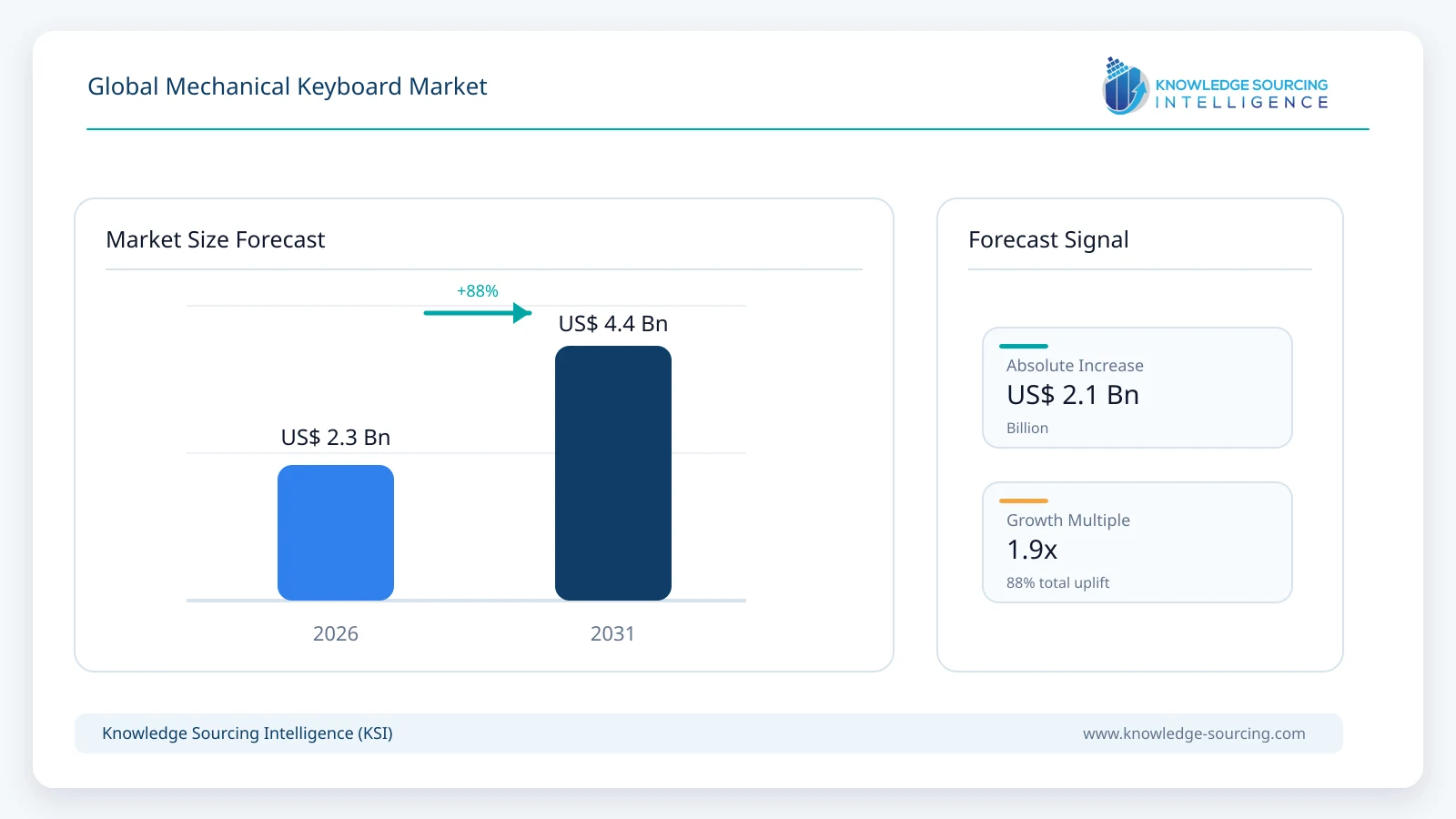
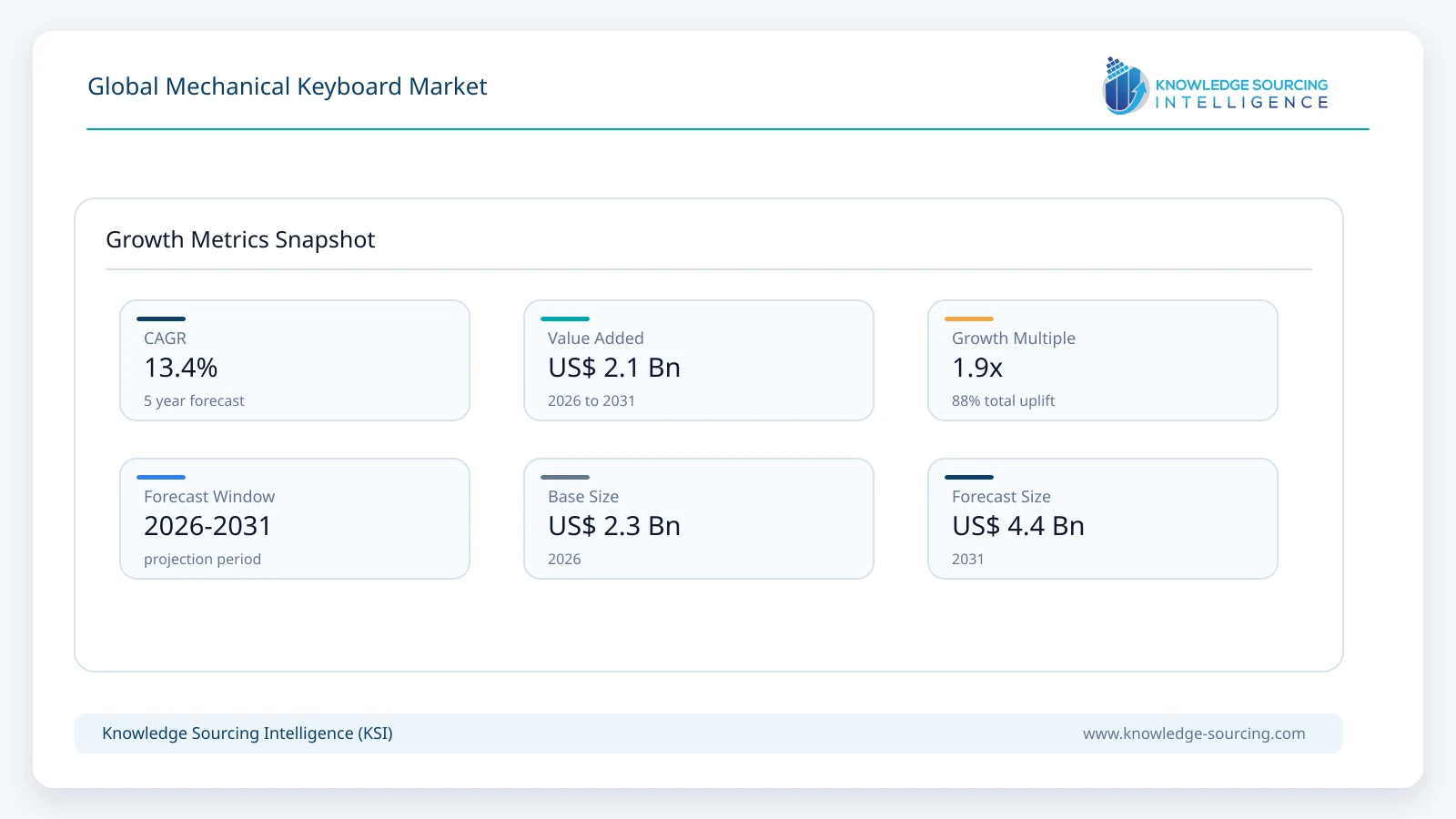
The global mechanical keyboard market is forecast to grow at a CAGR of 13.45%, reaching USD 4.38 billion in 2031 from USD 2.33 billion in 2026.
Highlights:
- 1Gaming accounts for approximately 58% of mechanical keyboard market value in 2026.
- 2Linear switches represent approximately 46% of global mechanical keyboard revenue in 2026.
- 3Wireless keyboards rise from approximately 38% of market value to 49% by 2031.
- 4Household users account for approximately 72% of mechanical keyboard spending in 2026.
- 5Asia Pacific increases from approximately 36% of global revenue to 40% by 2031.
Mechanical keyboards use individual switches beneath each key to provide defined actuation, tactile feedback and greater customization than conventional membrane keyboards. Their historical association with gaming continues to shape the market, but mechanical keyboards are increasingly used by programmers, content creators, office professionals and other users who prioritize typing feel, durability and personalization. Product development now extends beyond traditional full-size gaming keyboards to compact 60%, 65%, 75% and tenkeyless formats, low-profile designs, hot-swappable switches, programmable keys and multi-device wireless models.
Current manufacturer performance supports continued demand for higher-quality computer peripherals. Logitech reported fiscal 2026 Gaming sales of USD 1.41 billion, up 6% year over year, while its broader Keyboards & Combos category increased 6% to USD 937.6 million. Gaming growth accelerated to 12% during the fourth quarter. Corsair’s Gamer and Creator Peripherals business generated USD 492.1 million in 2025, increasing 4%, before reporting 10% year-over-year growth in Q1 2026 and 13% growth in Q2 2026. These categories extend beyond mechanical keyboards, but they demonstrate sustained spending on the gaming and keyboard ecosystems in which mechanical products compete.
The market is also becoming less dependent on one product proposition. Gaming buyers increasingly evaluate polling rate, adjustable actuation, rapid-trigger functions and switch response, while enthusiasts value switch interchangeability, acoustic tuning, keycaps and case construction. Productivity users place greater emphasis on low-profile switches, wireless connectivity, multi-device operation, quieter typing and compact layouts. Logitech’s MX Mechanical range illustrates this crossover by combining low-profile mechanical switches with wireless multi-device functionality for professional users, while its April 2026 MX ecosystem update extended software and multi-device features across MX Mechanical products.
Major Market Drivers
Performance Gaming Is Increasing Demand for Higher-Specification Keyboards
Gaming remains the principal demand driver because mechanical and advanced switch technologies offer characteristics that are directly visible to users, including actuation consistency, rapid reset, programmable inputs and low latency. The market is progressively moving beyond conventional fixed mechanical switches toward products that combine mechanical construction with Hall Effect, TMR and optical sensing. This provides adjustable actuation points and rapid-trigger functionality while maintaining the physical keyboard form factors familiar to gaming users.
Logitech’s April 28, 2026 launch of the G512 X reflects this transition. The keyboard combines traditional mechanical switches with TMR analog magnetic switches through a dual-swap architecture, along with an 8 kHz report rate and adjustable multi-action inputs. Razer expanded the same performance direction during 2026 through analog optical and Hall Effect products, including its Huntsman V3 Tenkeyless 8KHz and Huntsman V3 HE Magnetic 8KHz ranges. These launches show that performance differentiation is increasingly occurring at the switch, sensor and firmware level rather than through RGB lighting or exterior design alone.
Customization and Productivity Use Are Broadening the Addressable Market
Mechanical keyboards increasingly compete on user experience rather than gaming performance alone. Hot-swappable switches allow users to replace switches without soldering, while gasket mounting, dampening materials, custom keycaps and programmable controls make it possible to alter sound, feel and appearance. These characteristics have expanded enthusiast demand and are increasingly being incorporated into mainstream products at different price points.
At the same time, mechanical keyboards are becoming more relevant to professional users. Logitech’s MX Mechanical products provide low-profile switches, quieter typing and connection to as many as three devices, addressing programmers, creators and professionals rather than competitive gamers. In June 2026, Logitech introduced the G316 X 98 with hot-swappable switches, a gasket design, 8 kHz polling and an integrated dot-matrix display, bringing features associated with custom keyboards into a more accessible product tier. Corsair’s GALLEON 100 SD integrates a mechanical keyboard with Stream Deck controls, demonstrating another direction in which the keyboard becomes a configurable interface for games, applications and digital workflows.
Major Market Restraints
Lower-Cost Membrane and Scissor-Switch Keyboards Remain Effective Substitutes
Mechanical keyboards command a meaningful premium over basic membrane and scissor-switch devices, limiting adoption among buyers who primarily need standard typing functionality. Large volumes of desktop keyboards are still purchased for general office deployment, education, bundled PC systems and cost-sensitive household use, where switch longevity, adjustable actuation and customization do not necessarily justify higher prices.
The challenge is particularly relevant to commercial procurement because organizations may purchase hundreds or thousands of units and prioritize standardized layouts, low noise, simple maintenance and acquisition cost. Mechanical keyboard manufacturers are responding with lower-profile designs, quieter switches and products that blur the distinction between work and enthusiast hardware, but the mainstream keyboard market remains considerably larger and more price competitive. Mechanical keyboards therefore expand primarily by capturing users willing to pay for a differentiated typing or gaming experience rather than replacing conventional keyboards across every application.
Tariffs, Component Costs and Supply-Chain Volatility Can Pressure Pricing
Mechanical keyboards contain substantially more individual components than low-cost membrane products, including discrete switches, printed circuit boards, stabilizers, lighting systems, controllers, wireless chipsets and more complex enclosures. Premium products add aluminum cases, displays, magnetic sensors and custom switch technologies, increasing their exposure to component, freight and manufacturing costs.
Corsair reported tariff-related headwinds within its Gamer and Creator Peripherals business during 2026 and has highlighted ongoing semiconductor supply constraints and elevated component pricing across its wider portfolio. The company’s peripheral revenue nevertheless increased 10% in Q1 and 13% in Q2 2026, suggesting that premium demand has remained resilient, but suppliers must continue balancing feature improvements with retail pricing. Smaller specialist keyboard brands face an additional challenge because they generally lack the procurement scale and geographically diversified supply chains of larger peripheral manufacturers.
Mechanical Keyboard Market Trends
Magnetic and Analog Switch Technologies Are Moving Into Mainstream Gaming Portfolios
One of the most significant technology shifts is the growing use of magnetic sensing alongside established mechanical and optical switches. Hall Effect and TMR technologies can measure switch travel continuously, enabling adjustable actuation, rapid trigger and multiple actions from a single keystroke.
Razer entered the Hall Effect segment with its Huntsman V3 HE Magnetic 8KHz line on July 30, 2026, while Logitech’s G512 X combines TMR analog switches with conventional mechanical switches. SteelSeries had already established adjustable magnetic actuation through its OmniPoint platform. The result is a market in which the term mechanical keyboard increasingly describes a broader premium keyboard ecosystem incorporating multiple switch-sensing technologies.
Hot-Swappable and Custom-Keyboard Features Are Becoming Standardized
Customization that previously required specialist kits is increasingly available from large peripheral brands. Hot-swappable PCBs, gasket mounting, switch foam, replaceable keycaps and alternative layouts are becoming common product features.
Razer introduced its first BlackWidow barebones keyboard in June 2025, allowing customers to install their own three- or five-pin mechanical switches and keycaps. Logitech subsequently introduced hot-swap support in the G316 X, while Corsair continues to expand customizable keyboard platforms. This reduces the separation between enthusiast-built and branded keyboards and enables manufacturers to participate in recurring spending on switches, keycaps and accessories.
Low-Profile Designs Are Combining Comfort With Competitive Performance
Low-profile mechanical keyboards originally focused largely on office use and portability, but manufacturers are increasingly applying advanced gaming technology to thinner form factors. Razer introduced the Huntsman V3 Pro Low-profile Tenkeyless 8KHz on August 20, 2026 with adjustable analog optical actuation from 0.1 mm to 2.8 mm, rapid-trigger functions and 8 kHz polling.
The convergence expands the potential customer base because users no longer need to choose as sharply between a traditional high-profile gaming keyboard and a thinner work-oriented device. Lower key travel can also appeal to customers moving from laptop keyboards to external mechanical products.
Wireless Mechanical Keyboards Are Gaining Share
Wireless connectivity is expanding as latency improves and users increasingly operate multiple devices from the same workspace. Bluetooth supports productivity and multi-device switching, while proprietary 2.4 GHz connections address gaming applications where latency is more important.
Wireless mechanical keyboards account for approximately 38% of market value in 2026 and are projected to approach 49% by 2031. Wired products remain important in competitive gaming and lower-priced configurations, but battery improvements and reliable low-latency wireless technologies reduce one of the principal historical barriers to wireless adoption.
Mechanical Keyboard Market Segmentation Analysis
By Application
Gaming
Gaming accounts for approximately 58% of global mechanical keyboard market value in 2026, making it the largest application. Mechanical keyboards remain closely associated with PC gaming because switch feel, actuation behaviour, key rollover, programmability and latency can influence the user experience more directly than in routine typing applications.
The segment is projected to represent approximately 61% of the market by 2031 as premium gaming keyboards incorporate magnetic sensing, adjustable actuation and rapid-trigger technologies. Logitech’s fiscal 2026 Gaming sales increased 6% to USD 1.41 billion, while Corsair’s Gamer and Creator Peripherals business returned to double-digit growth during the first half of 2026. Mechanical keyboards represent only part of these companies’ gaming portfolios, but the results indicate continued investment in high-performance PC peripherals.
By Product Type
Linear Switches
Linear switches account for approximately 46% of mechanical keyboard market value in 2026, making them the largest switch-feel category. Their smooth keystroke without a pronounced tactile bump or audible click is particularly suitable for gaming applications where users prioritize rapid and repeatable actuation.
The segment is expected to approach 49% of market value by 2031 as gaming remains the leading application and magnetic and optical products increasingly adopt linear switch characteristics. Linear switches are also available in different actuation forces and travel distances, allowing vendors to differentiate products while retaining a broadly familiar user experience.
By Connectivity
Wireless
Wireless represents approximately 38% of global mechanical keyboard revenue in 2026 but is projected to be the fastest-growing connectivity segment, increasing to approximately 49% by 2031. Bluetooth, proprietary low-latency wireless connections and multi-device pairing allow the same keyboard to serve desktops, laptops and mobile devices while reducing cable requirements.
The shift is particularly relevant in productivity and hybrid gaming-work environments. Logitech’s MX Mechanical supports connection with as many as three devices, while gaming manufacturers increasingly offer wireless variants without substantially compromising response times. Wired keyboards remain important for esports and value-focused products, but the distinction between wired and wireless performance continues to narrow.
By End User
Household
Household customers account for approximately 72% of global mechanical keyboard market value in 2026. The category includes gamers, enthusiasts, programmers, creators and remote workers purchasing keyboards directly for personal use.
Consumer demand is particularly important because mechanical keyboard purchasing is frequently discretionary and feature-driven. Buyers can choose switch feel, case material, layout, keycap design, lighting, connectivity and software functionality according to individual preferences. Manufacturers are consequently expanding portfolios across entry-level, mid-market, enthusiast and esports price points rather than relying on a small number of standardized models.
Household users are expected to account for approximately 74% of market value by 2031 as customization and gaming continue to expand direct consumer demand.
Mechanical Keyboard Market by Geography
Asia Pacific
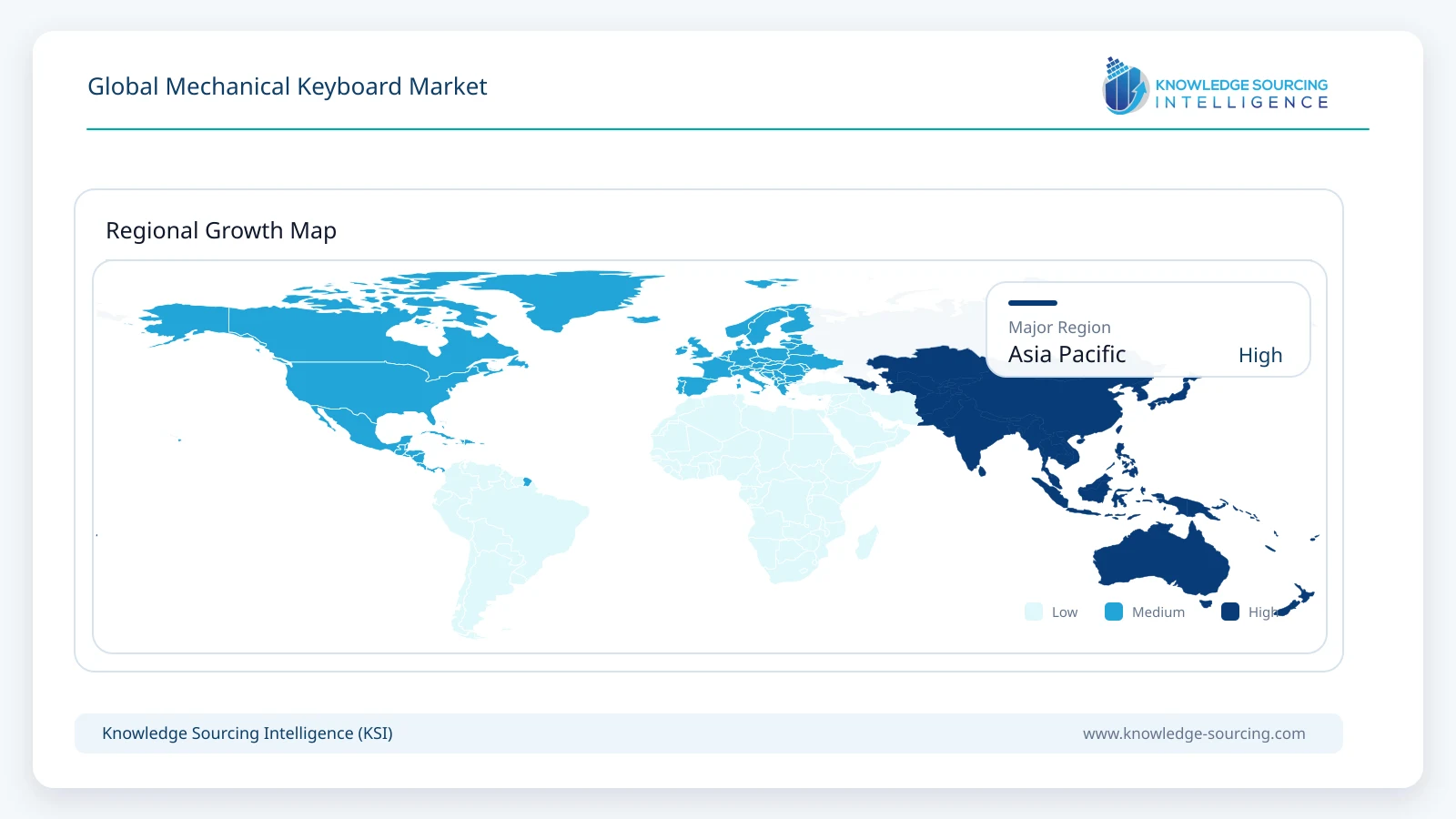
Asia Pacific accounts for approximately 36% of global mechanical keyboard market value in 2026 and is projected to reach approximately 40% by 2031, making it the fastest-growing major region. The region combines large gaming populations with extensive electronics manufacturing and a significant ecosystem of keyboard and switch manufacturers across China, Taiwan, Japan and South Korea.
Several specialist mechanical-keyboard companies, including Keychron, Ducky, Varmilo and Leopold, have strong Asian roots while selling internationally. China also plays a central role in manufacturing keyboard components, switches, keycaps and finished peripherals for both domestic and international brands.
Demand is expanding beyond the most established East Asian markets as PC gaming, e-commerce and enthusiast communities develop in India, Indonesia and other Southeast Asian countries. North America remains a major premium market throughout the forecast period, but Asia Pacific contributes the largest incremental revenue through 2031.
Competitive Landscape
The mechanical keyboard market combines large global peripheral companies with specialist keyboard brands and enthusiast-focused manufacturers. Logitech, Corsair, Razer, SteelSeries and HyperX compete through broad gaming ecosystems and international retail distribution, while Keychron, Ducky, Varmilo, Leopold, Filco and Das Keyboard differentiate through switch choices, layouts, construction and enthusiast positioning.
Competition increasingly centres on switch and sensing technology. Razer operates mechanical, optical and Hall Effect platforms, Logitech has introduced hybrid TMR/mechanical functionality, and SteelSeries uses adjustable magnetic sensing in its Apex Pro family. At the same time, mainstream brands are adopting customization features historically associated with smaller specialist companies, including hot-swappable switches, gasket mounting and replaceable keycaps.
Software is becoming another point of differentiation. Macros, RGB control, actuation settings, device switching, firmware profiles and integrated displays allow manufacturers to extend value beyond physical switch characteristics. Corsair’s GALLEON 100 SD takes this further by integrating Stream Deck controls directly into the keyboard.
Recent Developments
September 2026: Razer introduced the Huntsman V3 Pro Tenkeyless 8KHz Sentinels Edition through a collaboration with esports organization Sentinels.
August 2026: Razer launched the Huntsman V3 Pro Low-profile Tenkeyless 8KHz with low-profile analog optical switches, adjustable actuation and an 8 kHz polling rate.
July 2026: Razer introduced the Huntsman V3 HE Magnetic 8KHz line, expanding into Hall Effect magnetic keyboards in tenkeyless and 65% formats.
June 2026: Logitech introduced the G316 X 98 wired mechanical gaming keyboard with hot-swappable switches, gasket construction, an 8 kHz report rate and integrated display.
April 2026: Logitech launched the G512 X TMR Analog/Mechanical Gaming Keyboard, combining magnetic analog and conventional mechanical switches within the same keyboard.
January 2026: Corsair began worldwide shipments of the GALLEON 100 SD mechanical keyboard combining gaming controls with an integrated 12-button Stream Deck.
Regulatory and Product Compliance Outlook
Mechanical keyboards are subject to electronics, wireless communication, chemical and waste-management requirements that vary by market. Products sold in the European Union are affected by requirements including the Restriction of Hazardous Substances framework and Waste Electrical and Electronic Equipment rules. Wireless models also require radio and electromagnetic compatibility compliance in the jurisdictions where they are sold.
Battery-equipped wireless keyboards add requirements related to battery transportation, recycling and product safety. Manufacturers with international distribution therefore need to manage multiple product certifications and labelling requirements while maintaining common hardware platforms where possible.
Sustainability is also becoming part of product development as large peripheral companies increase the use of recycled plastics, lower-impact packaging and repairable construction. The growing popularity of hot-swappable switches and replaceable keycaps can extend product life by allowing individual components to be changed rather than replacing the complete keyboard.
Market Outlook
The global mechanical keyboard growth is increasingly being driven from a combination of gaming performance, enthusiast customization and expansion into productivity rather than from gaming alone.
Gaming remains the largest application through 2031 as adjustable actuation, rapid-trigger functionality and high polling rates create additional reasons for competitive users to upgrade. Linear switches retain the leading position, while magnetic and optical sensing technologies increasingly complement conventional mechanical switch architectures.
Wireless connectivity records particularly strong growth as multi-device use and low-latency connections improve. Household users remain the principal end-user segment because mechanical keyboards are frequently purchased as personalized peripherals rather than standardized IT equipment.
Asia Pacific gains the largest share through the forecast period, supported by both demand and a strong manufacturing ecosystem. North America and Europe remain important premium markets, particularly for gaming, enthusiast products and professional productivity keyboards.
Global Mechanical Keyboard Market Scope:
| Report Metric | Details |
|---|---|
| Total Market Size in 2026 | USD 2.33 billion in 2026 |
| Total Market Size in 2031 | 4.38 billion in 2031 |
| Forecast Unit | Billion |
| Growth Rate | 13.45% |
| Study Period | 2021 to 2031 |
| Historical Data | 2021 to 2024 |
| Base Year | 2025 |
| Forecast Period | 2026 – 2031 |
| Segmentation | Application, Product Type, Connectivity, End-User, Geography |
| Companies |
|
Market Segmentation
By Application
Office
Gaming
Others
By Product Type
Linear Switches
Clicky Switches
Tactile/Non-Clicky Switches
By Connectivity
Wired
Wireless
By End User
Household
Commercial
By Geography
North America
United States
Canada
Mexico
South America
Brazil
Argentina
Others
Europe
Germany
France
United Kingdom
Italy
Spain
Others
Middle East and Africa
Saudi Arabia
UAE
South Africa
Others
Asia Pacific
China
India
Japan
South Korea
Taiwan
Thailand
Indonesia
Others
Table of Contents
1. EXECUTIVE SUMMARY
1.1. Key Findings
1.2. Global Mechanical Keyboard Market Size, 2026-2031
1.3. Application Outlook
1.4. Product Type Outlook
1.5. Connectivity Outlook
1.6. End-User Outlook
1.7. Regional Opportunity Summary
2. MARKET SNAPSHOT
2.1. Market Overview
2.2. Market Definition
2.3. Scope of the Study
2.4. Market Segmentation
2.5. Base Year and Forecast Period
3. BUSINESS LANDSCAPE
3.1. Market Drivers
3.1.1. Performance Gaming and Esports Demand for Low-Latency Input
3.1.2. Expansion of Hot-Swappable and Customizable Keyboard Designs
3.1.3. Mechanical Keyboard Adoption Among Programmers, Creators and Professional Users
3.1.4. Wireless and Multi-Device Peripheral Adoption
3.2. Market Restraints
3.2.1. Price Competition From Membrane and Scissor-Switch Keyboards
3.2.2. Tariff, Component and Electronics Supply-Chain Cost Volatility
3.2.3. High Replacement Cycles of Durable Premium Keyboards
3.2.4. Noise and Form-Factor Limitations in Selected Workplace Environments
3.3. Market Opportunities
3.4. Porter’s Five Forces Analysis
3.5. Industry Value Chain Analysis
3.6. Policies and Regulations
3.7. Strategic Recommendations
4. TECHNOLOGICAL OUTLOOK
4.1. Conventional Mechanical Switch Architecture
4.2. Hall Effect Magnetic Switches
4.3. TMR Magnetic Sensing
4.4. Optical and Analog Optical Switches
4.5. Rapid Trigger and Adjustable Actuation
4.6. 8 kHz Polling Technology
4.7. Hot-Swappable Switch Architecture
4.8. Low-Profile Mechanical Keyboards
4.9. Wireless and Multi-Device Connectivity
4.10. Integrated Displays and Programmable Control Surfaces
4.11. Software-Based Personalization
5. GLOBAL MECHANICAL KEYBOARD MARKET BY APPLICATION
5.1. Introduction
5.2. Office
5.3. Gaming
5.4. Others
6. GLOBAL MECHANICAL KEYBOARD MARKET BY PRODUCT TYPE
6.1. Introduction
6.2. Linear Switches
6.3. Clicky Switches
6.4. Tactile/Non-Clicky Switches
7. GLOBAL MECHANICAL KEYBOARD MARKET BY CONNECTIVITY
7.1. Introduction
7.2. Wired
7.3. Wireless
8. GLOBAL MECHANICAL KEYBOARD MARKET BY END USER
8.1. Introduction
8.2. Household
8.3. Commercial
9. GLOBAL MECHANICAL KEYBOARD MARKET BY GEOGRAPHY
9.1. North America
9.1.1. United States
9.1.2. Canada
9.1.3. Mexico
9.2. South America
9.2.1. Brazil
9.2.2. Argentina
9.2.3. Others
9.3. Europe
9.3.1. Germany
9.3.2. France
9.3.3. United Kingdom
9.3.4. Italy
9.3.5. Spain
9.3.6. Others
9.4. Middle East and Africa
9.4.1. Saudi Arabia
9.4.2. UAE
9.4.3. South Africa
9.4.4. Others
9.5. Asia Pacific
9.5.1. China
9.5.2. India
9.5.3. Japan
9.5.4. South Korea
9.5.5. Taiwan
9.5.6. Thailand
9.5.7. Indonesia
9.5.8. Others
10. COMPETITIVE ENVIRONMENT AND ANALYSIS
10.1. Major Players and Strategy Analysis
10.2. Market Share Analysis
10.3. Mergers, Acquisitions, Agreements and Collaborations
10.4. Competitive Dashboard
11. COMPANY PROFILES
11.1. Logitech International S.A.
11.2. Corsair Gaming, Inc.
11.3. Razer Inc.
11.4. SteelSeries ApS
11.5. Cooler Master Co., Ltd.
11.6. HP Inc.
11.7. DuckyChannel International Co., Ltd.
11.8. Keychron Technology Co., Ltd.
11.9. Varmilo
11.10. Leopold Co., Ltd.
11.11. DIATEC Corporation
11.12. Metadot Corporation
12. APPENDIX
Navigate
Trusted by the world's leading organizations











