Report Overview
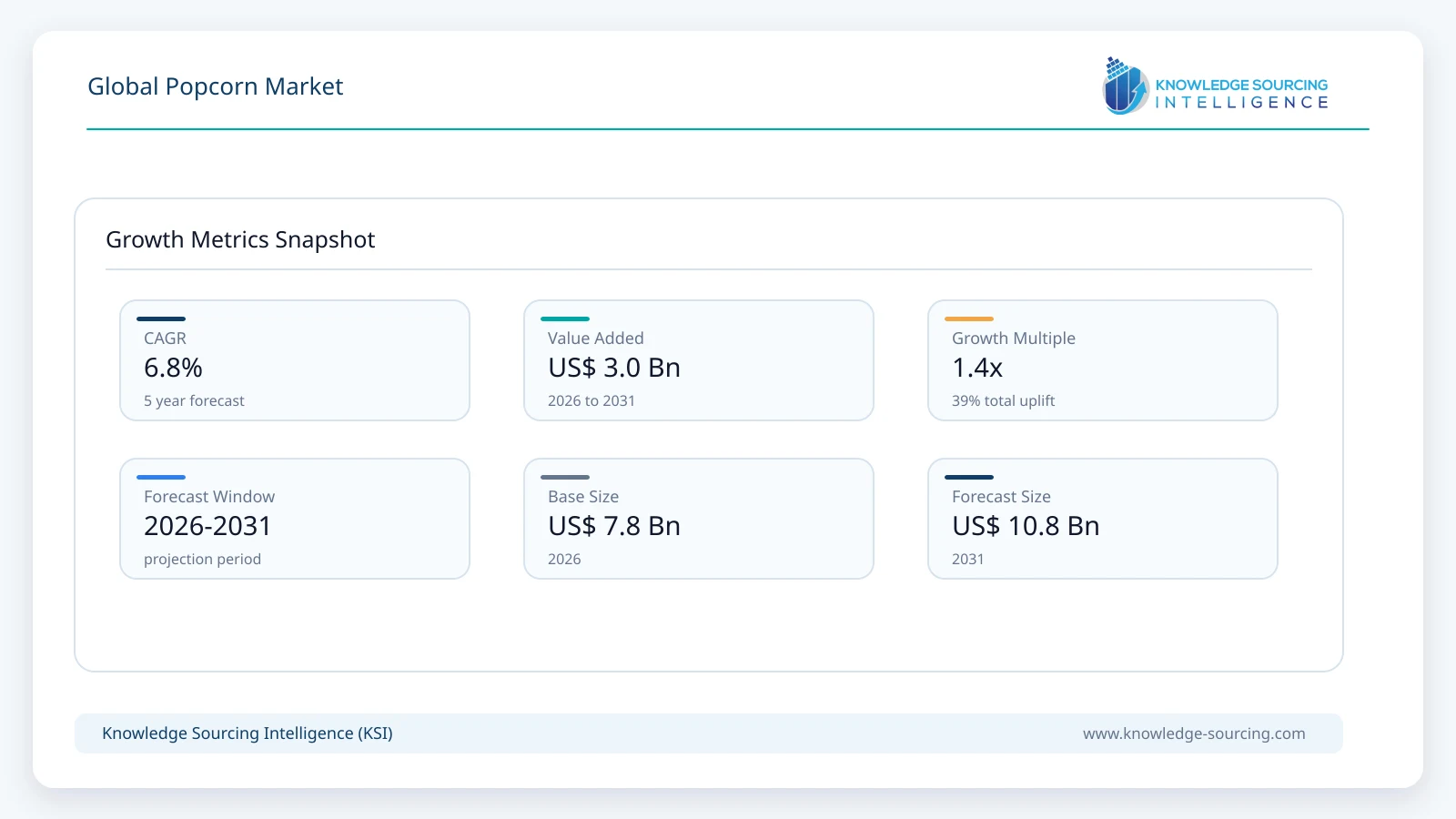
The global popcorn market is forecast to grow at a CAGR of 6.80%, reaching USD 10.84 billion in 2031 from USD 7.80 billion in 2026.
Highlights:
- 1Rising consumer preference for convenient, portion-controlled snack products continues to support demand for ready-to-eat and microwave popcorn.
- 2Ready-to-eat popcorn remains the leading commercial segment due to convenience, premium flavor innovation, and expanding retail availability.
- 3North America represents the largest regional market, supported by established consumption habits, organized retail infrastructure, and strong brand recognition.
- 4Product development increasingly emphasizes clean-label ingredients, non-GMO popcorn kernels, reduced sodium formulations, and innovative seasoning combinations.
- 5Food labeling regulations and nutrition disclosure requirements are encouraging manufacturers to improve ingredient transparency and packaging compliance.
- 6Competition increasingly depends on flavor innovation, premium positioning, retail partnerships, and expansion across online and convenience retail channels.
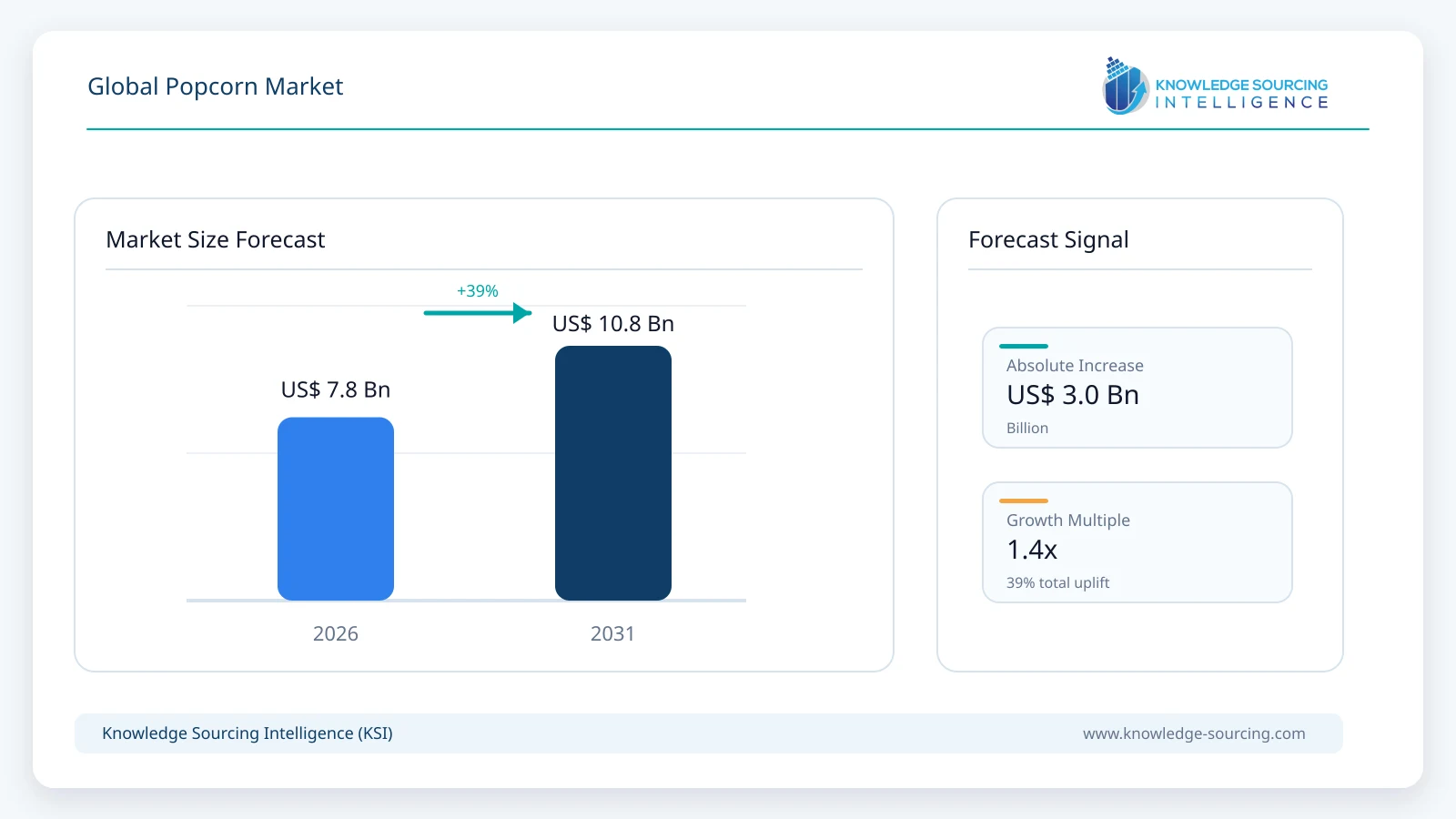
The popcorn market represents a mature but continuously evolving segment of the global savory snacks industry, serving consumers across retail, foodservice, entertainment, and institutional channels. Popcorn remains one of the most widely consumed whole-grain snack products because it combines affordability, convenience, and versatility with a comparatively simple ingredient profile. Product offerings have expanded well beyond traditional butter-flavored microwave popcorn to include ready-to-eat (RTE) formats, kettle corn, premium gourmet varieties, organic products, and clean-label formulations. Manufacturers are also introducing innovative seasoning blends, portion-controlled packaging, and products formulated with non-GMO corn or reduced sodium to address changing consumer preferences.
Demand is supported by households seeking convenient snacks, office workers purchasing portable food products, cinema operators, convenience retailers, and consumers replacing conventional fried snacks with alternatives perceived as containing fewer ingredients and more whole grains. Purchasing decisions increasingly reflect taste diversity, ingredient transparency, calorie content, packaging convenience, and brand familiarity. Premium products with natural seasonings and limited artificial additives are attracting health-conscious consumers, while value-oriented offerings continue to maintain strong demand in mass retail channels.
Industry economics are influenced by agricultural commodity prices, particularly popcorn kernels, edible oils, sugar, seasonings, and flexible packaging materials. Crop quality, weather conditions, transportation costs, and energy prices directly affect manufacturing margins. Companies therefore maintain diversified procurement networks and long-term supplier relationships to improve supply stability and manage raw material volatility.
Commercial competition extends beyond pricing. Product innovation, retail shelf positioning, merchandising programs, promotional campaigns, flavor differentiation, packaging innovation, and omnichannel distribution determine market performance. Major manufacturers also compete by expanding convenience-oriented product portfolios, strengthening retailer partnerships, and increasing investments in premium snack categories where consumers demonstrate greater willingness to pay.
Ready-to-eat popcorn has reshaped category dynamics by eliminating preparation time while supporting impulse purchases across supermarkets, convenience stores, airports, and online platforms. Microwave popcorn continues to generate substantial household demand due to its affordability and familiarity, while kettle corn and specialty products benefit from consumer interest in artisanal flavors and gifting occasions. Digital commerce further broadens product accessibility by allowing brands to introduce limited-edition flavors, subscription purchases, and direct-to-consumer offerings without relying exclusively on traditional retail networks.
The market also reflects broader consumer trends toward portion control and mindful snacking. While popcorn is not universally positioned as a health food, its whole-grain characteristics, relatively simple ingredient base, and adaptability to different flavor profiles support continued consumer interest. As retailers expand snack assortments and manufacturers invest in differentiated products, commercial opportunities increasingly depend on balancing value, convenience, ingredient quality, and innovation rather than competing solely on price.
Market Drivers
Growing Consumer Preference for Convenient Snacking
Changing work patterns, busy lifestyles, and increased consumption of snacks between meals have strengthened demand for popcorn products requiring minimal preparation. Consumers increasingly seek products that fit flexible eating occasions at home, in workplaces, during travel, and while streaming entertainment. Ready-to-eat popcorn addresses these requirements by offering portability and immediate consumption, while microwave popcorn remains a preferred household option because of its ease of preparation.
Manufacturers have responded by expanding package sizes, introducing resealable pouches, and offering multi-pack formats suitable for families and individual consumers. Retailers also allocate greater shelf space to premium snack categories with higher turnover and attractive margins. This commercial environment encourages continued investment in product innovation and merchandising initiatives.
Expansion of Premium and Better-for-You Snack Categories
Consumers are placing greater emphasis on ingredient quality, nutritional transparency, and balanced indulgence when selecting packaged snacks. Popcorn manufacturers have introduced products containing avocado oil, olive oil, organic kernels, natural seasonings, and fewer artificial ingredients to appeal to health-conscious buyers without sacrificing flavor.
Premium positioning allows suppliers to differentiate products beyond price while improving average selling prices. Retailers also benefit from diversified product assortments that appeal to consumers across multiple income segments. This trend supports sustained investment in premium product development, specialty retail partnerships, and enhanced packaging quality.
Flavor Innovation Expands Consumer Engagement
Flavor innovation has become an important commercial strategy within the popcorn industry. Manufacturers continue introducing sweet, savory, spicy, regional, and limited-edition flavor profiles to encourage repeat purchases and attract younger consumers seeking variety.
Seasonal launches, collaboration-based flavors, and gourmet product lines help brands strengthen consumer engagement while improving shelf visibility. Continuous innovation reduces dependence on traditional butter-flavored products and enables companies to compete across premium snack categories with higher profit margins.
Expansion of Organized Retail and Online Distribution
Large supermarket chains, warehouse clubs, convenience stores, and e-commerce platforms have broadened consumer access to popcorn products across developed and emerging markets. Organized retail enables manufacturers to showcase broader product portfolios, while online platforms facilitate premium assortment expansion and direct consumer engagement.
Digital commerce also supports product discovery through subscription services, promotional campaigns, and personalized recommendations. Manufacturers increasingly integrate digital marketing with retail partnerships to improve brand visibility and customer retention.
Market Restraints and Challenges
Agricultural Commodity Price Volatility
Popcorn production depends heavily on agricultural commodities whose prices fluctuate due to weather conditions, transportation costs, fuel prices, and harvest yields. Corn quality, edible oils, sugar, flavoring ingredients, and packaging materials all influence manufacturing costs.
Frequent input cost fluctuations create pricing challenges for manufacturers operating under long-term retail supply agreements. While some companies hedge commodity purchases or diversify sourcing, prolonged inflationary pressures can reduce profitability and delay product investments.
Competition from Alternative Snack Categories
Consumers have access to an expanding variety of snack products including potato chips, tortilla chips, pretzels, nuts, protein snacks, baked snacks, and cereal-based products. This intense competition requires popcorn manufacturers to continually justify shelf space and maintain consumer attention.
Retailers regularly review product performance and may replace slower-moving stock with faster-selling alternatives. Consequently, manufacturers must sustain product innovation, promotional investments, and competitive pricing strategies to protect market share.
Supply Chain and Packaging Challenges
Global supply chains continue experiencing periodic disruptions affecting transportation, packaging availability, and manufacturing schedules. Flexible packaging films, cartons, flavor ingredients, and edible oils remain vulnerable to cost fluctuations and procurement delays.
Manufacturers mitigate these risks through supplier diversification, inventory planning, regional sourcing strategies, and operational efficiency improvements. Nevertheless, supply uncertainty can increase production costs and complicate promotional planning.
Nutrition Perception and Consumer Expectations
Although popcorn is widely recognized as a whole-grain snack, flavored products containing high levels of sodium, butter flavoring, caramel coatings, or added sugar may face scrutiny from nutrition-conscious consumers. Buyers increasingly examine ingredient labels and nutritional information before purchasing packaged foods.
Manufacturers therefore balance flavor development with nutritional improvements by introducing lower-sodium formulations, cleaner ingredient lists, and portion-controlled packaging. Achieving this balance while maintaining taste expectations remains a continuing commercial challenge.
Major Segment Analysis
Ready-to-Eat (RTE) Popcorn
Ready-to-eat popcorn represents the most commercially influential product segment because it aligns with changing consumer purchasing behavior centered on convenience, portability, and immediate consumption. Unlike microwave popcorn, RTE products eliminate preparation requirements and suit multiple consumption occasions including workplaces, schools, travel, sporting events, cinemas, and home entertainment.
Retail demand for RTE popcorn continues to expand because the category supports premium pricing through flavor differentiation, healthier ingredient positioning, and attractive packaging formats. Consumers increasingly select products featuring sea salt, aged cheese, caramel, spicy seasonings, organic ingredients, or specialty oils, allowing manufacturers to introduce higher-value product lines with improved margins.
Retail buyers favor RTE products because they generate impulse purchases and fit well within checkout displays, snack aisles, and convenience store merchandising strategies. The segment also benefits from strong compatibility with online grocery platforms, where premium products receive greater product visibility through digital merchandising and targeted marketing.
Competitive differentiation within this segment increasingly depends on ingredient transparency, innovative seasoning combinations, sustainable packaging initiatives, and premium branding rather than production scale alone. Companies capable of consistently introducing differentiated products while maintaining quality standards are well positioned to strengthen retailer relationships and expand consumer loyalty.
Regional Analysis
North America
North America remains the largest regional market due to established popcorn consumption habits, extensive retail infrastructure, and strong consumer familiarity with microwave and ready-to-eat products. The United States accounts for the majority of regional demand, supported by widespread household consumption, cinema attendance, sports venues, and an extensive convenience retail network. Premium snack trends, clean-label products, and continued flavor innovation further support category expansion. Large manufacturers also benefit from well-developed agricultural supply chains and efficient distribution systems.
Europe
European demand is supported by growing consumer interest in convenient snack products with recognizable ingredients and portion-controlled packaging. Supermarkets and discount retailers continue expanding premium snack assortments, creating opportunities for flavored popcorn and gourmet offerings. Buyers increasingly consider ingredient sourcing, nutritional labeling, and packaging sustainability during purchasing decisions. Regulatory emphasis on food labeling and packaging compliance encourages manufacturers to invest in product reformulation and transparent ingredient disclosures.
Asia Pacific
Asia Pacific presents attractive long-term growth opportunities as urbanization, organized retail expansion, rising disposable incomes, and Western-style snacking habits increase packaged snack consumption. Countries including China, India, Japan, and South Korea continue experiencing growth in modern retail formats and e-commerce, improving market accessibility for domestic and international popcorn brands. Manufacturers are introducing locally inspired flavor profiles to align products with regional taste preferences while expanding brand recognition among younger consumers.
South America
South America demonstrates steady demand growth supported by expanding supermarket networks, rising urban populations, and increasing availability of packaged snack products. Brazil represents the largest regional market owing to its sizeable consumer base and growing organized retail sector. Economic volatility and inflationary pressures remain important purchasing considerations, encouraging manufacturers to balance premium product innovation with competitively priced offerings. Continued investment in retail infrastructure and food processing capacity is expected to improve long-term commercial opportunities across the region.
Competitive Landscape
The popcorn market is characterized by competition between established branded manufacturers, private-label suppliers, and specialty snack companies. Competitive positioning is determined by product quality, flavor innovation, retail distribution, manufacturing efficiency, brand recognition, and the ability to respond to changing consumer preferences. While microwave popcorn remains an important category, ready-to-eat popcorn has become a primary area of competition as consumers increasingly seek convenient snack options requiring no preparation.
Manufacturers differentiate their portfolios through premium ingredients, proprietary seasoning blends, non-GMO popcorn kernels, organic offerings, reduced-sodium formulations, and innovative package formats. Product launches frequently target specific consumer segments, including families, health-conscious buyers, and younger consumers seeking novel flavor experiences. Seasonal products and limited-edition flavors also help brands generate incremental sales while strengthening retailer engagement.
Distribution remains a strategic advantage. Companies continue expanding relationships with hypermarkets, supermarkets, convenience stores, warehouse clubs, specialty retailers, and online grocery platforms. Omnichannel availability improves product visibility and supports broader consumer reach, while direct-to-consumer channels provide opportunities to introduce premium and specialty products.
Operational efficiency also influences competitive performance. Manufacturers invest in supply chain resilience, procurement diversification, automated production facilities, and packaging improvements to manage input cost volatility while maintaining product quality. Sustainability initiatives—including recyclable packaging, responsible ingredient sourcing, and manufacturing efficiency improvements—are becoming increasingly important as retailers and consumers place greater emphasis on environmental performance.
Competition among Smartfoods, Inc. (PepsiCo, Inc.), Orville Redenbacher's (Conagra Brands, Inc.), Pop Secret (Our Home, Inc.), Angie's BOOMCHICKAPOP (Conagra Brands, Inc.), Weaver Popcorn Bulk, LLC, Black Jewell Popcorn, LesserEvil, LLC, and Utz Brands, Inc. reflects a balance between large-scale manufacturing capabilities and differentiated premium offerings. Larger companies benefit from extensive distribution networks and marketing resources, while specialty brands compete through ingredient transparency, niche positioning, and product innovation.
Recent Developments
August 2025: Conagra Brands released its inaugural Future of Snacking 2025 report, highlighting consumer demand for globally inspired flavors, better-for-you snacks, and on-the-go consumption patterns across brands including Orville Redenbacher's and Angie's BOOMCHICKAPOP. The findings reinforce continued investment in premium popcorn innovation and category expansion.
February 2026: Conagra Brands reaffirmed its fiscal 2026 business outlook while previewing a pipeline of new food and snack innovations planned for calendar year 2026. Continued investment in product innovation supports competitive differentiation within branded popcorn and broader snack categories.
May 2026: At the National Confectioners Association Sweets & Snacks Expo, Conagra Brands introduced new Orville Redenbacher's Cheddar Jalapeño seasoning and new Angie's BOOMCHICKAPOP Mango Habanero and Cinnamon Churro ready-to-eat popcorn flavors. The launches demonstrate continued emphasis on flavor innovation and premium value-added offerings.
Regulatory and Policy Environment
The popcorn market operates within comprehensive food safety and labeling frameworks that govern ingredient quality, manufacturing practices, packaging, and consumer information. Compliance requirements vary by jurisdiction but generally encompass food hygiene, traceability, allergen declaration, nutritional labeling, and contaminant control.
In the United States, manufacturers comply with food safety regulations administered by the U.S. Food and Drug Administration (FDA), including Current Good Manufacturing Practices (CGMPs), preventive controls under the Food Safety Modernization Act (FSMA), and mandatory nutrition labeling. Companies supplying popcorn products containing allergens or flavored seasonings must ensure accurate ingredient declarations and allergen disclosures to support consumer safety.
Within the European Union, food manufacturers comply with regulations covering food information provided to consumers, traceability requirements, hygiene standards, and permitted food additives. Increasing regulatory attention to packaging sustainability and environmental performance is encouraging manufacturers to reduce packaging waste, improve recyclability, and evaluate alternative materials without compromising product shelf life.
Many international markets also maintain maximum residue limits for agricultural products, import inspection requirements, and labeling standards governing nutritional claims such as "organic," "whole grain," or "non-GMO." Companies exporting popcorn products must therefore adapt packaging and documentation to individual country requirements.
Government initiatives promoting healthier dietary choices have encouraged manufacturers to reformulate products by reducing sodium, limiting artificial ingredients, and improving nutritional transparency. Although these measures may increase reformulation costs, they also create opportunities for differentiated premium products aligned with evolving consumer expectations.
Outlook and Strategic Implications
The popcorn market is expected to maintain steady commercial expansion over the forecast period as consumers continue incorporating convenient packaged snacks into daily eating habits. Demand growth will increasingly depend on product differentiation rather than consumption volume alone, encouraging manufacturers to invest in premium positioning, innovative flavor development, and improved ingredient quality.
Investment priorities are expected to focus on manufacturing automation, supply chain resilience, packaging innovation, and digital retail capabilities. Companies capable of improving production efficiency while responding quickly to evolving consumer preferences will strengthen competitive positioning. Procurement strategies are also likely to emphasize diversified agricultural sourcing to reduce exposure to weather-related supply disruptions and commodity price volatility.
Technology adoption within the industry will primarily support operational efficiency rather than fundamental product transformation. Advanced quality control systems, automated packaging lines, demand forecasting tools, and data-driven inventory management are expected to improve production planning and reduce operating costs. Digital commerce analytics will further assist manufacturers in identifying regional purchasing trends and optimizing product assortments.
Competitive dynamics will continue shifting toward premium and value-added offerings. Consumers increasingly evaluate popcorn products based on flavor variety, ingredient transparency, nutritional profile, and sustainability credentials alongside price. Manufacturers that successfully combine these attributes with broad retail availability are likely to strengthen customer loyalty and improve category performance.
Several risks remain relevant, including agricultural supply uncertainty, transportation costs, packaging inflation, changing consumer preferences, and intense competition from alternative snack categories. Nevertheless, the industry's established consumer base, expanding premium segment, and continued retail innovation provide a favorable commercial foundation.
Over the next five years, successful companies are expected to balance operational discipline with targeted product innovation, strengthen omnichannel distribution, enhance procurement resilience, and continue investing in differentiated product portfolios that address evolving consumer expectations across both mature and emerging markets.
Popcorn Market Scope
| Report Metric | Details |
|---|---|
| Total Market Size in 2026 | USD 7.80 billion |
| Total Market Size in 2031 | USD 10.84 billion |
| Forecast Unit | Billion |
| Growth Rate | 6.80% |
| Study Period | 2021 to 2031 |
| Historical Data | 2021 to 2024 |
| Base Year | 2025 |
| Forecast Period | 2026 – 2031 |
| Segmentation | Product Type, Distribution Channel, Geography |
| Geographical Segmentation | North America, South America, Europe, Middle East and Africa, Asia Pacific |
| Companies |
|
Market Segmentation
By Product Type
- Microwave Popcorn
- Ready-to-Eat (RTE) Popcorn
- Kettle Corn
- Others
By Distribution Channel
- Hypermarkets and Supermarkets
- Convenience Stores
- Online Retail
- Specialty Stores
- Others
By Geography
- North America
- United States
- Canada
- Mexico
- South America
- Brazil
- Argentina
- Others
- Europe
- United Kingdom
- Germany
- France
- Italy
- Spain
- Others
- Middle East and Africa
- Saudi Arabia
- UAE
- Others
- Asia Pacific
- Japan
- China
- India
- South Korea
- Taiwan
- Thailand
- Indonesia
- Others
Geographical Segmentation
North America, South America, Europe, Middle East and Africa, Asia Pacific
Table of Contents
1. INTRODUCTION
1.1. Market Overview
1.2. Market Definition
1.3. Scope of the Study
1.4. Market Segmentation
1.5. Currency
1.6. Assumptions
1.7. Base and Forecast Years Timeline
1.8. Key Benefits to the Stakeholders
2. RESEARCH METHODOLOGY
2.1. Research Design
2.2. Research Processes
3. EXECUTIVE SUMMARY
3.1. Key Findings
3.2. Analyst View
4. MARKET DYNAMICS
4.1. Market Drivers
4.2. Market Restraints
4.3. Porter’s Five Forces Analysis
4.3.1. Bargaining Power of Suppliers
4.3.2. Bargaining Power of Buyers
4.3.3. Threat of New Entrants
4.3.4. Threat of Substitutes
4.3.5. Competitive Rivalry in the Industry
4.4. Industry Value Chain Analysis
5. GLOBAL POPCORN MARKET BY PRODUCT TYPE
5.1. Introduction
5.2. Microwave Popcorn
5.2.1. Market Trends and Opportunities
5.2.2. Growth Prospects
5.2.3. Geographic Lucrativeness
5.3. Ready-to-Eat (RTE) Popcorn
5.3.1. Market Trends and Opportunities
5.3.2. Growth Prospects
5.3.3. Geographic Lucrativeness
5.4. Kettle Corn
5.4.1. Market Trends and Opportunities
5.4.2. Growth Prospects
5.4.3. Geographic Lucrativeness
5.5. Others
5.5.1. Market Trends and Opportunities
5.5.2. Growth Prospects
5.5.3. Geographic Lucrativeness
6. GLOBAL POPCORN MARKET BY DISTRIBUTION CHANNEL
6.1. Introduction
6.2. Hypermarkets and Supermarkets
6.2.1. Market Trends and Opportunities
6.2.2. Growth Prospects
6.2.3. Geographic Lucrativeness
6.3. Convenience Stores
6.3.1. Market Trends and Opportunities
6.3.2. Growth Prospects
6.3.3. Geographic Lucrativeness
6.4. Online Retail
6.4.1. Market Trends and Opportunities
6.4.2. Growth Prospects
6.4.3. Geographic Lucrativeness
6.5. Specialty Stores
6.5.1. Market Trends and Opportunities
6.5.2. Growth Prospects
6.5.3. Geographic Lucrativeness
6.6. Others
6.6.1. Market Trends and Opportunities
6.6.2. Growth Prospects
6.6.3. Geographic Lucrativeness
7. GLOBAL POPCORN MARKET BY GEOGRAPHY
7.1. Introduction
7.2. North America
7.2.1. By Product Type
7.2.2. By Distribution Channel
7.2.3. By Country
7.2.3.1. United States
7.2.3.1.1. Market Trends and Opportunities
7.2.3.1.2. Growth Prospects
7.2.3.2. Canada
7.2.3.2.1. Market Trends and Opportunities
7.2.3.2.2. Growth Prospects
7.2.3.3. Mexico
7.2.3.3.1. Market Trends and Opportunities
7.2.3.3.2. Growth Prospects
7.3. South America
7.3.1. By Product Type
7.3.2. By Distribution Channel
7.3.3. By Country
7.3.3.1. Brazil
7.3.3.1.1. Market Trends and Opportunities
7.3.3.1.2. Growth Prospects
7.3.3.2. Argentina
7.3.3.2.1. Market Trends and Opportunities
7.3.3.2.2. Growth Prospects
7.3.3.3. Others
7.3.3.3.1. Market Trends and Opportunities
7.3.3.3.2. Growth Prospects
7.4. Europe
7.4.1. By Product Type
7.4.2. By Distribution Channel
7.4.3. By Country
7.4.3.1. United Kingdom
7.4.3.1.1. Market Trends and Opportunities
7.4.3.1.2. Growth Prospects
7.4.3.2. Germany
7.4.3.2.1. Market Trends and Opportunities
7.4.3.2.2. Growth Prospects
7.4.3.3. France
7.4.3.3.1. Market Trends and Opportunities
7.4.3.3.2. Growth Prospects
7.4.3.4. Italy
7.4.3.4.1. Market Trends and Opportunities
7.4.3.4.2. Growth Prospects
7.4.3.5. Spain
7.4.3.5.1. Market Trends and Opportunities
7.4.3.5.2. Growth Prospects
7.4.3.6. Others
7.4.3.6.1. Market Trends and Opportunities
7.4.3.6.2. Growth Prospects
7.5. Middle East and Africa
7.5.1. By Product Type
7.5.2. By Distribution Channel
7.5.3. By Country
7.5.3.1. Saudi Arabia
7.5.3.1.1. Market Trends and Opportunities
7.5.3.1.2. Growth Prospects
7.5.3.2. UAE
7.5.3.2.1. Market Trends and Opportunities
7.5.3.2.2. Growth Prospects
7.5.3.3. Others
7.5.3.3.1. Market Trends and Opportunities
7.5.3.3.2. Growth Prospects
7.6. Asia Pacific
7.6.1. By Product Type
7.6.2. By Distribution Channel
7.6.3. By Country
7.6.3.1. Japan
7.6.3.1.1. Market Trends and Opportunities
7.6.3.1.2. Growth Prospects
7.6.3.2. China
7.6.3.2.1. Market Trends and Opportunities
7.6.3.2.2. Growth Prospects
7.6.3.3. India
7.6.3.3.1. Market Trends and Opportunities
7.6.3.3.2. Growth Prospects
7.6.3.4. South Korea
7.6.3.4.1. Market Trends and Opportunities
7.6.3.4.2. Growth Prospects
7.6.3.5. Taiwan
7.6.3.5.1. Market Trends and Opportunities
7.6.3.5.2. Growth Prospects
7.6.3.6. Thailand
7.6.3.6.1. Market Trends and Opportunities
7.6.3.6.2. Growth Prospects
7.6.3.7. Indonesia
7.6.3.7.1. Market Trends and Opportunities
7.6.3.7.2. Growth Prospects
7.6.3.8. Others
7.6.3.8.1. Market Trends and Opportunities
7.6.3.8.2. Growth Prospects
8. COMPETITIVE ENVIRONMENT AND ANALYSIS
8.1. Major Players and Strategy Analysis
8.2. Market Share Analysis
8.3. Mergers, Acquisitions, Agreements, and Collaborations
8.4. Competitive Dashboard
9. COMPANY PROFILES
9.1. Smartfoods, Inc. (PepsiCo, Inc.)
9.2. Orville Redenbacher's (Conagra Brands, Inc.)
9.3. Pop Secret (Our Home, Inc.)
9.4. Angie's BOOMCHICKAPOP (Conagra Brands, Inc.)
9.5. Weaver Popcorn Bulk, LLC
9.6. Black Jewell Popcorn
9.7. LesserEvil, LLC
9.8. Utz Brands, Inc.
Navigate
Trusted by the world's leading organizations











