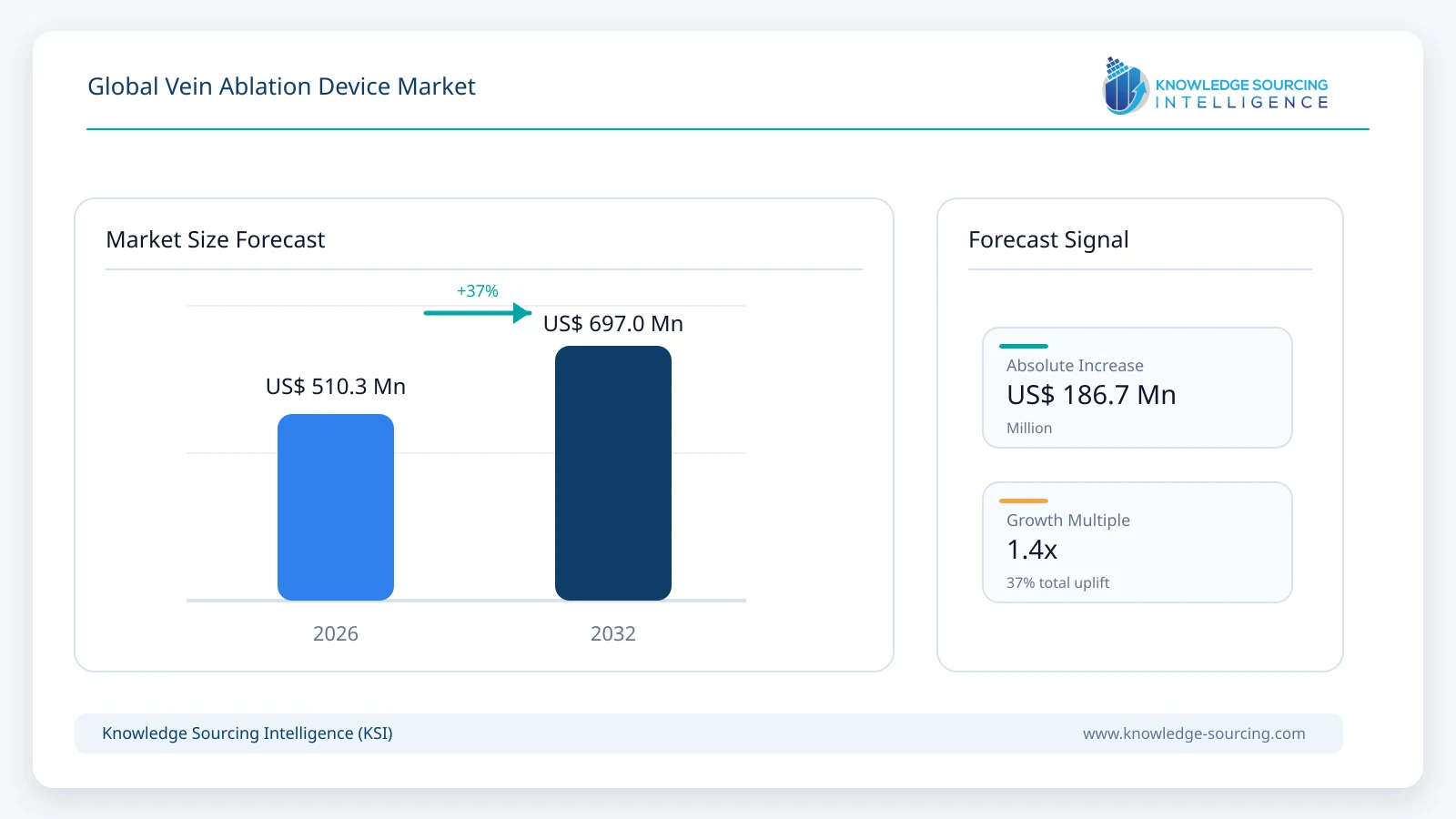
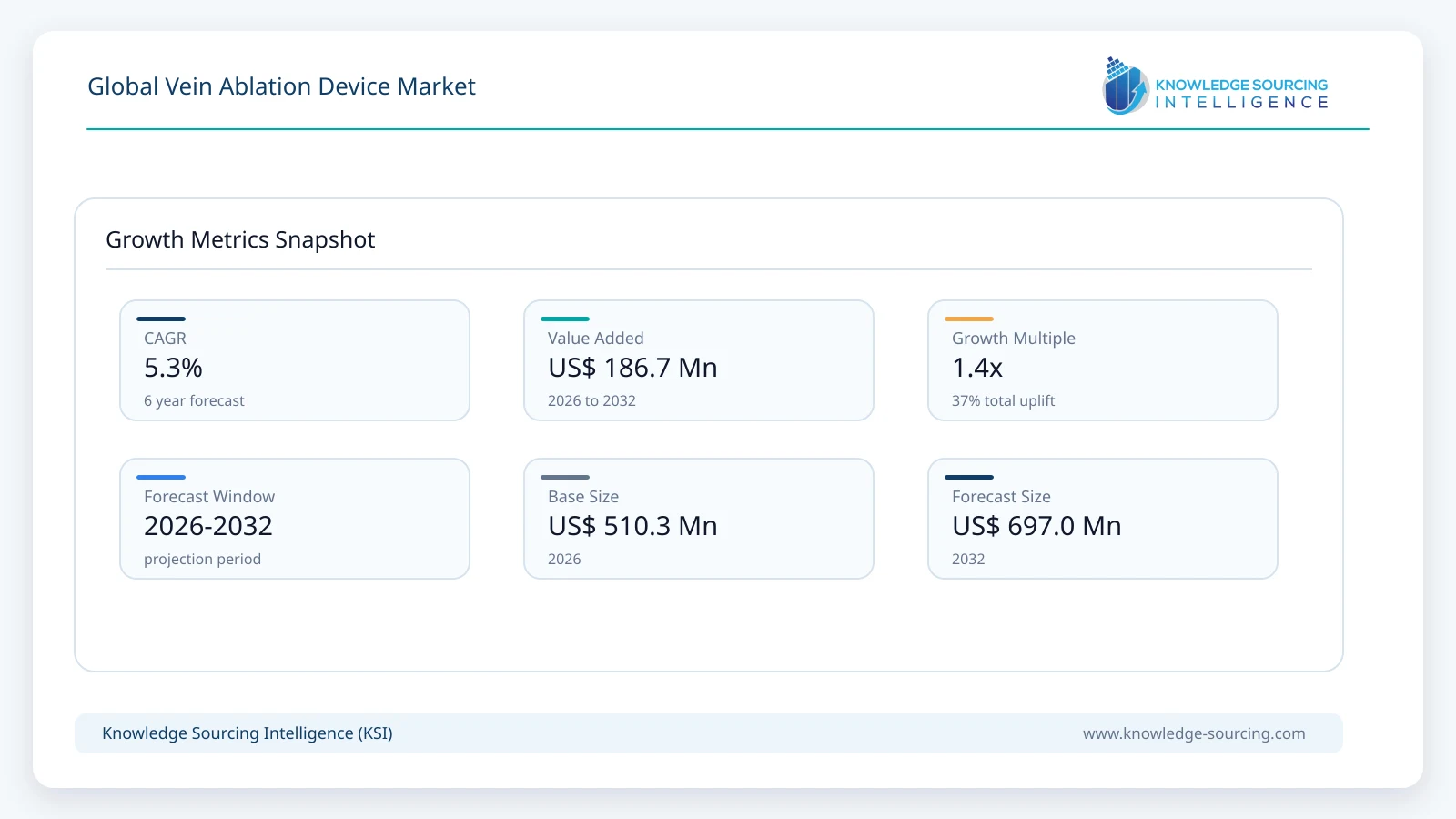
The global vein ablation device market is projected to grow from US$510.27 million in 2026 to US$697.00 million by 2032, at a CAGR of 5.33% during the forecast period.
Highlights:
- 1Radiofrequency ablationRFA accounts for an estimated 35.6% of global device revenue in 2026, making it the largest individual treatment segment.
- 2Endovenous laser ablationThe EVLA segment is estimated at US$141.25 million in 2026.
- 3Nonthermal nontumescent treatmentThe combined cyanoacrylate and mechanochemical segment is projected to grow at a CAGR of 7.54% between 2026 and 2032.
- 4North AmericaRegional device revenue is estimated at US$224.19 million in 2026.
- 5Asia PacificRegional revenue is projected to register a CAGR of 7.35% during 2026–2032.
- 6Cyanoacrylate closureThe adhesive-based device segment is projected to reach US$270.06 million by 2032.
Market Analysis
Radiofrequency remains the principal revenue segment
Radiofrequency ablation revenue is estimated at US$181.42 million in 2026 and is projected to reach US$227.92 million in 2032, representing a CAGR of 3.88%. Its share falls from 35.6% to 32.7% over the forecast period as nonthermal devices expand more rapidly. RFA therefore remains a substantial recurring consumables business even as the market becomes more diversified. Its commercial position rests on established physician workflows, access to generators and a supply chain built around procedure-specific catheters.
An installed generator can support repeated procedures, so catheter utilization matters more than equipment shipments alone. Suppliers that maintain training, dependable inventory and a consistent treatment workflow can protect customer relationships. However, the installed base does not guarantee a fixed selling price. Purchasing groups compare catheter costs, service commitments and alternative technologies; authorized reprocessing can also reduce the number of new OEM catheters purchased per procedure. As a result, treatment volumes can rise while new-device revenue grows more slowly.
Competition within RFA includes Medtronic’s ClosureFast platform, BD’s Venclose portfolio and F Care Systems’ EVRF products. These suppliers do not participate with identical product configurations or geographic access. Catheter dimensions, generator compatibility, treatment workflow and training affect product choice, while local indications and distribution determine where each supplier can compete.
Nonthermal devices alter the revenue mix
Nonthermal nontumescent devices are projected to increase from US$187.60 million in 2026 to US$290.17 million in 2032. Cyanoacrylate closure contributes most of this segment’s revenue and growth. The category can appeal to providers seeking to avoid thermal energy and tumescent anesthesia, but its value proposition depends on clinical suitability, procurement cost and payer eligibility. A more expensive delivery kit needs to earn its place through the overall treatment pathway and patient selection; a premium price alone does not establish superior economics.
Mechanochemical ablation combines mechanical action with delivery of an agent and has a different cost structure from adhesive closure. Merit Medical Systems offers ClariVein catheters in this category. Their commercial reach depends on local product indications, physician adoption and access to suitable treatment settings. The device component also faces a different purchasing decision from adhesive closure, where the delivery kit carries a larger share of the procedure-specific cost.
Laser competition centers on consumable economics
Endovenous laser ablation revenue is projected to rise from US$141.25 million in 2026 to US$178.90 million in 2032, a CAGR of 4.02%. The segment contains established suppliers such as AngioDynamics and biolitec, alongside laser platforms offered by MedArt and Eufoton. Fiber design, generator compatibility and reliable local distribution influence purchasing. A relatively accessible fiber price can support adoption in cost-sensitive facilities, while manufacturers must manage the pressure that tendering and competing consumables place on revenue per case.
Market Drivers and Restraints
The principal demand driver is access to treatment for clinically eligible patients with superficial venous reflux. Diagnosis, referral and an adequately staffed treatment service determine how much underlying disease becomes device demand. Prevalence estimates alone cannot establish the number of procedures performed in a year. Commercial expansion requires ultrasound assessment, trained practitioners, appropriate facilities and a funding route that enables treatment.
Outpatient delivery supports the market by allowing providers to organize treatment around shorter clinical encounters and repeatable workflows. For suppliers, this creates recurring demand for procedure-specific consumables and makes dependable stock availability commercially important. Provider capacity remains a constraint: staffing, imaging access and appointment availability can limit treatment throughput even where demand exists. Expansion of a clinic network creates device opportunities only when it results in actual treated cases.
Reimbursement and documentation requirements influence conversion from consultation to treatment. Coverage may depend on symptoms, diagnostic findings and local medical-necessity rules. A March 2026 Medicare contractor billing reminder reinforces the commercial relevance of documentation for thermal ablation claims. Reimbursement pressure can slow adoption of higher-priced devices when providers cannot recover the added treatment cost through the permitted care pathway.
Price pressure limits revenue expansion as distributors, tenders and purchasing groups negotiate consumable contracts. In higher-cost treatment categories, adoption may depend on whether the procedure’s workflow benefits justify the incremental kit expense. Clinical suitability, product labeling and availability of alternative treatments further constrain addressable demand. These factors produce different growth paths by modality rather than uniform expansion across all ablation technologies.
Technology and Purchasing Economics
Single-use devices generate most recurring sales. Catheter or fiber demand follows treated cases, while new generator demand depends on clinic openings, replacement cycles and platform changes. Manufacturers may place generators under contracts tied to consumable purchases, increasing the importance of continuing case volume. Multifunction laser and radiofrequency platforms can strengthen a distributor’s offer when the same service network supports several clinical applications.
Purchasing decisions reflect a combination of acquisition cost, permitted clinical use, staff familiarity, service coverage and supply reliability. A low headline device price can lose its advantage if compatibility restrictions or supply interruptions disrupt throughput. Conversely, a premium device requires a clear role within a provider’s patient mix. Hospitals, ambulatory surgery centers and specialized clinics therefore need separate commercial analysis even where they use the same technology.
End User Analysis
Hospitals serve patients through inpatient and outpatient departments and can offer access to a broader vascular service. Ambulatory surgery centers organize procedures around dedicated surgical facilities and contracted purchasing arrangements. Specialized vein and vascular clinics focus on consultation, ultrasound assessment and treatment within a concentrated outpatient workflow. Hospital-affiliated outpatient clinics can follow a distinct purchasing process from the parent hospital, adding another route to device adoption.
For suppliers, each setting creates a different route to demand. Hospitals may require formal vendor approval and wider procurement agreements, while specialist practices can place greater weight on physician preference and case scheduling. ASCs balance device cost against facility throughput and payer contracts. Training and product availability remain relevant across settings, particularly when a clinic depends on a small number of practitioners and needs predictable procedure scheduling.
Regional Market Analysis
North America accounts for an estimated 43.9% of global revenue in 2026, supported by a substantial procedure base and higher device revenue per treatment. The regional market is projected to reach US$295.74 million in 2032. Its value depends on treatment access, technology selection and payer rules rather than population alone. Providers across office-based practices, ambulatory surgery centers and hospital outpatient departments create several routes to market for device suppliers.
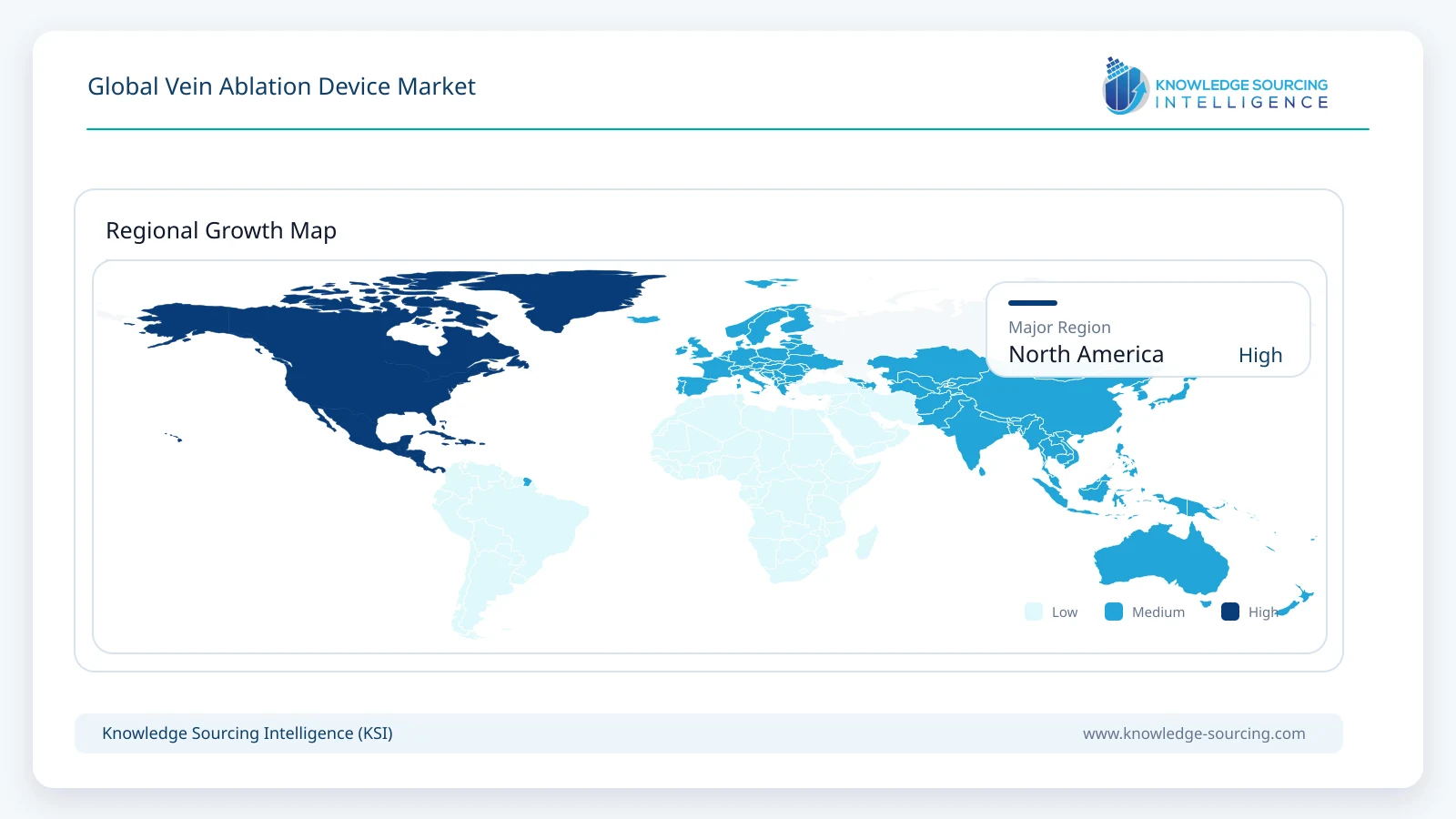
Europe is estimated at US$144.22 million in 2026 and is projected to reach US$185.90 million by 2032. Purchasing conditions vary across public tenders, private clinics and national reimbursement systems. Laser and radiofrequency platforms compete through established distribution and treatment familiarity, while nonthermal devices must demonstrate a commercially workable role within local care pathways. A single regional price would obscure these differences.
Asia Pacific is projected to expand from US$84.32 million to US$129.05 million during 2026–2032. Treatment capacity, specialist access and price-sensitive procurement shape its development. Japan’s vascular registry confirms substantial established procedure activity, while the wider region contains markets with very different levels of service availability. Provider capacity and funded treatment volumes are likely to concentrate growth in markets with established diagnostic and outpatient services.
South America is estimated at US$33.77 million in 2026, increasing to US$48.88 million in 2032. The Middle East and Africa region increases from US$23.77 million to US$37.43 million over the same period. Distributor reach, specialist infrastructure and the affordability of imported consumables influence commercial access in both regions. Expansion is likely to concentrate where a functioning diagnostic and treatment pathway supports repeat device utilization.
Competitive Landscape
Competition is organized around treatment platforms and the recurring sale of procedure-specific devices. Medtronic combines the established ClosureFast radiofrequency system with the VenaSeal adhesive closure portfolio, giving it access to both thermal and nonthermal demand. BD competes through its Venclose radiofrequency catheters, while F Care Systems offers EVRF radiofrequency products. Across these platforms, physicians weigh treatment workflow, generator compatibility and catheter performance; purchasing teams focus on total device cost, supply reliability and service response.
In endovenous laser ablation, AngioDynamics and biolitec compete through established fiber and laser offerings, with MedArt and Eufoton also serving this technology category. The commercial contest is shaped by fiber pricing, distributor reach, equipment support and the ability to keep consumables available across dispersed treatment sites. Merit Medical Systems participates in mechanochemical treatment through ClariVein. Technology choice varies with clinical suitability and local funding, so a supplier’s position depends on its approved portfolio and ability to support repeat procedures in each market.
Recent Developments
October 2026: Medtronic announced prospective, global clinical evidence from its Spectrum Program for the VenaSeal™ closure system in advanced chronic venous disease. The announcement strengthens the company's evidence strategy for adhesive closure, following expanded U.S. payer coverage that now reaches 96% of commercially and Medicare-insured lives
March 2026: A US Medicare contractor issued a reminder on vein ablation billing and medical-necessity documentation, highlighting the continuing importance of claim support for treatment access.
November 2025: Italy’s ASL CN1 published a procurement notice for biolitec ELVeS radial consumables, reflecting continued purchasing interest in endovenous laser supplies.
August 2023: Medtronic announced US FDA clearance for an updated ClosureFast radiofrequency catheter, illustrating continued development within the established thermal treatment category.
The global vein ablation device market Scope:
| Report Metric | Details |
|---|---|
| Total Market Size in 2026 | US$510.27 million |
| Total Market Size in 2032 | US$697.00 million |
| Forecast Unit | Million |
| Growth Rate | 5.33% |
| Study Period | 2021 to 2032 |
| Historical Data | 2021 to 2024 |
| Base Year | 2025 |
| Forecast Period | 2026 – 2032 |
| Segmentation | Treatment Type, Revenue Component, End User, Geography |
| Companies |
|
Market Segmentation
By Treatment Type
Radiofrequency Ablation
Endovenous Laser Ablation
Nonthermal Nontumescent Ablation
Cyanoacrylate Closure
Mechanochemical Ablation
By Revenue Component
Procedure-Specific Consumables
Generators and Capital Equipment
By End User
Hospitals
Ambulatory Surgery Centers
Specialized Vein and Vascular Clinics
By Geography
North America
United States
Canada
Mexico
South America
Brazil
Argentina
Others
Europe
Germany
France
United Kingdom
Others
Middle East and Africa
Saudi Arabia
United Arab Emirates
Others
Asia Pacific
China
India
Japan
South Korea
Taiwan
Thailand
Indonesia
Others
Table of Contents
1. INTRODUCTION
1.1 Market Definition and Scope
1.2 Revenue Boundaries and Exclusions
1.3 Market Segmentation
1.4 Currency and Forecast Period
2. RESEARCH METHODOLOGY
2.1 Procedure Volume Assessment
2.2 Device Utilization and Net Price Assessment
2.3 Generator Revenue Assessment
2.4 Supplier Revenue Cross Checks
2.5 Forecast Drivers and Sensitivity Analysis
3. EXECUTIVE SUMMARY
3.1 Global Market Size and Forecast
3.2 Key Findings
3.3 Segment and Regional Outlook
4. MARKET DYNAMICS
4.1 Market Drivers
4.2 Market Restraints
4.3 Clinical Access and Reimbursement
4.4 Value Chain Analysis
4.5 Porter Five Forces Analysis
4.5.1 Bargaining Power of Suppliers
4.5.2 Bargaining Power of Buyers
4.5.3 Threat of New Entrants
4.5.4 Threat of Substitutes
4.5.5 Competitive Rivalry
5. MARKET BY TREATMENT TYPE
5.1 Radiofrequency Ablation
5.2 Endovenous Laser Ablation
5.3 Nonthermal Nontumescent Ablation
5.3.1 Cyanoacrylate Closure
5.3.2 Mechanochemical Ablation
6. MARKET BY REVENUE COMPONENT
6.1 Procedure Specific Consumables
6.2 Generators and Capital Equipment
7. MARKET BY END USER
7.1 Hospitals
7.2 Ambulatory Surgery Centers
7.3 Specialized Vein and Vascular Clinics
8. MARKET BY GEOGRAPHY
8.1 North America
8.1.1 United States
8.1.2 Canada
8.1.3 Mexico
8.2 South America
8.2.1 Brazil
8.2.2 Argentina
8.2.3 Other South American Markets
8.3 Europe
8.3.1 Germany
8.3.2 France
8.3.3 United Kingdom
8.3.4 Other European Markets
8.4 Middle East and Africa
8.4.1 Saudi Arabia
8.4.2 United Arab Emirates
8.4.3 Other Middle Eastern and African Markets
8.5 Asia Pacific
8.5.1 China
8.5.2 India
8.5.3 Japan
8.5.4 South Korea
8.5.5 Taiwan
8.5.6 Thailand
8.5.7 Indonesia
8.5.8 Other Asia Pacific Markets
9. COMPETITIVE ENVIRONMENT
9.1 Product and Technology Positioning
9.2 Ownership and Portfolio Developments
9.3 Distribution and Procurement
10. COMPANY PROFILES
10.1 Medtronic
10.2 BD including Venclose
10.3 AngioDynamics
10.4 biolitec
10.5 Merit Medical Systems
10.6 F Care Systems
10.7 MedArt
10.8 Eufoton
Navigate
Trusted by the world's leading organizations