
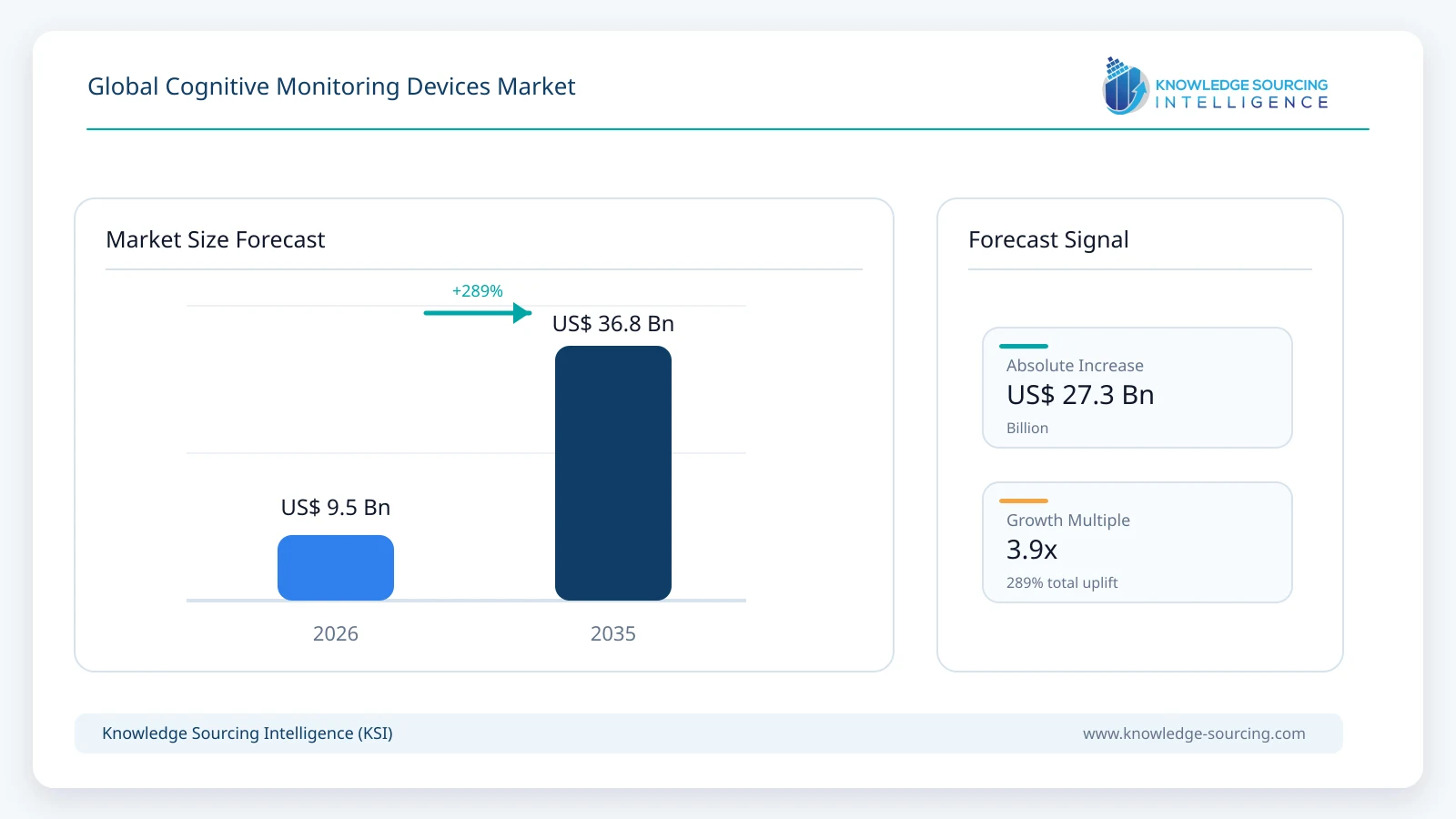
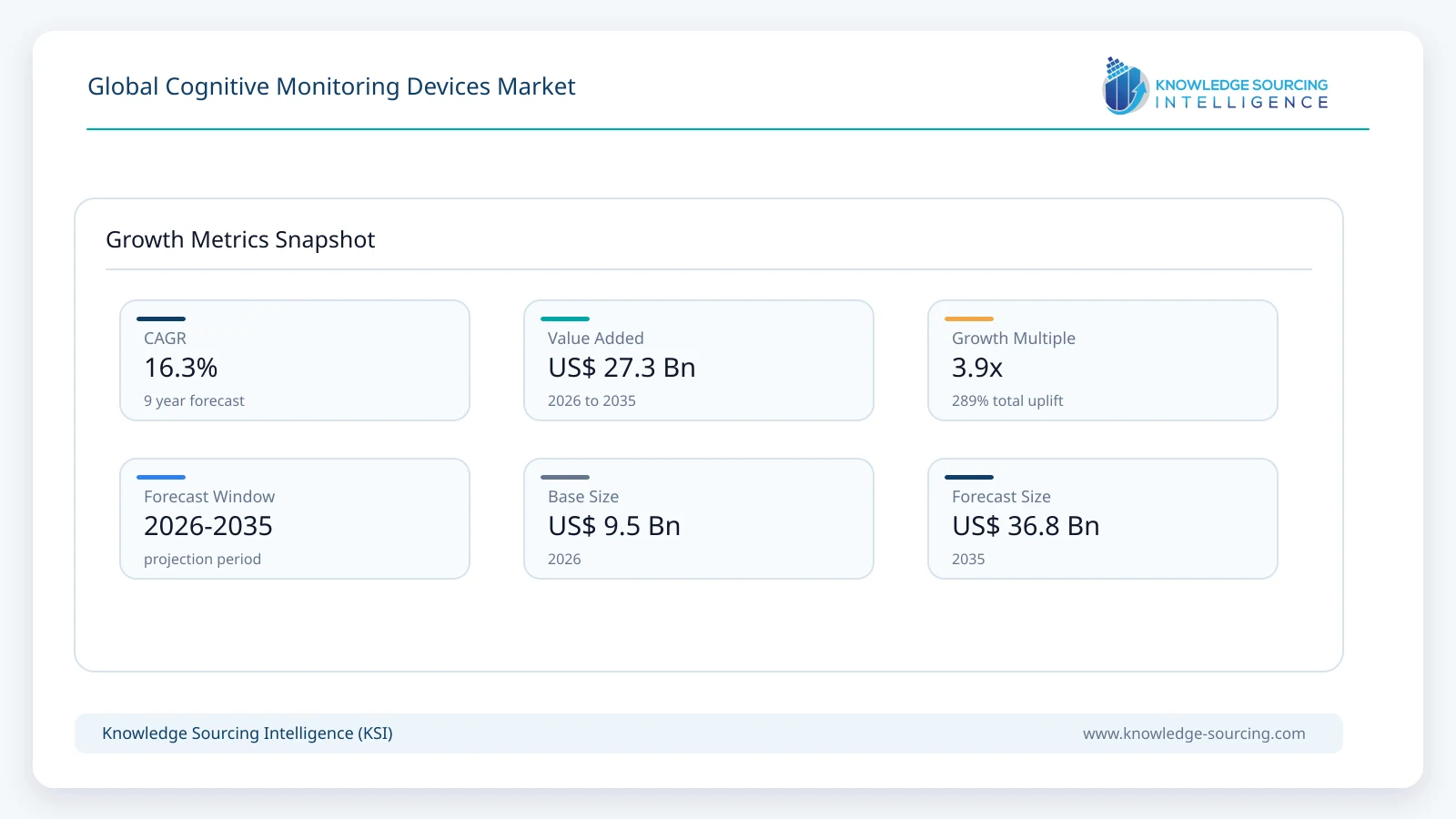
The Global Cognitive Monitoring Devices Market is set to reach USD 36.8 billion in 2035, growing at a CAGR of 16.3% from USD 9.47 billion in 2026.
Highlights:
- 1Rising dementia prevalence is increasing demand for continuous cognitive monitoring technologies.
- 2Artificial intelligence-based analytics are improving early detection of subtle cognitive impairment.
- 3Healthcare providers are expanding remote monitoring programs because neurological care increasingly extends beyond clinical settings.
- 4Digital biomarkers are strengthening objective assessment capabilities across cognitive disorders.
Cognitive monitoring devices evaluate, track, and analyze cognitive performance through digital platforms, wearable technologies, neurophysiological monitoring systems, and artificial intelligence-based assessment tools. Healthcare providers utilize these technologies because cognitive decline often develops gradually and may remain undetected during conventional clinical evaluations.
Neurological disease management increasingly depends on continuous monitoring because early identification of cognitive deterioration improves intervention opportunities. Cognitive monitoring solutions provide objective and repeatable measurements because digital technologies can capture cognitive performance across multiple settings.
Healthcare systems are expanding cognitive assessment programs because aging populations continue increasing the prevalence of dementia and neurodegenerative disorders. Technology companies are developing advanced monitoring platforms because clinicians require scalable tools that support early diagnosis and disease progression tracking.
Market Dynamics
Market Drivers
Increasing Prevalence of Cognitive Disorders
Cognitive impairment remains a growing healthcare challenge because aging populations continue increasing the incidence of dementia-related disorders. Healthcare providers are adopting cognitive monitoring technologies because earlier detection supports more effective clinical management. This trend drives market expansion.
Shift Toward Early Diagnosis
Neurological treatment increasingly emphasizes early intervention because disease-modifying therapies demonstrate greater value when administered during earlier disease stages. Clinicians are implementing continuous monitoring solutions because subtle cognitive changes often precede formal diagnosis. This factor strengthens adoption.
Expansion of Digital Health Infrastructure
Digital healthcare adoption continues accelerating because healthcare systems seek scalable monitoring solutions. Technology developers are integrating cognitive assessment platforms into remote care models because longitudinal monitoring improves clinical decision-making. This development supports market growth.
Advances in Artificial Intelligence
Artificial intelligence enhances cognitive assessment accuracy because machine learning algorithms identify complex behavioral and cognitive patterns. Companies are investing in advanced analytics platforms because predictive cognitive monitoring improves disease management. This trend stimulates innovation.
Market Restraints
Limited standardization across digital cognitive assessment methodologies creates adoption challenges.
Data privacy concerns complicate deployment of cloud-based cognitive monitoring platforms.
Reimbursement pathways remain inconsistent across several healthcare systems.
Market Opportunities
Development of Digital biomarkers
Digital biomarkers are becoming increasingly valuable because objective cognitive measurements improve diagnostic precision. Developers are expanding research initiatives because healthcare providers require scalable neurological assessment tools. This opportunity supports future growth.
Growth of Remote Neurological Care
Remote monitoring models continue expanding because healthcare systems seek cost-effective chronic disease management solutions. Cognitive monitoring platforms are supporting this transition because continuous assessment improves patient engagement and clinical oversight. This trend creates substantial opportunities.
Integration of Wearable Technologies
Wearable monitoring systems are gaining acceptance because passive data collection supports real-world cognitive assessment. Technology companies are advancing sensor capabilities because continuous monitoring generates richer clinical datasets. This development expands market potential.
Increasing Clinical Research Utilization
Pharmaceutical companies increasingly incorporate cognitive monitoring tools into clinical trials because objective endpoints improve study quality. Developers are strengthening cognitive assessment capabilities because neurological drug development requires more precise outcome measures. This opportunity accelerates demand.
Disease & Epidemiology Analysis
Cognitive disorders continue generating substantial healthcare burdens because aging populations are increasing the prevalence of neurodegenerative diseases worldwide. Healthcare providers increasingly prioritize cognitive assessment because early diagnosis improves treatment planning and patient management.
Alzheimer's disease remains the largest application area because progressive cognitive decline creates significant long-term healthcare requirements. Clinicians are implementing continuous monitoring solutions because earlier detection supports therapeutic intervention and care planning.
Mild cognitive impairment represents a rapidly growing focus area because progression risk varies significantly among patients. Healthcare providers are expanding assessment programs because identifying high-risk individuals improves disease management strategies.
Parkinson's disease, traumatic brain injury, and dementia-related disorders continue to support demand because cognitive dysfunction frequently affects patient outcomes. Researchers are advancing monitoring technologies because objective cognitive measurement remains a critical unmet need.
Treatment Guidelines Landscape
Clinical Area | Monitoring Objective | Demand Impact |
Alzheimer's Disease | Early detection and progression tracking | Expands digital monitoring adoption |
Mild Cognitive Impairment | Risk stratification | Increases cognitive assessment utilization |
Dementia | Longitudinal disease monitoring | Supports remote assessment tools |
Parkinson's Disease | Cognitive decline evaluation | Strengthens digital biomarker demand |
Traumatic Brain Injury | Recovery monitoring | Expands wearable monitoring applications |
Market Segmentation
By Product Type
Wearable cognitive monitoring devices continue gaining adoption because continuous data collection improves real-world cognitive assessment. Digital cognitive assessment platforms maintain strong demand because healthcare providers increasingly utilize remote screening tools. Neuropsychological testing systems remain important because clinical validation supports diagnostic decision-making. Brain activity monitoring devices are expanding because objective neurological measurements improve cognitive evaluation. Mobile cognitive monitoring applications continue growing because healthcare systems increasingly prioritize accessible and scalable monitoring solutions.
By Technology
Electroencephalography-based monitoring maintains significant utilization because neural activity measurements provide objective cognitive insights. Digital biomarker platforms are expanding because healthcare providers increasingly seek measurable indicators of cognitive decline. Artificial intelligence-based cognitive analytics continue advancing because predictive algorithms improve assessment accuracy. Sensor-based monitoring systems support growing adoption because passive monitoring enhances longitudinal data collection. Cloud-based cognitive assessment platforms are becoming more important because remote healthcare delivery continues expanding.
By Application
Alzheimer's disease monitoring represents the largest application area because dementia prevalence continues increasing worldwide. Mild cognitive impairment assessment is expanding because early detection supports intervention planning. Dementia monitoring remains a major demand driver because continuous assessment improves patient management. Parkinson's disease cognitive assessment is gaining attention because neurological care increasingly addresses cognitive symptoms. Traumatic brain injury monitoring, cognitive rehabilitation programs, and clinical research applications continue supporting market growth because objective cognitive measurement remains clinically valuable.
Regional Analysis
North America
North America leads the cognitive monitoring devices market because advanced digital health infrastructure supports rapid technology adoption. Healthcare providers increasingly deploy cognitive monitoring platforms because neurodegenerative disease prevalence continues rising. Research organizations strengthen digital biomarker development programs because early diagnosis remains a strategic priority. Technology companies expand artificial intelligence capabilities because healthcare systems require scalable neurological assessment solutions. These factors maintain regional market leadership.
Europe
European healthcare systems increasingly implement cognitive monitoring technologies because aging populations are elevating dementia-related healthcare demands. Healthcare providers expand digital assessment programs because early diagnosis improves long-term patient management. Academic institutions strengthen neurological research initiatives because cognitive impairment remains a major public health concern. Technology developers increase commercialization activities because healthcare systems continue embracing digital healthcare solutions. These developments support sustained market expansion.
Asia Pacific
Asia Pacific demonstrates significant growth potential because demographic aging and healthcare modernization continue accelerating. Healthcare organizations increasingly adopt digital cognitive assessment technologies because neurological disease awareness continues improving. Governments strengthen dementia management initiatives because cognitive disorders create growing economic burdens. Technology providers expand regional operations because demand for scalable neurological monitoring solutions continues rising. These trends support strong long-term growth opportunities.
Rest of the World
Healthcare systems across Latin America, the Middle East, and Africa continue expanding neurological care capabilities because cognitive disorders increasingly affect aging populations. Healthcare providers adopt digital monitoring technologies because specialist neurological resources remain limited in many regions. Technology companies strengthen market access initiatives because remote assessment solutions improve healthcare accessibility. These developments contribute to gradual market expansion.
Regulatory Landscape
Regulatory authorities are increasing oversight of digital cognitive monitoring technologies because artificial intelligence, digital biomarkers, and cloud-based healthcare platforms play growing roles in neurological assessment. Agencies focus on clinical validation, cybersecurity, patient privacy, and algorithm transparency because digital health solutions influence clinical decision-making.
The U.S. Food and Drug Administration continues evaluating digital neurological assessment technologies through evolving digital health frameworks.
European regulatory authorities emphasize evidence generation and software validation because cognitive monitoring platforms increasingly function as clinical decision-support tools. These requirements support patient safety while encouraging technological innovation.
Pipeline Analysis
Technology developers continue advancing next-generation cognitive monitoring platforms because earlier identification of neurological decline remains a major healthcare objective. Research programs increasingly focus on multimodal assessment approaches because cognitive disorders involve complex neurological changes.
Artificial intelligence-based analytics represent a major area of innovation because machine learning algorithms improve predictive assessment capabilities. Developers are integrating behavioral, cognitive, physiological, and neurological data streams because comprehensive monitoring enhances clinical insights.
Wearable technologies, digital biomarkers, and passive monitoring systems continue progressing through validation programs because healthcare providers increasingly seek objective cognitive measurement tools. These developments are strengthening future commercialization opportunities across neurological care and clinical research.
Reimbursement Landscape
Healthcare payers increasingly recognize the value of cognitive monitoring technologies because early detection may reduce long-term disease management costs. Reimbursement support continues expanding for validated cognitive assessment solutions because healthcare systems increasingly emphasize preventive care.
Coverage variability nevertheless remains a challenge because digital cognitive monitoring technologies are evolving rapidly. Technology developers continue generating health-economic evidence because reimbursement expansion depends on demonstrating clinical utility and cost-effectiveness.
Competitive Landscape
Cognition Therapeutics, Inc.
Cognition Therapeutics differentiates itself through its focus on cognitive disorder research and neurological innovation. The company supports market development because therapeutic and diagnostic advances increasingly converge within cognitive healthcare ecosystems.
Linus Health, Inc.
Linus Health specializes in digital cognitive assessment technologies that support early neurological disease detection. The company expands artificial intelligence capabilities because healthcare providers require scalable cognitive screening solutions.
Altoida, Inc.
Altoida focuses on digital biomarkers and predictive cognitive analytics. The company advances early detection technologies because healthcare systems increasingly emphasize preventive neurological care.
BrainCheck, Inc.
BrainCheck provides digital cognitive testing platforms supporting neurological screening and monitoring. The company strengthens remote assessment capabilities because virtual healthcare adoption continues increasing.
Cogstate Limited
Cogstate maintains a strong position in cognitive assessment and clinical trial support technologies. The company expands analytics capabilities because objective cognitive endpoints remain important in neurological research.
Cambridge Cognition Holdings plc
Cambridge Cognition develops advanced digital cognitive assessment solutions supporting pharmaceutical and clinical applications. The company strengthens research collaborations because neurological drug development increasingly relies on digital measurement tools.
Neurotrack Technologies, Inc.
Neurotrack focuses on cognitive health monitoring and dementia risk assessment technologies. The company advances digital health solutions because early intervention remains a major market priority.
Philips Healthcare
Philips Healthcare leverages extensive healthcare technology expertise to support neurological monitoring innovation. The company integrates digital health platforms because connected healthcare ecosystems continue expanding.
Neurosteer Ltd.
Neurosteer specializes in brain activity monitoring technologies supporting neurological assessment applications. The company advances EEG-based solutions because objective cognitive measurements remain increasingly valuable.
EMOTIV Inc.
EMOTIV focuses on wearable brain monitoring technologies and cognitive analytics. The company strengthens neurotechnology capabilities because continuous cognitive assessment increasingly depends on wearable platforms.
Key Developments
January 2026: Linus Health expanded digital cognitive assessment capabilities supporting early dementia detection initiatives.
December 2025: Altoida advanced artificial intelligence-based digital biomarker technologies for cognitive impairment assessment.
November 2025: BrainCheck strengthened remote cognitive testing platforms supporting neurological screening programs.
October 2025: Cogstate expanded cognitive analytics solutions supporting pharmaceutical clinical trials.
Strategic Insights and Future Market Outlook
Cognitive monitoring technologies are becoming essential components of neurological healthcare because healthcare systems increasingly prioritize prevention, early diagnosis, and longitudinal disease management. Providers continue shifting toward continuous monitoring models because traditional episodic assessments often fail to capture disease progression effectively.
Artificial intelligence, digital biomarkers, wearable monitoring technologies, and cloud-based assessment platforms will remain key competitive differentiators because cognitive healthcare increasingly depends on objective and scalable measurement tools. Developers are accelerating innovation because neurological disease prevalence continues rising globally.
Healthcare systems will continue integrating cognitive monitoring into routine neurological care because earlier intervention opportunities improve patient outcomes and healthcare efficiency. Providers increasingly utilize remote monitoring technologies because long-term cognitive assessment requires continuous and accessible evaluation methods.
The cognitive monitoring devices market will continue evolving toward predictive, data-driven, and personalized neurological care ecosystems. Advances in artificial intelligence, wearable neurotechnology, digital biomarkers, cloud-based analytics, and remote monitoring infrastructure will drive sustained demand across dementia management, cognitive rehabilitation, neurological research, and preventive brain health programs worldwide.
Global Cognitive Monitoring Devices Market Scope:
| Report Metric | Details |
|---|---|
| Total Market Size in 2026 | USD 9.47 billion |
| Total Market Size in 2035 | USD 36.8 billion |
| Forecast Unit | USD Billion |
| Growth Rate | 16.3% |
| Study Period | 2021 to 2035 |
| Historical Data | 2021 to 2024 |
| Base Year | 2025 |
| Forecast Period | 2026 – 2035 |
| Segmentation | Product Type, Technology, Application, End User |
| Companies |
|
Market Segmentation
By Product Type
- Wearable Cognitive Monitoring Devices
- Digital Cognitive Assessment Platforms
- Neuropsychological Testing Systems
- Brain Activity Monitoring Devices
- Mobile Cognitive Monitoring Applications
By Technology
- Electroencephalography-Based Monitoring
- Digital Biomarker Platforms
- Artificial Intelligence-Based Cognitive Analytics
- Sensor-Based Monitoring Systems
- Cloud-Based Cognitive Assessment Platforms
By Application
- Alzheimer's Disease Monitoring
- Mild Cognitive Impairment Assessment
- Dementia Monitoring
- Parkinson’s Disease Cognitive Assessment
- Traumatic Brain Injury Monitoring
- Cognitive Rehabilitation Programs
- Clinical Research Applications
By End User
- Hospitals
- Neurology Clinics
- Academic and Research Institutes
- Home Care Settings
- Pharmaceutical and Biotechnology Companies
By Geography
- North America
- Europe
- Asia-Pacific
- Latin America
- Middle East & Africa
Table of Contents
1.EXECUTIVE SUMMARY
1.1 Global Cognitive Monitoring Devices Market Scope and Objectives
1.2 Key Market Insights and Strategic Highlights
1.3 Cognitive Monitoring Adoption Trends
1.4 Market Growth Outlook and Revenue Forecast
1.5 Strategic Conclusions
2.GLOBAL COGNITIVE MONITORING DEVICES MARKET OVERVIEW
2.1 Definition and Scope of Global Cognitive Monitoring Devices Market
2.2 Global Cognitive Monitoring Devices Market Size Analysis 2021–2024
2.3 Global Cognitive Monitoring Devices Market Size Forecast 2025–2035
2.4 Market Drivers
2.4.1 Rising Prevalence of Cognitive Disorders and Dementia
2.4.2 Growing Demand for Early Cognitive Assessment and Monitoring
2.4.3 Increasing Adoption of Digital Health Technologies
2.4.4 Expanding Use of Cognitive Monitoring in Clinical Research
2.5 Market Restraints
2.5.1 Limited Standardization of Cognitive Assessment Tools
2.5.2 Data Privacy and Security Concerns
2.5.3 Reimbursement and Regulatory Challenges
2.6 Market Opportunities
2.6.1 AI-Based Cognitive Monitoring Solutions
2.6.2 Growth of Remote and Home-Based Cognitive Assessment
2.6.3 Expansion of Digital Biomarker Applications
2.7 Global Cognitive Monitoring Devices Market Segmentation
2.7.1 By Product Type
2.7.1.1 Wearable Cognitive Monitoring Devices
2.7.1.2 Digital Cognitive Assessment Platforms
2.7.1.3 Neuropsychological Testing Systems
2.7.1.4 Brain Activity Monitoring Devices
2.7.1.5 Mobile Cognitive Monitoring Applications
2.7.2 By Technology
2.7.2.1 Electroencephalography-Based Monitoring
2.7.2.2 Digital Biomarker Platforms
2.7.2.3 Artificial Intelligence-Based Cognitive Analytics
2.7.2.4 Sensor-Based Monitoring Systems
2.7.2.5 Cloud-Based Cognitive Assessment Platforms
2.7.3 By Application
2.7.3.1 Alzheimer's Disease Monitoring
2.7.3.2 Mild Cognitive Impairment Assessment
2.7.3.3 Dementia Monitoring
2.7.3.4 Parkinson’s Disease Cognitive Assessment
2.7.3.5 Traumatic Brain Injury Monitoring
2.7.3.6 Cognitive Rehabilitation Programs
2.7.3.7 Clinical Research Applications
2.7.4 By End User
2.7.4.1 Hospitals
2.7.4.2 Neurology Clinics
2.7.4.3 Academic and Research Institutes
2.7.4.4 Home Care Settings
2.7.4.5 Pharmaceutical and Biotechnology Companies
3.NEUROLOGICAL DISEASE EPIDEMIOLOGY AND MONITORING DEMAND ANALYSIS
3.1 Global Burden of Cognitive Disorders
3.2 Alzheimer's Disease Epidemiology
3.3 Mild Cognitive Impairment Epidemiology
3.4 Dementia Burden Analysis
3.5 Traumatic Brain Injury and Cognitive Dysfunction Trends
3.6 Forecast of Cognitive Monitoring Device Utilization
4.DISEASE AND UNMET NEED ANALYSIS
4.1 Need for Early Detection of Cognitive Decline
4.2 Challenges in Longitudinal Cognitive Assessment
4.3 Need for Objective and Quantifiable Cognitive Biomarkers
4.4 Limitations of Conventional Cognitive Testing Methods
4.5 Unmet Need in Remote Cognitive Monitoring Solutions
5.TECHNOLOGY AND INNOVATION LANDSCAPE
5.1 Evolution of Cognitive Monitoring Technologies
5.2 Digital Cognitive Assessment Platform Innovations
5.3 Brain Activity Monitoring Technology Analysis
5.4 Digital Biomarker Development Trends
5.5 Artificial Intelligence and Predictive Cognitive Analytics
5.6 Remote Monitoring and Tele-Neurology Integration Trends
5.7 Comparative Clinical Utility Analysis
6.CLINICAL AND COMMERCIAL INTELLIGENCE
6.1 Clinical Guideline Positioning
6.2 Cognitive Monitoring Utilization Trends
6.3 Comparative Effectiveness Benchmarking
6.4 Pricing Trends and Reimbursement Dynamics
6.5 Market Share Analysis by Product Type
6.6 Healthcare Provider Adoption Trends
6.7 Lifecycle Management Strategies
6.8 Regulatory Approval and Compliance Analysis
7.PRODUCT BENCHMARKING
7.1 Wearable Cognitive Monitoring Device Benchmarking
7.2 Digital Cognitive Assessment Platform Benchmarking
7.3 EEG-Based Cognitive Monitoring System Benchmarking
7.4 Digital Biomarker Solution Benchmarking
7.5 AI-Enabled Cognitive Analytics Platform Benchmarking
7.6 Competitive Differentiation Analysis
8.MARKET FORECAST AND RISK ANALYSIS
8.1 Revenue Forecast Modeling
8.2 Device Adoption Forecast
8.3 Technology Adoption Forecast
8.4 Pricing and Reimbursement Sensitivity Analysis
8.5 Key Risk Factors
8.5.1 Regulatory and Compliance Risks
8.5.2 Data Privacy and Cybersecurity Risks
8.5.3 Technology Validation Risks
8.5.4 Reimbursement Risks
8.6 Sensitivity and Scenario Analysis
9.COMPETITIVE LANDSCAPE
9.1 Market Share Analysis by Company
9.2 Competitive Positioning of Cognitive Monitoring Technologies
9.3 Innovation and Patent Landscape Analysis
9.4 Product Portfolio Breadth Analysis
9.5 Strategic Collaborations and Partnerships
9.6 Mergers, Acquisitions, and Investment Activity
10.GEOGRAPHIC ANALYSIS
10.1 North America
10.2 Europe
10.3 Asia-Pacific
10.4 Latin America
10.5 Middle East and Africa
11.KEY COUNTRIES ANALYSIS
11.1 United States
11.2 Canada
11.3 Germany
11.4 United Kingdom
11.5 France
11.6 Italy
11.7 Spain
11.8 China
11.9 Japan
11.10 India
11.11 South Korea
11.12 Australia
11.13 Brazil
11.14 Mexico
11.15 Saudi Arabia
11.16 South Africa
12.COMPANY PROFILES
12.1 Cognition Therapeutics, Inc.
12.1.1 Overview
12.1.2 Financials
12.1.3 Product Portfolio
12.1.4 Recent Developments
12.2 Linus Health, Inc.
12.2.1 Overview
12.2.2 Financials
12.2.3 Product Portfolio
12.2.4 Recent Developments
12.3 Altoida, Inc.
12.3.1 Overview
12.3.2 Financials
12.3.3 Product Portfolio
12.3.4 Recent Developments
12.4 BrainCheck, Inc.
12.4.1 Overview
12.4.2 Financials
12.4.3 Product Portfolio
12.4.4 Recent Developments
12.5 Cogstate Limited
12.5.1 Overview
12.5.2 Financials
12.5.3 Product Portfolio
12.5.4 Recent Developments
12.6 Cambridge Cognition Holdings plc
12.6.1 Overview
12.6.2 Financials
12.6.3 Product Portfolio
12.6.4 Recent Developments
12.7 Neurotrack Technologies, Inc.
12.7.1 Overview
12.7.2 Financials
12.7.3 Product Portfolio
12.7.4 Recent Developments
12.8 Philips Healthcare
12.8.1 Overview
12.8.2 Financials
12.8.3 Product Portfolio
12.8.4 Recent Developments
12.9 Neurosteer Ltd.
12.9.1 Overview
12.9.2 Financials
12.9.3 Product Portfolio
12.9.4 Recent Developments
12.10 EMOTIV Inc.
12.10.1 Overview
12.10.2 Financials
12.10.3 Product Portfolio
12.10.4 Recent Developments
13.FUTURE OUTLOOK AND STRATEGIC INSIGHTS
13.1 Expansion of Digital Biomarkers in Cognitive Assessment
13.2 Growth of AI-Powered Cognitive Monitoring Platforms
13.3 Increasing Adoption of Remote Cognitive Health Management Solutions
13.4 Opportunities in Precision Neurology and Clinical Trial Monitoring
13.5 Strategic Recommendations
14.METHODOLOGY AND DATA FRAMEWORK
14.1 Data Sources
14.2 Epidemiology and Device Utilization Modeling Approach
14.3 Market Sizing and Forecasting Methodology
14.4 Competitive Benchmarking Framework
14.5 Assumptions and Limitations
Navigate
Trusted by the world's leading organizations











