
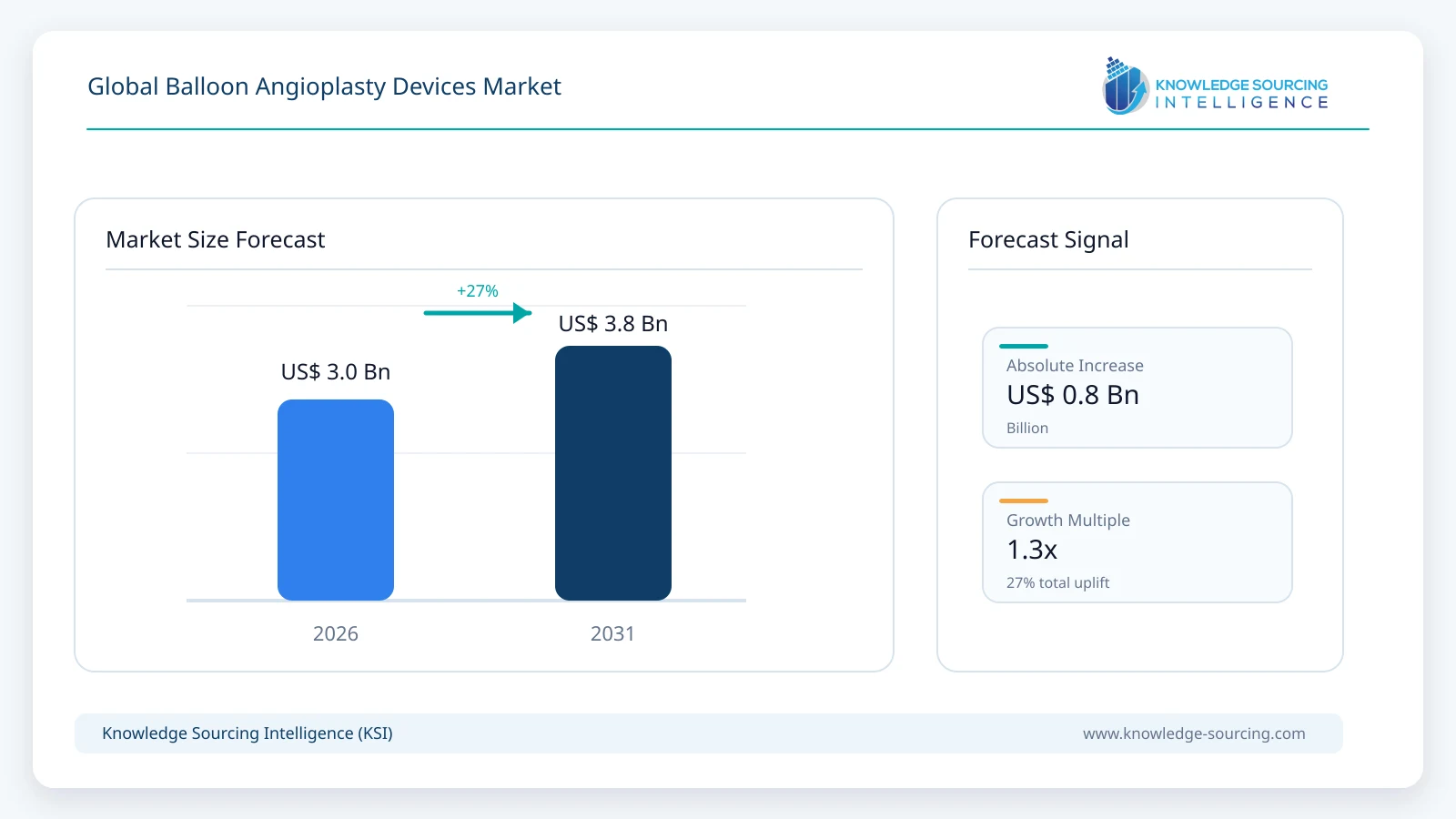
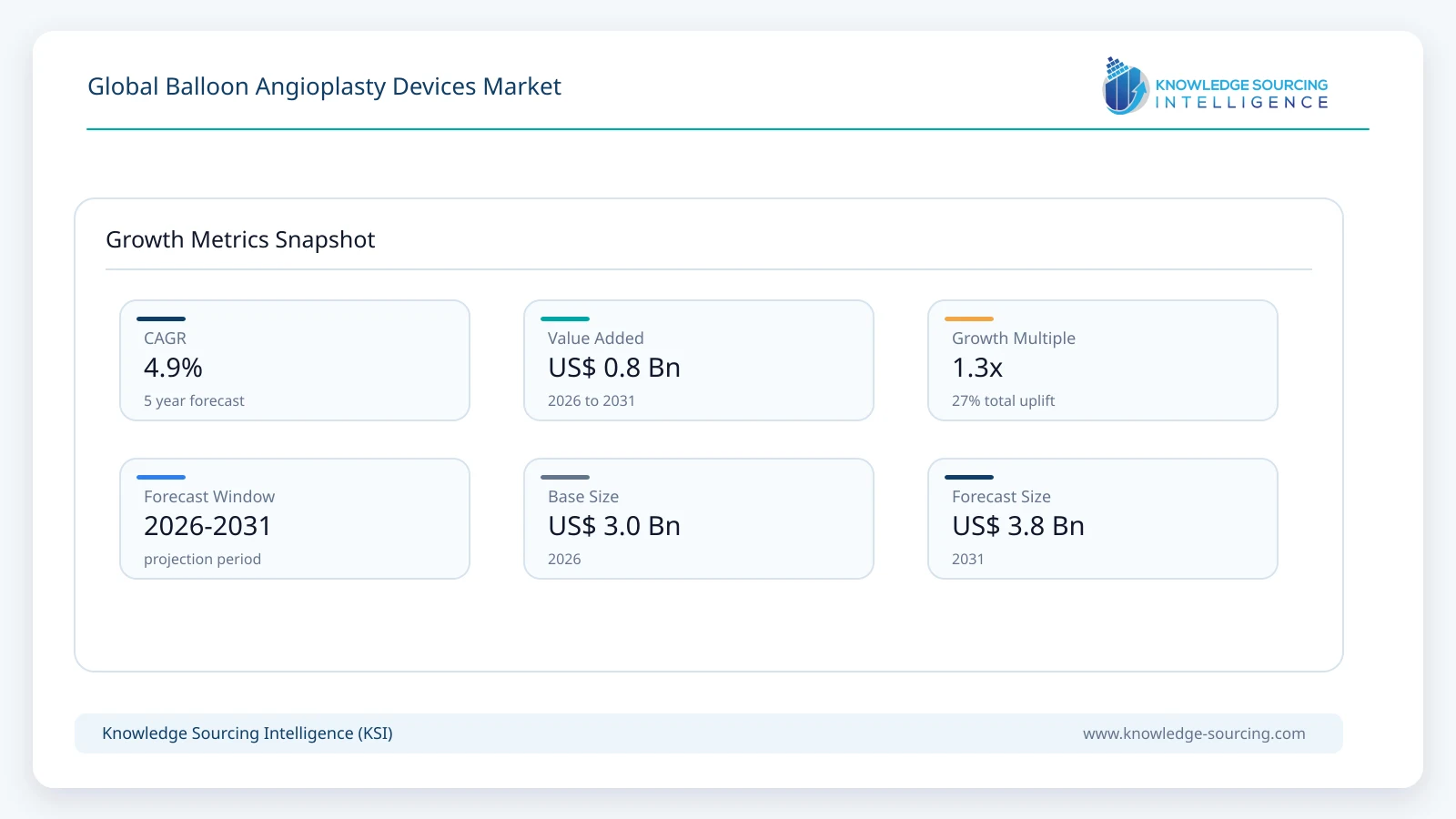
The Global Balloon Angioplasty Devices Market is forecast to grow at a CAGR of 4.9%, reaching USD 3.8 billion in 2031 from USD 3.0 billion in 2026.
Highlights:
- 1Rising peripheral artery disease incidence is increasing demand for drug-coated balloon technologies because healthcare providers are attempting to reduce restenosis-related repeat interventions.
- 2Hospital systems are prioritizing minimally invasive cardiovascular procedures because shorter recovery cycles improve procedural throughput and resource utilization.
- 3Aging populations and diabetes prevalence are expanding coronary intervention volumes because vascular calcification and arterial narrowing rates remain elevated.
- 4Interventional cardiology centers are adopting specialty scoring and cutting balloons because complex lesions require higher procedural precision before stent deployment.
Balloon angioplasty devices enable vessel dilation during minimally invasive treatment of stenotic or obstructed arteries. The market serves coronary artery disease, peripheral artery disease, and complex vascular lesions requiring catheter-based intervention. Demand remains connected to rising cardiovascular disease burden because sedentary lifestyles, diabetes prevalence, and aging populations continue increasing arterial occlusion incidence globally.
Healthcare systems are expanding interventional cardiology capacity because open surgical procedures create higher hospitalization costs and longer recovery cycles. This shift is increasing procedural dependency on balloon catheter technologies that support faster patient turnover and lower procedural invasiveness. Clinical practice consequently favors devices that improve lesion crossing ability, inflation control, and vessel conformity. Drug-coated balloons are gaining attention because providers are attempting to reduce repeat interventions associated with restenosis.
Regulatory agencies maintain strong oversight over coating materials, device safety, and long-term vascular outcomes because paclitaxel-related mortality concerns previously affected peripheral intervention adoption patterns. Manufacturers are increasing clinical trial investments to strengthen physician confidence and reimbursement positioning. Competitive differentiation, therefore, depends increasingly on evidence-backed efficacy rather than product commoditization alone.
The market also holds strategic importance within the broader cardiovascular care infrastructure because angioplasty procedures support emergency cardiac intervention, outpatient vascular management, and chronic disease treatment continuity. Emerging healthcare systems are increasing catheter laboratory investments while tertiary hospitals are modernizing peripheral vascular treatment capabilities. Device suppliers are consequently strengthening regional manufacturing, physician training programs, and hospital partnerships to secure procedural volume growth.
Market Dynamics
Market Drivers
Expansion of Peripheral Artery Disease Treatment Volumes: Peripheral artery disease management remains a major demand driver because diabetic and elderly populations continue experiencing rising vascular obstruction incidence. Hospitals are increasing endovascular intervention adoption because minimally invasive treatment reduces hospitalization burden compared with bypass surgery. This procedural shift increases demand for drug-coated and specialty balloons capable of maintaining vessel patency in below-the-knee and femoropopliteal lesions. Manufacturers are strengthening peripheral portfolios through coating optimization and low-profile catheter development. The market, consequently, is expanding beyond coronary intervention dependency.
Growth in Catheterization Laboratory Infrastructure: Cardiovascular intervention depends heavily on catheterization laboratory availability across tertiary hospitals and specialty cardiac centers. Healthcare providers are expanding cath lab networks because emergency cardiac intervention capacity directly affects patient survival outcomes. This infrastructure expansion increases recurring demand for balloon angioplasty consumables across routine and complex procedures. Device suppliers are building physician support and training ecosystems to secure institutional procurement contracts. The market, therefore, benefits from long-term hospital capital investment cycles.
Shift Toward Drug-Coated Balloon Adoption: Drug-coated balloons reduce neointimal hyperplasia risk during vascular intervention, which supports lower restenosis rates in selected lesions. Physicians are increasing the adoption of peripheral interventions because avoiding permanent implants improves treatment flexibility in certain patient populations. This transition places pressure on manufacturers to demonstrate coating durability, drug transfer efficiency, and long-term vessel outcomes. Companies are expanding clinical evidence generation and post-market surveillance programs to strengthen reimbursement positioning. The market, consequently, is moving toward evidence-driven product segmentation.
Increasing Preference for Minimally Invasive Cardiac Procedures: Healthcare systems prioritize minimally invasive intervention because procedural efficiency affects operating costs and patient recovery timelines. Patients prefer catheter-based procedures because shorter hospitalization reduces financial and physical burden. This demand trend supports rising angioplasty procedure volumes across ambulatory and hospital settings. Manufacturers are introducing highly deliverable balloon systems compatible with radial access and complex anatomy. The market, therefore, continues benefiting from procedural migration away from open surgery.
Market Restraints
Regulatory scrutiny surrounding drug-coated balloon safety increases approval timelines and raises post-market evidence requirements.
Procedure costs remain difficult for lower-income healthcare systems because advanced balloon technologies require specialized catheterization infrastructure.
Product commoditization in standard balloon categories reduces pricing power and intensifies procurement-based competition.
Market Opportunities
Expansion of Ambulatory Vascular Intervention Centers: Ambulatory cardiovascular care is creating new demand channels because healthcare providers are decentralizing lower-risk procedures from large hospitals. Specialty centers are increasing outpatient angioplasty volumes to improve procedural scheduling flexibility and reduce inpatient dependency. This transition supports demand for easy-to-use balloon systems with rapid procedural turnaround capability. Manufacturers are optimizing product portfolios for outpatient workflow efficiency. The market, consequently, is widening beyond tertiary hospital concentration.
Integration of Imaging-Guided Intervention Platforms: Interventional cardiology increasingly depends on intravascular imaging because complex lesions require improved visualization and procedural accuracy. Physicians are integrating imaging-guided angioplasty approaches to improve balloon placement precision and lesion preparation outcomes. This clinical shift creates opportunities for companies capable of aligning balloon technologies with imaging ecosystems. Device manufacturers are developing integrated procedural solutions across vascular intervention workflows. The market, therefore, is rewarding platform-based cardiovascular portfolios.
Rising Demand Across Emerging Healthcare Economies: Emerging economies continue experiencing growth in cardiovascular disease burden because urbanization and lifestyle-related metabolic disorders are increasing. Governments are expanding cardiac care infrastructure to reduce untreated cardiovascular mortality. This investment cycle increases demand for affordable angioplasty systems across public and private hospitals. Global manufacturers are strengthening local distribution and manufacturing capabilities to improve pricing competitiveness. The market is consequently gaining procedural volume growth outside mature healthcare regions.
Technological Development in Specialty Balloons: Complex vascular lesions require higher procedural control because calcification and bifurcation anatomy reduce standard balloon effectiveness. Physicians are increasing use of cutting and scoring balloons to improve lesion modification before stenting. This procedural need encourages innovation in balloon compliance, coating uniformity, and shaft flexibility. Manufacturers are focusing on differentiated specialty products to avoid commoditized pricing environments.
Supply Chain Analysis
The balloon angioplasty devices supply chain depends on polymer sourcing, catheter extrusion, coating technologies, sterilization operations, and hospital procurement networks. Raw material quality remains critical because balloon compliance, burst pressure, and catheter flexibility directly affect procedural safety during vascular intervention. Manufacturers are increasing sourcing control over nylon and polyurethane materials because inconsistency in polymer performance raises the risk of balloon rupture and coating instability. This pressure is strengthening long-term supplier partnerships and qualification audits across medical-grade component providers.
Device manufacturing remains concentrated within highly regulated medical technology facilities because angioplasty systems require precision assembly, coating validation, and sterile packaging compliance. Companies are regionalizing production capacity because healthcare providers experienced procedural delays during earlier global logistics disruptions. This transition is reducing dependency on single-region manufacturing while improving delivery continuity across high-volume cardiovascular markets. Manufacturers are also increasing automation in catheter assembly to improve dimensional consistency and production scalability.
Distribution channels remain closely tied to hospital purchasing systems, physician preference, and specialized cardiovascular sales networks. Interventional cardiologists continue influencing product selection because procedural familiarity affects lesion crossing performance and procedural outcomes. Device manufacturers are strengthening physician education and clinical support programs to secure long-term procurement contracts across hospital groups and catheterization laboratories. The supply chain consequently operates through both manufacturing precision and physician engagement strength.
Government Regulations
Region | Regulatory Authority | Regulatory Focus |
United States | U.S. Food and Drug Administration | Premarket approval, coating safety evaluation, post-market surveillance, and device labeling |
European Union | European Commission under the MDR framework | Clinical evidence, device traceability, and post-market clinical follow-up |
Japan | Pharmaceuticals and Medical Devices Agency | Device quality validation, manufacturing compliance, procedural safety |
China | National Medical Products Administration | Local clinical evaluation, product registration, and manufacturing inspection |
Market Segmentation
By Product Type
Standard balloon catheters continue generating baseline procedural demand because coronary angioplasty remains a high-volume cardiovascular intervention globally. Drug-coated balloons are gaining stronger clinical adoption because healthcare providers are attempting to reduce restenosis without increasing permanent implant placement. This transition is increasing demand for coating consistency, drug-transfer efficiency, and long-term vessel patency validation. Cutting and scoring balloons remain important in calcified and resistant lesions because complex anatomy requires improved plaque modification before stenting. Manufacturers are increasing investment in specialty lesion-preparation technologies to avoid commoditized pricing environments. The segment is consequently evolving toward clinically differentiated intervention platforms.
By Material
Nylon balloons remain widely utilized because high burst pressure performance supports procedural reliability in difficult vascular lesions. Physicians are increasingly preferring materials that balance flexibility with inflation control because catheter deliverability directly affects procedural success in tortuous anatomy. Polyurethane balloons continue gaining attention in selected interventions because enhanced compliance improves vessel conformity during dilation. Manufacturers are optimizing polymer engineering to improve crossing profiles and reduce procedural complications. Material selection, therefore, increasingly reflects lesion complexity and physician treatment strategy.
By Application
Coronary angioplasty continues to represent the largest procedural segment because ischemic heart disease prevalence remains elevated across aging populations. Peripheral angioplasty is expanding rapidly because diabetes-related vascular disease and lower-limb arterial obstruction continue increasing globally. This demand shift is strengthening the utilization of drug-coated and long-length balloon systems across femoropopliteal and below-the-knee interventions. Healthcare providers are increasing peripheral vascular screening and intervention capacity to reduce amputation risk. The application landscape consequently reflects broader chronic vascular disease management expansion.
Regional Analysis
North America Market Analysis
North America maintains strong balloon angioplasty device demand because cardiovascular intervention infrastructure remains highly developed across hospital and outpatient settings. Healthcare providers are increasing adoption of drug-coated and specialty balloons because reimbursement systems are increasingly prioritizing lower repeat intervention rates and procedural efficiency. This transition supports demand for clinically validated technologies with strong long-term vascular outcome evidence.
The United States dominates regional demand because catheterization laboratory penetration and emergency cardiac intervention capacity remain extensive. Peripheral artery disease treatment volumes are increasing as diabetic and elderly populations expand. Hospitals are prioritizing minimally invasive interventions because shorter inpatient cycles improve resource utilization and procedural throughput. Manufacturers are strengthening physician education and post-market evidence programs to reinforce competitive positioning.
Europe Market Analysis
Europe maintains a mature interventional cardiology environment supported by broad healthcare access and established cardiovascular screening systems. Hospitals are increasingly preferring clinically validated balloon technologies because reimbursement authorities closely evaluate long-term procedural outcomes and cost efficiency. This environment places pressure on manufacturers to generate robust evidence for specialty and drug-coated balloon platforms.
Germany, France, Italy, and the United Kingdom remain major demand centers because aging populations continue to increase the burden of coronary and peripheral artery disease. Physicians are adopting scoring and cutting balloons more actively because calcified lesions require improved lesion preparation before stenting. European Medical Device Regulation implementation is increasing compliance complexity and post-market surveillance obligations. Companies are expanding clinical follow-up capabilities to maintain commercialization continuity across the region.
Asia Pacific Market Analysis
Asia Pacific is experiencing strong procedural growth because cardiovascular disease prevalence continues rising alongside urbanization, obesity, and diabetes incidence. Governments are increasing investment in tertiary hospitals and catheterization laboratories to reduce the untreated cardiac disease burden. This infrastructure expansion is increasing the utilization of angioplasty devices across both public and private healthcare systems.
China, Japan, and India represent major growth markets because large patient populations continue requiring minimally invasive vascular treatment. Hospitals are increasing procurement of cost-effective balloon systems while premium tertiary centers adopt advanced drug-coated and specialty balloons. Domestic manufacturers are strengthening regional competitiveness through lower-cost manufacturing and distribution expansion. International companies are responding through localization strategies and physician training partnerships. The market consequently combines strong volume growth with increasing demand for advanced intervention technologies.
Rest of the World
The Rest of the World region continues expanding gradually because cardiovascular disease burden is increasing across Latin America, the Middle East, and parts of Africa. Healthcare systems are improving access to minimally invasive interventions because untreated coronary artery disease continues to create substantial mortality pressure. This transition supports demand for affordable angioplasty systems adaptable to resource-constrained healthcare environments.
Private healthcare expansion remains a major growth catalyst because advanced cardiovascular procedures often concentrate within urban specialty hospitals. Governments are increasing healthcare modernization investments to strengthen emergency cardiac care capacity. Manufacturers are strengthening distributor partnerships and physician training programs to improve procedural familiarity with advanced balloon technologies. Economic variability nevertheless continues to constrain the rapid adoption of premium intervention systems.
Regulatory Landscape
Balloon angioplasty devices remain subject to highly regulated cardiovascular device frameworks because procedural performance directly affects vessel integrity and patient survival outcomes. Regulatory authorities require extensive assessment of catheter flexibility, balloon inflation consistency, coating transfer efficiency, and long-term vascular safety before granting market approval. Manufacturers are increasing investment in multicenter clinical trials because reimbursement positioning increasingly depends on evidence-backed efficacy and restenosis reduction outcomes.
Drug-coated balloon regulation remains especially stringent because earlier paclitaxel-related mortality concerns affected physician confidence in peripheral intervention technologies. Authorities are requiring broader post-market surveillance systems and extended patient monitoring to evaluate long-term vascular outcomes across diverse patient populations. Companies are strengthening pharmacokinetic analysis, coating retention studies, and real-world evidence programs to maintain regulatory alignment. This pressure is increasing commercialization costs while reinforcing entry barriers for smaller competitors.
Regional differences in regulatory pathways continue shaping commercialization sequencing because evidence expectations vary significantly between the United States, Europe, Japan, China, and emerging healthcare systems. Manufacturers are aligning product launch strategies with region-specific approval timelines and clinical evidence requirements. Organizations with strong regulatory infrastructure, therefore, maintain stronger global expansion capability.
Pipeline Analysis
The balloon angioplasty device pipeline increasingly focuses on drug-delivery optimization, lesion preparation enhancement, and catheter deliverability improvement. Manufacturers are developing next-generation drug-coated balloons with advanced excipient formulations because coating transfer efficiency directly affects restenosis reduction outcomes. This innovation trend reflects physician demand for durable vessel patency without increasing dependence on permanent vascular implants.
Specialty balloon development remains active because calcified and bifurcation lesions continue to limit the effectiveness of standard angioplasty systems. Companies are introducing advanced scoring and cutting balloon technologies that improve plaque modification before stenting procedures. Peripheral artery disease pipelines are also expanding toward below-the-knee applications because diabetic limb ischemia continues increasing globally. Device developers are optimizing low-profile catheter design and shaft flexibility to improve procedural access across difficult anatomy.
Clinical evidence generation remains central to pipeline advancement because hospitals and reimbursement authorities increasingly prioritize long-term safety validation. Manufacturers are conducting multicenter trials evaluating target lesion revascularization, procedural success rates, and late lumen loss across complex patient populations. The innovation landscape consequently reflects both engineering advancement and evidence-based commercialization pressure.
Competitive Landscape
Abbott Laboratories
Abbott maintains strong positioning in coronary and peripheral intervention because the company combines angioplasty systems with a broad cardiovascular device ecosystem. Demand for its NC Trek RX Coronary Dilatation Catheter and Armada 35 PTA Balloon Catheter continues increasing as hospitals prioritize procedural precision and catheter deliverability.
Boston Scientific Corporation
Boston Scientific holds a strong competitive presence in drug-coated balloon technologies because peripheral artery disease treatment volumes continue rising globally. Ranger Drug-Coated Balloon and Agent Drug-Coated Balloon platforms are gaining physician attention as restenosis reduction becomes a higher treatment priority.
Medtronic plc
Medtronic competes through diversified cardiovascular intervention capabilities and large-scale hospital relationships. Products, including the Prevail Drug-Coated Balloon and Chocolate PTA Balloon Catheter, support demand across complex peripheral and coronary interventions.
Terumo Corporation
Terumo differentiates itself through catheter engineering expertise and strong physician-focused product development. Ryurei PTCA Balloon Dilatation Catheter and Glider PTCA Balloon Catheter platforms support rising radial access procedures and minimally invasive cardiovascular treatment.
Becton, Dickinson and Company
BD maintains competitive relevance through peripheral vascular intervention and chronic total occlusion treatment technologies. Demand for the Lutonix Drug-Coated Balloon continues to increase as outpatient vascular intervention capacity expands globally.
Koninklijke Philips N.V.
Philips competes through the integration of angioplasty technologies with image-guided therapy platforms. Stellarex Drug-Coated Balloon and Chocolate Touch Drug-Coated PTA Balloon systems support demand for precise lesion targeting and minimally invasive vascular workflows.
BIOTRONIK SE & Co. KG
BIOTRONIK maintains a focused cardiovascular intervention strategy centered on clinically validated angioplasty technologies. Pantera Lux Drug-Coated Balloon and Passeo-18 PTA Balloon Catheter platforms address the growing demand for peripheral artery disease treatment optimization.
B. Braun SE
B. Braun strengthens market presence through peripheral intervention and drug-coated balloon technologies. The SeQuent Please Drug-Coated Balloon and Passeo Balloon Catheter Family support demand for restenosis management and procedural flexibility.
Cook Medical
Cook Medical remains active in peripheral angioplasty through specialized vascular device engineering and physician support programs. Advance Enforcer 35 Focal Force PTA Balloon Catheter and Advance 18 LP Low Profile PTA Balloon Catheter systems address the growing demand for below-the-knee and complex peripheral interventions.
Key Developments
May 2026: Johnson & Johnson launched the Shockwave C2 Aero coronary IVL catheter globally to improve calcium modification in PCI.
May 2026: Boston Scientific said the Fracture IDE trial of its Seismic 4CE coronary IVL catheter met primary safety and effectiveness endpoints.
October 2025: Orchestra Biomed and Terumo entered a new $30 million strategic collaboration around the Virtue SAB platform, extending their partnership on sirolimus angioinfusion technology.
August 2025: MicroPort CardioFlow received EU CE Mark approval for the Alwide Plus balloon catheter, expanding its structural heart and peripheral intervention portfolio.
Strategic Insights and Future Market Outlook
The balloon angioplasty devices market is expected to remain closely linked to long-term cardiovascular disease management trends and minimally invasive intervention expansion. Healthcare systems are increasingly dependent on catheter-based procedures because aging populations and diabetes prevalence continue to raise vascular disease burden globally. This structural demand supports sustained procedural growth across coronary and peripheral intervention categories.
Drug-coated and specialty balloons are expected to gain stronger strategic importance because healthcare providers increasingly prioritize restenosis reduction and lesion-specific treatment pathways. Hospitals are moving toward outcome-based procurement systems where long-term vessel patency and procedural efficiency influence purchasing decisions more directly. This transition is increasing pressure on manufacturers to support commercialization through multicenter clinical evidence and post-market surveillance infrastructure.
The market structure increasingly reflects a transition from standard angioplasty utilization toward clinically differentiated vascular intervention ecosystems. Companies that combine imaging integration, lesion preparation capability, and drug-delivery optimization are strengthening long-term competitive positioning within interventional cardiology workflows. Competitive leadership, therefore, is likely to remain concentrated among organizations capable of balancing innovation speed with evidence-backed regulatory compliance.
Global Balloon Angioplasty Devices Market Scope:
| Report Metric | Details |
|---|---|
| Total Market Size in 2026 | USD 3.0 billion |
| Total Market Size in 2031 | USD 3.8 billion |
| Forecast Unit | USD Billion |
| Growth Rate | 4.9% |
| Study Period | 2021 to 2031 |
| Historical Data | 2021 to 2024 |
| Base Year | 2025 |
| Forecast Period | 2026 – 2031 |
| Segmentation | Product Type , Material, Application, Geography |
| Companies |
|
Market Segmentation
By Geography
Key Countries Analysis
Regulatory & Policy Landscape
Table of Contents
1. Executive Summary
1.1 Market Snapshot
1.2 Key Findings
1.2.1 Growth Outlook
1.2.2 Technological Advancements
1.2.3 Adoption Trends in Coronary and Peripheral Interventions
1.2.4 Emerging Markets Opportunity Assessment
1.3 Strategic Imperatives
1.3.1 Product Innovation
1.3.2 Regulatory Compliance
1.3.3 Pricing and Reimbursement Optimization
1.3.4 Expansion in Ambulatory and Outpatient Settings
1.4 Analyst Recommendations
2. Disease & Epidemiology Analysis
2.1 Overview of Cardiovascular Diseases
2.1.1 Coronary Artery Disease (CAD)
2.1.2 Peripheral Artery Disease (PAD)
2.1.3 Chronic Total Occlusion (CTO)
2.1.4 In-Stent Restenosis (ISR)
2.1.5 Small Vessel Disease
2.2 Global Epidemiology of Cardiovascular Disorders
2.2.1 Prevalence of Coronary Artery Disease
2.2.2 Prevalence of Peripheral Artery Disease
2.2.3 Incidence of Percutaneous Coronary Intervention (PCI) Procedures
2.2.4 Aging Population and Cardiovascular Burden
2.2.5 Diabetes and Hypertension Impact on Angioplasty Demand
2.3 Procedure Volume Analysis
2.3.1 Coronary Angioplasty Procedures
2.3.2 Peripheral Angioplasty Procedures
2.3.3 Drug-Coated Balloon Procedures
2.3.4 Specialty Balloon Utilization Trends
2.4 Risk Factor Assessment
2.4.1 Obesity
2.4.2 Smoking
2.4.3 Sedentary Lifestyle
2.4.4 Dyslipidemia
2.4.5 Chronic Kidney Disease
2.5 Unmet Clinical Needs
2.5.1 Restenosis Prevention
2.5.2 Improved Deliverability and Flexibility
2.5.3 Long Lesion Treatment Challenges
2.5.4 Calcified Lesion Management
2.5.5 Treatment in Small Vessels and Bifurcation Lesions
3. Market Dynamics
3.1 Market Drivers
3.1.1 Rising Burden of Cardiovascular Diseases
3.1.2 Increasing PCI Volumes Globally
3.1.3 Growth in Minimally Invasive Procedures
3.1.4 Technological Advancements in Balloon Catheters
3.1.5 Increasing Adoption of Drug-Coated Balloons
3.2 Market Restraints
3.2.1 Product Recalls and Safety Concerns
3.2.2 High Cost of Advanced Balloon Technologies
3.2.3 Stringent Regulatory Requirements
3.2.4 Reimbursement Variability
3.3 Market Opportunities
3.3.1 Emerging Market Penetration
3.3.2 Expansion of Peripheral Interventions
3.3.3 Development of Scoring and Cutting Balloons
3.3.4 AI and Imaging Integration in PCI Planning
3.4 Market Challenges
3.4.1 Competitive Pricing Pressure
3.4.2 Physician Preference for Drug-Eluting Stents
3.4.3 Complex Lesion Treatment Limitations
3.4.4 Supply Chain and Raw Material Constraints
3.5 Porter’s Five Forces Analysis
3.5.1 Bargaining Power of Suppliers
3.5.2 Bargaining Power of Buyers
3.5.3 Threat of New Entrants
3.5.4 Threat of Substitutes
3.5.5 Competitive Rivalry
3.6 PESTLE Analysis
3.7 SWOT Analysis
4. Commercial & Market Access
4.1 Pricing Analysis
4.1.1 Standard Balloon Catheters
4.1.2 Drug-Coated Balloons
4.1.3 Specialty Balloons
4.2 Reimbursement Landscape
4.2.1 Hospital Reimbursement Framework
4.2.2 Outpatient Reimbursement Trends
4.2.3 DRG and Bundled Payment Models
4.3 Procurement and Purchasing Trends
4.3.1 Group Purchasing Organizations (GPOs)
4.3.2 Hospital Tender Dynamics
4.3.3 Public vs Private Healthcare Procurement
4.4 Market Access Challenges
4.4.1 Cost-Effectiveness Assessment
4.4.2 HTA Considerations
4.4.3 Regulatory Approval Delays
5. Innovation & Pipeline Landscape
5.1 Technology Evolution
5.1.1 Semi-Compliant Balloon Technology
5.1.2 Non-Compliant Balloon Technology
5.1.3 Drug-Coated Balloon Technology
5.1.4 Scoring Balloon Technology
5.1.5 Cutting Balloon Technology
5.2 Pipeline Analysis by Development Stage
5.2.1 Commercially Approved Products
5.2.2 Late-Stage Pipeline Products
5.2.3 Early-Stage Development Technologies
5.3 Pipeline Analysis by Modality
5.3.1 Paclitaxel-Coated Balloons
5.3.2 Sirolimus-Coated Balloons
5.3.3 Specialty Balloons for Calcified Lesions
5.3.4 Bioresorbable Balloon Technologies
5.4 Clinical Trial Landscape
5.4.1 Coronary Balloon Angioplasty Trials
5.4.2 Peripheral Balloon Angioplasty Trials
5.4.3 Drug-Coated Balloon Clinical Evidence
5.4.4 Comparative Effectiveness Studies
5.5 Patent Analysis
5.6 Innovation Benchmarking
6. Treatment Landscape
6.1 Overview of Percutaneous Coronary Intervention (PCI)
6.2 Treatment Algorithms
6.2.1 Coronary Artery Disease
6.2.2 Peripheral Artery Disease
6.2.3 In-Stent Restenosis Management
6.2.4 Chronic Total Occlusion Management
6.3 Balloon Angioplasty Devices by Clinical Utility
6.3.1 Pre-Dilatation Balloons
6.3.2 Post-Dilatation Balloons
6.3.3 Drug-Coated Balloons
6.3.4 Specialty Balloons
6.4 Comparative Analysis of Interventional Devices
6.4.1 Balloon Angioplasty vs Drug-Eluting Stents
6.4.2 Balloon Angioplasty vs Atherectomy
6.4.3 Balloon Angioplasty vs Bypass Surgery
6.5 Guidelines and Recommendations
6.5.1 American College of Cardiology (ACC)
6.5.2 European Society of Cardiology (ESC)
6.5.3 Society for Cardiovascular Angiography and Interventions (SCAI)
7. Global Balloon Angioplasty Devices Market Size & Forecast
7.1 Global Market Overview
7.2 Market Revenue Forecast
7.2.1 Historical Market Size
7.2.2 Base Year Analysis
7.2.3 Forecast Period Analysis
7.3 Market Forecast by Product Type
7.4 Market Forecast by Application
7.5 Market Forecast by End User
7.6 Market Forecast by Region
7.7 Market Forecast by Country
8. Global Balloon Angioplasty Devices Market Segmentation
8.1 By Product Type
8.1.1 Standard Balloon Catheters
8.1.2 Drug-Coated Balloons
8.1.3 Cutting Balloons
8.1.4 Scoring Balloons
8.1.5 Others
8.2 By Material
8.2.1 Nylon Balloons
8.2.2 Polyurethane Balloons
8.3 By Application
8.3.1 Coronary Angioplasty
8.3.2 Peripheral Angioplasty
8.4 By End User
8.4.1 Hospitals
8.4.2 Cardiac Catheterization Laboratories
8.4.3 Ambulatory Surgical Centers
9. Geographical Analysis
9.1 North America
9.1.1 Market Size & Forecast
9.1.2 Procedure Volume Trends
9.1.3 Regulatory Environment
9.1.4 Competitive Landscape
9.1.5 Reimbursement Trends
9.2 Europe
9.2.1 Market Size & Forecast
9.2.2 Adoption of Drug-Coated Balloons
9.2.3 MDR Regulatory Impact
9.2.4 Competitive Landscape
9.2.5 Reimbursement Environment
9.3 Asia-Pacific
9.3.1 Market Size & Forecast
9.3.2 Expanding Interventional Cardiology Infrastructure
9.3.3 Regional Manufacturing Expansion
9.3.4 Regulatory Overview
9.3.5 Competitive Intensity
9.4 Latin America
9.4.1 Market Size & Forecast
9.4.2 Access to Interventional Procedures
9.4.3 Regulatory Environment
9.4.4 Competitive Landscape
9.5 Middle East & Africa
9.5.1 Market Size & Forecast
9.5.2 Healthcare Infrastructure Development
9.5.3 Regulatory Environment
9.5.4 Competitive Landscape
10. Key Countries Analysis
10.1 United States
10.1.1 Market Size & Forecast
10.1.2 PCI Procedure Volume
10.1.3 FDA Regulatory Framework
10.1.4 Reimbursement Landscape
10.1.5 Key Companies and Product Presence
10.2 Canada
10.2.1 Market Size & Forecast
10.2.2 Epidemiology and Procedure Trends
10.2.3 Regulatory Framework
10.2.4 Reimbursement Overview
10.2.5 Key Companies and Product Presence
10.3 Germany
10.3.1 Market Size & Forecast
10.3.2 PCI Volume Trends
10.3.3 MDR and National Regulatory Framework
10.3.4 Reimbursement Landscape
10.3.5 Key Companies and Product Presence
10.4 United Kingdom
10.4.1 Market Size & Forecast
10.4.2 Cardiovascular Disease Burden
10.4.3 MHRA Regulatory Environment
10.4.4 NHS Reimbursement Dynamics
10.4.5 Key Companies and Product Presence
10.5 France
10.5.1 Market Size & Forecast
10.5.2 Procedure Volume Trends
10.5.3 Regulatory Framework
10.5.4 Reimbursement Overview
10.5.5 Key Companies and Product Presence
10.6 Italy
10.6.1 Market Size & Forecast
10.6.2 Epidemiology Overview
10.6.3 Regulatory Environment
10.6.4 Reimbursement Landscape
10.6.5 Key Companies and Product Presence
10.7 Spain
10.7.1 Market Size & Forecast
10.7.2 PCI Adoption Trends
10.7.3 Regulatory Framework
10.7.4 Reimbursement Overview
10.7.5 Key Companies and Product Presence
10.8 China
10.8.1 Market Size & Forecast
10.8.2 Cardiovascular Disease Burden
10.8.3 NMPA Regulatory Framework
10.8.4 Volume-Based Procurement Impact
10.8.5 Key Companies and Product Presence
10.9 Japan
10.9.1 Market Size & Forecast
10.9.2 Aging Population Impact
10.9.3 PMDA Regulatory Framework
10.9.4 Reimbursement Landscape
10.9.5 Key Companies and Product Presence
10.10 India
10.10.1 Market Size & Forecast
10.10.2 Cardiovascular Disease Burden
10.10.3 CDSCO Regulatory Framework
10.10.4 Pricing and Reimbursement Dynamics
10.10.5 Key Companies and Product Presence
10.11 South Korea
10.11.1 Market Size & Forecast
10.11.2 Procedure Volume Trends
10.11.3 MFDS Regulatory Framework
10.11.4 Reimbursement Overview
10.11.5 Key Companies and Product Presence
10.12 Australia
10.12.1 Market Size & Forecast
10.12.2 Cardiovascular Disease Burden
10.12.3 TGA Regulatory Framework
10.12.4 Reimbursement Landscape
10.12.5 Key Companies and Product Presence
10.13 Brazil
10.13.1 Market Size & Forecast
10.13.2 Interventional Cardiology Trends
10.13.3 ANVISA Regulatory Framework
10.13.4 Reimbursement Environment
10.13.5 Key Companies and Product Presence
10.14 Mexico
10.14.1 Market Size & Forecast
10.14.2 Cardiovascular Disease Burden
10.14.3 COFEPRIS Regulatory Framework
10.14.4 Reimbursement Overview
10.14.5 Key Companies and Product Presence
10.15 Saudi Arabia
10.15.1 Market Size & Forecast
10.15.2 Cardiovascular Disease Trends
10.15.3 SFDA Regulatory Framework
10.15.4 Reimbursement Landscape
10.15.5 Key Companies and Product Presence
10.16 South Africa
10.16.1 Market Size & Forecast
10.16.2 Epidemiology Overview
10.16.3 SAHPRA Regulatory Framework
10.16.4 Reimbursement Environment
10.16.5 Key Companies and Product Presence
11. Regulatory & Policy Landscape
11.1 United States
11.1.1 FDA Device Classification
11.1.2 Premarket Approval (PMA) and 510(k) Pathways
11.1.3 UDI and Post-Market Surveillance
11.2 Europe
11.2.1 European MDR Framework
11.2.2 CE Marking Requirements
11.2.3 Clinical Evaluation Requirements
11.3 Japan
11.3.1 PMDA Approval Process
11.3.2 Reimbursement Listing Requirements
11.4 India
11.4.1 CDSCO Medical Device Regulations
11.4.2 Import and Manufacturing Compliance
11.5 China
11.5.1 NMPA Registration Requirements
11.5.2 Local Clinical Trial Requirements
11.6 Global Regulatory Harmonization
11.6.1 IMDRF Guidelines
11.6.2 ISO Standards for Balloon Catheters
11.6.3 Post-Market Vigilance Requirements
12. Competitive Landscape
12.1 Market Share Analysis
12.2 Competitive Benchmarking
12.2.1 Product Portfolio Comparison
12.2.2 Technology Benchmarking
12.2.3 Geographic Presence
12.2.4 Strategic Collaborations
12.3 Recent Developments
12.3.1 Product Launches
12.3.2 FDA and CE Mark Approvals
12.3.3 Mergers and Acquisitions
12.3.4 Partnerships and Distribution Agreements
12.4 Competitive Positioning Matrix
13. Company Profiles
13.1 Abbott Laboratories
13.1.1 Company Overview
13.1.2 Balloon Angioplasty Portfolio
NC Trek RX Coronary Dilatation Catheter
Armada 35 PTA Balloon Catheter
Passeo-18 Lux Drug-Coated PTA Balloon Catheter
13.1.3 Key Indications
13.1.4 Pipeline and Innovation Focus
13.1.5 Financial Overview
13.2 Boston Scientific Corporation
13.2.1 Company Overview
13.2.2 Balloon Angioplasty Portfolio
Ranger Drug-Coated Balloon
Sterling Balloon Dilatation Catheter
Agent Drug-Coated Balloon
13.2.3 Key Indications
13.2.4 Pipeline and Clinical Programs
13.2.5 Financial Overview
13.3 Medtronic plc
13.3.1 Company Overview
13.3.2 Balloon Angioplasty Portfolio
Prevail Drug-Coated Balloon
Euphora Semi-Compliant Balloon Dilatation Catheter
Chocolate PTA Balloon Catheter
13.3.3 Key Indications
13.3.4 Pipeline and Innovation Focus
13.3.5 Financial Overview
13.4 Terumo Corporation
13.4.1 Company Overview
13.4.2 Balloon Angioplasty Portfolio
Ryurei PTCA Balloon Dilatation Catheter
Glider PTCA Balloon Catheter
Misago Peripheral Balloon Systems
13.4.3 Key Indications
13.4.4 Pipeline and Innovation Focus
13.4.5 Financial Overview
13.5 Becton, Dickinson and Company
13.5.1 Company Overview
13.5.2 Balloon Angioplasty Portfolio
Ultraverse PTA Balloon Dilatation Catheter
Lutonix Drug-Coated Balloon
Crosser CTO Recanalization System
13.5.3 Key Indications
13.5.4 Pipeline and Innovation Focus
13.5.5 Financial Overview
13.6 Koninklijke Philips N.V.
13.6.1 Company Overview
13.6.2 Balloon Angioplasty Portfolio
Stellarex Drug-Coated Balloon
Chocolate Touch Drug-Coated PTA Balloon
13.6.3 Key Indications
13.6.4 Pipeline and Innovation Focus
13.6.5 Financial Overview
13.7 BIOTRONIK SE & Co. KG
13.7.1 Company Overview
13.7.2 Balloon Angioplasty Portfolio
Pantera Lux Drug-Coated Balloon
Passeo-18 PTA Balloon Catheter
13.7.3 Key Indications
13.7.4 Pipeline and Clinical Programs
13.7.5 Financial Overview
13.8 B. Braun SE
13.8.1 Company Overview
13.8.2 Balloon Angioplasty Portfolio
SeQuent Please Drug-Coated Balloon
Passeo Balloon Catheter Family
13.8.3 Key Indications
13.8.4 Pipeline and Innovation Focus
13.8.5 Financial Overview
13.9 Cook Medical
13.9.1 Company Overview
13.9.2 Balloon Angioplasty Portfolio
Advance Enforcer 35 Focal Force PTA Balloon Catheter
Advance 18 LP Low Profile PTA Balloon Catheter
13.9.3 Key Indications
13.9.4 Pipeline and Innovation Focus
13.9.5 Financial Overview
13.10 Cardinal Health
13.10.1 Company Overview
13.10.2 Balloon Angioplasty Portfolio
Scoreflex NC Scoring PTCA Catheter
VascuTrak PTA Dilatation Catheter
13.10.3 Key Indications
13.10.4 Pipeline and Commercial Strategy
13.10.5 Financial Overview
14. Future Outlook
14.1 Future Market Trends
14.1.1 Shift Toward Drug-Coated Balloons
14.1.2 Growth in Peripheral Interventions
14.1.3 AI and Imaging Integration
14.1.4 Outpatient PCI Expansion
14.2 Emerging Technologies
14.2.1 Sirolimus-Coated Balloon Development
14.2.2 Next-Generation Specialty Balloons
14.2.3 Bioresorbable Technologies
14.3 Strategic Recommendations
14.3.1 Expansion Strategies for Emerging Markets
14.3.2 Product Differentiation Approaches
14.3.3 Regulatory and Reimbursement Strategy
15. Methodology
15.1 Research Methodology
15.1.1 Primary Research
15.1.2 Secondary Research
15.1.3 Data Triangulation
15.2 Market Estimation Model
15.2.1 Top-Down Approach
15.2.2 Bottom-Up Approach
15.3 Forecasting Assumptions
15.4 Abbreviations and Definitions
15.5 Sources and References
Navigate
Trusted by the world's leading organizations











