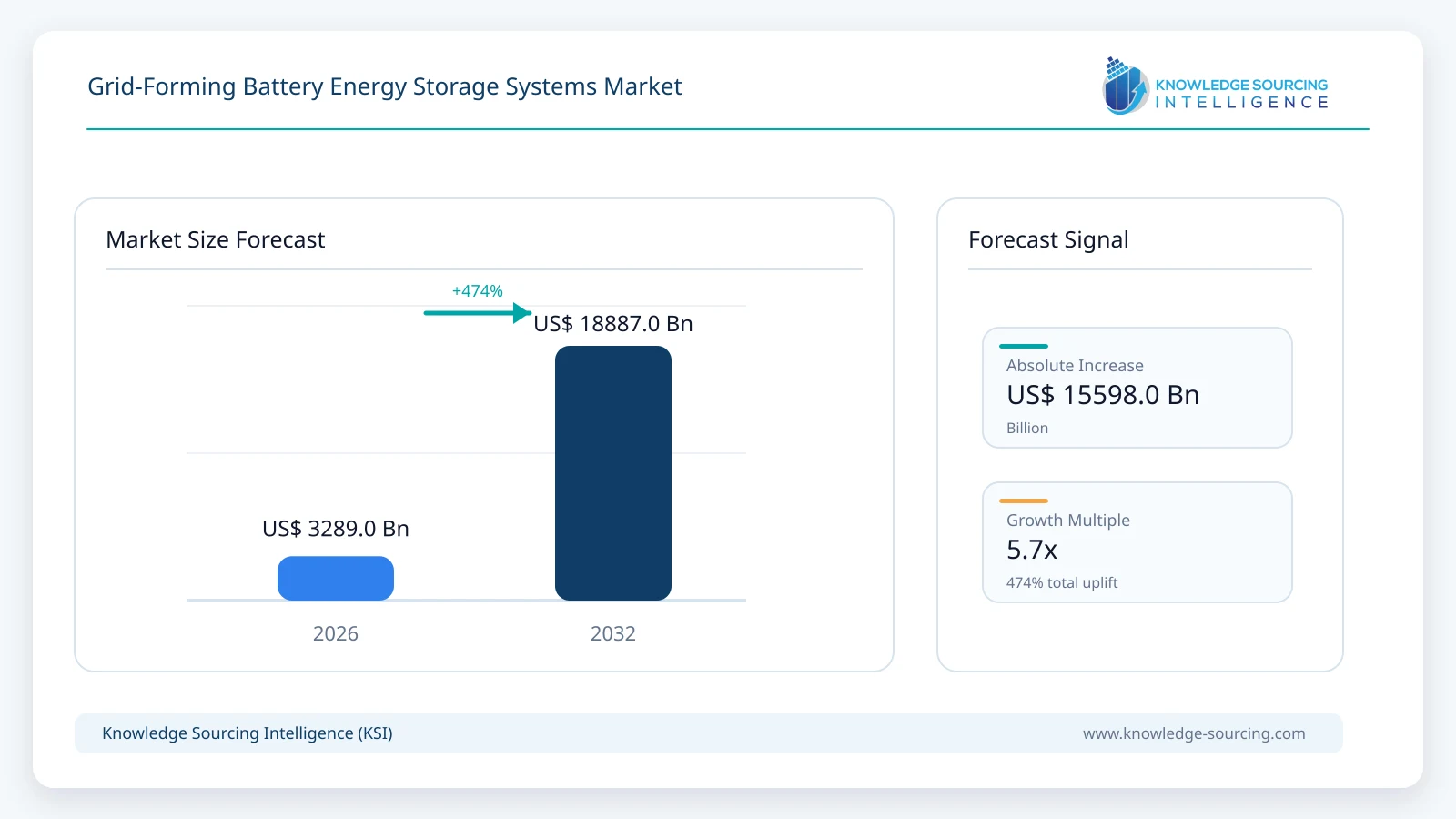
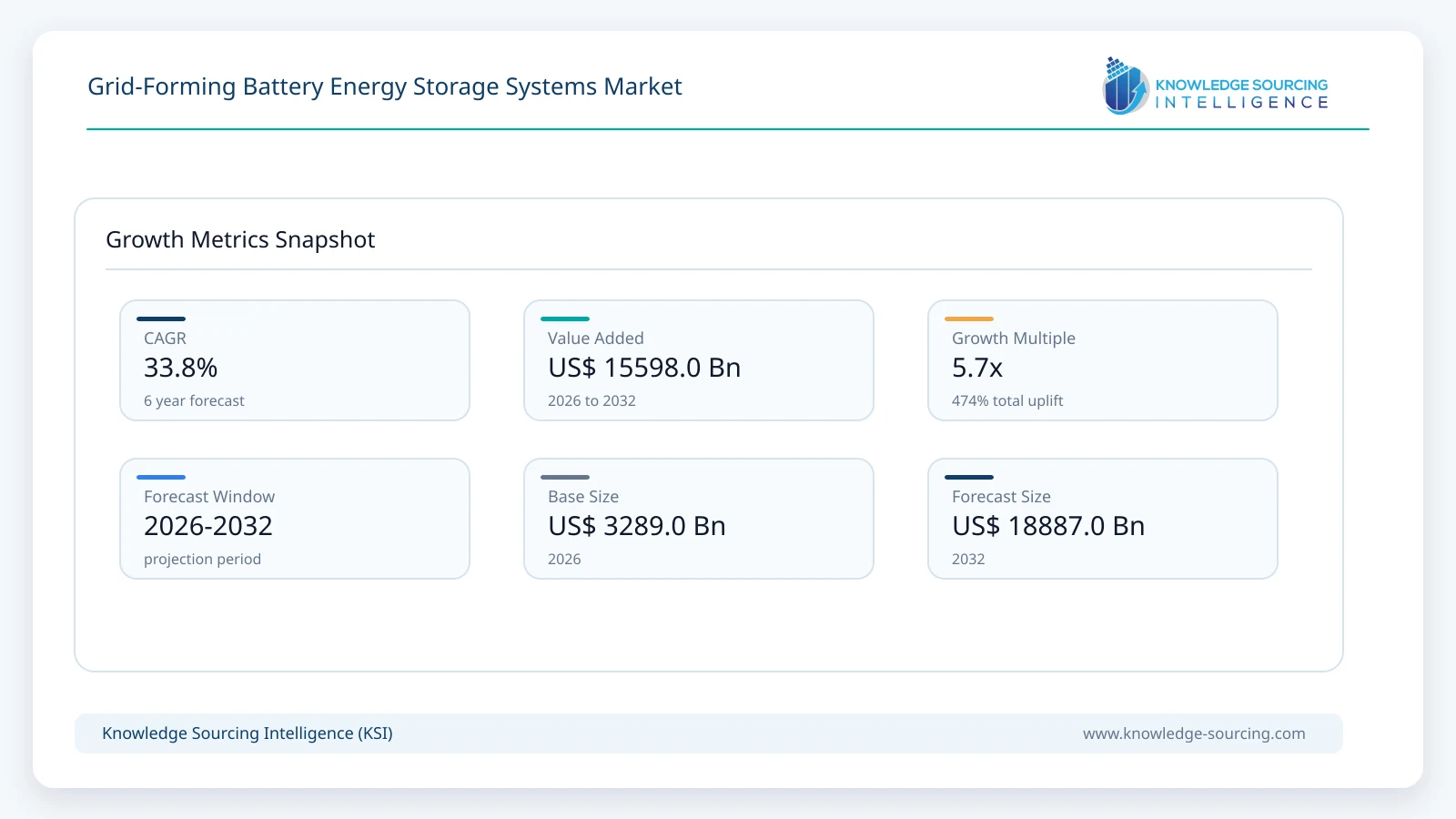
The global grid-forming battery energy storage systems market is estimated at USD 3,289 million in 2026 and is projected to reach USD 18,887 million by 2032, growing at a CAGR of 33.8% over the period.
Highlights:
- 1Australia has the most developed large-scale grid-forming battery portfolio, supported by multiple utility projects across the National Electricity Market.
- 2Great Britain's Stability Pathfinder has moved grid-forming batteries into contracted system-strength and inertia services.
- 3Grid-forming batteries can provide voltage reference, synthetic inertia, fast frequency response and black-start capability from the same storage asset.
- 4Hitachi Energy reported approximately 100 grid-forming BESS deployments worldwide by April 2026.
- 5Tesla, Power Electronics and SMA are supplying inverter technology to several of Australia's largest grid-forming battery projects.
- 6Sungrow completed large-scale grid-forming validation in 2026 across multiple extreme grid conditions.
- 7Huawei Digital Power launched the LUTERRA grid-forming energy storage System platform in June 2026.
- 8System strength and protection performance remain major technical qualification requirements as grid-forming deployment expands.
- 9Grid-forming capability is increasingly moving from a project-specific feature toward a standard requirement in weak and low-inertia networks.
- 10Utility procurement is expanding beyond energy arbitrage as batteries compete for stability, system-strength and restoration services.
- 11Grid-forming BESS equipment revenue is projected to grow at a 33.8% CAGR between 2026 and 2032 as more new storage projects adopt voltage-forming inverter controls.
Market Overview
Most solar, wind and battery plants have historically used grid-following inverters, that synchronizes to an existing voltage and frequency reference and performs well when the surrounding power system is strong. Grid-forming inverters operate differently. They behave as controlled voltage sources and can establish a stable reference for other equipment, allowing a battery to contribute characteristics that were traditionally supplied by synchronous generators.
This capability becomes more important as conventional generators retire. Synchronous machines naturally contribute rotational inertia, fault current and voltage stiffness. Inverter-based generation does not provide the same response unless it is specifically controlled to do so. Grid-forming BESS combines fast power electronics with stored energy, allowing the plant to support both active and reactive power during a disturbance. Depending on the design, the same asset can also provide energy shifting, frequency services, congestion relief and merchant market participation.
Commercial projects now span several operating models, as some batteries are built primarily for energy and capacity markets but include grid-forming capability as an additional service. Others are contracted specifically to deliver inertia, short-circuit contribution or system-strength support. Retrofit projects are also emerging, where an existing grid-following battery is upgraded through inverter controls, plant tuning or equipment replacement. The Victorian Big Battery in Australia is one example of a project selected for a grid-forming retrofit under ARENA's large-scale battery program.
Market Quantification Framework
Metric | Unit | Market Measurement |
Grid-forming BESS system revenue | USD million / billion | Tracks complete utility-scale BESS systems commissioned with grid-forming functionality. |
Annual grid-forming BESS additions | MW | Measures inverter and power-conversion capacity entering commercial operation. |
Annual grid-forming energy capacity | MWh / GWh | Captures storage duration and battery-system content alongside power capacity. |
Grid-forming share of utility-scale BESS additions | % | Measures the transition from grid-following to grid-forming control in new projects. |
Grid-forming inverter / power conversion content | USD per MW | Tracks the power-electronics and control value within a complete BESS project. |
Market Trends
Grid-Forming Capability Is Moving Into Standard Utility-Scale Storage Platforms
Grid-forming control is no longer confined to customized demonstration systems. Hitachi Energy markets BESS with both grid-following and grid-forming operation, GE Vernova includes grid-forming and black-start functionality in its FLEXINVERTER platform, and SMA positions grid-forming as a core large-scale storage capability. Sungrow and Huawei Digital Power have also completed large-scale validation or launched dedicated grid-forming storage systems. This broadening supplier base is important because utilities increasingly want the grid-forming function to be delivered within normal battery procurement rather than through a separate stability device.
System-Strength Services Are Becoming a Bankable Revenue Stream
Grid-forming economics improve when system operators procure inertia, short-circuit contribution and other stability services under long-term contracts. Great Britain's Stability Pathfinder Phase 2 contracted five grid-forming batteries together with synchronous condensers to provide short-circuit level and inertia in Scotland. Australia is developing a different model in which grid-forming batteries can reduce connection costs, support system strength and participate in energy storage and ancillary-service markets. These structures increase the value of advanced inverter functionality beyond energy arbitrage alone.
Plant-Level Validation Is Replacing Controller-Level Claims
Utilities are placing greater emphasis on how the complete plant behaves under weak-grid conditions, faults, phase-angle jumps and low state-of-charge conditions. Sungrow completed a large-scale validation program in April 2026 using a 30 MW grid-simulation platform and multiple extreme operating scenarios. The Australian Energy Market Operator (AEMO) is also refining methods for quantifying the system-strength contribution of grid-forming resources. This is shifting procurement toward validated plant-level performance rather than a simple software designation on the inverter controller.
Representative Grid-Forming Battery Projects
Project | Market | Capacity | Inverter / Platform | Significance |
Blackhillock | Great Britain | 300 MW / 600 MWh | SMA | Transmission-connected grid-forming BESS contracted for inertia and short-circuit support. |
Liddell BESS | Australia | 500 MW / 1,000 MWh | Power Electronics | Large ARENA-supported project designed to demonstrate grid-forming services at scale. |
Mortlake BESS | Australia | 300 MW / 650 MWh | SMA | Grid-forming functionality enabled for system-stability support in Victoria. |
Victorian Big Battery retrofit | Australia | 300 MW / 450 MWh | Tesla | Existing BESS selected for retrofit of grid-forming capability. |
Western Downs BESS | Australia | 255 MW / 510 MWh | Tesla | Large battery designed to transition from grid-following to grid-forming operation. |
Gnarwarre BESS | Australia | 250 MW / 500 MWh | Grid-forming enabled | New project intended to demonstrate advanced inverter capability at utility scale. |
Market Drivers
Retirement of Synchronous Generation Increases the Need for New Stability Resources
Coal and gas plants contribute inertia, fault current and voltage support whenever they are synchronized to the power system. As these units retire or operate less frequently, system operators require alternative sources of the same services. Grid-forming batteries are well suited to this requirement because they can respond within milliseconds and can provide both active and reactive power. NESO identifies grid-forming batteries as one of the technologies required to maintain system stability as Great Britain reduces dependence on conventional synchronous generation.
Weak-Grid Renewable Projects Need Better System-Strength Support
Renewable projects connected in weak parts of the network can face stability limits, additional modelling requirements or the cost of synchronous condensers. Grid-forming BESS can strengthen local voltage and improve the operating environment for nearby inverter-based resources. ARENA's Australian program specifically targets this use case, while the Australian Energy Market Commission recognizes grid-forming batteries as one option for remediating system-strength impacts from new connections.
Multi-Service Operation Improves Battery Project Economics
A grid-forming battery does not need to operate only as a stability asset. The battery can continue to provide energy arbitrage, frequency control, capacity and congestion services while reserving sufficient headroom for grid-forming response. This allows the incremental cost of advanced inverters, controls and engineering to be spread across several revenue streams. The commercial case becomes stronger where system-strength or inertia services are contracted over multiple years.
Market Restraints
Connection Studies and Protection Requirements Remain Complex
Grid-forming performance depends on the interaction between the inverter, battery, plant controller and surrounding network. Electromagnetic transient modelling, fault-current behaviour, protection coordination and tuning therefore become critical during connection studies. ARENA's Mortlake project has highlighted the need for early alignment between original equipment manufacturers, network service providers and AEMO on modelling and technical data. These requirements can extend development schedules even when the underlying battery equipment is commercially available.
Grid-Forming Capability Does Not Eliminate Energy and State-of-Charge Constraints
A battery can provide voltage and frequency reference through its inverter, but sustained active-power support still depends on available stored energy and power headroom. The plant controller must therefore coordinate energy-market dispatch with system-strength obligations, particularly during periods of low state of charge. This adds operating complexity compared with a synchronous condenser, which can provide reactive and short-circuit support without maintaining an energy reserve.
Segment Analysis
By Inverter Architecture - Centralized Power Conversion Systems
Centralized Power Conversion Systems remain the largest architecture for utility-scale grid-forming batteries because large projects can combine high-power inverter blocks with medium-voltage transformers, plant-level controllers and dedicated grid-compliance engineering. SMA, Power Electronics, Hitachi Energy and GE Vernova all participate in this architecture. Centralized systems are particularly well suited to transmission-connected batteries where the operator requires coordinated plant response, high fault withstand capability and detailed performance validation at the point of connection. String and modular inverter architectures are expanding as suppliers improve plant-level coordination and redundancy, with Huawei Digital Power and other vendors positioning distributed architectures for large storage plants.
By System Configuration - Standalone Grid-Forming BESS
Standalone grid-forming BESS remains the principal commercial configuration because the battery can be located at a constrained substation, retired power-station site or renewable-energy zone and dispatched independently from generation. Liddell, Mortlake and Blackhillock illustrate this model. Co-located renewable-plus-storage systems are also increasing as developers use grid-forming batteries to improve the connection behaviour of solar and wind plants. Grid-booster and system-strength batteries represent a smaller but high-value segment where the primary investment case is network stability rather than energy shifting.
By Storage Duration - Two-to-Four-Hour Systems
Two-to-four-hour batteries account for a large share of new utility-scale storage development and provide a practical balance between energy-market participation and grid-forming response. Many current projects fall within this range, including Mortlake at slightly above two hours and Blackhillock at two hours. Shorter-duration systems remain relevant where inertia, frequency response and system strength dominate the business case, while longer-duration batteries can combine grid-forming functionality with capacity and renewable-energy shifting.
By Grid Service - System Strength and Inertia
System strength and inertia are the most distinctive commercial applications for grid-forming BESS because they separate the technology from conventional grid-following storage. Grid-forming controls can establish voltage, support short-circuit level, provide inertial response and improve stability for nearby renewable generators. Frequency regulation and energy services remain important revenue sources, but they can also be provided by conventional batteries. Black start, islanding and restoration are smaller applications today but are becoming more important as system operators prepare for grids with fewer synchronous generators.
Grid-Forming Service Stack
Grid Service | Role of the Battery | Market Opportunity |
System strength | Provides voltage-source behaviour and supports stable operation of nearby inverter-based resources. | Can reduce network remediation requirements and support weak-grid connections. |
Synthetic inertia | Injects or absorbs active power rapidly in response to frequency changes. | Increasingly procured through system-stability contracts and grid-code requirements. |
Voltage and reactive power support | Regulates voltage and supplies dynamic reactive power. | Supports network compliance and can reduce dependence on separate reactive-power equipment. |
Fast frequency response | Responds rapidly to frequency deviations using stored energy. | Adds ancillary-service revenue alongside energy trading. |
Black start and islanding | Establishes local voltage and frequency without an external grid reference. | Supports restoration, microgrids and critical-system resilience. |
By Geography - Asia Pacific
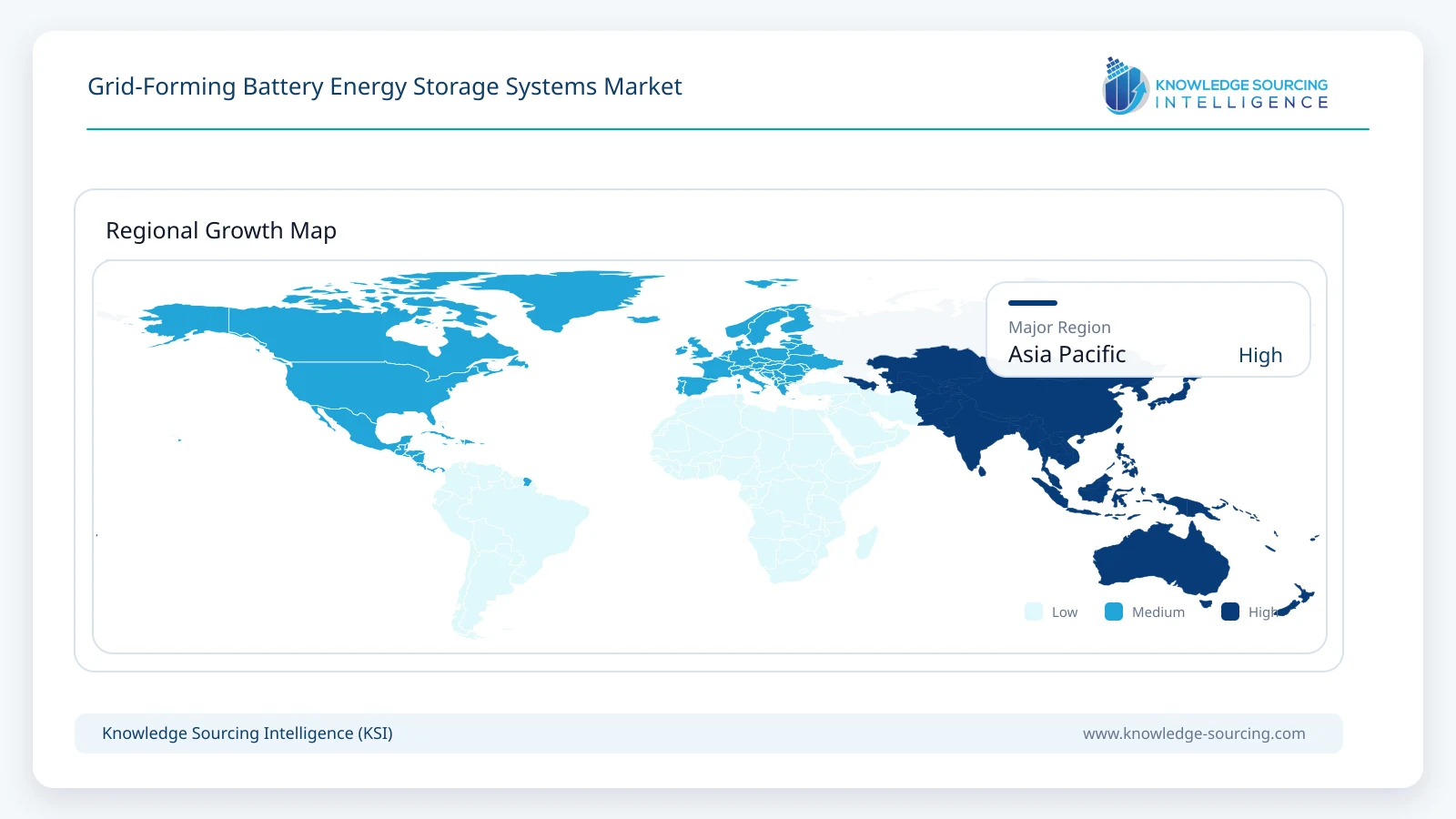
Asia Pacific currently provides the clearest large-scale commercial deployment base for grid-forming battery storage, led by Australia. ARENA's large-scale battery program has supported projects using Tesla, Power Electronics and SMA inverter technology, while earlier installations such as Hornsdale Power Reserve and Dalrymple established operating experience with advanced inverter functions. Five ARENA-supported grid-forming projects were already connected to the National Electricity Market by late 2025, with further projects progressing through construction and commissioning. Australia is also developing more detailed technical requirements: AEMO is reviewing grid-forming access standards and in September 2026 published further work on quantifying system-strength contribution from grid-forming resources. Outside Australia, China has become an important technology and manufacturing center. Sungrow completed large-scale grid-forming validation in 2026, while Huawei Digital Power launched its LUTERRA grid-forming Energy Storage System platform and is promoting plant-level grid-forming capability across Asia Pacific. India is also evaluating domestic manufacturing capability for grid-forming inverters as renewable penetration and storage procurement increase.
Competitive Environment
Competition is expanding from specialist power-conversion suppliers into a broader group of battery integrators and digital-power companies. SMA has a strong position in transmission-connected grid-forming projects through Blackhillock and Mortlake. Power Electronics is supplying Australian projects including Liddell and Blyth, while Tesla is associated with Western Downs and the Victorian Big Battery retrofit. Hitachi Energy combines batteries, power conversion, plant controls and high-voltage grid integration and reported around 100 grid-forming BESS deployments worldwide by April 2026.
Asian suppliers are increasing their presence in large-scale grid-forming storage. Sungrow has completed full-condition validation of its grid-forming controls, while Huawei Digital Power is commercializing plant-level grid-forming through the LUTERRA platform. GE Vernova offers grid-forming and black-start capability through FLEXINVERTER, and Fluence and Wärtsilä participate as system integrators on advanced storage projects. Competition therefore increasingly depends on verified plant behaviour, electromagnetic transient models, grid-code compliance, power-conversion efficiency, battery controls and the ability to tune complete systems for local network conditions.
Recent Developments
September 2026: Huawei Digital Power launched its new-generation LUTERRA Grid-Forming Energy Storage System platform across Asia Pacific, emphasizing plant-level grid-forming control.
September 2026: The Australian Energy Market Operator published new work on quantifying system-strength contribution from grid-forming resources using frequency-domain scans.
July 2026: ARENA updated the Gnarwarre project program, covering a 250 MW / 500 MWh battery in Victoria that will be commissioned with grid-forming functionality enabled.
June 2026: Huawei Digital Power launched the LUTERRA utility-scale grid-forming storage platform at Intersolar Europe.
May 2026: Sungrow announced independent validation of large-scale grid-forming performance following 138 hours of testing across 14 grid conditions.
May 2026: NESO issued updated Grid Forming Guidance for connection compliance in Great Britain.
April 2026: Hitachi Energy reported approximately 100 grid-forming BESS deployments worldwide and expanded its grid-forming converter portfolio.
March 2026: ARENA published further Mortlake project learnings covering modelling, harmonic requirements and the grid-connection process for the 300 MW / 650 MWh battery.
Grid-Forming battery energy storage Systems Market Scope:
| Report Metric | Details |
|---|---|
| Total Market Size in 2026 | USD 3,289 million |
| Total Market Size in 2032 | USD 18,887 million |
| Forecast Unit | USD Million |
| Growth Rate | 33.8% |
| Study Period | 2021 to 2032 |
| Historical Data | 2021 to 2024 |
| Base Year | 2025 |
| Forecast Period | 2026 – 2032 |
| Segmentation | Inverter Architecture, System Configuration, Storage Duration, Grid Service, Owner / Buyer Type, Geography |
| Companies |
|
Market Segmentation
By Inverter Architecture
Centralized Power Conversion Systems
String and Modular Power Conversion Systems
By System Configuration
Standalone Grid-Forming BESS
Renewable Energy + Grid-Forming BESS
Grid Booster and System-Strength BESS
Microgrid and Islanded Grid-Forming BESS
Retrofit of Existing Grid-Following BESS
By Storage Duration
Below 2 Hours
2–4 Hours
Above 4 Hours
By Grid Service
System Strength and Short-Circuit Support
Synthetic Inertia and Frequency Stability
Voltage and Reactive Power Support
Black Start and System Restoration
Oscillation Damping and Weak-Grid Stabilization
Energy and Ancillary Services
By Owner / Buyer Type
Transmission and System Operators
Utilities and Independent Power Producers
Renewable Energy Developers
Battery Storage Developers and Operators
Industrial, Island and Microgrid Operators
By Geography
North America
Europe
Asia Pacific
China
Middle East and Rest of World
Table of Contents
1. EXECUTIVE SUMMARY
2. MARKET SNAPSHOT
2.1. Market Overview
2.2. Market Segmentation
2.3. Market Size, Installed MW and MWh Forecast, 2026-2032
2.4. Grid-Forming Share of Utility-Scale BESS Additions
3. BUSINESS LANDSCAPE
3.1. Market Drivers
3.1.1. Retirement of Synchronous Generation Increases Demand for New Stability Resources
3.1.2. Weak-Grid Renewable Projects Require Additional System-Strength Support
3.1.3. Multi-Service Operation Improves Battery Project Economics
3.2. Market Restraints
3.2.1. Connection Studies and Protection Requirements Remain Complex
3.2.2. State-of-Charge and Power-Headroom Constraints Affect Service Delivery
3.3. Market Opportunities
3.4. Industry Value Chain Analysis
3.5. Grid Codes, System-Strength Frameworks and Technical Standards
3.6. Project Economics and Revenue Stack
4. TECHNOLOGICAL OUTLOOK
4.1. Grid-Following versus Grid-Forming Control
4.2. Virtual Synchronous Machine and Droop-Based Control
4.3. Synthetic Inertia and Fast Frequency Response
4.4. Fault Current and System-Strength Contribution
4.5. Black Start and Islanded Operation
4.6. Oscillation Damping and Voltage Support
4.7. Electromagnetic Transient Modelling and Hardware-in-the-Loop Validation
5. GRID-FORMING BESS MARKET BY INVERTER ARCHITECTURE
5.1. Introduction
5.2. Centralized Power Conversion Systems
5.3. String and Modular Power Conversion Systems
6. GRID-FORMING BESS MARKET BY SYSTEM CONFIGURATION
6.1. Introduction
6.2. Standalone Grid-Forming BESS
6.3. Renewable Energy + Grid-Forming BESS
6.4. Grid Booster and System-Strength BESS
6.5. Microgrid and Islanded Grid-Forming BESS
6.6. Retrofit of Existing Grid-Following BESS
7. GRID-FORMING BESS MARKET BY STORAGE DURATION
7.1. Introduction
7.2. Below 2 Hours
7.3. 2-4 Hours
7.4. Above 4 Hours
8. GRID-FORMING BESS MARKET BY GRID SERVICE
8.1. Introduction
8.2. System Strength and Short-Circuit Support
8.3. Synthetic Inertia and Frequency Stability
8.4. Voltage and Reactive Power Support
8.5. Black Start and System Restoration
8.6. Oscillation Damping and Weak-Grid Stabilization
8.7. Energy and Ancillary Services
9. GRID-FORMING BESS MARKET BY OWNER / BUYER TYPE
9.1. Transmission and System Operators
9.2. Utilities and Independent Power Producers
9.3. Renewable Energy Developers
9.4. Battery Storage Developers and Operators
9.5. Industrial, Island and Microgrid Operators
10. GRID-FORMING BESS MARKET BY GEOGRAPHY
10.1. North America
10.2. Europe
10.3. Asia Pacific
10.4. China
10.5. Middle East and Rest of World
11. COMPETITIVE ENVIRONMENT AND ANALYSIS
11.1. Major Players and Strategy Analysis
11.2. Inverter and Power Conversion Positioning
11.3. BESS Integration and Plant-Control Capability
11.4. Grid-Code Qualification and Project References
11.5. Competitive Dashboard
12. COMPANY PROFILES
12.1. Hitachi Energy
12.2. SMA Solar Technology AG
12.3. Tesla, Inc.
12.4. Power Electronics S.L.
12.5. Sungrow Power Supply Co., Ltd.
12.6. Huawei Digital Power
12.7. Fluence Energy, Inc.
12.8. Wärtsilä Energy Storage & Optimisation
12.9. GE Vernova
12.10. Ingeteam
12.11. Nidec Conversion
12.12. Sineng Electric Co., Ltd.
12.13. Kehua Tech
12.14. Delta Electronics, Inc.
12.15. Envision Energy
12.16. ABB Ltd.
13. APPENDIX
Navigate
Trusted by the world's leading organizations