
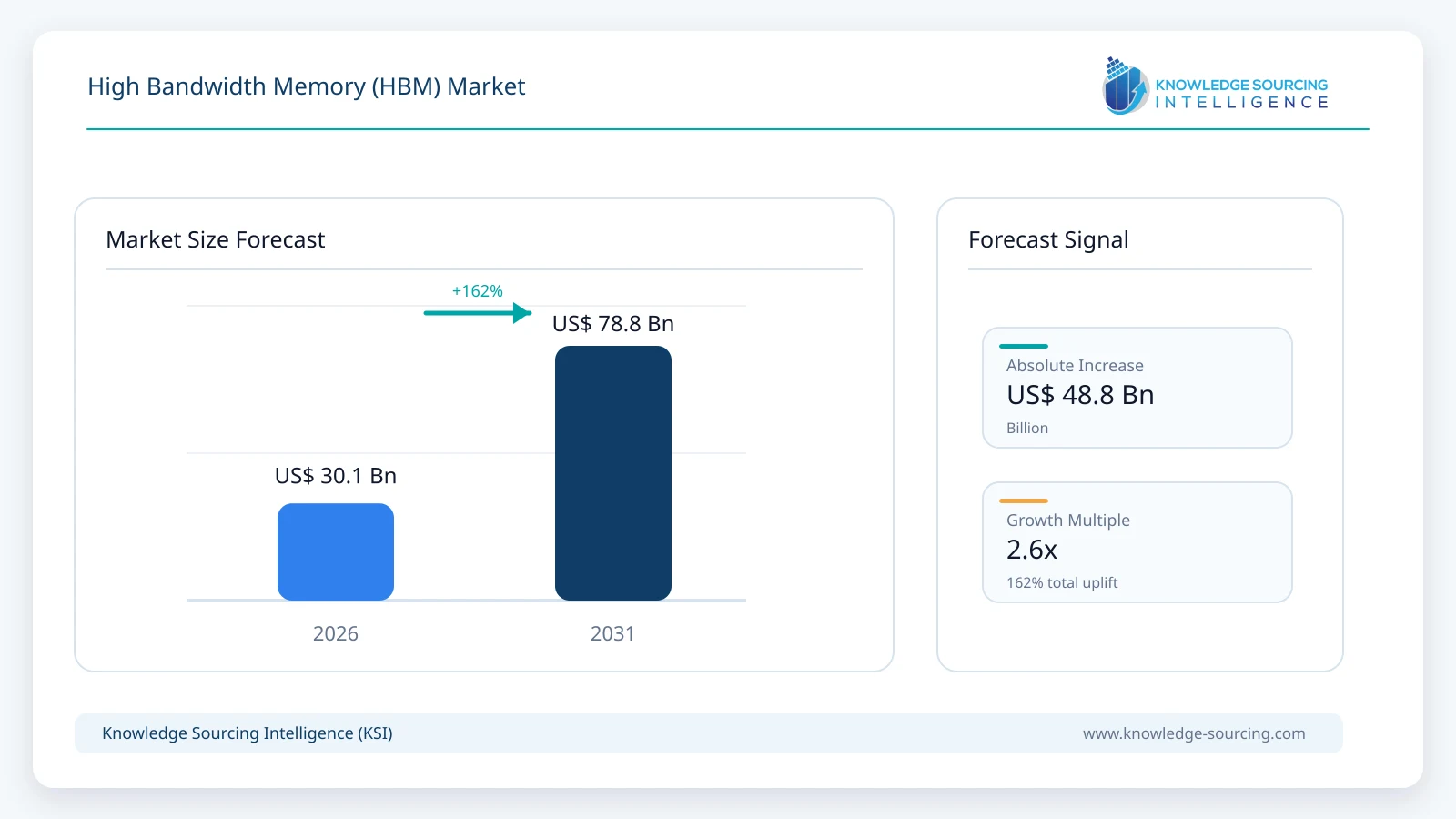
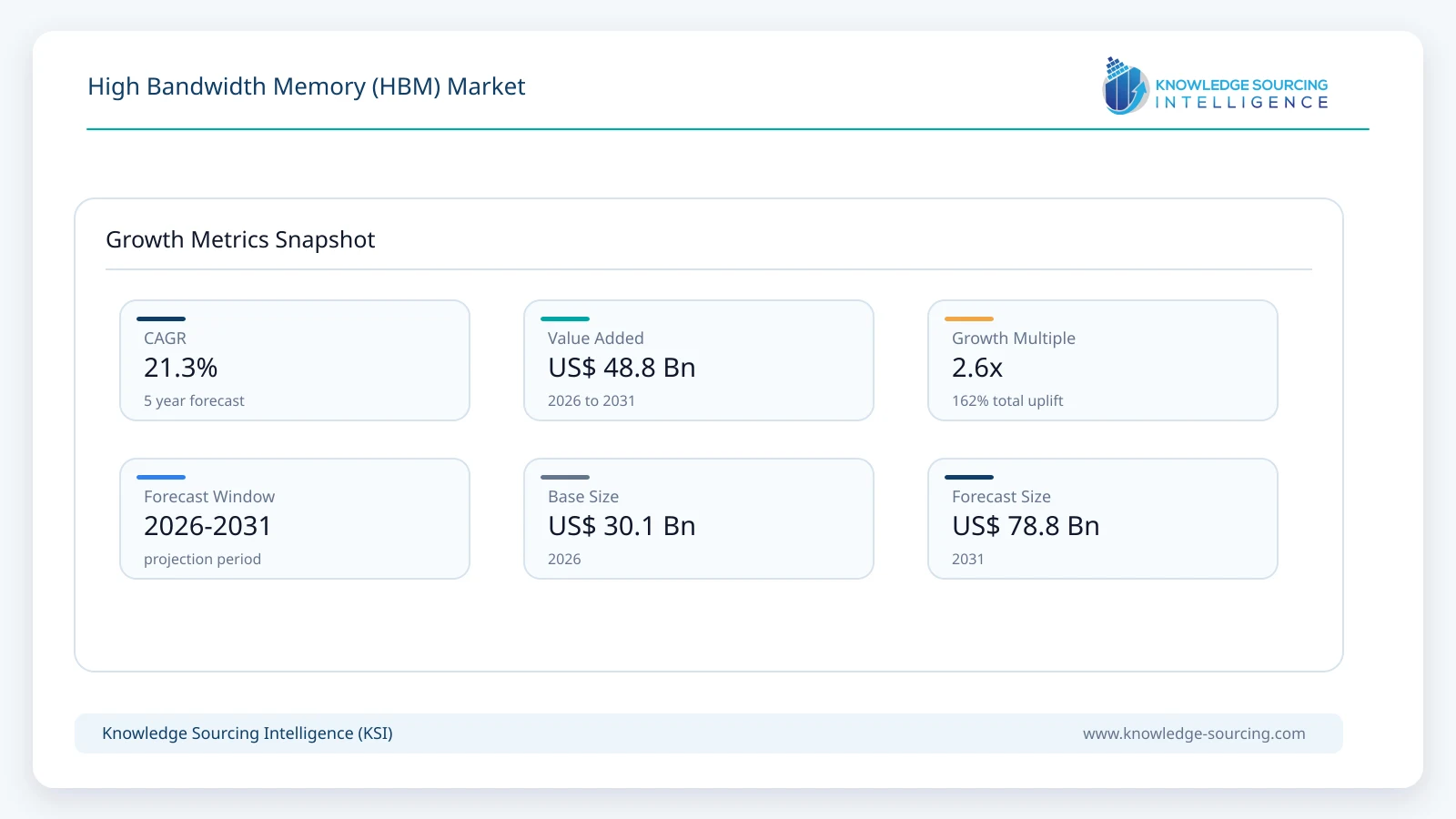
The High Bandwidth Memory (HBM) Market is forecast to grow at a CAGR of 21.3%, reaching USD 78.84 billion in 2031 from USD 30.08 billion in 2026.
Highlights:
- 1Market GrowthThe global HBM market is projected to reach USD 78.84 billion by 2031, expanding at a robust 21.3% CAGR during the forecast period.
- 2AI and ML LeadershipAI and Machine Learning lead applications, driven by rising memory bandwidth requirements across models, accelerators, cloud platforms, and enterprise computing.
- 3GPU-Integrated HBM DominanceGPU-integrated HBM leads processor integration, supported by growing demand for AI training, inference, scientific computing, and advanced graphics applications.
- 4IT and Telecommunications LeadershipIT and telecommunications hold the largest end-user share, fueled by AI servers, cloud infrastructure, networking equipment, and data center deployments.
- 5Asia-Pacific LeadershipAsia-Pacific leads globally, supported by semiconductor manufacturing, memory production, advanced packaging, and South Korea’s major HBM technology companies.
- 6North American DemandNorth America remains a major market, driven by hyperscalers, AI infrastructure, semiconductor innovation, research investments, and expanding data center deployments.
The HBM market growth is driven by increasing demand for AI training systems, cloud computing infrastructure, advanced graphics processors & next-generation supercomputing platforms.
HBM technology uses memory dies connected through Through-Silicon Vias (TSVs), allowing for greater than 200 GB/s per package bandwidth consumption and significantly less power than traditional memory architectures. These features have made HBM a mandatory tech for AI accelerators, GPUs, FPGAs, and high-performance processors that require low-latency access to large data sets.
Generative AI technologies have been commercialized much faster than the semiconductor ecosystems they depend upon, resulting in an inflection point of demand for semiconductors. AI training clusters are increasingly used, which use fewer and more powerful processors combined with advanced HBM architectures to meet ultra-high memory bandwidth requirements. As a result, semiconductor manufacturers have focused efforts on HBM capacity expansion and advanced packaging investment over the coming years.
Advanced packaging technologies are emerging as key competitive differentiators for manufacturers looking to best optimize memory density and performance. AI workloads are becoming more complex, which should accelerate deployments of HBM across data centers, network equipment, scientific research centers, defense systems, and autonomous computing applications.
The demand is driven by investment in AI infrastructure & cloud computing in North America. Production and innovation centres of the world are in the Asia-Pacific, and Europe focuses on initiatives around HPC and semiconductor sovereignty. Rapid AI adoption in the healthcare, automotive, and defense sectors is projected to further provide revenue opportunities throughout the forecast period.
Market Dynamics
Market Drivers
Accelerating Adoption of Artificial Intelligence: Generative AI, machine learning, and large language models are being implemented in a time span of months, which drastically expands the requirement for high-performance memory solutions. AI accelerators demand memory systems that can handle tremendous amounts of data at very high rates. HBM provides the bandwidth required to support both training and inference workloads, making it one of the most fundamental technologies used in modern AI infrastructure.
Expansion of Hyperscale Data Centers: As computational requirements continue to grow, cloud providers and hyperscale operators are investing heavily in AI-ready infrastructure. Processors with HBM improve performance while decreasing power consumption, making them attractive for large data center deployments. Rising demand for AI cloud services is expected to continue to be one of the significant market drivers.
Growth of High-Performance Computing Applications: HPC systems are increasingly used by scientific research institutions, weather forecasting centres, defense organizations, and engineering simulation environments. These applications also require extremely high memory bandwidth and computational efficiency, which leads to increasing demand for advanced HBM solutions.
Advancements in Semiconductor Packaging Technologies: Some innovations in 2.5D packaging, Chiplet architectures, and TSV are improving on HBM scalability and performance. AI and HPC processors are anticipated to continue to evolve forward through advanced packaging solutions that increase the memory densities and allow for extreme efficiency.
Market Restraints & Opportunities
The designs, materials, and packaging methods that are utilized in producing HBMs are fairly complex, which increases their production costs over typical memory solutions. Capacity issues and yield management challenges can also limit the availability of supply.
Despite this, the ongoing adoption of AI, higher investments in semiconductor with growth in the advanced packaging ecosystem provide great opportunities. Continuous demand from autonomous systems, edge AI platforms, advanced networking infrastructure, and next-generation gaming technologies can prove supportive factors covering further growth in this market.
Key Developments
June 2026: SK hynix displaced Samsung Electronics as South Korea's most valued publicly traded company. Its stock soared on an optimistic outlook over rising demand for HBM chips for use in AI accelerators. This more than 340 percent rise in share price is due to the company's leadership in HBM technology and importance as a large supplier for leading AI platforms.
February 2026: Samsung Electronics began mass production and announced commercial shipment of the industry's first HBM4 memory. The new HBM4 offers transfer speeds of 11.7 Gbps (up to 13 Gbps), up to 3.3 TB/s bandwidth per stack, and 40% higher power efficiency over HBM3E, further bolstering Samsung's leadership in AI computing and next-generation data center infrastructure.
August 5, 2025: NEO Semiconductor announced the world's first X-HBM (Extreme HBM) architecture for AI chips. Based on its proprietary 3D X-DRAM technology, X-HBM provides a 32K-bit data bus and up to 512 Gbit per die for scaling out performance by between 16 times the bandwidth density or 10 times the highest capacity of conventional HBM, targeting next-gen AI and high-performance computing workloads.
Market Segmentation
The market is segmented by memory type, memory capacity, processor integration, application, end-user, and geography.
By Processor Integration – GPU-Integrated HBM
GPUs are currently the primary processing architecture for AI training, AI inference, scientific computing, and advanced graphics workloads, and are expected to continue to dominate the market with HBM integrated onto them. GPUs paired with HBM provide world-class compute performance and memory bandwidth.
The SK hynix AI Memory Solutions are Hybrid HBM technologies that facilitate over 2x performance improvements through tailored solutions targeting demanding, high-throughput requirements of modern AI processing environments with industry-leading power efficiency for GPU manufacturers.
Samsung Semiconductor HBM Portfolio has memory solutions tailored for GPU-based AI accelerators and ultra-high-performance graphics systems.
There will be sustained strong demand for GPU-integrated HBM technologies as demand for AI training clusters and hyperscale infrastructure continues to grow.
By Application – Artificial Intelligence (AI) & Machine Learning (ML)
The largest application segment is AI and ML, as modern AI models need huge memory bandwidth to cover all those large datasets effectively. The migration of HBM technologies as fundamental building blocks for both cloud, enterprise, and research systems is largely a reflection of the broader adoption of AI accelerators globally.
Micron AI Memory Solutions are optimized memory architectures for the most demanding models where bandwidth, power, and performance are critical. Additionally, SK hynix HBM Solutions supports premier AI infrastructure providers with memory products optimized for generative AI and machine learning workloads.
The explosive expansion of AI use cases throughout industries is increasing major investment in HBM-driven compute platforms.
By End User – IT & Telecommunications
The IT and telecommunications sectors have the highest market share as a result of the wide deployment of AI servers, cloud computing infrastructure, networking equipment, and data center technologies. Telecom operators and cloud providers are especially dependent on HBM systems for AI services and digital applications of higher complexity.
Samsung Semiconductor Data Center Memory Solutions are leading HBM technologies to support AI data center systems and next-generation networking infrastructure. For cloud service providers and hyperscale operators, SK hynix Enterprise Memory Solutions delivers advanced memory products optimized for data-intensive environments.
HBM adoption across the IT ecosystem continues to be driven by the growth of AI-enabled cloud services, edge computing, and advanced networking applications.
Regional Analysis
North America Market Analysis
North America continued to be among the biggest HBM markets primarily due to its concentration of AI infrastructure, cloud hyperscalers, semiconductor innovators, and research institutions. Regional demand is led by the United States, backed by significant investments for AI training, supercomputing infrastructure, and advanced semiconductor technologies.
Large cloud players are also continuing to scale up their data centers, specifically for AI, which needs many HBM-enabled accelerators and GPU chips. Support from the government for semiconductor manufacturing and AI innovation is also aiding the growth of the market. Rapid interaction among memory vendors, AI processor designers, and hyperscale operators makes the region thrive.
South America Market Analysis
South America is expected to continue to grow gradually, with the rising focus on cloud adoption, digital transformation projects, and enterprise IT infrastructure modernization. Brazil is still the dominant market, driven by rising investments in data centers and an increasing demand for AI-based services.
The advanced computing technologies that need great performance memory solutions are being adopted rapidly in financial services, telecommunications, and research institutions. To accommodate the spread of AI-trained use in all areas, the demand for HBM-enabled infrastructure is expected to grow.
Europe Market Analysis
Europe market is expected to rise with investments into HPC infrastructure, semiconductor independence initiatives, and AI innovation programs. Through heavy public and private sector investments in countries like Germany, France, the UK, and the Netherlands are gradually augmenting their advanced computing ecosystems.
Additionally, with its bandwidth advantages and ability to integrate with CPUs or GPUs, research institutions and supercomputing centers in the region have readily adopted HBM-enabled systems for scientific modelling, climate research, and engineering simulations. The launch of European AI strategies and several plans and initiatives for semiconductor development will also contribute to market expansion.
Middle East and Africa Market Analysis
The Middle East and Africa region is also growing as governments are investing in AI, smart city development, and cloud infrastructure & digital transformation. National AI strategies are also being backed by the implementation of an advanced computing infrastructure, with countries like the UAE and Saudi Arabia already in the rollout phase.
Rising adoption of HBM-enabled systems is aided by data center investments as well as emerging AI applications. There is also expected future demand from government-backed programs to modernize technology with the use of advanced semiconductor technologies.
Asia Pacific Market Analysis
The Asia–Pacific region contributes significantly to the HBM market because of the presence of leading manufacturers of memory and extremely enormous semiconductor fabrication facilities, & packaging ecosystem. SK Hynix and Samsung Electronics have put South Korea at the forefront of global HBM innovation.
China, Japan, Taiwan, and South Korea are still heavily investing in AI infrastructure, semiconductor manufacturing, and advanced packaging. Strong supply chain integration and mass production benefits in the region. Regional expansion is further bolstered by government initiatives to increase the domestic manufacture of semiconductors.
List of Companies
SK hynix
Samsung Electronics
Micron Technology
SK hynix
SK hynix is a leading global HBM company and one of the top suppliers of HBM3 and HBM3E chips for AI accelerator products. The company has solidified a stronghold in the market through robust innovation, packaging capabilities at scale, and collaborations with the leading AI processor manufacturers.
Samsung Electronics
Samsung Electronics Semiconductor Division is one of the world's largest memory manufacturers and a key player in HBM development. The company is aggressively developing HBM3E and HBM4 to meet increasing demand for AI and high-performance computing.
Micron Technology
Micron Technology is a global leader in innovative memory solutions and continues expanding its HBM portfolio for AI, data center, and HPC applications. The company is focused on high-performance memory architectures optimized for next-generation computing platforms.
Analyst View
The High Bandwidth Memory market is undergoing the highest growth stage, driven by AI Infrastructure investments that will be further facilitated with even more computational requirements across all industries. Hyperscale operators continue to support rapidly expanding AI deployments, which will drive the rapid adoption of HBM3E, while HBM4 emerges as an advanced memory technology. HBM will remain one of the fastest-growing segments within global semiconductors due to strong AI, data center, and high-performance computing demand.
High Bandwidth Memory (HBM) Market Scope:
| Report Metric | Details |
|---|---|
| Total Market Size in 2026 | USD 30.08 billion |
| Total Market Size in 2031 | USD 78.84 billion |
| Forecast Unit | USD Billion |
| Growth Rate | 21.3% |
| Study Period | 2021 to 2031 |
| Historical Data | 2021 to 2024 |
| Base Year | 2025 |
| Forecast Period | 2026 – 2031 |
| Segmentation | Memory Type, Memory Capacity, End User, Geography |
| Companies |
|
Market Segmentation
By Memory Type
By Memory Capacity
By Processor Integration
By Application
By End User
By Geography
Table of Contents
1. EXECUTIVE SUMMARY
2. MARKET SNAPSHOT
2.1. Market Overview
2.2. Market Definition
2.3. Scope of the Study
2.4. Market Segmentation
3. BUSINESS LANDSCAPE
3.1. Market Drivers
3.2. Market Restraints
3.3. Market Opportunities
3.4. Porter’s Five Forces Analysis
3.5. Industry Value Chain Analysis
3.6. Policies and Regulations
3.7. Strategic Recommendations
4. TECHNOLOGICAL OUTLOOK
5. HIGH BANDWIDTH MEMORY (HBM) MARKET BY MEMORY TYPE
5.1. Introduction
5.2. HBM
5.3. HBM2 & HBM2E
5.5. HBM3 & HBM3E
5.7. HBM4
6. HIGH BANDWIDTH MEMORY (HBM) MARKET BY MEMORY CAPACITY
6.1. Introduction
6.2. Up to 4 GB
6.3. 4 GB–8 GB
6.4. 8 GB–16 GB
6.5.16 GB–24 GB
6.6. 24 GB–36 GB
6.7. Above 36 GB
7. HIGH BANDWIDTH MEMORY (HBM) MARKET BY PROCESSOR INTEGRATION
7.1. Introduction
7.2. GPU-Integrated HBM
7.3.CPU-Integrated HBM
7.4. FPGA-Integrated HBM
7.5. ASIC-Integrated HBM
7.6.Others
8. HIGH BANDWIDTH MEMORY (HBM) MARKET BY APPLICATION
8.1. Introduction
8.2. High-Performance Computing (HPC)
8.3. Data Centers
8.4. Networking Equipment
8.5. Graphics
8.6. Artificial Intelligence (AI) & Machine Learning (ML)
8.7. Others
9. HIGH BANDWIDTH MEMORY (HBM) MARKET BY END USER
9.1. Introduction
9.2. IT & Telecommunications
9.3. Consumer Electronics
9.4. Automotive
9.5. Healthcare & Life Sciences
9.6. Aerospace & Defense
9.7. Gaming & Entertainment
9.8. Others
10. HIGH BANDWIDTH MEMORY (HBM) MARKET BY GEOGRAPHY
10.1. Introduction
10.2. North America
10.2.1. USA
10.2.2. Canada
10.2.3. Mexico
10.3. South America
10.3.1. Brazil
10.3.2. Argentina
10.3.3. Others
10.4. Europe
10.4.1. United Kingdom
10.4.2. Germany
10.4.3. France
10.4.4. Italy
10.4.5. Others
10.5. Middle East and Africa
10.5.1. Saudi Arabia
10.5.2. UAE
10.5.3. Others
10.6. Asia Pacific
10.6.1. China
10.6.2. Japan
10.6.3. South Korea
10.6.4. India
10.6.5. Indonesia
10.6.6. Thailand
10.6.7. Others
11. COMPETITIVE ENVIRONMENT AND ANALYSIS
11.1. Major Players and Strategy Analysis
11.2. Market Share Analysis
11.3. Mergers, Acquisitions, Agreements, and Collaborations
11.4. Competitive Dashboard
12. COMPANY PROFILES
12.1. SK hynix
12.2. Samsung Electronics
12.3. Micron Technology
13. APPENDIX
13.1. Currency
13.2. Assumptions
13.3. Base and Forecast Years Timeline
13.4. Key benefits for the stakeholders
13.5. Research Methodology
13.6. Abbreviations
Navigate
Trusted by the world's leading organizations











