
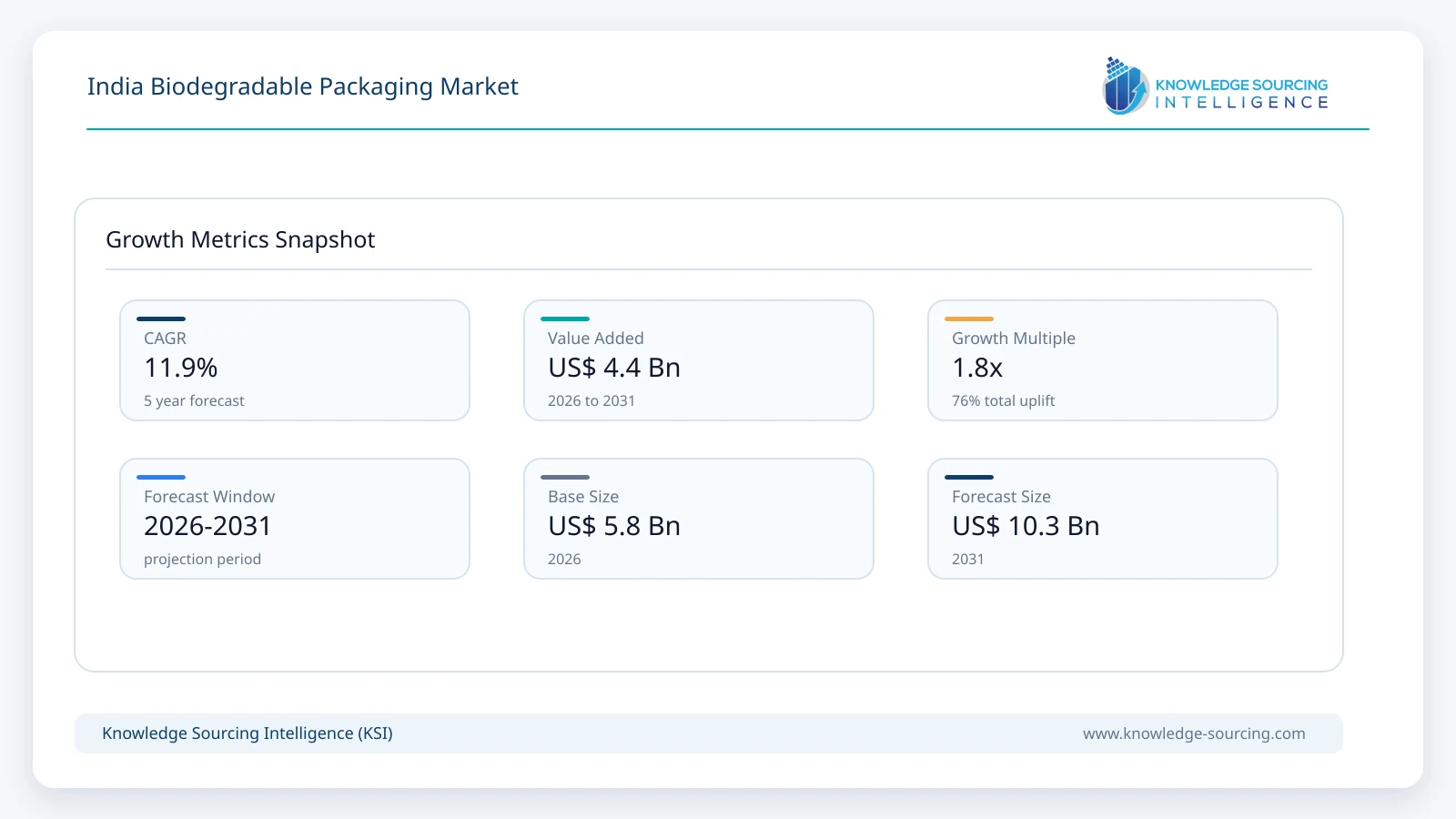
The India Biodegradable Packaging Market is projected to grow at a CAGR of approximately 11.9%, reaching USD 10.28 billion by 2031 from USD 5.85 billion in 2026.
Highlights:
- 1Paper and molded-fiber formats account for approximately 86% of market value in 2026.
- 2Food and beverage applications represent approximately 50% of biodegradable packaging demand in 2026.
- 3Compostable films and pouches are projected to grow approximately 14.6% annually through 2031.
- 4West India accounts for approximately 31% of national biodegradable packaging market value in 2026.
- 5CPCB’s 2026-27 framework requires 70% processing of Category IV compostable plastic packaging waste.
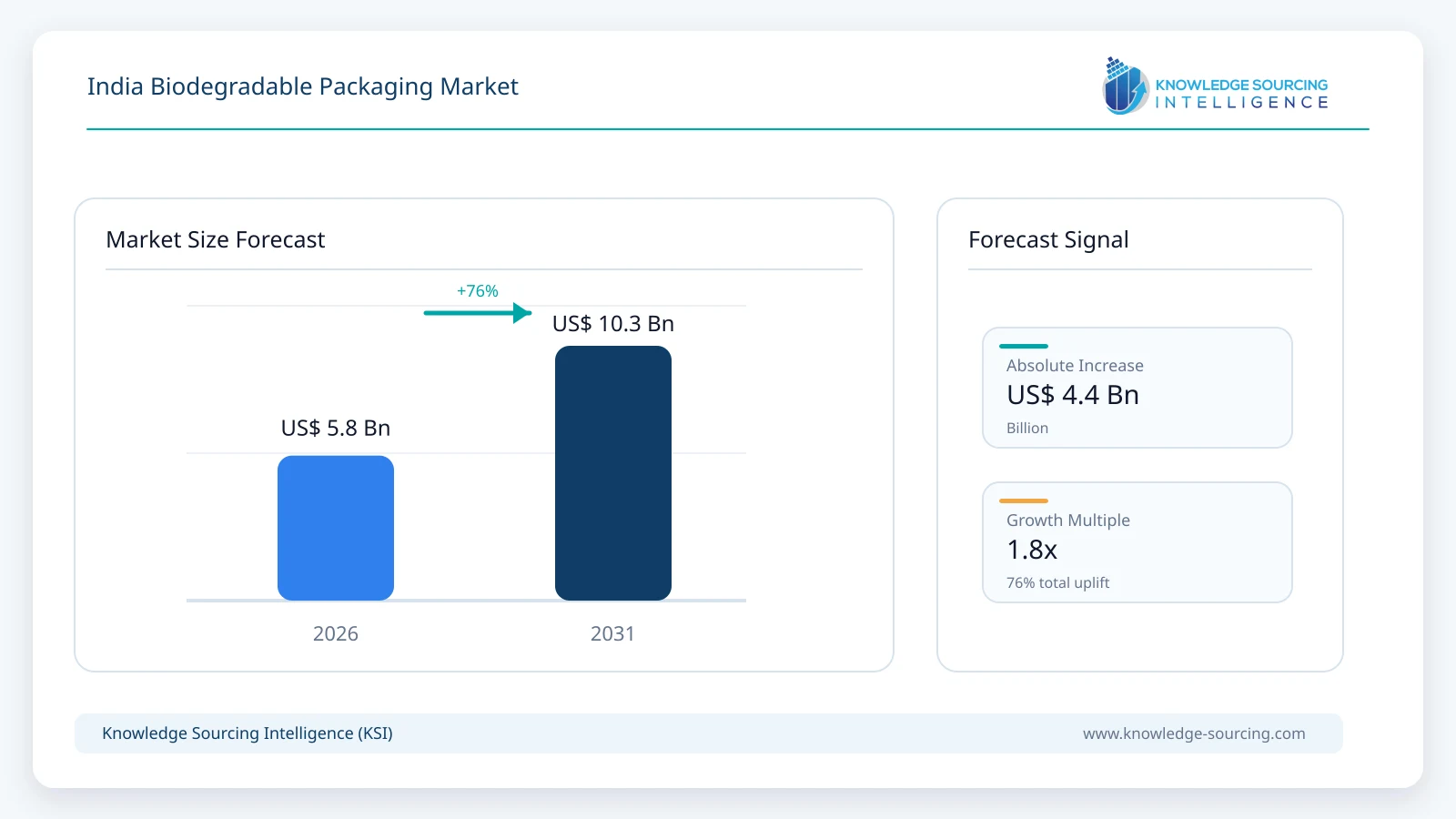
India’s biodegradable packaging market is developing around two distinct material platforms. The first is fiber-based packaging, including paper, paperboard, corrugated formats and molded agricultural-fiber products. The second is certified biodegradable or compostable plastic packaging designed for applications where conventional paper cannot provide the required flexibility, sealing or moisture barrier. Fiber-based packaging currently accounts for most market value because India’s established paper-converting industry already supplies cartons, boxes, bags and foodservice packaging at commercial scale, while compostable polymer formats remain a smaller but faster-growing segment.
India’s broader packaging industry provides a substantial addressable base for this transition. CRISIL Intelligence data reproduced in a 2025 offer document valued the Indian packaging market at approximately INR 2.55-2.65 trillion in FY2025 and projected it to reach INR 3.6-3.8 trillion by FY2029. Paper packaging represented approximately 16% of packaging market value in FY2025, while substitution away from plastic and foam has been particularly visible in food, e-commerce and premium-product applications.
Regulation is strengthening the commercial case for alternatives. Under India’s plastic packaging Extended Producer Responsibility framework, Category IV covers plastic sheets and similar packaging and carry bags made from compostable plastics. Minimum processing requirements increase from 60% of the EPR target in 2025-26 to 70% in 2026-27 and 80% from 2027-28 onward, with processing for Category IV defined as composting through industrial composting facilities. Compostable packaging must also comply with applicable Indian standards and labelling requirements.
The market therefore expands through a combination of conventional paper substitution, molded-fiber adoption and newer compostable films rather than through one material replacing all plastic packaging. Products requiring high moisture, oxygen or grease barriers continue to present greater technical challenges, while secondary packaging, foodservice containers, dry-food pouches and e-commerce applications provide more immediate conversion opportunities.
Major Market Drivers
Plastic-Waste Compliance and Material Substitution
India’s plastic waste regulations are increasing the cost and operational requirements associated with conventional packaging. Producers and brand owners are subject to EPR obligations, recycling requirements and progressively stronger recycled-content rules, while compostable packaging has its own certification and end-of-life requirements. The effect is not an automatic shift from plastic into compostable materials, but it changes packaging economics by increasing the importance of recovery, traceability and design-for-end-of-life.
Paper, molded bagasse and certified compostable packaging benefit where they can meet required barrier and mechanical performance without significantly increasing total packaging cost. CPCB maintains a certification framework for compostable plastic manufacturers and sellers, and certified packaging producers must also meet applicable plastic packaging EPR registration requirements.
Foodservice, FMCG and E-Commerce Packaging Conversion
Food and beverage applications provide the largest demand pool because takeaway meals, quick-service restaurants, bakery products, groceries, beverages and packaged foods generate large volumes of short-life packaging. Fiber-based trays, bowls, clamshells, cartons and paper bags are increasingly commercially available, while compostable films are progressing in applications including dry foods, tea, coffee and snack products.
The growing e-commerce sector adds demand for corrugated boxes, paper cushioning, envelopes and lower-plastic secondary packaging. These applications generally require less complex moisture and oxygen barriers than primary food packaging, making material substitution more straightforward.
Pakka, for example, has expanded from paper and molded-fiber products into compostable flexible packaging, while Ecoware supplies bagasse-based food packaging manufactured from sugarcane fiber. Pakka’s FY2024-25 report states that the company entered the compostable flexible packaging segment, while Ecoware markets bagasse products as biodegradable and compostable alternatives to conventional foodservice packaging.
Major Market Restraints
Cost and Performance Gap Against Conventional Plastic
Conventional flexible plastic remains difficult to replace in applications requiring long shelf life, high-speed filling, strong sealing and high moisture or oxygen barriers. Compostable films generally carry a material premium and can require adjustments to packaging machinery or product specifications.
The constraint is particularly important for mass-market Indian FMCG products, where small pack sizes and low consumer price points make even a minor per-unit packaging increase commercially significant. Biodegradable solutions therefore gain adoption faster in premium food, foodservice, institutional procurement and brands with explicit sustainability commitments than in highly price-sensitive mass-market sachets.
Inadequate Collection and Composting Infrastructure
A package being technically compostable does not guarantee that it will be composted after use. India’s regulatory framework specifically links Category IV compostable plastic processing to industrial composting facilities, making collection and end-of-life infrastructure essential to the environmental performance of the material.
This creates a structural gap between product certification and actual waste treatment. Fiber-based products that can enter established paper-recovery streams may have an infrastructure advantage in many urban markets, while compostable polymers require clearer segregation and suitable treatment. Companies consequently need to assess end-of-life availability alongside material performance when selecting biodegradable packaging.
India Biodegradable Packaging Market Trends
Agricultural Residues Are Becoming Packaging Feedstock
India has substantial availability of sugarcane bagasse and other agricultural residues that can be converted into molded-fiber food packaging. Bagasse is particularly suitable for plates, bowls, trays and takeaway containers because it can provide rigidity and grease resistance without conventional petroleum-based plastic.
Indian manufacturers are increasingly using agricultural residue as both a sustainability proposition and a domestic feedstock strategy. This reduces dependence on imported specialty polymers for selected packaging formats and supports circular-economy models that convert low-value agricultural by-products into higher-value packaging.
Compostable Flexible Packaging Is Moving Beyond Carry Bags
The compostable-plastics opportunity is gradually expanding from shopping and garbage bags toward primary flexible packaging. Pakka states that its compostable flexible packaging development is targeted at applications requiring a flexible alternative to conventional packaging, while its flexC portfolio includes paper-based compostable flexible structures for food packaging.
Flexible packaging remains technically more demanding than molded fiber because manufacturers must deliver sealability, barrier properties, printability and production-line compatibility simultaneously. Adoption is therefore likely to remain concentrated in applications where available compostable structures already satisfy shelf-life requirements.
Barrier Coatings Are Increasing the Addressable Paper Market
Paper packaging growth increasingly depends on functional coatings that improve water, grease, heat-sealing and barrier performance without undermining recyclability or biodegradability. BASF announced on February 13, 2026 that it was adding a new dispersions production line at its Mangalore facility. The company specifically identified paper and packaging applications, including high-solids binders and lower-product-carbon-footprint technologies, among the end markets supported by the expansion.
Improved coatings allow paper to compete in applications that previously required more complex plastic laminates, expanding opportunities in food packaging and selected flexible structures.
Certification Is Becoming More Important to Procurement
As the number of products marketed as biodegradable or compostable increases, certification becomes important for distinguishing compliant materials from unverified environmental claims. India’s Plastic Waste Management framework defines biodegradable and compostable plastics separately and requires defined labelling for these products.
Large FMCG companies, foodservice chains and institutional buyers are therefore expected to place greater emphasis on certification, traceability and end-of-life claims when qualifying packaging vendors.
India Biodegradable Packaging Market Segmentation Analysis
By Material
Paper, Paperboard and Molded Fiber
Paper, paperboard and molded-fiber packaging accounts for approximately 86% of India’s biodegradable packaging market value in 2026. Corrugated boxes, folding cartons, paper bags and molded bagasse containers already have established converting capacity, procurement channels and user familiarity, allowing the material family to scale more rapidly than newer compostable polymers.
Paper also benefits from widespread demand across e-commerce, food and beverage, pharmaceuticals and consumer goods. Its market share is expected to decline modestly through 2031 despite strong absolute growth because compostable films and other biopolymer packaging expand from a much smaller base at faster rates.
By Application
Boxes and Cartons
Boxes, cartons and corrugated formats represent approximately 42% of market value in 2026, making them the largest application. Their dominance reflects India’s large FMCG, e-commerce, food-processing and industrial distribution sectors, where fiber-based secondary packaging can replace conventional plastic with relatively limited performance compromise.
Growth is supported by increasing parcel volumes, branded retail packaging and greater use of paperboard structures for premium consumer goods. The segment is projected to remain the largest application through 2031, although compostable films and foodservice formats expand more rapidly.
By End-User Industry
Food and Beverage
Food and beverage applications represent approximately 50% of the market in 2026 and provide the largest growth opportunity. Demand includes cartons, paper bags, takeaway containers, molded-fiber trays, wraps and selected compostable films.
Quick-service restaurants, food delivery, dairy, bakery, snacks, tea, coffee and processed foods each create different performance requirements. Fiber-based formats are already established in secondary packaging and foodservice, while compostable flexible films are increasingly relevant where shelf-life and sealing specifications can be met.
India Biodegradable Packaging Market by Region
West India
West India accounts for approximately 31% of market value in 2026, supported by Maharashtra and Gujarat’s large FMCG, food-processing, pharmaceutical and packaging-conversion bases. The region also benefits from established chemical and paper supply chains and strong port connectivity for imported specialty materials.
Demand spans corrugated and paperboard packaging, molded-fiber foodservice products and newer sustainable flexible-packaging structures. West India remains the largest regional market through 2031, although South India is expected to grow slightly faster as sustainable packaging technology and food-processing investment expand.
Competitive Landscape
India’s biodegradable packaging market includes large global packaging and material suppliers alongside domestic specialists focused on fiber products, compostable plastics and foodservice packaging. Competition is highly application-specific because companies that manufacture corrugated boxes do not necessarily compete directly with suppliers of compostable films or molded-fiber food containers.
Pakka has developed a strong domestic position in paper, molded fiber and compostable food packaging, while Ecoware specialises in plant-based foodservice formats. BASF participates primarily as a material and coating technology supplier rather than a finished-packaging manufacturer. Huhtamaki, Tetra Pak, Amcor and other large packaging companies are advancing fiber-based and lower-plastic structures that influence the broader sustainable-packaging transition.
Cost competitiveness, certification, barrier performance, converting compatibility and consistent feedstock supply remain the major differentiators. Domestic production capacity becomes increasingly important as large users seek alternatives that can be procured at scale without dependence on costly imported biopolymers.
Recent Developments
June 2026: CPCB discontinued operations of its previous Plastic EPR Portal and migrated registered-user data to the new Common EPR Portal, consolidating future compliance activity on the upgraded platform.
February 2026: BASF announced a new dispersions production line at its Mangalore site, including technologies serving paper and packaging applications.
February 2025: Tetra Pak announced the introduction of packaging material containing 5% ISCC PLUS-certified recycled polymers in India, aligned with recycled-content requirements effective April 1, 2025.
Market Outlook
India’s biodegradable packaging market is expected to expand as fiber packaging gains additional applications and compostable polymer solutions gradually move into higher-performance formats.
Paper, paperboard and molded fiber remain dominant through the forecast period because they combine domestic production capacity with established recovery infrastructure. Compostable films grow faster but remain a smaller share because cost, barrier performance and industrial composting availability limit mass-market substitution.
Food and beverage remains the largest end-user industry, while e-commerce, pharmaceuticals and personal care provide additional growth. The market increasingly moves from simple replacement of single-use plastic items toward application-specific packaging redesign, where material selection reflects product protection, regulatory compliance, cost and realistic end-of-life treatment.
India Biodegradable Packaging Market Scope:
| Report Metric | Details |
|---|---|
| Total Market Size in 2026 | USD 5.85 billion |
| Total Market Size in 2031 | USD 10.28 billion |
| Forecast Unit | Billion |
| Growth Rate | 11.9% |
| Study Period | 2021 to 2031 |
| Historical Data | 2021 to 2024 |
| Base Year | 2025 |
| Forecast Period | 2026 – 2031 |
| Segmentation | Material, Application, End-User Industry, Region |
| Companies |
|
Market Segmentation
By Material
Paper and Paperboard
Molded Fiber and Agricultural Residue Packaging
Biodegradable and Compostable Bioplastics
PLA
Starch Blends
PHA
PBS/PBAT-Based Compostable Blends
Others
By Application
Boxes, Cartons and Corrugated Packaging
Films and Pouches
Trays, Clamshells and Foodservice Containers
Bags and Sacks
Bottles and Other Packaging
By End-User Industry
Food and Beverage
E-Commerce and Logistics
Pharmaceuticals and Healthcare
Cosmetics and Personal Care
Others
By Region
North India
Delhi NCR
Uttar Pradesh
Punjab
Haryana
Others
South India
Karnataka
Tamil Nadu
Telangana
Kerala
Others
West India
Maharashtra
Gujarat
Rajasthan
Others
East India
West Bengal
Odisha
Others
Table of Contents
1. EXECUTIVE SUMMARY
1.1. Key Findings
1.2. India Biodegradable Packaging Market Size, 2026-2031
1.3. Material Outlook
1.4. Application Outlook
1.5. End-User Industry Outlook
1.6. Regional Opportunity Summary
2. MARKET SNAPSHOT
2.1. Market Overview
2.2. Market Definition
2.3. Product Inclusion and Exclusion Criteria
2.4. Market Segmentation
2.5. Historical and Forecast Period
3. BUSINESS LANDSCAPE
3.1. Market Drivers
3.1.1. Plastic EPR Compliance and Substitution of Difficult-to-Recycle Packaging
3.1.2. Foodservice, FMCG and E-Commerce Adoption of Fiber-Based Packaging
3.1.3. Expansion of Domestic Bagasse and Agricultural-Residue Packaging Capacity
3.1.4. Development of Higher-Barrier Compostable Films and Functional Paper
3.2. Market Restraints
3.2.1. Cost and Barrier-Performance Gap versus Conventional Flexible Plastic
3.2.2. Limited Industrial Composting, Segregation and Collection Infrastructure
3.2.3. Certification Complexity and Misleading Biodegradable Product Claims
3.2.4. Feedstock, Coating and Specialty-Biopolymer Cost Volatility
3.3. Market Opportunities
3.4. Porter’s Five Forces Analysis
3.5. Industry Value Chain Analysis
3.6. Strategic Recommendations
4. REGULATORY AND TECHNOLOGY OUTLOOK
4.1. Plastic Waste Management Rules
4.2. Extended Producer Responsibility for Plastic Packaging
4.3. Compostable Plastic Certification
4.4. Biodegradable Plastic Labelling Requirements
4.5. Industrial Composting Requirements
4.6. Paper and Molded-Fiber Barrier Technologies
4.7. Compostable Flexible Packaging Technology
4.8. Agricultural-Residue Processing
5. INDIA BIODEGRADABLE PACKAGING MARKET BY MATERIAL
5.1. Introduction
5.2. Paper and Paperboard
5.3. Molded Fiber and Agricultural Residue Packaging
5.4. Biodegradable and Compostable Bioplastics
5.4.1. PLA
5.4.2. Starch Blends
5.4.3. PHA
5.4.4. PBS/PBAT-Based Compostable Blends
5.4.5. Others
6. INDIA BIODEGRADABLE PACKAGING MARKET BY APPLICATION
6.1. Introduction
6.2. Boxes, Cartons and Corrugated Packaging
6.3. Films and Pouches
6.4. Trays, Clamshells and Foodservice Containers
6.5. Bags and Sacks
6.6. Bottles and Other Packaging
7. INDIA BIODEGRADABLE PACKAGING MARKET BY END-USER INDUSTRY
7.1. Introduction
7.2. Food and Beverage
7.3. E-Commerce and Logistics
7.4. Pharmaceuticals and Healthcare
7.5. Cosmetics and Personal Care
7.6. Others
8. INDIA BIODEGRADABLE PACKAGING MARKET BY REGION
8.1. North India
8.1.1. Delhi NCR
8.1.2. Uttar Pradesh
8.1.3. Punjab
8.1.4. Haryana
8.1.5. Others
8.2. South India
8.2.1. Karnataka
8.2.2. Tamil Nadu
8.2.3. Telangana
8.2.4. Kerala
8.2.5. Others
8.3. West India
8.3.1. Maharashtra
8.3.2. Gujarat
8.3.3. Rajasthan
8.3.4. Others
8.4. East India
8.4.1. West Bengal
8.4.2. Odisha
8.4.3. Others
9. COMPETITIVE ENVIRONMENT AND ANALYSIS
9.1. Major Players and Strategy Analysis
9.2. Market Share Analysis
9.3. Mergers, Acquisitions, Agreements and Collaborations
9.4. Competitive Dashboard
10. COMPANY PROFILES
10.1. Pakka Limited
10.2. Ecoware
10.3. BASF SE
10.4. Huhtamaki India Limited
10.5. Tetra Pak India Private Limited
10.6. Amcor plc
10.7. Mondi plc
10.8. TIPA Corp Ltd.
10.9. Nature-Tec India
10.10. BioPak India
10.11. Deevyashakti India Private Limited
10.12. Kalpataru Papers LLP
11. APPENDIX
Navigate
Trusted by the world's leading organizations











