
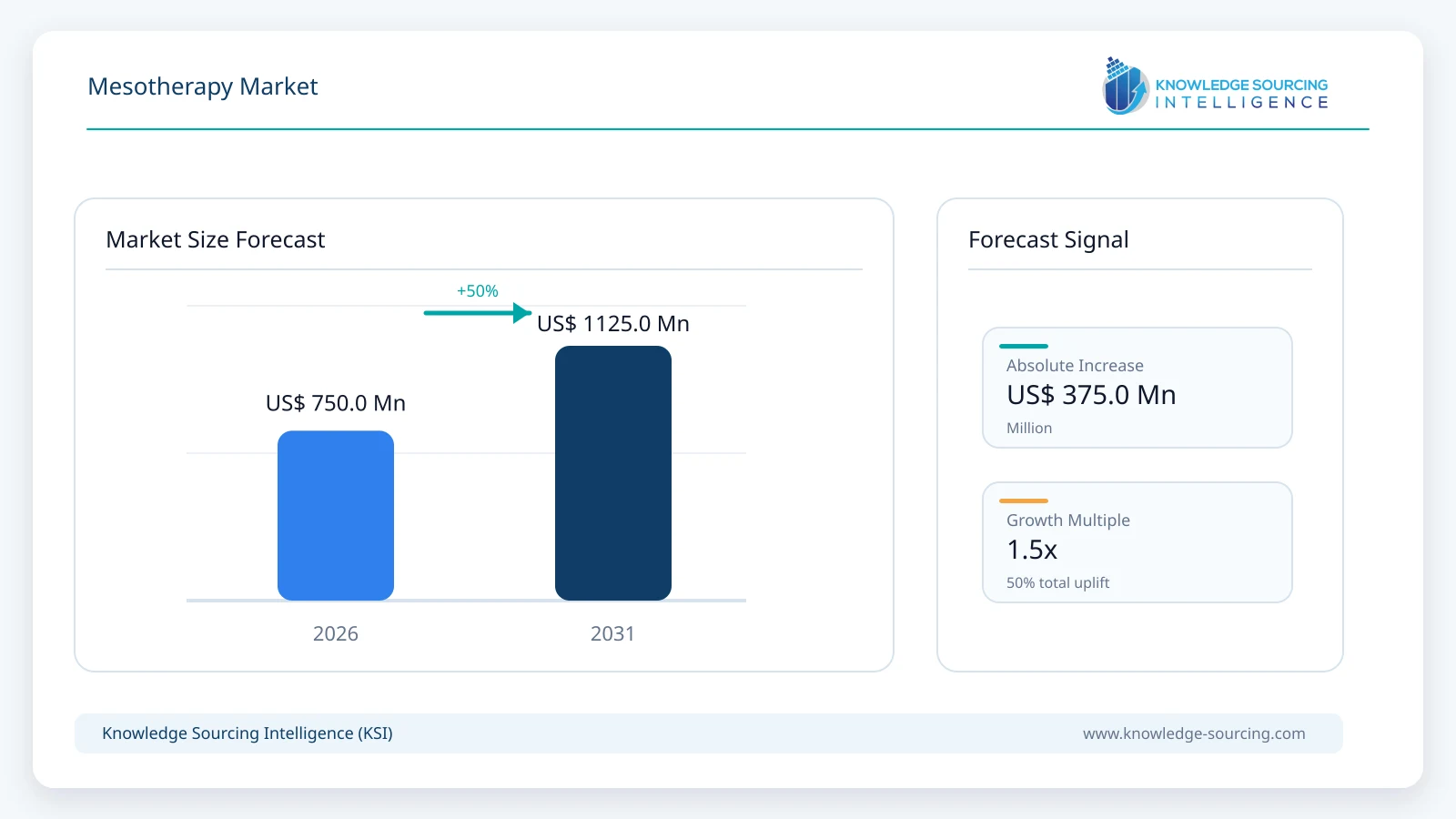
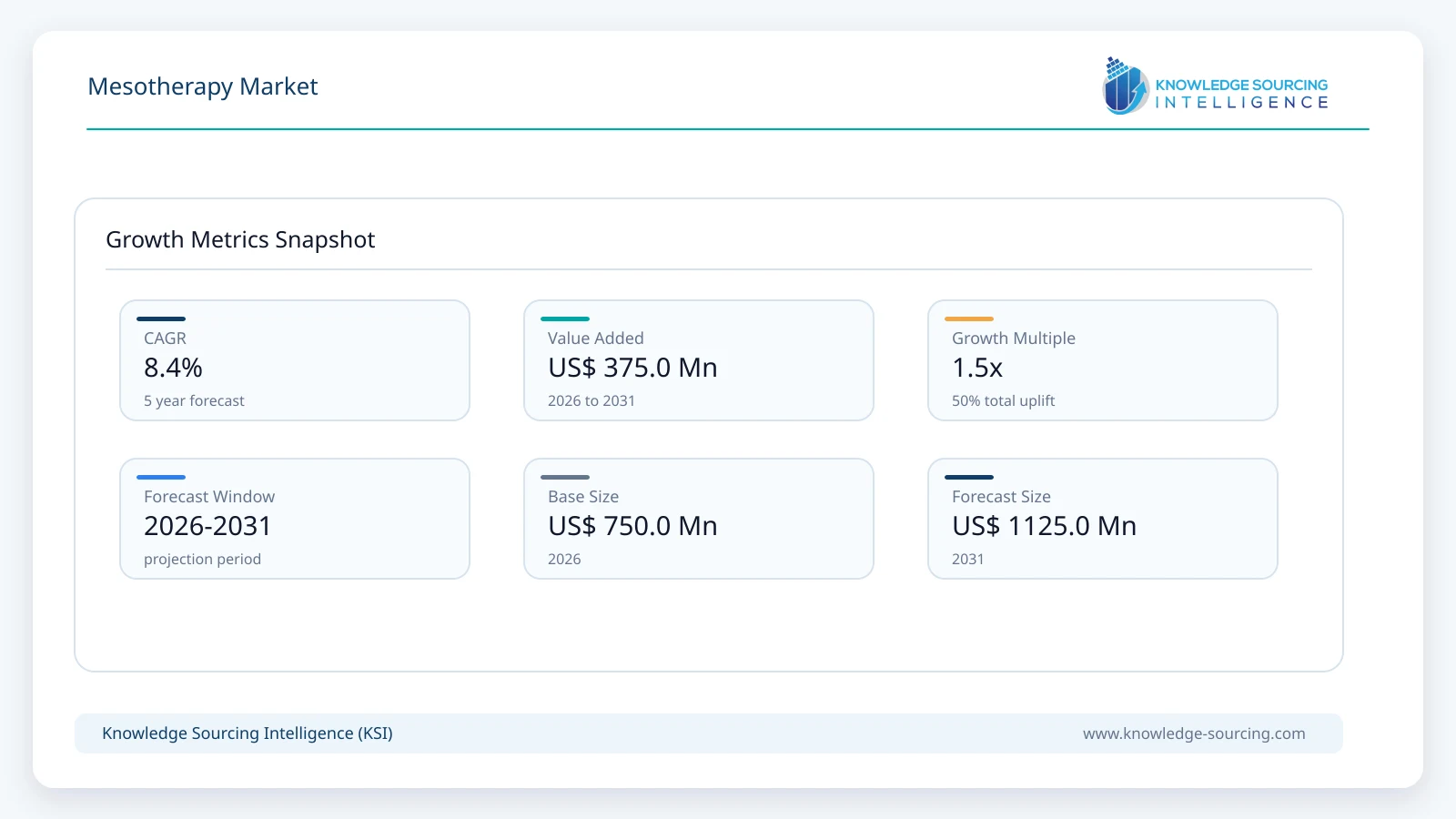
The mesotherapy market is forecast to grow from USD 750.0 million in 2026 to USD 1,125.0 million in 2031, representing a CAGR of 8.45% during the forecast period.
Highlights:
- 1Injectable mesotherapy products account for approximately 82.0% of global 2026 market revenue.
- 2Skin rejuvenation represents approximately 55.0% of global mesotherapy revenue in 2026.
- 3Clinics account for approximately 48.0% of global 2026 mesotherapy spending.
- 4North America represents approximately 34.0% of global mesotherapy revenue in 2026.
- 5The product mix is shifting toward non-cross-linked hyaluronic acid, polynucleotide/PDRN and multi-ingredient skin-booster formulations.
- 6Professional-use products remain the economic center of the market, while devices and needle-free delivery systems broaden treatment formats.
Market Overview
The mesotherapy market covers injectable and professional-use non-injectable products and delivery devices used to place small quantities of active ingredients into or across superficial skin layers for aesthetic applications. The scope includes non-cross-linked hyaluronic acid skin boosters, vitamin and amino-acid cocktails, PN/PDRN formulations, scalp and hair solutions, body-contouring solutions, sterile mesotherapy vials, micro-needling-compatible formulations, mesoguns and needle-free transdermal systems. Conventional dermal fillers, botulinum toxin, standalone topical cosmetics and general-purpose microneedling products sold without a mesotherapy positioning are excluded.
The market is being reshaped by a transition from traditional vitamin cocktails toward products positioned around skin quality, hydration and tissue regeneration. FILLMED continues to commercialize NCTF 135 HA as an injectable medical device combining non-cross-linked hyaluronic acid with vitamins, amino acids, minerals, coenzymes and nucleosides. Koru Pharma has expanded into polynucleotide and PDRN skin boosters, while mesoestetic, Fusion Meso, Institute BCN and MCCM maintain broad professional mesotherapy portfolios across facial, scalp and body applications.
The 2026 market estimate of USD 750.0 million is consistent with the commercial scale of specialist mesotherapy brands, the recurring nature of professional treatment protocols and the continued expansion of skin-booster products. The market remains substantially smaller than the broader dermal filler or minimally invasive aesthetics markets because treatment definitions vary by country and many mesotherapy products compete with adjacent skin-quality injectables, microneedling formulations and clinic-compounded solutions.
Growth is supported by rising demand for minimally invasive aesthetic procedures, repeated treatment cycles, wider availability of professional skin-boosting products and increasing consumer interest in preventive skin quality. The spread of PN/PDRN formulations is also adding a higher-value product category to the market. At the same time, regulatory differences, variable clinical evidence across applications and inconsistent treatment terminology constrain standardization.
The forecast to 2031 assumes continued expansion of professional aesthetic clinics, wider adoption of mesotherapy in Asia and Latin America, higher use of skin boosters and scalp treatments, and steady product innovation. Growth is expected to remain in the high-single digits rather than accelerating sharply because mesotherapy competes directly with fillers, energy-based devices, microneedling, biostimulators and other minimally invasive treatments.
Mesotherapy Market Trends
Skin Boosters Replace Traditional Cocktail-Led Positioning
The market is moving toward standardized, branded skin-quality products rather than loosely defined vitamin cocktails. FILLMED's NCTF 135 HA, mesoestetic's mesohyal range and newer PN/PDRN products are positioned around hydration, skin density, elasticity and dermal revitalization. This shift improves product differentiation and supports premium pricing in professional clinics.
Polynucleotides and PDRN Expand the Regenerative Segment
PN and PDRN products have become one of the most visible areas of product innovation in aesthetic medicine. Koru Pharma's Crystal Healer PN, Crystal Healer Lite and Crystal Hydro PDRN illustrate the expansion of regenerative formulations into facial and periocular protocols. These products are broadening the market beyond classic HA and vitamin-based mesotherapy.
Professional Protocols Remain Multi-Session and Recurring
Mesotherapy is generally delivered through treatment courses rather than as a one-time intervention. FILLMED's NCTF protocols, for example, use multiple sessions over several weeks. Recurring treatment cycles support repeat product demand and make clinics a central purchasing channel.
Needle-Free and Device-Assisted Delivery Broadens Use Cases
Needle-free electroporation, mesoguns and microneedling-compatible formulations are extending mesotherapy-style treatment to customers who prefer less invasive delivery. Mesoskinline and Toskani both maintain professional equipment alongside mesotherapy formulations, supporting a broader equipment-and-consumables ecosystem.
Segment Analysis
By Product Type - Injectables
Injectable mesotherapy products are estimated at approximately USD 615.0 million in 2026. The segment is the largest revenue pool because professional mesotherapy remains centered on sterile vials, prefilled syringes and skin-booster formulations delivered intradermally or through controlled microinjection techniques. Non-cross-linked hyaluronic acid, vitamins, amino acids, PN/PDRN and combination products command higher per-treatment value than many topical or needle-free alternatives and are commonly used across repeated treatment protocols. FILLMED, Koru Pharma, mesoestetic, Institute BCN, Fusion Meso and other specialist suppliers maintain broad injectable or sterile professional portfolios, supporting the segment's dominant position through 2031.
By Application - Skin Rejuvenation
Skin rejuvenation is estimated at approximately USD 412.5 million in 2026. It is the largest application because mesotherapy is most widely marketed for hydration, fine lines, radiance, elasticity, texture and general skin-quality improvement. The growth of non-cross-linked HA, PN/PDRN, amino-acid and multi-ingredient skin boosters has strengthened the segment by offering more standardized treatment propositions than traditional cocktail-based mesotherapy. Facial and periocular protocols also benefit from high repeat-treatment frequency and broad consumer demand across both younger preventive-aesthetics customers and older patients seeking non-surgical skin improvement.
By End User - Clinics
Clinics are estimated at approximately USD 360.0 million in 2026. Dedicated aesthetic, dermatology and cosmetic-medicine clinics remain the largest purchasing channel because injectable mesotherapy requires trained professionals, sterile handling and protocol-based patient assessment. Clinics also use a wider range of products than home or spa settings, including injectable HA skin boosters, PN/PDRN products, mesoguns and professional scalp or body formulations. The expansion of independent aesthetic clinics and multi-location chains is supporting standardized procurement and repeat orders, while product training and practitioner education increasingly form part of supplier commercialization strategies.
By Geography - North America
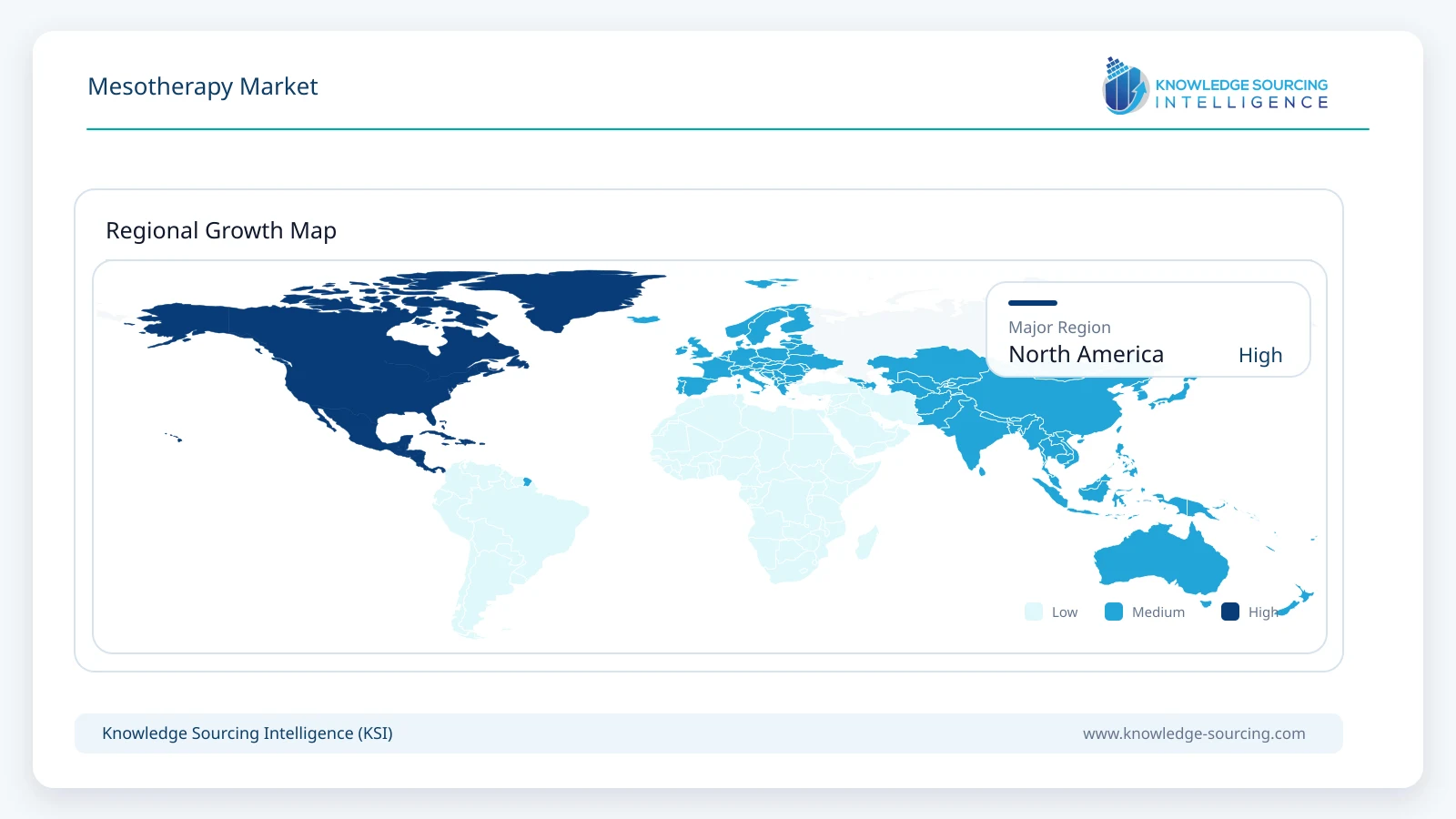
North America is estimated at approximately USD 255.0 million in 2026. The region benefits from high consumer spending on minimally invasive aesthetics, a large base of medical spas and aesthetic clinics, and strong demand for skin-quality and hair-restoration treatments. Mesotherapy terminology and regulatory treatment vary across jurisdictions, so the regional market includes a mix of branded professional products, compounded protocols and adjacent skin-booster techniques. Growth is being supported by consumer interest in less invasive procedures and regenerative aesthetics, although competition from fillers, microneedling, laser treatments and biostimulators limits share expansion.
Market Drivers
Demand for Minimally Invasive Aesthetic Treatments
Consumers increasingly seek treatments that require limited downtime and can be delivered in outpatient aesthetic settings. Mesotherapy fits this demand profile and can be combined with broader skin-quality programs.
Growth of Skin-Quality and Preventive Aesthetics
Aesthetic demand is shifting beyond wrinkle filling toward hydration, texture, radiance and preventive treatment. This directly supports HA skin boosters, PN/PDRN products and nutrient-based mesotherapy formulations.
Recurring Treatment Protocols
Many mesotherapy protocols use multiple initial sessions followed by maintenance treatments. This creates recurring consumable demand and supports revenue growth even where the number of unique patients grows more slowly.
Expansion of Professional Aesthetic Clinics
The number of clinics and medical spas offering minimally invasive treatments is increasing across Asia, Latin America, the Middle East and mature markets. Broader provider access increases product availability and consumer awareness.
Product Innovation in Regenerative Formulations
PN, PDRN, exosome-adjacent formulations, peptides and advanced HA combinations are expanding the range of professional products. These newer formulations typically carry premium pricing and increase average revenue per treatment.
Market Restraints
Regulatory Variability
Mesotherapy products are not regulated identically across countries, and permitted claims, routes of administration and product classifications differ. This complicates international commercialization and provider education.
Variable Clinical Evidence
Evidence quality differs substantially by indication and formulation. The broad use of the term mesotherapy can make it difficult to distinguish clinically documented products from loosely standardized treatment cocktails.
Competition from Adjacent Aesthetic Procedures
Dermal fillers, botulinum toxin, microneedling, lasers, radiofrequency and biostimulators compete for the same aesthetic spending. Clinics often combine these treatments, but substitution limits mesotherapy's share of the overall aesthetics market.
Treatment Cost and Repeat Sessions
Mesotherapy often requires several sessions to achieve and maintain results. The cumulative cost can reduce adoption among price-sensitive consumers, particularly in markets where treatments are entirely self-funded.
Practitioner Dependence
Injectable mesotherapy depends on trained practitioners and consistent technique. Outcomes may vary with injection depth, product selection and protocol, making practitioner education important for market expansion.
Competitive Landscape
The market is fragmented across specialist mesotherapy laboratories, aesthetic medicine companies and skin-booster suppliers. FILLMED has a long-established position through NCTF 135 HA, while mesoestetic maintains a broad mesohyal range for intradermal applications. Koru Pharma is expanding aggressively through PN/PDRN and regenerative skin-booster products, while Fusion Meso, Institute BCN, MCCM Medical Cosmetics, Mesoskinline and Toskani compete across professional vials, cocktails and delivery systems.
Competitive differentiation increasingly depends on regulatory status, formulation standardization, practitioner education, treatment protocols and clinical support rather than on ingredient lists alone. Suppliers with recognizable branded protocols and professional training can command stronger clinic loyalty than vendors selling generic ampoules or loosely defined cocktails.
The next phase of competition is likely to center on regenerative skin quality. PN/PDRN, advanced HA combinations, peptide formulations and targeted periocular or scalp products are expanding faster than traditional multi-vitamin cocktails. Companies able to combine credible regulatory documentation with differentiated formulations and international distributor networks are best positioned.
Recent Developments
2026: Koru Pharma expanded its regenerative skin-booster portfolio with Crystal Healer NMN, combining PDRN, hyaluronic acid, amino acids and NMN in a dual-vial mesotherapy formulation.
2026: FILLMED continued international commercialization of NCTF 135 HA following its 2025 EU MDR certification, reinforcing the product's regulatory positioning as an injectable medical device for skin revitalization.
2025: Koru Pharma showcased its Mesoheal Glow and Crystal Healer PN lines at IMCAS World Congress 2025, reflecting the industry's shift toward branded regenerative and skin-quality formulations.
Market Outlook
The mesotherapy market is expected to grow steadily through 2031 as professional aesthetics continues to shift toward minimally invasive, repeatable skin-quality treatments. Skin rejuvenation will remain the largest application, while scalp and regenerative protocols provide additional growth opportunities.
Injectable products will remain the economic center of the market because branded sterile formulations generate higher treatment value and are embedded in multi-session protocols. PN/PDRN and advanced HA formulations are expected to gain share from traditional vitamin-only cocktails, raising average product value.
Regulatory standardization will remain a key constraint. Suppliers that combine strong quality systems, medical-device or other appropriate regulatory documentation, clinical evidence and practitioner training are likely to gain share as clinics become more selective about products used in professional treatment.
Mesotherapy Market Scope
| Report Metric | Details |
|---|---|
| Total Market Size in 2026 | USD 750.0 million |
| Total Market Size in 2031 | USD 1,125.0 million |
| Forecast Unit | Million |
| Growth Rate | 8.45% |
| Study Period | 2021 to 2031 |
| Historical Data | 2021 to 2024 |
| Base Year | 2025 |
| Forecast Period | 2026 – 2031 |
| Segmentation | Product Type, Application, End-User, Geography |
| Companies |
|
Market Segmentation
By Product Type
Injectables
Non-Injectables
By Application
Skin Rejuvenation
Fat Reduction and Body Contouring
Hair Restoration
Others
By End User
Clinics
Dermatologists and Aesthetic Physicians
Spas and Wellness Centers
Hospitals
Home Treatment Users
By Geography
North America
United States
Canada
Mexico
South America
Brazil
Argentina
Others
Europe
United Kingdom
Germany
France
Spain
Italy
Others
Middle East and Africa
Saudi Arabia
UAE
Others
Asia Pacific
China
Japan
South Korea
India
Australia
Thailand
Indonesia
Others
Table of Contents
1. INTRODUCTION
1.1. Market Overview
1.2. Market Definition
1.3. Scope of the Study
1.4. Market Segmentation
1.5. Currency
1.6. Assumptions
1.7. Base and Forecast Years Timeline
2. RESEARCH METHODOLOGY
2.1. Research Design
2.2. Secondary Research
2.3. Primary Validation
2.4. Market Estimation and Forecasting
2.5. Data Triangulation and Quality Control
3. EXECUTIVE SUMMARY
3.1. Key Findings
3.2. Global Market Size, 2026-2031
3.3. Segment Summary
3.4. Regional Summary
4. MARKET DYNAMICS
4.1. Market Drivers
4.1.1. Demand for Minimally Invasive Aesthetic Treatments
4.1.2. Growth of Skin-Quality and Preventive Aesthetics
4.1.3. Recurring Treatment Protocols
4.1.4. Expansion of Professional Aesthetic Clinics
4.1.5. Product Innovation in Regenerative Formulations
4.2. Market Restraints
4.2.1. Regulatory Variability
4.2.2. Variable Clinical Evidence
4.2.3. Competition from Adjacent Aesthetic Procedures
4.2.4. Treatment Cost and Repeat Sessions
4.2.5. Practitioner Dependence
5. MESOTHERAPY MARKET BY PRODUCT TYPE
5.1. Introduction
5.2. Injectables
5.3. Non-Injectables
6. MESOTHERAPY MARKET BY APPLICATION
6.1. Introduction
6.2. Skin Rejuvenation
6.3. Fat Reduction and Body Contouring
6.4. Hair Restoration
6.5. Others
7. MESOTHERAPY MARKET BY END USER
7.1. Introduction
7.2. Clinics
7.3. Dermatologists and Aesthetic Physicians
7.4. Spas and Wellness Centers
7.5. Hospitals
7.6. Home Treatment Users
8. MESOTHERAPY MARKET BY GEOGRAPHY
8.1. North America
8.1.1. United States
8.1.2. Canada
8.1.3. Mexico
8.2. South America
8.2.1. Brazil
8.2.2. Argentina
8.2.3. Others
8.3. Europe
8.3.1. United Kingdom
8.3.2. Germany
8.3.3. France
8.3.4. Spain
8.3.5. Italy
8.3.6. Others
8.4. Middle East and Africa
8.4.1. Saudi Arabia
8.4.2. UAE
8.4.3. Others
8.5. Asia Pacific
8.5.1. China
8.5.2. Japan
8.5.3. South Korea
8.5.4. India
8.5.5. Australia
8.5.6. Thailand
8.5.7. Indonesia
8.5.8. Others
9. COMPETITIVE ENVIRONMENT AND ANALYSIS
9.1. Major Players and Strategy Analysis
9.2. Product and Formulation Positioning
9.3. Regulatory and Distribution Strategy
9.4. Recent Developments
9.5. Competitive Dashboard
10. COMPANY PROFILES
10.1. FILLMED Laboratories
10.2. Koru Pharma Co., Ltd.
10.3. Mesoestetic Pharma Group
10.4. Fusion Meso
10.5. Institute BCN
10.6. Mesoskinline
10.7. Toskani
10.8. MCCM Medical Cosmetics
10.9. Revitacare
10.10. Dermaqual
10.11. Professional Derma SA
10.12. Derma 2.0
11. APPENDIX
11.1. Currency
11.2. Assumptions
11.3. Base and Forecast Years Timeline
11.4. Abbreviations
Navigate
Trusted by the world's leading organizations











