
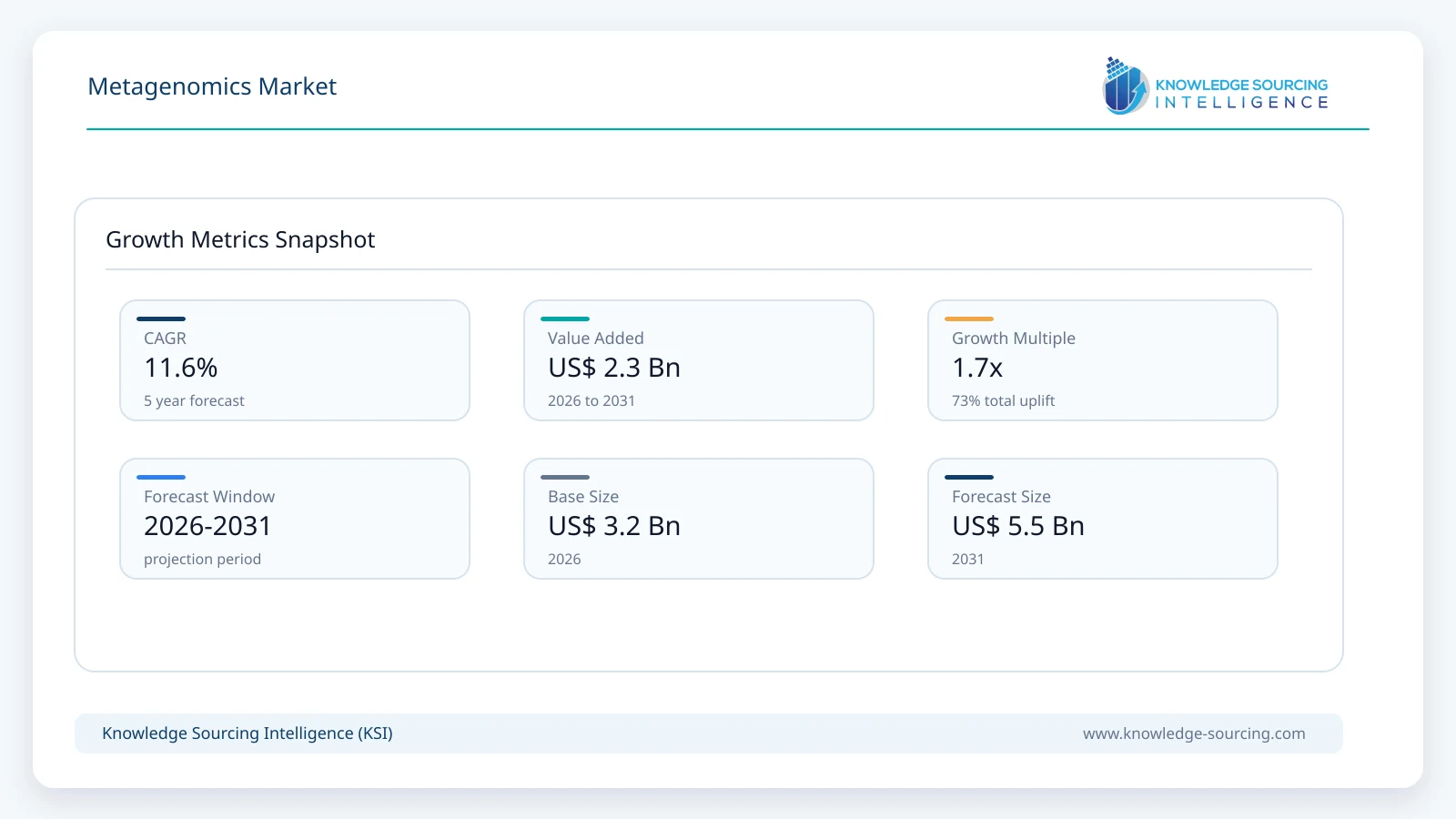
The metagenomics market is estimated at USD 3.20 billion in 2026 and is forecast to reach approximately USD 5.54 billion in 2031, representing a CAGR of 11.6% across the forecast period.
Highlights:
- 1Clinical metagenomic sequencing is moving from exploratory research toward selected routine diagnostic workflows.
- 2Kits and reagents remain the largest offering because every sequencing workflow requires recurring consumables.
- 3Shotgun sequencing expands functional and strain-level analysis beyond conventional targeted microbiome profiling.
- 4North America remains the largest market, while Asia Pacific records faster infrastructure expansion.
- 5Bioinformatics, automation and long-read sequencing are reducing workflow bottlenecks and improving interpretation.
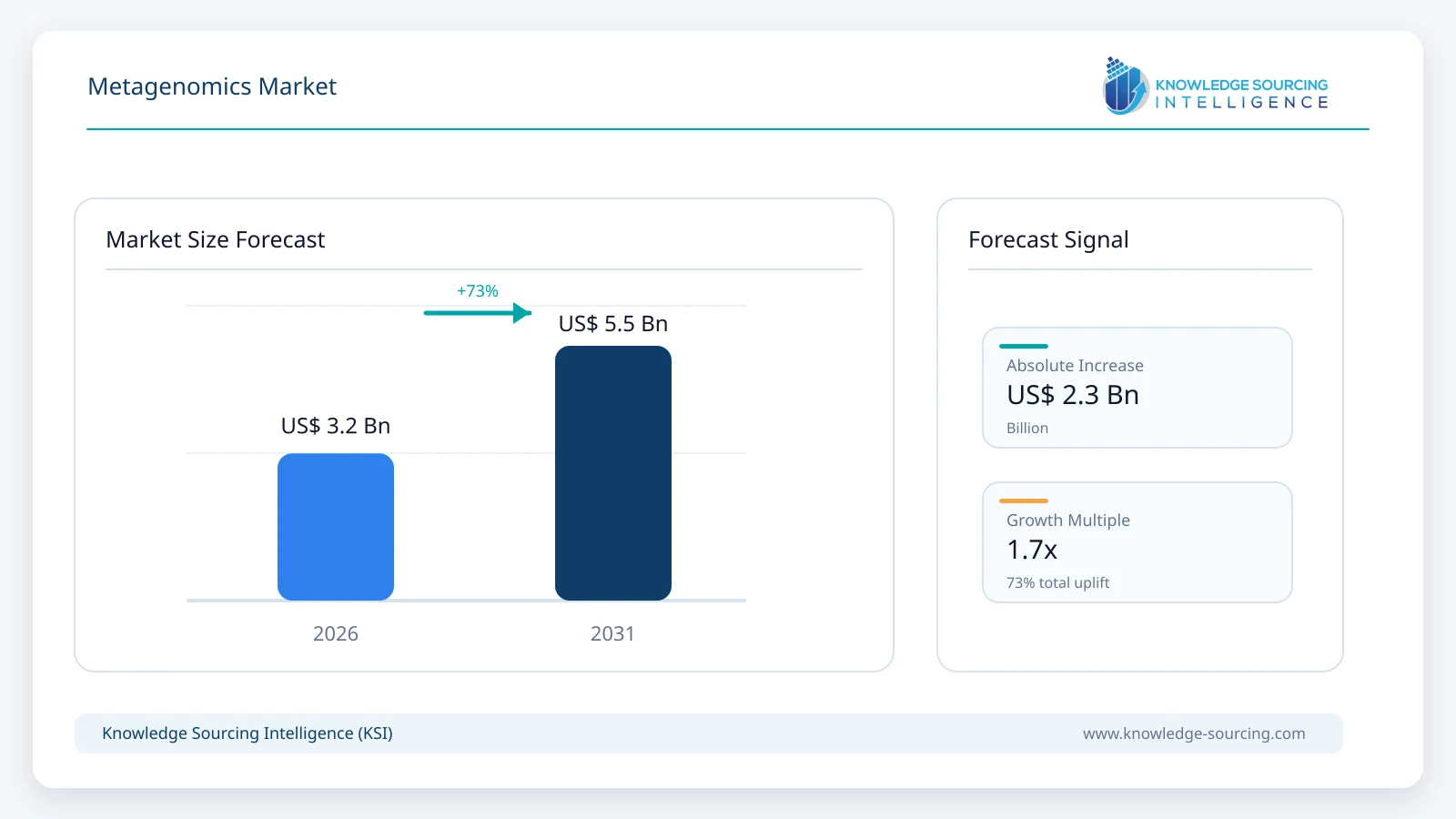
The forecast does not assume one constant annual growth rate. Adoption is expected to accelerate as automated sample preparation improves throughput, bioinformatics becomes easier to deploy and sequencing platforms support faster or longer reads. Growth remains constrained by total workflow cost, contamination risk, lack of standardized interpretation thresholds, data-compute requirements and the need for clinical validation and regulatory acceptance.
The forecast assumes continued sequencing-cost efficiency, greater automation of sample preparation, rising outsourcing of sequencing and analysis, and increased clinical and public-health use of pathogen-agnostic sequencing. Growth is moderated by reimbursement uncertainty, bioinformatics expertise requirements, contamination control and the need to distinguish colonization from clinically relevant infection.
Metagenomics Market Trends
Clinical Metagenomics Moves Closer to Routine Use
Clinical metagenomic next-generation sequencing is gaining traction for difficult infections where culture and targeted molecular tests fail to identify a pathogen. The approach can detect bacteria, viruses, fungi and parasites within a single hypothesis-free workflow. Evidence published in 2025 and 2026 increasingly focuses on prospective clinical impact rather than technical feasibility alone, supporting broader evaluation in meningitis, sepsis, respiratory infection, immunocompromised patients and culture-negative disease.
Long-Read Sequencing Broadens Functional Resolution
Short-read platforms remain central to high-throughput metagenomics, but long-read systems from Oxford Nanopore Technologies and PacBio are expanding use cases requiring complete microbial genomes, plasmid context, structural variation and rapid sequencing. Hybrid short- and long-read workflows can improve assembly quality and antimicrobial-resistance characterization, while portable nanopore systems support field and near-real-time surveillance applications.
Automation and Bioinformatics Become Commercial Differentiators
The sequencing instrument is only one part of the metagenomics workflow. Sample extraction, host-DNA depletion, library preparation, quality control, taxonomic classification and functional interpretation determine the reliability of results. QIAGEN expanded sample-preparation automation during 2026, while its metagenomics portfolio spans targeted and whole-genome workflows. Across the market, vendors are combining consumables, automation and software to reduce manual steps and improve reproducibility.
Metagenomics Market Segment Analysis
By Offering
Kits and Reagents
Kits and reagents represent the largest offering category because metagenomics depends on recurring consumables across extraction, host-DNA depletion, library preparation, enrichment, cleanup and quality-control steps. Unlike sequencing instruments, which are capital purchases with multi-year replacement cycles, consumables generate repeat demand with every sample processed. Growth is also supported by workflow-specific products for low-biomass samples, viral and bacterial enrichment, 16S/ITS profiling and unbiased whole-metagenome sequencing.
By Sequencing Approach
Shotgun Metagenomic Sequencing
Shotgun metagenomic sequencing is the most strategically important sequencing approach because it captures genetic material across the microbial community rather than targeting a single marker region. This enables species- and strain-level identification, functional pathway analysis, antimicrobial-resistance gene detection and discovery of unexpected organisms. The approach requires greater sequencing depth, compute capacity and contamination control than targeted amplicon workflows, but its broader information content is driving adoption in clinical diagnostics, public-health surveillance and advanced microbiome research.
By Application
Human Health and Clinical Research
Human health and clinical research form the leading application area because metagenomics is increasingly used to study the gut, respiratory, oral and other microbiomes as well as pathogen detection in complex infections. Pharmaceutical and biotechnology companies also use microbiome data for biomarker discovery and therapeutic research. Clinical use remains selective rather than universal, but growing prospective evidence, better sample workflows and faster analysis are expanding the addressable market beyond academic microbiome studies.
By End User
Academic and Research Institutes
Academic and research institutes remain the largest end-user group because they conduct a substantial share of exploratory microbiome, environmental and translational metagenomics studies. Universities and research centers support method development, longitudinal cohort studies, microbial ecology and new clinical applications. Their role also creates downstream demand for core sequencing facilities, outsourced service providers, library-preparation kits and bioinformatics platforms, while hospitals and clinical laboratories represent a faster-emerging commercialization channel.
By Geography
North America
North America remains the largest regional market due to its concentration of sequencing-platform vendors, life-science research institutions, clinical genomics laboratories, biotechnology companies and large microbiome programs.
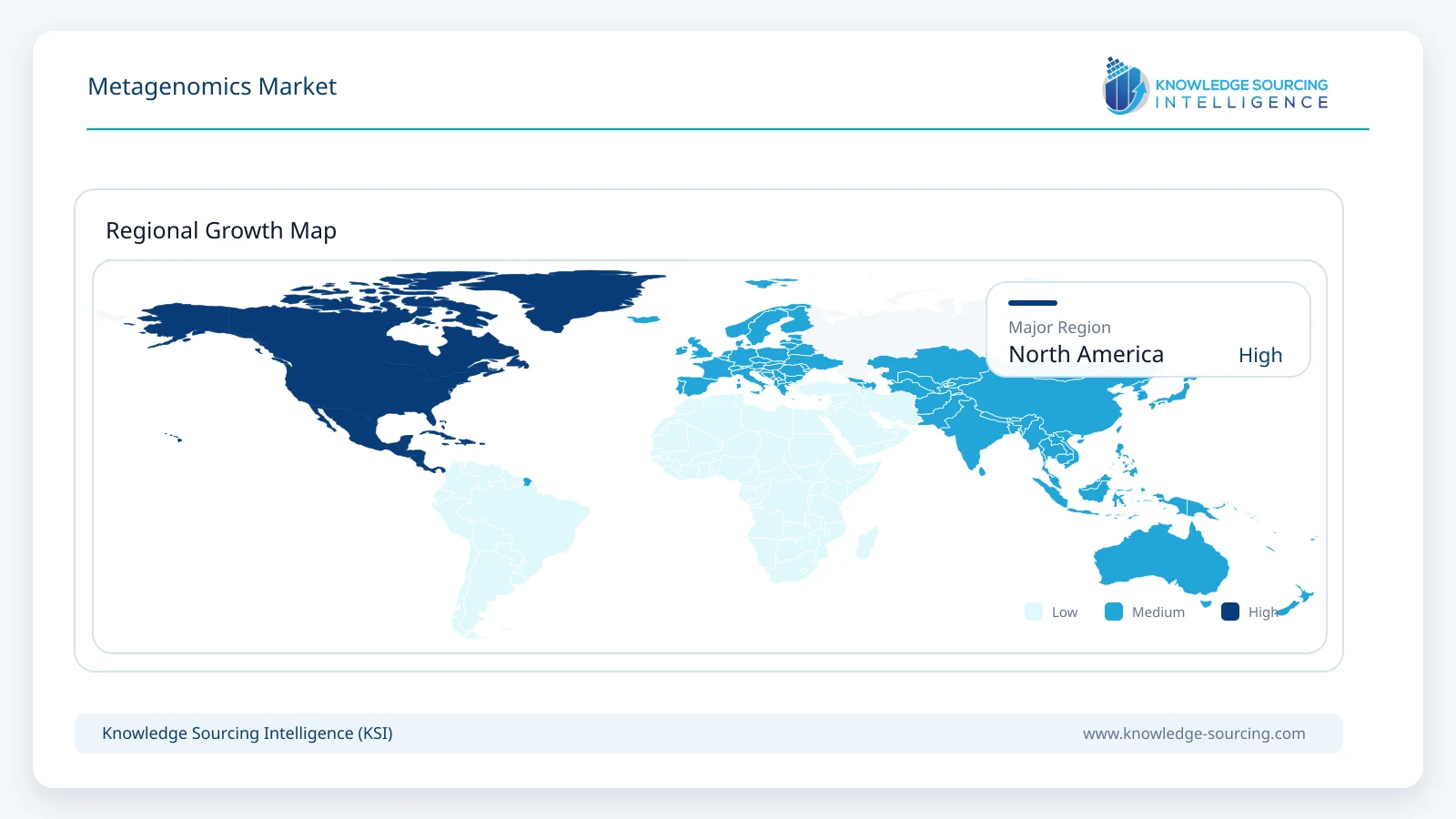
The region also benefits from established NGS infrastructure and bioinformatics expertise. Asia Pacific is expanding more rapidly as China, Japan, South Korea, India and other markets add sequencing capacity and apply metagenomics in healthcare, food, agriculture and environmental monitoring.
Market Drivers
Declining sequencing cost and rising throughput expanding the number and scale of metagenomic studies.
Growing clinical evidence for pathogen-agnostic sequencing in difficult infectious-disease diagnosis.
Increasing microbiome research across therapeutics, nutrition, oncology and precision-health applications.
Expansion of environmental, wastewater, food and antimicrobial-resistance surveillance programs.
Automation and cloud bioinformatics reducing manual workflow and analysis barriers.
Market Restraints
High total workflow cost when extraction, sequencing depth, compute and expert interpretation are combined.
Contamination and host-DNA background affecting sensitivity and increasing false-positive interpretation risk.
Limited standardization of reporting thresholds, reference databases and clinical interpretation practices.
Shortage of experienced bioinformatics personnel in smaller research and diagnostic laboratories.
Reimbursement, regulatory and clinical-validation requirements slowing routine diagnostic adoption.
Competitive Environment
Competition spans sequencing-platform companies, sample-preparation and reagent suppliers, sequencing-service providers and bioinformatics specialists. Illumina remains central to short-read sequencing workflows, while Oxford Nanopore Technologies and PacBio strengthen long-read and real-time sequencing options. QIAGEN, Thermo Fisher Scientific, Takara Bio, Bio-Rad, Promega and Revvity supply workflow components, reagents or analysis solutions. Novogene, BGI Genomics and Eurofins Scientific provide sequencing and analytical services, while Zymo Research, CosmosID, One Codex and GenoScreen participate through microbiome workflows, sequencing services or dedicated metagenomics bioinformatics. Competitive differentiation increasingly depends on end-to-end workflow integration, throughput, read quality, turnaround time and interpretation capability.
Recent Developments
September 2026: QIAGEN launched QIAmini, a compact automated sample-preparation system aimed at smaller research laboratories and recurring molecular workflows.
August 2026: QIAGEN launched QIAsymphony Connect for automated nucleic-acid extraction, extending standardized sample preparation across clinical molecular workflows.
April 2026: The Lancet Infectious Diseases published a review of prospective clinical metagenomic testing evidence, reflecting growing attention to patient-management impact.
April 2026: A pediatric infectious-disease meta-analysis reported materially higher sensitivity for metagenomic NGS than conventional microbiological tests across the evaluated studies.
2026: QIAGEN continued to market dedicated whole-genome, targeted and metatranscriptomic metagenomics workflows, reflecting broader commercialization of end-to-end microbiome analysis.
Market Outlook
Metagenomics should remain a double-digit growth market through 2031 as sequencing becomes easier to automate and interpretation tools improve. Research will continue to represent a large revenue base, but the composition of growth is shifting toward clinical diagnostics, public-health surveillance, outsourced analysis and long-read applications. Companies that combine robust sample preparation, flexible sequencing, validated bioinformatics and clear workflow support are likely to capture the strongest recurring demand.
Metagenomics Market Scope:
| Report Metric | Details |
|---|---|
| Total Market Size in 2026 | USD 3.20 billion |
| Total Market Size in 2031 | USD 5.54 billion |
| Forecast Unit | Billion |
| Growth Rate | 11.6% |
| Study Period | 2021 to 2031 |
| Historical Data | 2021 to 2024 |
| Base Year | 2025 |
| Forecast Period | 2026 – 2031 |
| Segmentation | Offering, Sequencing Approach, Application, End User, Geography |
| Companies |
|
Market Segmentation
By Offering
Kits and Reagents
Instruments
Sequencing and Analysis Services
Software and Bioinformatics
By Sequencing Approach
Shotgun Metagenomic Sequencing
Targeted/Amplicon Sequencing
Long-Read and Hybrid Metagenomics
By Application
Human Health and Clinical Research
Drug Discovery and Biotechnology
Environmental Monitoring
Food and Agriculture
Others
By End User
Academic and Research Institutes
Hospitals and Clinical Laboratories
Pharmaceutical and Biotechnology Companies
Sequencing Service Providers and CROs
Others
By Geography
North America
United States
Canada
South America
Brazil
Others
Europe
Germany
United Kingdom
France
Netherlands
Others
Middle East and Africa
Saudi Arabia
UAE
South Africa
Others
Asia Pacific
China
Japan
South Korea
India
Australia
Others
Table of Contents
1. INTRODUCTION
1.1. Market Overview
1.2. Market Definition and Scope
1.3. Currency and Assumptions
2. RESEARCH METHODOLOGY
2.1. Secondary Research
2.2. Company and Workflow Validation
2.3. Market Estimation and Triangulation
3. EXECUTIVE SUMMARY
3.1. Key Findings
3.2. Global Market Size, 2026-2031
4. MARKET DYNAMICS
4.1. Market Drivers
4.2. Market Restraints
4.3. Clinical Adoption and Standardization
4.4. Sequencing and Bioinformatics Trends
5. METAGENOMICS MARKET BY OFFERING
5.1. Kits and Reagents
5.2. Instruments
5.3. Sequencing and Analysis Services
5.4. Software and Bioinformatics
6. METAGENOMICS MARKET BY SEQUENCING APPROACH
6.1. Shotgun Metagenomic Sequencing
6.2. Targeted/Amplicon Sequencing
6.3. Long-Read and Hybrid Metagenomics
7. METAGENOMICS MARKET BY APPLICATION
7.1. Human Health and Clinical Research
7.2. Drug Discovery and Biotechnology
7.3. Environmental Monitoring
7.4. Food and Agriculture
7.5. Others
8. METAGENOMICS MARKET BY END USER
8.1. Academic and Research Institutes
8.2. Hospitals and Clinical Laboratories
8.3. Pharmaceutical and Biotechnology Companies
8.4. Sequencing Service Providers and CROs
8.5. Others
9. METAGENOMICS MARKET BY GEOGRAPHY
9.1. North America
9.1.1. United States
9.1.2. Canada
9.2. South America
9.2.1. Brazil
9.2.2. Others
9.3. Europe
9.3.1. Germany
9.3.2. United Kingdom
9.3.3. France
9.3.4. Netherlands
9.3.5. Others
9.4. Middle East and Africa
9.4.1. Saudi Arabia
9.4.2. UAE
9.4.3. South Africa
9.4.4. Others
9.5. Asia Pacific
9.5.1. China
9.5.2. Japan
9.5.3. South Korea
9.5.4. India
9.5.5. Australia
9.5.6. Others
10. COMPETITIVE ENVIRONMENT AND ANALYSIS
10.1. Sequencing Platform Competition
10.2. Workflow and Bioinformatics Positioning
10.3. Recent Developments and Partnerships
11. COMPANY PROFILES
11.1. Illumina, Inc.
11.2. QIAGEN N.V.
11.3. Thermo Fisher Scientific Inc.
11.4. Oxford Nanopore Technologies plc
11.5. Pacific Biosciences of California, Inc.
11.6. BGI Genomics Co., Ltd.
11.7. Novogene Co., Ltd.
11.8. Eurofins Scientific SE
11.9. Takara Bio Inc.
11.10. Bio-Rad Laboratories, Inc.
11.11. Promega Corporation
11.12. Revvity, Inc.
11.13. Zymo Research Corporation
11.14. CosmosID, Inc.
11.15. One Codex
11.16. GenoScreen
12. APPENDIX
12.1. Currency
12.2. Assumptions
12.3. Abbreviations
Navigate
Trusted by the world's leading organizations











