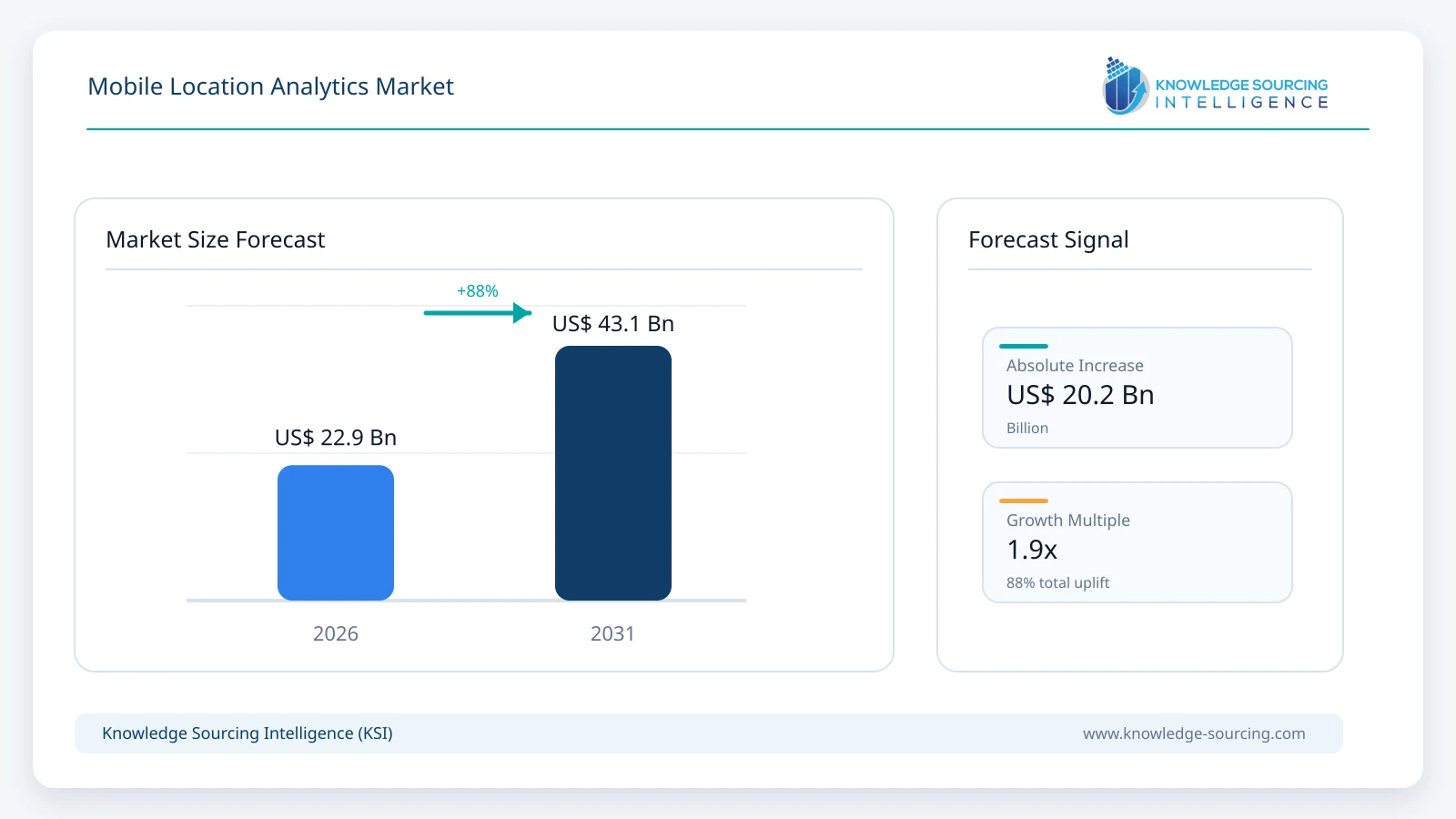
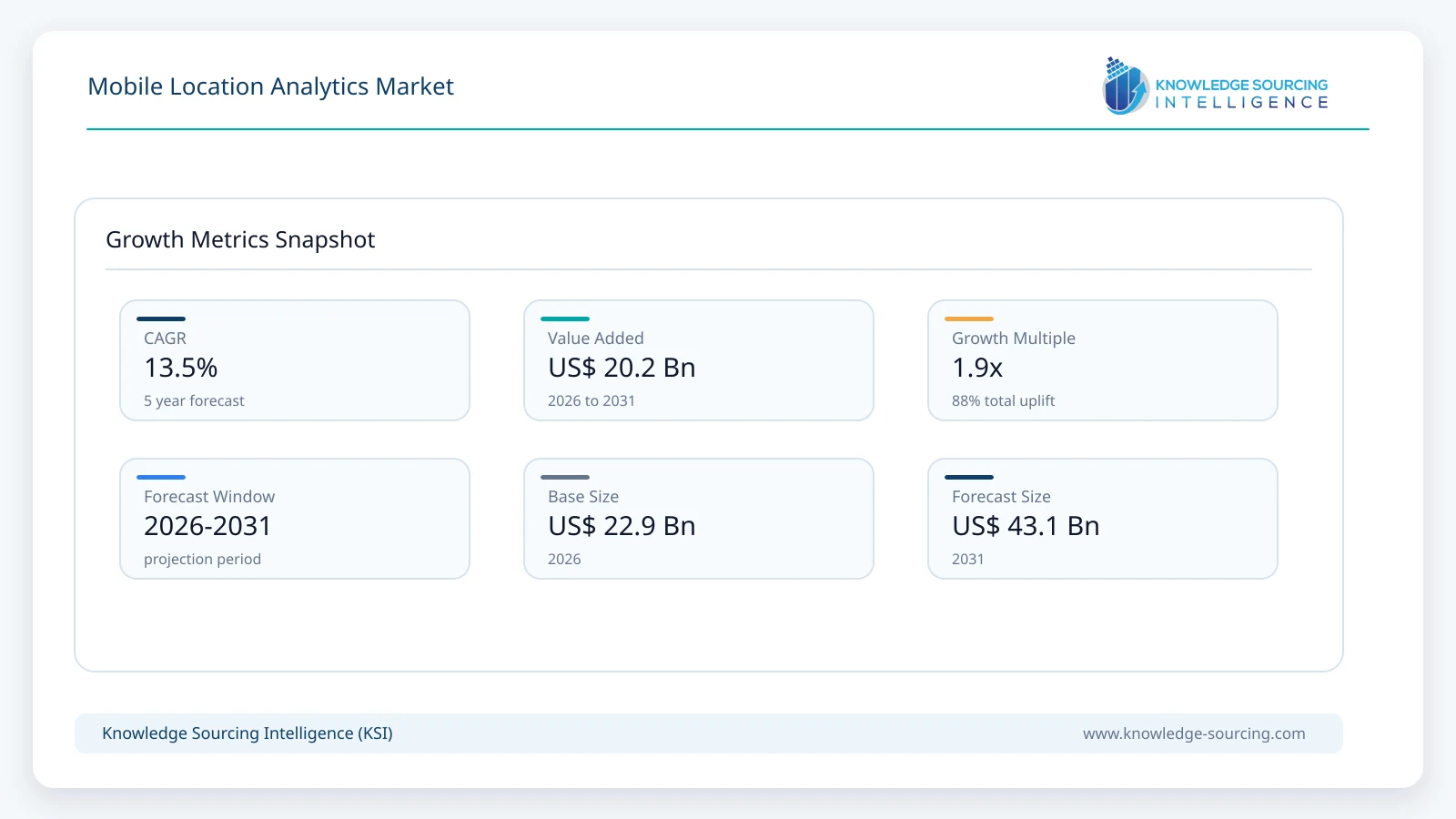
The mobile location analytics market is forecast to grow at a CAGR of 13.5%, reaching USD 43.1 billion in 2031 from USD 22.9 billion in 2026.
Highlights:
- 1Smartphone and internet connectivity is expanding, strengthening demand for location-enabled analytics across industries.
- 2Retailers are increasingly using location intelligence to optimize stores, customer engagement, and geographic expansion.
- 3AI integration is improving location analytics by automating data enrichment, quality management, and predictive insights.
- 4Privacy regulations are increasingly shaping MLA adoption, encouraging consent-based, aggregated, and responsibly governed location data.
Mobile location analytics (MLA) uses location signals from smartphones, connected devices, applications, telecommunications networks, and other internet-enabled devices to understand movement patterns, geographic behavior, visitation, mobility, and the relationship between people, places, and business activity. Depending on the use case and data permissions, these solutions can combine geospatial information with demographic, transactional, network, traffic, points-of-interest, and behavioral datasets. Retailers, logistics providers, financial institutions, transportation organizations, advertisers, and public-sector agencies use these insights to understand where customers and assets move, how locations perform, and where operational changes can create measurable value.
The role of mobile location analytics is expanding beyond simple customer-location tracking. Modern platforms increasingly combine real-time location intelligence with artificial intelligence, predictive analytics, geospatial visualization, geocoding, mobility data, and automated decision-making. This enables organizations to assess trade areas, optimize delivery routes, identify high-potential locations, analyze footfall and visitation patterns, improve transportation planning, evaluate advertising effectiveness, and identify geographic anomalies associated with fraud or operational risk.
Digital connectivity provides a broad underlying foundation for this market. The International Telecommunication Union (ITU) estimated that approximately 6 billion people, or 74% of the world's population, were using the internet in 2025, compared with 5.8 billion in 2024. Asia-Pacific reached 77% internet usage in 2025, while Europe and the Americas recorded substantially higher levels. The expanding connected population increases the volume of location-enabled interactions that organizations can potentially analyze, although commercial use remains dependent on consent, applicable privacy rules, data quality, and legitimate business purposes.
India represents an important example of the expanding digital base supporting location-enabled services. Government data indicate that India had approximately 100.29 crore internet connections in 2025, compared with 25.15 crore in 2014. Broadband connections reached 99.56 crore in 2025, while average monthly data consumption per user increased to approximately 24.01 GB from 61.66 MB in 2014. Around 85.5% of Indian households owned at least one smartphone. These developments provide a large connected-user environment for location-based applications, mobility intelligence, retail analytics, digital advertising, logistics optimization, and other geospatial use cases.
At the same time, mobile location analytics is moving into a more privacy-conscious phase. Location data can reveal sensitive information about an individual's routines and places visited. The European Commission identifies mobile-phone location data as personal data under the General Data Protection Regulation (GDPR), while the U.S. Federal Trade Commission (FTC) has taken enforcement action against companies over the sale or disclosure of sensitive location information. Consequently, the commercial value of MLA increasingly depends on privacy-by-design architectures, informed consent, data minimization, aggregation, de-identification, retention controls, supplier governance, and transparent data-use policies.
Mobile Location Analytics Market Growth Drivers:
Expansion of smartphone and internet connectivity to strengthen the addressable data ecosystem.
The growth of mobile location analytics is closely connected with the expansion of mobile connectivity. Smartphones have become a primary interface for navigation, digital commerce, communication, payments, entertainment, transportation, and location-based applications. Each of these activities can create location-relevant signals when users have provided the required permissions and when organizations have a legitimate basis to process the information.
According to the ITU's Facts and Figures 2025, approximately 6 billion people were online globally in 2025, equivalent to 74% of the world's population. The number of internet users increased by more than 240 million compared with the previous year. However, the remaining 2.2 billion people who were offline demonstrate that digital connectivity is still uneven, particularly across lower-income markets. This creates both an expanding global opportunity and a geographic concentration of addressable mobile data.
The Asia-Pacific region is particularly important because of its large population and continued growth in digital connectivity. ITU data show that 77% of the population in Asia-Pacific used the internet in 2025. The region combines mature digital economies with rapidly expanding connected markets, creating opportunities for location intelligence across retail, transportation, travel, financial services, telecommunications, and logistics.
India provides particularly strong evidence of this structural shift. Government statistics reported that internet connections in the country increased nearly fourfold between 2014 and 2025, reaching 100.29 crore. Broadband connections reached 99.56 crore in 2025, and average monthly data consumption per user increased to approximately 24.01 GB. The same government source reported that around 85.5% of Indian households owned at least one smartphone.
The Government of India's Comprehensive Modular Survey: Telecom 2025 provides additional evidence of smartphone penetration. The survey found that approximately 85.5% of Indian households possessed at least one smartphone and 86.3% had access to the internet within the household premises. Among people aged 15 to 29 years, smartphone ownership among mobile-phone owners was approximately 95.5% in rural areas and 97.6% in urban areas. Such levels of connectivity create an increasingly broad foundation for permission-based location services and mobile-enabled analytics.
The continuing deployment of high-speed mobile networks also improves the usefulness of location-enabled services. India's government reported that 5G services had become available in 99.6% of districts by February 2025, supported by 4.69 lakh 5G base transceiver stations. Higher network capacity and lower latency can support real-time navigation, connected mobility, location-aware applications, logistics tracking, and other applications in which timely geographic information is important.
However, higher connectivity does not automatically translate into unrestricted access to individual location information. The market is increasingly shifting toward privacy-conscious analytics in which aggregated movement patterns, consented application data, first-party information, and appropriately governed third-party datasets are used instead of unrestricted individual-level tracking.
Increasing adoption of location intelligence for retail, mobility, logistics, and business planning.
Organizations are increasingly using location analytics to connect digital behavior with physical-world activity. For retailers, MLA can help estimate visitation patterns, understand trade areas, evaluate store performance, assess competitive overlap, identify potential expansion locations, and measure changes in customer movement. For logistics providers, location intelligence can support route planning, delivery optimization, fleet management, congestion analysis, and service-area design. Financial institutions can use geographic context as one input into fraud and risk analysis, while travel and transportation companies can analyze demand and movement patterns.
Location intelligence is also becoming more closely integrated with artificial intelligence. In 2026, Precisely introduced new Data Quality, Data Enrichment, and Location Intelligence AI agents within its Data Integrity Suite. The February 25, 2026 announcement stated that the agents were designed to automate complex data workflows while retaining human oversight and improving the quality and contextual richness of data used for analytics and AI. This development illustrates the broader movement from static geographic reporting toward AI-assisted location analysis.
Similarly, Kalibrate's Q2 2026 Location Intelligence release introduced a refreshed Hotspot Analysis tool and the k.ai Companion, alongside other platform enhancements. The company stated that these capabilities were intended to help market planning and real-estate teams identify high-potential markets and make more informed location decisions. Such developments increase the practical utility of location intelligence for organizations managing physical portfolios.
Mobile Location Analytics Market Restraints:
Privacy, consent, and regulatory requirements remain a major constraint on mobile location analytics adoption.
Privacy is one of the most important considerations affecting mobile location analytics. Location information can reveal a person's home area, workplace, travel patterns, visits to sensitive facilities, and recurring routines. As a result, regulators have increasingly focused on how precise location information is collected, combined, retained, sold, and shared.
The European Commission explicitly lists mobile-phone location data as an example of personal data under the GDPR. Organizations processing such information must consider principles including lawfulness, transparency, purpose limitation, data minimization, accuracy, storage limitation, integrity, confidentiality, and accountability. These requirements influence how MLA platforms collect, store, analyze, and share location-derived information.
Regulatory enforcement in the United States also demonstrates the financial and reputational risks associated with poorly governed location data. In May 2026, the FTC announced a proposed settlement involving Kochava that would prohibit the company from selling, sharing, or disclosing sensitive location data without consumers' affirmative express consent. The FTC's action reinforces the importance of consent and controls around sensitive location information.
These developments are changing the competitive requirements of the MLA industry. Vendors increasingly need to demonstrate where their data originates, how consent is obtained, whether individual identities are removed or protected, how long information is retained, and how downstream customers are permitted to use the data. Organizations that cannot establish reliable data provenance and governance may face restrictions on commercial deployment.
Data quality, interoperability, and analytical skills can limit the value generated from location data.
Location analytics requires more than access to geographic signals. Data must be accurately geocoded, normalized, contextualized, and linked with other datasets. Differences in geographic boundaries, address formats, timestamps, device identifiers, data refresh rates, and measurement methodologies can create inconsistencies. Poor-quality location data can lead to inaccurate trade-area analysis, misleading customer profiles, inefficient routing, or unreliable site-selection decisions.
Integration is another challenge. Enterprises may hold location-related information across CRM systems, mobile applications, point-of-sale platforms, transportation management systems, mapping platforms, cloud databases, and external data providers. Connecting these sources requires suitable APIs, data models, governance processes, and technical expertise.
The increasing use of AI adds another layer of complexity. AI systems require reliable and sufficiently contextualized data to produce dependable location-based recommendations. As organizations move toward automated decision-making, data quality and explainability become more important because errors can propagate rapidly through automated workflows.
Mobile Location Analytics Market Segmentation Analysis:
Retail remains a major application area because physical-store decisions increasingly depend on behavioral and geographic intelligence.
Based on end-user industry, the mobile location analytics market includes healthcare, BFSI, travel and tourism, retail, and other industries. Retail is a particularly important segment because physical locations remain central to sales, customer acquisition, fulfillment, and brand visibility even as digital commerce expands.
Retailers can use location analytics to understand visitation frequency, customer catchment areas, competitive proximity, store accessibility, mobility patterns, and changes in footfall. When responsibly aggregated and governed, these insights can help retailers evaluate store performance and determine where additional locations may be appropriate. Location intelligence can also support advertising measurement by connecting geographic exposure with store visits or other permissible real-world outcomes.
The technology is also relevant to store operations. Location-derived insights can inform staffing levels, opening hours, delivery coverage, pickup operations, and store-format decisions. Retailers with large networks can compare locations using consistent geographic and behavioral indicators rather than relying solely on historical sales.
The growing integration of location intelligence with AI should further increase the sophistication of retail analytics. In 2026, Esri continued publishing retail-focused location intelligence applications, including analysis of customer behavior and business outcomes. Its May 2026 discussion on location intelligence and retail emphasized the use of validated geographic information to improve retail decision-making. These developments indicate that location analytics is becoming more closely connected with enterprise business intelligence rather than remaining a standalone mapping function.
Transportation and logistics are gaining importance as real-time mobility intelligence becomes increasingly valuable.
Transportation and logistics represent another important use case for mobile location analytics. Delivery networks operate within highly variable geographic conditions, including congestion, road closures, changing customer demand, and differences in travel time. Location intelligence can help organizations understand movement patterns, optimize routes, identify demand concentrations, and improve the allocation of vehicles and delivery resources.
In January 2026, HERE Technologies highlighted AI-powered location intelligence and real-time predictive insights as part of its CES 2026 portfolio. The company's 2026 initiatives connected location intelligence with navigation, mobility planning, software-defined vehicles, logistics, and advanced driving applications. Although these applications extend beyond traditional retail-oriented MLA, they demonstrate the widening role of location intelligence in real-time operational decision-making.
HERE also announced an expanded collaboration with NIO in September 2026 to provide continuously refreshed location intelligence across NIO's European vehicle lineup. The development highlights the growing importance of continuously updated location information for connected mobility and future assisted-driving applications.
Mobile Location Analytics Market Geographical Outlook:
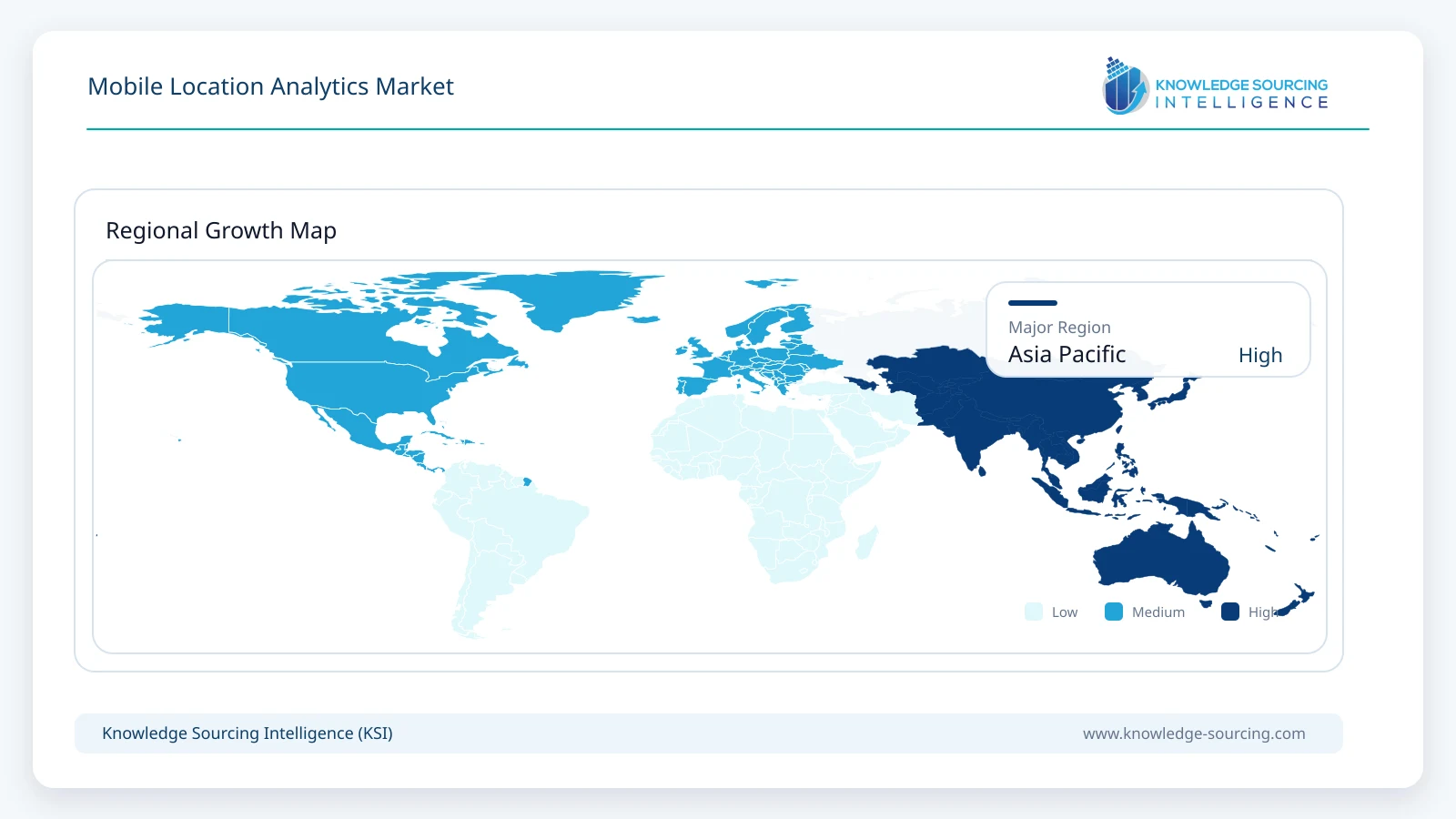
Asia Pacific is positioned for strong expansion as connectivity, smartphone ownership, digital commerce, and mobility ecosystems continue to develop.
Asia Pacific is expected to remain one of the most important growth regions for mobile location analytics because of its large connected population and diverse digital economy. The region includes mature technology markets such as Japan, South Korea, Singapore, and Australia, as well as rapidly digitizing economies including India and several Southeast Asian markets.
The scale of the region's internet population is an important structural advantage. ITU data indicate that 77% of the Asia-Pacific population used the internet in 2025. This represents a substantial improvement in the region's connected population and provides an expanding base for mobile applications, digital commerce, navigation, mobility services, and location-enabled business processes.
India is expected to remain particularly significant. Government data show that internet connections reached approximately 100.29 crore in 2025 and broadband connections reached 99.56 crore. Average monthly wireless data consumption also reached approximately 24.01 GB per user. The country's high smartphone ownership and expanding 5G infrastructure create favorable conditions for mobile-enabled services and location intelligence.
Government data also show that the digital divide within India is narrowing, although differences between urban and rural users remain important. The 2025 Comprehensive Modular Survey: Telecom found that 92.7% of rural individuals aged 15 to 29 had used the internet during the previous three months, compared with 95.7% in urban areas. Smartphone ownership among mobile-phone owners in the same age group was also high in both rural and urban areas. This widening geographic distribution of connected users can create opportunities for location intelligence beyond large metropolitan areas.
China also represents an important regional market because of its extensive mobile ecosystem, large digital consumer base, mature e-commerce infrastructure, and advanced transportation networks. Japan and South Korea contribute through high smartphone adoption, advanced telecommunications infrastructure, connected mobility, and sophisticated retail environments. Southeast Asian markets provide additional opportunities as mobile commerce, ride-hailing, digital payments, logistics, and urban mobility services expand.
North America is also expected to remain an important market because of advanced digital infrastructure, established enterprise analytics adoption, large retail networks, mature advertising ecosystems, and extensive use of location intelligence in transportation and logistics. The region's regulatory environment, however, increases the importance of consent, data governance, and responsible handling of precise location information.
Europe represents another significant market, supported by high internet penetration and advanced retail, mobility, logistics, and financial-services ecosystems. However, GDPR requirements and the broader European data-protection framework make privacy governance a fundamental component of commercial location analytics deployments.
Mobile Location Analytics Market Key Developments:
September 2026: HERE Technologies and NIO expanded their European collaboration to provide continuously refreshed location intelligence across NIO's European vehicle lineup, supporting navigation and future AI-driven assisted-driving experiences.
July 2026: Esri announced ArcGIS for ServiceNow, connecting ArcGIS location intelligence with ServiceNow workflows to enable real-time geographic visualization of incidents, assets, work orders, and facilities across enterprise applications.
July 2026: Kalibrate launched its Q2 2026 Location Intelligence release with a refreshed Hotspot Analysis tool, the k.ai Companion, a redesigned mobile experience, and other capabilities for market planning and location strategy teams.
April 2026: Kalibrate released its Q1 2026 Location Intelligence update, adding platform improvements including enhanced clustering capabilities and performance enhancements aimed at helping users analyze location datasets more efficiently.
February 2026: Precisely announced new Data Quality, Data Enrichment, and Location Intelligence AI agents for its Data Integrity Suite, designed to automate data workflows while supporting trusted, context-rich information for analytics and AI.
January 2026: HERE Technologies introduced an AI-powered portfolio for software-defined vehicles at CES 2026, combining live map intelligence and advanced software for navigation, driver assistance, automated driving, and connected mobility applications.
Overall, the mobile location analytics market is evolving from a narrowly defined mobile-tracking application into a broader location intelligence ecosystem. Smartphone and internet penetration remain important underlying drivers, but the next phase of market development will increasingly depend on the quality, governance, interoperability, and analytical value of location data.
The strongest opportunities are likely to emerge where mobile location signals can be combined responsibly with first-party business data, geospatial information, transportation datasets, demographic context, and AI-enabled analytics. Retailers can use these capabilities to improve store-network decisions and understand physical customer behavior, while logistics and mobility providers can use them to optimize routes, capacity, and real-time operations.
At the same time, privacy should be treated as a core market requirement rather than simply a regulatory obstacle. Recent enforcement actions demonstrate that precise location information can create substantial consumer and business risks when collected or shared without appropriate controls. Vendors and users that prioritize consent, data minimization, aggregation, de-identification, retention controls, security, and transparent data provenance are better positioned to build sustainable location analytics programs.
Consequently, the competitive environment is increasingly shifting toward platforms that can combine accurate geographic data with AI, real-time analytics, enterprise integration, and strong data governance. The market's long-term development will depend not only on how many devices generate location signals, but also on how effectively organizations can transform those signals into reliable, privacy-conscious, and actionable business intelligence.
Mobile Location Analytics Market Scope:
| Report Metric | Details |
|---|---|
| Total Market Size in 2026 | USD 22.9 billion |
| Total Market Size in 2031 | USD 43.1 billion |
| Forecast Unit | Billion |
| Growth Rate | 13.5% |
| Study Period | 2021 to 2031 |
| Historical Data | 2021 to 2024 |
| Base Year | 2025 |
| Forecast Period | 2026 – 2031 |
| Segmentation | Tool, Component, End-User Industry, Geography |
| Companies |
|
Market Segmentation
By Tool
Reporting and Visualization Tool
Geocoding and Reverse Geocoding Tool
Data Integration and ETL Tool
Thematic Mapping and Spatial Analysis Tool
Others
By Component
Hardware
Software
Service
By End-User Industry
Healthcare
BFSI
Travel and Tourism
Retail
Others
By Geography
North America
United States
Canada
Mexico
South America
Brazil
Argentina
Others
Europe
United Kingdom
Germany
France
Italy
Spain
Others
Middle East and Africa
Saudi Arabia
UAE
Israel
Others
Asia Pacific
Japan
China
India
Australia
South Korea
Indonesia
Thailand
Taiwan
Others
Table of Contents
1. INTRODUCTION
1.1. Market Overview
1.2. Market Definition
1.3. Scope of the Study
1.4. Market Segmentation
1.5. Currency
1.6. Assumptions
1.7. Base and Forecast Years Timeline
1.8. Key Benefits for the Stakeholder
2. RESEARCH METHODOLOGY  
2.1. Research Design
2.2. Research Processes
3. EXECUTIVE SUMMARY
3.1. Key Findings
4. MARKET DYNAMICS
4.1. Market Drivers
4.2. Market Restraints
4.3. Porter’s Five Forces Analysis
4.3.1. Bargaining Power of Suppliers
4.3.2. Bargaining Power of Buyers
4.3.3. Threat of New Entrants
4.3.4. Threat of Substitutes
4.3.5. Competitive Rivalry in the Industry
4.4. Industry Value Chain Analysis
4.5. Analyst View
5. MOBILE LOCATION ANALYTICS MARKET BY TOOL
5.1. Introduction
5.2. Reporting and Visualization Tool
5.3. Geocoding and Reverse Geocoding Tool
5.4. Data Integration and ETL Tool
5.5. Thematic Mapping and Spatial Analysis Tool
5.6. Others
6. MOBILE LOCATION ANALYTICS MARKET BY COMPONENT
6.1. Introduction
6.2. Hardware
6.3. Software
6.4. Service
7. MOBILE LOCATION ANALYTICS MARKET BY END-USER INDUSTRY
7.1. Introduction
7.2. Healthcare
7.3. BFSI
7.4. Travel and Tourism
7.5. Retail
7.6. Others
8. MOBILE LOCATION ANALYTICS MARKET BY GEOGRAPHY
8.1. Introduction
8.2. North America
8.2.1. United States
8.2.2. Canada
8.2.3. Mexico
8.3. South America
8.3.1. Brazil
8.3.2. Argentina
8.3.3. Others
8.4. Europe
8.4.1. United Kingdom
8.4.2. Germany
8.4.3. France
8.4.4. Italy
8.4.5. Spain
8.4.6. Others
8.5. Middle East and Africa
8.5.1. Saudi Arabia
8.5.2. UAE
8.5.3. Israel
8.5.4. Others
8.6. Asia Pacific
8.6.1. Japan
8.6.2. China
8.6.3. India
8.6.4. Australia
8.6.5. South Korea
8.6.6. Indonesia
8.6.7. Thailand
8.6.8. Taiwan
8.6.9. Others
9. COMPETITIVE ENVIRONMENT AND ANALYSIS
9.1. Major Players and Strategy Analysis
9.2. Market Share Analysis
9.3. Mergers, Acquisitions, Agreements, and Collaborations
9.4. Competitive Dashboard
10. COMPANY PROFILES
10.1. Oracle Corporation
10.2. IBM Corporation
10.3. Pitney Bowes Inc.
10.4. Cisco Systems
10.5. PlaceIQ (Precisely)
10.6. TIBCO Software Inc.
10.7. Galigeo
10.8. Google LLC
Navigate
Trusted by the world's leading organizations