
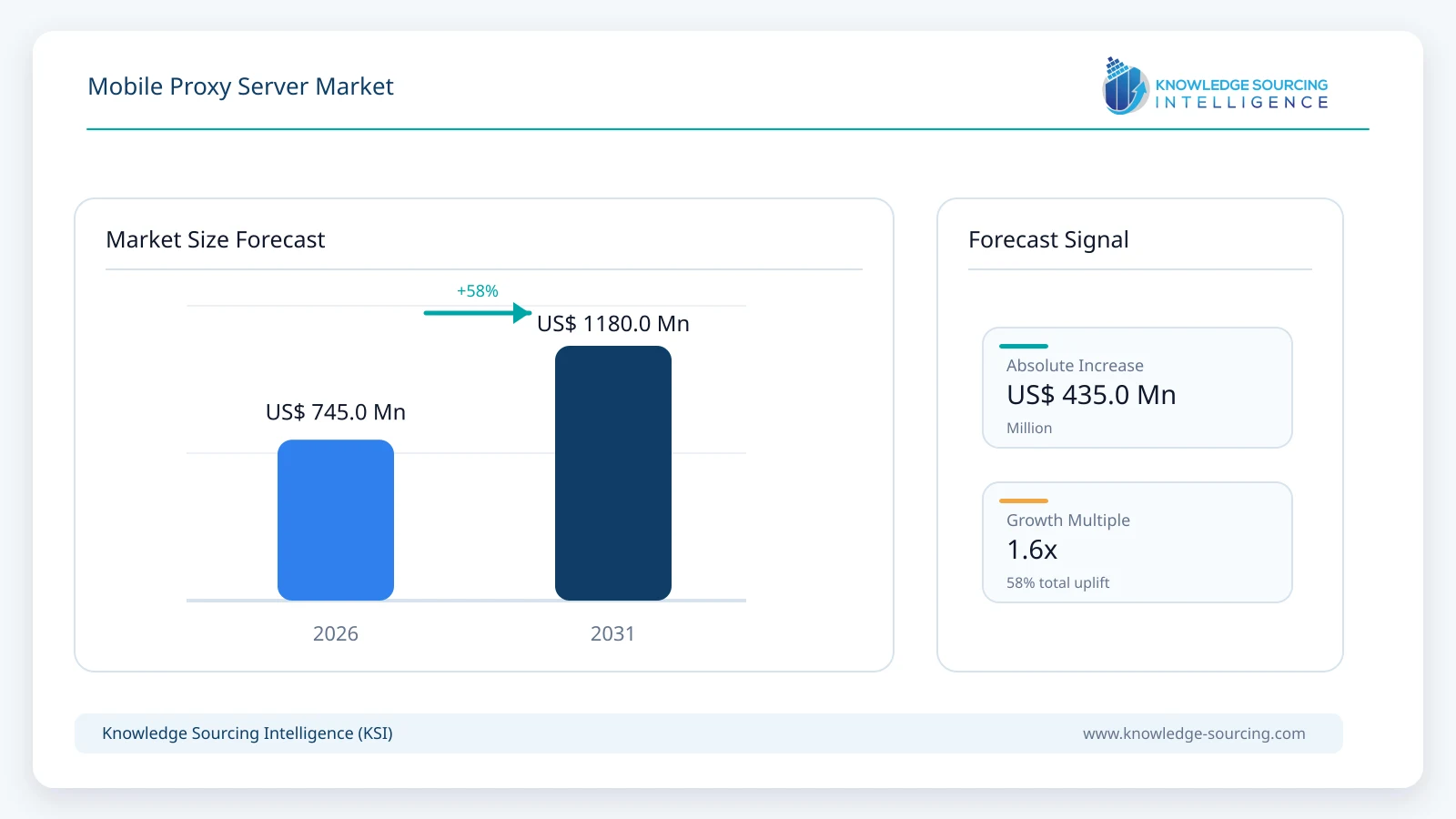
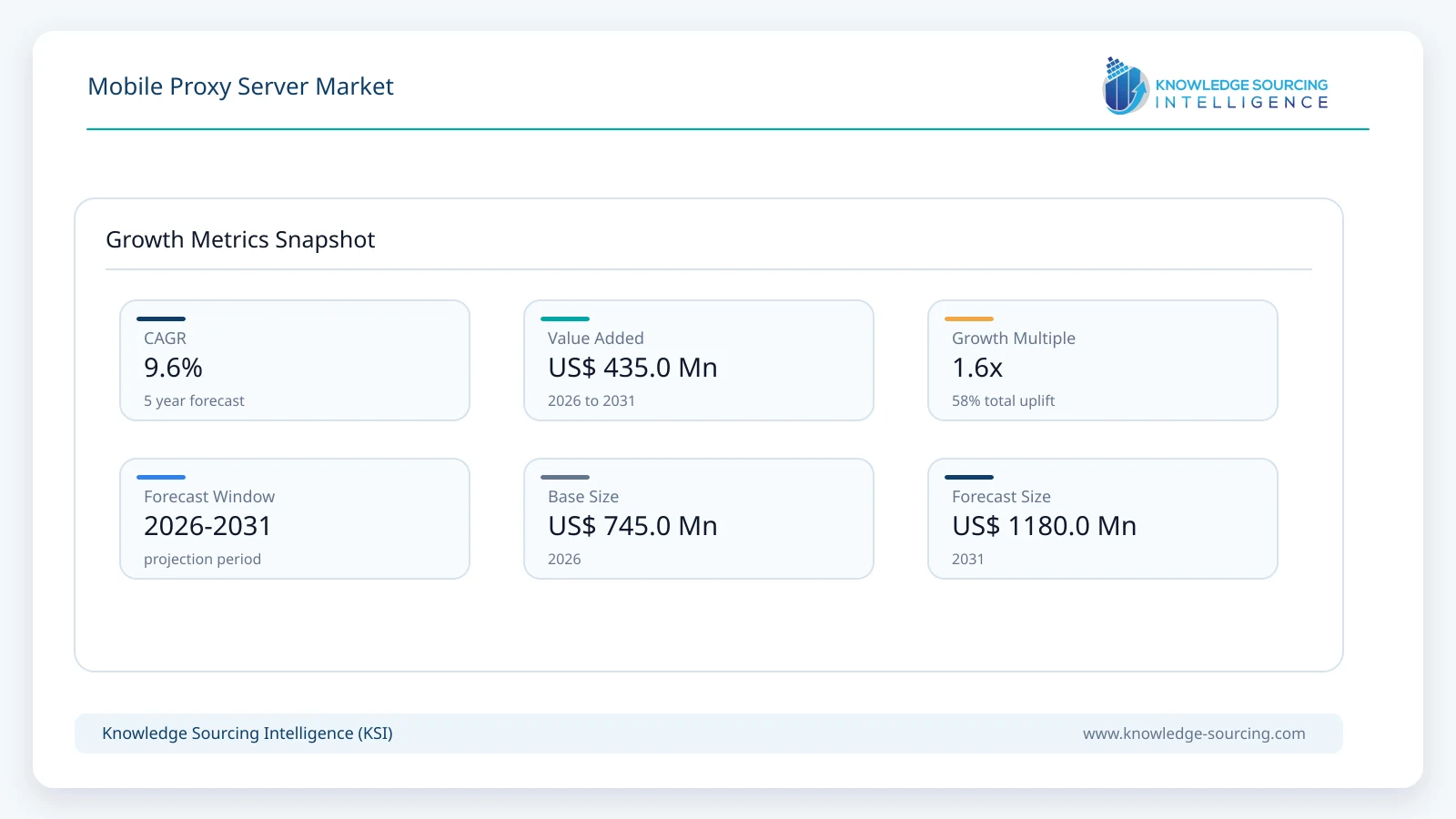
The mobile proxy server market is growing at a CAGR of approximately 9.6%, from USD 745 million in 2026 to USD 1,180 million by 2031.
Highlights:
- 1Rotating mobile proxies account for approximately 74% of global market value in 2026, reflecting their widespread use in scalable data collection and geographically distributed access.
- 2HTTP/HTTPS accounts for approximately 68% of global mobile proxy server revenue in 2026, supported by broad compatibility with web-data and browser-based applications.
- 3Web data collection and scraping account for approximately 39% of market value in 2026, supported by e-commerce intelligence, AI data pipelines and market monitoring.
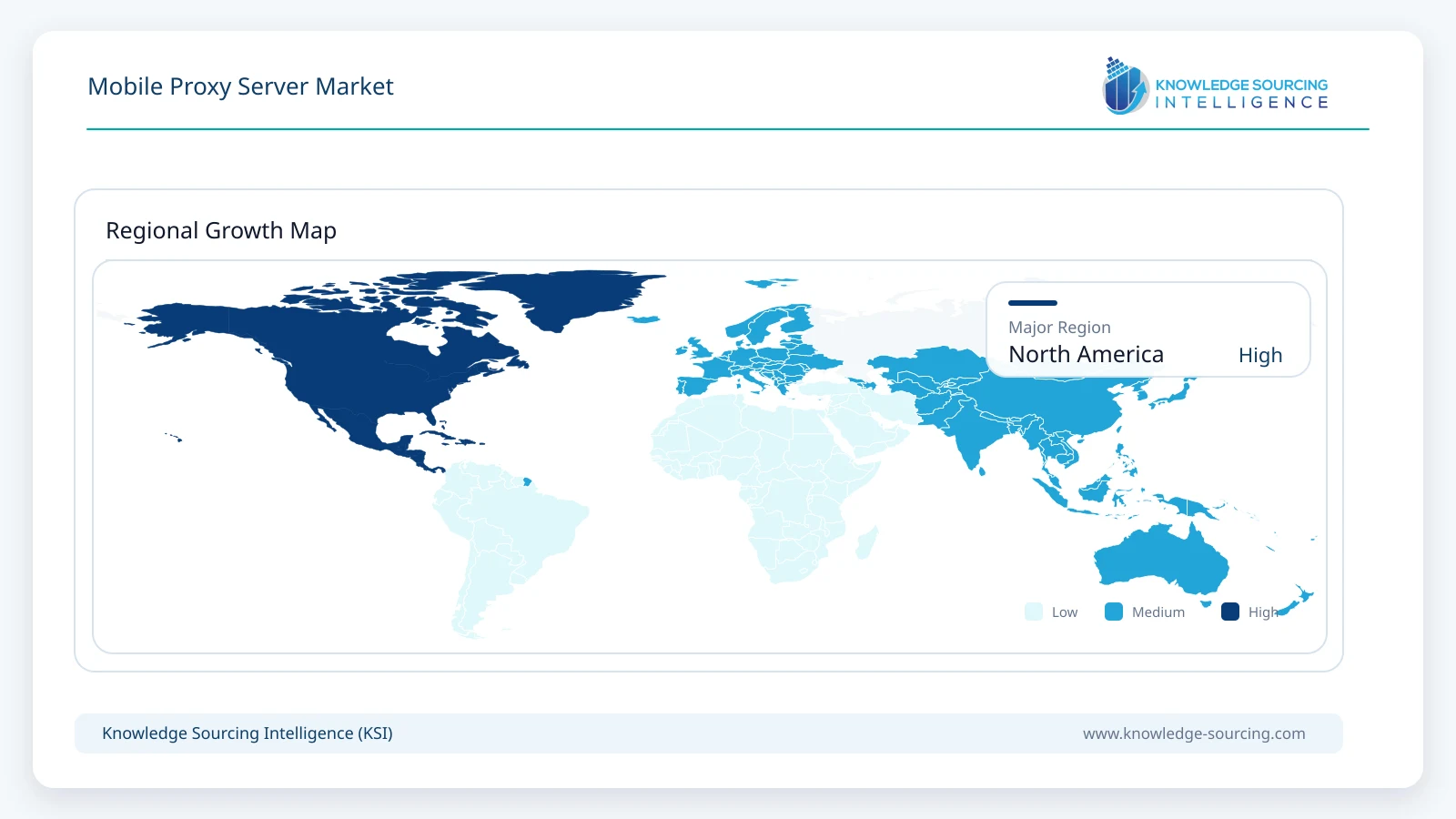
- 4North America accounts for approximately 36% of global market value in 2026, supported by extensive enterprise adoption of public web-data infrastructure.
- 5The United States accounts for approximately 27% of global mobile proxy server revenue in 2026, remaining the largest individual national market.
Mobile proxy servers route internet requests through IP addresses assigned by mobile network operators and associated with cellular connections such as 3G, 4G LTE and 5G. The service allows users to access online resources through mobile-network identities rather than conventional data-center IP addresses. Commercial services commonly provide geographic targeting, carrier or ASN selection, rotating or persistent sessions and support for HTTP/HTTPS or SOCKS5 protocols.
The market includes paid mobile-proxy network services, dedicated mobile proxy infrastructure and associated managed connectivity. Residential, ISP and data-center proxy services are excluded unless they form part of a specifically marketed mobile-proxy offering. Web-scraping software, datasets and standalone anti-detection software are also excluded where proxy-network access is not the primary service being purchased.
Mobile proxy networks are becoming increasingly extensive. Oxylabs currently advertises access to more than 20 million mobile IPs across over 140 countries, Decodo provides more than 10 million mobile IPs across more than 160 locations and 700 carriers, Bright Data reports a network of more than 7 million mobile IPs, while SOAX markets mobile coverage across more than 195 geographies. These figures are provider-reported network capacities and illustrate the scale at which leading suppliers are competing for enterprise data workloads.
The underlying mobile-connectivity environment also continues expanding. GSMA Intelligence reported 8.8 billion wireless connections and approximately 5.8 billion unique mobile subscribers globally in 2026, while continued 5G deployment is increasing the diversity of mobile-network infrastructure available across regions.
Market Trends
Mobile Proxies Are Becoming Part of Enterprise Web-Data Infrastructure
Commercial proxy networks are moving beyond standalone IP access toward broader public web-data platforms. Leading providers increasingly combine proxies with scraping APIs, browser infrastructure, data parsing, automated session management and enterprise data-delivery tools.
Decodo's transition from Smartproxy in April 2025 reflected this shift, with the company expanding from its original proxy-service positioning toward an integrated web-data platform. Its current mobile service combines carrier-grade IP access with city and ASN targeting and integrations intended for automated data workflows.
Artificial intelligence adds another source of demand. Bright Data's 2026 research among organizations using public web data found that real-time external information is becoming increasingly integrated into AI systems, while Oxylabs reported USD 350 million in annual recurring revenue across its wider data platform in July 2026. Mobile proxies represent one component of this infrastructure where mobile-specific access, localized information or higher-trust network identities are required.
5G and Newer Connection Protocols Are Improving Mobile Proxy Performance
Mobile proxy services historically depended largely on 3G and 4G connections, but providers increasingly offer IP pools associated with 5G networks as deployments expand internationally. The transition improves network capacity and latency in markets where 5G coverage is mature, although mobile proxy performance still depends on routing, target location, carrier infrastructure and provider architecture rather than network generation alone.
Providers are also modernizing transport protocols. Oxylabs added HTTP/3 support to its residential and mobile proxy services in May 2026 through SOCKS5 endpoints supporting UDP traffic. SOAX similarly supports protocols including HTTP, HTTPS, SOCKS5, UDP and QUIC across its current mobile proxy offering.
These improvements are particularly relevant for applications requiring large numbers of geographically distributed requests, where connection latency and unsuccessful requests can materially influence the total cost of collecting data.
Consent-Based IP Sourcing Is Becoming a Competitive Requirement
Enterprise customers increasingly evaluate how proxy providers acquire the mobile and residential IP addresses included in their networks. This is shifting competition toward transparent sourcing, user consent, know-your-customer controls and documented acceptable-use policies.
SOAX describes its mobile network as consisting of voluntarily shared IP addresses, while Decodo markets its mobile IPs as ethically sourced. Industry organizations such as the Ethical Web Data Collection Initiative are also promoting standards around consent, transparency and accountability within the broader proxy ecosystem.
The shift is commercially significant because enterprises using proxies for advertising verification, market intelligence and AI data collection have greater legal and reputational exposure than small individual users. Large providers are consequently positioning compliance infrastructure alongside network size, speed and geographic coverage.
Pricing Competition Is Making Mobile Proxy Capacity More Accessible
Mobile proxy services continue to command higher prices than many residential and data-center proxy offerings because mobile IP supply is more constrained and carrier-based connections have higher infrastructure costs. However, competition has reduced entry prices and expanded pay-as-you-go options.
Proxyway's 2025 provider benchmarking showed mobile proxy pricing declining as additional suppliers entered the market, with volume pricing considerably below earlier premium levels. Decodo currently lists high-volume enterprise pricing from approximately USD 2.25 per GB, while IPRoyal and other providers increasingly offer both rotating usage-based products and dedicated mobile connections.
Lower unit pricing broadens adoption among small and medium-sized companies, developers and specialized data teams, although enterprise usage can still generate substantial expenditure when workloads require significant bandwidth or highly targeted locations.
Market Drivers
Real-Time Public Web Data Is Increasingly Important to Business Applications
Companies increasingly use continuously updated public web information for pricing intelligence, product monitoring, search analysis, market research and AI applications. These workloads require network infrastructure capable of accessing information across different locations while maintaining consistent request success rates.
Mobile proxies are particularly relevant when online services differentiate content according to device network, carrier or geography. Carrier-issued IP addresses can provide a more representative view of mobile user experiences than data-center addresses, supporting localized market intelligence and mobile-specific testing.
Bright Data's 2026 AI data research indicates that organizations developing AI applications increasingly rely on real-time public web infrastructure rather than static datasets alone. The expansion of automated AI systems is therefore creating an additional source of demand for large-scale proxy infrastructure alongside conventional e-commerce and digital-marketing applications.
Advertising Verification Requires Localized Mobile Access
Digital advertisers need to verify whether campaigns are displayed correctly across different countries, cities, carriers and mobile environments. Mobile proxies enable verification platforms and agencies to observe advertising from network locations resembling genuine mobile users without maintaining physical devices in every target geography.
The requirement is particularly relevant for mobile-first advertising markets where campaign delivery can vary by carrier, location and device context. Bright Data specifically positions mobile proxies for mobile advertising verification, while IPRoyal and SOAX identify ad verification among their primary commercial use cases.
As advertising platforms increase geographic and audience segmentation, verification providers require broader mobile IP coverage and more precise targeting, supporting continued commercial demand for premium proxy networks.
Mobile-First Digital Services Increase Testing Requirements
Many online services are designed primarily or substantially for smartphone users. GSMA reported approximately 4.8 billion mobile internet users globally by the end of 2025, illustrating the scale of consumer activity taking place over mobile connections.
Developers, testing organizations and digital businesses use mobile network locations to evaluate localized content, mobile search results, application behavior and regional service availability. Mobile proxy providers increasingly enable targeting by country, city, carrier and ASN, allowing businesses to recreate a wider range of network contexts without maintaining distributed physical testing infrastructure.
This makes mobile proxies useful not only for data collection but also for quality assurance, localization testing and monitoring of mobile-first services.
Market Restraints and Challenges
Mobile Proxy Services Remain Relatively Expensive
Mobile IP addresses remain more expensive to supply than conventional data-center capacity because providers require access to genuine cellular-network connections or consent-based device networks. Even as pricing declines, mobile proxies generally remain a premium option within the wider proxy-services market.
Customers therefore tend to reserve mobile IPs for tasks where their characteristics provide a meaningful advantage. High-volume, low-complexity collection can often be performed more economically through residential or data-center proxies, while mobile networks are used where carrier identity, mobile-specific content or high request acceptance is important.
Price competition can also pressure provider margins as customers compare increasingly similar offerings based on cost per gigabyte, success rate and geographic coverage.
Network Sourcing and Compliance Increase Operational Complexity
Mobile proxy providers must manage relationships with device-network participants, connectivity suppliers and customers while preventing misuse of their infrastructure. Poorly sourced networks can create legal, security and reputational risks for both providers and enterprise users.
Enterprise procurement increasingly requires evidence of consent-based sourcing, acceptable-use policies, customer verification and data-security practices. These requirements increase operating costs and can slow onboarding compared with less controlled proxy services.
Industry initiatives promoting ethical sourcing can strengthen trust in legitimate providers but also create greater differentiation between enterprise-grade networks and low-cost suppliers with less transparent sourcing practices.
Segment Analysis
By Proxy Model: Rotating Mobile Proxies
Rotating mobile proxies are projected to generate approximately USD 895 million by 2031, remaining the largest service model throughout the forecast period. These networks automatically change the mobile IP used for requests according to provider rules or customer-defined session settings, allowing businesses to distribute workloads across large pools of carrier-issued addresses.
Rotating access is particularly suited to market monitoring, localized search analysis, advertising verification and public web-data collection because these applications frequently require large numbers of requests across different locations. Leading services provide both per-request rotation and sticky sessions that preserve an IP for a defined period when continuity is required.
SOAX allows customers to rotate on each request or retain sessions for longer periods, while Decodo provides access to more than 10 million mobile IPs with rotating and sticky-session configurations. Dedicated mobile proxies remain important for persistent identities and specialized testing, but rotating networks account for the majority of commercial traffic-based mobile proxy services.
By Protocol: HTTP/HTTPS
HTTP/HTTPS mobile proxy services are projected to generate approximately USD 795 million by 2031, remaining the largest protocol category. Their position reflects broad compatibility with browsers, web-scraping frameworks, APIs and common automation environments.
Most commercial providers support HTTP and HTTPS by default, reducing integration complexity for organizations already using conventional web-data tools. SOCKS5 is also widely supported and becomes particularly useful where customers need broader traffic handling or newer capabilities such as UDP-based connections.
Protocol boundaries are becoming less rigid as enterprise providers increasingly support several options through the same network. Oxylabs' 2026 introduction of HTTP/3 connectivity through SOCKS5 and SOAX's support for multiple protocols illustrate this transition toward more flexible proxy infrastructure.
By Application: Web Data Collection and Scraping
Web data collection and scraping are projected to generate approximately USD 500 million in mobile proxy revenue by 2031, remaining the largest individual application. Businesses use mobile proxy networks to collect publicly available information for price monitoring, product intelligence, search analysis, market research and AI-related datasets.
The segment is shifting toward more automated workflows. Proxy providers increasingly bundle infrastructure with scraping APIs, data parsing, browser technologies and AI integrations, reducing the engineering required to manage IP rotation and unsuccessful requests manually.
Decodo now positions its mobile infrastructure for AI data pipelines alongside conventional data collection, while SOAX identifies e-commerce data, price monitoring, SEO analysis and AI/LLM datasets among its commercial applications.
Ad verification, mobile application testing and social media management remain sizeable additional applications, but public web-data collection increasingly shapes product development among the largest enterprise providers.
Regional Analysis
Major Region: North America
North America is projected to generate approximately USD 425 million in mobile proxy server revenue by 2031, remaining the largest regional market. The region contains a large concentration of e-commerce companies, advertising technology businesses, AI developers and digital-data providers that rely on geographically distributed online information.
Mobile proxy demand is supported by extensive mobile internet usage and a mature enterprise software environment. Organizations use carrier-based IP networks for advertising verification, localized market intelligence, mobile-app testing and public web-data infrastructure.
The region also represents one of the most commercially valuable locations for global proxy providers, with substantial IP capacity allocated to the United States and Canada. Decodo, for example, reports approximately 3.9 million mobile IPs available in the United States within its global pool, illustrating provider emphasis on North American coverage.
Major Country: United States
The United States is projected to generate approximately USD 320 million in mobile proxy server revenue by 2031, remaining the largest individual country market.
Demand is supported by the scale of US e-commerce, digital advertising, AI development, price intelligence and online research activities. The country is also a priority geography for international businesses requiring localized monitoring of search results, advertisements, product availability and digital content.
Competition for US carrier IP coverage is consequently strong among major providers. IPRoyal lists more than 500,000 mobile IPs in the United States, while Decodo reports several million available addresses and Bright Data provides city, ASN and ZIP-code targeting within its mobile proxy network.
Competitive Environment and Analysis
The mobile proxy server market includes specialist proxy providers, broader web-data infrastructure companies and firms focused on dedicated mobile-proxy hardware. Bright Data, Oxylabs, Decodo and SOAX operate large international networks and increasingly compete through complete data-collection platforms rather than IP access alone.
Bright Data maintains more than 7 million mobile IPs and combines proxy networks with web-scraping and data infrastructure. Oxylabs advertises more than 20 million mobile IPs across over 140 countries and increasingly positions its infrastructure around enterprise and AI applications. Decodo provides more than 10 million mobile IPs across more than 700 carriers, while SOAX combines broad geographic coverage with carrier, city and session controls.
Companies such as IPRoyal, NetNut, Infatica, ProxyEmpire and DataImpulse compete through pricing, specialized coverage and more accessible self-service plans. Proxidize occupies a differentiated position by supplying infrastructure that allows organizations to build and manage dedicated mobile proxy networks using cellular modems.
Competitive advantage increasingly depends on IP quality, geographic coverage, request success rate, session control, network sourcing, technical integration and customer compliance requirements. Scale remains important, but enterprise buyers increasingly evaluate whether IP sourcing and customer-use policies can withstand procurement and regulatory scrutiny.
Pricing is also becoming more transparent. Pay-as-you-go products allow smaller users to access mobile networks without large commitments, while enterprise providers offer declining per-gigabyte prices as traffic volumes increase. This lowers entry barriers but increases pressure on providers to differentiate through reliability, compliance and software capabilities.
Recent Developments
July 2026: Oxylabs announced a USD 130 million investment from Warburg Pincus, valuing the wider Oxylabs group at approximately USD 3.6 billion as the company expands infrastructure serving AI and real-time web-data applications.
May 2026: Oxylabs introduced HTTP/3 support for residential and mobile proxies, expanding protocol support for modern web connections.
March 2026: SOAX expanded its Asian network infrastructure with a Singapore point of presence, reporting a reduction in average time-to-first-byte for targeted Asian websites.
April 2025: Smartproxy officially became Decodo, reflecting its expansion from proxy access toward a broader public web-data platform incorporating scraping and AI-oriented tools.
2026: Bright Data expanded its positioning around real-time web infrastructure for AI applications through its Data for AI 2026 initiative, reflecting increasing convergence between proxy networks and AI data pipelines.
Market Outlook
The global mobile proxy server market is forecast to increase. Demand increasingly comes from commercial data infrastructure rather than basic privacy use cases.
Web-data collection remains the largest application as e-commerce, market intelligence and AI systems require continuously updated information from geographically distributed online sources. Advertising verification and mobile testing provide additional demand where carrier-level or mobile-specific access is required.
Mobile proxy networks also become more technically sophisticated through broader 5G availability, modern protocols, improved geographic targeting and automated session management. At the same time, declining per-gigabyte pricing makes premium mobile IP infrastructure accessible to a wider customer base.
Ethical sourcing and compliance become increasingly important competitive factors through 2031. Providers able to combine large mobile IP pools with transparent sourcing, enterprise controls and integrated web-data software are positioned to capture a greater proportion of commercial demand.
Mobile Proxy Server Market Scope:
| Report Metric | Details |
|---|---|
| Total Market Size in 2026 | USD 745 million |
| Total Market Size in 2031 | USD 1,180 million |
| Forecast Unit | Million |
| Growth Rate | 9.6% |
| Study Period | 2021 to 2031 |
| Historical Data | 2021 to 2024 |
| Base Year | 2025 |
| Forecast Period | 2026 – 2031 |
| Segmentation | Proxy Model, Protocol, Application, Geography |
| Companies |
|
Market Segmentation
By Proxy Model
Rotating Mobile Proxies
Dedicated Mobile Proxies
By Protocol
HTTP/HTTPS
SOCKS5 and Other Protocols
By Application
Web Data Collection and Scraping
Ad Verification
SEO and SERP Monitoring
Mobile Application and Localization Testing
Social Media Management
Price Intelligence and Market Research
Others
By Geography
North America
United States
Canada
Mexico
South America
Brazil
Argentina
Others
Europe
United Kingdom
Germany
France
Spain
Lithuania
Others
Middle East and Africa
Saudi Arabia
UAE
Israel
South Africa
Others
Asia Pacific
China
India
Japan
South Korea
Indonesia
Singapore
Australia
Others
Table of Contents
1. EXECUTIVE SUMMARY
2. MARKET SNAPSHOT
2.1. Market Overview
2.2. Market Definition
2.3. Scope of the Study
2.4. Market Segmentation
3. BUSINESS LANDSCAPE
3.1. Market Drivers
3.2. Market Restraints
3.3. Market Opportunities
3.4. Porter's Five Forces Analysis
3.5. Industry Value Chain Analysis
3.6. Mobile IP Sourcing and Network Architecture
3.7. 4G and 5G Connectivity Outlook
3.8. Ethical Sourcing and Compliance Environment
3.9. Pricing and Traffic Economics
3.10. AI and Public Web Data Infrastructure
3.11. Strategic Recommendations
4. MOBILE PROXY SERVER MARKET BY PROXY MODEL
4.1. Introduction
4.2. Rotating Mobile Proxies
4.3. Dedicated Mobile Proxies
5. MOBILE PROXY SERVER MARKET BY PROTOCOL
5.1. Introduction
5.2. HTTP/HTTPS
5.3. SOCKS5 and Other Protocols
6. MOBILE PROXY SERVER MARKET BY APPLICATION
6.1. Introduction
6.2. Web Data Collection and Scraping
6.3. Ad Verification
6.4. SEO and SERP Monitoring
6.5. Mobile Application and Localization Testing
6.6. Social Media Management
6.7. Price Intelligence and Market Research
6.8. Others
7. MOBILE PROXY SERVER MARKET BY GEOGRAPHY
7.1. Introduction
7.2. North America
7.2.1. By Proxy Model
7.2.2. By Protocol
7.2.3. By Application
7.2.4. By Country
7.2.4.1. United States
7.2.4.2. Canada
7.2.4.3. Mexico
7.3. South America
7.3.1. By Proxy Model
7.3.2. By Protocol
7.3.3. By Application
7.3.4. By Country
7.3.4.1. Brazil
7.3.4.2. Argentina
7.3.4.3. Others
7.4. Europe
7.4.1. By Proxy Model
7.4.2. By Protocol
7.4.3. By Application
7.4.4. By Country
7.4.4.1. United Kingdom
7.4.4.2. Germany
7.4.4.3. France
7.4.4.4. Spain
7.4.4.5. Lithuania
7.4.4.6. Others
7.5. Middle East and Africa
7.5.1. By Proxy Model
7.5.2. By Protocol
7.5.3. By Application
7.5.4. By Country
7.5.4.1. Saudi Arabia
7.5.4.2. UAE
7.5.4.3. Israel
7.5.4.4. South Africa
7.5.4.5. Others
7.6. Asia Pacific
7.6.1. By Proxy Model
7.6.2. By Protocol
7.6.3. By Application
7.6.4. By Country
7.6.4.1. China
7.6.4.2. India
7.6.4.3. Japan
7.6.4.4. South Korea
7.6.4.5. Indonesia
7.6.4.6. Singapore
7.6.4.7. Australia
7.6.4.8. Others
8. COMPETITIVE ENVIRONMENT AND ANALYSIS
8.1. Major Players and Strategy Analysis
8.2. Mobile IP Pool and Geographic Coverage
8.3. Pricing and Service Positioning
8.4. Ethical Sourcing and Enterprise Compliance
8.5. Product and Protocol Innovation
8.6. Mergers, Investments, Agreements, and Collaborations
8.7. Competitive Dashboard
9. COMPANY PROFILES
9.1. Bright Data Ltd.
9.2. Oxylabs
9.3. Decodo
9.4. SOAX
9.5. NetNut Ltd.
9.6. IPRoyal Services FZE LLC
9.7. Infatica
9.8. Rayobyte
9.9. Proxidize
9.10. ProxyEmpire
9.11. DataImpulse
9.12. Evomi
9.13. Proxy-Cheap
9.14. TheSocialProxy
9.15. MobileHop
10. APPENDIX
10.1. Market Definition and Scope
10.2. Currency
10.3. Assumptions
10.4. Base and Forecast Years
10.5. Research Methodology
10.6. Segment Modelling
10.7. Data Triangulation and Validation
10.8. Abbreviations
Navigate
Trusted by the world's leading organizations











