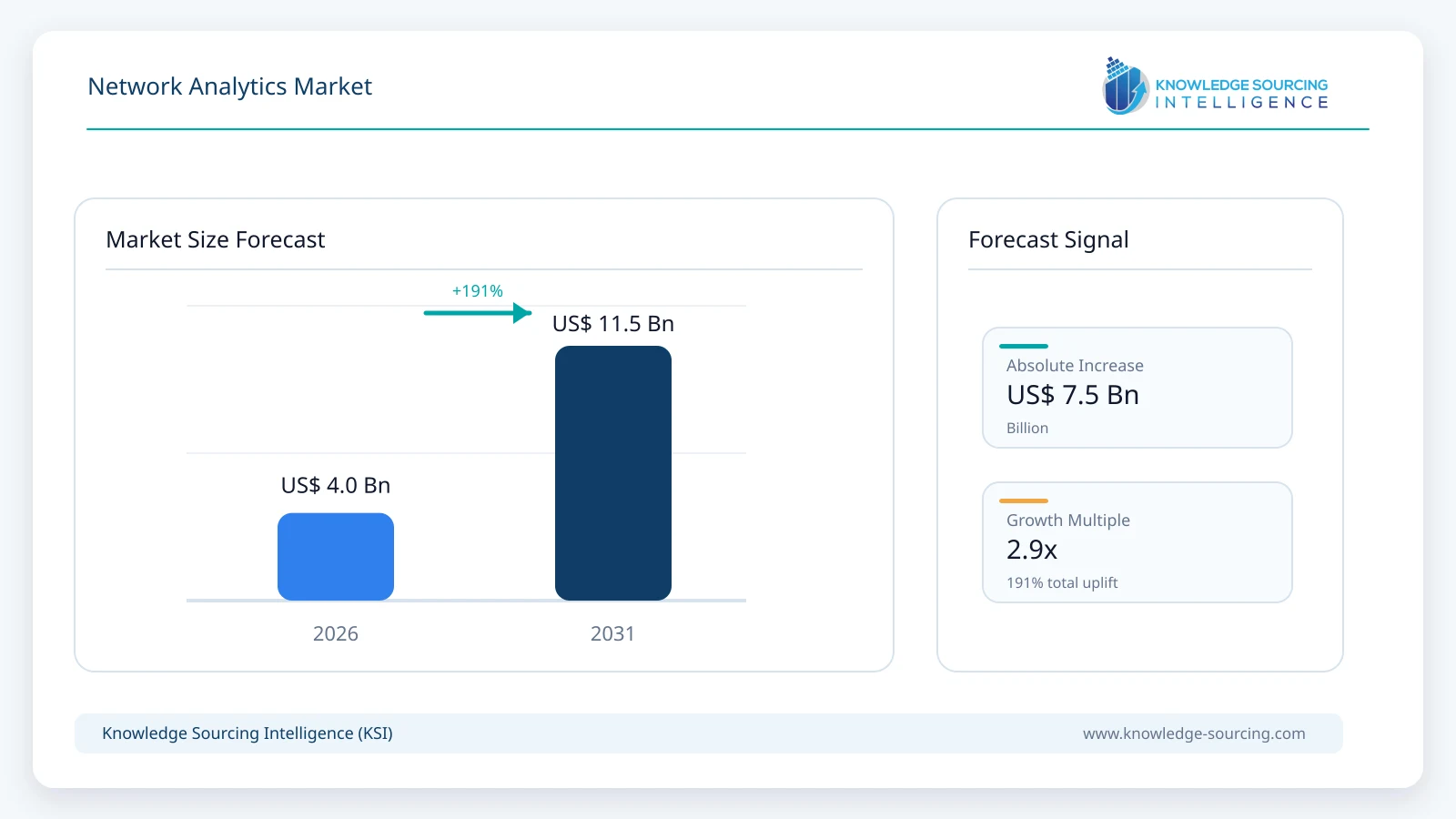
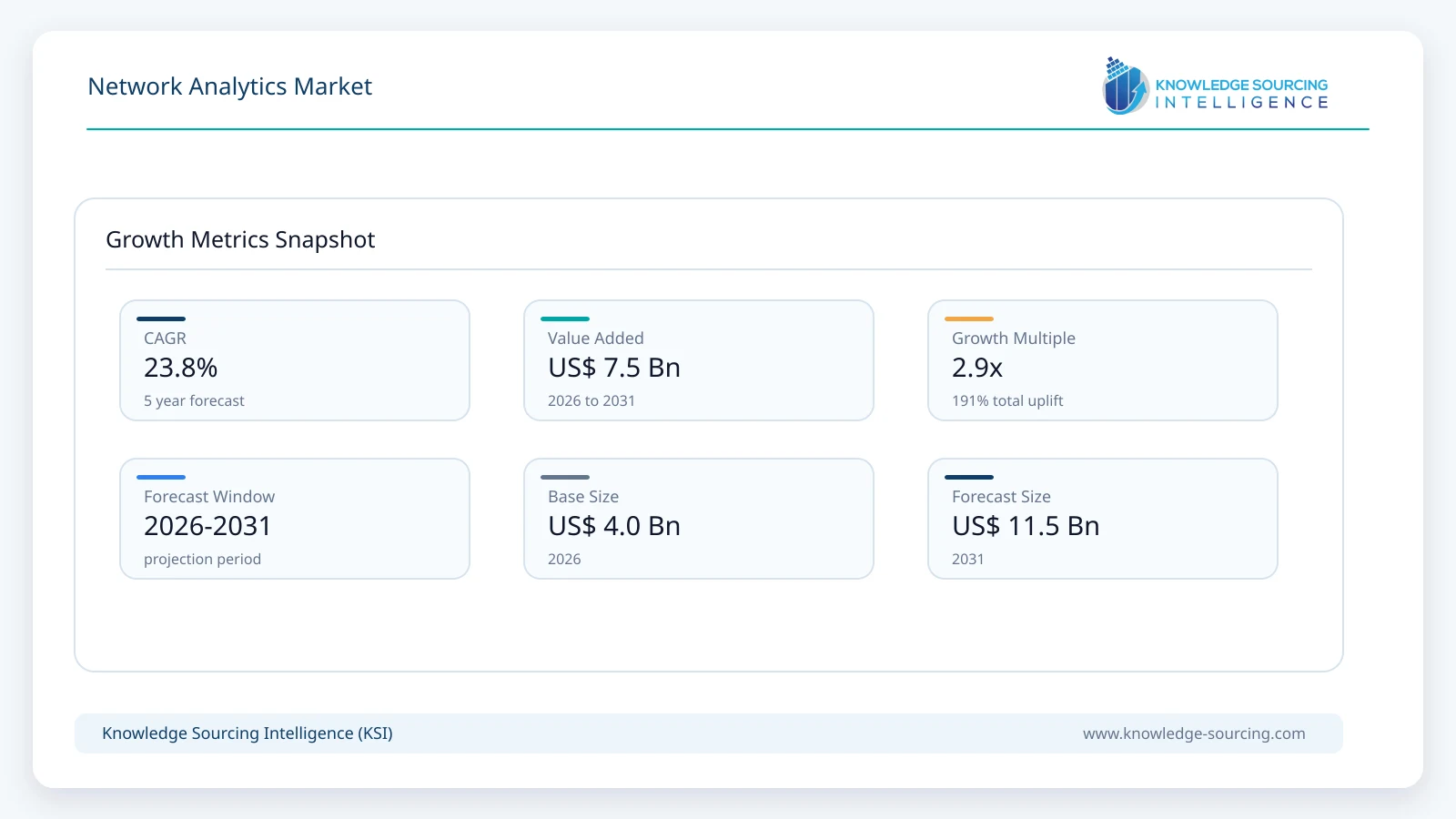
The Network Analytics Market is forecast to grow at a CAGR of 23.8%, reaching USD 11.48 billion in 2031 from USD 3.95 billion in 2026.
Highlights:
- 1AI-enabled operations are strengthening demandNetwork operators are deploying analytics to move from reactive monitoring toward predictive fault detection, automated investigation, and service assurance.
- 2Network intelligence solutions remain commercially importantBuyers increasingly want unified analytics across network, infrastructure, applications, cloud environments, and user-experience data.
- 3Cloud and hybrid deployments are gaining preferenceFlexible architectures allow organizations to scale telemetry processing while retaining local control over sensitive workloads.
- 4Telecom providers remain major usersService quality obligations and the economics of large-scale networks create strong demand for performance analytics and automated assurance.
- 5Regulatory requirements support monitoring investmentNIS2 expands cybersecurity risk-management and incident-reporting obligations across digital infrastructure, cloud, managed services, and communications providers in Europe.
- 6Competition is moving toward integrated platformsVendors are combining network assurance, observability, security analytics, automation, and AI capabilities rather than selling isolated monitoring functions.
The Network Analytics Market covers software platforms, intelligence solutions, and associated professional and managed services that collect, correlate, analyze, and interpret data generated across communication networks, IT infrastructure, cloud environments, applications, and connected devices. These capabilities help organizations identify performance deviations, understand customer experience, detect faults, manage operational risk, support compliance, and improve network utilization. The market spans analytics embedded within network management platforms as well as dedicated observability, assurance, telemetry, and intelligence solutions.
Commercial demand is being shaped by the growing operational complexity of hybrid networks. Enterprises and service providers now manage combinations of private infrastructure, public cloud, software-defined networks, distributed applications, wireless connectivity, and third-party network paths. Traditional monitoring tools that examine isolated devices or individual infrastructure layers can identify symptoms without adequately explaining their business impact. Network analytics therefore has greater value when it correlates telemetry from multiple domains and connects network conditions with application availability, user experience, security events, and service-level commitments.
The primary buyers differ by operating model. Telecom providers require analytics to manage radio, transport, core, and service-layer performance while controlling operating expenditure. Cloud service providers need high-volume telemetry analysis across geographically distributed infrastructure. Managed service providers purchase analytics capabilities to support multiple customers from centralized operations environments. Large enterprises generally prioritize cross-domain visibility, incident reduction, application performance, and governance. Smaller organizations tend to place greater emphasis on ease of deployment, predictable subscription costs, and managed services that reduce the requirement for specialist network operations personnel.
Procurement decisions are also shifting from device-centric monitoring toward outcome-oriented network intelligence. Buyers increasingly assess whether a platform can reduce false alerts, accelerate root-cause analysis, automate remediation workflows, support multiple vendors, and operate across on-premise and cloud environments. Open telemetry standards and APIs have become commercially important because customers do not want analytics platforms that require replacement of their existing infrastructure simply to obtain consolidated visibility.
The economic case for network analytics rests primarily on operational efficiency and service continuity. A network outage can affect revenue, customer retention, employee productivity, service-level agreements, and regulatory obligations simultaneously. Analytics software can therefore be justified not only as an IT expenditure but also as an operational-risk control. For telecom and managed service providers, the economic calculation is particularly direct because network performance affects service quality and support costs across large customer populations.
Cloud deployment is gaining commercial relevance because organizations want analytics capabilities without maintaining additional management infrastructure. However, on-premise deployments remain important where data sovereignty, latency, security controls, legacy architectures, or operational policies restrict the movement of telemetry. Hybrid deployment consequently provides a practical route for organizations that need centralized intelligence while retaining sensitive data or operational workloads locally.
Artificial intelligence and machine learning are also changing the functionality expected from network analytics platforms. The value proposition is moving beyond dashboards toward anomaly detection, event correlation, predictive maintenance, automated incident investigation, and closed-loop optimization. Ericsson reported that its network strategy increasingly incorporates AI into network operations and that its Predictive Cell Energy Management solution achieved the first TM Forum verification of Level 4 autonomy in a telecom scenario in June 2025.
The market is consequently becoming connected to broader observability and AIOps budgets. Cisco's integration of Splunk observability with ThousandEyes illustrates this convergence. In 2025, Cisco introduced capabilities designed to correlate application, infrastructure, and network telemetry while applying AI to troubleshooting and incident analysis.
For 2026–2031, purchasing decisions are expected to increasingly depend on measurable operational outcomes rather than the number of dashboards, devices, or data sources supported. Buyers will evaluate analytics accuracy, integration depth, automation capability, deployment flexibility, data governance, and the ability to reduce mean time to detect and resolve incidents.
Market Drivers
Expansion of Multi-Domain and Hybrid Network Infrastructure
Network architectures now contain more operational domains than conventional enterprise networks. Applications can run across private data centers, multiple public clouds, edge locations, branch infrastructure, and third-party connectivity providers. This distribution makes fault isolation more difficult because an application outage may originate from a network path, cloud service, DNS issue, application dependency, or endpoint.
The resulting buyer requirement is correlation. Enterprises want analytics platforms capable of connecting infrastructure telemetry with application and user-experience information. Cloud providers and managed service providers have an even stronger requirement because they must distinguish infrastructure-wide problems from customer-specific incidents.
The commercial implication is a gradual shift from simple monitoring licenses toward broader analytics platforms. Vendors that can ingest diverse telemetry, normalize data, identify relationships, and provide actionable recommendations can address larger portions of the operations budget.
Cisco's 2025 observability initiatives illustrate this movement. Its Splunk and ThousandEyes integration connects application, infrastructure, and network visibility, while its observability portfolio adds AI-supported troubleshooting and event correlation.
Higher Operational Cost of Network Complexity
Network operators face an economic problem when telemetry volumes and alerts increase faster than available engineering capacity. Manual triage becomes expensive because engineers must inspect multiple dashboards, correlate timestamps, validate dependencies, and determine whether an incident affects customers.
Network analytics addresses this problem by prioritizing events and identifying relationships between seemingly independent signals. This can reduce the volume of incidents requiring human investigation and allow specialized personnel to concentrate on complex cases.
The requirement is particularly strong among telecom providers and managed service providers, where network operations centers handle large infrastructure estates. The commercial benefit extends beyond software efficiency because faster incident resolution can reduce service credits, customer complaints, truck rolls, and escalation costs.
Cisco's own network operations experience provides an example of this economic logic. The company reports that its internal observability architecture processes millions of daily alerts and automates the handling of 99.998% of those alerts, demonstrating the potential operational significance of telemetry correlation and automation at large scale.
Growth of AI-Based Network Operations
AI is becoming an important purchasing criterion because conventional threshold-based monitoring is less effective when network conditions vary continuously. Machine-learning systems can establish behavioral baselines, identify anomalies, correlate events, and support predictive decisions.
For network operators, the objective is not simply to add AI to existing dashboards. The more valuable application is using network intelligence to automate decisions within operational workflows. This includes predicting congestion, identifying likely causes of degradation, optimizing resources, and initiating corrective actions under defined controls.
Ericsson's June 2025 announcement concerning Level 4 network autonomy demonstrates the direction of this technology. Its Predictive Cell Energy Management solution was assessed in a live communication service provider network and verified under TM Forum's autonomous-network assessment framework.
The implication for analytics suppliers is that AI functionality will increasingly need to connect directly with operational systems. Standalone analytical recommendations may become less valuable than systems capable of translating network intelligence into controlled operational actions.
Increasing Cybersecurity and Compliance Requirements
Network analytics also benefits from the convergence between network operations and cybersecurity. Security incidents can manifest as unusual traffic patterns, changes in network behavior, service degradation, or abnormal authentication activity. Organizations therefore increasingly need telemetry that can be analyzed across operational and security domains.
The European Union's NIS2 framework reinforces this requirement. The legislation covers digital infrastructure, cloud computing providers, public electronic communications networks, ICT-managed services, and other critical sectors. It requires covered entities to implement cybersecurity risk-management measures and report significant incidents.
This creates demand for systems capable of retaining relevant operational evidence, identifying anomalies, supporting incident investigation, and generating information required for compliance processes. For vendors, integration between network analytics and security analytics becomes a competitive differentiator.
Pressure to Improve Network Resource Utilization
Network operators face continuing pressure to improve asset utilization because network infrastructure requires substantial capital expenditure and ongoing energy, maintenance, and personnel costs. Analytics allows operators to identify underutilized capacity, recurring congestion, inefficient routing, abnormal consumption, and performance bottlenecks.
Telecom providers are particularly sensitive to this issue because network investment decisions must balance service quality against infrastructure costs. Analytics can support decisions about capacity expansion, network optimization, equipment replacement, and energy management.
Huawei's 2025 AI WAN and AI-centric networking announcements demonstrate how suppliers are connecting network intelligence with operational efficiency. Its AI WAN solution was designed around network performance, operations, and total-cost considerations for carriers.
Market Restraints and Challenges
High Integration Complexity
The largest technical barrier is often not analytics itself but data integration. Enterprises operate equipment from different manufacturers, legacy management systems, cloud platforms, applications, and security tools. These systems produce telemetry in different formats and at different frequencies.
Integrating these sources can increase implementation costs and extend deployment timelines. Large enterprises may also need extensive customization to align analytics with existing service-management processes.
Vendors can mitigate this challenge through APIs, open telemetry frameworks, prebuilt connectors, standardized schemas, and modular architectures. Cisco's 2025 OpenTelemetry initiatives demonstrate the importance of vendor-neutral telemetry collection in reducing observability integration friction.
Data Volume and Processing Economics
Network analytics generates substantial quantities of logs, metrics, traces, flow records, events, and performance information. Cloud-based analytics can introduce consumption-based costs when customers retain or process large telemetry volumes.
Buyers therefore increasingly evaluate data-retention policies, sampling, filtering, storage architecture, and analytics efficiency alongside functional capabilities. A platform that produces excessive data-storage or processing costs can weaken the economic case even when its analytical performance is strong.
Suppliers need to provide controls that allow customers to retain high-value data while reducing unnecessary ingestion and storage. The ability to manage telemetry economics will become an important procurement criterion.
Shortage of Specialized Network and Data Skills
Advanced analytics requires expertise spanning networking, data engineering, cloud infrastructure, cybersecurity, and AI. Many enterprises do not maintain sufficient internal staff across all these disciplines.
This constraint supports demand for professional and managed services but can slow adoption of complex platforms. It also encourages customers to prioritize products that offer automated configuration, guided investigations, and simplified workflows.
Managed service providers can benefit from this gap by packaging analytics with monitoring, incident management, and network operations. However, they must demonstrate measurable service outcomes rather than simply reselling software.
Data Governance and Sovereignty
Network telemetry can contain sensitive information about users, devices, applications, traffic patterns, infrastructure configurations, and organizational operations. Moving such data into external cloud platforms can create governance concerns.
Organizations operating across multiple jurisdictions may face different requirements for data storage, access, processing, and incident reporting. The result is continued demand for on-premise and hybrid architectures, particularly in regulated industries and public-sector environments.
Vendors therefore need flexible deployment models, granular access controls, encryption, audit capabilities, and clear data-processing arrangements. Architecture decisions can become as important as analytics functionality in enterprise procurement.
Difficulty Demonstrating Direct Financial Returns
Network analytics often prevents problems rather than generating directly measurable revenue. This can make investment approval more difficult because benefits such as avoided downtime, faster troubleshooting, and reduced incident workload require comparison against a hypothetical cost.
Buyers increasingly expect proof through operational metrics such as mean time to detect, mean time to resolve, alert reduction, service availability, capacity utilization, and technician productivity. Suppliers that connect analytics outcomes to these measures will have a stronger commercial proposition.
Major Segment Analysis
Network Intelligence Solutions
Network Intelligence Solutions represent a commercially important segment because they form the analytical core of network visibility, assurance, and optimization activities.
These solutions collect and process network telemetry to identify performance patterns, faults, anomalies, capacity issues, and service degradation. Their role has expanded beyond traditional network management because buyers increasingly require relationships between infrastructure conditions and application or customer experience.
Telecom providers are major buyers because their networks contain large numbers of interconnected radio, transport, core, and service components. A problem at one layer can affect performance elsewhere. Network intelligence solutions can therefore reduce investigation time by correlating signals across domains.
Cloud service providers have a different requirement. Their infrastructure is distributed across data centers and cloud regions, while workloads can move dynamically between environments. Analytics must therefore maintain visibility despite frequent changes in topology and workload placement.
Managed service providers value centralized intelligence because one operations team may supervise multiple customer environments. Multi-tenant analytics, role-based access, data isolation, and standardized reporting become important purchasing requirements.
Enterprise buyers generally emphasize interoperability. They are less likely to accept a platform that provides excellent analytics for only one vendor's infrastructure. Open APIs, telemetry compatibility, cloud integration, and application observability therefore influence procurement.
The competitive model is consequently shifting toward integrated intelligence platforms. Vendors increasingly combine network analytics with observability, automation, security, application performance management, and service assurance. Cisco's integration of Splunk and ThousandEyes provides a clear example of this model, combining network assurance with application and infrastructure observability.
AI functionality will further influence this segment through anomaly detection, predictive analysis, event correlation, and automated remediation. Ericsson's autonomous-network work and Huawei's AI-based network initiatives show that network intelligence is increasingly being treated as an operational decision layer rather than only a reporting function.
For 2026–2031, solution vendors that can demonstrate lower alert volumes, faster root-cause identification, stronger cross-domain correlation, and measurable operating-cost reductions are likely to secure stronger enterprise and service-provider budgets.
Regional Analysis
North America
North America represents an important demand center because of its concentration of cloud providers, technology companies, large enterprises, telecom operators, and managed service providers. The region also has substantial adoption of hybrid infrastructure, increasing the requirement for centralized visibility across cloud and enterprise networks.
The United States has a mature enterprise software procurement environment where buyers increasingly evaluate observability and network analytics according to operational outcomes. Cybersecurity requirements also encourage organizations to improve telemetry collection and incident analysis.
The FCC's Broadband Data Collection framework demonstrates the importance of structured network information within the U.S. connectivity ecosystem. Providers are required to submit broadband availability information on defined reporting schedules, reinforcing the role of accurate network data and governance.
Canada offers demand through telecom infrastructure, cloud services, financial institutions, government networks, and large distributed enterprises. Mexico provides opportunities through telecom expansion, enterprise connectivity, and managed infrastructure services, although procurement budgets and technical-resource availability can vary considerably across organizations.
Competition in North America is strongly influenced by platform integration. Buyers increasingly prefer suppliers capable of combining networking, observability, security, cloud management, and automation.
Europe
Europe presents a strong regulatory-driven opportunity because network and information systems are subject to extensive cybersecurity, privacy, resilience, and service-quality requirements.
NIS2 is particularly relevant. The framework covers public electronic communications, cloud computing, data centers, managed services, and other digital infrastructure categories. It introduces risk-management and incident-reporting requirements, increasing the importance of network visibility and operational evidence.
Germany, France, and the United Kingdom have large telecom and enterprise technology markets, while Spain has substantial telecommunications infrastructure and digital-service activity. European buyers also place strong emphasis on data governance and interoperability.
The region's procurement environment can therefore favor vendors with strong compliance controls, data residency options, audit capabilities, and open architectures. Network analytics suppliers must address both operational performance and regulatory requirements.
Asia Pacific
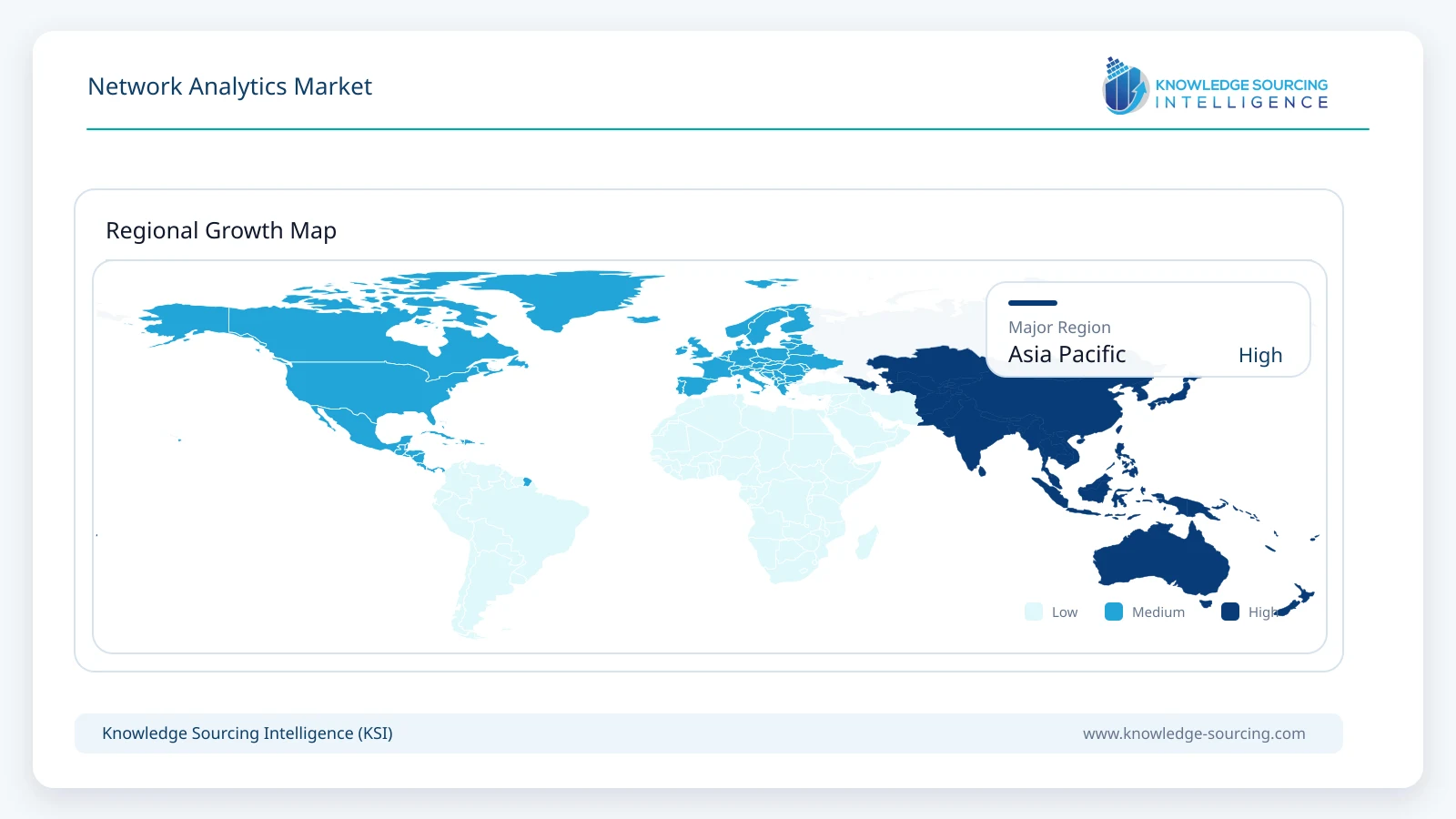
Asia Pacific is expected to remain a major demand center because of large telecom subscriber bases, extensive broadband deployment, cloud infrastructure investment, and continuing network modernization.
China has a large domestic telecommunications ecosystem and strong investment in intelligent network infrastructure. Huawei's 2025 AI WAN and AI-centric network initiatives demonstrate the degree to which network intelligence is being integrated into carrier infrastructure strategies.
India offers demand from telecom providers, data centers, digital services, government networks, and enterprises. TRAI's quality-of-service framework requires service providers to monitor and report performance against defined benchmarks, creating a regulatory rationale for network measurement and analytics. In September 2025, TRAI directed service providers to publish performance against QoS benchmarks, while further QoS-related consultation activity continued in 2026.
Japan and South Korea have sophisticated telecom markets with high requirements for reliability, automation, and network performance. Indonesia and Thailand provide opportunities linked to expanding connectivity, cloud adoption, and managed network services.
The principal constraint across parts of the region is uneven enterprise spending capacity. However, telecom operators and large digital-service providers can sustain sophisticated analytics investment because network availability directly affects customer experience and service economics.
Middle East and Africa
The Middle East is developing demand through telecom modernization, cloud infrastructure, smart-city programs, enterprise connectivity, and data-center investment. Saudi Arabia and the UAE are particularly relevant because large-scale digital infrastructure programs require continuous monitoring and service assurance.
Network analytics can support these projects by providing centralized performance information across geographically distributed infrastructure. Cloud and managed service models can also reduce the requirement for organizations to build large internal network operations teams.
Africa presents a more heterogeneous market. Telecom operators remain the principal buyers, while managed service providers can help smaller enterprises access network analytics without major internal investment. Budget limitations, infrastructure diversity, and skills availability remain constraints.
South America
South America offers demand from telecom operators, cloud service providers, financial institutions, large enterprises, and managed service providers. Brazil represents the largest opportunity in the supplied regional structure because of its scale, diversified enterprise base, and substantial telecommunications infrastructure.
Argentina also provides demand through telecommunications and enterprise digital infrastructure, although economic volatility can affect technology investment cycles. Other South American markets are more dependent on operator-led deployments and managed services.
The commercial opportunity is strongest where network analytics can be bundled with monitoring and operational services. Subscription-based and managed models can lower upfront investment requirements for customers with constrained capital budgets.
Competitive Landscape
The Network Analytics Market has a broad competitive structure spanning networking vendors, telecom equipment suppliers, enterprise technology companies, analytics specialists, and professional service providers. The supplied competitive set includes Accenture, Cisco Systems, Inc., Hewlett Packard Enterprise, IBM Corporation, Juniper Networks, Inc., TIBCO Software Inc., Ericsson, Huawei Technologies Co., Ltd., SAS Institute, Inc., and Nokia.
Competition increasingly occurs around platform breadth rather than a single analytics feature. Networking suppliers can differentiate through direct access to infrastructure telemetry, while enterprise technology companies can compete through integration with cloud, data, AI, security, and IT service-management environments.
Cisco's combination of networking, Splunk observability, and ThousandEyes illustrates an integrated approach in which network telemetry is connected with application and infrastructure data. Its 2025 product activity also emphasized AI-supported incident analysis and OpenTelemetry integration.
Telecom-focused vendors such as Ericsson, Nokia, and Huawei compete through network-specific intelligence, assurance, automation, and AI-based operational capabilities. Ericsson's autonomous-network initiatives and Nokia's AI-RAN strategy demonstrate how analytics is becoming connected to network architecture and operational automation.
Nokia's October 2025 strategic partnership with NVIDIA also illustrates the importance of ecosystem positioning. The companies announced collaboration around AI-RAN, while NVIDIA committed a USD 1 billion investment in Nokia. The initiative also included cooperation around data-center networking and AI infrastructure.
Accenture and other services-oriented suppliers can compete through implementation, integration, managed operations, and transformation programs rather than proprietary network infrastructure. IBM, HPE, SAS, and TIBCO can differentiate through analytics, enterprise software, data management, automation, and integration capabilities.
The resulting competition is multidimensional. Vendors must demonstrate technical interoperability, analytical accuracy, AI capabilities, deployment flexibility, cybersecurity, service expertise, and ecosystem reach. Partnerships with cloud providers, network operators, hardware manufacturers, and software vendors are becoming commercially relevant because customers increasingly expect end-to-end operational workflows.
Recent Developments
August 2026: Ericsson and Mobily signed an MoU to advance AI-driven network operations, optimization, self-healing and energy management, supporting Mobily’s progression toward Level 4 autonomous networks.
July 2026: Ericsson and LG Uplus agreed to develop network-based voice AI and AI-native network capabilities, including AI-driven automation for network performance, energy efficiency and operational agility.
March 2026: Google Cloud and Nokia integrated Network as Code with Google’s agentic AI stack, enabling AI agents to observe, program and optimize telecommunications networks using real-time network conditions.
March 2026: Nokia announced further AI-RAN progress with NVIDIA, including successful functional tests involving T-Mobile, Indosat, and SoftBank and additional operator ecosystem participation. Commercial relevance: The development links network intelligence with GPU-based infrastructure and supports demand for analytics across AI-native wireless networks.
September 2025: Cisco introduced agentic AI capabilities across Splunk Observability, including AI troubleshooting agents, automated event correlation, and incident summarization. Commercial relevance: The release increases competitive pressure on network analytics suppliers to connect telemetry analysis with automated incident investigation and remediation workflows.
Regulatory and Policy Environment
Regulation is becoming an important commercial factor because network analytics increasingly supports operational resilience, cybersecurity, service-quality reporting, and incident management.
In Europe, NIS2 establishes cybersecurity risk-management and reporting obligations for a broader group of critical entities. Digital infrastructure covered by the framework includes cloud computing providers, data centers, public electronic communications networks, and managed service providers.
ENISA's June 2025 technical guidance provides practical implementation support for organizations subject to NIS2 requirements, including digital infrastructure and managed service providers.
Incident reporting is especially relevant to network analytics because organizations need accurate information about network and information-system events. ENISA notes that NIS2 incident processes include early warnings within 24 hours and more complete notifications within 72 hours for qualifying incidents.
India also provides a clear example of regulation influencing network measurement. TRAI's Standards of Quality of Service regulations cover access and broadband services, while its 2025 direction required service providers to publish performance against specified QoS benchmarks.
The regulatory effect is not limited to cybersecurity. Telecommunications authorities increasingly require providers to demonstrate service quality, coverage, performance, and consumer protection. These requirements create recurring demand for accurate telemetry, analytics, reporting, and auditability.
Data protection rules also influence deployment architecture. Where network telemetry contains personal or commercially sensitive information, buyers must consider access controls, data minimization, retention, processing location, and cross-border transfers. Consequently, cloud analytics suppliers need strong governance controls, while hybrid and on-premise options remain relevant for sensitive environments.
Outlook and Strategic Implications
The Network Analytics Market is expected to become more closely integrated with network observability, AIOps, cybersecurity, cloud management, and autonomous network operations during 2026–2031. The primary change will be in the role of analytics. Buyers will increasingly expect systems to interpret network conditions and recommend or execute operational responses rather than simply display performance information.
Investment priorities are likely to center on telemetry infrastructure, AI-based analytics engines, data correlation, automation, and integration capabilities. Service providers will continue investing where analytics can reduce operational workload or improve network utilization. Enterprises will favor projects tied to measurable application availability, user experience, resilience, and security outcomes.
Procurement trends will favor flexible commercial models. Cloud subscriptions can reduce infrastructure-management requirements, while hybrid architectures will remain necessary for organizations with strict data or latency requirements. Managed services should gain relevance among SMEs and enterprises that lack specialized network analytics personnel.
Technology direction will move toward predictive and intent-based operations. Ericsson's Level 4 autonomy work and Nokia's AI-RAN developments indicate that network intelligence is moving closer to automated operational decision-making.
The importance of open telemetry should also increase. Customers will resist analytics platforms that require proprietary data pipelines or extensive infrastructure replacement. Open standards can lower integration costs and allow enterprises to combine products from different suppliers.
Competitive evolution will favor vendors that can connect network analytics to adjacent operational systems. Networking companies can extend upward into application observability and security, while enterprise software suppliers can extend downward into network telemetry and assurance. Professional service providers can compete by integrating these platforms into customer-specific operating models.
The principal risks include high telemetry costs, data-governance restrictions, insufficient internal skills, fragmented infrastructure, inaccurate AI recommendations, and lengthy integration projects. AI adoption also introduces governance concerns because automated network changes can create operational consequences if models misinterpret conditions.
Strategically, buyers should prioritize platforms with measurable operational outcomes, broad interoperability, strong data controls, and human oversight for high-impact automated actions. Suppliers should demonstrate value through reduced alert volumes, faster incident resolution, improved capacity utilization, and better service-level performance.
The strongest opportunities are likely to emerge where network analytics becomes an operational control layer rather than a standalone reporting product. Telecom operators can apply it to autonomous assurance and resource optimization. Cloud providers can use it to correlate infrastructure and workload performance. Managed service providers can package analytics into recurring operational contracts. Large enterprises can apply it across hybrid infrastructure and application environments.
Over the five-year outlook, the market's commercial direction will therefore be determined less by the quantity of network data available and more by how effectively suppliers convert that data into operational decisions. Vendors that combine reliable telemetry, cross-domain correlation, AI-assisted analysis, automation, governance, and flexible deployment should be better positioned to capture enterprise and service-provider spending.
Network Analytics Market Scope:
| Report Metric | Details |
|---|---|
| Total Market Size in 2026 | USD 3.95 billion |
| Total Market Size in 2031 | USD 11.48 billion |
| Forecast Unit | Billion |
| Growth Rate | 23.8% |
| Study Period | 2021 to 2031 |
| Historical Data | 2021 to 2024 |
| Base Year | 2025 |
| Forecast Period | 2026 – 2031 |
| Segmentation | Component, Deployment Model, Enterprise Size, Application, End-User, Geography |
| Companies |
|
Market Segmentation
By Component
By Deployment Model
By Enterprise Size
By Application
By End-user
By Geography
Table of Contents
1. EXECUTIVE SUMMARY
2. MARKET SNAPSHOT
2.1. Market Overview
2.2. Market Definition
2.3. Scope of the Study
2.4. Market Segmentation
3. BUSINESS LANDSCAPE
3.1. Market Drivers
3.2. Market Restraints
3.3. Market Opportunities
3.4. Porter’s Five Forces Analysis
3.5. Industry Value Chain Analysis
3.6. Regulatory and Policy Environment
3.7. Strategic Recommendations
4. TECHNOLOGICAL OUTLOOK
5. NETWORK ANALYTICS MARKET BY COMPONENT
5.1. Introduction
5.2. Network Intelligence Solutions
5.3. Services
5.3.1. Professional Services
5.3.2. Managed Services
6. NETWORK ANALYTICS MARKET BY DEPLOYMENT MODEL
6.1. Introduction
6.2. On-Premise
6.3. Cloud
6.4. Hybrid
7. NETWORK ANALYTICS MARKET BY ENTERPRISE SIZE
7.1. Introduction
7.2. Large Enterprises
7.3. Small and Medium-Sized Enterprises
8. NETWORK ANALYTICS MARKET BY APPLICATION
8.1. Introduction
8.2. Customer Analysis
8.3. Risk Management
8.4. Fault Detection
8.5. Network Performance Management
8.6. Compliance Management
8.7. Quality Management
8.8. Others
9. NETWORK ANALYTICS MARKET BY END-USER
9.1. Introduction
9.2. Cloud Service Providers
9.3. Managed Service Providers
9.4. Telecom Providers
9.5. Others
10. NETWORK ANALYTICS MARKET BY GEOGRAPHY
10.1. Introduction
10.2. North America
10.2.1. USA
10.2.2. Canada
10.2.3. Mexico
10.3. South America
10.3.1. Brazil
10.3.2. Argentina
10.3.3. Others
10.4. Europe
10.4.1. Germany
10.4.2. France
10.4.3. United Kingdom
10.4.4. Spain
10.4.5. Others
10.5. Middle East and Africa
10.5.1. Saudi Arabia
10.5.2. UAE
10.5.3. Others
10.6. Asia Pacific
10.6.1. China
10.6.2. India
10.6.3. Japan
10.6.4. South Korea
10.6.5. Indonesia
10.6.6. Thailand
10.6.7. Others
11. COMPETITIVE ENVIRONMENT AND ANALYSIS
11.1. Major Players and Strategy Analysis
11.2. Market Share Analysis
11.3. Mergers, Acquisitions, Agreements, and Collaborations
11.4. Competitive Dashboard
12. COMPANY PROFILES
12.1. Accenture
12.2. Cisco Systems, Inc.
12.3. Hewlett Packard Enterprise
12.4. IBM Corporation
12.5. Juniper Networks, Inc.
12.6. TIBCO Software Inc.
12.7. Ericsson
12.8. Huawei Technologies Co., Ltd.
12.9. SAS Institute, Inc.
12.10. Nokia
13. APPENDIX
13.1. Currency
13.2. Assumptions
13.3. Base Year and Forecast Years
13.4. Key Benefits for Stakeholders
13.5. Research Methodology
13.6. Abbreviations
LIST OF FIGURES
LIST OF TABLES
Navigate
Trusted by the world's leading organizations