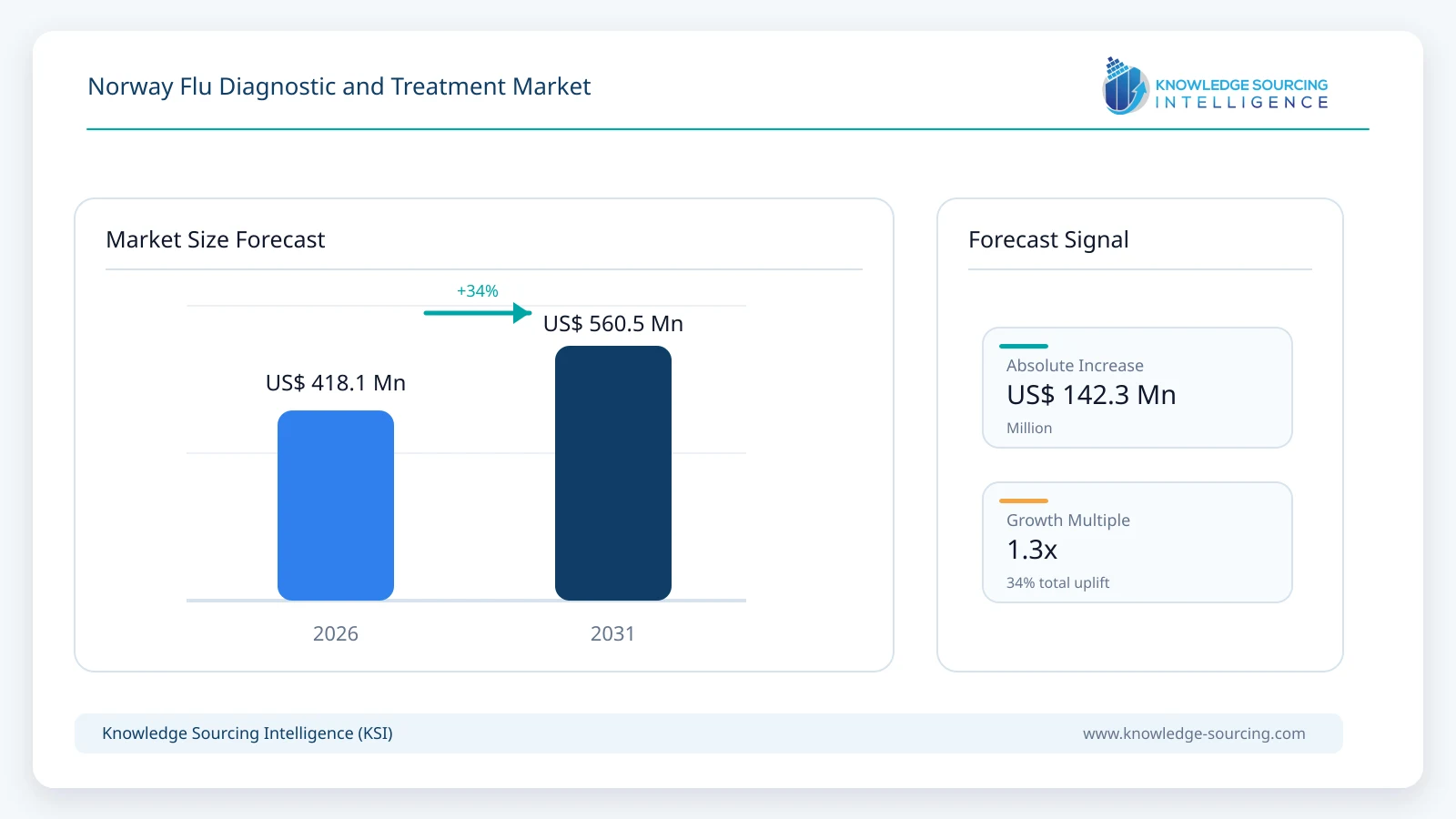
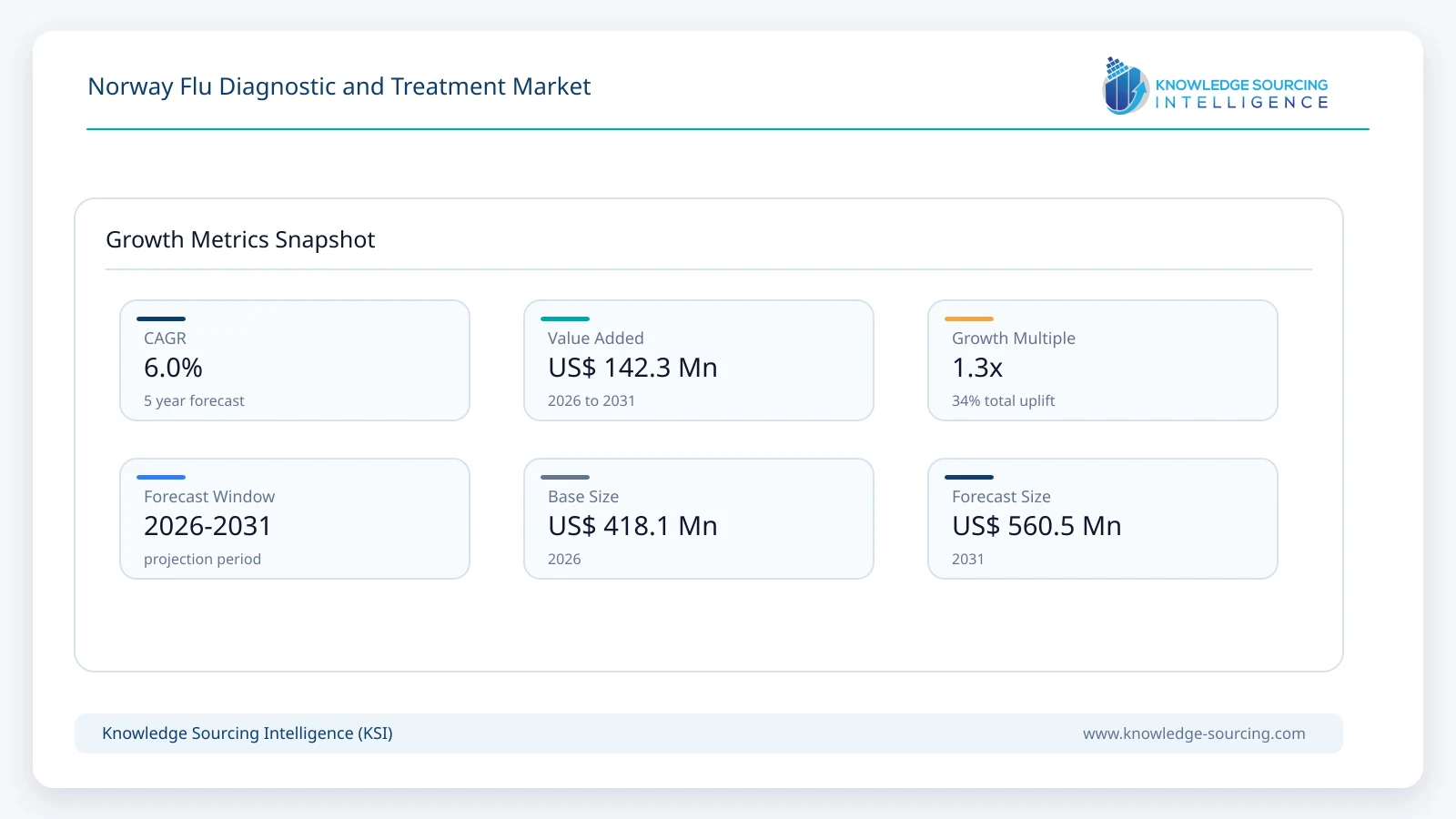
The Norway flu diagnostic and treatment market is estimated at USD 418.15 million in 2026 and is forecast to reach USD 560.46 million in 2031, representing an implied CAGR of approximately 6.0% over the forecast period.
Highlights:
- 1Molecular NAAT/PCR and multiplex respiratory assays account for approximately 78% of 2026 market revenue.
- 2Diagnostics represent more than 99% of the defined market; prescription antiviral treatment is very small in Norway.
- 3Norwegian laboratories tested more than 520,000 patients for influenza in the 2024/25 season, providing a direct volume anchor for market sizing.
- 4The 2025/26 season was severe, with more than 170,000 patients tested by early February 2026 and high hospitalization and mortality burden.
- 5Influenza A dominates detected infections in most recent Norwegian seasons, but assay revenue is not segmented by virus type because the same tests generally detect A and B simultaneously.
- 6Revenue is segmented by diagnostic technology, offering and care setting because these dimensions better reflect how suppliers generate revenue than patient age or virus type.
Norway Flu Diagnostic and Treatment Market Trends
Multiplex molecular testing is changing the economics of influenza diagnosis. Rather than ordering a stand-alone influenza test, hospitals increasingly use respiratory panels that simultaneously detect influenza A/B, RSV, SARS-CoV-2 and other pathogens. bioMérieux BIOFIRE, QIAGEN QIAstat-Dx and other syndromic platforms illustrate this shift. The result is higher supplier revenue per tested patient, but influenza captures only a portion of the panel value. The market model therefore allocates only the influenza-relevant share of multiplex panel revenue rather than counting the full respiratory-panel market.
Near-patient molecular testing is also gaining importance because antiviral treatment is most useful early in the illness course and because rapid differentiation between influenza, RSV and COVID-19 can influence isolation, bed management and antibiotic stewardship. Cepheid Xpert Xpress Flu/RSV and similar rapid molecular systems reduce turnaround time compared with batched central-laboratory testing. In Norway, broad public laboratory access and strong hospital microbiology infrastructure mean point-of-care molecular testing complements rather than replaces central laboratories.
Norway’s treatment market remains structurally constrained. FHI reports that oseltamivir is currently the only influenza antiviral on the Norwegian market, and 2024 use involved only 1,371 patients. This prevents treatment revenue from scaling in line with influenza case counts. The market therefore behaves very differently from countries where multiple branded antivirals, large retail self-pay markets or widespread empiric prescribing create substantial drug revenue.
Vaccination materially influences diagnostic and treatment demand but is excluded from market revenue in this report. Norway launched its adult vaccination programme in autumn 2025, and influenza vaccination coverage among people aged 65 and older reached 69% in the 2025/26 season. Higher vaccination can reduce severe disease in target groups, while severe seasons can simultaneously increase testing. The net effect is therefore more complex than assuming vaccination simply reduces the diagnostic market.
Norway Flu Diagnostic and Treatment Market Segment Analysis
By Offering
Diagnostics
Diagnostics are estimated at approximately USD 21.7 million in 2026, representing more than 99% of the defined market. This high share is supported directly by national testing volumes exceeding several hundred thousand patients per season and by the very small number of oseltamivir users. The diagnostics segment includes influenza-specific and influenza-containing assays, test consumables, the influenza-attributable portion of multiplex respiratory panels, and allocated analyzer/service revenue.
Treatment is estimated at less than USD 0.2 million at supplier/pharmacy level in a typical year under the narrow prescription-antiviral definition. Because FHI reports oseltamivir as the only currently available influenza antiviral in Norway, this segment is not split into multiple drug classes. Seasonal vaccine sales are deliberately excluded from treatment to avoid combining prophylaxis with therapy.
By Diagnostic Technology
Molecular NAAT/PCR and Multiplex Panels
Molecular NAAT/PCR and multiplex respiratory assays are estimated at approximately USD 17.0 million in 2026, or about 78% of total market revenue. The share is higher in value than in test count because molecular assays and syndromic panels command substantially higher consumable value than rapid antigen tests. FHI surveillance is built on laboratory-confirmed influenza, and Norway’s hospital and medical microbiology network relies heavily on molecular confirmation for respiratory pathogens.
Rapid antigen testing is estimated at approximately USD 2.6 million, while other laboratory, reference and surveillance testing contributes about USD 2.1 million. Rapid antigen tests remain useful where low cost and immediate results are prioritized, but lower sensitivity and the availability of rapid molecular platforms limit their value share. Sequencing and specialized reference-laboratory characterization are important for public health but represent a small commercial revenue pool.
By Care Setting
Hospitals and Medical Microbiology Laboratories
Hospitals and medical microbiology laboratories are estimated at approximately USD 14.4 million in 2026, about 66% of market revenue. Hospitalized and high-risk patients are more likely to receive molecular respiratory testing, and FHI reported more than 10,000 influenza-positive hospitalized-patient samples during the 2024/25 season. The concentration of severe cases in older adults and young children reinforces hospital laboratory demand during peak weeks.
Primary care, outpatient and near-patient settings account for approximately USD 5.2 million, while reference and surveillance laboratories account for around USD 2.2 million. Near-patient testing is the faster-growing care-setting segment because rapid multiplex systems can deliver results during the clinical encounter, but the established central-laboratory network remains the largest value pool through 2031.
Market Drivers
High seasonal testing volumes are the clearest market driver. Norway tested more than 520,000 patients during the 2024/25 season and more than 170,000 by early February in the 2025/26 season. Even after normalizing for exceptional respiratory-pathogen demand, influenza remains one of the country’s highest-volume seasonal molecular diagnostic categories.
Severe seasons increase testing intensity and hospital use. The 2024/25 season produced 10,657 influenza-positive hospitalized-patient samples, 278 intensive-care admissions and 375 influenza-associated deaths over the reported periods. The 2025/26 season also showed high severity. These events drive demand for rapid differentiation of influenza from RSV, COVID-19 and bacterial respiratory disease.
The shift toward syndromic respiratory panels raises market value per tested patient. A single multiplex assay can cover influenza A/B alongside multiple other pathogens, which increases consumable revenue and supports analyzer placements in hospitals and emergency-care settings.
Market Restraints
The treatment segment is constrained by very low antiviral utilization. FHI reports only 1,371 individuals with an oseltamivir prescription in 2024 and no other registered influenza antiviral currently in use. Unless prescribing practice changes materially, treatment revenue cannot become a major share of this market.
Testing volume is highly seasonal and can be distorted by co-circulating respiratory pathogens. FHI specifically attributed part of the exceptionally high 2024/25 testing volume to a Mycoplasma pneumoniae outbreak. Forecasts that simply extend that season’s 520,000-plus tests would therefore overstate a normalized market.
Public procurement and centralized laboratory systems constrain pricing. Norway’s healthcare system has significant purchasing power, while diagnostic platforms compete within hospital and regional procurement frameworks. Volume can grow faster than revenue when laboratories negotiate lower reagent prices or consolidate assays onto high-throughput platforms.
Competitive Environment
The Norwegian influenza diagnostics market is characterized by large international diagnostics suppliers rather than domestic test manufacturers. The relevant competitive set includes companies with current influenza A/B molecular, multiplex or rapid-test portfolios that can serve European and Nordic laboratories. Roche also participates on the treatment side through marketed Tamiflu in Norway.
Roche is uniquely positioned across both diagnostics and therapeutics: Roche Diagnostics supplies molecular respiratory-testing systems globally, while the Norwegian medicines database lists Roche Registration GmbH as the marketing-authorization holder for Tamiflu. Cepheid, bioMérieux and QIAGEN compete strongly in rapid or syndromic molecular testing; Abbott and QuidelOrtho are important in rapid testing; Hologic, BD, DiaSorin and Thermo Fisher participate through molecular or respiratory assay platforms.
Company inclusion in this report is based on current influenza diagnostic or treatment capability relevant to the Norwegian market. It does not imply a quantified Norway market share. Procurement awards and installed-base data are not consistently public, so the competitive section avoids unsupported share claims.
Recent Developments
September 2026: FHI reported that Norway’s adult vaccination programme achieved 69% influenza vaccination coverage among people aged 65 and older in the 2025/26 season, the highest level recorded to date. Vaccines are outside this report’s revenue scope but materially influence the population at risk and seasonal disease severity.
February 2026: FHI reported more than 170,000 influenza tests since week 35/2025, 20,798 laboratory-confirmed influenza A infections and only 125 influenza B detections. The season had already produced 194 intensive-care admissions and 270 influenza-associated deaths by the reporting cut-off.
October 2025: FHI’s annual antiviral-resistance report confirmed that oseltamivir remained the only influenza antiviral available in Norway and documented 1,371 individuals receiving at least one oseltamivir prescription in 2024. Resistance remained rare in the 2024/25 season.
2025-2026: Rapid multiplex respiratory platforms from bioMérieux, QIAGEN, Cepheid and other suppliers continue to expand the menu of influenza-containing molecular tests, reinforcing the shift from stand-alone flu assays toward broader respiratory syndromic testing.
Market Outlook
The Norway flu diagnostic and treatment market is expected to reach approximately USD 29.4 million in 2031. The forecast assumes no structural change that would suddenly expand antiviral prescribing. Most growth therefore comes from diagnostics, especially higher-value molecular and multiplex assays and near-patient systems. Influenza-season severity creates year-to-year volatility, so the forecast should be interpreted as a normalized revenue path rather than a prediction of case counts in any single winter.
Molecular diagnostics should continue to gain value share because Norwegian clinicians and laboratories increasingly need simultaneous differentiation of influenza, RSV, SARS-CoV-2 and other respiratory pathogens. Rapid antigen tests remain relevant for low-cost screening, but their lower sensitivity limits use in high-risk or hospitalized populations when molecular capacity is available.
The major forecast risk is that respiratory testing volumes normalize more sharply after the unusually high 2024/25 season. Conversely, another severe influenza season, increased near-patient molecular adoption, or broader use of multiplex panels could push revenue above the base case. Because supplier pricing and regional procurement are not fully public, the estimates are presented as a triangulated market model rather than audited sales data.
Norway Flu Diagnostic and Treatment Market Scope:
| Report Metric | Details |
|---|---|
| Total Market Size in 2026 | USD 418.15 million |
| Total Market Size in 2031 | 560.46 million |
| Forecast Unit | Million |
| Growth Rate | 6.0% |
| Study Period | 2021 to 2031 |
| Historical Data | 2021 to 2024 |
| Base Year | 2025 |
| Forecast Period | 2026 – 2031 |
| Segmentation | Offering, Technology, Care Setting |
| Companies |
|
Market Segmentation
By Offering
Diagnostics
Prescription Antiviral Treatment
By Technology
Molecular NAAT / RT-PCR
Multiplex Respiratory Panels
Rapid Molecular Point-of-Care Tests
Rapid Antigen Tests
Reference, Sequencing and Other Tests
By Care Setting
Hospitals and Medical Microbiology Laboratories
Primary Care and Outpatient / Near-Patient Testing
Reference and Surveillance Laboratories
Table of Contents
1. INTRODUCTION
1.1. Market Overview
1.2. Market Definition
1.3. Scope of the Study
1.4. Market Segmentation
1.5. Currency
1.6. Assumptions
1.7. Base and Forecast Years Timeline
2. RESEARCH METHODOLOGY
2.1. Research Design
2.2. Norwegian Surveillance and Utilization Data
2.3. Supplier and Product Validation
2.4. Market Estimation and Forecasting
2.5. Data Triangulation and Quality Control
3. EXECUTIVE SUMMARY
3.1. Key Findings
3.2. Norway Market Size, 2026-2031
3.3. Segment Summary
4. MARKET DYNAMICS
4.1. Market Drivers
4.1.1. Seasonal Influenza Testing Volume
4.1.2. Hospital and Severe-Disease Burden
4.1.3. Multiplex Respiratory Testing Adoption
4.1.4. Faster Near-Patient Molecular Diagnostics
4.2. Market Restraints
4.2.1. Low Antiviral Utilization
4.2.2. Seasonal and Epidemic Volatility
4.2.3. Public Procurement and Price Pressure
5. NORWAY FLU DIAGNOSTIC AND TREATMENT MARKET BY OFFERING
5.1. Diagnostics
5.2. Prescription Antiviral Treatment
6. NORWAY FLU DIAGNOSTIC MARKET BY TECHNOLOGY
6.1. Molecular NAAT / RT-PCR
6.2. Multiplex Respiratory Panels
6.3. Rapid Molecular Point-of-Care Tests
6.4. Rapid Antigen Tests
6.5. Reference, Sequencing and Other Tests
7. NORWAY FLU DIAGNOSTIC MARKET BY CARE SETTING
7.1. Hospitals and Medical Microbiology Laboratories
7.2. Primary Care and Outpatient / Near-Patient Testing
7.3. Reference and Surveillance Laboratories
8. COMPETITIVE ENVIRONMENT AND ANALYSIS
8.1. Diagnostic Platform Competition
8.2. Molecular and Multiplex Portfolio Positioning
8.3. Point-of-Care Testing
8.4. Antiviral Treatment Landscape
8.5. Recent Developments
8.6. Competitive Dashboard
9. COMPANY PROFILES
9.1. F. Hoffmann-La Roche Ltd. / Roche Norge AS
9.2. Abbott Laboratories
9.3. Cepheid / Danaher Corporation
9.4. bioMérieux SA
9.5. QIAGEN N.V.
9.6. Hologic, Inc.
9.7. QuidelOrtho Corporation
9.8. Becton, Dickinson and Company
9.9. DiaSorin S.p.A.
9.10. Thermo Fisher Scientific Inc.
10. APPENDIX
10.1. Currency
10.2. Assumptions
10.3. Base and Forecast Years Timeline
10.4. Abbreviations
Navigate
Trusted by the world's leading organizations