
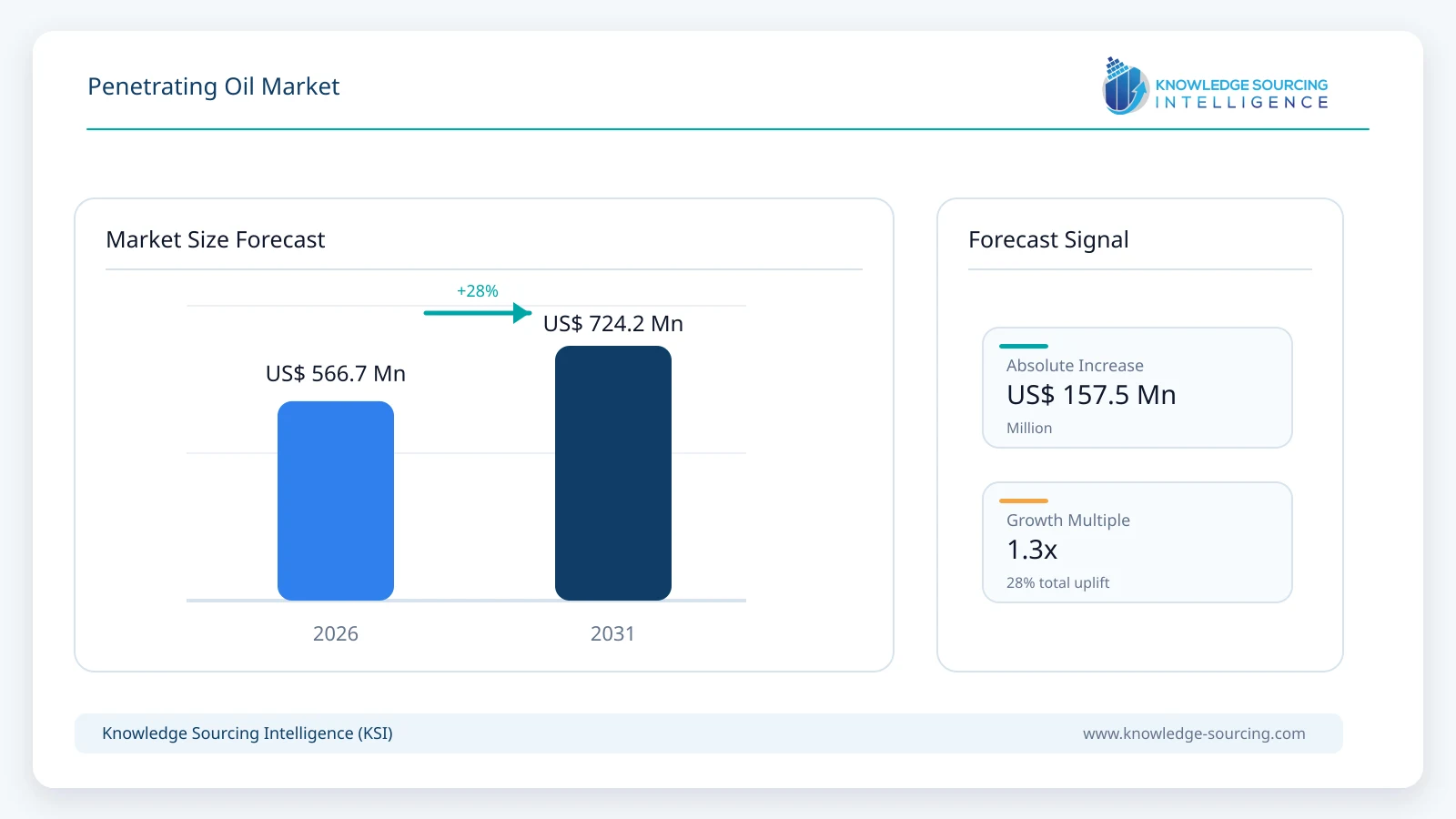
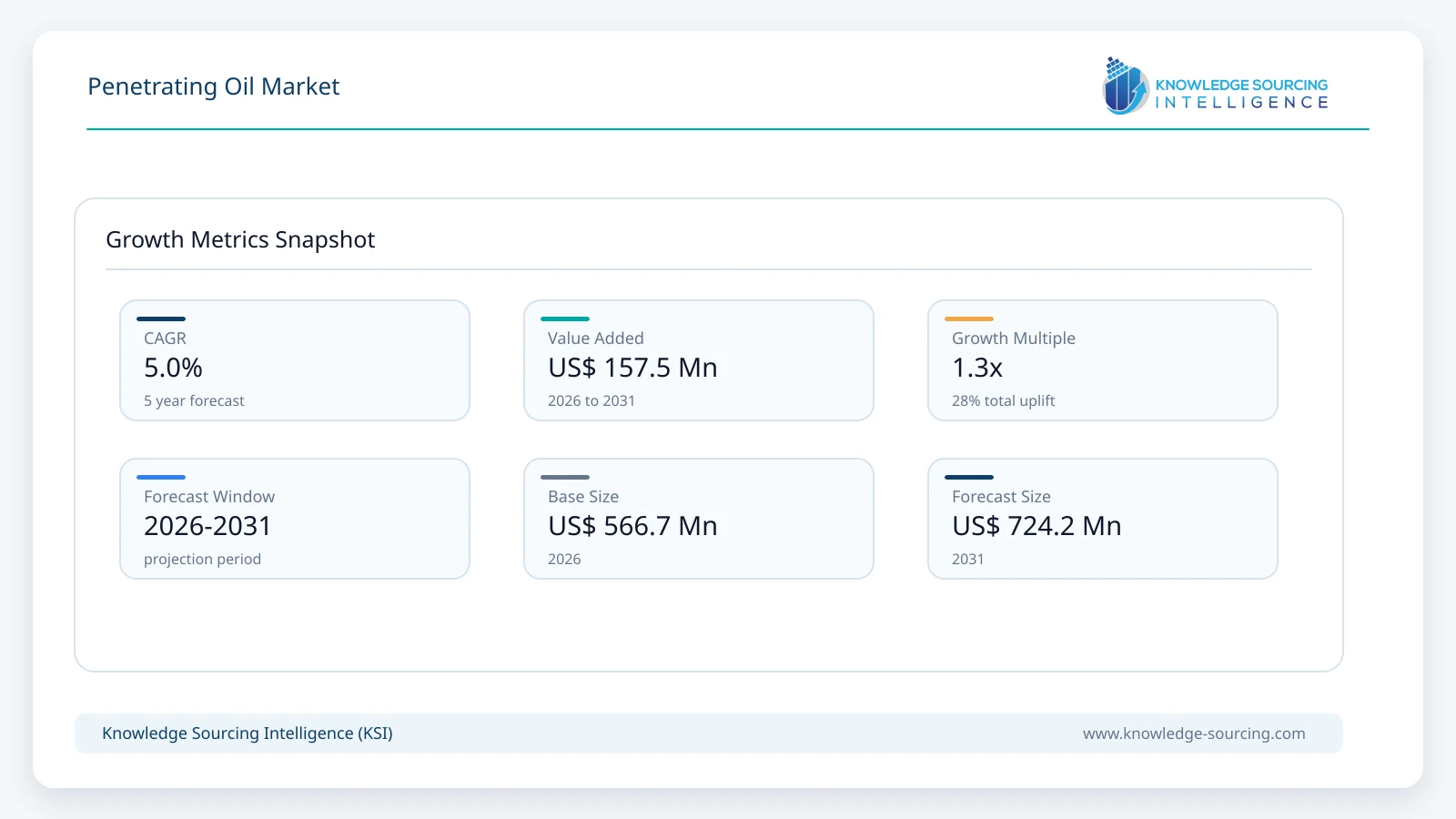
The Penetrating Oil market is set to reach USD 724.21 million in 2031, growing at a CAGR of 5.0% between 2026 and 2031, from USD 566.74 million in 2026.
Highlights:
- 1Growing preference for bio-based and biodegradable formulations supports safer industrial and household maintenance while meeting stricter environmental and workplace safety standards.
- 2Advanced solvent and nano-additive technologies improve capillary action, enabling faster penetration into rusted threads and seized mechanical assemblies across demanding applications.
- 3Multi-functional performance expands adoption in automotive repair, industrial maintenance, and food-processing environments by combining rust dissolution, lubrication, and corrosion protection.
- 4Specialized delivery systems, including precision aerosols and food-grade certified variants, enhance usability and regulatory compliance for professional technicians and everyday users.
Market Overview
The penetrating oil market is being shaped by environmental regulations that govern how these products can be formulated and sold, together with steady investment by major suppliers racing to launch greener, higher-performance formulations. Companies including WD-40 Company, CRC Industries, LPS Laboratories (ITW Pro Brands), Kano Laboratories, and B'laster/Illinois Tool Works are all rolling out new products within months of each other, while U.S. and state regulators are also reshaping how much VOC content these formulations are allowed to contain.
Penetrating oils fall under California Air Resources Board's (CARB) "Multi-purpose Lubricant" consumer product category, which since 1989 has been regulated under the California Clean Air Act. Under the current standards, multi-purpose lubricant products must not exceed a reactivity limit of 0.45 grams of ozone per gram of product when complying with CARB's alternate compliance option. This requirement is in addition to the base VOC content limit for the category.
CARB backs this up with enforcement. For instance, the agency has fined major retailers a combined $325,270 over two years for selling household products, including multipurpose lubricants, that exceeded California's VOC limits, a reminder to suppliers and retailers alike that formulation compliance isn't optional in the state.
At the federal level, the EPA regulates VOCs in aerosol consumer products under 40 CFR Part 59, and has been actively revising related aerosol standards. Most recently, it pushed the compliance deadline for amended aerosol emission standards from July 2025 to January 2027 in response to industry requests for more time.
In response to this regulatory backdrop, suppliers have been building compliance and specialization directly into their products. WD-40 Company's own product pages show its Specialist Penetrant line is marketed as 50-state VOC-compliant and safe to use on metal, rubber, and plastic parts, a direct answer to the patchwork of state-level VOC rules that CARB's framework has influenced nationally.
WD-40 has also pushed into food-safety compliance niches. Its Specialist Food-Grade Lubricant & Penetrant is NSF Nonfood Compounds Program Listed H1, making it suitable for use in and around food-processing equipment. The company notes it continues to perform at temperature extremes between -100°F and 400°F.
CRC Industries has matched that positioning with its own food-grade line, describing its Food Grade Penetrating Oil as one that is NSF H1 registered for incidental food contact. This product meets the standards set by USDA, NSF, and FDA. Additionally, the company provides other products like Knock'er Loose, a penetrating solvent, and Power Lube, a multi-purpose lubricant designed for rust removal and corrosion protection.
Overall, the pattern across regulators and suppliers points in the same direction. Government VOC rules, primarily driven by CARB and mirrored federally by the EPA, are steadily tightening what can go into a can of penetrating oil. In response, suppliers are competing on compliance credentials (50-state VOC compliance, NSF food-grade listings) and specialized formulations rather than on solvency alone.
Market Drivers
Increased Industrial Automation
Manufacturing facilities are shifting more of their production lines toward automated and robotic systems that run continuously and rely on conveyors, robotic arms, and precision machinery rather than manual operation. This shift is a direct driver of the penetrating oil market, since every automated line depends on machinery mechanics keeping fasteners, hinges, rollers, and moving parts free of rust and seizure to avoid unplanned downtime.
The U.S. Bureau of Labor Statistics reports that industrial machinery mechanics, machinery maintenance workers, and millwrights held thousands of jobs, and that the continued adoption of automated manufacturing machinery is expected to create jobs for these workers, as they will be needed to help keep machines in good working order.
BLS specifically highlights conveyor systems as a key area for growth in maintenance demand. The increasing use of automated conveyors to transport products and materials in factories is expected to create high demand for these workers. This is because the conveyor belts, motors, and rollers need regular care and maintenance. These components consist of moving metal parts that benefit from penetrating oils and multi-purpose lubricants, which are formulated to keep them free from wear and protected.
Additionally, BLS's occupational data on robotics technicians indicates their daily duties include tasks like performing preventive or corrective maintenance on robotic systems or components. This work often involves repairing robots or related equipment, such as replacement of defective circuit boards, sensors, controllers, encoders, or servomotors. Many of these repairs routinely require freeing corroded fasteners and lubricating moving joints as part of the repair process.
Suppliers have built their industrial product lines directly around this maintenance demand. CRC Industries describes its role plainly on its own site. The company manufactures over 1,300 chemical MRO products for Automotive, Marine, Mining, Oil & Gas, Hardware, Electrical, Industrial, Welding, and other markets.
CRC frames this explicitly as an uptime issue for industrial customers. The company’s broader lubricants and penetrants line offers fast-acting power that cuts through rust, scale, and corrosion to free up equipment, preventing downtime from escalating into a disaster. This language is aimed directly at manufacturers operating continuous automated lines, where even a single seized part can halt production.
Taken together, these trends create a reinforcing cycle for market growth. As manufacturing facilities increasingly deploy automated conveyors, robotic systems, and computer-controlled machinery, the demand for penetrating oils rises in parallel. Regular maintenance of these high-value assets requires penetrating oils to loosen seized fasteners, remove rust, protect metal components from corrosion, and minimize equipment downtime, ensuring the reliability and operational efficiency that automation is designed to achieve.
Supply Chain Analysis
The penetrating oil supply chain is currently transitioning from "commodity distribution" to "specialized brand ecosystems" to manage evolving regulatory landscapes. Producers are successfully enlisting strategic acquisitions, such as Kano’s acquisition of CAIG (2026) and Synco Chemical (2024), to integrate high-margin specialty lubricants into their core portfolios. This evolution is becoming critical as firms like WD-40 Company are reaching a structural outcome where 55% gross margins (achieved a year ahead of schedule in 2025) are currently enabling significant reinvestment into global advertising and sales promotion.
Government Regulations
Regulation/Policy | Region | Impact on Market |
ECHA PFAS Opinion | Europe | Issued March/April 2026; currently enlisting a proposed 12-year derogation for industrial lubricants while flagging high emissions. |
EPA VOC Guidelines | USA | Mandates lower hydrocarbon release; currently forcing over 60% of producers to enlist bio-based or low-solvent reformulations. |
REACH Restrictions | EU | Updates in March 2026 target hazardous substances in construction products, currently forcing a shift in penetrating oil formulations used on-site. |
Major Segmentation Analysis
Automotive
By end-user, the penetrating oil market is segmented into automotive, industrial manufacturing, marine, construction, agriculture, oil & gas, aerospace & defense, power generation, and others. Industrial manufacturing is expected to show constant growth owing to the rapid industrialization and machinery usage.
Ongoing investments in the establishment of production plants have escalated demand for accessories supporting longer machinery usage, which has driven the market’s demand. The automotive segment is projected to grow at a steady rate, driven by rising vehicle production, an expanding global vehicle parc, and increasing demand for maintenance, repair, and overhaul (MRO) activities.
The low viscosity and high capillary action of penetrating oil make it an ideal choice to be used in vehicles for removing rust and corrosion in microscopic gaps, thereby prolonging the performance life of various components.
With improved global automotive production, the demand for specialty lubricants is expected to grow, thereby supporting the market expansion of penetrating oils. According to the International Organization of Motor Vehicle Manufacturers (OICA), in Q1 2026, global automotive production reached 22.36 million units, which, though it showed a marginal decline from the previous year’s comparison, experienced significant growth in production volume from Q1 2021 to Q12024.
Growing demand for fuel-efficient vehicles featuring high-performance components has amplified the market outlook, with global economies like China and the United States investing in new specialty oil chemistries for automotive applications.
Automotive industry standards such as China’s “QC/T 721-2024” define technical requirements for material and component usage, thereby ensuring quality. Likewise, implementation of policies like the EU’s “End-of-Life Vehicles Regulations (ELVR)” has promoted components reuse to regulate vehicles’ lifecycle. Such standards and policies have provided a framework for reducing the use of penetrating oil in vehicles.
Major companies like Kano Laboratories LLC have capitalized on the growing trend of modern vehicles by providing an extensive portfolio under its “Kroil” product line. Additionally, the continued sustainable shift, followed by VOC guidelines, has promoted new penetrant chemistries, which are expected to improve the market outlook.
Regional Analysis
North America: the US
Improved industrial production index of the United States shows its continued investments in manufacturing units, which is projected to support usage of penetrating oils such as anti-corrosive agents and lubricants for industrial machinery.
Growth in the country’s automotive production, with volume reaching 2.552 million units in Q1 2026, represented a 2% growth over Q1 2025, further bolsters the market scope for specialty oils to maintain component durability
Report Metric Details Total Market Size in 2026 USD 566.74 million Total Market Size in 2031 USD 724.21 million Forecast Unit USD Million Growth Rate 5.0% Study Period 2021 to 2031 Historical Data 2021 to 2024 Base Year 2025 Forecast Period 2026 – 2031 Segmentation Type, Application, End-User, Distribution Channel, Geography Companies - Kano Laboratories LLC
- CRC Industries Inc.
- WD-40 Company
- PLZ Corp
- The B'laster Corporation
Being a top naval power globally with an operating fleet of 232 units, the United States invests billions in its naval fleet maintenance. According to the “FY 2027 Budget”, the government was requested to grant USD 65.8 billion for naval ship-building. Such high spending will improve the usage of penetrating oils in the US marine sector.
EPA’s low-emission and VOC policies have provided a framework for the development of advanced and sustainable penetrating oil chemistries in the United States, which is anticipated to support the regional market expansion.
Key companies like Kano Laboratories LLC, WD-40 Company, and B’Laster Corporation have a well-established presence in the US market, which has amplified the market competitiveness. Additionally, the improved private manufacturing output, totalling 403,833 units in Q4 2025, also increases the usage scenario for machine accessories in the USA.
Company Profiles
WD-40 Company focuses its penetrating oil strategy on strengthening its leadership in the global maintenance products category through continuous brand investment, product innovation, and international market expansion. The company positions its WD-40 Specialist portfolio alongside its flagship WD-40 Multi-Use Product to address professional maintenance, industrial, automotive, and MRO (maintenance, repair, and operations) applications that require superior penetration, corrosion protection, and lubrication.
Its strategy emphasizes expanding distribution across hardware retailers, automotive aftermarket channels, industrial distributors, and e-commerce platforms while increasing market penetration in high-growth regions such as Asia-Pacific, Latin America, and EIMEA (Europe, India, Middle East, and Africa).
Recent Developments
July 2026: WD-40 Company launched its WD-40 Specialist Bio Lubricant Multi-Use aerosol spray. Formulated with 85% bio-based ingredients, this sustainable product is the first multi-use formula in its portfolio certified under the EU Ecolabel criteria.
July 2026: Kano Laboratories acquired Triboscience & Engineering to strengthen tribology research, formulation capabilities, and innovation in specialty lubricants. The acquisition supports development of next-generation penetrating oils and expands the company's industrial maintenance solutions portfolio.
B'laster Holdings NASCAR Partnership Renewal (February 2026): B'laster Holdings re-upped with Spire Motorsports for the 2026 Cup Series, currently enlisting high-visibility racing platforms to reinforce its brand status for "performance under tough conditions".
Kano Laboratories Acquired CAIG Laboratories (January 2026): Kano expanded its "Family of Brands" by acquiring CAIG, which is currently enlisting its expertise in electrical cleaners to complement Kano’s Kroil industrial penetrant line.
Penetrating Oil Market Scope:
Market Segmentation
By Type (2021-2031)
By Application (2021-2031)
By End-user (2021-2031)
By Distribution Channel (2021-2031)
By Geography (2021-2031)
Table of Contents
1. EXECUTIVE SUMMARY
2. MARKET SNAPSHOT
2.1. Market Overview
2.2. Market Definition
2.3. Scope of the Study
2.4. Market Segmentation
3. MARKET DYNAMICS
3.1. Market Drivers
3.2. Market Restraints
3.3. Market Opportunities
3.4. Porter’s Five Forces Analysis
3.5. Industry Value Chain Analysis
4. BUSINESS LANDSCAPE
4.1. Regulatory & Standards Landscape
4.2. Raw Material Analysis
4.3. Pricing Analysis
4.4. Import/Export Analysis
4.5. Distribution Channel Landscape
5. TECHNOLOGICAL OUTLOOK
5.1. Advanced Rust-Penetrating Formulations
5.2. Bio-Based & Low-VOC Penetrating Oils
5.3. Multi-Function Lubricant Technologies
5.4. Smart Manufacturing & Production Automation
6. PENETRATING OIL MARKET BY TYPE (2021-2031)
6.1. Introduction
6.2. Petroleum-Based Penetrating Oils
6.3. Synthetic Penetrating Oils
6.4. Bio-Based Penetrating Oils
6.5. Silicone-Based Penetrating Oils
6.6. Others
7. PENETRATING OIL MARKET BY APPLICATION (2021-2031)
7.1. Introduction
7.2. Lubrication
7.3. Rust Loosening
7.4. Corrosion Protection
7.5. Cleaning & Maintenance
7.6. Moisture Displacement
7.7. Others
8. PENETRATING OIL MARKET BY END-USER (2021-2031)
8.1. Introduction
8.2. Automotive
8.3. Industrial Manufacturing
8.4. Marine
8.5. Construction
8.6. Agriculture
8.7. Oil & Gas
8.8. Aerospace & Defense
8.9. Power Generation
8.10. Others
9. PENETRATING OIL MARKET BY DISTRIBUTION CHANNEL (2021-2031)
9.1. Introduction
9.2. OEM
9.3. Industrial Distributors
9.4. Retail Stores
9.5. E-commerce
9.6. Others
10. PENETRATING OIL MARKET BY GEOGRAPHY (2021-2031)
10.1. Introduction
10.2. North America
10.2.1. USA
10.2.2. Canada
10.2.3. Mexico
10.3. South America
10.3.1. Brazil
10.3.2. Argentina
10.3.3. Others
10.4. Europe
10.4.1. United Kingdom
10.4.2. Germany
10.4.3. France
10.4.4. Spain
10.4.5. Others
10.5. Middle East and Africa
10.5.1. Saudi Arabia
10.5.2. UAE
10.5.3. Others
10.6. Asia Pacific
10.6.1. China
10.6.2. India
10.6.3. Japan
10.6.4. South Korea
10.6.5. Australia
10.6.6. Others
11. COMPETITIVE ENVIRONMENT AND ANALYSIS
11.1. Major Players and Strategy Analysis
11.2. Market Share Analysis
11.3. Mergers, Acquisitions, Agreements, and Collaborations
11.4. Competitive Dashboard
12. COMPANY PROFILES
12.1. Kano Laboratories LLC
12.2. CRC Industries, Inc.
12.3. WD-40 Company
12.4. PLZ Corp
12.5. The B'laster Corporation
12.6. Liquid Wrench (Radiator Specialty Company)
12.7. A.W. Chesterton Company
12.8. Liqui Moly GmbH
12.9. OKS Spezialschmierstoffe GmbH
12.10. Rocol (ITW Ltd.)
12.11. Schaeffer Manufacturing Co. (Schaeffer Oil)
12.12. Miller-Stephenson, Inc.
13. RESEARCH METHODOLOGY
14. LIST OF FIGURES
15. LIST OF TABLES
Navigate
Trusted by the world's leading organizations











