
The polar robots market is projected to show steady growth during the forecast period.
Highlights:
- 1Growing factory automation investments are expanding demand for industrial robots that improve productivity and operational consistency.
- 2Material handling remains one of the most commercially important applications due to continuous warehouse and production line automation.
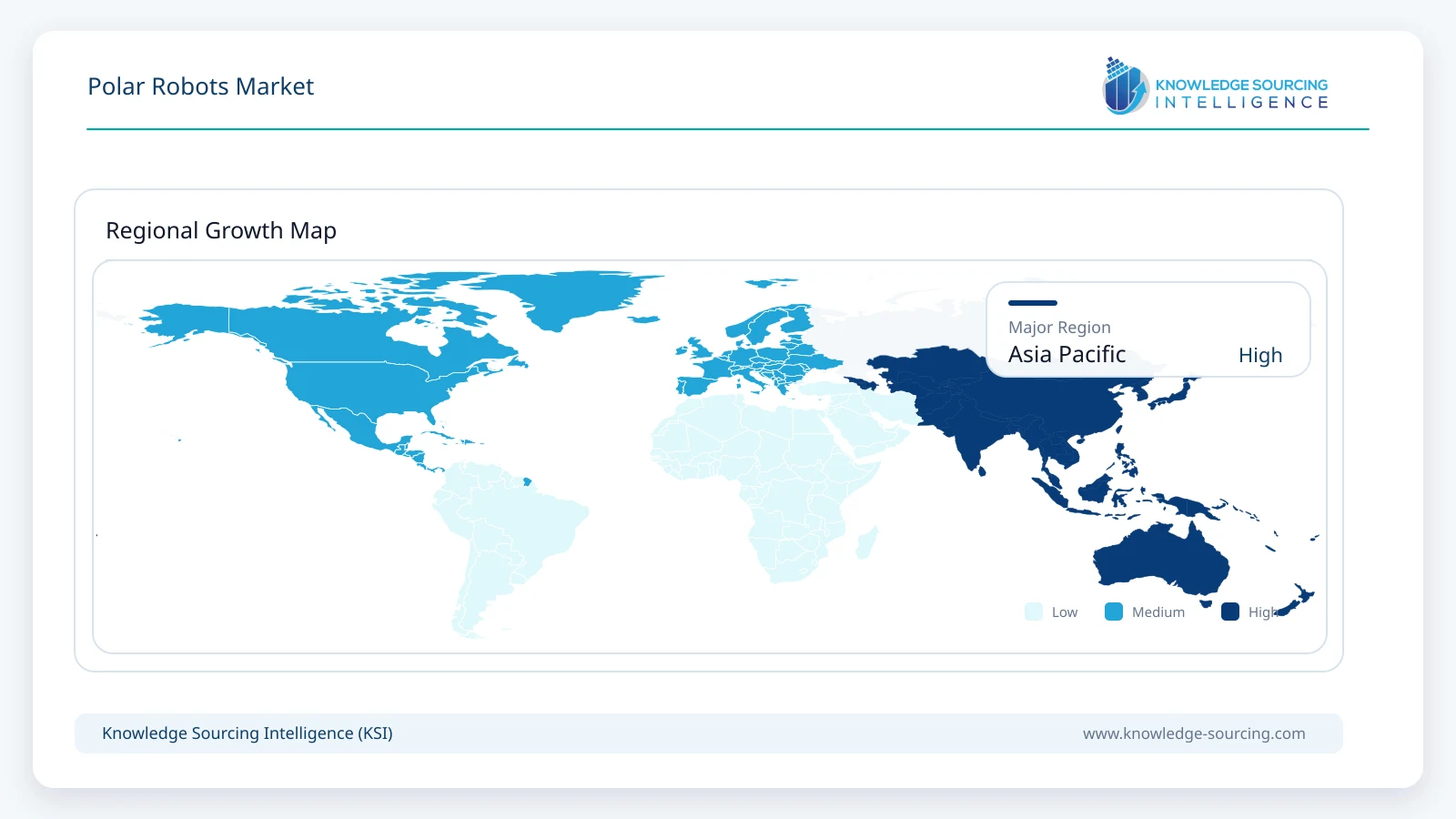
- 3Asia Pacific represents the largest regional opportunity, supported by manufacturing expansion and industrial automation investment.
- 4Advanced robot software, digital simulation, predictive maintenance, and AI-assisted programming are strengthening purchasing decisions.
- 5Industrial safety standards and smart manufacturing initiatives continue encouraging robotics deployment across multiple industries.
- 6Competition increasingly depends on system integration capability, lifecycle service offerings, software ecosystems, and application engineering expertise.
The polar robots market comprises industrial robotic systems built around a polar coordinate configuration, where movement is achieved through rotational and linear axes. This architecture allows robots to operate within spherical work envelopes, making them suitable for applications requiring wide reach, vertical movement, and access to confined workspaces. Although articulated and collaborative robots account for a larger share of industrial automation installations, polar robots continue to serve specialized manufacturing operations where their kinematic advantages improve productivity and process consistency.
Demand is supported by manufacturers seeking automation solutions for repetitive, high-cycle production environments where precision, repeatability, and operational uptime directly influence production economics. Automotive component manufacturers, electronics assemblers, heavy machinery producers, and packaging facilities remain among the primary purchasers. Procurement decisions increasingly consider total cost of ownership, integration capability, software compatibility, predictive maintenance features, lifecycle support, and availability of skilled service partners rather than equipment cost alone.
Industrial labor shortages across developed economies have strengthened the commercial case for robotic automation. Companies continue investing in robotics to stabilize production output, reduce dependence on manual labor, improve workplace safety, and maintain consistent product quality. Buyers also prioritize flexible automation platforms capable of accommodating changing production volumes and product variants without extensive mechanical redesign.
Software has become an increasingly important component of purchasing decisions. Robot programming platforms, digital twin capabilities, simulation software, artificial intelligence-assisted path optimization, and industrial connectivity features now influence procurement alongside hardware specifications. Integration with manufacturing execution systems (MES), enterprise resource planning (ERP), industrial Ethernet networks, and industrial Internet of Things (IIoT) infrastructure has become an important evaluation criterion for manufacturers implementing new production lines.
Supply chain resilience has also become a strategic consideration. Manufacturers increasingly seek suppliers capable of providing localized technical support, spare parts availability, cybersecurity updates, and long-term maintenance services. As industrial facilities modernize production assets to improve equipment utilization and reduce operating costs, polar robots continue to maintain relevance within applications requiring extensive reach, heavy payload handling, and specialized motion profiles.
Market Drivers
Rising Industrial Automation Investments
Manufacturers continue investing in factory automation to improve equipment utilization, reduce production variability, and offset labor shortages. Polar robots provide reliable operation for repetitive manufacturing tasks involving large work envelopes and continuous production cycles. Automotive suppliers, machinery manufacturers, and electronics producers increasingly evaluate automation based on productivity improvements over equipment lifespan rather than initial capital expenditure.
Robot suppliers are responding by expanding turnkey automation solutions that combine robotic hardware, motion control software, vision systems, and integration services. This approach reduces deployment complexity while improving customer return on investment through faster commissioning and optimized production performance.
Expanding Demand for Material Handling Automation
Warehousing, manufacturing logistics, and production line operations increasingly require automated handling systems capable of supporting continuous production schedules. Polar robots are well suited for lifting, transferring, loading, and unloading operations where repeatable positioning reduces handling errors and minimizes workplace injuries.
End users increasingly procure complete automation cells incorporating conveyors, sensors, safety systems, and robotic handling equipment. This integrated purchasing approach supports higher production throughput while lowering operating costs associated with manual material movement.
Manufacturing Quality Requirements
Industries such as automotive, aerospace, electronics, and medical manufacturing continue strengthening quality control requirements. Polar robots deliver highly repeatable motion that improves assembly precision, welding consistency, packaging accuracy, and machine tending reliability.
Manufacturers increasingly recognize that improved production consistency lowers scrap rates, minimizes rework, and enhances customer satisfaction. Consequently, investment decisions increasingly emphasize process capability improvements alongside labor savings.
Industrial Digitalization Supporting Robot Adoption
Industrial facilities continue integrating robotics into connected production environments. Robot controllers capable of communicating with factory management software provide real-time production monitoring, predictive maintenance insights, and operational analytics that support continuous process improvement.
Equipment suppliers increasingly differentiate offerings through advanced software, cloud-enabled diagnostics, cybersecurity capabilities, and lifecycle monitoring services, creating recurring service revenue beyond initial equipment sales.
Market Restraints and Challenges
High Initial Capital Requirements
Industrial robotic installations involve substantial investment extending beyond robot procurement to include tooling, programming, integration, safety infrastructure, workforce training, and production line modifications. Small and medium-sized manufacturers often delay automation projects because investment returns depend heavily on production volume and utilization rates.
Suppliers increasingly address this challenge through modular automation platforms, financing programs, leasing arrangements, and scalable deployment strategies that reduce upfront financial commitments.
Integration Complexity
Successful robot deployment requires compatibility with existing machinery, production software, conveyors, sensors, and quality control systems. Legacy manufacturing facilities frequently present integration challenges that increase implementation timelines and engineering costs.
System integrators therefore play an essential commercial role by customizing automation solutions while minimizing production disruption during installation.
Skilled Workforce Availability
Although robotics reduce manual labor requirements, successful implementation requires engineers, programmers, maintenance technicians, and automation specialists. Many industrial regions continue experiencing shortages of qualified personnel capable of supporting advanced robotic systems.
Manufacturers increasingly invest in operator training, remote diagnostics, intuitive programming interfaces, and simplified maintenance procedures to reduce dependence on highly specialized expertise.
Semiconductor and Component Supply Risks
Robot manufacturers depend on electronic controllers, servo motors, sensors, semiconductors, and precision mechanical components sourced through global supply chains. Supply disruptions can increase production costs, extend delivery schedules, and delay customer projects.
Many suppliers are diversifying sourcing strategies, strengthening inventory management, and regionalizing manufacturing operations to improve supply continuity.
Major Segment Analysis
Material Handling Remains the Leading Commercial Application
Material handling represents one of the most commercially significant applications for polar robots because virtually every manufacturing environment requires efficient movement of components, finished products, pallets, or production materials. Continuous production schedules place considerable emphasis on minimizing downtime while ensuring consistent handling accuracy.
Manufacturers increasingly seek robotic handling systems capable of operating continuously with minimal maintenance while integrating seamlessly with automated storage systems, conveyors, inspection equipment, and warehouse management software. Purchasing decisions frequently prioritize payload capacity, operating speed, positioning accuracy, safety certification, and software interoperability.
Competitive differentiation extends beyond mechanical performance. Suppliers offering integrated vision technology, predictive maintenance capabilities, digital simulation tools, and application engineering support are better positioned to secure long-term customer relationships. The recurring demand for maintenance services, software upgrades, and production optimization further strengthens the commercial importance of this application segment.
Regional Analysis
North America
North America continues demonstrating strong demand for industrial robotics driven by manufacturing modernization, labor shortages, reshoring initiatives, and investment in advanced manufacturing. Automotive production, aerospace manufacturing, food processing, and logistics automation remain important demand sources. Buyers typically prioritize lifecycle support, cybersecurity compliance, software integration, and productivity improvements when selecting robotic systems.
Europe
European manufacturers maintain high automation adoption supported by stringent quality requirements, industrial safety standards, and energy efficiency objectives. Germany, Italy, and France continue investing in robotics across automotive, machinery, food processing, and industrial equipment manufacturing. Sustainability initiatives and Industry 4.0 programs further encourage modernization of production facilities despite relatively high implementation costs.
Asia Pacific
Asia Pacific represents the largest manufacturing base for industrial robotics due to extensive production activity across China, Japan, South Korea, and India. Electronics manufacturing, automotive production, semiconductor fabrication, and machinery industries continue expanding automation investments. Competitive manufacturing costs and government-supported industrial modernization programs strengthen regional demand despite increasing competition among domestic and international robot suppliers.
Middle East & Africa
Manufacturing diversification initiatives, industrial development programs, and logistics infrastructure investments are gradually expanding robotics adoption across the Middle East and Africa. Demand remains concentrated within automotive assembly, food processing, warehousing, and industrial manufacturing. Adoption rates vary considerably depending on industrial maturity, investment capacity, and workforce availability.
South America
Brazil remains the largest regional market, supported by automotive manufacturing, food processing, packaging, and industrial production. Investment decisions remain influenced by economic conditions, exchange rate volatility, and capital expenditure cycles. Nevertheless, manufacturers continue pursuing automation projects that improve productivity and production consistency.
Competitive Landscape
The competitive environment includes established global industrial robotics manufacturers with extensive engineering capabilities, diversified product portfolios, and broad international distribution networks. Competition extends beyond robot hardware to encompass software platforms, digital engineering tools, application-specific solutions, systems integration, and long-term maintenance services.
Companies including ABB Ltd., FANUC Corporation, Yaskawa Electric Corporation, KUKA AG, DENSO Robotics, Kawasaki Heavy Industries, Ltd., Mitsubishi Electric Corporation, Epson Robots (Seiko Epson Corporation), ESSERT GmbH, and Omron Corporation compete through technological differentiation, regional manufacturing presence, industrial partnerships, application expertise, and lifecycle customer support. Increasing emphasis is placed on intelligent robot controllers, AI-assisted programming, simulation software, predictive maintenance, and integrated automation ecosystems capable of supporting complex manufacturing operations.
Recent Developments
June 2026: Yaskawa Electric introduced the MOTOMAN-GP215L, GP400L, and GP700 industrial robots for heavy-object transportation, extending its high-payload robot portfolio to support material handling and industrial automation across manufacturing facilities.
May 2026: ABB expanded its industrial robotics portfolio with enhanced AI-enabled programming and digital engineering capabilities for manufacturing automation. The development improves deployment efficiency and production optimization across industrial applications.
April 2026: ABB Robotics launched a new automated surface finishing cell, integrating robotic automation for finishing processes to improve consistency, productivity, and deployment efficiency in industrial manufacturing environments.
Regulatory and Policy Environment
Industrial robotics adoption is influenced by machinery safety regulations, workplace safety legislation, cybersecurity requirements, and international technical standards governing robotic systems. Compliance with ISO 10218 industrial robot safety requirements and related robotic system integration standards remains essential for manufacturers deploying industrial automation.
Government-supported advanced manufacturing initiatives across North America, Europe, and Asia continue encouraging automation investment through productivity improvement programs, digital manufacturing strategies, workforce development initiatives, and industrial innovation funding. Export regulations, functional safety certification, electromagnetic compatibility requirements, and industrial cybersecurity guidance further influence equipment development and procurement decisions.
Growing emphasis on energy efficiency, sustainable manufacturing, and worker safety continues supporting investments in robotic automation while encouraging suppliers to develop systems that reduce operational energy consumption and improve production efficiency.
Outlook and Strategic Implications
The polar robots market will continue developing as manufacturers seek production systems capable of improving operational efficiency while supporting greater manufacturing flexibility. Investment priorities are shifting toward intelligent automation platforms that combine robotics, machine vision, industrial software, predictive analytics, and cloud-based monitoring capabilities within integrated production environments.
Procurement strategies increasingly emphasize long-term operational value, software functionality, service availability, and compatibility with existing factory infrastructure rather than standalone hardware performance. Buyers are also evaluating cybersecurity readiness, lifecycle maintenance costs, workforce training requirements, and scalability before committing capital expenditures.
Technology development is expected to focus on simplified robot programming, AI-assisted process optimization, digital twin simulation, autonomous maintenance diagnostics, and stronger interoperability across connected manufacturing systems. Suppliers capable of delivering integrated automation solutions supported by extensive engineering expertise and localized service networks are likely to strengthen their competitive position.
Challenges including workforce shortages, capital investment constraints, and supply chain uncertainty will continue influencing purchasing decisions. However, sustained investment in manufacturing modernization, industrial productivity, and operational resilience is expected to maintain long-term commercial demand for polar robotic systems across diverse industrial sectors.
Polar Robots Market Scope
| Report Metric | Details |
|---|---|
| Forecast Unit | Billion |
| Study Period | 2021 to 2031 |
| Historical Data | 2021 to 2024 |
| Base Year | 2025 |
| Forecast Period | 2026 – 2031 |
| Segmentation | Component, Application, End-User, Geography |
| Companies |
|
Market Segmentation
By Component
- Hardware
- Software
- Services
By Application
- Material Handling
- Pick and Place
- Assembly
- Packaging and Palletizing
- Machine Tending
- Others
By End-User
- Automotive
- Electronics and Semiconductor
- Metal and Machinery
- Food and Beverage
- Healthcare
- Aerospace and Defense
- Others
By Geography
- North America
- United States
- Canada
- Mexico
- South America
- Brazil
- Argentina
- Others
- Europe
- Germany
- United Kingdom
- France
- Italy
- Spain
- Others
- Middle East and Africa
- Saudi Arabia
- United Arab Emirates
- South Africa
- Others
- Asia Pacific
- China
- Japan
- India
- South Korea
- Australia
- Others
Table of Contents
1. INTRODUCTION
1.1. Market Overview
1.2. Market Definition
1.3. Scope of the Study
1.4. Market Segmentation
1.5. Currency
1.6. Assumptions
1.7. Base and Forecast Years Timeline
2. RESEARCH METHODOLOGY
2.1. Research Data
2.2. Research Process
3. EXECUTIVE SUMMARY
3.1. Research Highlights
4. MARKET DYNAMICS
4.1. Market Drivers
4.2. Market Restraints
4.3. Market Opportunities
4.4. Porter's Five Forces Analysis
4.4.1. Bargaining Power of Suppliers
4.4.2. Bargaining Power of Buyers
4.4.3. Threat of New Entrants
4.4.4. Threat of Substitutes
4.4.5. Competitive Rivalry in the Industry
4.5. Industry Value Chain Analysis
5. POLAR ROBOTS MARKET BY COMPONENT
5.1. Introduction
5.2. Hardware
5.3. Software
5.4. Services
6. POLAR ROBOTS MARKET BY APPLICATION
6.1. Introduction
6.2. Material Handling
6.3. Pick and Place
6.4. Assembly
6.5. Packaging and Palletizing
6.6. Machine Tending
6.7. Others
7. POLAR ROBOTS MARKET BY END-USER
7.1. Introduction
7.2. Automotive
7.3. Electronics and Semiconductor
7.4. Metal and Machinery
7.5. Food and Beverage
7.6. Healthcare
7.7. Aerospace and Defense
7.8. Others
8. POLAR ROBOTS MARKET BY GEOGRAPHY
8.1. Introduction
8.2. North America
8.2.1. United States
8.2.2. Canada
8.2.3. Mexico
8.3. South America
8.3.1. Brazil
8.3.2. Argentina
8.3.3. Others
8.4. Europe
8.4.1. Germany
8.4.2. United Kingdom
8.4.3. France
8.4.4. Italy
8.4.5. Spain
8.4.6. Others
8.5. Middle East and Africa
8.5.1. Saudi Arabia
8.5.2. United Arab Emirates
8.5.3. South Africa
8.5.4. Others
8.6. Asia Pacific
8.6.1. China
8.6.2. Japan
8.6.3. India
8.6.4. South Korea
8.6.5. Australia
8.6.6. Others
9. COMPETITIVE ENVIRONMENT AND ANALYSIS
9.1. Major Players and Strategy Analysis
9.2. Market Share Analysis
9.3. Mergers, Acquisitions, Agreements, and Collaborations
10. COMPANY PROFILES
10.1. ABB Ltd.
10.2. FANUC Corporation
10.3. Yaskawa Electric Corporation
10.4. KUKA AG
10.5. DENSO Robotics
10.6. Kawasaki Heavy Industries, Ltd.
10.7. Mitsubishi Electric Corporation
10.8. Epson Robots (Seiko Epson Corporation)
10.9. ESSERT GmbH
10.10. Omron Corporation
LIST OF FIGURES
LIST OF TABLES
Navigate
Trusted by the world's leading organizations











