
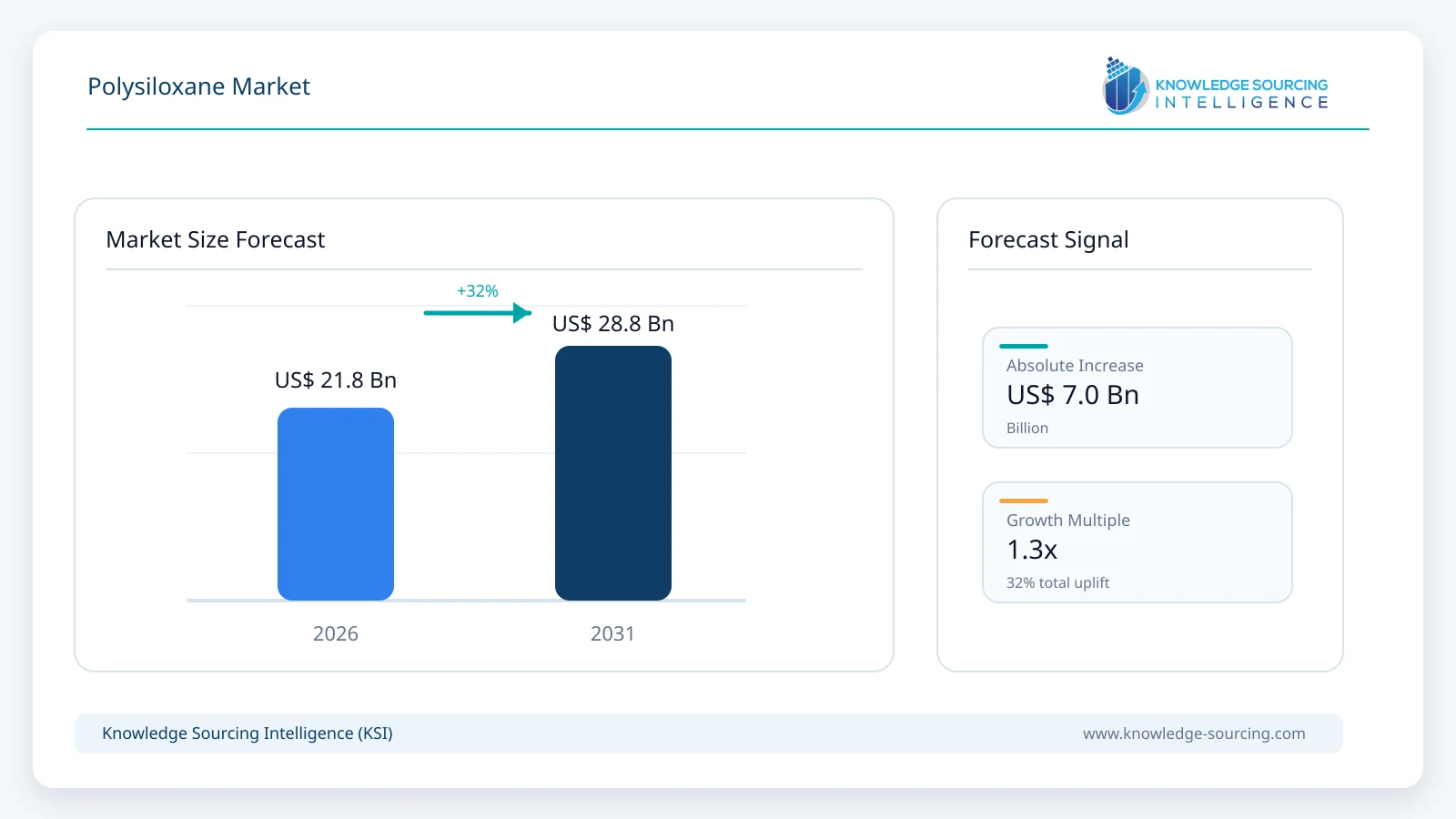
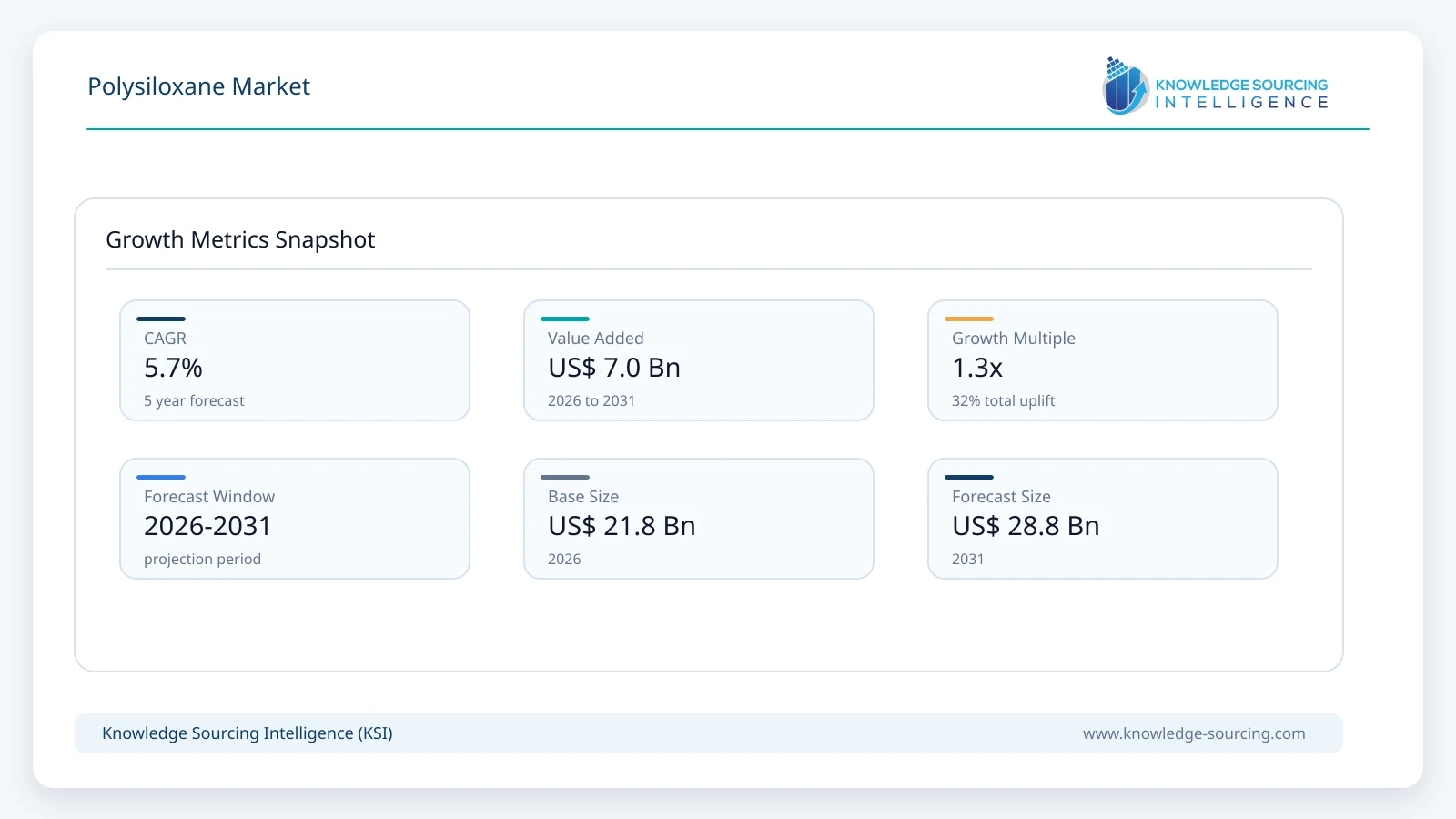
The polysiloxane market is projected to expand at a 5.7% CAGR, attaining USD 28.8 billion in 2031 from USD 21.8 billion in 2026.
Highlights:
- 1Silicone elastomers account for approximately 42% of global polysiloxane market value in 2026, led by sealants, molded components, electronics and transportation applications.
- 2Adhesives and sealants account for approximately 24% of market value in 2026, with construction providing the largest established volume base.
- 3Building and construction accounts for approximately 23% of end-user demand in 2026, spanning glazing, weather sealing, waterproofing and structural bonding.
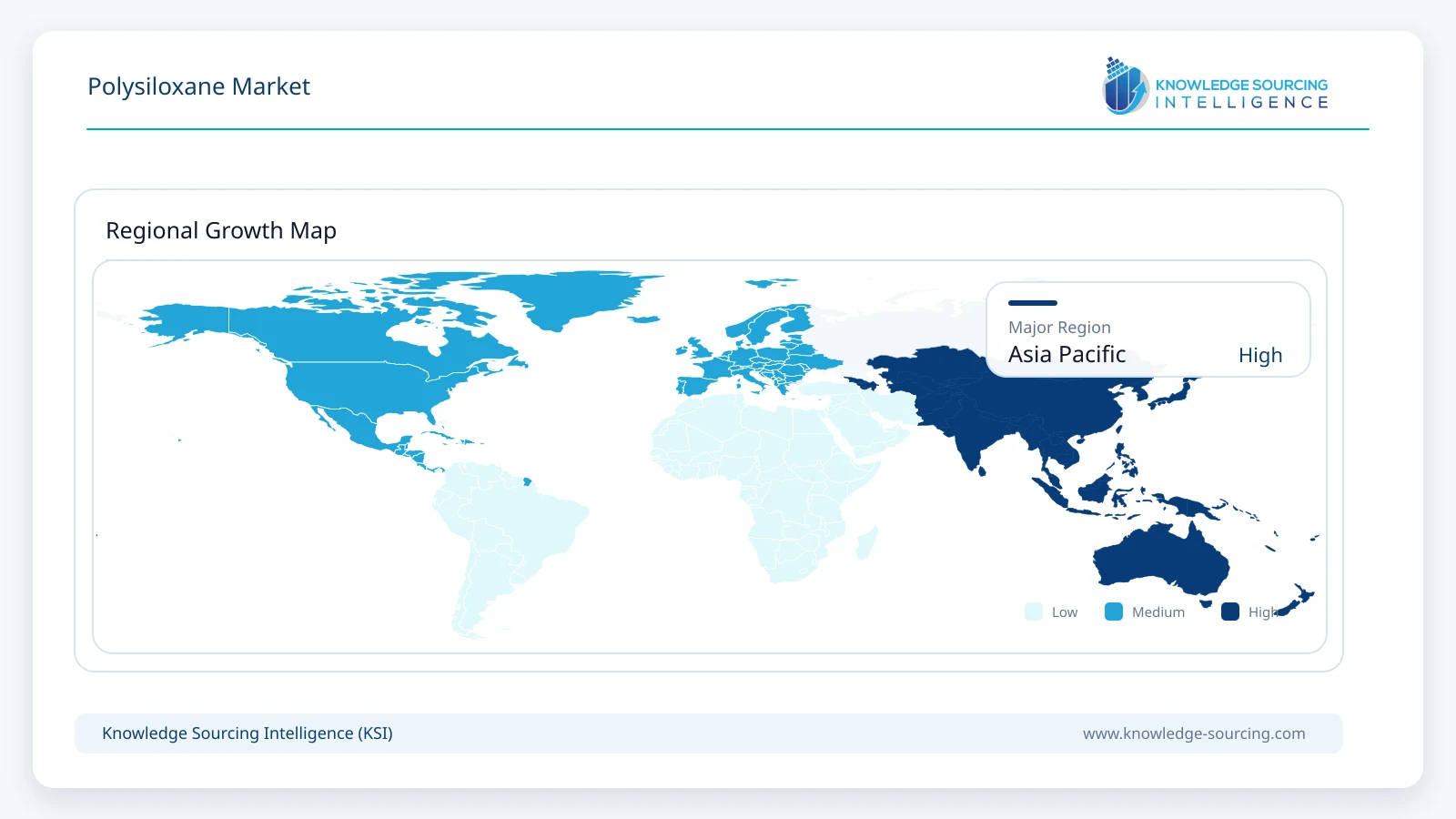
- 4Asia Pacific accounts for approximately 46% of global market value in 2026, combining large-scale Chinese production with major electronics and automotive manufacturing hubs.
- 5China represents approximately 28% of global polysiloxane market value in 2026, with an even larger share of global production volume.
Polysiloxanes are polymers built around repeating silicon-oxygen bonds and are commercially referred to as silicones. Differences in molecular weight, crosslinking, organic substitution and formulation allow the chemistry to range from low-viscosity fluids to highly elastic rubbers and rigid silicone resins.
The market covers commercial silicone polymer materials including silicone elastomers, fluids, emulsions, resins, gels and formulated compounds where polysiloxane is the principal functional polymer. It includes materials sold into adhesives and sealants, electrical encapsulation, molding, lubrication, release systems, personal care, healthcare, coatings and industrial applications.
Elemental silicon, polysilicon used in photovoltaic and semiconductor wafers, standalone silanes, basic cyclic siloxane intermediates sold for further polymerization and finished products in which silicone represents only a minor input are excluded.
This definition is substantially broader than the separate polysiloxane coatings market. The coatings application covered here includes silicone resins, modifiers, release coatings, electrical coatings and other polysiloxane materials used within coating formulations. A dedicated polysiloxane coatings study covers the narrower market for finished protective polysiloxane and hybrid coating systems.
Industry scale confirms the broader market boundary. WACKER generated EUR 2.73 billion from its Silicones division in 2025, Hoshine recorded approximately CNY 9.6 billion from its silicone business, and Shin-Etsu's Functional Materials division, which contains its major silicone operations alongside other products, generated JPY 448.6 billion. Global silicone demand is estimated at more than three million tonnes annually, with Asia accounting for the largest production and consumption base.
Market Trends
Shift Toward Specialty Silicones
Large additions to upstream silicone capacity, particularly in China, have increased price competition in basic materials. Major producers are directing more capital toward products where formulation, qualification and technical service carry greater weight than raw-material scale.
WACKER has identified electromobility, health, digitalization, energy transition and sustainable construction as priority markets for its Silicones business. Dow announced approximately USD 100 million of specialty silicone investments in 2026, covering liquid silicone rubber and materials for advanced electronics, mobility and healthcare.
The commercial divide between commodity and specialty polysiloxanes is widening. Producers able to sell thermally conductive, medical-grade, optical or precisely formulated materials can achieve substantially higher revenue per tonne than suppliers concentrated in basic silicone rubber and fluids.
Electronics Drive Thermal Management
Data centers, power electronics, semiconductor packaging and EV power systems are creating new thermal-management requirements. Silicone gels, gap fillers, encapsulants and adhesives combine dielectric insulation with flexibility and heat resistance, making them suitable for electronic assemblies exposed to thermal cycling.
Dow is expanding engineered silicone materials for power electronics, semiconductor packaging and thermal protection in China, Japan and the United States. WACKER is developing thermally conductive compounds for EV batteries and electronic systems, while CHT has introduced silicone foams and potting materials for battery protection.
Customer qualification is an important competitive barrier. Once a material is approved for a specific module or manufacturing process, switching suppliers can require additional validation.
LSR Gains in Precision Manufacturing
Liquid silicone rubber is taking a larger role in automated molding because it can be injected into complex geometries with high repeatability and limited secondary processing. Medical devices, automotive connectors, consumer products and electronic components are major applications.
Dow is adding LSR capacity in Kentucky and Zhangjiagang, while WACKER, Momentive, Shin-Etsu, KCC Silicone and CHT maintain extensive elastomer portfolios.
Medical and electronics applications are particularly attractive because customers require consistency, controlled curing and tight material specifications rather than simply low-cost polymer supply.
Production Becomes More Regional
Silicone suppliers are placing downstream manufacturing closer to major customers. The shift reduces logistics exposure and allows technical teams to adapt formulations for local electronics, mobility and healthcare companies.
Dow's current investment programme spans the United States, China and Japan. WACKER is starting specialty silicone capacity in the Czech Republic and Germany, while Shin-Etsu's new Zhejiang facility expands functional and environmentally oriented silicone products in China.
Regional manufacturing is more commercially important for formulated products than for basic intermediates because development work frequently takes place alongside the customer's engineering team.
Market Drivers
Construction Creates a Large Recurring Demand Base
Polysiloxanes are used in structural glazing, façade joints, expansion joints, roofing, waterproofing, weather barriers and other construction systems. Silicone sealants can retain flexibility under UV exposure, temperature cycling and moisture conditions that degrade many organic alternatives.
Renovation adds a recurring demand stream beyond new construction. Building façades, glazing systems and joints require maintenance or replacement over long operating lives, while energy-efficiency upgrades create additional requirements around air and moisture sealing.
Higher-specification materials are used where fire performance, structural adhesion or long service intervals justify a premium over general-purpose sealants.
Electrification Raises Material Intensity
Electric vehicles require silicone materials around battery packs, high-voltage connectors, inverters, sensors, charging systems and electronic control units. The chemistry is used for sealing, dielectric protection, thermal transfer, vibration management and environmental protection.
Thermally conductive gap fillers and encapsulants are particularly important as battery and power-electronics systems become denser. Silicone elastomers also continue to serve conventional automotive uses including lighting, hoses, gaskets, connectors and under-hood components.
This creates a broader transportation opportunity than EV volumes alone suggest.
Healthcare Favors Qualified Specialty Grades
Silicone elastomers and gels are used in tubing, seals, respiratory equipment, wearable devices, drug-delivery components and other medical products because of their flexibility, chemical stability and established biocompatibility.
Medical grades require more stringent manufacturing, documentation and customer qualification than general industrial products. These requirements limit the effective supplier base and give qualified producers greater pricing resilience.
NuSil, Dow, WACKER, Momentive and Shin-Etsu are among suppliers serving medical and healthcare applications through specialized silicone materials.
Market Restraints and Challenges
Commodity Capacity Pressures Pricing
China's rapid organosilicon expansion has changed the economics of basic silicone production. Integrated producers have added substantial upstream and downstream capacity, creating periods of weak utilization and price competition.
Hoshine's silicone revenue declined during 2025 despite substantial production scale, illustrating how falling selling prices can offset large physical volumes. Similar conditions affect basic rubber, fluids and intermediates throughout the supply chain.
The pressure is strongest in standardized products and less pronounced in materials requiring customer qualification, complex formulation or regulatory approval.
Siloxane Regulation Requires Reformulation
European regulation of cyclic siloxanes is affecting formulation and manufacturing decisions. D4, D5 and D6 face restrictions because of persistence and environmental concerns, requiring producers to reduce residual cyclic content or reformulate certain products.
Compliance raises processing and testing requirements, particularly for personal care and other applications where volatile cyclics historically played an important role.
Large suppliers have developed low-cyclic and alternative formulations, but regulatory changes add cost and can affect smaller manufacturers more heavily.
Segment Analysis
By Product Form: Silicone Elastomers
Silicone elastomers are forecast to approach USD 12.5 billion by 2031, keeping the largest product position.
The segment includes high-consistency rubber, liquid silicone rubber and room-temperature-vulcanizing materials. Construction sealants provide substantial volume, while transportation, medical devices and electronics consume higher-value formulations.
LSR is gaining importance as automated injection molding expands. Medical components, electrical connectors, seals and precision consumer products can be produced in high-volume multi-cavity systems with consistent dimensions and limited post-processing. WACKER, Dow, Momentive and Shin-Etsu continue investing in this part of the market.
By Application: Adhesives and Sealants
Adhesives and sealants are expected to account for approximately USD 7.0 billion in market value by 2031.
Construction uses large quantities for glazing, façades, joints and weather sealing, and transportation manufacturers use silicone bonding materials where components face vibration, moisture or temperature extremes. Electronics provides a smaller but higher-value application for assemblies requiring dielectric protection and flexible bonds.
Specialized structural and thermal products carry significantly different pricing from general-purpose RTV sealants, producing a wide value range within the segment.
By End-User: Building and Construction
By 2031, building and construction is expected to represent approximately USD 6.5 billion of global polysiloxane demand.
The sector uses silicone primarily for sealing, glazing, waterproofing, protective treatment and bonding. Long outdoor service life is a central purchasing consideration because replacement work on façades and glazing systems can be substantially more expensive than the sealant itself.
Commercial construction, renovation and increasingly complex façade systems keep silicone usage high even in mature building markets.
Regional Analysis
Major Region: Asia Pacific
Asia Pacific is expected to reach approximately USD 14.0 billion by 2031, retaining the largest regional market.
China provides the largest manufacturing base, while Japan and South Korea have strong positions in higher-performance electronics and automotive materials. India and Southeast Asia add demand through construction, industrialization, consumer products and expanding vehicle production.
The region includes both major global suppliers and large Chinese producers, creating intense price competition in commodity grades alongside continued investment in specialty materials.
Major Country: China
China is forecast to approach USD 8.3 billion in polysiloxane market value by 2031.
Its share of physical production is higher than its revenue share because commodity-grade materials carry lower prices than many specialty products manufactured in Japan, Europe and North America.
Hoshine, Wynca, Dongyue, Xingfa and Tangshan Sanyou operate alongside multinational companies with Chinese manufacturing facilities. Domestic suppliers are moving further into downstream rubber, fluids and specialty compounds as basic siloxane capacity becomes less differentiated.
Competitive Environment and Analysis
The global polysiloxane market combines large integrated manufacturers with specialty formulators. Upstream competitiveness depends on silicon-metal access, energy costs, plant scale and utilization. Downstream margins depend more heavily on formulation knowledge, quality control, regulatory qualification and technical collaboration with customers.
WACKER’s Silicones division generated EUR 2.73 billion in sales in 2025, highlighting the significant scale of the global polysiloxane industry.
Bluestar regained control of the majority of Elkem's former Silicones business in April 2026, restoring the Bluestar Silicones identity to a substantial global operation. Hoshine is one of the largest Chinese producers by physical scale, complemented by Wynca, Dongyue, Xingfa and Tangshan Sanyou.
Specialists occupy narrower high-value niches. CHT supplies elastomers and electronic materials, BRB has extensive fluids and specialty formulations, Gelest focuses on advanced silicon chemistry, NuSil serves demanding medical and aerospace applications, and Siltech produces functional silicone polymers for personal care and industrial customers.
Recent Developments
June 2026: Dow announced approximately USD 100 million of specialty silicone investments through 2027, including LSR and advanced-electronics capacity in the United States, China and Japan.
May 2026: CHT presented new low-density silicone foams and potting elastomers for electronic and EV battery protection, including materials designed to limit thermal-runaway propagation.
April 2026: Bluestar completed the acquisition of the majority of Elkem's Silicones division, with the business subsequently returning to the Bluestar Silicones name.
February 2026: Shin-Etsu's new Zhejiang silicone plant was scheduled for completion, adding functional emulsions and higher-performance silicone products for the Chinese market.
Market Outlook
Through 2031, the market should become more polarized between high-volume commodity production and technically differentiated specialty materials. Chinese capacity will keep pressure on basic polymer pricing, limiting the extent to which revenue can rise purely through tonnage growth.
Electronics, EV batteries, medical devices and advanced industrial applications should absorb a greater share of supplier investment. These markets use smaller quantities than construction but carry higher realized values and longer customer qualification cycles.
Elastomers will retain the largest product position, with LSR and specialty RTV grades gaining within the mix. Fluids will continue to serve large personal care and industrial-process markets, though environmental rules will accelerate movement toward low-cyclic formulations.
By the end of the forecast period, the strongest competitive positions should belong to companies combining low-cost upstream production with specialty formulation capabilities and technical support close to major customers.
Polysiloxane Market Scope
| Report Metric | Details |
|---|---|
| Total Market Size in 2026 | USD 21.8 billion |
| Total Market Size in 2031 | USD 28.8 billion |
| Forecast Unit | Billion |
| Growth Rate | 5.7% |
| Study Period | 2021 to 2031 |
| Historical Data | 2021 to 2024 |
| Base Year | 2025 |
| Forecast Period | 2026 – 2031 |
| Segmentation | Product Form, Application, End-User, Geography |
| Companies |
|
Market Segmentation
By Product Form
Silicone Elastomers
High Consistency Rubber
Liquid Silicone Rubber
Room Temperature Vulcanizing Silicone
Silicone Fluids
Silicone Resins
Silicone Emulsions
Silicone Gels and Others
By Application
Adhesives and Sealants
Coatings and Surface Treatment
Encapsulation, Potting and Electrical Insulation
Mold Release, Lubrication and Process Aids
Molded and Fabricated Components
Personal Care and Healthcare Formulations
Others
By End-User
Building and Construction
Automotive and Transportation
Electrical and Electronics
Industrial Manufacturing
Healthcare and Medical
Personal Care and Consumer Products
Energy and Power
Textile
Others
By Geography
North America
United States
Canada
Mexico
South America
Brazil
Argentina
Others
Europe
Germany
France
United Kingdom
Italy
Spain
Others
Middle East and Africa
Saudi Arabia
UAE
South Africa
Others
Asia Pacific
China
Japan
South Korea
India
Indonesia
Thailand
Others
Table of Contents
1. EXECUTIVE SUMMARY
2. MARKET SNAPSHOT
2.1. Market Overview
2.2. Market Definition
2.3. Scope of the Study
2.4. Market Segmentation
3. BUSINESS LANDSCAPE
3.1. Market Drivers
3.2. Market Restraints
3.3. Market Opportunities
3.4. Porter's Five Forces Analysis
3.5. Industry Value Chain Analysis
3.6. Raw Material and Siloxane Supply Analysis
3.7. Policies and Regulations
3.8. Strategic Recommendations
4. TECHNOLOGICAL OUTLOOK
4.1. Liquid Silicone Rubber
4.2. Thermally Conductive Polysiloxanes
4.3. Medical-Grade Silicones
4.4. Low-Cyclic Formulations
4.5. Silicone Recycling and Circularity
5. POLYSILOXANE MARKET BY PRODUCT FORM
5.1. Introduction
5.2. Silicone Elastomers
5.2.1. High Consistency Rubber
5.2.2. Liquid Silicone Rubber
5.2.3. Room Temperature Vulcanizing Silicone
5.3. Silicone Fluids
5.4. Silicone Resins
5.5. Silicone Emulsions
5.6. Silicone Gels and Others
6. POLYSILOXANE MARKET BY APPLICATION
6.1. Introduction
6.2. Adhesives and Sealants
6.3. Coatings and Surface Treatment
6.4. Encapsulation, Potting and Electrical Insulation
6.5. Mold Release, Lubrication and Process Aids
6.6. Molded and Fabricated Components
6.7. Personal Care and Healthcare Formulations
6.8. Others
7. POLYSILOXANE MARKET BY END-USER
7.1. Introduction
7.2. Building and Construction
7.3. Automotive and Transportation
7.4. Electrical and Electronics
7.5. Industrial Manufacturing
7.6. Healthcare and Medical
7.7. Personal Care and Consumer Products
7.8. Energy and Power
7.9. Textile
7.10. Others
8. POLYSILOXANE MARKET BY GEOGRAPHY
8.1. Introduction
8.2. North America
8.2.1. By Product Form
8.2.2. By Application
8.2.3. By End-User
8.2.4. By Country
8.2.4.1. United States
8.2.4.2. Canada
8.2.4.3. Mexico
8.3. South America
8.3.1. By Product Form
8.3.2. By Application
8.3.3. By End-User
8.3.4. By Country
8.3.4.1. Brazil
8.3.4.2. Argentina
8.3.4.3. Others
8.4. Europe
8.4.1. By Product Form
8.4.2. By Application
8.4.3. By End-User
8.4.4. By Country
8.4.4.1. Germany
8.4.4.2. France
8.4.4.3. United Kingdom
8.4.4.4. Italy
8.4.4.5. Spain
8.4.4.6. Others
8.5. Middle East and Africa
8.5.1. By Product Form
8.5.2. By Application
8.5.3. By End-User
8.5.4. By Country
8.5.4.1. Saudi Arabia
8.5.4.2. UAE
8.5.4.3. South Africa
8.5.4.4. Others
8.6. Asia Pacific
8.6.1. By Product Form
8.6.2. By Application
8.6.3. By End-User
8.6.4. By Country
8.6.4.1. China
8.6.4.2. Japan
8.6.4.3. South Korea
8.6.4.4. India
8.6.4.5. Indonesia
8.6.4.6. Thailand
8.6.4.7. Others
9. COMPETITIVE ENVIRONMENT AND ANALYSIS
9.1. Major Players and Strategy Analysis
9.2. Market Share Analysis
9.3. Mergers, Acquisitions, Agreements, and Collaborations
9.4. Competitive Dashboard
10. COMPANY PROFILES
10.1. Dow Inc.
10.2. Wacker Chemie AG
10.3. Shin-Etsu Chemical Co., Ltd.
10.4. Momentive Performance Materials Inc.
10.5. Bluestar Silicones
10.6. Hoshine Silicon Industry Co., Ltd.
10.7. KCC Silicone Corporation
10.8. Zhejiang Xinan Chemical Industrial Group Co., Ltd.
10.9. Shandong Dongyue Organosilicon Materials Co., Ltd.
10.10. Hubei Xingfa Chemicals Group Co., Ltd.
10.11. Tangshan Sanyou Chemical Industries Co., Ltd.
10.12. BRB International B.V.
10.13. CHT Germany GmbH
10.14. Gelest, Inc.
10.15. NuSil Technology LLC
11. APPENDIX
11.1. Currency
11.2. Assumptions
11.3. Base and Forecast Years Timeline
11.4. Key Benefits for the Stakeholders
11.5. Research Methodology
11.6. Abbreviations
Navigate
Trusted by the world's leading organizations











