Polystyrene Packaging Market - Strategic Insights and Forecasts (2026-2031)
Polystyrene Packaging Market Share, Growth, and Analysis By Type (Expanded Polystyrene (EPS), General Purpose Polystyrene (GPPS), High Impact Polystyrene (HIPS), Other Polystyrene Types), Product (Cups, Bowls and Containers, Plates, Trays, Clamshells, Boxes, Protective Packaging, Films, Other Products), End-User (Food and Beverage, Electrical and Electronics, Healthcare and Pharmaceuticals, Automotive, Consumer Goods, Cosmetics and Personal Care, Household Appliances, Others), and Geography
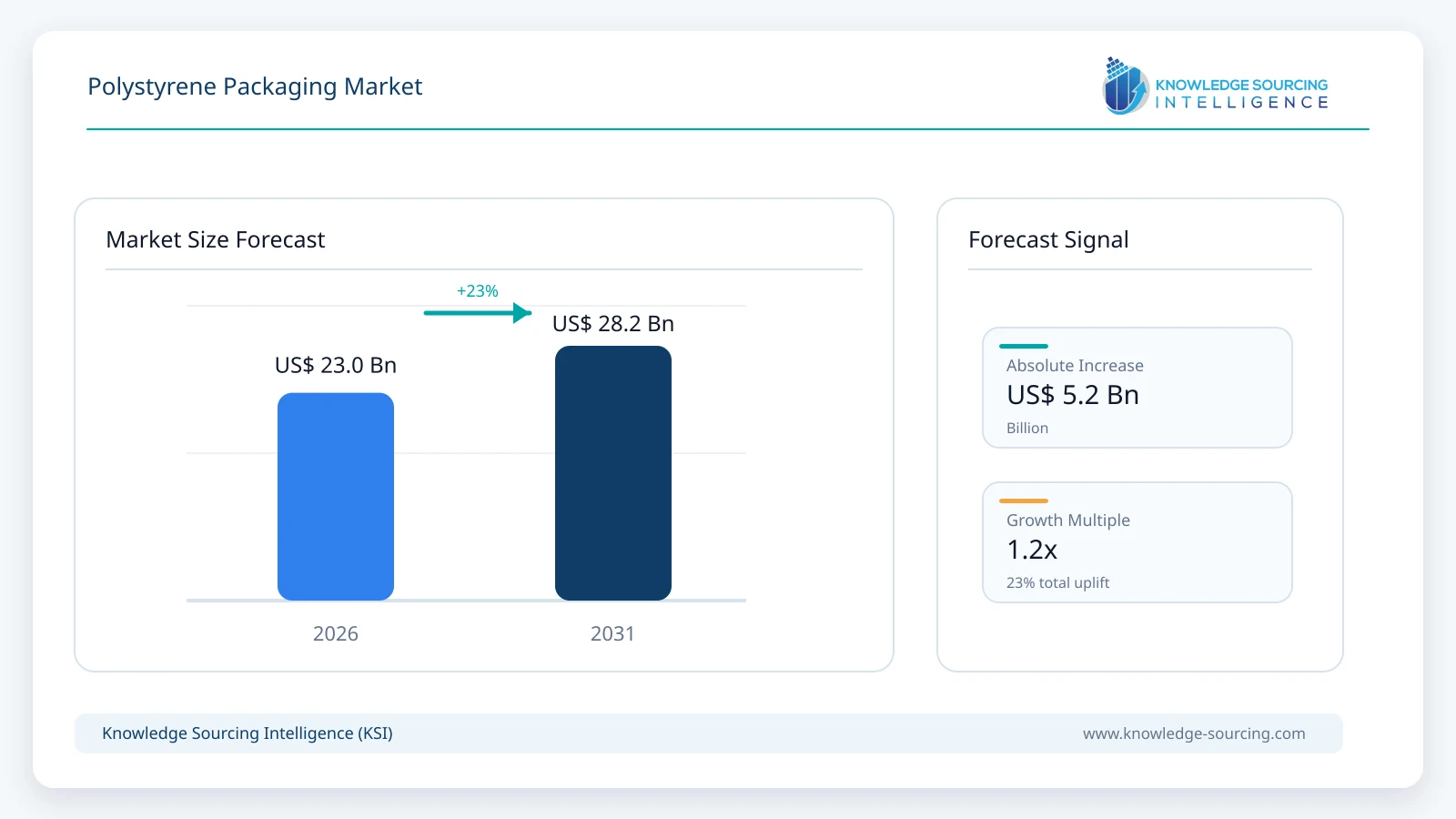
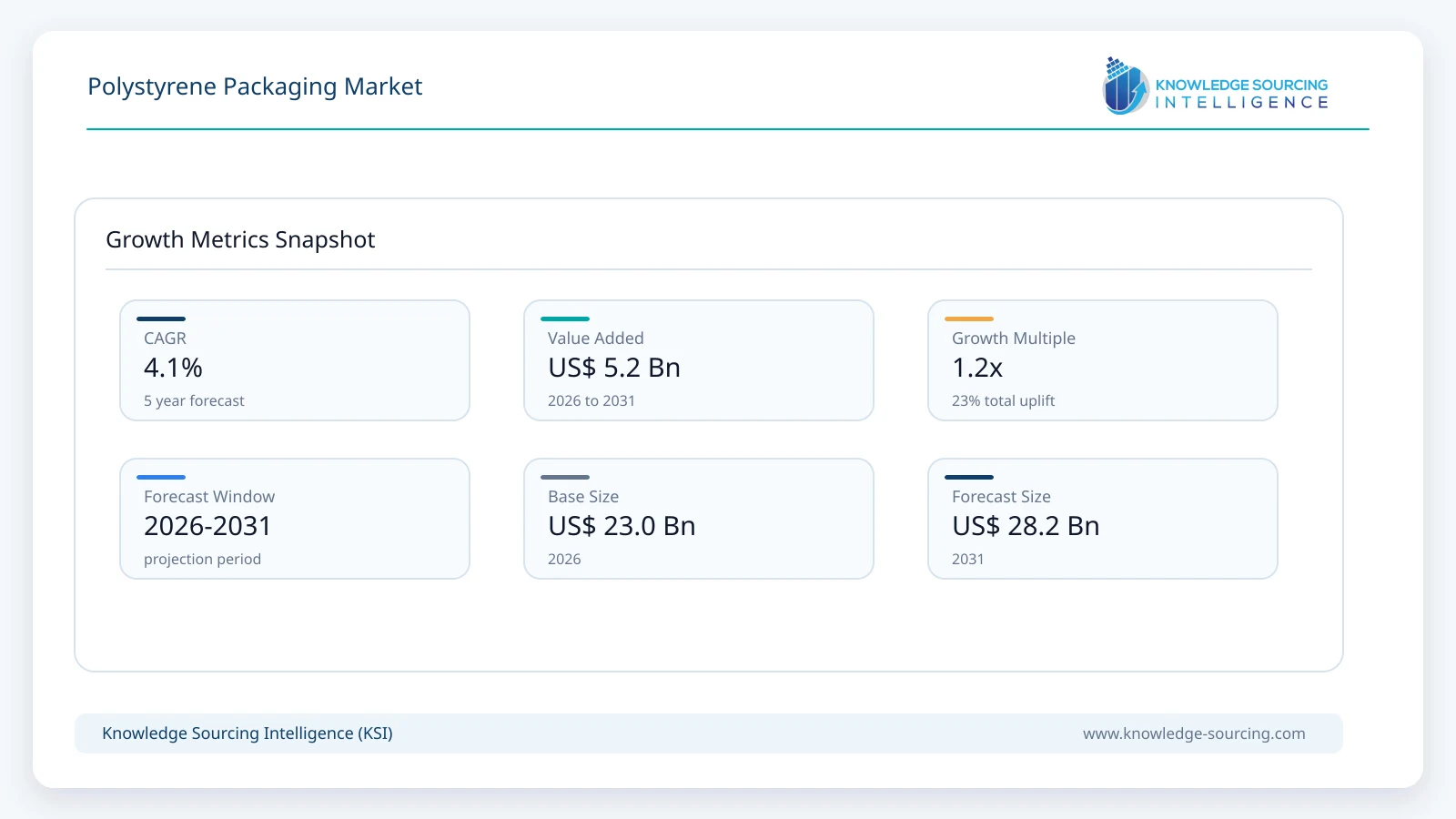
The Polystyrene Packaging Market is forecast to grow at a CAGR of 4.1%, reaching USD 28.2 billion in 2031 from USD 23.0 billion in 2026.
Highlights:
1
Food protection and cold-chain logistics are sustaining demand for lightweight EPS and rigid polystyrene packaging where cushioning and thermal performance affect product losses.
2
EPS remains commercially important in protective packaging, particularly for appliances, electronics, industrial equipment, perishables, and temperature-sensitive products.
3
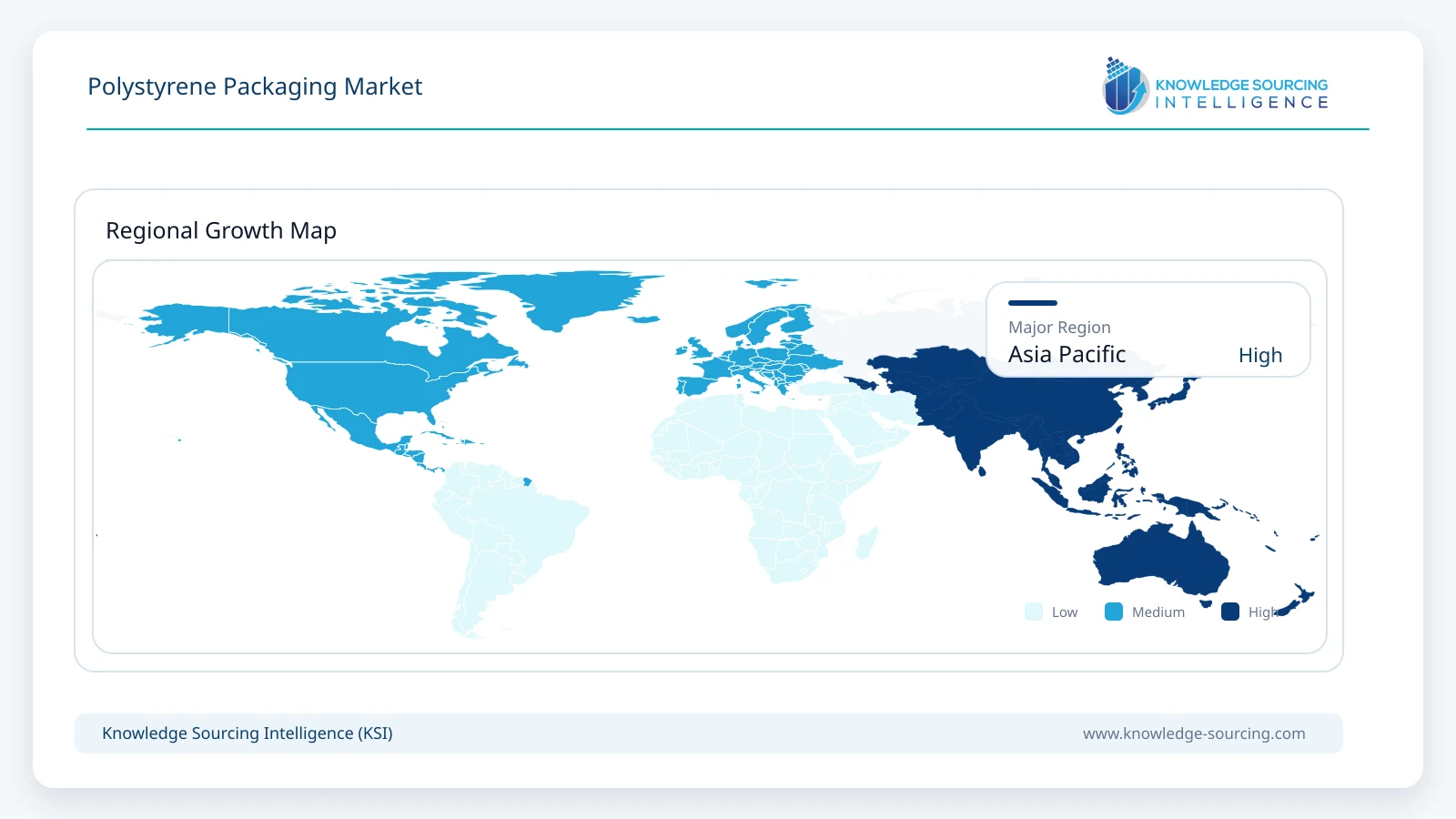
Asia Pacific offers the broadest manufacturing and consumption base, supported by food processing, electronics production, consumer goods manufacturing, and expanding distribution networks.
4
Recycled polystyrene technology is becoming a competitive differentiator, with producers investing in recycled EPS and recycled GPPS capacity and food-contact decontamination processes.
5
Packaging regulation is changing product economics, particularly in Europe and jurisdictions restricting selected foam foodservice and packaging formats.
6
Competition is shifting toward material efficiency, circularity, application engineering, and supply reliability, rather than resin price alone.
The Polystyrene Packaging Market covers the production and conversion of polystyrene-based materials into packaging formats used to contain, protect, insulate, display, transport, and serve products. The market includes expanded polystyrene (EPS), general purpose polystyrene (GPPS), high impact polystyrene (HIPS), and other polystyrene grades converted into cups, bowls and containers, plates, trays, clamshells, boxes, protective packaging, films, and related products. Demand originates across food and beverage, electrical and electronics, healthcare and pharmaceuticals, automotive, consumer goods, cosmetics and personal care, household appliances, and other industrial applications.
Polystyrene remains commercially relevant because its economics combine low density, moldability, cushioning, thermal insulation, moisture resistance, surface appearance, and relatively straightforward conversion. EPS is particularly suited to protective packaging because the cellular structure absorbs impact while adding limited shipping weight. Rigid polystyrene formats provide dimensional stability and can be thermoformed into containers, trays, cups, and clamshells. Alpek describes EPS as a material used for impact reduction, thermal insulation, customized molding, and protection of impact-sensitive goods and perishables.
The demand environment is therefore determined less by a single end-use industry and more by the performance requirements of individual packaging applications. Food producers prioritize hygiene, product protection, temperature management, stackability, and unit cost. Electronics manufacturers place greater emphasis on cushioning, dimensional precision, electrostatic considerations, and damage prevention during distribution. Pharmaceutical and healthcare buyers add requirements around cleanliness, traceability, product integrity, and regulatory compliance. Industrial customers often assess packaging through total delivered cost rather than material price alone, because breakage, product returns, warehouse utilization, and transport efficiency directly affect packaging economics.
Procurement decisions are also becoming more specification-driven. Large food processors, consumer-goods manufacturers, electronics companies, and logistics-intensive businesses increasingly evaluate packaging suppliers against material efficiency, recycled content, recyclability, supply continuity, technical consistency, and compliance documentation. This changes the competitive basis from simply supplying resin or converted packaging to providing predictable performance across a customer's production and distribution network.
The market has two distinct but interconnected commercial layers. The first is the upstream supply of styrenic materials, including expandable and solid polystyrene grades. The second is downstream conversion into packaging products through molding, extrusion, thermoforming, cutting, laminating, printing, and other processes. Resin availability, styrene economics, energy prices, transportation costs, conversion yields, and customer specifications collectively determine the economics of the finished packaging product.
Circularity is becoming a more important commercial variable. Producers are developing recycled EPS, recycled GPPS, recycled HIPS, and other recycled polystyrene solutions while packaging converters are investigating material designs that simplify collection and recycling. Alpek reported in its 2025 annual report that its EPS business launched an extrusion facility in Tennessee capable of processing up to 25 kilotons of recycled material annually, with the objective of producing EPS solutions containing recycled material. The company also reported selling more than 7,000 tons of EPS with biodegradable and recyclable content in the Americas during 2025.
The shift toward recycled material does not mean conventional polystyrene packaging is disappearing uniformly. Application requirements, local legislation, collection infrastructure, food-contact requirements, and the availability of technically suitable alternatives vary substantially by geography. Instead, the market is moving toward a more differentiated product mix in which virgin grades continue serving performance-sensitive applications while recycled and lower-impact grades gain relevance where regulatory and customer specifications permit.
The European regulatory environment illustrates this change particularly clearly. Regulation (EU) 2025/40 establishes requirements covering packaging sustainability, labeling, extended producer responsibility, waste prevention, reuse, collection, and recycling. The regulation applies broadly to packaging regardless of material and began applying generally from August 12, 2026. This creates a stronger commercial incentive for suppliers to demonstrate recyclability, material efficiency, traceability, and compliance rather than compete solely on packaging price.
Outside Europe, regulatory pressure is more fragmented. In North America, state and local restrictions on certain foam foodservice and packaging products affect demand patterns, while packaging manufacturers respond through material substitution, redesign, and expanded fiber-based offerings. Huhtamaki, for example, reported that 17 U.S. states were progressing with foam packaging restrictions in 2025 and linked this environment to its expansion of fiber-based egg packaging capacity.
Market Drivers
Growth in Food Distribution, Foodservice, and Cold-Chain Requirements
Food and beverage packaging is a major demand source because polystyrene can combine protection, thermal insulation, low weight, and efficient conversion. These characteristics are particularly useful for seafood, meat, fresh produce, prepared foods, dairy products, takeaway food, and other products requiring controlled handling.
The commercial mechanism is straightforward. Food processors and distributors incur costs when packaging fails to protect products from crushing, leakage, contamination, temperature fluctuation, or rough handling. EPS can reduce those risks without adding substantial mass to the shipment. For foodservice operators, lightweight containers and cups can also simplify storage and transport.
Buyer behavior varies by application. Large food manufacturers generally require consistent dimensions, predictable material properties, food-contact compliance, and reliable supply. Smaller foodservice buyers are more sensitive to unit cost and availability. Packaging suppliers therefore compete through manufacturing scale, tooling capability, customer-specific designs, logistics coverage, and increasingly through material options with improved recycled content.
The commercial implication is that demand is strongest where polystyrene provides a measurable functional benefit. Applications with few performance requirements face greater substitution pressure, while applications involving thermal management or impact protection have stronger technical justification.
Protective Packaging for Electronics, Appliances, and Industrial Goods
Polystyrene is widely used to protect products during storage and transportation. EPS cushioning can be molded around products, allowing packaging geometry to match the shape and vulnerability of the item. This is valuable for televisions, refrigerators, air conditioners, small appliances, electronics, furniture components, industrial equipment, and other products exposed to impact or vibration.
Electronics and appliance manufacturers evaluate packaging differently from foodservice buyers. Their primary concern is minimizing damage during increasingly complex distribution routes. Packaging must withstand repeated handling while maintaining low weight and efficient warehouse utilization.
Alpek's reporting identifies protective packaging applications for polystyrene, including electronics, while its broader EPS portfolio addresses impact reduction and protection of sensitive goods. This application base gives EPS a role beyond disposable food packaging and provides a demand channel that is less directly affected by restrictions targeting single-use foodservice products.
Supplier competition is consequently influenced by engineering capability. Mold design, density control, cushioning performance, dimensional accuracy, and material consistency can determine whether a supplier wins a large industrial account. Customers may also request packaging redesigns that reduce material consumption while preserving protection.
Expansion of Recycled and Circular Polystyrene Solutions
Recycled-content requirements and corporate packaging targets are creating a new demand layer for recycled polystyrene. Instead of treating recycling solely as a waste-management issue, resin producers are developing commercial grades that can be incorporated into packaging applications.
Alpek reported that its EPS business launched a Tennessee extrusion facility capable of processing up to 25 kilotons of recycled material annually. The company's 2030 EPS objective includes offering packaging products with up to 30% recycled and/or bio-based content.
Versalis has pursued a similar direction through its Revive portfolio. Its recycled PS products use feedstock from household waste, recovered appliances, and compacted EPS waste, with applications including packaging and household products.
The commercial mechanism is driven by both supply and demand. Brand owners want packaging that can contribute toward recycled-content and sustainability objectives, while resin producers need higher-value outlets for recovered material. The result is a gradual shift from conventional commodity resin procurement toward specifications that include recycled content, traceability, certification, and end-of-life considerations.
Material Efficiency and Transportation Economics
Polystyrene's low density remains a practical economic advantage. Packaging represents an additional cost in almost every supply chain, and the cost is not limited to purchasing the packaging itself. Packaging contributes to freight weight, warehouse space, handling labor, product damage, and disposal expenses.
EPS can provide cushioning and thermal protection with relatively low material mass. For large appliances and fragile products, molded foam can be engineered around product geometry, allowing manufacturers to optimize protection without simply increasing packaging volume.
The economic value is particularly relevant where transportation distances are long. A lightweight package reduces the amount of material transported from packaging producer to product manufacturer and subsequently from manufacturer to distribution center, retailer, or end customer. This does not automatically make EPS the lowest-cost solution in every application, but it strengthens its position where protection-to-weight performance is important.
Increasing Demand for Application-Specific Packaging
Customers are moving away from one-format-fits-all packaging where product fragility, dimensions, distribution routes, and regulatory requirements vary. Packaging suppliers are consequently being asked to provide more customized formats.
EPS molding supports this requirement because tooling can be designed around specific products. Rigid polystyrene can also be thermoformed into customized trays, containers, and clamshells.
Customization improves supplier differentiation but increases tooling, engineering, quality-control, and customer-service requirements. Suppliers with broad technical capabilities and geographically distributed manufacturing can therefore compete for accounts that require frequent product changes or multiple production locations.
Market Restraints and Challenges
Restrictions on Selected Single-Use Foam Packaging
The largest structural challenge for some polystyrene applications is regulatory restriction. Governments and local authorities have introduced measures targeting selected single-use plastic and foam packaging formats, particularly foodservice products.
The impact is not uniform. A ban on a foam cup or food container directly removes demand from that application, whereas restrictions on protective packaging may have a much smaller effect. The regulatory risk is therefore concentrated by product category and geography.
Huhtamaki's 2025 investor material illustrates the effect in the United States, where it identified 17 states progressing with foam packaging bans and connected these measures to increased demand for fiber-based alternatives in egg packaging.
Suppliers can mitigate this risk through product substitution, recycled-content development, alternative materials, and geographic diversification. However, substitution also requires tooling, customer qualification, manufacturing adjustments, and supply-chain changes, which can limit the speed of transition.
Collection and Recycling Economics
Polystyrene recycling faces a logistical challenge because many EPS products contain a high proportion of air relative to polymer mass. Collection and transportation can therefore become expensive unless waste is compacted near the point of generation.
Recycling economics also depend on contamination and sorting quality. Food residue, labels, mixed materials, and incompatible polymers can reduce the value of recovered material. Packaging producers therefore require reliable feedstock streams before recycled-content products can be scaled economically.
The industry response includes densification, dedicated collection systems, improved sorting, mechanical recycling, and advanced decontamination technologies. SUNPOR, for example, offers recycled EPS grades containing post-consumer material and has supported efforts to improve the collection and recycling of EPS packaging.
Food-Contact Requirements for Recycled Polystyrene
Food-contact packaging creates a higher technical and regulatory threshold for recycled polystyrene. Recovered packaging must be sufficiently sorted and decontaminated to meet applicable food-contact requirements.
Versalis has developed its Newer decontamination technology for recycled polymers and reports that the process enables recycled polystyrene suitable for direct food contact. The company states that the technology is applied industrially and can support food packaging containing up to 100% recycled polystyrene under the relevant regulatory framework.
The challenge is therefore not simply producing recycled resin. Suppliers must demonstrate consistent feedstock quality, contaminant removal, process control, traceability, and regulatory compliance. These requirements raise investment and qualification costs compared with conventional virgin-material supply.
Feedstock and Energy Cost Volatility
Polystyrene economics remain connected to petrochemical feedstock prices, particularly styrene-related raw material costs. Resin producers and converters must manage fluctuations in feedstock, electricity, natural gas, logistics, and labor.
Converters often operate under customer contracts that limit their ability to immediately pass through cost increases. This creates margin pressure during periods of rapid input-cost movement. Larger suppliers may mitigate the effect through purchasing scale, integrated production, inventory management, and contractual mechanisms, while smaller converters can face greater exposure.
Substitution by Fiber and Other Plastics
Polystyrene competes with molded fiber, paperboard, polypropylene, polyethylene, PET, polyurethane, and other materials. Substitution decisions depend on application-specific performance rather than material preference alone.
Fiber is gaining attention in applications where recyclability perception, renewable feedstock, or regulatory acceptance is important. Huhtamaki's packaging strategy, for example, emphasizes recyclable, compostable, or reusable formats and includes investment in fiber packaging capabilities.
Polystyrene suppliers must therefore defend applications through measurable performance, cost efficiency, material reduction, recycled content, and improved end-of-life pathways.
Major Segment Analysis
Expanded Polystyrene (EPS)
Expanded Polystyrene (EPS) represents the most commercially important segment because its cellular structure provides a combination of cushioning, insulation, low density, moldability, and cost efficiency that is difficult to reproduce simultaneously with many alternative materials.
EPS demand is particularly strong in protective packaging. Electronics, appliances, industrial components, furniture, and other fragile products can be placed in molded EPS structures designed around product geometry. The material absorbs impact and helps limit movement inside the shipping package. This reduces the probability of damage during loading, transportation, warehouse handling, and final delivery.
The buyer requirement is increasingly shifting from basic cushioning toward engineered protection. Large manufacturers assess compression strength, impact performance, density, dimensional accuracy, moisture behavior, stacking characteristics, and packaging weight. They may also require packaging designs that reduce material use without compromising product protection.
Food applications add another dimension. EPS can provide thermal insulation and help maintain product condition during transport. For products such as seafood and other perishables, insulation performance can have a direct economic relationship with product quality and waste.
EPS suppliers are also under pressure to address end-of-life concerns. Recycled EPS grades are emerging as a commercial response. SUNPOR's product portfolio includes post-consumer recycled EPS containing 33% recycled content for molded parts, while its portfolio also includes 100% recycled EPS grades for selected applications.
Alpek has made recycled and bio-based EPS a strategic development area. Its 2025 annual report states that the company launched a Tennessee extrusion facility capable of processing up to 25 kilotons of recycled material annually and is targeting up to 30% recycled and/or bio-based content in packaging products by 2030.
Versalis is taking a related route through its Revive EPS products, using secondary raw materials sourced from food packaging, appliance packaging, and seed trays. Its Revive EPS 3000 contains 35% secondary feedstock and is used for appliance, furniture, and pharmaceutical packaging applications.
These developments indicate that competition within EPS is shifting from conventional resin supply toward a broader value proposition involving recycled content, material traceability, product certification, performance consistency, and regulatory readiness.
For buyers, the commercial calculation remains application-specific. If a packaging format is directly exposed to a ban, substitution can be unavoidable. Where EPS delivers essential impact or thermal performance, buyers have stronger incentives to retain the material while improving recycled content and recovery. Consequently, EPS should not be assessed as a single homogeneous product category. Its future demand will differ substantially between foodservice disposables, protective packaging, industrial packaging, and specialized temperature-management applications.
Regional Analysis
North America
North America combines substantial food processing, consumer goods manufacturing, electronics distribution, appliance production, healthcare activity, and e-commerce logistics. These industries create demand for protective and food-related packaging, including polystyrene formats.
The United States represents the principal demand center, but regulatory conditions differ considerably between states and municipalities. Restrictions on selected foam foodservice products can reduce demand for cups, containers, plates, and similar formats, while protective packaging applications remain governed more by performance and customer specifications.
The region also offers opportunities for recycled EPS. Alpek's investment in Tennessee demonstrates the commercial importance of domestic recycling capacity and recycled-material conversion. The facility is designed to process recycled material and produce EPS solutions with recycled content and improved thermal insulation.
Canada's packaging demand is influenced by food processing, retail distribution, industrial manufacturing, and environmental policy. Mexico benefits from its manufacturing integration with the United States, particularly in automotive, appliances, electronics, food processing, and consumer products. Cross-border manufacturing therefore supports demand for protective packaging while creating requirements for consistent supply and standardized specifications.
The primary constraint across the region is regulatory fragmentation. Suppliers must monitor state, provincial, and municipal requirements while maintaining product portfolios capable of serving customers across multiple jurisdictions.
Europe
Europe is one of the most policy-sensitive regions for polystyrene packaging. The implementation of Regulation (EU) 2025/40 from August 2026 establishes a harmonized framework for packaging sustainability, waste prevention, reuse, recyclability, labeling, and waste management.
The regulation creates both constraints and investment opportunities. Packaging manufacturers face higher requirements for compliance and design, while recyclers and recycled-material suppliers gain a stronger policy rationale for investment.
Germany, France, Italy, the United Kingdom, and Spain remain important manufacturing and consumption markets. Germany and Italy have particularly relevant industrial and chemical value chains, while food processing, consumer goods, healthcare, and industrial packaging provide diverse demand sources.
Versalis' Porto Marghera investment illustrates the regional transition. In March 2025, the company started a plant with annual capacity of up to 20,000 tonnes of recycled GPPS and recycled EPS produced from secondary raw materials derived from EPS waste.
European buyers are consequently placing greater emphasis on recycled content, recyclability, documentation, and supply-chain traceability. Virgin polystyrene remains commercially relevant, but suppliers that cannot demonstrate a credible circular-material strategy may face greater pressure in regulated applications.
Asia Pacific
Asia Pacific is expected to remain a major demand center because of its large manufacturing base and extensive food, electronics, appliance, automotive, and consumer-goods industries.
China has a broad downstream plastics-conversion ecosystem and substantial domestic demand across food, electronics, appliances, and industrial packaging. India is supported by expanding food processing, organized retail, manufacturing, healthcare, and logistics. Japan and South Korea have sophisticated electronics and industrial manufacturing sectors where packaging performance and dimensional accuracy are important. Indonesia and Thailand provide additional demand through food processing, consumer products, electronics, automotive production, and regional trade.
Buyer priorities vary by country. Large multinational manufacturers generally apply global packaging specifications, while local manufacturers may place greater emphasis on cost and supply availability. This creates opportunities for both integrated resin producers and specialized converters.
Recycling infrastructure remains uneven across the region. Countries with stronger collection and sorting systems can adopt recycled polystyrene more readily, while markets with fragmented waste collection may remain more dependent on virgin material. Investment in local recycling infrastructure is therefore likely to influence the pace of recycled-content adoption.
Middle East and Africa
The Middle East and Africa represent a more fragmented market, with demand concentrated around food processing, beverage distribution, retail, healthcare, consumer products, construction-related applications, and industrial logistics.
Saudi Arabia and the United Arab Emirates have expanding food, retail, logistics, and manufacturing ecosystems. Their geographic position also creates demand for packaging capable of protecting goods through long-distance transport and high-temperature conditions.
South Africa has a relatively diversified manufacturing and food-processing base and provides a regional platform for packaging demand. However, waste-management infrastructure, collection economics, and regulatory enforcement vary across countries.
The principal opportunity lies in applications where packaging performance has a direct relationship with product protection. The principal constraint is the economics of collecting low-density EPS waste over large geographic areas. Suppliers seeking recycled-content growth in the region therefore require commercially viable collection and densification systems.
South America
South America is led by Brazil in terms of manufacturing scale and packaging demand, with Argentina representing another important market. Food processing, agriculture, beverages, consumer products, appliances, healthcare, and logistics create demand for multiple polystyrene packaging formats.
Brazil's large food and beverage industry supports packaging consumption, while industrial and consumer-goods manufacturing creates demand for protective formats. Argentina also has established food-processing and manufacturing activity.
The regional market remains sensitive to currency conditions, inflation, imported raw material costs, and infrastructure limitations. These factors can influence packaging purchasing decisions and favor suppliers capable of maintaining local inventories and stable delivery.
Recycling remains an important development area, but collection economics can constrain adoption of recycled EPS and other recycled polystyrene grades. Suppliers with established recovery partnerships and localized processing capabilities have an advantage when customers require recycled content.
Competitive Landscape
The competitive structure of the Polystyrene Packaging Market spans resin producers, polymer specialists, packaging converters, protective-packaging suppliers, and diversified packaging companies. The supplied competitive set includes Alpek, S.A.B. de C.V.; Monotez S.A. (Ravago Group); SUNPOR Kunststoff GmbH; Versalis S.p.A.; Ohishi Sangyo Co., Ltd.; Heubach Corporation; Sonoco Products Company; Sealed Air Corporation; Huhtamaki Oyj; and Rogers Foam Corporation.
Competition is not based on a single product specification. Upstream producers compete through polymer quality, grade availability, recycled-content capability, technical support, feedstock management, and production reliability. Downstream packaging companies compete through design engineering, conversion efficiency, tooling, customer integration, geographic coverage, and logistics performance.
Alpek and Versalis illustrate the increasing importance of circular-material capabilities. Alpek's 2025 reporting identifies recycled and bio-based EPS as a strategic area, while Versalis has expanded its recycled PS portfolio and commissioned dedicated recycled GPPS and EPS capacity in Italy.
SUNPOR has developed recycled EPS grades that can be incorporated into molded applications, demonstrating how specialized polymer producers can differentiate through material engineering rather than scale alone.
Diversified packaging companies compete through broader customer relationships and substitution capabilities. Sonoco's 2025 packaging activity demonstrates its focus on alternative materials and recyclable packaging formats, including a polystyrene-free closure option within its packaging portfolio. Sealed Air operates across food and protective packaging, serving food, medical and life sciences, e-commerce, logistics, and industrial markets.
Huhtamaki represents another form of competition: customers may prefer a supplier capable of moving between material platforms as regulations and brand requirements change. The company's strategy emphasizes sustainable packaging, customer collaboration, operational efficiency, and investment in strategic capabilities.
The competitive direction therefore favors suppliers that can combine material science, conversion expertise, regulatory knowledge, recycling access, and customer-specific engineering. Partnerships are also becoming important because recycled polystyrene supply chains often require coordination among waste collectors, recyclers, polymer producers, converters, and packaging users.
Recent Developments
August 2026: The European Union's Packaging and Packaging Waste Regulation began applying across the EU on August 12, establishing harmonized requirements for packaging sustainability, waste prevention, recyclability, labeling, and waste management. Commercially, the regulation increases the importance of compliant packaging design and circular-material strategies for suppliers serving European customers.
July 2026: Versalis and Eco+Eco signed an agreement covering recycled polystyrene production and commercialization, securing additional recycled EPS feedstock for Versalis’ Porto Marghera operations.
June 2026: BEWI announced Flatlantic’s adoption of Certified Recycled EPS fish boxes, maintaining food-safety performance while reducing the packaging’s carbon footprint by 30% during fresh seafood transport.
March 2025: Versalis started its Porto Marghera recycled-polymer plant, with capacity of up to 20,000 tonnes annually of recycled GPPS and EPS produced from secondary raw materials derived from EPS waste. Commercially, the facility strengthens the European supply of recycled polystyrene for packaging and other applications.
Regulatory and Policy Environment
Regulation is becoming one of the most important non-price variables affecting polystyrene packaging procurement. Requirements differ substantially across countries and even within national markets, making regulatory monitoring an important part of product strategy.
In the European Union, Regulation (EU) 2025/40 establishes requirements covering the full packaging life cycle, including environmental sustainability, labeling, extended producer responsibility, waste prevention, reuse, collection, and recycling. It applies to packaging regardless of material and entered into application generally on August 12, 2026.
The EU framework also creates new requirements around packaging composition, recyclability, reuse, and hazardous substances. The European Commission states that the regulation is intended to reduce packaging waste, improve resource efficiency, strengthen secondary-material markets, and support a circular economy.
Food-contact packaging adds another regulatory layer. Recycled polymers used in direct food-contact applications must meet applicable safety and recycling requirements. Versalis' Newer technology is specifically designed to address contamination and food-contact requirements for recycled polystyrene and references compliance with EU Regulation 2022/1616 governing recycled plastics intended for food contact.
In the United States, requirements are more decentralized. State and local restrictions on selected foam foodservice and packaging formats create different market conditions across jurisdictions. This fragmentation can increase compliance costs for national suppliers and encourage customers to adopt packaging portfolios that can be adjusted according to local rules.
For suppliers, regulatory compliance increasingly extends beyond certificates for individual products. Buyers require evidence concerning recycled content, material composition, food-contact status, recyclability, waste management, and environmental claims. Packaging manufacturers therefore need stronger documentation systems and traceability across their material supply chains.
Industry standards and certification systems also influence procurement. Recycled-content certifications, food-contact compliance, product declarations, and technical specifications can help customers validate packaging claims and reduce qualification risk.
Outlook and Strategic Implications
The 2026–2031 outlook for the Polystyrene Packaging Market will be shaped by a tension between strong application economics and rising environmental requirements. Polystyrene will retain demand where its performance-to-weight characteristics, cushioning, insulation, moldability, and cost provide measurable value. At the same time, applications with limited technical differentiation will face stronger substitution pressure from fiber and other polymers.
The most important investment priority is likely to be circular-material capability. Resin producers and packaging manufacturers need access to reliable post-consumer feedstock, sorting systems, densification infrastructure, recycling capacity, decontamination technology, and quality-control systems. Investments such as Alpek's recycled-material extrusion facility and Versalis' Porto Marghera plant demonstrate how recycling is moving into industrial-scale production rather than remaining a niche activity.
Procurement will also become more specification-oriented. Large customers are likely to assess packaging suppliers against several variables simultaneously: unit cost, protection performance, recycled content, recyclability, regulatory compliance, supply reliability, carbon-related information, and ability to support redesign. Suppliers that satisfy only the lowest-cost requirement may become less competitive in accounts with formal sustainability and compliance criteria.
Technology investment will focus on improving recycled-material quality, reducing contamination, optimizing EPS density, reducing packaging weight, and enabling recycled polystyrene for higher-value applications. Food-contact recycling is particularly important because it could increase the economic value of recovered polystyrene by expanding the number of applications that can accept recycled feedstock. Versalis' Newer technology illustrates this direction.
The competitive landscape is also likely to become more integrated. Partnerships between resin producers, recyclers, converters, waste-management organizations, and large packaging users can improve feedstock security and shorten qualification cycles. Such partnerships are particularly relevant for EPS because collection and transportation economics make fragmented recycling systems difficult to scale.
Regional strategies will need to differ. Europe requires a compliance-led approach because PPWR requirements are now directly affecting packaging placed on the market. North America requires greater attention to state-level restrictions and customer-specific material preferences. Asia Pacific offers scale through manufacturing and food-processing demand but requires localized approaches to recycling infrastructure. The Middle East and Africa present selective opportunities in food, logistics, healthcare, and industrial packaging, while South America offers demand from food processing and manufacturing but remains sensitive to economic and infrastructure conditions.
Risk management will remain important. Suppliers face exposure to resin and energy-price volatility, regulatory restrictions, substitution, recycled-feedstock shortages, and changing customer specifications. Maintaining multiple feedstock sources, flexible production capabilities, regional inventories, and alternative packaging solutions can reduce these risks.
The strategic opportunity is therefore not simply to increase conventional polystyrene volumes. The stronger opportunity lies in serving applications where the material's technical properties remain difficult to replace while simultaneously improving its environmental profile. Recycled EPS, recycled GPPS, improved collection, better material efficiency, and food-contact recycling can help extend the addressable application base.
Companies with established polymer expertise can use recycled-material development to defend existing customers, while diversified packaging companies can use their broader portfolios to retain accounts even when customers shift away from particular polystyrene formats. The ability to provide both conventional and alternative packaging can become an important customer-retention mechanism.
Over the next five years, market performance will therefore depend on the industry's ability to reconcile three commercial requirements: performance, cost, and regulatory compatibility. Demand will remain strongest where polystyrene solves a genuine packaging problem, particularly impact protection, thermal management, lightweight transport, and customized product protection. Applications where these advantages are weak will face greater substitution.
The resulting market should become more segmented by application, geography, and material specification. Virgin polystyrene will continue to serve performance-sensitive requirements, while recycled grades gain relevance in applications supported by suitable collection systems and regulatory acceptance. Suppliers that invest in recycling infrastructure, application engineering, compliance capabilities, and customer-specific product development will be better positioned to capture the portions of demand that remain commercially attractive through 2031.
Polystyrene Packaging Market Scope:
Report Metric
Details
Total Market Size in 2026
USD 23.0 billion
Total Market Size in 2031
USD 28.2 billion
Forecast Unit
Billion
Growth Rate
4.1%
Study Period
2021 to 2031
Historical Data
2021 to 2024
Base Year
2025
Forecast Period
2026 – 2031
Segmentation
Type, Product, End-User, Geography
Companies
Alpek S.A.B. de C.V.
Monotez S.A. (Ravago Group)
SUNPOR Kunststoff GmbH
Versalis S.p.A.
Ohishi Sangyo Co. Ltd.
Market Segmentation
By Type
Expanded Polystyrene (EPS)
General Purpose Polystyrene (GPPS)
High Impact Polystyrene (HIPS)
Other Polystyrene Types
By Product
Cups
Bowls and Containers
Plates
Trays
Clamshells
Boxes
Protective Packaging
Films
Other Products
By End-user
Food and Beverage
Electrical and Electronics
Healthcare and Pharmaceuticals
Automotive
Consumer Goods
Cosmetics and Personal Care
Household Appliances
Others
By Geography
North America
United States
Canada
Mexico
South America
Brazil
Argentina
Others
Europe
Germany
France
United Kingdom
Italy
Spain
Others
Middle East and Africa
Saudi Arabia
South Africa
Others
Asia Pacific
China
India
Japan
South Korea
Indonesia
Thailand
Others
Table of Contents
1. EXECUTIVE SUMMARY
2. MARKET SNAPSHOT
2.1. Market Overview
2.2. Market Definition
2.3. Scope of the Study
2.4. Market Segmentation
3. BUSINESS LANDSCAPE
3.1. Market Drivers
3.2. Market Restraints
3.3. Market Opportunities
3.4. Porter's Five Forces Analysis
3.5. Industry Value Chain Analysis
3.6. Policies and Regulatory Environment
3.7. Strategic Recommendations
4. TECHNOLOGICAL OUTLOOK
4.1. Introduction
4.2. EPS Molding and Forming Technologies
4.3. Thermoforming Technologies for Polystyrene Packaging
4.4. Lightweighting and Material Efficiency
4.5. Recycled Polystyrene and Recycled Content Integration
4.6. Packaging Design for Recyclability
5. POLYSTYRENE PACKAGING MARKET BY TYPE
5.1. Introduction
5.2. Expanded Polystyrene (EPS)
5.3. General Purpose Polystyrene (GPPS)
5.4. High Impact Polystyrene (HIPS)
5.5. Other Polystyrene Types
6. POLYSTYRENE PACKAGING MARKET BY PRODUCT
6.1. Introduction
6.2. Cups
6.3. Bowls and Containers
6.4. Plates
6.5. Trays
6.6. Clamshells
6.7. Boxes
6.8. Protective Packaging
6.9. Films
6.10. Other Products
7. POLYSTYRENE PACKAGING MARKET BY END-USER
7.1. Introduction
7.2. Food and Beverage
7.3. Electrical and Electronics
7.4. Healthcare and Pharmaceuticals
7.5. Automotive
7.6. Consumer Goods
7.7. Cosmetics and Personal Care
7.8. Household Appliances
7.9. Others
8. POLYSTYRENE PACKAGING MARKET BY GEOGRAPHY
8.1. Introduction
8.2. North America
8.2.1. United States
8.2.2. Canada
8.2.3. Mexico
8.3. South America
8.3.1. Brazil
8.3.2. Argentina
8.3.3. Others
8.4. Europe
8.4.1. Germany
8.4.2. France
8.4.3. United Kingdom
8.4.4. Italy
8.4.5. Spain
8.4.6. Others
8.5. Middle East and Africa
8.5.1. Saudi Arabia
8.5.2. United Arab Emirates
8.5.3. South Africa
8.5.4. Others
8.6. Asia Pacific
8.6.1. China
8.6.2. India
8.6.3. Japan
8.6.4. South Korea
8.6.5. Indonesia
8.6.6. Thailand
8.6.7. Others
9. COMPETITIVE ENVIRONMENT AND ANALYSIS
9.1. Major Players and Strategy Analysis
9.2. Competitive Positioning Analysis
9.3. Mergers, Acquisitions, Agreements, and Collaborations
The Polystyrene Packaging Market is forecast to grow at a Compound Annual Growth Rate (CAGR) of 4.1%, expanding from USD 23.0 billion in 2026 to reach USD 28.2 billion by 2031. This growth indicates a steady increase in demand for polystyrene packaging solutions across various industries.
The demand for polystyrene packaging is significantly driven by industries such as electronics, appliances, food and beverages, and pharmaceuticals. Notably, the electrical and electronics sector is experiencing substantial growth in its adoption due to polystyrene's superior shock absorption and insulating properties, critical for protecting fragile components.
Key growth drivers include polystyrene's lightweight and versatile nature, which facilitates ease of handling and reduces shipping costs. Its excellent insulating properties are crucial for temperature-sensitive products, while superior shock absorption capabilities protect delicate items from damage during transportation and handling, ensuring product integrity.
Manufacturers in the polystyrene packaging market are actively addressing sustainability challenges by partnering to develop circular and recycled polystyrene products. This strategic focus aims to meet evolving environmental goals and increasing demand for eco-friendly packaging alternatives.
The growth of e-commerce is a significant driver for the polystyrene packaging market, as it fuels the demand for reliable and lightweight packaging solutions. Polystyrene's protective qualities, including shock absorption and insulation, make it ideal for safeguarding goods shipped through online retail channels.
Polystyrene packaging is highly suitable for temperature-sensitive products, such as certain food items, pharmaceuticals, and electronics, due to its excellent thermal insulation capabilities. This property allows it to maintain consistent temperatures during transit, thereby preserving product quality and freshness, which is a critical factor for these industries.