
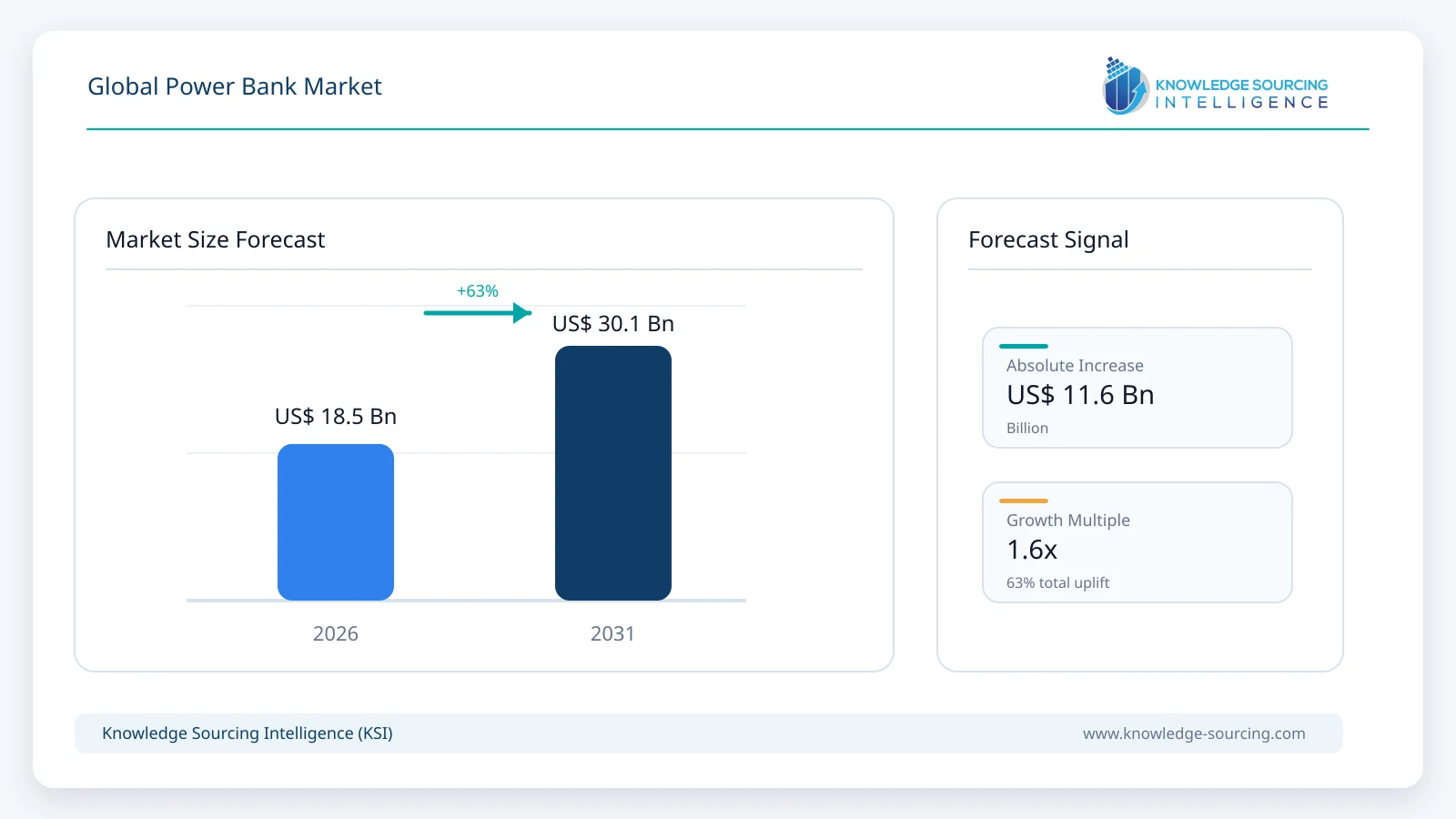
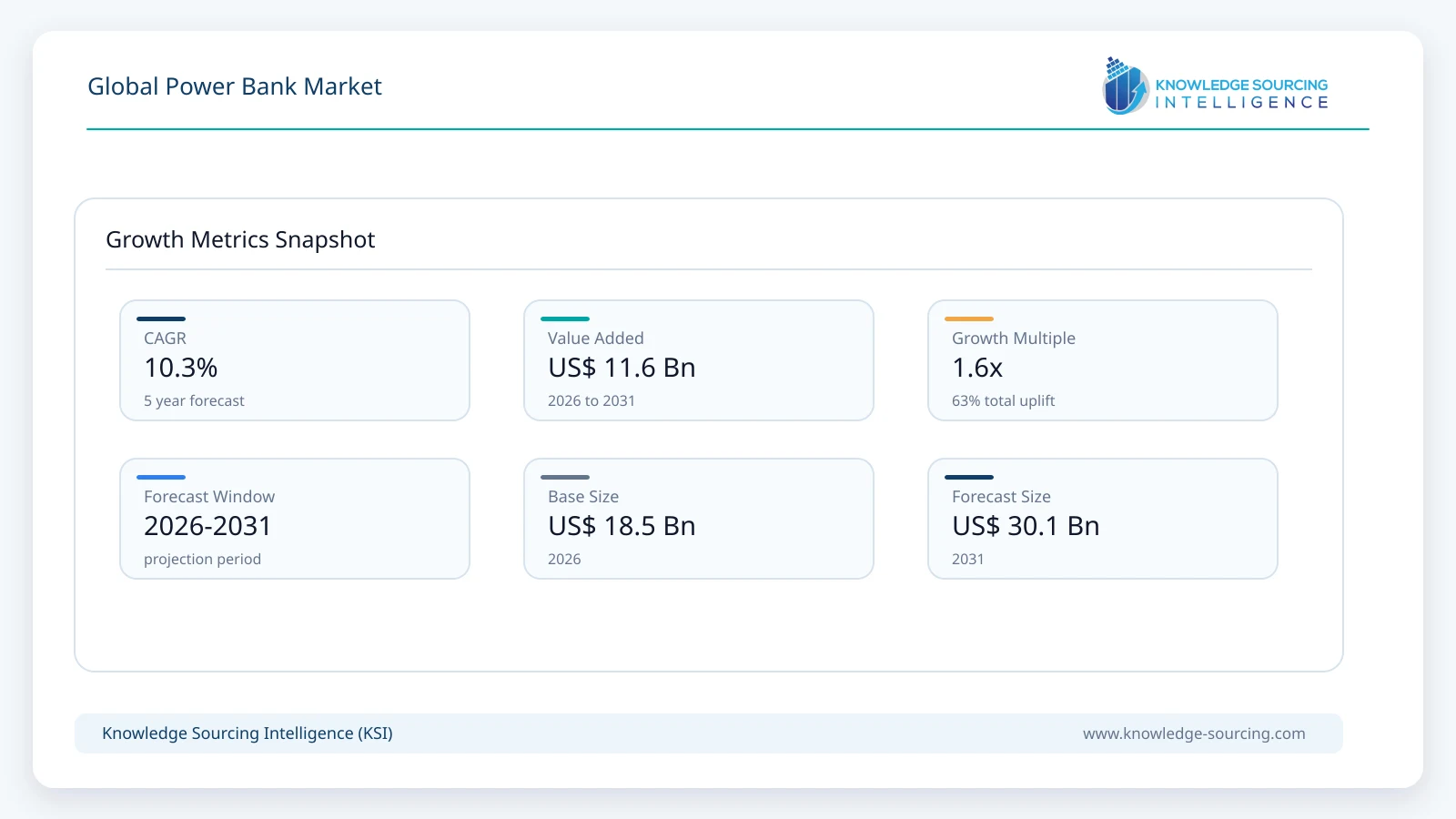
The global power bank market is expected to grow at a CAGR of 10.3%, reaching a market size of USD 30.1 billion in 2031 from USD 18.5 billion in 2026.
Highlights:
- 110,001-20,000mAh products account for approximately 44% of global power bank market value in 2026, balancing portability with sufficient capacity for repeated smartphone charging.
- 2Smartphones account for approximately 65% of global power bank demand in 2026, remaining the largest application despite increasing laptop and tablet usage.
- 3Online channels account for approximately 57% of global power bank market value in 2026, supported by strong electronics marketplace penetration and direct-to-consumer sales.
- 4Asia Pacific accounts for approximately 47% of global power bank market value in 2026, supported by China's manufacturing ecosystem and large regional consumer-electronics base.
- 5China accounts for approximately 31% of global market value in 2026, combining substantial domestic demand with the industry's most important production and component-supply cluster.
Power banks are portable rechargeable battery systems designed to supply electrical power to smartphones, tablets, laptops, wearables, cameras, handheld gaming devices and other portable electronics. The market includes conventional USB power banks, high-output laptop-compatible units and magnetic or wireless charging models. Large portable power stations intended primarily for household backup, camping appliances or off-grid electricity supply are excluded.
The category is shifting away from low-output backup batteries toward more capable charging systems. USB-C has become increasingly important across smartphones, tablets and laptops, while USB Power Delivery enables a single portable battery to support several device categories. The European Union's common-charger requirements now apply to laptops as well as a range of smaller electronics, reinforcing USB-C interoperability. High-output products increasingly support 65W, 100W, 140W or greater charging capabilities, allowing power banks to move into applications previously served primarily by wall adapters.
Growth is nevertheless becoming less dependent on smartphone unit expansion. IDC expects global smartphone shipments to contract sharply in 2026 as memory constraints and higher device prices affect the mass market. Power-bank manufacturers are responding by increasing average product value through faster charging, higher capacity, integrated cables, magnetic charging and laptop compatibility. Anker Innovations' broader charging and power-storage business recorded strong revenue growth during 2025, illustrating the ability of premium charging products to expand even when underlying device markets become more mature.
Market Trends
High-Wattage Power Banks Are Expanding the Category Beyond Smartphones
Power banks are increasingly designed to charge laptops, tablets, handheld gaming systems, and several devices simultaneously rather than functioning only as emergency smartphone batteries. Premium models now commonly provide 65W or higher USB-C output, while flagship products have moved substantially beyond 100W. Anker's current Prime portfolio includes a 26,250mAh power bank capable of up to 300W total output and up to 140W through individual USB-C connections, illustrating how portable chargers are converging with compact desktop charging systems.
Higher output increases the addressable market because consumers can carry one battery for both smartphones and computers. It also supports higher selling prices and reduces the importance of capacity as the only major point of differentiation. The result is a category increasingly segmented by output power, number of ports, recharging speed, and charging intelligence alongside the traditional milliamp-hour rating.
Magnetic Wireless Charging Is Becoming a More Standard Premium Feature
Wireless power banks are evolving from relatively slow convenience accessories toward faster and more interoperable charging products. The Wireless Power Consortium introduced Qi2 25W in 2025, increasing standardized wireless charging power substantially compared with the original Qi2 specification and extending participation beyond Apple's ecosystem. The consortium reports more than 13,000 Qi-certified products across the wider wireless-charging market, providing a large installed ecosystem for compatible accessories.
Magnetic alignment makes wireless power banks particularly useful for smartphones because consumers can continue using a device without managing a charging cable. The trade-off remains lower charging efficiency compared with wired connections, but higher Qi2 power levels and improved thermal management narrow the performance gap. Manufacturers are therefore combining magnetic charging with USB-C ports, allowing the same product to serve both convenience-oriented wireless use and faster wired charging.
Integrated Cables and Hybrid Designs Are Reducing Accessory Complexity
Built-in USB-C cables are appearing across mainstream power-bank portfolios as manufacturers compete on convenience rather than capacity alone. Integrated cables reduce the likelihood that users carry a charged power bank but lack the appropriate cable, while some designs use the cable itself as a carrying loop or lanyard.
Hybrid designs are also combining wall charging and battery storage in a single unit. These products can function as conventional chargers when connected to a socket and as power banks when disconnected. The approach is particularly relevant for travel and business users seeking to reduce the number of accessories carried. Product differentiation is consequently shifting toward complete charging experiences, including integrated cables, multiple ports, digital displays, charging-base compatibility and intelligent power allocation.
Alternative Battery Technologies Are Moving Into Commercial Products
Lithium-ion technology remains central to the market, but manufacturers are beginning to commercialize alternatives designed around safety, temperature tolerance or durability. ELECOM launched a sodium-ion power bank in Japan in 2025 and followed with a semi-solid-battery power bank in 2026. The semi-solid product was positioned around improved safety and easier identification of battery replacement timing.
These technologies remain small relative to conventional lithium-ion products and are unlikely to displace established chemistries during the forecast period. However, they demonstrate increasing competition around battery safety and lifecycle performance. Regulatory scrutiny and highly visible product recalls make improvements in cell stability and thermal management commercially relevant rather than purely technical features.
Market Drivers
USB-C Standardization Is Increasing Cross-Device Power-Bank Utility
USB-C increasingly allows consumers to use a single power bank across smartphones, tablets, laptops, cameras and other electronics. The European Union's common-charger requirements have applied to smartphones and several other portable devices since December 2024 and to laptops since April 2026. Devices requiring wired charging above specified power levels must support USB Power Delivery, reinforcing interoperability across the charging ecosystem.
For power-bank manufacturers, this expands the useful life and application range of products. Consumers are less dependent on proprietary connectors and can justify purchasing higher-output units capable of serving several devices. The effect is particularly important for business travelers and remote workers carrying phones, tablets, and laptops simultaneously. USB-C standardization therefore supports market value even without equivalent growth in the number of smartphones sold.
Increasing Device Power Requirements Support Faster Portable Charging
Consumers increasingly use smartphones for navigation, video, gaming, photography, communications, and mobile payments throughout the day. Tablets and laptops are also being used in mobile work environments, while wireless earbuds, watches, cameras and handheld gaming devices add additional charging requirements.
Internal battery improvements reduce power-bank dependence in some situations, but device usage has become more intensive at the same time. The commercial opportunity consequently shifts toward products capable of delivering energy quickly rather than merely storing large amounts of it. Fast charging is particularly important for premium users who expect portable batteries to provide charging speeds comparable with wall adapters. Manufacturers are responding through USB PD, programmable power supply support, improved battery-management systems and higher-power internal electronics.
Travel and Mobile Work Continue to Support Portable Energy Demand
Power banks remain particularly useful during air travel, commuting, field work and other situations where wall charging is intermittent. Aviation regulation strongly influences product design because spare lithium-ion batteries and power banks must generally remain in carry-on baggage. The FAA permits most rechargeable batteries up to 100Wh without airline approval, while units above 100Wh and up to 160Wh require airline approval.
This has encouraged manufacturers to design premium travel-oriented models just below the 100Wh threshold. Such products can provide enough energy to support laptops and multiple smaller devices while remaining within the most convenient aviation category. Travel regulation therefore constrains extreme capacity but simultaneously creates a recognizable premium product class optimized around maximum permissible portable energy.
Market Restraints and Challenges
Battery Safety and Product Recalls Increase Brand and Compliance Risk
Power banks store substantial energy in compact enclosures and can overheat if cells are defective, damaged or improperly managed. In September 2025, the U.S. Consumer Product Safety Commission announced a recall covering approximately 481,000 Anker power banks because the lithium-ion batteries could overheat and create fire and burn hazards. Anker had also initiated a broader voluntary global recall covering selected models after identifying a potential issue with cells from a supplier.
Safety incidents increase the importance of cell traceability, supplier qualification, protection circuitry and thermal management. Recalled batteries can also face travel restrictions, increasing inconvenience for consumers. The resulting compliance burden is likely to benefit larger manufacturers with established quality systems while increasing the difficulty faced by low-cost unbranded suppliers competing primarily on capacity and price.
Tighter Safety Regulation Raises Manufacturing Requirements
China published mandatory national standard GB 47372-2026, Safety Technical Specification for Power Bank, in March 2026, with implementation scheduled for April 1, 2027. The standard addresses issues including overcharging, over-discharge, short circuits, thermal abuse, battery materials and production controls. China has also incorporated the standard into updated compulsory certification requirements for power banks and their batteries.
Because China is the industry's largest manufacturing base, tighter domestic requirements can affect products supplied into international markets as well. Manufacturers must devote greater resources to testing, battery sourcing and production consistency, potentially increasing costs for lower-priced products. The change nevertheless strengthens the long-term market by reducing the ability of unsafe products to compete solely through unusually low pricing or inflated capacity claims.
Segment Analysis
By Capacity: 10,001-20,000mAh
Power banks in the 10,001-20,000mAh range are projected to generate approximately USD 12.7 billion by 2031, remaining the largest capacity category. Products around 20,000mAh provide enough stored energy for several smartphone charges while remaining sufficiently compact for backpacks, handbags and travel.
The category has also become more capable as charging power increases. Recent 20,000mAh products support outputs previously associated with much larger portable batteries, allowing them to serve smartphones, tablets and laptops. Xiaomi's 2026 Indian portfolio, for example, includes 20,000mAh products ranging from mainstream 67W models to a 165W unit.
Lower-capacity models remain important for consumers prioritizing compact size and magnetic charging, while products above 20,000mAh attract laptop and heavy-use customers. However, the middle range retains the strongest balance between capacity, portability and price.
By Application: Smartphone
Smartphone applications are projected to generate approximately USD 18.6 billion by 2031, remaining the largest source of power-bank demand. Smartphones are carried continuously and support communications, navigation, entertainment, photography, mobile payments and work applications, making battery depletion more disruptive than for many other portable devices.
The smartphone segment is also broadening technologically. Conventional wired charging remains important, but magnetic and Qi2-compatible products provide an additional use case for premium phones. Integrated cables make mainstream power banks easier to use, while fast USB-C outputs allow the same battery to support tablets or notebooks when required.
Smartphone shipment weakness during 2026 limits the contribution of new-device sales to accessory demand, but the installed smartphone base remains substantial. Power-bank growth therefore depends increasingly on replacement, premiumization and multi-device functionality rather than only on the number of newly shipped handsets.
By Distribution Channel: Online
Online distribution is projected to generate approximately USD 18.7 billion by 2031, remaining the largest sales channel for power banks. Portable chargers are particularly suitable for e-commerce because buyers can compare capacity, wattage, port configuration, dimensions, reviews and price without physically inspecting the product.
Marketplaces also enable specialized brands such as Anker, UGREEN, Baseus, INIU and CUKTECH to access customers across multiple countries without relying exclusively on traditional consumer-electronics stores. Direct-to-consumer websites provide an additional route for premium brands to launch new products and bundle chargers, cables and power banks.
Offline retail remains relevant for immediate replacement purchases, travel outlets and markets where consumers prefer established electronics retailers. However, continued online product discovery and the category's standardized specifications support a gradual increase in digital sales through 2031.
Major Region: Asia Pacific
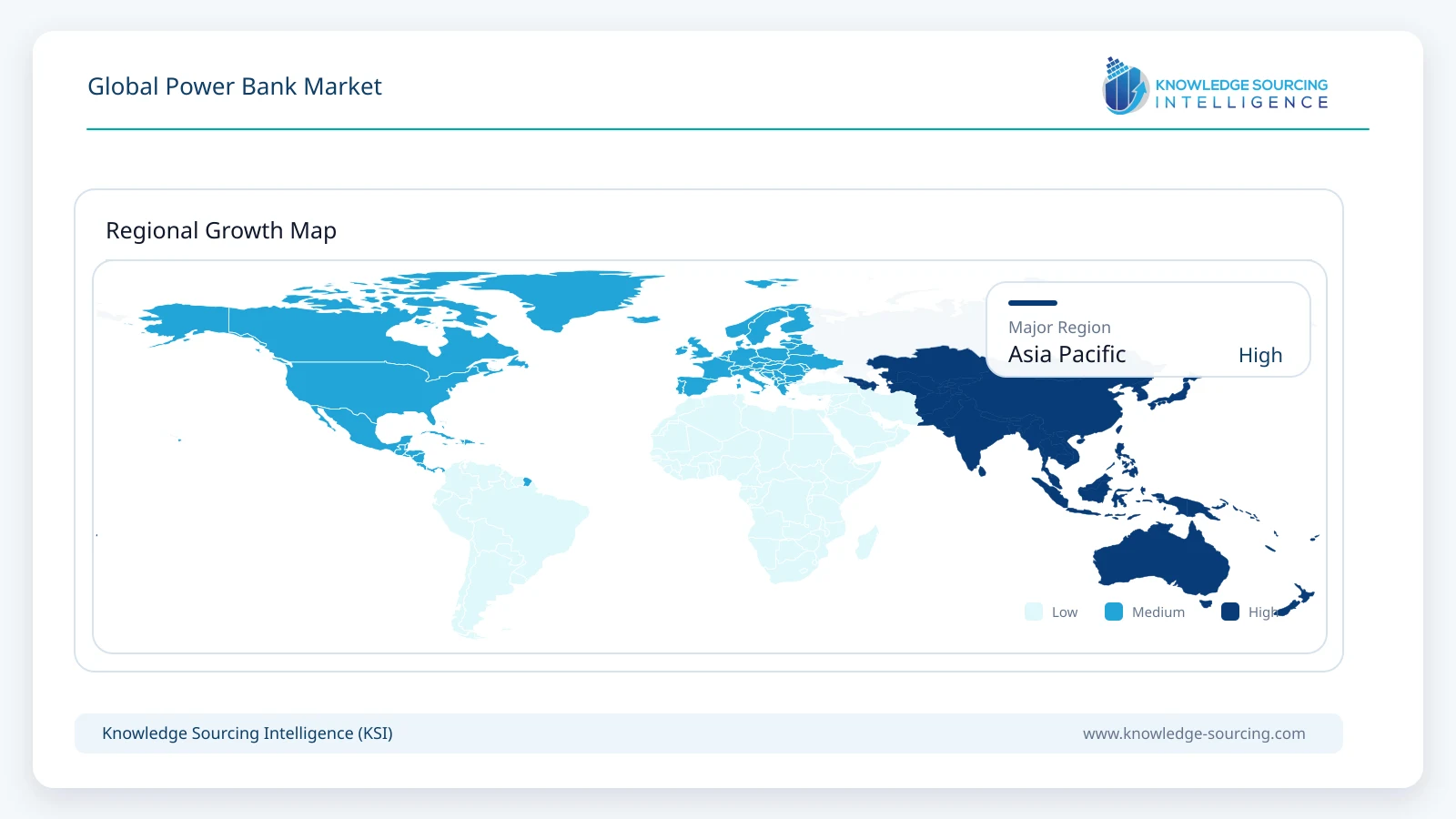
Asia Pacific is projected to generate approximately USD 15.2 billion in power bank revenue by 2031, remaining the largest regional market. China combines a large domestic electronics market with the world's most developed power-bank manufacturing and component ecosystem, while India, Japan, South Korea and Southeast Asia add substantial smartphone and accessory demand.
The region contains several major charging brands, including Anker, Xiaomi, UGREEN, Baseus, Huawei, CUKTECH and ELECOM. Production benefits from proximity to battery-cell manufacturers, electronics assembly, power-management semiconductor suppliers and accessory supply chains. Asia Pacific is also an important testing ground for faster charging specifications and new battery technologies.
Rising safety requirements in China increase compliance costs but may strengthen the position of established manufacturers capable of meeting stricter production and certification standards.
Major Country: China
China is projected to generate approximately USD 9.7 billion in power bank revenue by 2031, remaining the largest individual national market. The country combines a large base of mobile-device users with an extensive domestic ecosystem spanning battery cells, battery-management systems, charging controllers, cables and finished portable chargers.
China also plays an outsized role in product development. Domestic brands compete aggressively on fast charging, high-capacity designs, integrated cables, magnetic charging and digital displays. The new GB 47372-2026 safety standard is likely to reshape competition by increasing requirements for battery materials, protection systems, production control and certification.
The resulting market is expected to become more quality-sensitive, particularly as major brands use compliance and safety performance to distinguish themselves from low-cost suppliers.
Competitive Environment and Analysis
The global power bank market combines specialist charging brands, smartphone manufacturers, computer-accessory suppliers and established consumer-electronics companies. Anker has developed one of the most visible international charging portfolios, while Xiaomi, UGREEN, Baseus and CUKTECH compete strongly across fast-charging and value-oriented products. Smartphone manufacturers such as Samsung and Huawei participate through ecosystem accessories, while companies including Belkin, mophie and ELECOM address premium or regionally strong channels.
Technology competition increasingly centers on charging output, compactness, integrated cables, thermal management, wireless charging and battery intelligence rather than basic energy capacity. Anker's charging and power-storage revenue increased strongly in 2025, while the company states that Anker ranked first globally among mobile charging brands by retail value sales over 2020-2025 under the methodology used by Euromonitor.
Safety is becoming another competitive differentiator. Brands able to demonstrate stronger battery sourcing, temperature protection and certification can command higher consumer trust as recalls increase awareness of lithium-battery risk. The combination of tighter regulation and higher charging power is therefore likely to encourage greater separation between established branded products and low-cost commodity suppliers.
Recent Developments
September 2026: Xiaomi introduced a 20,000mAh power bank in India supporting up to 165W charging output and an integrated USB-C cable.
July 2026: Xiaomi launched the Power Bank 5i 20,000mAh 67W in India, extending higher-output USB-C charging further into the mainstream accessory market.
March 2026: China published mandatory power-bank safety standard GB 47372-2026, scheduled to become effective on April 1, 2027.
March 2026: ELECOM began launching power banks using semi-solid battery technology, expanding its alternative-battery portfolio beyond the sodium-ion product introduced during 2025.
September 2025: Anker expanded its Prime charging portfolio with a 26,250mAh power bank capable of up to 300W combined output, targeting multi-device and laptop charging.
Market Outlook
The global power bank market is experiencing strong growth, supported by increasing demand for reliable portable power across smartphones, tablets, laptops, wearables, and other connected devices. Growth increasingly comes from greater product capability rather than basic smartphone accessory penetration alone, with higher-capacity batteries, faster charging, compact designs, and multi-device compatibility expanding consumer and professional use cases.
USB-C Power Delivery enables power banks to support smartphones, tablets, and notebooks with the same hardware, while higher charging speeds and integrated cables improve convenience. Wireless magnetic charging adds another premium product category, and alternative battery technologies create opportunities around safety and lifecycle performance.
The market also becomes more demanding from a compliance perspective. Stronger safety requirements in China, international lithium-battery transport rules and product recalls increase the importance of cell quality and battery-management systems. Established manufacturers with strong sourcing, certification and product-development capabilities are therefore positioned to gain greater advantage as portable charging shifts from a commodity accessory toward a more technically differentiated consumer-electronics category.
Power Bank Market Scope:
| Report Metric | Details |
|---|---|
| Total Market Size in 2026 | USD 18.5 billion |
| Total Market Size in 2031 | USD 30.1 billion |
| Forecast Unit | Billion |
| Growth Rate | 10.3% |
| Study Period | 2021 to 2031 |
| Historical Data | 2021 to 2024 |
| Base Year | 2025 |
| Forecast Period | 2026 – 2031 |
| Segmentation | Capacity, Application, Distribution Channel, Geography |
| Companies |
|
Market Segmentation
By Capacity
Up to 10,000mAh
10,001-20,000mAh
Above 20,000mAh
By Application
Smartphones
Laptops and Tablets
Wearable Devices
Cameras and Portable Media Devices
Handheld Gaming Devices
Others
By Distribution Channel
Online
Offline
Consumer Electronics Stores
Supermarkets and Hypermarkets
Specialty and Travel Retail
Others
By Geography
North America
United States
Canada
Mexico
South America
Brazil
Argentina
Others
Europe
United Kingdom
Germany
France
Italy
Spain
Others
Middle East and Africa
Saudi Arabia
UAE
Israel
South Africa
Others
Asia Pacific
China
Japan
India
South Korea
Indonesia
Thailand
Taiwan
Australia
Others
Table of Contents
1. EXECUTIVE SUMMARY
2. MARKET SNAPSHOT
2.1. Market Overview
2.2. Market Definition
2.3. Scope of the Study
2.4. Market Segmentation
3. BUSINESS LANDSCAPE
3.1. Market Drivers
3.2. Market Restraints
3.3. Market Opportunities
3.4. Porter's Five Forces Analysis
3.5. Industry Value Chain Analysis
3.6. USB-C and Fast-Charging Technology Outlook
3.7. Battery Safety and Thermal Management
3.8. Wireless and Magnetic Charging Trends
3.9. Regulatory and Certification Environment
3.10. Strategic Recommendations
4. POWER BANK MARKET BY CAPACITY
4.1. Introduction
4.2. Up to 10,000mAh
4.3. 10,001-20,000mAh
4.4. Above 20,000mAh
5. POWER BANK MARKET BY APPLICATION
5.1. Introduction
5.2. Smartphones
5.3. Laptops and Tablets
5.4. Wearable Devices
5.5. Cameras and Portable Media Devices
5.6. Handheld Gaming Devices
5.7. Others
6. POWER BANK MARKET BY DISTRIBUTION CHANNEL
6.1. Introduction
6.2. Online
6.3. Offline
6.3.1. Consumer Electronics Stores
6.3.2. Supermarkets and Hypermarkets
6.3.3. Specialty and Travel Retail
6.3.4. Others
7. POWER BANK MARKET BY GEOGRAPHY
7.1. Introduction
7.2. North America
7.2.1. By Capacity
7.2.2. By Application
7.2.3. By Distribution Channel
7.2.4. By Country
7.2.4.1. United States
7.2.4.2. Canada
7.2.4.3. Mexico
7.3. South America
7.3.1. By Capacity
7.3.2. By Application
7.3.3. By Distribution Channel
7.3.4. By Country
7.3.4.1. Brazil
7.3.4.2. Argentina
7.3.4.3. Others
7.4. Europe
7.4.1. By Capacity
7.4.2. By Application
7.4.3. By Distribution Channel
7.4.4. By Country
7.4.4.1. United Kingdom
7.4.4.2. Germany
7.4.4.3. France
7.4.4.4. Italy
7.4.4.5. Spain
7.4.4.6. Others
7.5. Middle East and Africa
7.5.1. By Capacity
7.5.2. By Application
7.5.3. By Distribution Channel
7.5.4. By Country
7.5.4.1. Saudi Arabia
7.5.4.2. UAE
7.5.4.3. Israel
7.5.4.4. South Africa
7.5.4.5. Others
7.6. Asia Pacific
7.6.1. By Capacity
7.6.2. By Application
7.6.3. By Distribution Channel
7.6.4. By Country
7.6.4.1. China
7.6.4.2. Japan
7.6.4.3. India
7.6.4.4. South Korea
7.6.4.5. Indonesia
7.6.4.6. Thailand
7.6.4.7. Taiwan
7.6.4.8. Australia
7.6.4.9. Others
8. COMPETITIVE ENVIRONMENT AND ANALYSIS
8.1. Major Players and Strategy Analysis
8.2. Market Share Analysis
8.3. Product and Technology Positioning
8.4. Mergers, Acquisitions, Agreements, and Collaborations
8.5. Competitive Dashboard
9. COMPANY PROFILES
9.1. Anker Innovations Technology Co., Ltd.
9.2. Xiaomi Corporation
9.3. UGREEN Group Limited
9.4. Baseus Technology
9.5. Belkin International, Inc.
9.6. Samsung Electronics Co., Ltd.
9.7. Huawei Device Co., Ltd.
9.8. Lenovo Group Limited
9.9. ADATA Technology Co., Ltd.
9.10. ELECOM Co., Ltd.
9.11. ZAGG Inc. / mophie
9.12. Duracell Inc.
9.13. Ambrane India Pvt. Ltd.
9.14. Portronics Digital Pvt. Ltd.
9.15. CUKTECH
10. APPENDIX
10.1. Market Definition and Scope
10.2. Currency
10.3. Assumptions
10.4. Base and Forecast Years
10.5. Research Methodology
10.6. Segment Modelling
10.7. Data Triangulation and Validation
10.8. Abbreviations
Navigate
Trusted by the world's leading organizations











