
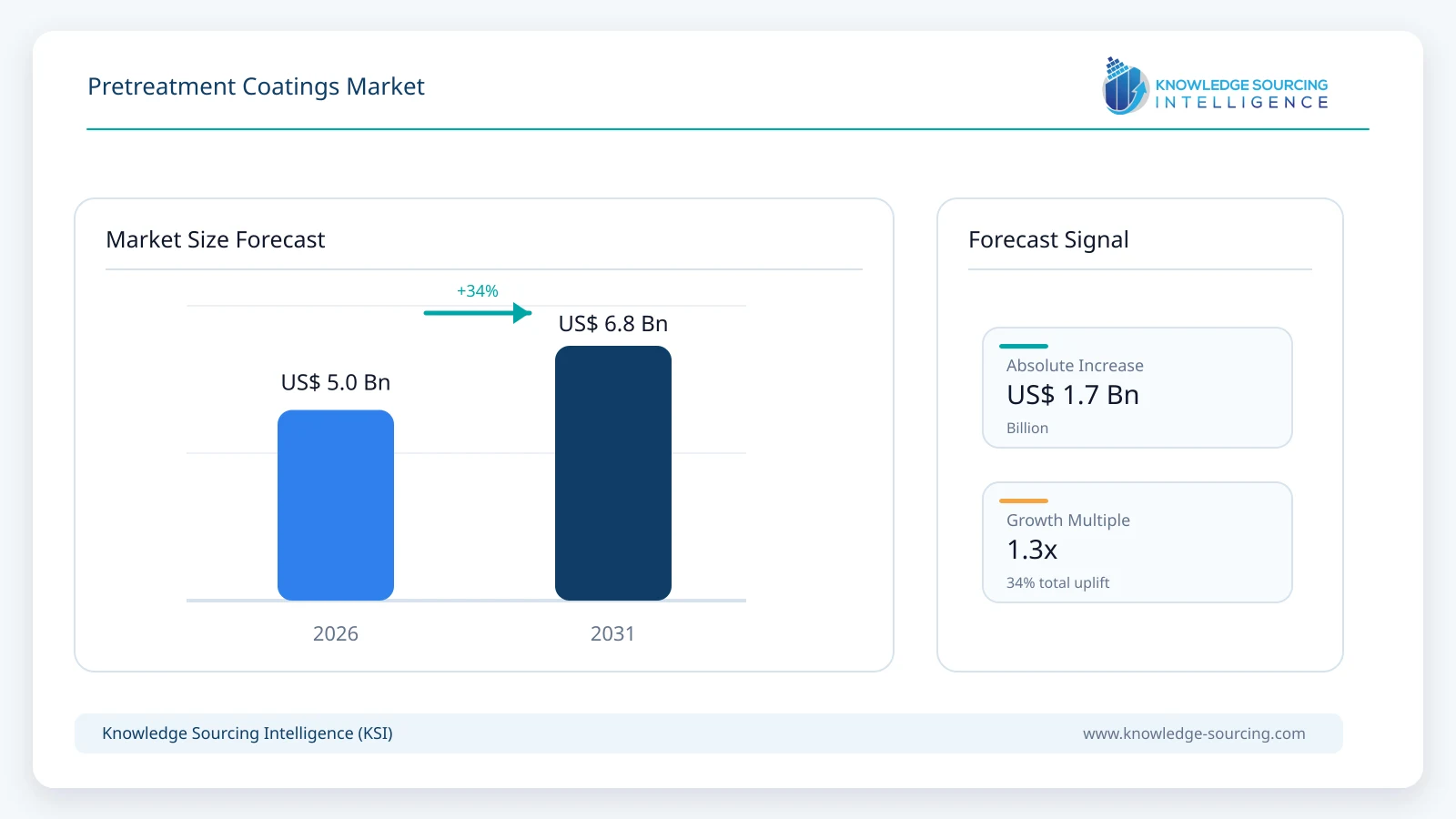
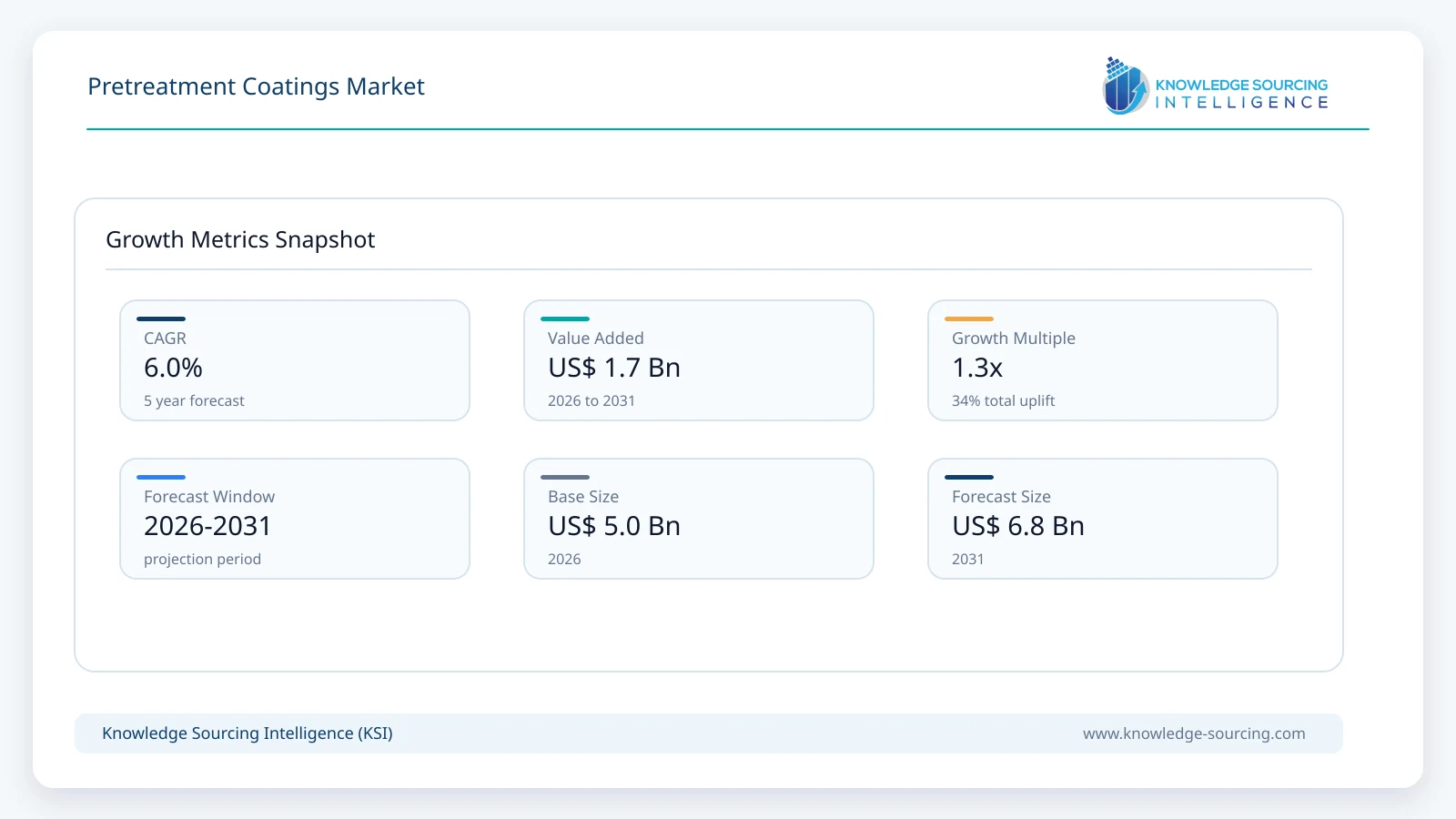
The pretreatment coatings market is projected to increase from USD 5.05 billion in 2026 to USD 6.75 billion in 2031, representing a CAGR of 6.0% throughout the forecast period.
Highlights:
- 1Phosphate-based systems remain the largest 2026 product category despite gradual share erosion.
- 2Chromate-free and zirconium-based chemistries record the strongest structural growth through 2031.
- 3Steel remains the largest substrate, while aluminum gains share across mobility and construction.
- 4Automotive and transportation contribute approximately one-third of global 2026 market revenue.
- 5Asia Pacific accounts for roughly 43% of 2026 demand and leads incremental volume growth.
- 6Low-temperature, no-rinse and digitally controlled lines improve resource efficiency and coating consistency.
Pretreatment chemistry is moving toward lower-footprint processes that maintain adhesion and corrosion resistance while reducing energy, water and chemical consumption. Henkel is expanding chromium-free BONDERITE technologies for aluminum coils, battery housings and architectural applications, while its 2026 E-CO GUARD launch adds automated control of cleaners, rinses and treatment stages. Chemetall is expanding technical capacity in Asia Pacific and commercializing chromium- and fluoride-free passivation solutions for battery-related copper foil. These developments indicate that future revenue growth is increasingly linked to chemistry upgrades and process-control value rather than simply greater coating volume.
Material mix is another key driver. Multi-metal vehicle bodies and battery systems increase the need for pretreatments that can handle steel, galvanized steel and aluminum within the same production environment. Aluminum growth in vehicles, architectural systems and packaging favours chromium-free thin films and advanced anodizing or sealing processes. Meanwhile, aerospace and industrial applications continue to require tightly controlled surface quality and qualification, creating demand for supplier technical support, application laboratories and approved formulations alongside the treatment chemicals themselves.
Selected Segment Estimates
Dimension | Selected Subsegment | 2026 Indicator | Forecast Interpretation |
Product Type | Phosphate-based coatings | ~34% share; ~USD 1.72 billion | Largest installed process base, but share gradually declines as thin-film alternatives expand. |
Product Type | Chromate-free / zirconium systems | ~24% combined share | Fastest structural growth as OEMs reduce hazardous chemistry and process intensity. |
Substrate | Steel | ~52% of 2026 revenue | Automotive, appliances, industrial equipment and construction maintain a broad steel base. |
Substrate | Aluminum | ~27% of 2026 revenue | Gains share through EVs, battery housings, architectural profiles and lightweight transport. |
End User | Automotive & transportation | ~33% of 2026 revenue | Multi-metal bodies, corrosion warranties and EV platforms sustain high specification intensity. |
Geography | Asia Pacific | ~43% of 2026 revenue | China, India, Japan, South Korea and Southeast Asia support the largest manufacturing demand pool. |
Market Dynamics
Drivers
Transition to chromate-free and thin-film chemistry. Regulatory pressure, worker-safety objectives and OEM sustainability targets are accelerating substitution away from hazardous pretreatment systems. Zirconium, silane and other conversion technologies can also reduce bath temperatures, rinse stages and sludge, improving the economics of line conversion when combined with lower utility consumption.
Growth in aluminum and multi-metal manufacturing. Electric vehicles, battery enclosures, lightweight automotive structures, architectural aluminum and metal packaging require reliable adhesion and corrosion protection across increasingly diverse substrates. Pretreatment suppliers that can process steel, zinc-coated steel and aluminum on flexible production lines are positioned to capture higher-value applications.
Process efficiency and digital control. Manufacturers are placing greater value on stable bath chemistry, automated dosing, diagnostics and data capture. Henkel’s 2026 E-CO GUARD launch illustrates this direction, where pretreatment value extends beyond chemistry into operational consistency, reduced manual intervention and quality management.
Restraints
Conversion of established production lines can require qualification work, capital expenditure and customer approvals, particularly in automotive and aerospace applications. Performance requirements vary significantly by substrate, paint system and end use, so a lower-resource chemistry cannot always be substituted without extensive testing. Raw-material volatility and the need for technical service across dispersed industrial customers can also pressure supplier margins.
Pretreatment Coatings Market Segment Analysis
By Product Type
Phosphate-Based Coatings
Phosphate-based coatings remain the largest product category in 2026 because automotive, appliance and general industrial lines have a large installed base of proven iron- and zinc-phosphate processes. Their position is strongest where corrosion-performance requirements are well established and line conversion costs are high. However, share declines gradually through 2031 as thin-film zirconium and silane systems gain approval on new lines and retrofit projects. The shift is therefore more pronounced in new capacity than in fully depreciated legacy assets.
Fastest Structural Growth
Chromate-Free and Zirconium Systems
Chromate-free and zirconium-based technologies are gaining because they address both compliance and process-efficiency requirements. New formulations target aluminum coils, mixed-metal automotive bodies, battery housings and other applications where conventional chromate systems face regulatory or customer restrictions. Lower bath temperatures and fewer rinse stages can improve total process economics, while no-rinse and dry-in-place systems are attractive in coil coating and packaging where line speed and water use are important.
Technology and Demand Indicators
Indicator | Latest Development | Market Impact |
Chromium-free aluminum pretreatment | Henkel presented BONDERITE M-NT 61000, M-NT 5200 and M-NT 811 for aluminum applications in September 2026. | Supports substitution toward non-chromium coil, architectural and packaging pretreatment. |
Automated line control | Henkel launched BONDERITE E-CO GUARD and E-CO GUARD+ in September 2026. | Extends value toward process stability, diagnostics and automated chemical control. |
Regional technical support | Chemetall opened its first Vietnam surface-treatment application laboratory in May 2026. | Shortens qualification cycles in a fast-growing Southeast Asian manufacturing base. |
North American distribution | Chemetall and Azelis expanded surface-treatment distribution across the U.S., Canada and Mexico in 2026. | Improves access and technical support for general industrial customers. |
Battery-material passivation | Chemetall launched chromium- and fluoride-free Gardolene D for copper foil in late 2025. | Creates new pretreatment demand linked to EV batteries and energy storage. |
Energy-efficient anodizing | Henkel commercialized BONDERITE M-ED 11204 for lower-temperature aluminum sealing in 2026. | Reduces energy and water intensity in architectural and decorative aluminum finishing. |
Asia Pacific Analysis
Asia Pacific accounts for approximately 43% of global pretreatment-coatings revenue in 2026. China remains the largest manufacturing base, supported by automotive production, appliances, machinery, construction products, electronics and metal packaging.
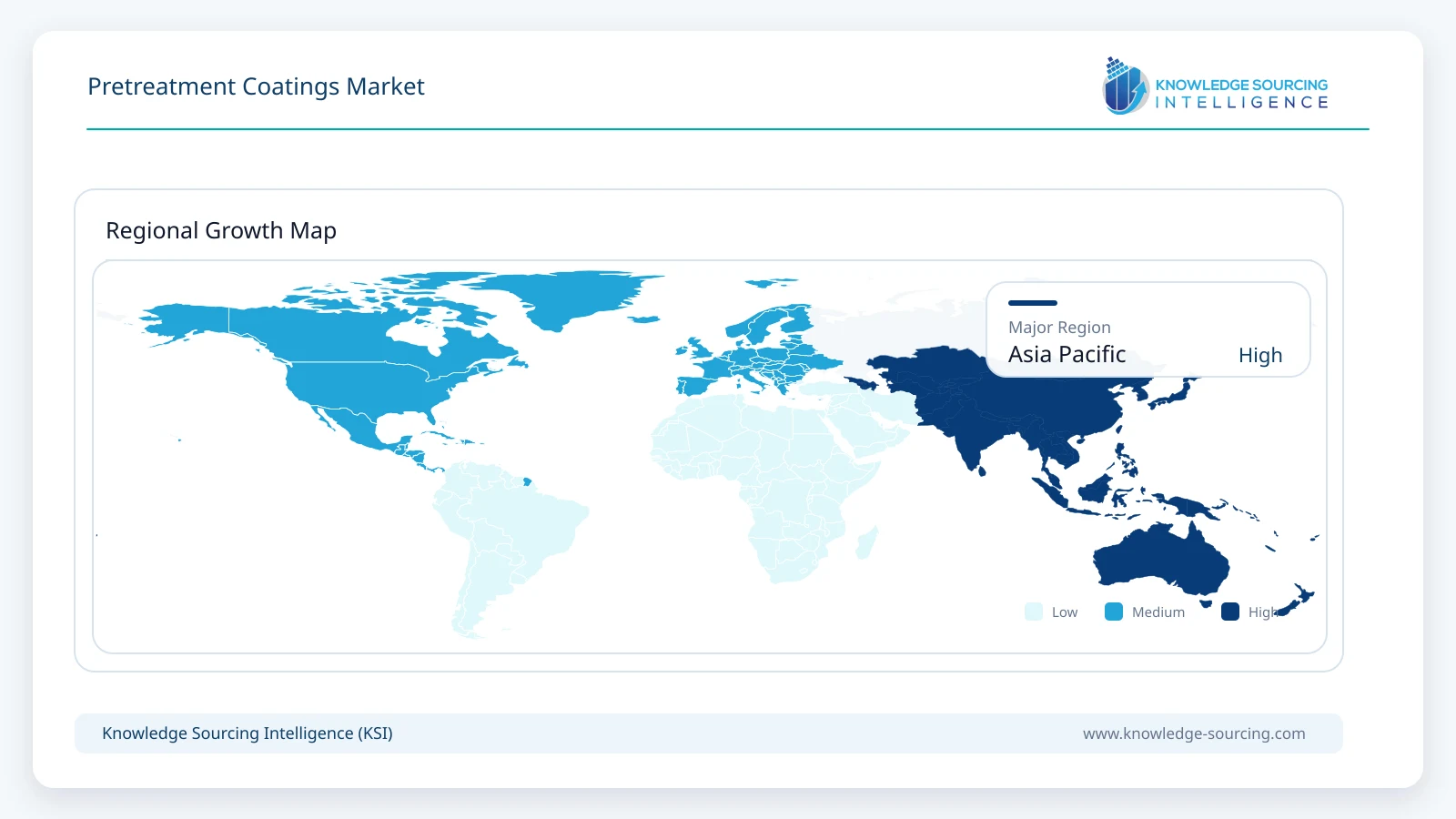
India and Southeast Asia provide a faster incremental growth component as new vehicle, appliance and general industrial capacity is commissioned. Japan and South Korea retain high-value demand in automotive, electronics and precision manufacturing, where qualification standards support premium surface-treatment chemistry and technical-service intensity.
The regional market is also benefiting from greater localization by global suppliers. Chemetall’s new Vietnam application laboratory expands its Asia Pacific technical network, while Henkel continues to target automotive and battery applications with multi-metal and aluminum pretreatment systems. The transition toward electric vehicles is especially relevant because battery enclosures and lightweight structures increase aluminum use, while copper-foil and battery-component treatment creates adjacent surface-preparation opportunities. This gives the region both the largest volume base and a disproportionate share of new-technology conversion projects.
Competitive Landscape
Competition is led by global surface-treatment specialists with deep OEM qualification records and local technical-service networks. Henkel and Chemetall are especially strong in automotive and industrial metal pretreatment, while Nihon Parkerizing has a substantial position in Asia. PPG, AkzoNobel, Sherwin-Williams, Axalta, Nippon Paint and Kansai Paint participate through broader coating systems and industrial customer relationships. SurTec, MacDermid Enthone and Atotech/MKS provide additional specialized surface-treatment technologies. Competitive differentiation increasingly centres on chromium-free performance, multi-metal capability, lower-temperature processing, line simplification, technical support and digital process control.
Recent Developments
September 2026: Henkel presented new chromium-free BONDERITE pretreatment solutions for aluminum coil, architectural and packaging applications.
September 2026: Henkel launched BONDERITE E-CO GUARD and E-CO GUARD+ for automated pretreatment-line process control.
June 2026: Chemetall expanded its North American surface-treatment distribution agreement with Azelis across the United States, Canada and Mexico.
June 2026: Chemetall received Airbus Accredited Supplier status for the eleventh consecutive year under the SQIP programme.
May 2026: Chemetall opened its first surface-treatment application laboratory in Vietnam.
April 2026: Henkel launched BONDERITE M-ED 11204, a mid-temperature aluminum sealing solution designed to reduce energy and water use.
October 2025: Chemetall introduced Gardolene D, a chromium- and fluoride-free passivation solution for copper foils used in batteries and energy storage.
Pretreatment Coatings Market Scope:
| Report Metric | Details |
|---|---|
| Total Market Size in 2026 | USD 5.05 billion |
| Total Market Size in 2031 | USD 6.75 billion |
| Forecast Unit | Billion |
| Growth Rate | 6.0% |
| Study Period | 2021 to 2031 |
| Historical Data | 2021 to 2024 |
| Base Year | 2025 |
| Forecast Period | 2026 – 2031 |
| Segmentation | Product Type, Substrate Material, End-User Industry, Geography |
| Companies |
|
Market Segmentation
By Product Type
Phosphate-Based Coatings
Chromate-Based Coatings
Chromate-Free Coatings
Silane-Based Coatings
Anodic Coatings
Zirconium-Based Coatings
Nanocoatings
By Substrate Material
Steel
Aluminum
Zinc
Magnesium
Alloys
By End-User Industry
Automotive & Transportation
Appliances
Aerospace
Industrial Equipment
Construction
Metal Packaging
Others
By Geography
North America
United States
Canada
Mexico
South America
Brazil
Others
Europe
United Kingdom
Germany
France
Italy
Others
Middle East and Africa
Saudi Arabia
United Arab Emirates
Others
Asia Pacific
China
India
Japan
South Korea
Others
Table of Contents
1. EXECUTIVE SUMMARY
2. MARKET SNAPSHOT
2.1 Market Overview
2.2 Market Segmentation
3. BUSINESS LANDSCAPE
3.1 Market Drivers
3.1.1 Transition to Chromate-Free and Thin-Film Chemistry
3.1.2 Growth in Aluminum and Multi-Metal Manufacturing
3.1.3 Process Efficiency and Digital Control
3.2 Market Restraints
3.2.1 Qualification and Line-Conversion Requirements
3.2.2 Raw-Material and Technical-Service Cost Pressures
3.3 Market Opportunities
3.4 Porter’s Five Forces Analysis
3.5 Industry Value Chain Analysis
3.6 Regulatory and Standards Landscape
4. TECHNOLOGICAL OUTLOOK
5. PRETREATMENT COATINGS MARKET BY PRODUCT TYPE
5.1 Phosphate-Based Coatings
5.2 Chromate-Based Coatings
5.3 Chromate-Free Coatings
5.4 Silane-Based Coatings
5.5 Anodic Coatings
5.6 Zirconium-Based Coatings
5.7 Nanocoatings
6. PRETREATMENT COATINGS MARKET BY SUBSTRATE MATERIAL
6.1 Steel
6.2 Aluminum
6.3 Zinc
6.4 Magnesium
6.5 Alloys
7. PRETREATMENT COATINGS MARKET BY END-USER INDUSTRY
7.1 Automotive & Transportation
7.2 Appliances
7.3 Aerospace
7.4 Industrial Equipment
7.5 Construction
7.6 Metal Packaging
7.7 Others
8. PRETREATMENT COATINGS MARKET BY GEOGRAPHY
8.1 North America
8.1.1 United States
8.1.2 Canada
8.1.3 Mexico
8.2 South America
8.2.1 Brazil
8.2.2 Others
8.3 Europe
8.3.1 United Kingdom
8.3.2 Germany
8.3.3 France
8.3.4 Italy
8.3.5 Others
8.4 Middle East and Africa
8.4.1 Saudi Arabia
8.4.2 United Arab Emirates
8.4.3 Others
8.5 Asia Pacific
8.5.1 China
8.5.2 India
8.5.3 Japan
8.5.4 South Korea
8.5.5 Others
9. COMPETITIVE ENVIRONMENT AND ANALYSIS
10. COMPANY PROFILES
11. RECENT DEVELOPMENTS
12. APPENDIX
12.1 Currency
12.2 Assumptions
12.3 Base and Forecast Years Timeline
12.4 Research Methodology
12.5 Abbreviations
Navigate
Trusted by the world's leading organizations











