
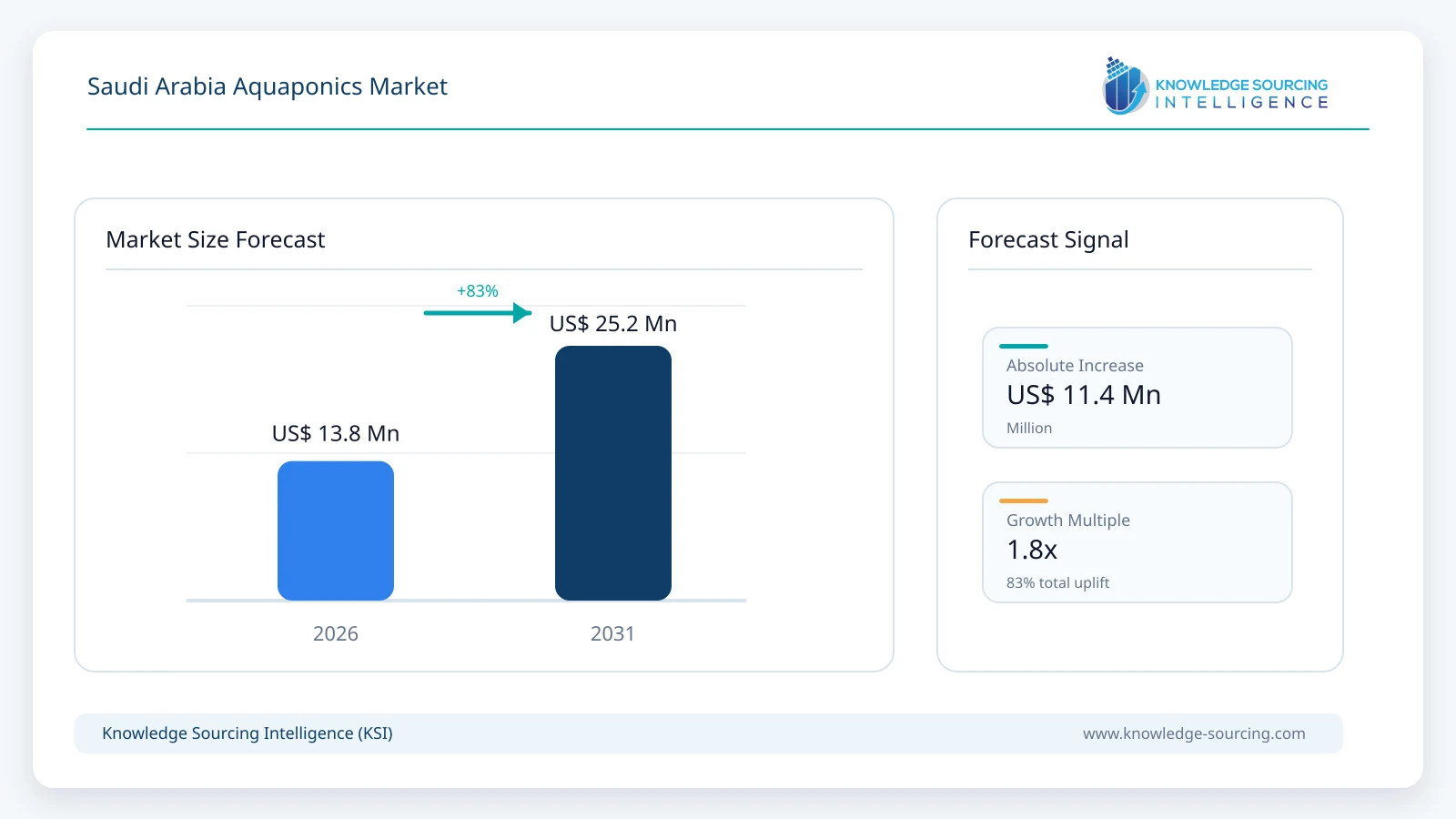
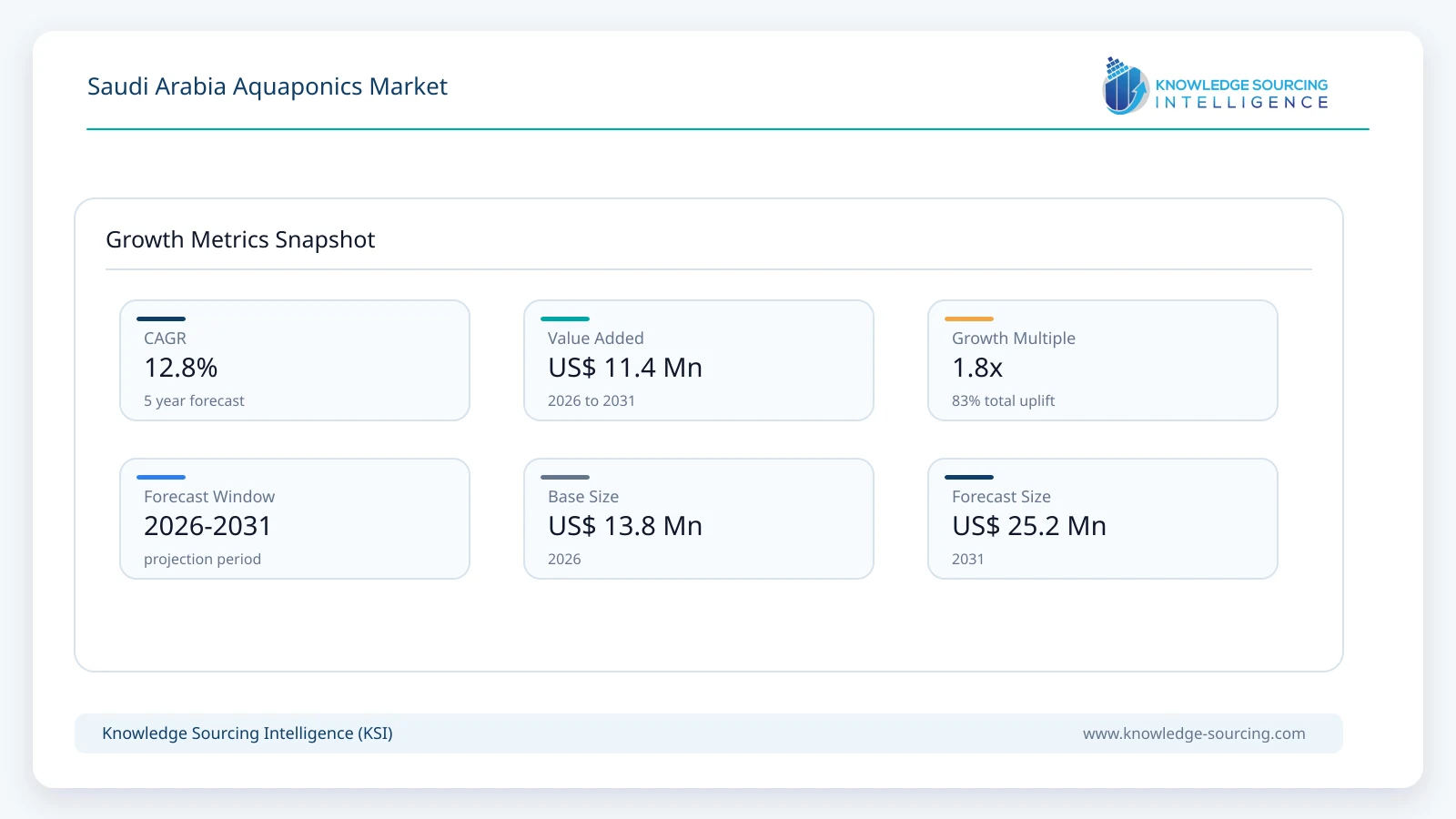
The Saudi Arabia aquaponics market is expected to rise from USD 13.8 million in 2026 to USD 25.2 million by 2031, expanding at a CAGR of 12.8% during the forecast period.
Highlights:
- 1Commercial aquaponics investment is moving toward larger, professionally engineered project footprints.
- 2Government investment opportunities now include aquaponics sites ranging from 40,000 to 80,000 m².
- 3Commercial farms remain the primary demand center for systems, integration and technical services.
- 4Deep water culture remains well suited to scalable leafy-green production alongside fish systems.
- 5Software and monitoring gain importance as biological stability becomes more costly to disrupt.
- 6Local recirculating aquaculture manufacturing improves commissioning, maintenance and spare-parts availability.
Saudi Arabia's aquaponics opportunity is supported by the country's wider move toward water-efficient agriculture and modern aquaculture. The Ministry of Environment, Water and Agriculture (MEWA) has promoted hydroponics, aquaponics, protected cultivation and advanced aquaculture as part of the effort to improve food security while reducing pressure on water resources. Aquaponics is attractive because it combines crop and fish production in a recirculating system, but its commercial economics depend on disciplined water-quality management, climate control, crop selection and fish performance. This makes the market more engineering-intensive than simple hydroponic installations.
The commercial base is no longer limited to small pilots. MEWA reported three licensed aquaponics projects in 2019 with combined planned production exceeding 15,000 tonnes of vegetables and fish. In 2024, a 40,000 m² aquaponics fish-farm opportunity was offered in Jubail. A separate 50,000 m² aquaponics opportunity was announced in Al-Aqiq in 2025, while an 80,000 m² aquaponics fish-culture opportunity appeared in Jubail in 2026. A reported 20,000 m² aquaponics project opportunity in Al-Ahsa was valued at SAR 72 million, indicating the capital intensity of fully integrated commercial farms.
Saudi capability is also broadening. Saudi Aquaculture Systems Factory (SAQUA) manufactures closed-water and recirculating aquaculture systems in Riyadh and offers aquaponics design, installation, training and after-sales support. A 1,066 m² aquaponics demonstration project developed with King Abdulaziz University and MEWA provides a local reference for integrated production, while the Hail Center of Excellence for Salmon Production includes a 1,000 m² aquaponics unit. Mowreq Specialized Agriculture also identifies aquaponics among its controlled-environment capabilities, reinforcing the shift toward domestic operating experience.
Selected Market Indicators
Indicator | Evidence | Commercial Relevance |
Licensed base | Three aquaponics projects licensed in 2019; combined planned output exceeded 15,000 tonnes | Shows that Saudi aquaponics has an established commercial licensing history. |
Commercial project benchmark | 20,000 m² aquaponics opportunity reported at SAR 72 million | Demonstrates the capital intensity of integrated fish-and-crop projects. |
2024 pipeline | 40,000 m² aquaponics fish-farm opportunity in Jubail | Supports larger Eastern Province project development. |
2025 pipeline | 50,000 m² aquaponics opportunity in Al-Aqiq | Broadens project activity beyond the main eastern cluster. |
2026 pipeline | 80,000 m² aquaponics fish-culture opportunity in Jubail | Raises the potential scale of the next project cycle. |
Market Trends
Aquaponics Is Moving Toward Larger Engineered Projects
Saudi project opportunities are becoming larger and more infrastructure-intensive. The progression from a 40,000 m² Jubail opportunity in 2024 to a 50,000 m² Al-Aqiq opportunity in 2025 and an 80,000 m² Jubail opportunity in 2026 points to a market in which commercial-scale engineering matters more than hobby or educational equipment. Larger systems require coordinated fish tanks, plant-production zones, solids separation, biological filtration, oxygenation, pumping, backup power, climate control and operating software. This increases the addressable revenue per project for integrators, equipment suppliers and service providers, while also raising the technical threshold for successful operation.
Local Manufacturing and Service Capability Are Becoming More Important
Aquaponics uptime is highly sensitive to pumps, oxygenation, water treatment and biological filtration. Local support therefore matters more than in agricultural systems where short equipment outages create less immediate biological risk. SAQUA's manufacturing and service presence provides Saudi operators with access to locally supported recirculating aquaculture system equipment, training and maintenance. International suppliers remain important for pumps, sensors, automation, lighting and environmental control, but local system integration can reduce spare-parts delays, improve commissioning and adapt equipment to local water chemistry and extreme temperatures.
Aquaponics Is Converging with Smart-Farm Monitoring
Continuous measurement is becoming central to commercial aquaponics. Dissolved oxygen, pH, temperature, conductivity, flow, water level and oxidation-reduction potential can change quickly and affect both fish and crops. Larger facilities therefore require connected sensors, automated alarms, remote dashboards and maintenance records. MEWA's 2026 agricultural innovation work identifies integrated aquaculture farm management, including aquaponics, among priority technology clusters, while a USD 5 million MEWA-CGIAR cooperation agreement focuses on high-tech agriculture, sustainable water management and digital tools. These developments support faster growth in software, controls and monitoring than in basic structural hardware.
Market Drivers
Water Scarcity Supports Closed-Loop Production
Water efficiency remains the strongest structural driver. Saudi agriculture operates in an arid environment where reducing dependence on non-renewable water is a long-term policy priority. Aquaponics recirculates water between fish and plant systems and can materially reduce discharge compared with conventional open production. The technology is most commercially relevant where water savings are combined with high-value crop production, fish revenue and reliable year-round output. The business case is therefore stronger for premium vegetables, herbs and specialty crops than for low-value commodity production.
Food-Security Policy Expands the Addressable Project Pipeline
Saudi Arabia continues to invest in modern agriculture and aquaculture as part of its food-security strategy. National aquaculture production has expanded sharply, while MEWA is promoting inland fish farming, closed systems and aquaponics through licensing, investment opportunities and technology programs. A larger domestic aquaculture ecosystem also improves access to technical skills, hatchery knowledge, fish health services, feed supply and water-treatment expertise. These capabilities lower barriers for integrated aquaponics projects that would otherwise require more imported operating knowledge.
Visible Investment Opportunities Improve Commercial Confidence
The number and size of publicly visible investment opportunities is important for suppliers because it creates a more identifiable project pipeline. The 40,000 m², 50,000 m² and 80,000 m² opportunities announced between 2024 and 2026 provide reference points for equipment vendors, engineering firms and investors evaluating the Saudi market. They do not guarantee immediate construction revenue, but they demonstrate that aquaponics is being incorporated into formal agricultural investment channels rather than treated only as a research or demonstration technology.
Market Restraints
Higher Integration Complexity Raises Capital and Operating Risk
Aquaponics combines aquaculture and soil-free cultivation, so operators must manage two biological production systems through a shared water loop. Pump or oxygenation failures can affect fish quickly, while nutrient imbalance, pH instability and temperature problems can reduce crop performance. Saudi summer conditions add cooling and water-temperature challenges, increasing the need for redundancy, environmental control and skilled technical staff. These requirements raise capital and operating costs compared with simpler hydroponic projects and can extend commissioning periods for inexperienced operators.
Hydroponics Retains a Larger Commercial Ecosystem
Hydroponics has a deeper supplier base, simpler production logic and wider adoption in protected agriculture. Many growers can achieve strong water savings and year-round production without taking on fish-health, feed and aquaculture-management risks. Aquaponics therefore competes for a narrower group of projects where combined fish and crop production creates sufficient commercial or strategic value. This limits the speed at which the technology can become a mainstream controlled-environment system even as the number of larger projects increases.
Market Opportunities
The strongest opportunities are in commercial system integration, modular recirculating aquaculture packages, water-treatment upgrades, farm automation, environmental controls and lifecycle technical services. The Eastern Province has the clearest large-project visibility through Jubail, while Riyadh benefits from engineering supply, system manufacturing and a large consumption market. Research and training installations also remain commercially relevant because they build local operating capability and create reference sites for investors. Suppliers able to combine feasibility support, engineering, commissioning, remote monitoring, operator training and maintenance are positioned more strongly than vendors selling isolated components.
Technological Outlook
Recirculating Aquaculture Systems and Biological Filtration
Recirculating Aquaculture Systems (RAS) form the technical core of commercial aquaponics. Mechanical solids removal, nitrification biofilters, oxygenation, circulation and disinfection determine fish health and the stability of nutrient flows to the plant system. Saudi manufacturing capability is improving the availability of modular RAS packages and factory-assembled treatment skids. Through 2031, larger projects are expected to use more standardized treatment modules, greater equipment redundancy and stronger integration between fish and crop zones.
Sensors, Controls and Remote Monitoring
Connected sensing is becoming a standard requirement for larger projects. Continuous monitoring of dissolved oxygen, pH, temperature, conductivity, flow and water level allows operators to identify problems before they cause mortality or yield loss. Software and monitoring revenue should expand faster than basic hardware because every increase in project scale raises the cost of biological instability. Remote alarms, predictive maintenance, digital logs and camera-based monitoring are therefore moving from optional features toward normal commercial operating tools.
Climate Control and Energy Efficiency
Extreme heat makes climate control an important design variable for Saudi aquaponics. Operators must manage both plant-air conditions and water temperature, creating demand for insulated structures, efficient cooling, thermal screens, heat rejection and energy-management controls. This favours integrated project design rather than treating the fish loop and crop greenhouse as separate systems. Energy efficiency becomes particularly important for inland projects using intensive cooling, artificial lighting or high stocking densities.
Saudi Arabia Aquaponics Market Segment Analysis
By System Type
Deep Water Culture
Deep Water Culture (DWC) is the leading system type for scalable Saudi aquaponics projects because floating-raft production works well with leafy greens and herbs, provides a stable root environment and can be integrated with larger water-treatment loops. Nutrient Film Technique (NFT) remains relevant for lighter-rooted crops, while media-filled growbeds are more common in smaller systems and training installations. Vertical and hybrid configurations remain an emerging category where land efficiency or premium urban production justifies additional complexity.
By Offering
Software and Monitoring
Software and monitoring represent the fastest-growing offering through 2031. Hardware continues to account for the largest portion of new-project expenditure, but the installed base creates recurring demand for sensors, calibration, alarms, data logging and remote operational support. Commercial operators increasingly require traceability and rapid fault detection because water-quality disruption can simultaneously affect fish survival and plant performance. This shifts part of the market from one-time construction revenue toward recurring digital and service expenditure.
Market and Demand Indicators
Indicator | Development | Market Impact |
Commercial investment benchmark | A 20,000 m² aquaponics opportunity was reported at SAR 72 million in 2025. | Shows that integrated commercial projects can carry substantial systems and engineering expenditure. |
Jubail project pipeline | Aquaponics opportunities expanded from 40,000 m² in 2024 to 80,000 m² in 2026. | Supports a larger addressable project envelope for suppliers and integrators. |
Al-Aqiq opportunity | MEWA announced a 50,000 m² aquaponics farm opportunity in September 2025. | Adds geographic diversification to the project pipeline. |
Local technology base | SAQUA manufactures RAS and aquaponics systems in Riyadh and provides lifecycle support. | Improves local serviceability and reduces dependence on fully imported integration. |
Digital agriculture support | MEWA and CGIAR signed a USD 5 million high-tech agriculture cooperation agreement in January 2026. | Supports technology transfer, water-efficiency research and digital-farming adoption. |
Recent Developments
September 2026: Furas listed an 40,000 m² aquaponics fish-culture opportunity in Jubail, Eastern Province.
July 2026: Mowreq Specialized Agriculture joined SABIC Home of Innovation with aquaponics among its controlled-environment capabilities.
July 2026: King Abdulaziz University, represented by its Faculty of Marine Sciences, in partnership with the Ministry of Environment, Water and Agriculture (via the National Livestock and Fisheries Development Program), inaugurated the rehabilitation and development project of its fish farm facility in Obhur, Jeddah.
January 2026: MEWA signed a USD 5 million cooperation agreement with CGIAR covering high-tech agriculture, water efficiency and digital tools.
September 2025: MEWA announced a 50,000 m² aquaponics farm opportunity in Al-Aqiq, Al-Baha Region.
December 2024: The Hail Center of Excellence for Salmon Production opened with a 1,000 m² aquaponics unit.
Competitive Landscape
The Saudi aquaponics competitive environment spans local system integrators, controlled-environment farm operators and international suppliers of water treatment, pumps, sensors, greenhouse systems, automation and lighting. SAQUA has a distinctive local position because it manufactures RAS equipment and supports aquaponics design, installation and after-sales service. Mowreq contributes operating experience in controlled-environment agriculture, while Aquaponica Co. and Ghiras Alsahraa represent smaller specialist participants focused on aquaponic design, farming and project development.
International suppliers compete primarily through technology layers rather than complete Saudi farm ownership. Priva, Netafim, Richel Group, Pentair, Xylem, AKVA group, OxyGuard and Signify can address climate control, irrigation, pumping, water treatment, aquaculture systems, oxygen monitoring and horticultural lighting. Competitive advantage is therefore based on integration capability, reference projects, local technical support, equipment reliability and the ability to support operators after commissioning. Because the market remains relatively small and project-driven, individual project awards can materially change supplier positions from year to year.
Saudi Arabia Aquaponics Market Scope:
| Report Metric | Details |
|---|---|
| Total Market Size in 2026 | USD 13.8 million |
| Total Market Size in 2031 | USD 25.2 million |
| Forecast Unit | Million |
| Growth Rate | 12.8% |
| Study Period | 2021 to 2031 |
| Historical Data | 2021 to 2024 |
| Base Year | 2025 |
| Forecast Period | 2026 – 2031 |
| Segmentation | System Type, Offering, Application, End User |
| Companies |
|
| Customization Scope | 15% Free Customization included with purchase — Request Custom Breakdown → |
| Sample & Data Access | PDF Sample, Excel Databook & Analyst Briefing — Download Free Sample → |
Market Segmentation
BY SYSTEM TYPE
Media-Filled Growbeds (MFG)
Nutrient Film Technique (NFT)
Deep Water Culture (DWC)
Vertical and Hybrid Aquaponics
Others
BY OFFERING
Hardware
Software and Monitoring
Services
BY APPLICATION
Fish
Vegetables
Herbs and Microgreens
Fruits and Specialty Crops
BY END USER
Commercial Farms
Research and Education
Residential and Hobbyist
BY REGION
Riyadh Region
Eastern Province
Makkah / Jeddah Region
Other Regions
Table of Contents
1. EXECUTIVE SUMMARY
2. MARKET SNAPSHOT
2.1. Market Overview
2.2. Market Segmentation
3. BUSINESS LANDSCAPE
3.1. Market Drivers
3.1.1. Water Scarcity Supports Closed-Loop Production
3.1.2. Food-Security Policy Expands the Addressable Project Pipeline
3.1.3. Visible Investment Opportunities Improve Commercial Confidence
3.2. Market Restraints
3.2.1. Higher Integration Complexity Raises Capital and Operating Risk
3.2.2. Hydroponics Retains a Larger Commercial Ecosystem
3.3. Market Opportunities
3.4. Porter's Five Forces Analysis
3.5. Industry Value Chain Analysis
3.6. Policies and Regulations
4. TECHNOLOGICAL OUTLOOK
4.1. Recirculating Aquaculture Systems and Biological Filtration
4.2. Sensors, Controls and Remote Monitoring
4.3. Climate Control and Energy Efficiency
5. SAUDI ARABIA AQUAPONICS MARKET BY SYSTEM TYPE
5.1. Media-Filled Growbeds (MFG)
5.2. Nutrient Film Technique (NFT)
5.3. Deep Water Culture (DWC)
5.4. Vertical and Hybrid Aquaponics
5.5. Others
6. SAUDI ARABIA AQUAPONICS MARKET BY OFFERING
6.1. Hardware
6.2. Software and Monitoring
6.3. Services
7. SAUDI ARABIA AQUAPONICS MARKET BY APPLICATION
7.1. Fish
7.2. Vegetables
7.3. Herbs and Microgreens
7.4. Fruits and Specialty Crops
8. SAUDI ARABIA AQUAPONICS MARKET BY END USER
8.1. Commercial Farms
8.2. Research and Education
8.3. Residential and Hobbyist
9. SAUDI ARABIA AQUAPONICS MARKET BY REGION
9.1. Riyadh Region
9.2. Eastern Province
9.3. Makkah / Jeddah Region
9.4. Other Regions
10. COMPETITIVE ENVIRONMENT AND ANALYSIS
10.1. Major Players and Strategy Analysis
10.2. Market Share Analysis
10.3. Agreements, Projects and Collaborations
10.4. Competitive Dashboard
11. COMPANY PROFILES
11.1. Saudi Aquaculture Systems Factory Company (SAQUA)
11.2. Mowreq Specialized Agriculture Company
11.3. Aquaponica Co.
11.4. Ghiras Alsahraa
11.5. Pure Harvest Smart Farms
11.6. iyris (formerly RedSea)
11.7. Priva
11.8. Netafim Ltd.
11.9. Richel Group
11.10. Pentair plc
11.11. Xylem Inc.
11.12. AKVA group ASA
11.13. OxyGuard International A/S
11.14. Signify N.V. (Philips Horticulture LED Solutions)
11.15. Nelson and Pade, Inc.
11.16. ECF Farmsystems GmbH
12. RECENT DEVELOPMENTS
13. APPENDIX





Frequently asked questions
What is the forecast for Saudi Arabia's aquaponics market size?
The Saudi Arabia Aquaponics Market is projected to reach USD 25.2 million by 2031, growing at 12.8% CAGR.
What drives the Saudi Arabia aquaponics market growth?
Water efficiency, food security, and government support are key drivers.
What are the key investment trends in Saudi Arabia aquaponics?
Investment is shifting towards larger, professionally engineered project footprints.
How is the Saudi government supporting aquaponics development?
MEWA promotes advanced agriculture for food security and water efficiency.
What is the scale of commercial aquaponics projects in Saudi Arabia?
Projects range from 40,000 to 80,000 m² with significant capital intensity.
Which aquaponics methods are prominent in Saudi Arabia?
Deep water culture for leafy greens, software, and local manufacturing are important.
Cite this report
Knowledge Sourcing Intelligence. (Sep 2026). Saudi Arabia Aquaponics Market - Strategic Insights and Forecasts (2026-2031). https://www.knowledge-sourcing.com/report/saudi-arabia-aquaponics-market