
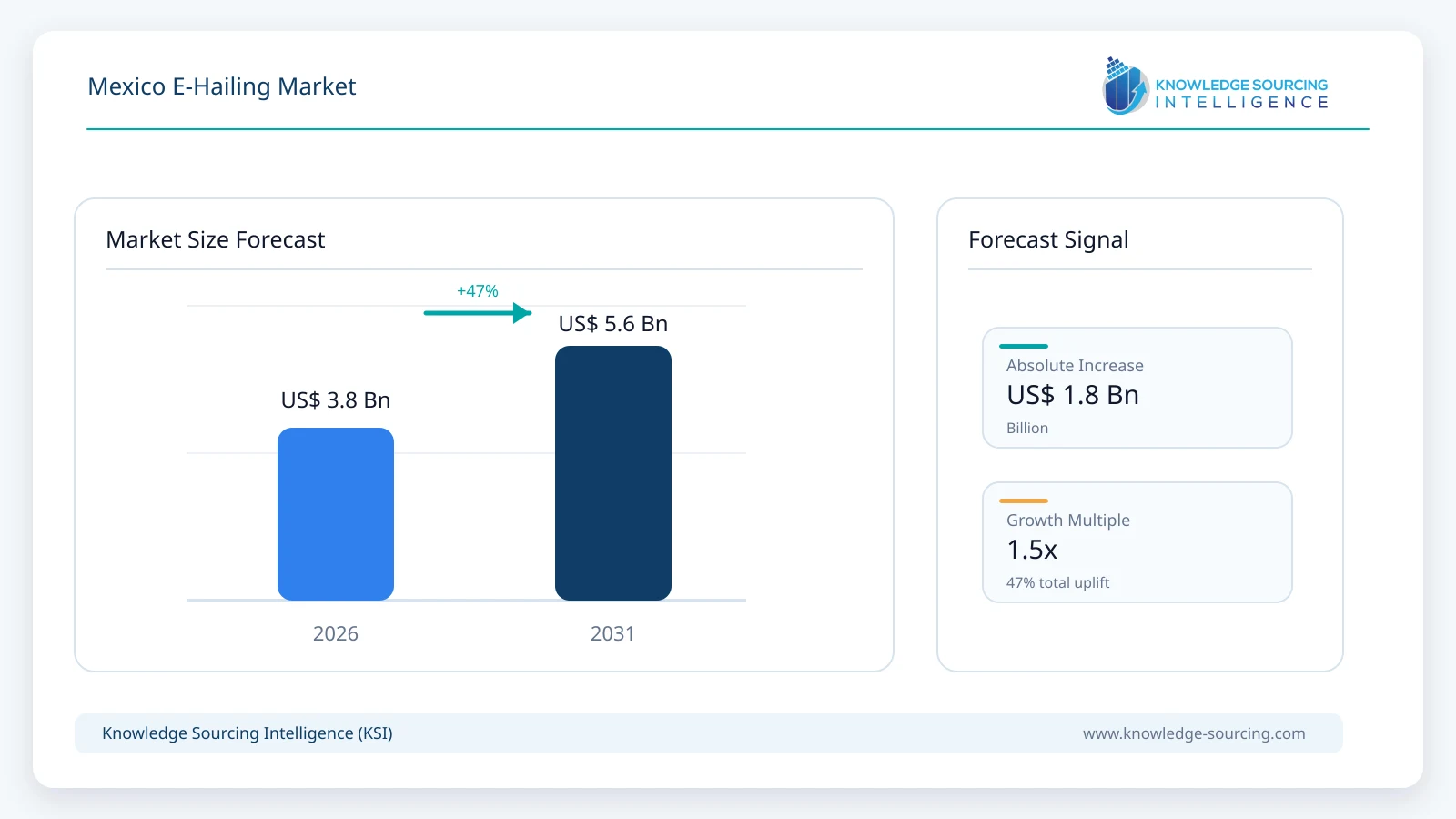
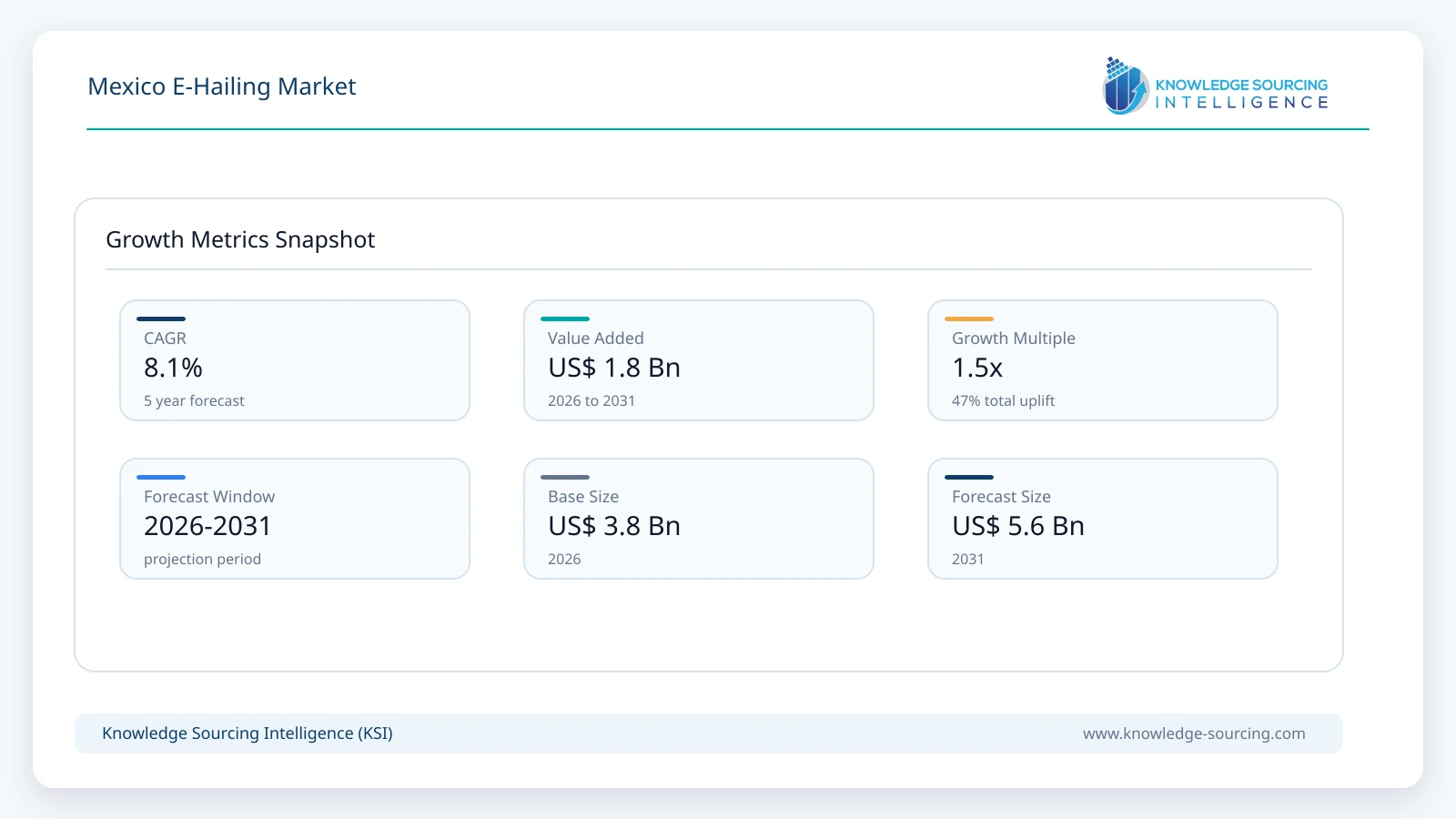
The Mexico e-hailing market is estimated at USD 3.80 billion in 2026 and is forecast to reach approximately USD 5.60 billion in 2031, representing a CAGR of 8.1% throughout the forecast period.
Highlights:
- 1Four-wheel passenger-car e-hailing accounts for approximately 89% of estimated 2026 market value.
- 2Personal B2C trips represent approximately 87% of 2026 gross booking value, with corporate/business travel forming a smaller but higher-value segment.
- 3Mexico City and its metropolitan area account for approximately 40% of 2026 e-hailing value because of population density, congestion, airport/business travel and platform penetration.
- 4Uber, DiDi and inDrive form the national competitive core, while Bolt and Eiby Taxi add selective competition in app-based private-car or licensed-taxi services.
- 5The market remains structurally attractive but highly competitive, with driver economics, safety, regulation, insurance, platform commissions and vehicle access shaping future growth.
Mexico E-Hailing Market Trends
National Platforms Deepen Driver Infrastructure
Competition is moving beyond rider acquisition into driver retention and vehicle access. inDrive opened Casa inDrive in Mexico City in August 2026 after completing more than 100 million trips in Mexico during the first half of the year. The center provides account activation, support, safety training and access to partner programs, illustrating how platforms are building physical infrastructure around a digital marketplace.
Vehicle Access Becomes a Competitive Lever
Vehicle financing and rental access can constrain driver supply. In May 2026, inDrive and OCN announced a program targeting more than 1,000 vehicles in more than 10 Mexican cities through a rent-to-own model. Similar fleet-access models can increase active-driver supply and accelerate adoption of newer hybrid and electric vehicles without requiring drivers to make large upfront purchases.
Licensed-Taxi Apps Retain a Distinct Role
Eiby Taxi demonstrates that digital dispatch is not limited to private-car platforms. The Mexican app connects passengers with licensed taxi drivers and currently lists service in cities including Mexico City, Tijuana, Ensenada, Guadalajara, Merida and Cancun. Its app was updated in September 2026, showing continued operation within a regulated-taxi model.
Scale Expands Beyond the Largest Cities
Uber and DiDi both maintain broad city coverage across Mexico, while inDrive operates nationally and Bolt offers ride-hailing service in Mexico. Expansion into secondary cities increases trip availability but can lower average fare and utilization compared with the largest metropolitan areas. Competitive intensity is therefore likely to rise faster than headline passenger value in some locations.
Mexico E-Hailing Market Segment Analysis
By Vehicle Type
Four-Wheel Passenger Cars
Four-wheel passenger-car rides are estimated at approximately USD 3.38 billion in 2026, or 89% of market value. Private cars and app-dispatched sedans remain the default e-hailing format because they suit urban commuting, airport travel, business trips and family journeys. Two-wheel and specialty services are meaningful in selected locations but represent a much smaller value pool in Mexico than passenger cars.
By Rider Type
Personal B2C
Personal B2C demand is estimated at approximately USD 3.31 billion in 2026, or 87% of market value. Daily mobility, social/leisure trips, airport rides and substitution for private cars and street-hailed taxis form the core volume. Corporate accounts account for the remaining approximately 13% and typically carry higher average trip values, centralized billing and stronger weekday/business-district concentration.
By Geography
Mexico City Metropolitan Area
Mexico City and its metropolitan area are estimated at approximately USD 1.52 billion in 2026, or 40% of market value. The concentration reflects the region’s population, business activity, airport traffic, congestion and platform density. Guadalajara and Monterrey form the next tier, followed by tourist and regional centers such as Cancun/Riviera Maya, Tijuana, Puebla, Queretaro and other cities.
Market Drivers
High smartphone and mobile-internet penetration supporting app-based booking, payments and safety features.
Urban congestion and the cost of private-vehicle ownership increasing demand for on-demand mobility.
Expansion of ride-hailing platforms into secondary cities and tourism markets.
Driver-financing, rental and fleet-access programs that broaden the available supply of vehicles.
Growing corporate adoption, digital payments, in-app safety tools and real-time trip tracking.
Market Restraints
Driver earnings pressure from fuel, insurance, financing and maintenance costs.
State and municipal regulatory variation, including licensing, taxation and airport-access rules.
Safety concerns for riders and drivers and the cost of continuous trust-and-safety investment.
Heavy promotional and pricing competition among major platforms.
Congestion and long pickup times in dense urban markets, which can reduce driver utilization.
Competitive Environment
The competitive set is concentrated around operators with directly verifiable current Mexico operations. Uber, DiDi, inDrive, Bolt and Eiby Taxi are included in the core participant set. Cabify is excluded because it ceased Mexico operations on October 11, 2024. KEKO is excluded from the defined market because its core proposition is car rental/carsharing rather than passenger e-hailing, while BlaBlaCar is principally an intercity carpool marketplace. Lyft is also excluded because current local ride-hailing operations in Mexico could not be verified from primary or current operational sources.
Uber and DiDi compete on nationwide scale, product breadth and established driver/rider networks. inDrive differentiates through its pricing model and has expanded driver-support infrastructure. Bolt adds international app competition, while Eiby Taxi serves the licensed-taxi channel. The market is therefore concentrated at the national level but fragmented at the edge by taxi cooperatives, local apps and specialist services.
Recent Developments
September 2026: Eiby Taxi continued active app development, with its passenger application updated during September and service listed across multiple Mexican cities.
May 2026: inDrive and OCN announced a vehicle-access partnership targeting more than 1,000 units across more than 10 Mexican cities.
February 2026: inDrive and the Mexican Internet Association reported more than 200 million trips completed through inDrive in Mexico during 2025.
2026: DiDi continued to report operations in more than 50 Mexican cities, while Uber maintained broad nationwide city coverage and Bolt marketed ride-hailing service in Mexico.
Market Outlook
Mexico’s e-hailing market should continue expanding through 2031, but the character of growth is changing. The largest cities are increasingly mature, so future gains depend on secondary-city penetration, higher trip frequency, corporate use, improved driver supply and platform differentiation rather than first-time app adoption alone. Operators that improve driver economics, safety, service reliability and localized regulatory relationships are likely to sustain volume without relying exclusively on discounts.
Mexico E-Hailing Market Scope:
| Report Metric | Details |
|---|---|
| Total Market Size in 2026 | USD 3.80 billion |
| Total Market Size in 2031 | USD 5.60 billion |
| Forecast Unit | Billion |
| Growth Rate | 8.1% |
| Study Period | 2021 to 2031 |
| Historical Data | 2021 to 2024 |
| Base Year | 2025 |
| Forecast Period | 2026 – 2031 |
| Segmentation | Vehicle Type, Rider Type, City Cluster |
| Companies |
|
Market Segmentation
By Vehicle Type
Four-Wheel Passenger Cars
Two-Wheelers and Other Vehicles
By Rider Type
Personal / B2C
Corporate / Business
By City Cluster
Mexico City Metropolitan Area
Guadalajara
Monterrey
Cancun / Riviera Maya
Tijuana and Baja California
Other Mexican Cities
Table of Contents
1. INTRODUCTION
1.1. Market Overview
1.2. Market Definition and Scope
1.3. Revenue Reference Point
1.4. Currency and Assumptions
2. RESEARCH METHODOLOGY
2.1. Secondary Research
2.2. Platform and Company Validation
2.3. Market Estimation and Trip-Volume Triangulation
3. EXECUTIVE SUMMARY
3.1. Key Findings
3.2. Mexico Market Size, 2026-2031
4. MARKET DYNAMICS
4.1. Market Drivers
4.2. Market Restraints
4.3. Regulatory and Driver-Economics Considerations
5. MEXICO E-HAILING MARKET BY VEHICLE TYPE
5.1. Four-Wheel Passenger Cars
5.2. Two-Wheelers and Other Vehicles
6. MEXICO E-HAILING MARKET BY RIDER TYPE
6.1. Personal / B2C
6.2. Corporate / Business
7. MEXICO E-HAILING MARKET BY CITY CLUSTER
7.1. Mexico City Metropolitan Area
7.2. Guadalajara
7.3. Monterrey
7.4. Cancun / Riviera Maya
7.5. Tijuana and Baja California
7.6. Other Mexican Cities
8. COMPETITIVE ENVIRONMENT AND ANALYSIS
8.1. National Platform Competition
8.2. Driver Supply and Vehicle Access
8.3. Licensed-Taxi Apps
8.4. Safety, Pricing and Service Differentiation
9. COMPANY PROFILES
9.1. Uber Technologies, Inc.
9.2. DiDi Global Inc.
9.3. inDrive
9.4. Bolt Technology OÜ
9.5. Eiby Taxi / Tech Taxi México, S.A. de C.V.
10. APPENDIX
10.1. Currency
10.2. Assumptions
10.3. Abbreviations
Navigate
Trusted by the world's leading organizations











