
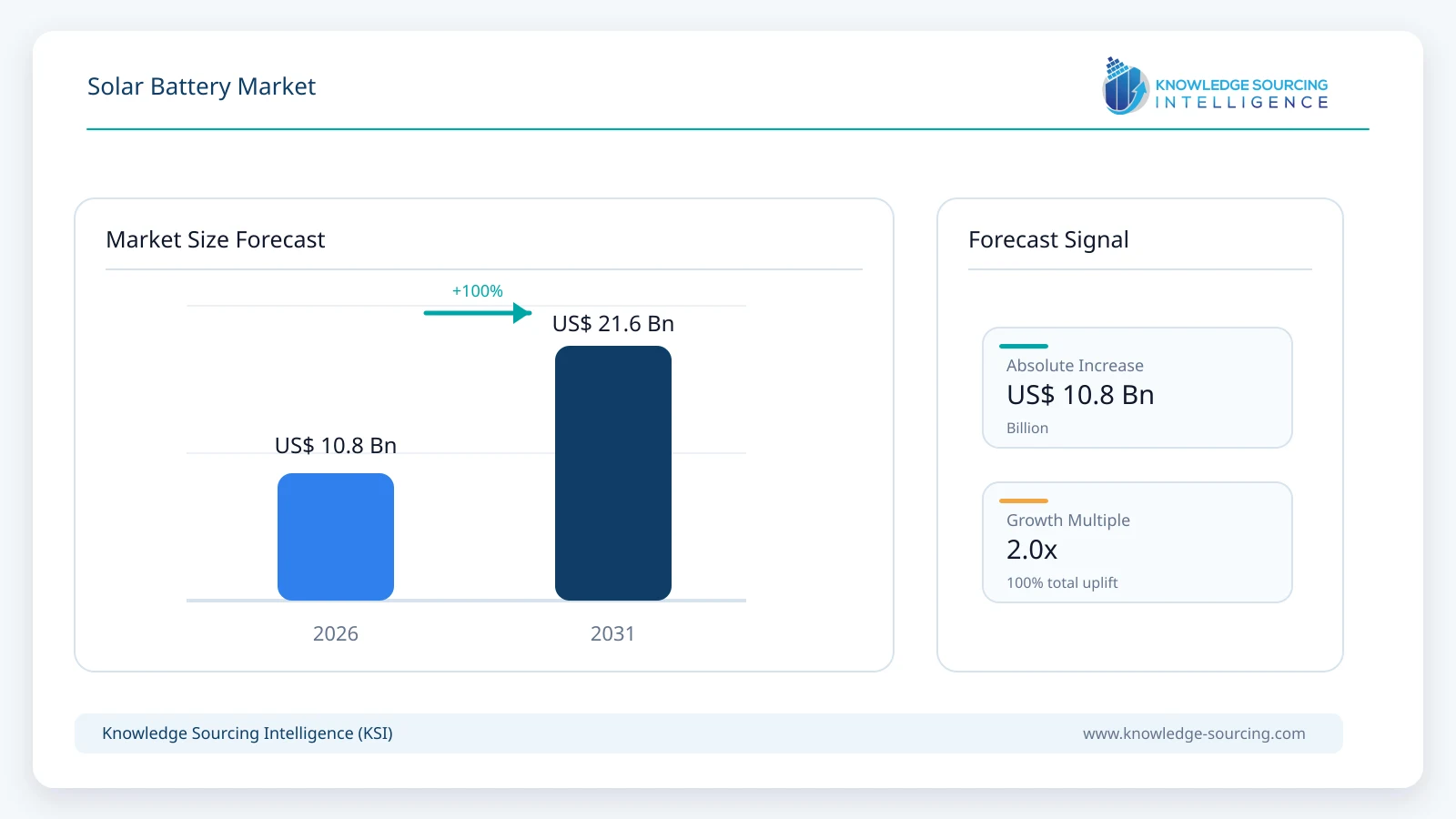
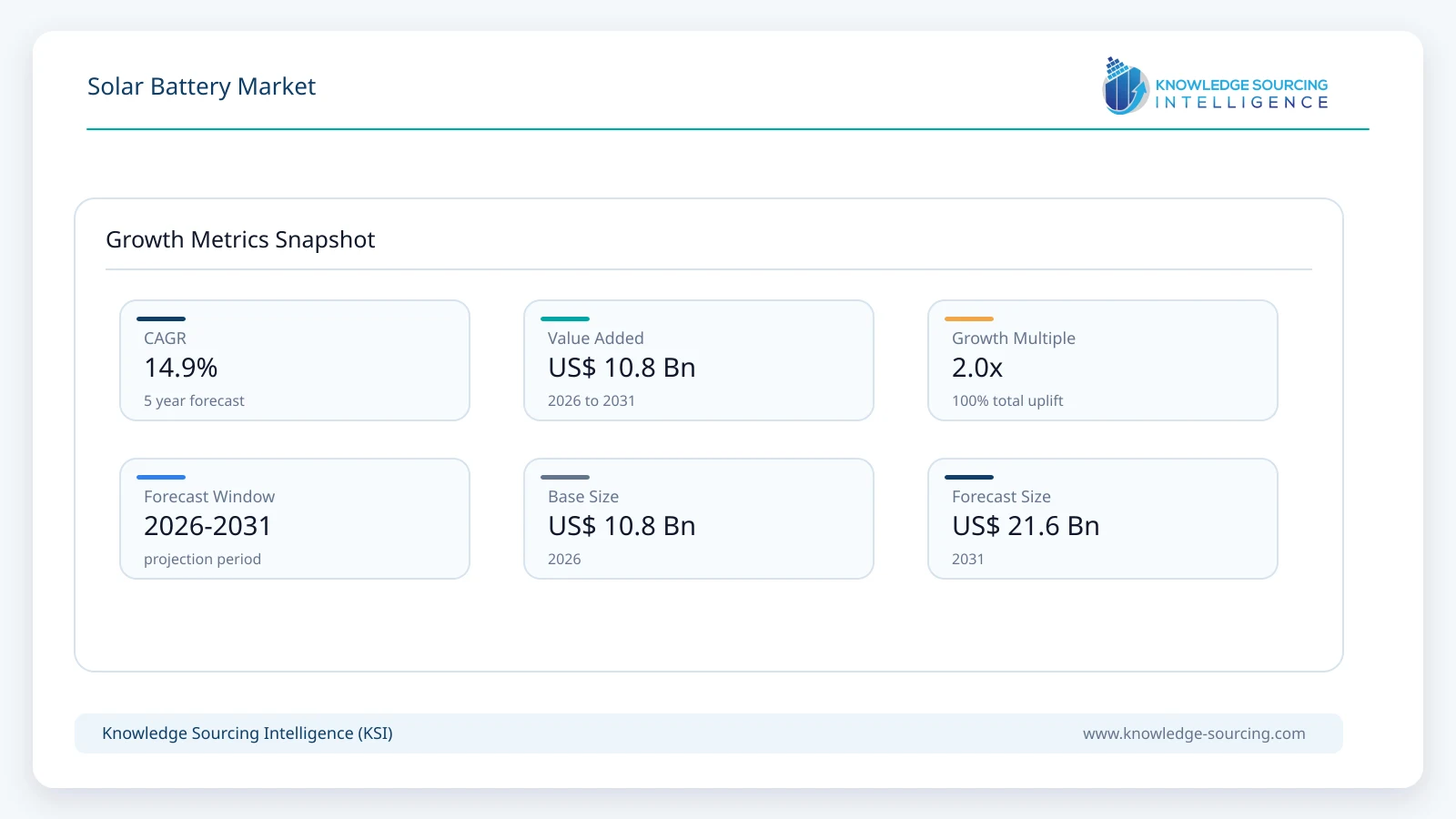
The solar battery market is forecast to grow at a CAGR of 14.9%, increasing from approximately USD 10.8 billion in 2026 to USD 21.6 billion in 2031.
Highlights:
- 1Lithium-ion batteries account for approximately 87% of solar battery market value in 2026 as LFP chemistry increasingly dominates new stationary-storage installations.
- 2Systems with power output above 5 kW represent approximately 54% of market value in 2026 as household systems become larger and commercial solar-plus-storage adoption expands.
- 3Residential applications account for approximately 59% of global solar battery market value in 2026, supported by rooftop solar, backup-power requirements and time-of-use electricity tariffs.
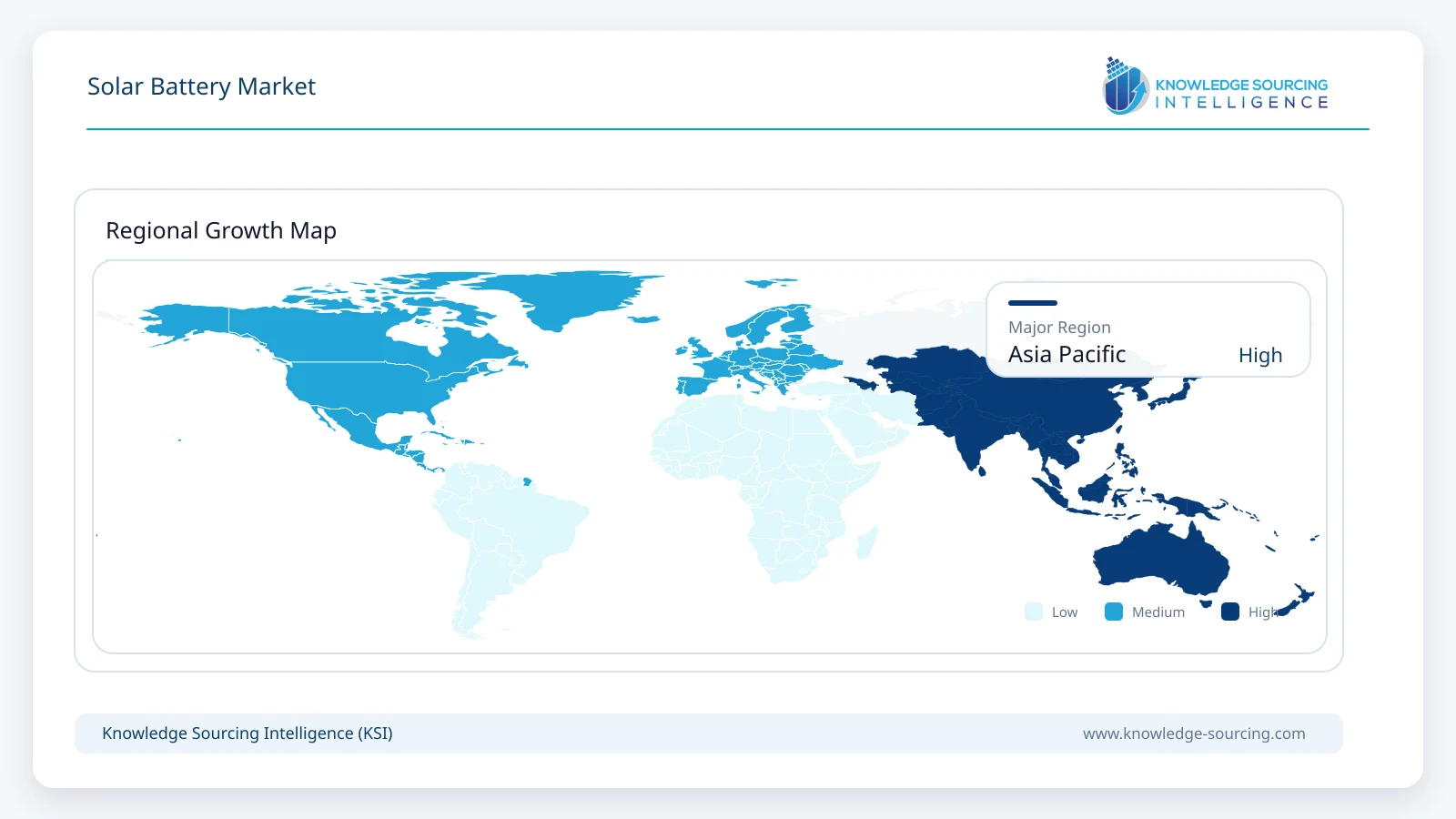
- 4Asia Pacific represents approximately 38% of global solar battery market value in 2026, led by China, Australia, Japan, India and expanding Southeast Asian distributed-energy markets.
- 5Asia Pacific is also projected to record the strongest regional growth at approximately 17.3% annually between 2026 and 2031.
The market covers battery packs and integrated battery units used primarily with distributed solar PV systems across homes, commercial buildings and smaller industrial installations. Utility-scale battery energy storage projects and stand-alone grid batteries that are not associated with distributed solar installations are excluded.
Solar battery adoption is becoming increasingly important as distributed photovoltaic capacity expands. The International Energy Agency estimates that solar PV installations surpassed 600 GW globally in 2025, taking cumulative solar capacity to around 2,800 GW. Distributed solar across residential, commercial, industrial and off-grid applications is expected to account for approximately 42% of global PV capacity expansion between 2025 and 2030.
Battery adoption is also accelerating rapidly behind the meter. Australia added approximately 3.4 GW of behind-the-meter battery capacity in 2025, while more than 268,000 home battery units were installed during the year. Europe added 36 GWh of battery capacity in 2025, with distributed residential and commercial systems continuing to represent a substantial component despite utility-scale storage overtaking them as the largest segment.
Solar batteries store electricity generated by photovoltaic panels for use when solar production falls below electricity demand. Residential systems typically shift daytime solar generation into evening consumption, provide backup during power outages and increasingly respond automatically to electricity tariffs and grid signals.
The market is moving away from separate batteries, inverters and controllers toward integrated energy systems. Tesla Powerwall 3 combines 13.5 kWh of energy capacity with an integrated solar inverter and 11.5 kW continuous power capability. Enphase, Sungrow, Growatt, Huawei and other suppliers are pursuing similar integrated architectures combining batteries, hybrid inverters, backup functionality and software-based energy management.
Tesla reports that more than one million Powerwall units have now been installed globally. The company’s global home-battery network participated in more than 89,000 virtual-power-plant events during 2025, demonstrating how residential batteries are becoming distributed grid assets rather than operating exclusively as household backup systems.
Lithium-ion technology has displaced most alternative chemistries in new installations. The IEA estimates that LFP chemistry accounted for around 80% of new battery-storage installations as early as 2023 because stationary systems place greater emphasis on cost, durability and safety than on maximum energy density. Battery costs have fallen approximately 90% since 2010, fundamentally improving the economics of solar-plus-storage.
Lead-acid technology continues to retain a position in lower-cost off-grid and backup systems, particularly in price-sensitive developing markets, but its lower cycle life and usable depth of discharge are limiting its position in digitally managed daily-cycling applications.
Market Trends
Solar Batteries Are Becoming Integrated Home-Energy Platforms
Battery manufacturers are increasingly combining storage with hybrid inverters, solar controls, backup switching, EV charging and digital energy-management systems.
Sungrow launched PowerHarbor in June 2026 as an integrated residential storage platform with 10–30 kW power ratings and modular battery configurations expandable to 120 kWh. Growatt followed with its MINA system in August 2026, integrating storage, solar management and backup within a single residential architecture.
The trend reduces installation complexity while increasing supplier control over the complete household energy ecosystem. Battery purchasing decisions are consequently becoming linked to inverter compatibility, energy-management software, backup performance and EV integration rather than battery specifications alone.
Residential Batteries Are Becoming Virtual Power Plant Assets
Aggregation platforms allow thousands of household batteries to operate collectively as a flexible power resource. Batteries can charge when electricity is inexpensive or solar generation is abundant and discharge during periods of high system demand.
Tesla reported more than 89,000 virtual-power-plant events across its global Powerwall network during 2025. sonnen is expanding a virtual power plant in Texas that could add as many as 10,000 customers and provide approximately 600 MWh of flexible capacity.
This capability creates additional economic value beyond solar self-consumption and backup power. Utilities and grid operators can use aggregated batteries for peak management, demand response and grid-support services while household owners can receive payments or electricity credits.
Commercial Solar Storage Is Moving Toward Standardized Modular Systems
Residential-storage suppliers are moving upward into small commercial systems as battery and power-electronics architectures become increasingly modular.
Enphase opened U.S. pre-orders for its first commercial storage product, the IQ Battery C80, in August 2026. The system provides 80 kWh of usable storage and up to 40 kVA continuous power in a single enclosure and is designed to operate within complete commercial solar-plus-storage systems.
sonnen launched the sonnenPro Compact 261 in June 2026 for small and medium-sized businesses, with 261 kWh of capacity and 125 kW of power. These products illustrate the increasing convergence between larger residential systems and standardized small-commercial storage.
Market Drivers
Rapid Expansion of Distributed Solar PV
Solar PV created more new power-generation capacity than any other renewable technology in 2025. Global solar additions exceeded 600 GW, lifting cumulative capacity to approximately 2,800 GW. China alone installed nearly 370 GW, India added almost 50 GW and European Union additions approached 70 GW.
Distributed installations are particularly important for solar batteries because the battery is positioned behind the electricity meter and can directly increase self-consumption. The IEA expects residential, commercial, industrial and off-grid distributed solar to account for approximately 42% of worldwide PV capacity expansion between 2025 and 2030.
Each additional rooftop or onsite solar installation creates a potential future battery customer even where the battery is not installed simultaneously. Retrofit demand is becoming increasingly relevant as existing solar households add storage later.
Falling Battery Costs Are Improving Solar-Storage Economics
Lithium-ion battery costs have declined approximately 90% since 2010. The IEA recorded prices below USD 140 per kWh by 2023 and expects continued reductions in battery-system capital costs through the remainder of the decade.
Cost reductions are being accompanied by improvements in power output, cycle life and integration. Australia’s Clean Energy Council reported that battery costs fell approximately 20% during 2025 while home battery installations increased 260% year over year.
Manufacturers are also reducing cost through standardized LFP cells, modular enclosures and integrated hybrid inverters. Enphase stated in 2026 that its next-generation battery architecture is expected to provide approximately 50% higher energy density while reducing cost by about 40% compared with its IQ Battery 10C generation.
Backup Power and Electricity-Tariff Optimization Are Increasing Battery Value
Solar batteries increasingly provide three distinct economic functions: storing excess solar generation, supplying electricity during grid outages and avoiding electricity purchases during high-tariff periods.
Australia illustrates how quickly demand can accelerate when these benefits combine with policy support. More than 268,000 home batteries were installed in 2025, taking the cumulative household base to approximately 454,000 systems by year-end. More than 4.3 million Australian homes already have rooftop solar, creating a large potential retrofit market.
The United States is following a similar direction. SEIA reported that more than 28% of new residential solar capacity was paired with storage in 2024, compared with less than 12% in 2023.
Market Restraints
Installed Cost Remains High for Residential Customers
Battery prices have fallen substantially, but the complete installed cost remains a meaningful barrier for households.
The U.S. Department of Energy’s Q1 2024 benchmark placed the modeled market price of an 8 kW residential PV system at approximately USD 3.15/W, while an 8 kW PV system paired with 13.5 kWh of battery storage increased to approximately USD 5.19/W. This implies an additional capital requirement of more than USD 16,000 for storage and associated equipment in the benchmark configuration.
Financing, installation labor, backup hardware, electrical-panel upgrades and permitting can therefore remain important parts of the total customer cost even when battery-cell prices decline.
Residential Demand Remains Sensitive to Incentives and Electricity-Market Design
Solar-battery economics vary considerably according to electricity tariffs, export compensation, tax credits and direct subsidies.
Europe demonstrates this sensitivity. The region installed a record 36 GWh of batteries in 2025, but utility-scale systems generated more than half of additions while residential installations weakened after the exceptional growth associated with the earlier energy-price crisis.
Australia moved in the opposite direction after policy support strengthened. Home battery installations increased 260% during 2025 following the introduction of the federal Cheaper Home Batteries Program and complementary state incentives.
Sharp changes in incentive structures can therefore accelerate or temporarily suppress household purchasing even when the underlying technology continues improving.
Segment Analysis
By Phase Type: Lithium-Ion Battery
Lithium-ion remains the dominant solar battery technology because it combines high round-trip efficiency, long cycle life, compact installation and compatibility with digitally controlled power electronics.
Within lithium-ion, LFP has become increasingly important because stationary storage does not require the maximum gravimetric energy density demanded by electric vehicles. Its cycle life, comparatively strong thermal characteristics and avoidance of nickel and cobalt make it particularly suitable for daily solar charging and discharging.
The lithium-ion solar battery segment is projected to reach approximately USD 19.8 billion by 2031, representing growth of about 16.3% annually from 2026. Its expansion is supported by continued replacement of lead-acid systems in daily-cycling applications and wider use of modular residential storage.
By Power Output: Greater Than 5 kW
Systems above 5 kW represent the leading power-output category as homeowners increasingly install whole-home backup systems capable of supporting air-conditioning, heat pumps, pumps and other relatively high-load equipment.
Tesla’s Powerwall 3 provides 11.5 kW of continuous output from a single unit, while Sungrow’s PowerHarbor residential platform ranges from 10 kW to 30 kW. These specifications illustrate how modern home-storage products are moving well beyond the lower-output systems associated with early residential batteries.
The greater-than-5-kW segment is projected to reach approximately USD 12.8 billion by 2031. Expansion is also being supported by small commercial installations, where multiple battery modules can be combined into substantially larger systems while retaining standardized product architectures.
By End User: Residential
Residential installations remain the largest end-user category because rooftop solar provides a large addressable base and household batteries can simultaneously increase solar self-consumption, reduce peak-tariff exposure and provide backup electricity.
Residential solar battery revenue is projected to reach approximately USD 12.3 billion by 2031. Growth is supported both by batteries sold with new rooftop solar installations and retrofits to the existing solar installed base.
Tesla surpassed one million cumulative Powerwall installations in 2025, while Australia’s household battery base reached approximately 454,000 systems by the end of the same year. These installed bases demonstrate that residential storage has moved beyond an early-adopter technology in several major solar markets.
Regional Outlook
Asia Pacific
Asia Pacific represents the largest solar battery market and is also projected to record the strongest regional growth through 2031.
The regional market is projected to reach approximately USD 9.1 billion by 2031, representing growth of approximately 17.3% annually from 2026. China contributes through its extensive battery manufacturing ecosystem and rapidly expanding distributed-energy market, while Australia has become one of the world’s strongest household battery markets.
Australia’s behind-the-meter battery additions increased from approximately 0.2 GW in 2024 to around 3.4 GW in 2025. More than 268,000 home battery systems were installed during 2025 alone.
India provides another substantial long-term opportunity as distributed solar expands. The country added almost 50 GW of solar PV during 2025, while manufacturers including Enphase have begun introducing residential batteries configured specifically for India’s single- and three-phase electricity systems.
Japan, South Korea and Southeast Asian markets add further demand through distributed solar, resilience requirements and sophisticated residential-energy systems.
Competitive Landscape
The solar battery market includes global battery manufacturers, solar inverter companies, integrated home-energy suppliers and regional power-backup specialists.
Tesla maintains a major position in premium home storage through Powerwall, with more than one million cumulative installations globally. BYD participates through the Battery-Box family and its vertically integrated battery manufacturing capabilities. Sungrow, Huawei, Growatt and GoodWe leverage large solar-inverter distribution networks to sell integrated battery systems alongside photovoltaic equipment.
Enphase differentiates through an AC-coupled architecture, distributed microinverters and integrated home-energy management. sonnen combines batteries with electricity tariffs and virtual-power-plant services, particularly in Germany, Europe and selected U.S. markets.
LG Energy Solution, Panasonic Energy and Pylontech provide established battery technology and supply relationships, while AlphaESS, FoxESS and other Asian manufacturers compete aggressively through modular storage systems and inverter compatibility.
Market Share Analysis
The market remains fragmented because supplier strength differs substantially by geography and installation architecture. Tesla holds a particularly strong position in North American residential storage, while BYD, Sungrow, Huawei, Pylontech, Growatt and GoodWe maintain significant positions across Europe and Asia Pacific.
No single supplier controls the global distributed solar battery market because regional installer networks, inverter compatibility, local certification, electrical architecture and after-sales service strongly influence purchasing decisions.
Increasing vertical integration is nevertheless strengthening larger suppliers. Companies able to combine cells, battery-management systems, inverters, software, backup controls and virtual-power-plant participation can capture a larger share of customer value than companies supplying battery modules alone.
Recent Developments
August 2026: Enphase opened U.S. pre-orders for the IQ Battery C80, its first commercial battery-storage system, offering 80 kWh usable energy and 40 kVA continuous output.
August 2026: Enphase expanded IQ Battery 10C support to homes with existing third-party solar systems in the United States and Canada, enabling storage retrofits without replacing installed solar equipment.
August 2026: Growatt launched MINA, an integrated residential solar-storage system combining battery storage, backup power and energy management.
June 2026: Sungrow launched PowerHarbor, an all-in-one residential storage platform with 10–30 kW power options and battery capacity expandable to 120 kWh.
June 2026: Enphase presented its fifth-generation IQ Battery G5 for Europe, using stackable 5 kWh modules scalable to 30 kWh and designed for both single- and three-phase systems.
June 2026: sonnen expanded into standardized commercial storage with the 261 kWh sonnenPro Compact 261 and accompanying commercial energy-management platform.
Market Outlook
Solar PV expansion provides the largest structural demand base. Global PV additions exceeded 600 GW in 2025, while distributed installations are expected to represent more than two-fifths of PV growth through 2030. Each rooftop installation expands the addressable market for batteries either at initial installation or through later retrofit.
Lithium-ion remains the leading battery technology through 2031, with LFP increasingly preferred for stationary applications. Larger home batteries and higher power output also shift revenue toward systems capable of whole-home backup and participation in energy markets.
Residential demand remains the largest application, although commercial systems are expected to increase their contribution as standardized storage products reach the 50–300 kWh range and simplify deployment for smaller businesses.
Asia Pacific maintains the leading regional position through 2031 and records the strongest growth, supported by Australia’s rapid home-storage adoption, China’s manufacturing and distributed-energy ecosystem, and continued expansion of rooftop solar across India and Southeast Asia.
The competitive basis of the market is also changing. Battery capacity and cycle life remain important, but inverter integration, backup capability, digital energy management, electricity-price optimization and participation in virtual power plants increasingly influence customer selection.
Solar Battery Market Scope:
| Report Metric | Details |
|---|---|
| Total Market Size in 2026 | USD 10.8 billion |
| Total Market Size in 2031 | USD 21.6 billion |
| Forecast Unit | Billion |
| Growth Rate | 14.9% |
| Study Period | 2021 to 2031 |
| Historical Data | 2021 to 2024 |
| Base Year | 2025 |
| Forecast Period | 2026 – 2031 |
| Segmentation | Phase Type, Power Output, End User, Geography |
| Companies |
|
Market Segmentation
By Phase Type
Lithium-Ion Battery
Lead-Acid Battery
Nickel-Cadmium Battery
Flow Battery
By Power Output
Up to 3 kW
3 to 5 kW
Greater than 5 kW
By End User
Residential
Commercial
Industrial
By Geography
North America
USA
Canada
Mexico
South America
Brazil
Argentina
Others
Europe
Germany
France
United Kingdom
Spain
Italy
Others
Middle East and Africa
Saudi Arabia
UAE
South Africa
Others
Asia Pacific
China
Australia
India
Japan
South Korea
Indonesia
Taiwan
Others
Table of Contents
1. INTRODUCTION
1.1. Market Overview
1.2. Market Definition
1.3. Scope of the Study
1.4. Market Segmentation
1.5. Currency
1.6. Assumptions
1.7. Base and Forecast Years
1.8. Key Benefits to Stakeholders
2. RESEARCH METHODOLOGY
2.1. Research Design
2.2. Secondary Research
2.3. Primary Research
2.4. Market Estimation
2.5. Segment Modelling
2.6. Data Triangulation and Validation
3. EXECUTIVE SUMMARY
3.1. Key Findings
3.2. Solar Battery Market Size, 2026-2031
3.3. Battery Type Outlook
3.4. Power Output Outlook
3.5. End-User Outlook
3.6. Regional Opportunity Summary
4. MARKET DYNAMICS
4.1. Market Drivers
4.1.1. Rapid Expansion of Distributed Solar PV
4.1.2. Falling Battery Costs and Improving System Economics
4.1.3. Backup Power and Electricity-Tariff Optimization
4.2. Market Restraints
4.2.1. High Installed Cost for Residential Customers
4.2.2. Dependence on Incentives and Electricity-Market Design
4.3. Market Opportunities
4.4. Porter’s Five Forces Analysis
4.5. Industry Value Chain Analysis
4.6. Policies and Regulations
4.7. Strategic Recommendations
5. TECHNOLOGICAL OUTLOOK
5.1. Lithium Iron Phosphate Batteries
5.2. Battery Management Systems
5.3. Hybrid Inverter Integration
5.4. Virtual Power Plant Integration
5.5. Smart Energy Management
5.6. Alternative Battery Chemistries
6. SOLAR BATTERY MARKET BY PHASE TYPE
6.1. Introduction
6.2. Lithium-Ion Battery
6.3. Lead-Acid Battery
6.4. Nickel-Cadmium Battery
6.5. Flow Battery
7. SOLAR BATTERY MARKET BY POWER OUTPUT
7.1. Introduction
7.2. Up to 3 kW
7.3. 3 to 5 kW
7.4. Greater than 5 kW
8. SOLAR BATTERY MARKET BY END USER
8.1. Introduction
8.2. Residential
8.3. Commercial
8.4. Industrial
9. SOLAR BATTERY MARKET BY GEOGRAPHY
9.1. North America
9.1.1. USA
9.1.2. Canada
9.1.3. Mexico
9.2. South America
9.2.1. Brazil
9.2.2. Argentina
9.2.3. Others
9.3. Europe
9.3.1. Germany
9.3.2. France
9.3.3. United Kingdom
9.3.4. Spain
9.3.5. Italy
9.3.6. Others
9.4. Middle East and Africa
9.4.1. Saudi Arabia
9.4.2. UAE
9.4.3. South Africa
9.4.4. Others
9.5. Asia Pacific
9.5.1. China
9.5.2. Australia
9.5.3. India
9.5.4. Japan
9.5.5. South Korea
9.5.6. Indonesia
9.5.7. Taiwan
9.5.8. Others
10. COMPETITIVE ENVIRONMENT AND ANALYSIS
10.1. Major Players and Strategy Analysis
10.2. Market Share Analysis
10.3. Mergers, Acquisitions, Agreements, and Collaborations
10.4. Competitive Dashboard
11. COMPANY PROFILES
11.1. Tesla, Inc.
11.2. BYD Company Limited
11.3. LG Energy Solution Ltd.
11.4. Sungrow Power Supply Co., Ltd.
11.5. Enphase Energy, Inc.
11.6. sonnen GmbH
11.7. Huawei Digital Power Technologies Co., Ltd.
11.8. Pylon Technologies Co., Ltd.
11.9. AlphaESS Co., Ltd.
11.10. Growatt New Energy Technology Co., Ltd.
11.11. GoodWe Technologies Co., Ltd.
11.12. SolarEdge Technologies, Inc.
11.13. Panasonic Energy Co., Ltd.
11.14. FoxESS Co., Ltd.
11.15. Luminous Power Technologies Pvt. Ltd.
Navigate
Trusted by the world's leading organizations











