
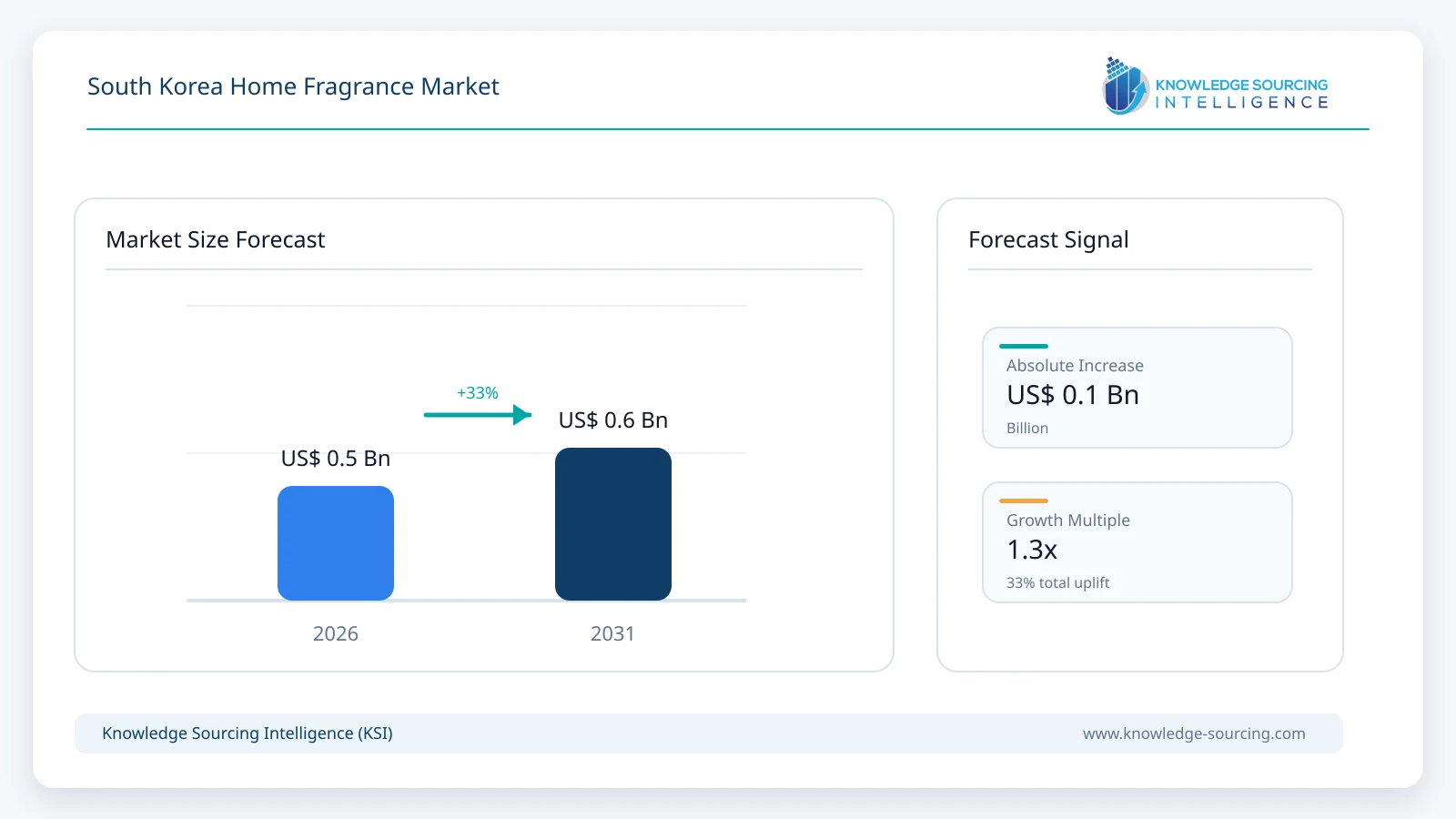
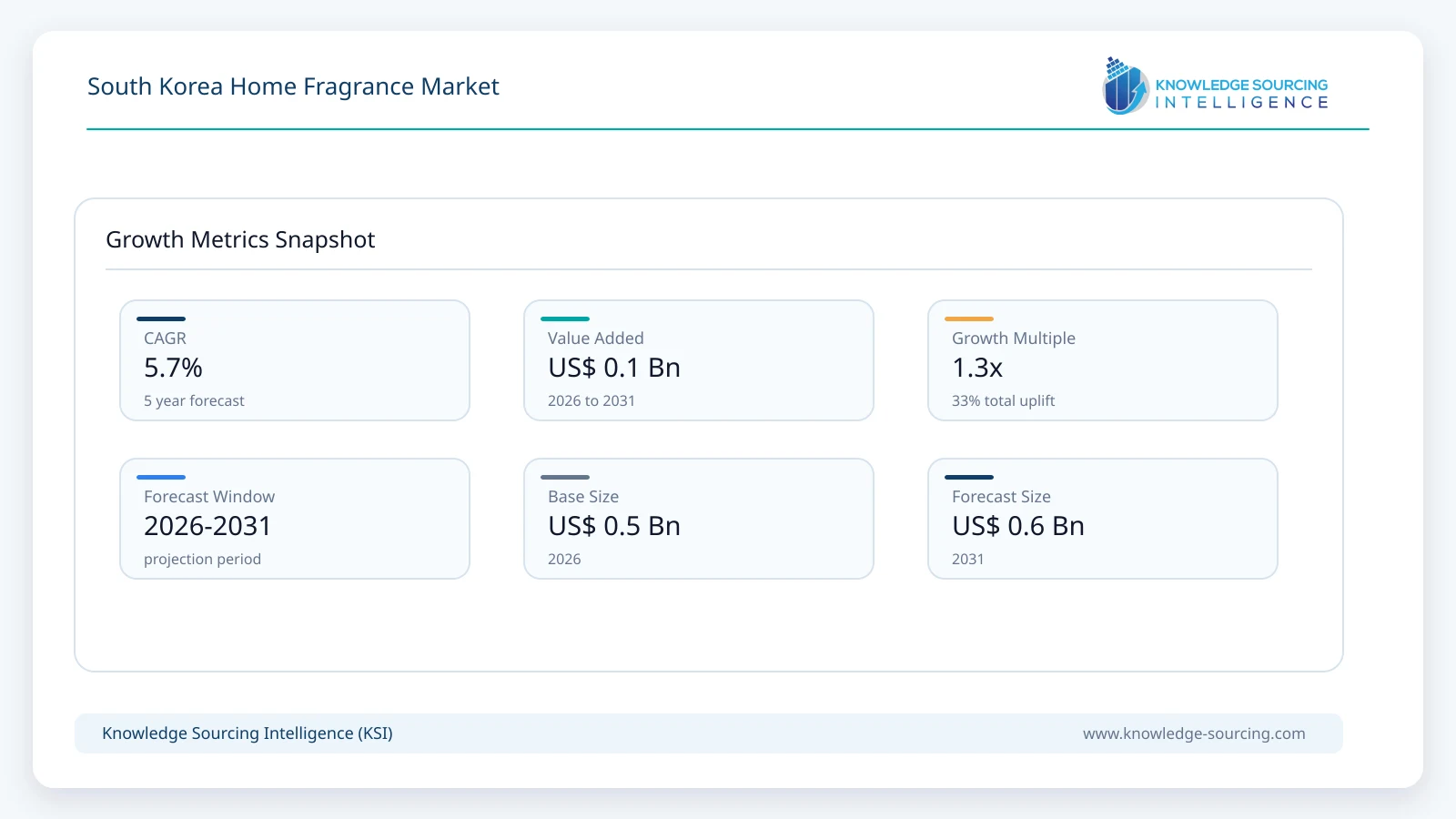
The South Korean Home Fragrance market is anticipated to reach USD 604.90 million in 2031, growing at a CAGR of 5.7% between 2026 and 2031, from USD 458.90 million in 2026, driven by rising consumer interest in creating pleasant, personalized, and aesthetically appealing home environments.
Highlights:
- 1K-fragrancebrands integrate cultural elements to create scents with deep historical roots that enhance daily relaxation and emotional well-being in homes.
- 2Korean home fragranceplayers innovate with minimalist designs and natural ingredients to deliver long-lasting aroma experiences that blend seamlessly with traditional aesthetics.
- 3Home fragranceofferings from Seoul producers emphasize immersive store experiences that capture unique local scents and sensibilities for visitors and residents alike.
- 4Home fragrancetrends in South Korea highlight wellness-focused products that promote harmony and comfort through thoughtful, nature-inspired formulations.
Key Highlights
Market Overview
South Korea's home fragrance category is shifting from a background grocery item to a design-led, brand-driven lifestyle purchase, powered by the "K-perfume" wave, single-person household growth, and Seoul's retail-flagship culture.
Key Takeaways
Candles are the largest product segment, as every major Korean fragrance house, Tamburins, Nonfiction, and now Loewe's Seoul flagship, anchors its home-scent lineup around candles as the entry product.
Diffusers are the fastest-growing product segment, since Tamburins only added room sprays and diffusers to its lineup in late 2025, and Loewe's new Seongsu store treats "Home Scents" as a newly launched category rather than a legacy one.
K-perfume is becoming a mainstream category, as domestic labels such as Tamburins, Nonfiction, and Granhand are gaining ground both in Korea and internationally, according to The Korea Herald.
Celebrity marketing is functioning as a major demand driver, with Tamburins' use of Jennie (Blackpink) and Byeon Woo-seok pulling K-pop fans directly into fragrance and home-scent purchases.
Seoul is concentrating the bulk of category opportunity, as the capital area holds roughly 43% of Korea's population, and its Seongsu-dong district has become the country's flagship-store epicenter for beauty and fragrance brands.
Global luxury players are entering the local home-scent race, exemplified by LVMH's Loewe opening its first-ever standalone Perfumes store worldwide in Seoul in February 2026, which explicitly includes a Home Scents and Bath line, validating the category while adding new competition.
Distribution is bifurcating between offline scale and online growth, as Olive Young's 1,300+ stores anchor offline reach.
Regulatory requirements are tightening, as Korea now mandates labeling of 25 designated fragrance allergens above set concentration thresholds, reinforced by a September 2024 MFDS update that raises formulation and compliance costs for brands.
Key Opportunities
Home-scent line extensions for existing K-beauty/fragrance brands, riding celebrity-led demand.
Global e-commerce expansion via platforms like Olive Young Global, which is already showing triple-digit sales-event growth.
Single-person household solutions, including smaller formats, gifting sets, and subscription-style scent refills.
Key Risks
Rising competition from global luxury entrants, such as Loewe, that can outspend domestic brands on flagship retail experiences.
Regulatory compliance costs from allergen labeling and cosmetic-precaution rules, which fall hardest on smaller brands.
Product-safety exposure, since candles and electronic diffusers are recurring recall categories globally, as seen in large-scale diffuser and candle recalls tied to fire and mechanical hazards.
Analyst View
For brands, the near-term opportunity lies less in inventing new scent categories and more in extending existing personal-fragrance equity into the home. Retailers and investors should watch Seongsu-dong as a bellwether district, since what launches there tends to signal category direction six to twelve months out. Smaller domestic players face a two-sided squeeze: global luxury houses moving into home scent from above, and tightening allergen and labeling regulation raising the cost of compliance from below, which makes scale, whether through Olive Young's distribution or strong D2C and global e-commerce execution, increasingly important for defending margin.
Market Drivers
Expansion of E-Commerce and Specialty Retail Stores
The South Korean home fragrance market is benefiting from the rapid expansion of e-commerce platforms, specialty lifestyle stores, and omnichannel retail networks. South Korea's highly developed digital infrastructure and widespread internet and smartphone usage allow consumers to conveniently discover and purchase home fragrance products through online marketplaces, brand websites, social commerce platforms, and lifestyle-focused retail channels. The availability of detailed product descriptions, customer reviews, fragrance information, and personalized recommendations is further helping consumers compare products and make purchasing decisions.
According to the Ministry of Data and Statistics, the value of online shopping transactions in South Korea reached KRW 24.10 trillion in January 2026, representing an 8.6% increase compared with KRW 22.19 trillion in January 2025. The ongoing growth of online shopping demonstrates the increasing importance of digital channels for consumer product purchases, particularly in lifestyle and home-related categories.
The expansion of online retail is providing home fragrance brands with broader consumer reach while enabling consumers to access a wider range of scented candles, reed diffusers, room sprays, essential oils, wax melts, and other fragrance products without relying exclusively on physical stores.
In parallel, specialty lifestyle stores, boutique fragrance retailers, department stores, and brand-owned stores are expanding their home fragrance offerings. Physical retail provides consumers with an important experiential advantage because shoppers can evaluate fragrance intensity, scent characteristics, packaging, and product quality before purchase.
The increasing adoption of omnichannel retail strategies is further strengthening market development. Brands are combining e-commerce with physical retail experiences, allowing consumers to discover products online, visit stores to experience fragrances, and subsequently purchase through their preferred channel.
Cocodor, a South Korean home fragrance brand, has introduced its “Traditional Korean Diffuser Edition,” incorporating Korean heritage and cultural aesthetics into its home fragrance offerings. The collection features reed diffusers inspired by traditional Korean themes and seasonal scents. It showcases how brands are blending product differentiation, cultural identity, and fragrance experiences. This strategy aims to appeal to both domestic consumers and international buyers interested in Korean-inspired home fragrance products.
High Seasonal Trend Responsiveness in Consumers: Korean consumers frequently alter their lifestyle habits, including their preferences for fragrances, due to their sensitivity to cultural rhythms and seasonal moods. Brands capitalize on this seasonal sensitivity by releasing limited-edition collections that are inspired by winter coziness, Korean holidays, the cherry blossom season, or monsoon moods. Consumers alter perfumes throughout the year, which increases the likelihood that they will make repeat purchases.
Branding on an emotional level and scent memory marketing: In South Korea, brands are depending more and more on memory-based marketing and emotional storytelling. Scents are positioned as emotional triggers, with the intention of arousing feelings of comfort, aspiration, or nostalgia. Strong emotional brand devotion is fueled by emotionally charged names and stories that appeal to both collective memory and individual identity, transforming fragrance from a product into an experience.
Market Restraints and Challenges
Domestic Brand Oversaturation and Overcrowding: The home fragrance market in South Korea has grown rapidly in recent years, reaching market saturation, particularly among domestic small to mid-sized firms. Numerous independent manufacturers are already selling comparable goods (such as soy candles, reed diffusers, and linen sprays) due to the low entry barrier and strong demand for artisanal, design-forward products. Customer fatigue is increasing as a result, and brand distinctiveness becomes challenging. In this congested market, many smaller companies find it difficult to maintain awareness or loyalty without excellent storytelling, innovative scents, or a digital presence.
Major Segment Analysis
Candles
By product type, the South Korean home fragrance market is divided into candles, sprays, diffusers, essential oils, incense sticks, plug-in devices, potpourri and sachets, wax melts, and others. Hence, candles and sprays account for a considerable share in 2026, while diffusers and plug-in devices will showcase steady growth during the forecast period. Likewise, essential oil and incense sticks are expected to grow at a considerable rate during the forecast period. Potpourri and sachets, wax melts, and other product types will hold a minimal market share.
Candles and diffusers are emerging as lifestyle and décor products within these product categories, whereas sprays and plug-in devices remain significant for convenient, everyday home fragrance and odor-control applications. Candles remain a key home-fragrance product format in South Korea, driven by increasing consumer focus on ambience creation, relaxation, and interior styling, as well as the desire for premium scent experiences.
The consumer landscape in South Korea is evolving, fueled by lifestyle shifts, cultural dynamics, and other economic factors. Changes in consumer preferences have significantly influenced the types of decorative & scented products people choose. Nowadays, there is a tendency to favor options that are affordable, easily accessible, and available in varied fragrances. Hence, scented candles meet these criteria, owing to which they have become a popular choice for home fragrance in South Korea.
Moreover, much of the population is urban, i.e., 81% as of 2025, according to the World Bank, which further outlines consumption frequency in South Korea. Additionally, the average household income is experiencing positive growth, which is likely to boost the demand for affordable luxuries like scented candles. According to data from the Ministry of Data and Statistics, in 2025, average household income was 116,786 Won, an increase of 8.28% from the previous year.
Additionally, candles are an integral part of the festive season in South Korea, with festivals like Yeondeunghoe, the lantern lighting festival that takes place throughout the country, involving widespread use of lotus-shaped candles for house decoration. Such festivals act as additional factors driving the use of scented candles in Korean households.
Furthermore, the growing home ambience needs in South Korea, followed by the ongoing K-pop and gifting culture, have led various domestic market players to provide extensive product offerings of fragrance candles. For instance, Cocodor, through its fully equipped facilities, provides cost-effective scented candles in South Korea with ingredients like natural palm wax imported from Italy. The company provides candles in varied fragrances ranging from White Jasmine and Cotton Flower to Damson Rose and Black Cherry. The following table shows the extensive candle product portfolio of major candle manufacturers available in South Korea.
Regional Analysis
Gyeonggi
Gyeonggi holds great market potential due to its large and steadily increasing population in the province. According to the Ministry of Data and Statistics, the total population of Gyeonggi reached 13.968 million in 2025 from 13.914 million in 2024, an increase of 53,391 compared to the preceding year. This growth will significantly increase the demand for consumer products, including home fragrance products, in Gyeonggi.
Similarly, the same source also specified that the total number of housing units in Gyeonggi for 2024 reached 4,962,282 and further increased to 5,042,716 units in 2025, accounting for nearly 25% of the total number of dwellings recorded in South Korea in 2025. Hence, this high frequency further provides new growth prospects for home fragrance products, including sprays, candles, and diffusers, which are among the most commonly used fragrance items in South Korean Households.
Likewise, the growing sustainable culture in South Korea has impacted consumer choice, with a preference for products featuring sustainable ingredients gaining traction. Gyeonggi is actively investing in establishing itself as one of South Korea’s leading sustainable provinces. As a result, there is an anticipated shift among consumers toward fragrance products, bio-based waxes, and essential oils. This transition aligns with the growing awareness of the importance of maintaining good indoor air quality and environmental sustainability.
The drastic changes in living standards in Gyeonggi have played an integral role in driving the market’s demand for home fragrance products in the province. Furthermore, to optimize the growing market opportunities in consumer household products, companies like Cocodor Global and AromafLAvum Co., Ltd. have established their centers in Gyeonggi, which is also estimated to drive future market expansion.
The expanding tourism ecosystem in Gyeonggi also adds unique opportunities for added demand from hospitality and commercial spaces. According to the Gyeonggi Tourism Organization, about 680 million domestic and international visitors came to the province in 2025. In April 2026, it announced its 2030 tourism vision for increasing the length of tourist stays and spending, supporting demand for ambience-enhancing products such as diffusers, candles, room sprays, and signature scents across hotels, cafes, restaurants, and experiential venues.
Company Profiles
Amorepacific Corporation adopts a holistic, brand-ecosystem strategy in the South Korean home fragrance market, weaving home scents into its expansive K-beauty portfolio to create immersive lifestyle experiences that extend beyond personal care. By leveraging its vast R&D infrastructure and sub-brand synergies, the company crafts fragrances that harmonize with emotional well-being, drawing on floral and citrus motifs rooted in Korean botanicals to appeal to urban consumers embracing "Honjok" solitude.
This approach integrates storytelling and sensory layering, where home diffusers complement skincare routines, positioning products as extensions of self-expression rather than standalone items. Amorepacific focuses on multi-channel accessibility, blending e-commerce with experiential retail to cultivate aspirational yet approachable luxury, while innovating subtle, non-intrusive formulations that align with the clean beauty ethos.
Recent Developments
April 2026: South Korean fragrance house Nonfiction launched "The Breath of Spring" collection. The release introduced modern chypre-scented premium candles and interior room sprays tailored for a minimal aesthetic.
March 2026: The local lifestyle brand Granhand launched its seventh core line, featuring the fresh orange-hued "IREUN Early" scent. The collection expanded its popular home diffuser and room spray offerings.
February 2025: Touch Capital, a U.S. consumer-focused venture firm, and Bold, L'Oréal's corporate venture capital fund, led the Korean luxury perfume brand Borntostandout's Series A fundraising round.
2025: The Amorepacific Group announced a new leap forward to mark its 80th anniversary. At its anniversary ceremony held on September 4, the company unveiled the goal of KRW 15 trillion in group sales by 2035, alongside its mid- to long-term vision and strategies to become a global leader in beauty and wellness.
South Korea Home Fragrance Market Scope:
| Report Metric | Details |
|---|---|
| Total Market Size in 2026 | USD 458.90 million |
| Total Market Size in 2031 | USD 604.90 million |
| Forecast Unit | Million |
| Growth Rate | 5.7% |
| Study Period | 2021 to 2031 |
| Historical Data | 2021 to 2024 |
| Base Year | 2025 |
| Forecast Period | 2026 – 2031 |
| Segmentation | Fragrance, Product Type, Distribution Channel, Region |
| Companies |
|
Market Segmentation
By Fragrance
Floral
Fresh/Citrus
Woody
Oriental/Spicy
Herbal
Fruity
Sweet/Gourmand
Oceanic
Others
By Product Type
Candles
Sprays
Diffusers
Essential Oils
Incense Sticks
Plug-in Devices
Potpourri and Sachets
Wax Melts
Others
By Distribution Channel
Offline
Department Stores
Specialty & Lifestyle Stores
Hypermarkets & Supermarkets
Convenience & Other Retail
Brand-Owned Stores
Online
Brand Websites
Social Commerce & Lifestyle Platforms
By Region
Gyeonggi
Gangwon
South Chungcheong
North Jeolla
South Jeolla
Others
Table of Contents
1. EXECUTIVE SUMMARY
2. MARKET SNAPSHOT
2.1. Market Overview
2.2. Market Definition
2.3. Scope of the Study
2.4. Market Segmentation
3. MARKET DYNAMICS
3.1. Market Drivers
3.2. Market Restraints
3.3. Market Opportunities
3.4. Porter’s Five Forces Analysis
3.5. Industry Value Chain Analysis
4. BUSINESS LANDSCAPE
4.1. Consumer Preferences and Home Fragrance Usage Trends
4.2. Premiumization and Product Innovation Analysis
4.3. Consumer Purchasing Behavior and Spending Patterns
4.4. Regulatory, Compliance, and Policy Landscape
4.5. Strategic Recommendations
5. TECHNOLOGICAL AND PRODUCT INNOVATION OUTLOOK
5.1. Smart Home Fragrance and Connected Diffuser Technologies
5.2. Natural, Organic, and Sustainable Fragrance Innovations
5.3. Long-Lasting and Advanced Fragrance Delivery Technologies
5.4. Personalized Fragrance and Scent Customization Technologies
5.5. Emerging Home Fragrance Technologies and Innovations
6. SOUTH KOREA HOME FRAGRANCE MARKET BY FRAGRANCE (2021-2031)
6.1. Introduction
6.2. Floral
6.3. Fresh/Citrus
6.4. Woody
6.5. Oriental/Spicy
6.6. Herbal
6.7. Fruity
6.8. Sweet/Gourmand
6.9. Oceanic
6.10. Others
7. SOUTH KOREA HOME FRAGRANCE MARKET BY PRODUCT TYPE (2021-2031)
7.1. Introduction
7.2. Candles
7.3. Sprays
7.4. Diffusers
7.5. Essential Oils
7.6. Incense Sticks
7.7. Plug-in Devices
7.8. Potpourri and Sachets
7.9. Wax Melts
7.10. Others
8. SOUTH KOREA HOME FRAGRANCE MARKET BY DISTRIBUTION CHANNEL (2021-2031)
8.1. Introduction
8.2. Offline
8.2.1. Department Stores
8.2.2. Specialty & Lifestyle Stores
8.2.3. Hypermarkets & Supermarkets
8.2.4. Convenience & Other Retail
8.2.5. Brand-Owned Stores
8.3. Online
8.3.1. Brand Websites
8.3.2. Social Commerce & Lifestyle Platforms
9. SOUTH KOREA HOME FRAGRANCE MARKET BY REGION (2021-2031)
9.1. Introduction
9.2. Gyeonggi
9.3. Gangwon
9.4. South Chungcheong
9.5. North Jeolla
9.6. South Jeolla
9.7. Others
10. COMPETITIVE ENVIRONMENT AND ANALYSIS
10.1. Major Players and Strategy Analysis
10.2. Market Share Analysis
10.3. Mergers, Acquisitions, Agreements, and Collaborations
10.4. Competitive Dashboard
11. COMPANY PROFILES
11.1. Cocodor
11.2. JH Korea Co., Ltd.
11.3. Jo Malone London
11.4. HeavenSense Company Ltd.
11.5. Diptyque S.A.S
11.6. The Yankee Candle Company, Inc.
11.7. Amorepacific Corporation
11.8. LG Household & Health Care
11.9. Bath & Body Works, LLC
11.10. Aesop
11.11. Soohyang
12. RESEARCH METHODOLOGY
13. LIST OF FIGURES
14. LIST OF TABLES
Navigate
Trusted by the world's leading organizations











