
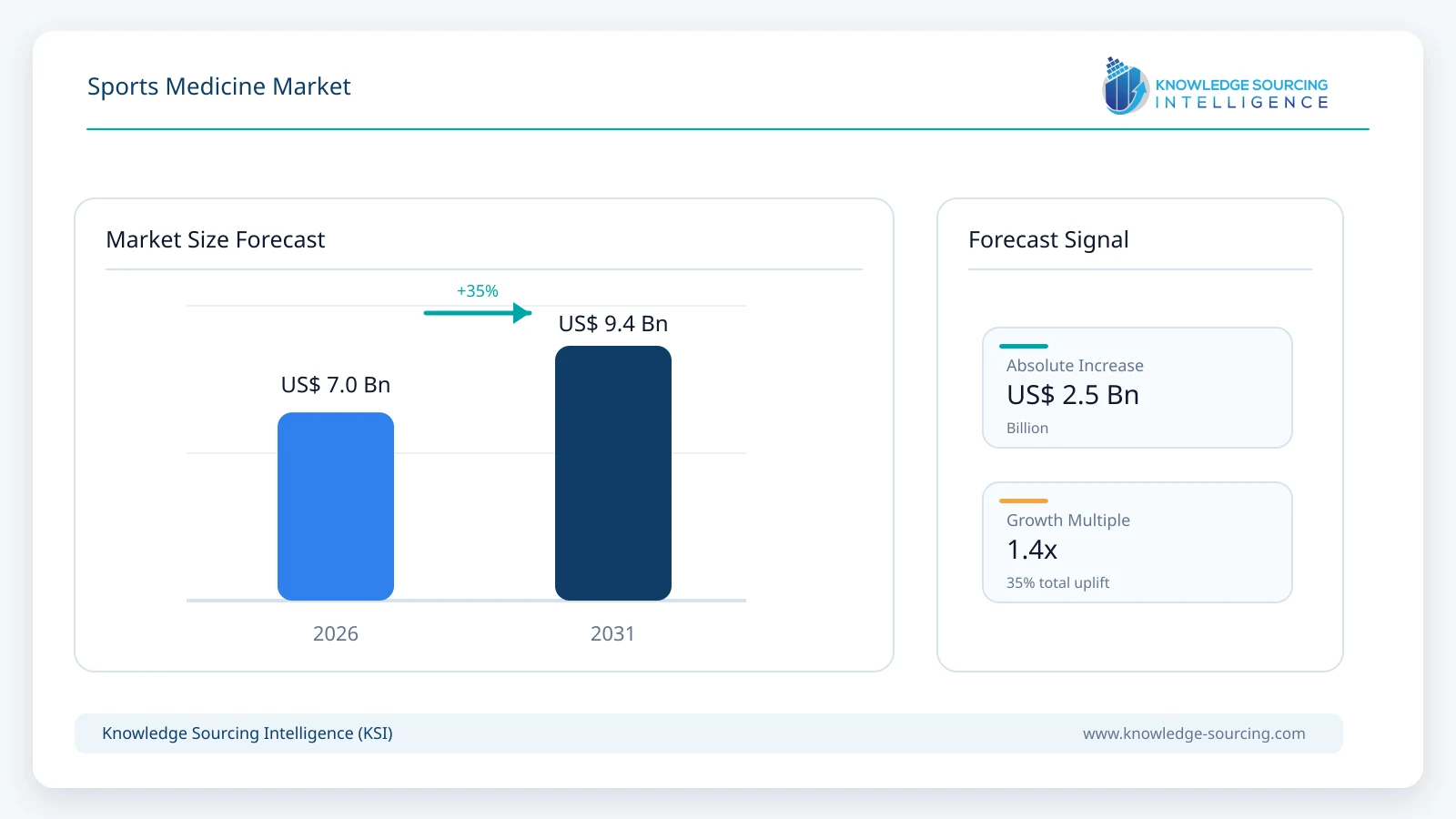
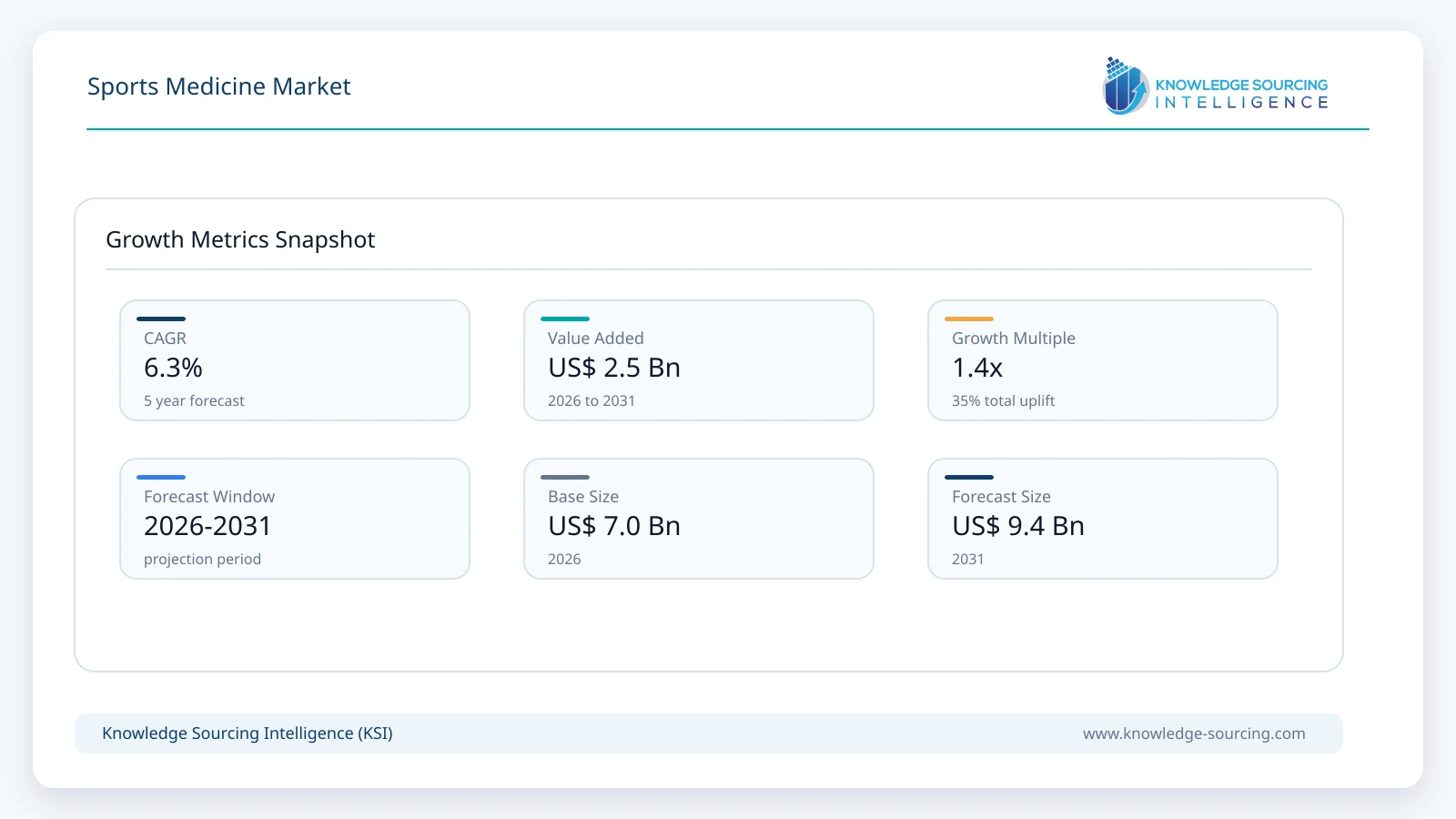
The sports medicine market is estimated at USD 6.98 billion in 2026 and will reach USD 9.45 billion by 2031, at a CAGR of 6.25% during this forecast Period.
Highlights:
- 1Surgical repair and reconstruction accounts for the largest share of 2026 market demand.
- 2Knee applications remain the largest clinical segment, supported by ligament and meniscal procedures.
- 3North America leads global revenue through high arthroscopy utilization and sports-medicine procedure volumes.
- 4Biologic augmentation and cartilage restoration are expanding the value of joint-preservation procedures.
- 5Ambulatory surgery centers are increasing demand for compact, integrated and workflow-efficient arthroscopy systems.
- 6Digital visualization and spatial-surgery platforms are becoming a new competitive layer in arthroscopic care.
Sports medicine has moved from a product category centered on braces, arthroscopes and fixation implants toward an integrated procedural market. Current treatment pathways combine imaging and diagnosis, minimally invasive visualization, soft-tissue repair, biologic augmentation, postoperative protection and structured rehabilitation. Knee and shoulder procedures remain central because ligament, meniscus, labral and rotator-cuff injuries are common in athletes and active adults. Manufacturers are therefore building broader procedural ecosystems around anchors, sutures, implants, resection, fluid management, visualization and digital guidance.
Current company performance supports continued expansion of the category. Smith+Nephew reported USD 1.067 billion of Sports Medicine Joint Repair revenue in 2025, up 8.6% on a reported basis, while its Arthroscopic Enabling Technologies business generated USD 647 million. Excluding China, Sports Medicine Joint Repair grew 13.4% in 2025, led by shoulder repair and the REGENETEN bioinductive implant. CONMED identifies orthopedic surgery, including sports medicine instrumentation, implants, visualization, powered resection and fluid management, as a core product line. Vericel generated USD 239.5 million of MACI revenue in 2025, up 21%, demonstrating the faster growth available in advanced cartilage restoration relative to mature mechanical device categories.
The market is also changing through the migration of procedures from hospitals to ambulatory surgery centers. Smith+Nephew estimates that close to 4,000 U.S. ASCs perform musculoskeletal procedures and notes that more than 60% of these centers perform both sports medicine and orthopedic procedures. This shift favors systems that reduce setup time, simplify sterilization, integrate visualization and fluid management, and fit smaller operating rooms. It also increases purchasing scrutiny because ASCs place greater emphasis on procedure economics, inventory efficiency and throughput.
Market Trends
Biologic Augmentation Is Moving Into Mainstream Soft-Tissue Repair
Biologic and regenerative products are increasingly being used to complement mechanical repair rather than replace it. In 2025, the American Academy of Orthopaedic Surgeons issued a strong recommendation supporting bioinductive implants during rotator cuff repair because evidence showed lower retear rates and improved patient-reported outcomes in selected procedures. Smith+Nephew continues to expand REGENETEN, while Stryker agreed in August 2026 to acquire ZuriMED, developer of the FiberLocker rotator-cuff augmentation system. The commercial opportunity extends to cartilage restoration, where Vericel's MACI franchise continues to post double-digit growth.
Digital and Spatial Arthroscopy Is Emerging as a New Procedural Layer
Sports medicine is beginning to adopt digital platforms that place imaging, planning and procedural data closer to the surgeon. Smith+Nephew received FDA De Novo classification for the TESSA Spatial Surgery System in July 2026, while Stryker received FDA authorization for SportSuite Vision for use with Apple Vision Pro in arthroscopic surgery. These technologies are designed to improve access to arthroscopic feeds, imaging and planning tools without relying on multiple fixed displays. The category remains early, but digital workflow may become increasingly important in complex hip, shoulder and knee procedures.
Meniscal Preservation Is Replacing Resection Where Clinically Appropriate
The clinical emphasis in knee sports medicine continues to move toward preservation of meniscal tissue because meniscus function is important to long-term joint health. This supports all-inside repair devices, root-repair systems, collagen scaffolds and improved visualization. In July 2026, the FDA cleared Stryker's AIR+ all-inside meniscal repair devices. Broader preservation strategies also support cartilage restoration technologies and biologic scaffolds, increasing procedural value beyond conventional sutures and anchors.
Smaller-Incision and Ultra-Minimally Invasive Arthroscopy Is Expanding
Manufacturers are reducing instrument profiles and improving visualization to support diagnosis and intervention through smaller portals. Arthrex has expanded nano-arthroscopy training and use of the NanoNeedle Scope 2.0, positioning small-diameter visualization for knee, shoulder and elbow procedures. These approaches can support office-based evaluation, ambulatory workflows and selected minimally invasive interventions, although adoption depends on surgeon preference, image quality, procedure complexity and reimbursement.
Market Drivers
High Burden of Ligament, Meniscal and Rotator-Cuff Injuries
Sports participation and active lifestyles sustain a large recurring pool of musculoskeletal injuries. Arthrex cites approximately 200,000 ACL tears annually in the United States, while AAOS notes roughly 4.5 million U.S. patient visits each year for shoulder pain, with rotator-cuff tears representing a major cause. The market therefore benefits from both acute traumatic injuries among athletes and degenerative tears among active older adults.
Joint Preservation Extends Treatment Before Arthroplasty
Sports medicine increasingly overlaps with joint preservation as surgeons seek to repair soft tissue, preserve menisci and restore cartilage before end-stage degeneration requires joint replacement. This favors repair anchors, biologic scaffolds, cartilage implants and osteochondral technologies. Vericel's sustained MACI growth and broader commercialization of cartilage repair products support this shift toward higher-value restorative procedures.
Procedure Migration to Ambulatory Surgery Centers
Lower-acuity arthroscopy and soft-tissue repair are well suited to outpatient settings. ASCs place a premium on compact equipment, standardized kits, rapid room turnover and predictable procedure cost. This creates demand for integrated arthroscopy towers, efficient fluid management, disposable accessories and vendor programs that simplify inventory and training.
Innovation in Repair Strength and Healing Quality
New product development is focused on both mechanical fixation and biologic healing. Knotless anchors, all-suture anchors, meniscal repair systems, augmentation scaffolds and advanced suture constructs are designed to improve fixation while reducing surgical complexity. Clinical evidence supporting bioinductive augmentation and the continued entry of specialized technologies into large-company portfolios are reinforcing investment in this area.
Market Restraints
Pricing Pressure, Reimbursement and Procedure Economics
Sports medicine devices face purchasing pressure from hospital systems, group purchasing organizations, ambulatory centers and national procurement programs. China has implemented volume-based procurement across selected sports medicine categories, creating material pricing headwinds for major suppliers. In mature markets, newer biologic or digital technologies must demonstrate measurable clinical or workflow value to justify premium pricing. Reimbursement uncertainty can also slow adoption of cartilage restoration, orthobiologics and emerging digital platforms, particularly when the technology adds cost without replacing another billable component.
Clinical Evidence and Learning-Curve Requirements
Advanced repair and biologic technologies require surgeon training, procedural standardization and clinical evidence. Adoption can be slower when outcomes depend strongly on patient selection or surgical technique. New spatial-computing and digital-arthroscopy systems also require integration with existing operating-room workflows. These factors favor suppliers with strong medical-education platforms, field support and installed relationships with sports medicine surgeons.
Segment Analysis
By Function - Surgical Repair and Reconstruction
Surgical repair and reconstruction is the largest functional segment, representing an estimated USD 3.84 billion in 2026. The segment includes soft-tissue fixation, ligament and tendon reconstruction, meniscal repair, cartilage restoration, biologic augmentation and arthroscopic enabling products directly used during surgery. Growth is supported by a shift from tissue removal toward preservation, broader use of knotless and all-suture fixation, and increasing adoption of bioinductive and cartilage-restoration technologies. Support and recovery remains important through braces, cold therapy and rehabilitation systems, but carries lower average selling prices than procedural implants and enabling equipment.
By Application - Knee
Knee applications are estimated at approximately USD 2.58 billion in 2026 and remain the largest clinical segment. ACL reconstruction, meniscal repair, cartilage restoration and postoperative bracing generate recurring demand across implants, instruments and recovery products. New technologies are increasingly oriented toward meniscal preservation, root repair, all-inside fixation and cartilage restoration rather than meniscectomy alone. Shoulder is the second major segment and benefits from rotator-cuff and instability repair, with biologic augmentation contributing to faster value growth.
By Geography - North America
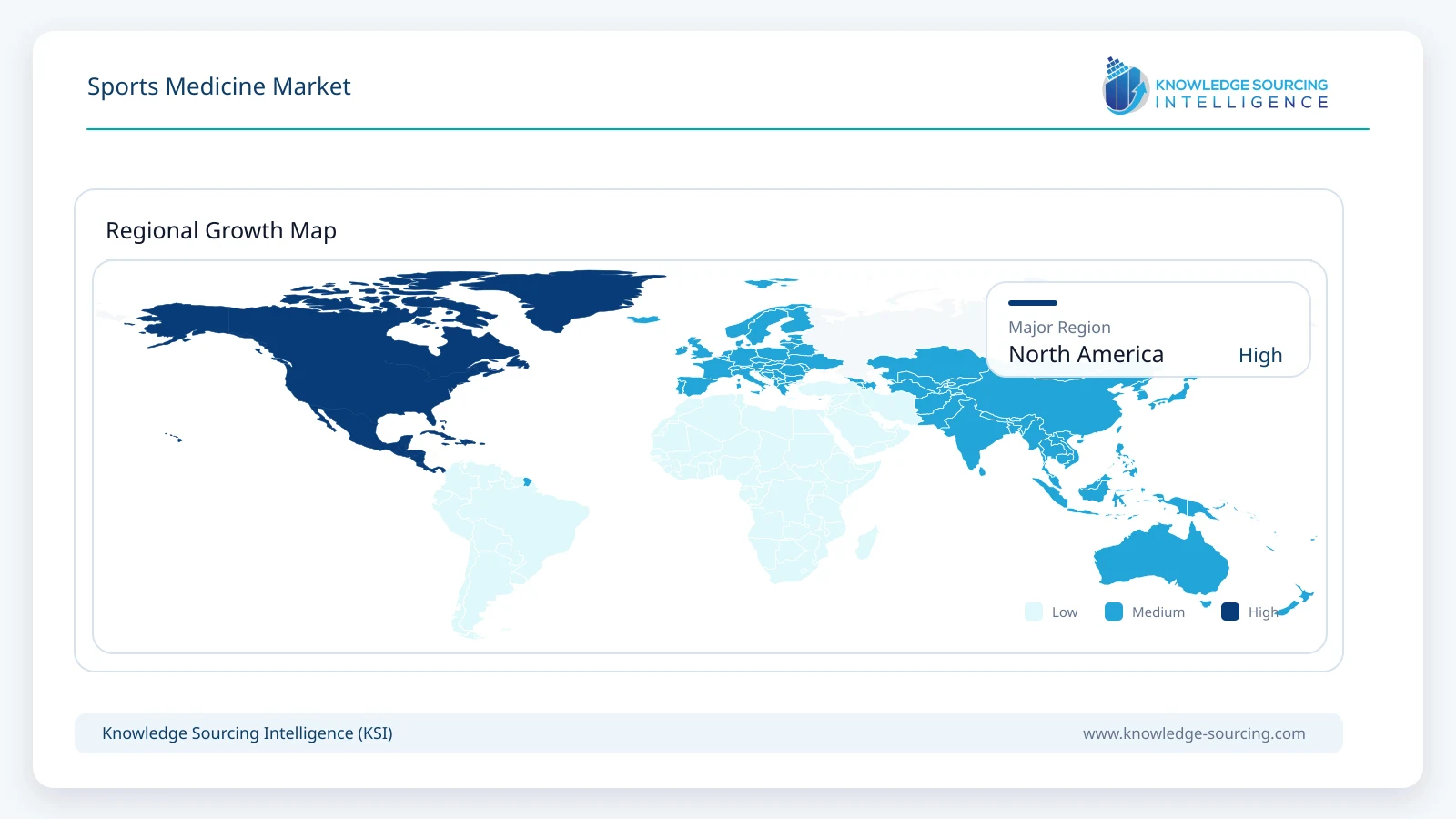
North America is estimated at approximately USD 3.00 billion in 2026 and remains the largest regional market. The United States combines high sports participation, established orthopedic referral pathways, advanced arthroscopy adoption, strong surgeon training networks and a large ASC base. Europe is another major market with strong adoption of arthroscopy and soft-tissue repair, while Asia Pacific is expected to grow faster through rising sports participation, private healthcare investment and expanding access to advanced orthopedic procedures. China remains strategically important but pricing is affected by volume-based procurement.
Competitive Environment
Arthrex is a major specialist in sports medicine and minimally invasive orthopedics, with broad portfolios in knee, shoulder, hip, foot and ankle, orthobiologics, visualization and medical education. Smith+Nephew competes across joint repair, arthroscopic enabling technologies and biologics, with REGENETEN, Q-FIX, CARTIHEAL AGILI-C, WEREWOLF and TESSA supporting its innovation strategy. Stryker has expanded its sports medicine position through meniscal repair, soft-tissue fixation, digital surgery and its proposed acquisition of ZuriMED.
CONMED competes in implants, powered resection, fluid management and visualization through its orthopedic surgery business. Zimmer Biomet participates across sports medicine, shoulder, biologics and ambulatory orthopedic solutions, while J&J MedTech's DePuy Synthes/Mitek portfolio remains active in soft-tissue repair and arthroscopy. Enovis competes in prevention and recovery through DonJoy, Aircast and Chattanooga and reports approximately USD 1.1 billion of trailing P&R sales, reinforcing its scale in bracing and rehabilitation.
Specialist companies remain important in high-growth niches. Vericel is expanding MACI cartilage restoration, Anika Therapeutics participates in joint preservation and regenerative orthopedics, Bioventus supplies bone and soft-tissue healing technologies, and Össur, Breg and Mueller compete in bracing and supports. Competitive advantage increasingly depends on procedural breadth, clinical evidence, surgeon education, ASC economics and the ability to combine implants with enabling technologies and postoperative recovery solutions.
Recent Developments
September 2026: Zimmer Biomet announced plans to showcase its Complete Shoulder Solution at ICSES 2026, including sports medicine technologies and biologics alongside robotic and mixed-reality systems.
August 2026: Stryker signed a definitive agreement to acquire ZuriMED, adding the FiberLocker rotator-cuff augmentation system to its shoulder portfolio.
August 2026: Smith+Nephew introduced the FLOW FLEXTEND COBLATION Wand for complex hip procedures, expanding access and resection options in arthroscopy.
July 2026: Smith+Nephew received FDA De Novo classification for the TESSA Spatial Surgery System for sports medicine procedures.
July 2026: The FDA cleared Stryker's AIR+ all-inside meniscal repair devices for soft-tissue fixation.
March 2026: Vericel received FDA approval for commercial MACI manufacturing at its new advanced cell-therapy facility, increasing capacity for cartilage restoration.
Sports Medicine Market Scope
| Report Metric | Details |
|---|---|
| Total Market Size in 2026 | USD 6.98 billion |
| Total Market Size in 2031 | USD 9.45 billion |
| Forecast Unit | Billion |
| Growth Rate | 6.25% |
| Study Period | 2021 to 2031 |
| Historical Data | 2021 to 2024 |
| Base Year | 2025 |
| Forecast Period | 2026 – 2031 |
| Segmentation | Function, Application, Geography |
| Companies |
|
Market Segmentation
By Function
Surgical Repair and Reconstruction
Support, Bracing and Recovery
Monitoring and Evaluation
Others
By Application
Knee
Shoulder
Hip
Ankle and Foot
Elbow and Wrist
Spine and Back
Others
By Geography
North America
USA
Canada
Mexico
South America
Brazil
Argentina
Others
Europe
Germany
France
United Kingdom
Spain
Italy
Others
Middle East and Africa
Saudi Arabia
UAE
South Africa
Others
Asia Pacific
China
India
Japan
South Korea
Australia
Indonesia
Thailand
Others
Table of Contents
1. EXECUTIVE SUMMARY
2. MARKET SNAPSHOT
2.1. Market Overview
2.2. Market Definition
2.3. Scope of the Study
2.4. Market Segmentation
3. BUSINESS LANDSCAPE
3.1. Market Drivers
3.1.1. High Burden of Ligament, Meniscal and Rotator-Cuff Injuries
3.1.2. Joint Preservation Extends Treatment Before Arthroplasty
3.1.3. Procedure Migration to Ambulatory Surgery Centers
3.1.4. Innovation in Repair Strength and Healing Quality
3.2. Market Restraints
3.2.1. Pricing Pressure, Reimbursement and Procedure Economics
3.2.2. Clinical Evidence and Learning-Curve Requirements
3.3. Market Opportunities
3.4. Porter’s Five Forces Analysis
3.5. Industry Value Chain Analysis
3.6. Policies and Regulations
3.7. Strategic Recommendations
4. TECHNOLOGICAL OUTLOOK
4.1. Arthroscopic Visualization and Fluid Management
4.2. Knotless and All-Suture Fixation
4.3. Meniscal Preservation Systems
4.4. Bioinductive and Regenerative Implants
4.5. Cartilage Restoration Technologies
4.6. Nano-Arthroscopy and Minimally Invasive Access
4.7. Digital and Spatial Surgery Platforms
5. SPORTS MEDICINE MARKET BY FUNCTION
5.1. Introduction
5.2. Surgical Repair and Reconstruction
5.3. Support, Bracing and Recovery
5.4. Monitoring and Evaluation
5.5. Others
6. SPORTS MEDICINE MARKET BY APPLICATION
6.1. Introduction
6.2. Knee
6.3. Shoulder
6.4. Hip
6.5. Ankle and Foot
6.6. Elbow and Wrist
6.7. Spine and Back
6.8. Others
7. SPORTS MEDICINE MARKET BY GEOGRAPHY
7.1. Introduction
7.2. North America
7.2.1. USA
7.2.2. Canada
7.2.3. Mexico
7.3. South America
7.3.1. Brazil
7.3.2. Argentina
7.3.3. Others
7.4. Europe
7.4.1. Germany
7.4.2. France
7.4.3. United Kingdom
7.4.4. Spain
7.4.5. Italy
7.4.6. Others
7.5. Middle East and Africa
7.5.1. Saudi Arabia
7.5.2. UAE
7.5.3. South Africa
7.5.4. Others
7.6. Asia Pacific
7.6.1. China
7.6.2. India
7.6.3. Japan
7.6.4. South Korea
7.6.5. Australia
7.6.6. Indonesia
7.6.7. Thailand
7.6.8. Others
8. COMPETITIVE ENVIRONMENT AND ANALYSIS
8.1. Major Players and Strategy Analysis
8.2. Procedural Portfolio Positioning
8.3. Biologics and Joint-Preservation Competition
8.4. ASC and Digital-Surgery Strategies
8.5. Mergers, Acquisitions, Agreements and Collaborations
8.6. Competitive Dashboard
9. COMPANY PROFILES
9.1. Arthrex, Inc.
9.2. Smith & Nephew plc
9.3. Stryker Corporation
9.4. CONMED Corporation
9.5. Zimmer Biomet Holdings, Inc.
9.6. Johnson & Johnson MedTech (DePuy Synthes / Mitek)
9.7. Enovis Corporation (DonJoy)
9.8. KARL STORZ SE & Co. KG
9.9. Olympus Corporation
9.10. Vericel Corporation
9.11. Anika Therapeutics, Inc.
9.12. Bioventus Inc.
9.13. Össur hf.
9.14. Breg, Inc.
9.15. Mueller Sports Medicine, Inc.
9.16. Medacta International SA
10. APPENDIX
10.1. Currency
10.2. Assumptions
10.3. Base and Forecast Years Timeline
10.4. Key Benefits for Stakeholders
10.5. Research Methodology
10.6. Abbreviations
Navigate
Trusted by the world's leading organizations











