
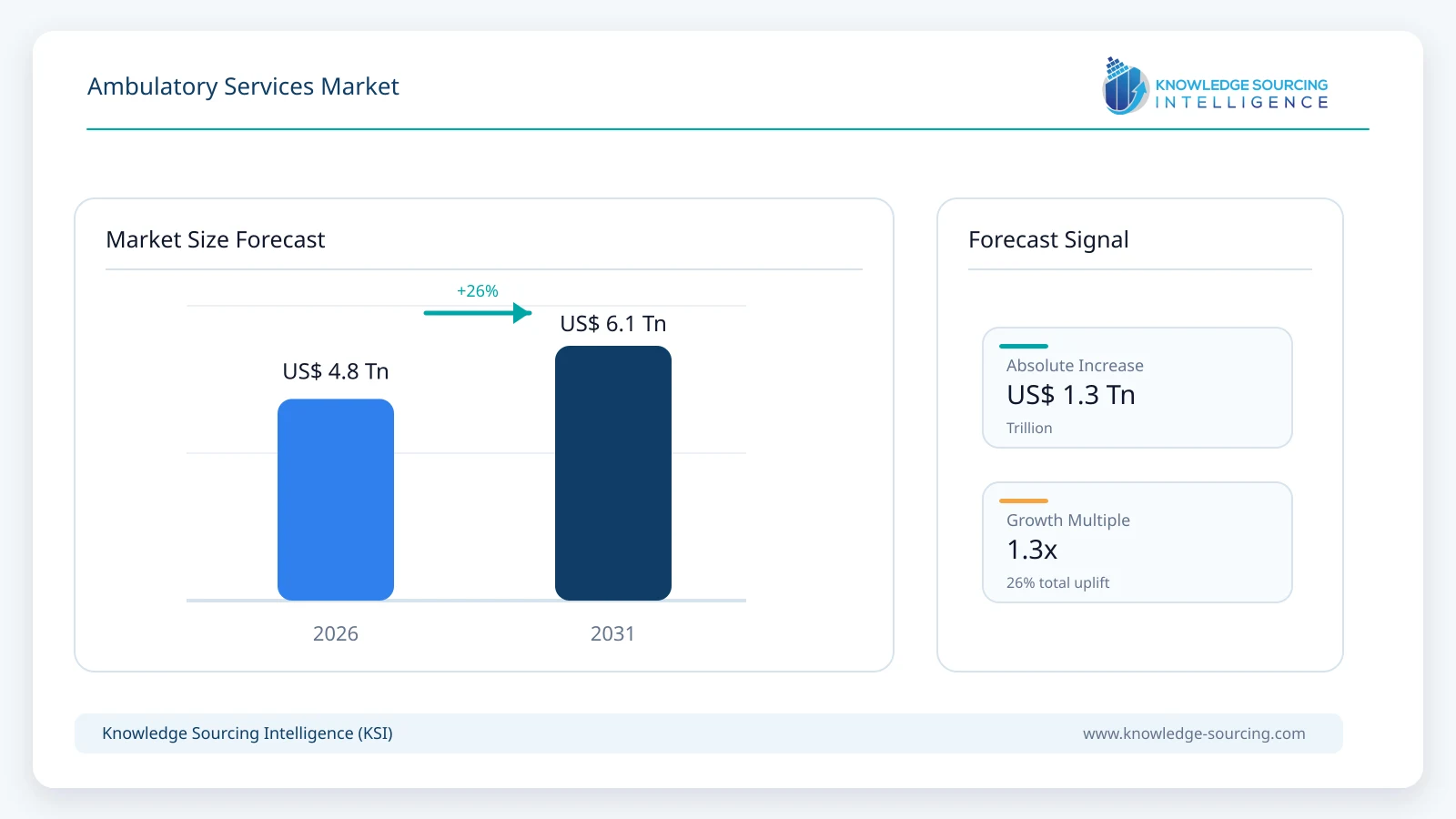
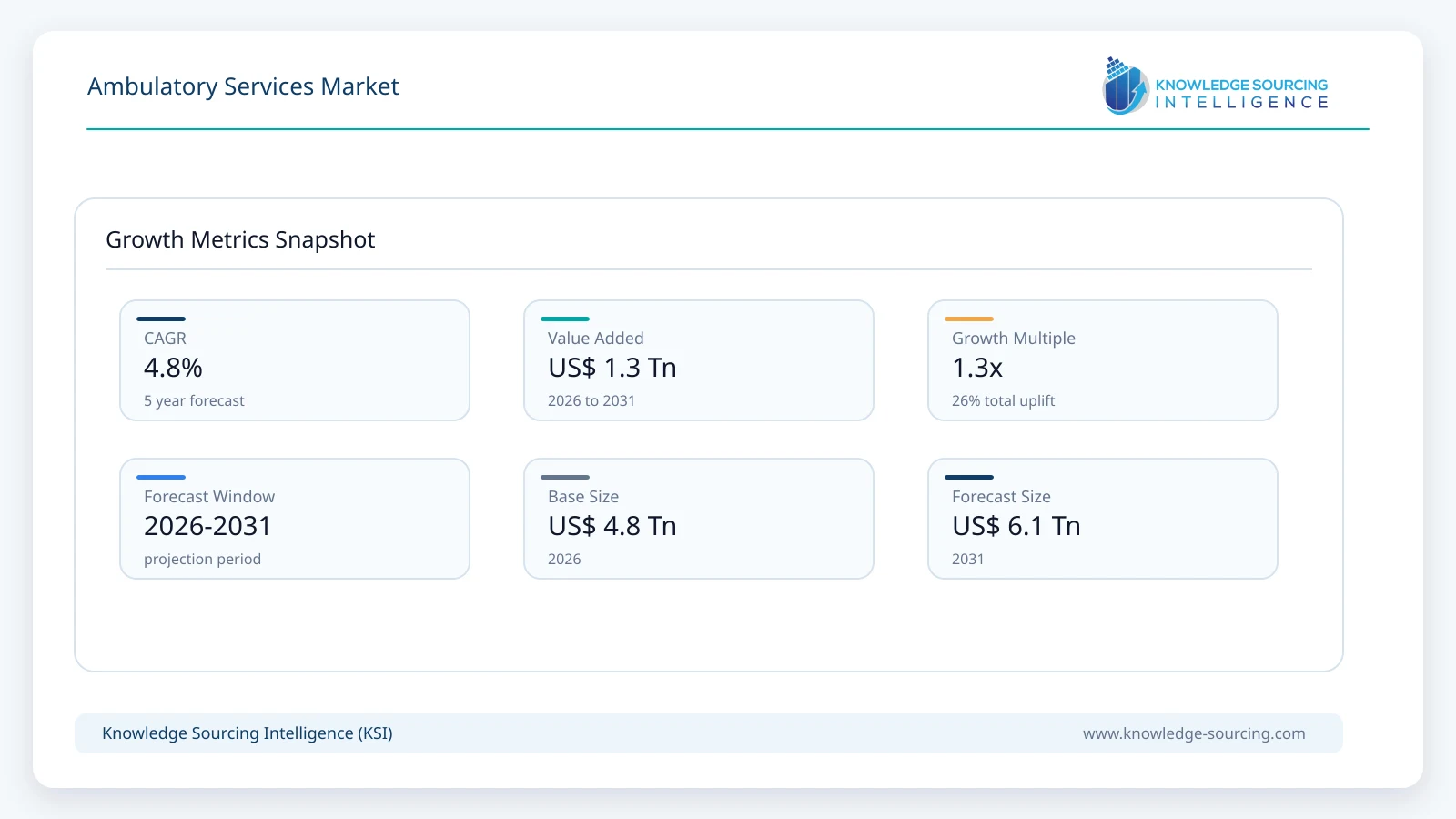
The global Ambulatory Services Market is projected to increase from USD 4.82 trillion in 2026 to USD 6.09 trillion by 2031, at a CAGR of 4.79% during the forecast period.
Highlights:
- 1Outpatient departments and specialty offices provide a broad service base; freestanding surgery centres are the most visible area of site-of-care migration.
- 2Gastroenterology remains commercially important because diagnostic and therapeutic endoscopy can be delivered through repeatable ambulatory workflows.
- 3The US Medicare programme expanded its ambulatory surgery centre covered-procedure list for calendar year 2026, subject to patient-safety and clinical-judgement requirements.
- 4Network ownership has shifted following Ascension’s June 2026 acquisition of AMSURG, while Tenet’s USPI and Surgery Partners continue to report material outpatient operations.
- 5Capacity development extends beyond surgerydiagnostic centres, chronic-care clinics and dialysis networks offer different models of ambulatory demand.
- 6Patient selection, workforce availability, reimbursement and safe post-procedure follow-up remain decisive constraints on broader outpatient substitution.
Ambulatory services are consultations, diagnostic procedures, treatments and surgeries delivered without a conventional overnight hospital admission. The market includes emergency department visits that do not result in inpatient admission, hospital outpatient departments, office-based specialty care, primary-care practices and facilities designed for short-stay surgery. Hospitals, physician groups, private medical networks and specialist operators earn patient-service revenue under reimbursement or self-pay arrangements. Outpatient care does not necessarily occur outside a hospital campus, and an ambulatory surgery centre is not interchangeable with every office or emergency service.
Service selection reflects medical necessity and the clinical resources a patient requires after intervention. Endoscopy, cataract surgery, pain procedures and selected orthopaedic cases frequently lend themselves to outpatient management when anaesthesia, staffing and discharge arrangements are appropriate. Operators compete through physician access, reliable scheduling, efficient room use, clinical quality and contracts with payers. Scale can improve purchasing and administration, but the local supply of specialists and the range of procedures eligible for each facility determine how effectively that scale converts to revenue.
Medicare’s 2026 payment changes have made site selection a more immediate strategic issue for US providers. The Centers for Medicare & Medicaid Services (CMS) added procedures to the ASC Covered Procedures List and began phasing selected services off the inpatient-only list. Those actions widen payment eligibility; they do not mean that every covered patient is suitable for an ambulatory centre. Clinical screening, access to escalation and evidence of satisfactory outcomes remain prerequisites for moving more complex cases into lower-acuity settings. Against this backdrop, hospital outpatient departments account for an estimated USD 1.37 trillion of global ambulatory spending in 2026, rising to USD 1.77 trillion by 2031. Their diagnostic breadth and capacity for complex consultations remain important even as independent centres expand.
Provider reporting reveals why service mix can matter more than headline visit growth. Tenet Healthcare’s USPI business recorded USD 1.388 billion in second-quarter 2026 net operating revenue and reported a 5.0% increase in same-facility system-wide net patient service revenues, even as surgical case volume declined 1.2%. Surgery Partners reported second-quarter same-facility revenue growth of 5.0%, compared with 0.3% same-facility case growth. Higher-acuity procedures and revenue per case can support growth without a proportionate increase in treated patients; they also increase exposure to implants, specialist labour and payer negotiations. Within the same broad market, surgical specialty offices are estimated at USD 0.53 trillion in 2026 and USD 0.79 trillion in 2031. Greater clinical eligibility and specialist-centre investment account for their faster growth relative to primary care.
Outside the US, community diagnostic programmes and integrated physician networks provide different expansion routes. England’s April 2026 investment in community diagnostic centres prioritised scanning and outpatient capacity near residential populations. Indian networks such as Apollo combine clinics, diagnostics and remote consultations with hospital services. The economics differ by country, but the operating problem is similar: patients benefit from accessible services, while providers must maintain referral continuity, credible quality assurance and effective coordination when an outpatient visit reveals the need for hospital treatment.
Market Trends
Surgical-site migration is becoming more selective
The 2026 CMS final rule revised the eligibility framework for ambulatory surgery centre procedures and added several hundred codes under different policy routes. Orthopaedic and other higher-acuity cases are attracting attention because operating techniques, anaesthesia and postoperative protocols have improved. The decision to move a case, however, remains patient-specific. A centre with appropriate recovery capability may safely manage a procedure that would be unsuitable in a smaller office setting.
Operators consequently emphasise clinical pathways rather than a simple shift in procedure counts. Physician privileges, unplanned-transfer arrangements, infection prevention and discharge planning must expand with the case mix. Payers may favour less expensive sites of service, but a poorly selected case can erase those savings through complications or readmission. Within the application breakdown, orthopaedics is estimated to increase from USD 603 billion in 2026 to USD 883 billion in 2031, reflecting greater procedural complexity as well as activity growth.
Consolidation is reorganising specialist outpatient networks
Ascension’s June 2026 completion of the AMSURG acquisition brought more than 250 centres into a wider health-system platform. The network has particular exposure to gastroenterology, ophthalmology and orthopaedics. The transaction illustrates the appeal of connecting physician-owned procedures with hospital referral infrastructure while preserving the operational advantages of specialised centres.
Large groups can negotiate supplies and coordinate billing across facilities, but ownership does not eliminate physician alignment problems. A successful integration must protect local referral patterns, clinical accountability and scheduling autonomy. For competitors, expansion increasingly requires a persuasive partnership model for surgeons and gastroenterologists, not merely access to acquisition financing.
Revenue per procedure is diverging from case growth
USPI reported a higher same-facility revenue per case in the second quarter of 2026 while the number of same-facility cases fell. Surgery Partners also recorded faster same-facility revenue growth than case growth. The distinction matters when comparing operators: a facility treating more complex cases may grow revenue without increasing operating-room turns.
The same shift puts greater weight on implants, anaesthesia coverage and payer authorisation. Management teams must protect margins by understanding procedure-level contribution rather than relying solely on patient counts. Capital equipment also needs to match the case mix, creating a trade-off between a more sophisticated clinical offering and the fixed costs of outfitting a centre.
Community diagnostics are separating testing from hospital visits
England’s April 2026 plan earmarked GBP 237 million for additional and enhanced community diagnostic centres, with four new sites, 17 physical expansions and 15 targeted upgrades. MRI, CT, ultrasound and selected specialist clinics are being brought closer to patients without requiring a conventional hospital outpatient visit. Such centres depend on reliable referral and results-management processes because diagnostic separation cannot become clinical fragmentation.
Imaging capacity is not a proxy for ambulatory surgical revenue, yet it affects how quickly patients move through outpatient pathways. Earlier diagnosis can increase specialist referrals, while inconsistent electronic records can create repeat investigations. Commercial providers with integrated scheduling and reporting may therefore gain an advantage even when equipment capability is similar.
Chronic-care networks are broadening outpatient demand
DaVita served approximately 298,500 patients across 3,266 outpatient dialysis centres as of June 2026. That network demonstrates a recurring-service model unlike episodic surgery: revenue depends on treatment frequency, transport access, workforce retention and long-term clinical outcomes. Primary-care clinics and chronic-specialty offices similarly rely on continuity rather than rapid procedure turnover.
Aging populations and multimorbidity increase the importance of local follow-up, but the commercial benefit depends on reimbursement and effective care coordination. Patient-facing technology can reduce administrative friction, yet it cannot replace physical treatment for dialysis, endoscopy or interventions. Providers with dependable referral and follow-up systems are better placed to secure repeat use.
Ambulatory Services Market Segment Analysis
By Type
Outpatient Departments
Hospital outpatient departments combine consultations, diagnostic imaging, infusions and selected procedures in an environment able to escalate care without admitting every patient overnight. Complex chronic patients may benefit from hospital-based laboratory services, anaesthesia support and specialist review even when the scheduled episode remains outpatient. Their operating model differs from that of freestanding surgery centres: equipment and staffing are shared with hospital departments, while the payment rules and patient cost-sharing can differ materially by site.
Hospitals must balance outpatient expansion against crowded diagnostic schedules and personnel shared with inpatient departments. Separate off-campus facilities can improve access but introduce transport, digital-record and staffing requirements. The provider advantage lies in routing patients to the clinically appropriate setting while retaining a consistent specialist team. Surgical-specialty offices and primary-care sites compete for convenience; hospitals retain an important role where case complexity demands immediate multidisciplinary support. Hospital outpatient departments are estimated to represent USD 1.374 trillion in 2026, increasing to USD 1.766 trillion by 2031, with a relatively stable share of roughly 29% of global non-admitted care revenue. The continuing role of shared imaging and specialist resources supports that position even as simpler procedures migrate elsewhere.
By Application
Gastroenterology
Gastroenterology combines scheduled colorectal screening with diagnostic and therapeutic endoscopy, giving operators identifiable procedure rooms, preparation protocols and recovery requirements. SCA Health reports more than 170 facilities with gastroenterology capabilities, illustrating the specialty infrastructure available in organised outpatient networks. Ascension’s acquisition of AMSURG adds a separate national platform with established gastroenterology activity. The quality of referral pathways and repeatable endoscopy scheduling matter more than network size alone.
Revenue varies with colonoscopy and advanced-endoscopy mix, insurer contracts, sedation requirements and throughput lost to inadequate bowel preparation. An efficient network connects referring physicians, pre-procedure screening, pathology reporting and follow-up appointments rather than optimising procedure-room utilisation in isolation. Ophthalmology and orthopaedics have their own reimbursement and technology dynamics; a broad ambulatory provider may operate in each specialty without making their growth rates interchangeable. Gastroenterology services are estimated to rise from USD 747 billion in 2026 to USD 974 billion by 2031. Their growth reflects both procedural utilization and the continuing shift of appropriate endoscopy cases into dedicated outpatient settings.
Market Drivers
Procedure eligibility is expanding under Medicare
CMS’s calendar-year 2026 rule added 289 procedures to the ASC Covered Procedures List through revised criteria and another 271 codes from the inpatient-only-list changes. This broadens the menu of services that could be paid in an ASC when clinical judgement supports the setting. Payment eligibility is a prerequisite, not a guarantee of migration, and actual uptake will depend on payer contracts and available teams.
Centre operators can use expanded eligibility to assess new service lines, but capital expenditure should follow local surgeon demand and demonstrated case suitability. Facilities that already have strong postoperative pathways may move first, especially for selected musculoskeletal interventions.
Persistent chronic disease supports recurring outpatient visits
People living with diabetes, kidney disease, cardiovascular conditions and multiple long-term illnesses require repeated monitoring, diagnostics and specialist reviews. Much of that activity can be performed in medical offices, community clinics or outpatient departments rather than through inpatient admission. DaVita’s extensive dialysis-centre network demonstrates the economic significance of scheduled, recurring treatment.
The effect is particularly relevant where insurers and health systems coordinate primary and specialist care. Recurrent visits support facility utilisation, although patients with complex conditions still require robust escalation routes when acute events develop.
Lower-acuity settings can reduce avoidable inpatient use
An appropriately selected outpatient procedure can avoid an overnight admission and reduce exposure to some hospital fixed costs. Patients also value a known appointment time and recovery at home. MedPAC identifies lower cost sharing, convenience and scheduling as possible attractions of ASCs compared with hospital outpatient departments.
The potential saving depends on the procedure, site-specific charges and clinical risk. Providers should not assume that every non-admitted service is less costly; duplicated assessment, transportation or unexpected readmission can change total episode economics.
Specialist partnerships support faster network formation
ASC operators commonly combine central management with local physician participation. Such arrangements can align utilisation, clinical scheduling and capital decisions while limiting the need for a health system to build every facility itself. The Ascension-AMSURG combination illustrates how provider networks can grow through acquisition of established specialty capacity. Surgical specialty offices are estimated to increase their share from 11% of market value in 2026 to 13% in 2031, creating greater need for qualified clinical staff and appropriately equipped procedure facilities.
For hospitals and insurers, partnerships offer more outpatient options without transferring all patient relationships outside the system. Physician retention remains critical because procedural cases are often directed through specialist referral and practice patterns rather than through consumer advertising.
Community diagnostics and digital referral infrastructure are expanding
The UK’s April 2026 diagnostic-centre investment and Apollo’s distributed clinic network illustrate two approaches to bringing testing and specialist visits closer to patients. Digital records, appointment systems and laboratory reporting make it possible to separate the site of a test from the hospital responsible for treatment.
Where referral pathways operate reliably, decentralised capacity can reduce waiting and support earlier decisions about surgery, medication or admission. Its contribution to market growth is wider access to reimbursed services, not the sale of diagnostic scanners themselves.
Market Restraints
Clinical screening limits transfer of higher-risk procedures
A procedure may be eligible for outpatient payment without being appropriate for every patient. Frailty, complex comorbidities, anaesthesia risk and the possibility of difficult postoperative recovery can require hospital-level resources or planned admission. CMS explicitly preserves physician considerations for patient safety in its revised ASC criteria.
Centres adding higher-acuity cases need transfer agreements, emergency response protocols and discharge monitoring. Those requirements can raise costs and constrain the facilities capable of offering newer procedures, limiting the speed of market migration.
Staffing constraints are acute in specialist settings
Endoscopy, cataract surgery and orthopaedic procedures require experienced nurses, anaesthesia coverage, technicians and appropriately credentialled physicians. An ASC cannot treat additional cases merely by adding an operating room if the local labour pool is inadequate. Recovery-space staffing and sterile processing are frequent operational bottlenecks.
Wage pressure and agency dependence may erode the cost advantage that attracts payers. Smaller facilities have fewer options to rotate staff across service lines, making recruitment and retention central to capacity plans.
Reimbursement and site-of-service rules vary materially
Payment systems distinguish hospital outpatient departments, ASCs and physician offices, often with different eligible procedures and billing codes. Medicare’s 2026 changes are US-specific and do not establish a global reimbursement framework. Commercial insurance contracts may add prior authorisation and network requirements even where public rules permit outpatient care.
Providers face uncertain revenue when services shift to a cheaper setting faster than case volumes grow. Operators therefore need contract-level modelling and transparent episode costs before committing to a new specialty or facility.
Capital costs rise as centres undertake complex cases
Orthopaedic implants, imaging systems, endoscopy reprocessing and more advanced anaesthesia equipment can increase the investment needed for an ambulatory centre. Case mix may justify that expenditure, but returns depend on sufficiently regular use. A facility targeting a narrow specialty is vulnerable when a key physician leaves or referrals slow.
Hospital-backed centres can sometimes access central procurement and financing, yet they still face the practical constraint of operating-room time and recovery capacity. Larger facilities are not automatically more productive if patient flow is poorly managed.
Fragmented referrals and uneven access restrict utilisation
An outpatient visit often depends on a preceding referral, transport, test results and follow-up availability. In rural or lower-income areas, patients may struggle to reach specialist facilities or arrange the support required after same-day surgery. Poor information transfer between primary care, diagnostics and specialty offices can delay treatment and duplicate examinations.
These frictions weaken utilisation even where clinical demand is substantial. Networks that expand physical locations without investing in scheduling and care coordination may redistribute visits rather than create genuinely greater access.
Regional Outlook
North America
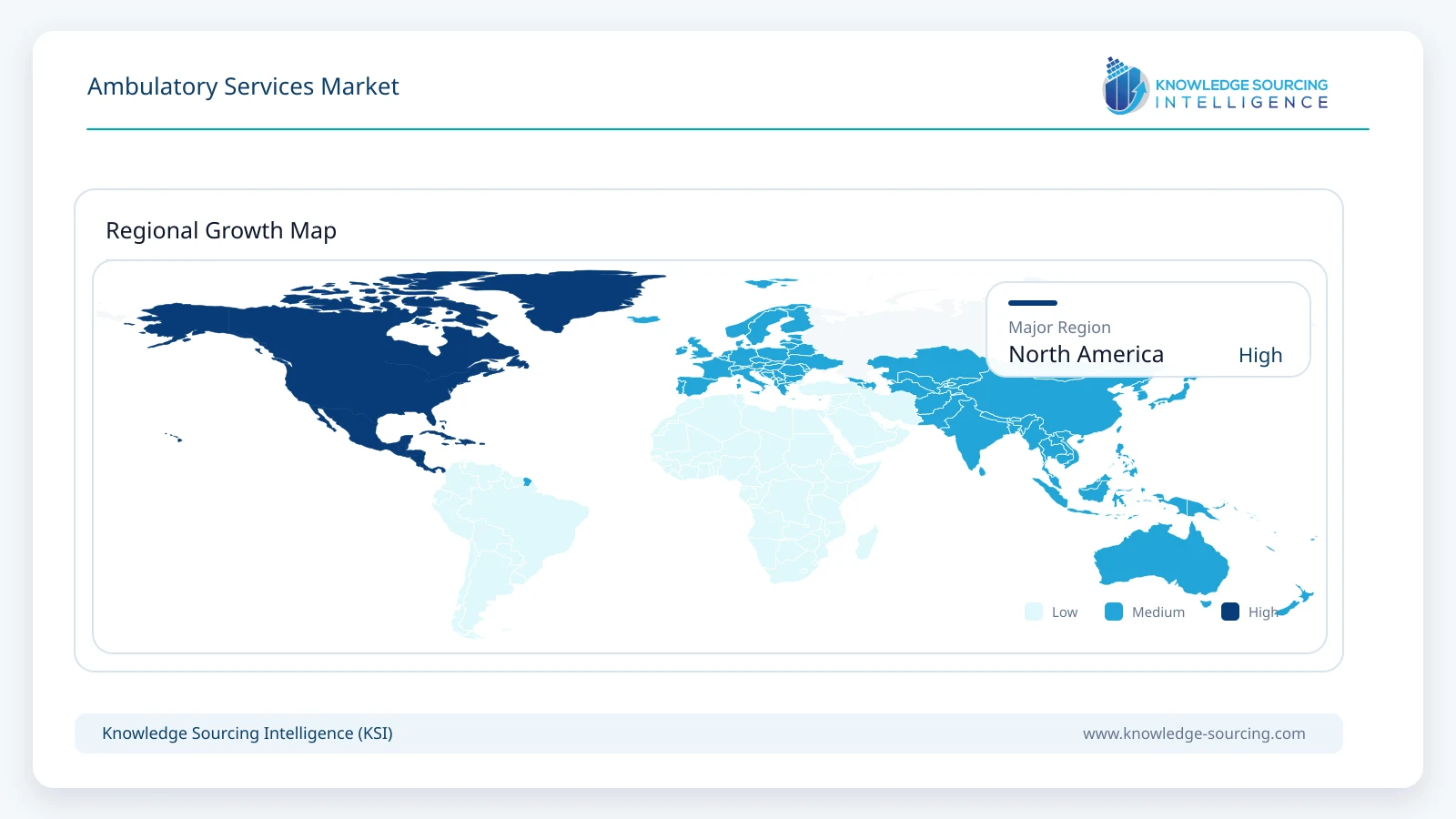
North America remains the clearest reported centre of organised ambulatory surgery activity. MedPAC’s March 2026 review counted approximately 6,400 US ASCs in 2024, while Tenet’s USPI held interests in 538 centres by June 2026 and Ascension’s acquisition of AMSURG added substantial specialty capacity. Medicare policy, established physician ownership models and insurer negotiations make the US an important reference point for procedural migration. Canada and Mexico have different funding and provider structures; the US operator economics should not be applied to them without adjustment. Regional ambulatory service revenues are estimated at USD 2.35 trillion in 2026 and USD 2.88 trillion in 2031, representing an implied CAGR of 4.2%.
The strongest North American opportunities are linked to procedure selection, local payer arrangements and specialist capacity. Tenet’s revenue-per-case increases in 2026 show how operators can enhance financial results through service mix, but case-count declines also caution against assuming constant demand growth. Hospital outpatient departments remain relevant for patients requiring wider clinical support. Quality reporting, postoperative transfers and costs for more advanced procedures will determine how much further care moves into stand-alone centres.
Asia Pacific
Asia Pacific presents a different outpatient-growth profile, with large patient populations, uneven specialist access and increasing networks of private clinics and diagnostic centres. Apollo Hospitals reports more than 299 clinics in India alongside its hospitals and diagnostics infrastructure; its 2026 Health of the Nation reporting also describes extensive remote-healthcare reach. In Australia, Ramsay operates day surgeries, clinics and hospitals, reflecting an established private outpatient model. These arrangements vary considerably from US ASC reimbursement, but both address access and treatment outside a traditional inpatient stay. The region is estimated to expand from USD 1.13 trillion in 2026 to USD 1.58 trillion by 2031, at 6.9% annually, outpacing other regional markets as China, India and established East Asian healthcare networks deepen non-admitted service capacity.
Growth will depend on the local financing of primary care, specialist consultation, diagnostics and day procedures. India’s urban physician networks can support multi-site models, while regional districts need affordable transport, linked medical records and dependable referral pathways. The commercial opportunity is not limited to surgery: recurrent chronic-care services, screening and outpatient specialty follow-up can expand visit numbers without equivalent investment in inpatient beds. Southeast Asian clinic operators such as Healthway Medical provide further evidence of a distributed provider model.
Competitive Landscape
Tenet’s United Surgical Partners International, Surgery Partners, Ascension’s AMSURG network and SCA Health have different ownership structures but compete for physicians, reimbursed procedures and efficient outpatient capacity. Tenet links USPI to a larger hospital organisation; SCA Health is connected with Optum; and Ascension now controls AMSURG following the June 2026 transaction. HCA Healthcare combines freestanding surgery centres with a broad network of urgent-care and physician offices. Investors should compare these groups at an equivalent service level rather than rank them using consolidated corporate revenue that includes hospital, insurance or other non-ambulatory businesses.
Beyond US surgery, competition is less concentrated in a single facility model. Ramsay runs hospital and day-procedure operations in Australia; Apollo and Healthway operate distributed consultation and diagnostic networks; DaVita and Fresenius Medical Care focus on recurring renal treatment. CVS Health’s MinuteClinic model adds retail-based walk-in care. The factors differentiating these providers include specialist relationships, geographic reach, payer access, clinical outcomes, dependable scheduling and the ability to refer safely to higher-acuity services. Device vendors and pharmaceutical distributors enable outpatient activity but should not be profiled as direct ambulatory-service operators.
Recent Developments
August 2026: DaVita extends coordinated kidney care with Humana
DaVita announced an expanded value-based agreement covering more than 10,000 Humana Medicare Advantage members with advanced chronic kidney disease. The programme began on 1 July and aims to strengthen earlier intervention, care coordination and access to specialist support. The agreement broadens longitudinal ambulatory care beyond episodic surgery, with investment tied to disease management and avoidable hospital use.
August 2026: Surgery Partners reports second-quarter performance
Surgery Partners reported 5.0% year-on-year same-facility revenue growth against 0.3% growth in same-facility cases. The divergence highlights the importance of procedure complexity, payer mix and facility economics; it does not suggest an equivalent increase in patient volumes throughout the ambulatory services market.
July 2026: Tenet reports USPI ambulatory network results
Tenet reported interests in 538 ambulatory surgery centres and 26 surgical hospitals as at 30 June. USPI’s second-quarter ambulatory net operating revenue reached USD 1.388 billion, with same-facility revenue per case up 6.3% while cases declined 1.2%. Service mix and higher-acuity work, rather than case growth alone, drove the reported revenue performance.
July 2026: CMS proposes further outpatient payment changes for 2027
The US Centers for Medicare & Medicaid Services proposed updates for 2027 affecting about 3,500 hospitals and 6,400 ambulatory surgery centres. The proposal includes changes to off-campus payment policy and a further phase of the inpatient-only list removal; these are proposed policies, not final 2027 rates. Providers will need to evaluate site-of-service economics and patient selection against the final rule.
June 2026: Ascension closes the AMSURG acquisition
Ascension completed its acquisition of AMSURG, bringing its national network to approximately 300 ambulatory surgery centres. The combination increases its exposure to community-based specialty procedures while retaining the importance of local physician relationships, facility quality and integration into hospital referral pathways.
April 2026: England expands community diagnostic capacity
The UK government committed GBP 237 million to four new community diagnostic centres, 17 expansions and 15 targeted enhancements. This investment supports tests and specialist outpatient appointments closer to patients’ homes; its immediate effect is greater community testing capacity rather than additional surgical-centre case volume.
Market Outlook
The next stage of ambulatory care expansion will be shaped by the quality of clinical pathways rather than by the number of new centres alone. Procedure-list changes and more capable short-stay facilities will enlarge the pool of cases considered for outpatient treatment. However, higher-acuity work also requires greater attention to anaesthesia, observation, postoperative contact and transfer arrangements. Providers with stable medical teams and dependable data about outcomes can make the most credible case to insurers and referring physicians. At the global level, this places the 2031 market near USD 6.09 trillion, while the underlying opportunity remains highly uneven between routine medical offices, diagnostic pathways and elective surgical centres.
Gastroenterology, ophthalmology, orthopaedics and chronic-care offices should remain important commercial activities, although their growth patterns differ. Surgery networks will seek profitable case mix and physician alignment; diagnostic and primary-care operators will compete on patient access and follow-through. North America has an established market for multi-centre ASC groups, while Asia Pacific offers opportunities through specialist clinics, day surgery and local testing. Across both regions, successful expansion will rest on proven clinical suitability, transparent reimbursement and continuity between outpatient and hospital care.
Ambulatory Services Market Scope:
| Report Metric | Details |
|---|---|
| Total Market Size in 2026 | USD 4.82 trillion |
| Total Market Size in 2031 | USD 6.09 trillion |
| Forecast Unit | Trillion |
| Growth Rate | 4.79% |
| Study Period | 2021 to 2031 |
| Historical Data | 2021 to 2024 |
| Base Year | 2025 |
| Forecast Period | 2026 – 2031 |
| Segmentation | Type, Application, Geography |
| Companies |
|
| Customization Scope | 15% Free Customization included with purchase — Request Custom Breakdown → |
| Sample & Data Access | PDF Sample, Excel Databook & Analyst Briefing — Download Free Sample → |
Market Segmentation
By Type
Emergency Department
Outpatient Department
Surgical Specialty Office
Medical Specialty Office
Primary Care Office
Other Types
By Application
Pain Management
Gastroenterology
Orthopedics
Ophthalmology
Other Applications
By Geography
North America
United States
Canada
Mexico
South America
Brazil
Argentina
Others
Europe
Germany
United Kingdom
France
Italy
Spain
Others
Middle East and Africa
Saudi Arabia
United Arab Emirates
Israel
South Africa
Others
Asia Pacific
China
India
Japan
South Korea
Australia
Indonesia
Thailand
Taiwan
Others
Table of Contents
1. EXECUTIVE SUMMARY
2. MARKET SNAPSHOT
3. BUSINESS LANDSCAPE
3.1 Market Drivers
3.2 Market Restraints
3.3 Market Opportunities
3.4 Porter’s Five Forces Analysis
3.4.1 Supplier Power
3.4.2 Buyer Power
3.4.3 New Entrants
3.4.4 Substitute Services
3.4.5 Competitive Rivalry
3.5 Industry Value Chain
3.6 Policies and Regulations
3.7 Strategic Recommendations
4. TECHNOLOGICAL OUTLOOK
4.1 Minimally Invasive Treatment and Anaesthesia
4.2 Outpatient Diagnostics and Scheduling Systems
4.3 Clinical Quality, Data Exchange and Discharge Monitoring
5. AMBULATORY SERVICES MARKET BY TYPE
5.1 Emergency Department
5.2 Outpatient Department
5.3 Surgical Specialty Office
5.4 Medical Specialty Office
5.5 Primary Care Office
5.6 Other Types
6. AMBULATORY SERVICES MARKET BY APPLICATION
6.1 Pain Management
6.2 Gastroenterology
6.3 Orthopedics
6.4 Ophthalmology
6.5 Other Applications
7. AMBULATORY SERVICES MARKET BY GEOGRAPHY
7.1 North America
7.1.1 United States
7.1.2 Canada
7.1.3 Mexico
7.2 South America
7.2.1 Brazil
7.2.2 Argentina
7.2.3 Others
7.3 Europe
7.3.1 Germany
7.3.2 United Kingdom
7.3.3 France
7.3.4 Italy
7.3.5 Spain
7.3.6 Others
7.4 Middle East and Africa
7.4.1 Saudi Arabia
7.4.2 United Arab Emirates
7.4.3 Israel
7.4.4 South Africa
7.4.5 Others
7.5 Asia Pacific
7.5.1 China
7.5.2 India
7.5.3 Japan
7.5.4 South Korea
7.5.5 Australia
7.5.6 Indonesia
7.5.7 Thailand
7.5.8 Taiwan
7.5.9 Others
8. COMPETITIVE ENVIRONMENT AND ANALYSIS
8.1 Major Players and Strategy Analysis
8.2 Market Share Analysis
8.3 Mergers, Acquisitions and Partnerships
8.4 Competitive Dashboard
9. COMPANY PROFILES
9.1 Tenet Healthcare Corporation (United Surgical Partners International)
9.2 Ascension (AMSURG)
9.3 Surgery Partners, Inc.
9.4 SCA Health (Optum)
9.5 HCA Healthcare, Inc.
9.6 Ramsay Health Care Limited
9.7 Apollo Hospitals Enterprise Limited
9.8 Healthway Medical Corporation Limited
9.9 DaVita Inc.
9.10 Fresenius Medical Care AG
9.11 CVS Health Corporation (MinuteClinic)
9.12 IHH Healthcare Berhad
10. APPENDIX
10.1 Currency and Units
10.2 Market Scope and Assumptions
10.3 Base and Forecast Years Timeline
10.4 Key Benefits
10.5 Research Methodology
10.6 Abbreviations





Frequently asked questions
What is the projected market size by 2031?
The Ambulatory Services Market is projected to reach USD 6.09 trillion by 2031.
What is the projected compound annual growth rate?
The Ambulatory Services Market is projected to grow at a CAGR of 4.79%.
What are key growth opportunities in ambulatory services?
Site-of-care migration and expanded US Medicare covered procedures.
Which service types lead the ambulatory market?
Outpatient departments and specialty offices form a broad service base.
Which application areas are commercially important?
Gastroenterology, orthopedics, ophthalmology, and pain management are key.
What major regional factors influence the market?
US Medicare program's expanded procedure list impacts site selection.
Cite this report
Knowledge Sourcing Intelligence. (Oct 2026). Ambulatory Services Market - Strategic Insights and Forecasts (2026-2031). https://www.knowledge-sourcing.com/report/ambulatory-services-market