
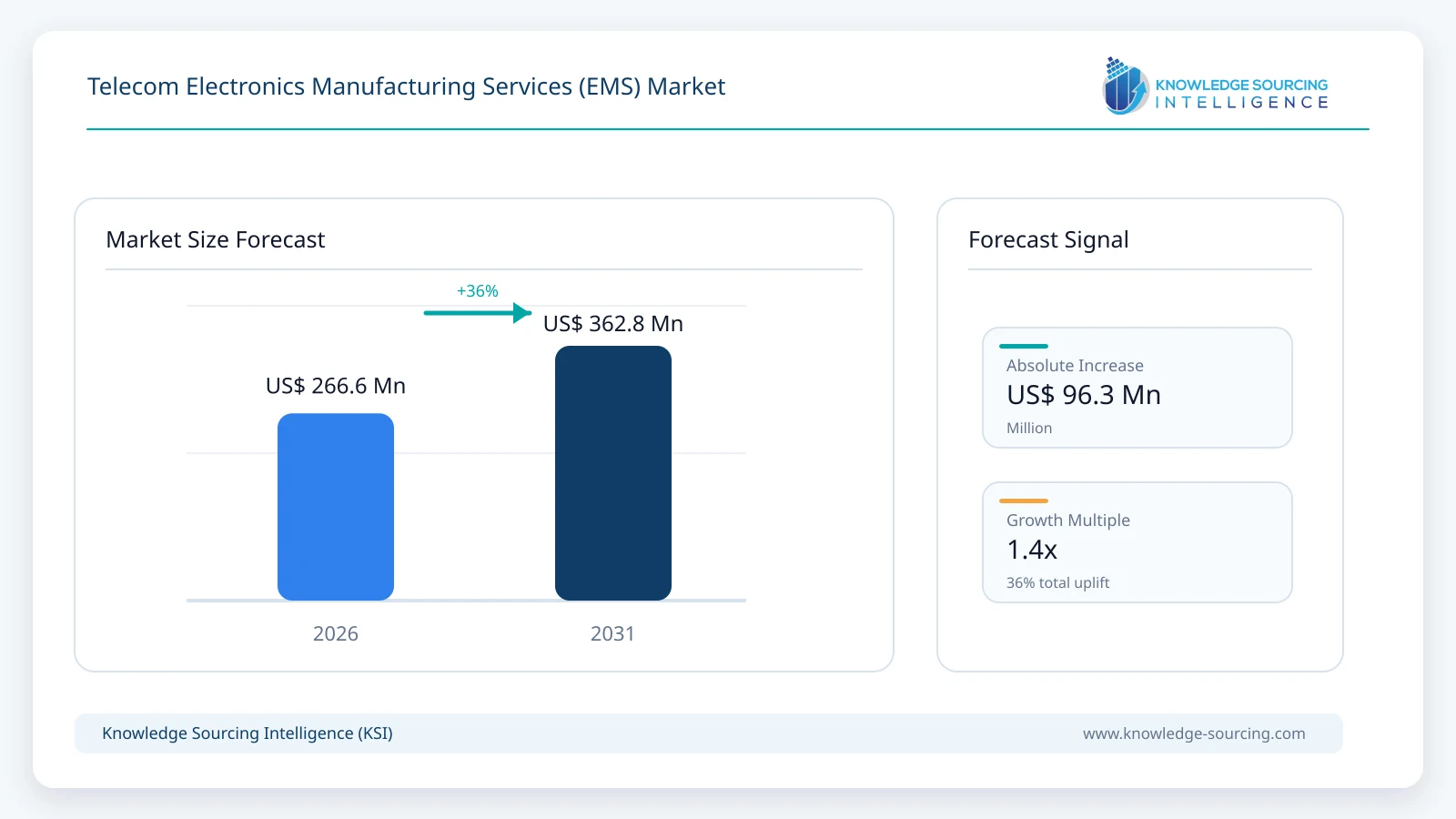
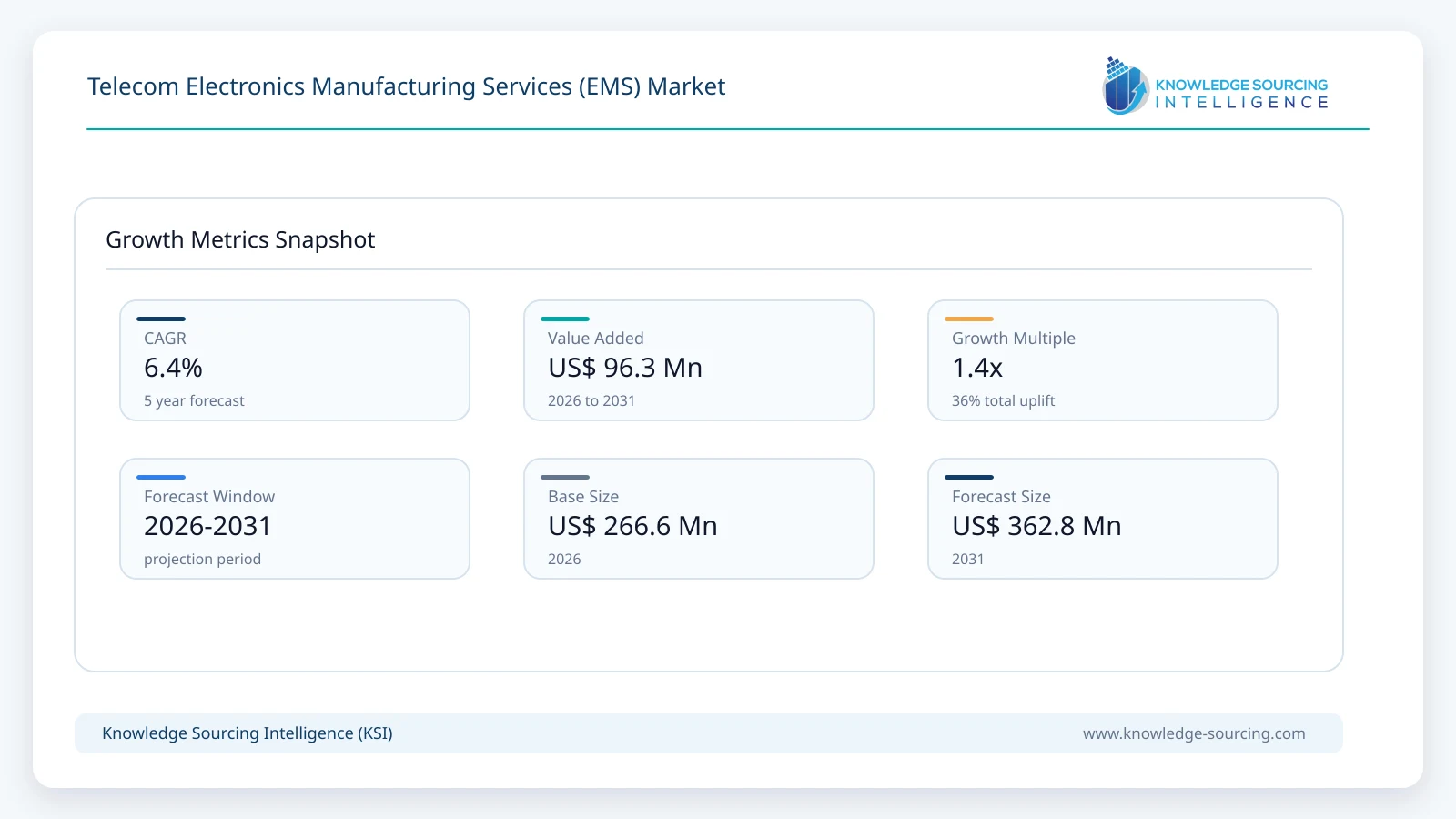
The Telecom Electronic Manufacturing Services Market is forecast to grow at a CAGR of 6.36%, reaching USD 362.81 million in 2031 from USD 266.55 million in 2026.
Highlights:
- 15G, fiber, and high-capacity networking infrastructureremain major demand sources for telecom electronics manufacturing, with China alone reporting 4.838 million 5G base stations at the end of 2025.
- 2Manufacturing and system-level integrationrepresent commercially important service opportunities because telecom buyers increasingly require suppliers to combine PCBA, assembly, testing, configuration, and logistics.
- 3Asia Pacific remains the principal manufacturing center, supported by large electronics ecosystems in China, Taiwan, South Korea, Japan, and Southeast Asia, while India is expanding its telecom manufacturing base through industrial policy.
- 4Optical networking, high-speed switching, and telecom computing equipmentare gaining relevance as network traffic, cloud infrastructure, and data-center interconnection require greater throughput and equipment density.
- 5Supply-chain security and national industrial policyare becoming procurement considerations alongside cost, particularly in the United States, Europe, India, and other markets seeking greater control over critical communications infrastructure.
- 6EMS competition is shifting toward integrated manufacturing relationships, where engineering, sourcing, testing, regional production, and lifecycle services can influence customer retention as much as factory pricing.
The Telecom Electronics Manufacturing Services (EMS) Market covers third-party engineering, electronics manufacturing, assembly, testing, integration, supply-chain, and lifecycle support services delivered for telecommunications hardware. The market includes contract manufacturing and broader electronics manufacturing relationships supporting routers, switches, servers, base station equipment, optical networking equipment, and other telecom infrastructure products. Its commercial scope extends beyond printed circuit board assembly because telecom equipment buyers increasingly require suppliers that can manage product introduction, component sourcing, system integration, testing, logistics, and production scaling within one operating framework.
Demand for telecom EMS is closely linked to capital expenditure by network operators, internet service providers, telecom equipment manufacturers, hyperscale and enterprise infrastructure providers, and public-sector communications programs. Unlike consumer electronics, telecom equipment generally operates within long deployment cycles, stringent reliability requirements, and demanding qualification processes. An EMS provider therefore competes on manufacturing quality, engineering depth, supply continuity, compliance capability, geographic coverage, and its ability to support product changes without disrupting network deployment schedules.
The demand environment entering 2026 is shaped by continued investment in 5G networks, fiber connectivity, high-capacity optical infrastructure, edge computing, data-center interconnection, and network modernization. China provides a clear illustration of the scale of infrastructure demand. The Ministry of Industry and Information Technology reported 4.838 million 5G base stations at the end of 2025, while 5G subscriptions reached 1.204 billion. China also recorded 12.1 billion fiber-access ports and 31.62 million 10G PON ports by year-end, creating a large installed base requiring networking hardware, upgrades, replacement equipment, and associated manufacturing capacity.
The United States presents a different but complementary demand pattern. Broadband deployment funding is moving from program design toward project execution, creating procurement opportunities for network infrastructure and associated electronics. In February 2026, the National Telecommunications and Information Administration announced approval of 50 of 56 BEAD final proposals, while the program carries $42.45 billion in federal funding. The emphasis on cost efficiency and technology-neutral deployment also affects EMS procurement because suppliers must support equipment configurations that meet technical requirements while maintaining competitive delivered costs.
Europe remains an important market because national broadband programs, 5G deployment, fiber expansion, network security requirements, and efforts to strengthen strategic communications infrastructure require dependable electronics production. The European Commission's 2026 connectivity assessment reported that fiber-to-the-premises had become Europe's most widespread fixed technology and that 5G coverage was approaching broad population reach. These developments support continuing requirements for optical networking hardware, access equipment, radio equipment, switches, routers, and associated manufacturing services.
Telecom OEMs and network operators are also changing how they evaluate EMS suppliers. Unit manufacturing cost remains important, but buyers increasingly assess total supply-chain cost, regional manufacturing availability, component-risk management, engineering support, production traceability, repair capability, and the ability to relocate production when geopolitical or tariff conditions change. This favors EMS providers with multi-region manufacturing networks and established supplier ecosystems.
The industry structure consists of large global EMS companies, specialized electronics manufacturers, regional contract manufacturers, and vertically integrated telecom equipment companies that outsource selected production stages. Large providers such as Benchmark Electronics, Flex, Jabil, Celestica, Compal Electronics, and Sanmina compete through combinations of manufacturing scale, engineering resources, supply-chain management, system integration, testing, and geographic reach. Their telecom exposure also intersects with cloud infrastructure, optical systems, computing, defense, industrial electronics, and data-center hardware, allowing manufacturing capacity to be allocated according to customer demand and factory economics.
Revenue generation within telecom EMS therefore comes from several layers. Basic PCBA and box-build manufacturing produce direct production revenue, while design engineering, new product introduction, testing, system integration, logistics, repair, and aftermarket services can increase the value captured per customer relationship. Higher-complexity equipment generally creates more opportunities for engineering and testing services because products require extensive validation before volume production.
No market size or CAGR has been supplied for this market; accordingly, this report does not introduce an unsupported market valuation or forecast rate. The forecast period is 2026–2031, and the commercial outlook is assessed through infrastructure investment, procurement behavior, manufacturing economics, technology adoption, and regulatory developments.
Market Drivers
Expansion of 5G and High-Capacity Network Infrastructure
5G deployment creates recurring requirements across radio access equipment, transport systems, routers, switches, power electronics, and optical connectivity. The manufacturing opportunity does not end when a new base station is deployed. Operators subsequently require capacity expansion, replacement units, software-related hardware revisions, network densification, and equipment compatible with newer standards.
China's 2025 communications statistics illustrate the manufacturing scale associated with this demand. The country added 588,000 5G base stations during 2025, bringing the national total to 4.838 million. The same year, 5G accounted for 65.9% of China's mobile subscriptions.
For EMS providers, large network rollouts create production programs with substantial volume requirements but demanding quality controls. Customers need predictable output because shortages of a relatively small number of electronic assemblies can delay complete network systems. This encourages telecom OEMs to outsource production to suppliers capable of managing component procurement, automated assembly, testing, and final configuration at scale.
The commercial implication is a greater role for EMS companies in production planning rather than simple build-to-print manufacturing. Suppliers that can participate earlier in product development can influence manufacturability, component selection, test architecture, and regional production strategy.
Fiber, Optical Networking, and Broadband Infrastructure Investment
Fiber deployment is creating demand for optical networking equipment, access platforms, switches, routers, transceivers, and associated electronics. China's 2025 statistics recorded 74.99 million kilometers of optical-fiber cable and 12.1 billion FTTH/O access ports, while 10G PON ports reached 31.62 million.
Europe is also moving toward broader fiber coverage. The European Commission's 2026 connectivity assessment identified FTTP as Europe's most widespread fixed technology, while monitoring progress toward 2030 connectivity targets.
For EMS suppliers, optical networking products can provide attractive manufacturing opportunities because they combine electronics, optical components, precision assembly, thermal management, calibration, and testing. Production requires tighter process control than conventional low-complexity electronics, which can raise the value of engineering and testing services within an outsourcing contract.
Broadband programs also create demand from smaller network operators and infrastructure providers that may lack internal manufacturing infrastructure. EMS suppliers can therefore serve multiple layers of the communications ecosystem rather than relying exclusively on large telecom OEM contracts.
Telecom OEM Outsourcing and Greater Manufacturing Specialization
Telecom equipment manufacturers face pressure to allocate internal capital toward product architecture, software, semiconductor development, customer support, and network solutions rather than maintaining every production capability internally. Outsourcing allows OEMs to adjust production volumes while using external manufacturing capacity, engineering resources, and established supplier networks.
The commercial rationale becomes stronger for products with fluctuating demand. A telecom OEM may require relatively high production volumes during a deployment cycle and substantially lower volumes during subsequent network phases. An EMS partner can spread factory utilization across multiple customers and end markets, reducing the fixed-cost burden associated with maintaining dedicated manufacturing capacity.
Large EMS companies also provide supplier-management capabilities that can be difficult for individual OEMs to replicate across multiple countries. This includes qualification of component suppliers, inventory planning, logistics, production scheduling, and quality management. As a result, outsourcing decisions increasingly consider the complete cost and risk profile rather than the quoted assembly price.
Regionalization of Electronics Supply Chains
Telecom infrastructure has become closely connected with national security, economic resilience, and industrial policy. Governments increasingly encourage domestic or regional production of strategically important communications equipment and components.
India's Department of Telecommunications, for example, operates a Production Linked Incentive framework for telecom and networking products and applies public-procurement preferences designed to encourage domestic manufacturing. The Department's procurement framework also identifies eligible telecom manufacturers under the PLI scheme as deemed Class II local suppliers for specified purposes.
For EMS companies, these policies can influence factory location, supplier qualification, customer sourcing decisions, and capital allocation. Rather than operating exclusively through a lowest-cost global manufacturing model, suppliers increasingly need regional production options that satisfy local-content, procurement, security, or resilience requirements.
Market Restraints and Challenges
High Component and Semiconductor Supply-Chain Exposure
Telecom hardware contains processors, memory, power-management devices, optical components, RF components, connectors, and specialized semiconductors. Some components have limited supplier alternatives or long qualification cycles. A shortage in one component can prevent completion of an otherwise finished system.
The problem affects EMS companies and their customers differently. EMS providers face working-capital and inventory risks, while OEMs face deployment delays and contractual consequences. Mitigation requires approved alternate components, dual sourcing, longer-term procurement agreements, lifecycle monitoring, and stronger supplier visibility.
However, excessive inventory can reduce margins and increase obsolescence exposure. EMS companies therefore need to balance resilience against the financial cost of carrying inventory.
Margin Pressure from Large-Volume Procurement
Telecom operators and equipment OEMs typically have substantial purchasing power. Large programs can generate high manufacturing volumes, but procurement teams may use that scale to negotiate aggressively on unit pricing, conversion costs, logistics, and working-capital terms.
This creates a structural tension within EMS economics. Higher volume improves factory utilization, yet pricing pressure can limit the benefit captured by manufacturers. Providers therefore seek additional value through engineering, testing, supply-chain services, system integration, and lifecycle support.
The challenge is especially relevant where products have limited differentiation at the manufacturing level. EMS companies must demonstrate measurable value in yield, quality, delivery reliability, inventory reduction, engineering support, or regional production rather than relying only on scale.
Regulatory and Security Requirements
Communications equipment can face country-specific security, certification, import, export, cybersecurity, spectrum, and procurement requirements. In the United States, the FCC's Covered List framework can restrict equipment authorization for designated equipment and services, while later regulatory activity has considered the implications of covered components within broader equipment configurations.
These requirements increase compliance work for EMS providers. Manufacturers may need detailed traceability for components, suppliers, manufacturing locations, software or firmware elements, and testing records. A factory that is technically capable of producing a product may therefore not be commercially suitable if it cannot satisfy a customer's regulatory or security requirements.
Demand Cycles and Factory Utilization
Telecom equipment demand is closely linked to operator capital expenditure cycles. Network construction can produce large orders followed by periods of slower replacement demand. EMS providers must therefore manage production capacity without creating excessive fixed costs.
Large global suppliers can reduce this risk by sharing factories across communications, cloud infrastructure, industrial, medical, automotive, aerospace, and other markets. Smaller suppliers may have less flexibility, making customer concentration and capacity planning more material risks.
Major Segment Analysis
By Devices: Base Station Equipment
Base station equipment represents a commercially important device segment because mobile network deployment requires large quantities of radio and related infrastructure hardware across geographic markets. The segment encompasses equipment supporting radio access functions, including hardware associated with 4G, 5G, 5G-Advanced, and emerging open or disaggregated network architectures.
Demand is driven by network densification, new spectrum deployment, replacement of older equipment, capacity upgrades, rural coverage programs, and the introduction of new radio configurations. China's 2025 statistics demonstrate the continuing scale of this requirement, with 4.838 million 5G base stations deployed by year-end and 2.064 million 5G base stations equipped with 5G RedCap access capability.
EMS providers serving base-station equipment must satisfy requirements that differ from conventional networking hardware. Products can involve high-power electronics, RF assemblies, thermal-management systems, complex PCBs, mechanical structures, and demanding environmental testing. Manufacturing quality therefore affects not only product reliability but also field maintenance costs and operator network availability.
Buyers typically evaluate suppliers on manufacturing consistency, RF testing capabilities, component availability, production traceability, engineering support, and geographical proximity. Qualification can also be lengthy because telecom OEMs must validate equipment against network standards and customer specifications before broad deployment.
The shift toward open and disaggregated network architectures can create additional manufacturing opportunities. Open interfaces can separate portions of the traditional network equipment stack, potentially increasing the number of hardware configurations and specialized modules that require production and integration. ETSI continues to publish 3GPP and O-RAN-related specifications covering 5G radio systems and open interfaces, reinforcing the importance of standards-compliant testing and integration capabilities.
For EMS providers, the commercial opportunity lies in supporting the entire product lifecycle. This includes design-for-manufacturing input, prototype production, qualification builds, volume manufacturing, RF testing, system integration, configuration, logistics, field repair, and end-of-life management. Suppliers capable of handling several of these stages can become more deeply embedded in OEM production programs.
Regional Analysis
North America
North American demand is supported by 5G deployment, fiber broadband expansion, enterprise networking, cloud infrastructure, government communications, and data-center interconnection. The United States also has an important policy-driven broadband opportunity through the BEAD program.
In February 2026, NTIA reported that 50 of 56 state and territorial final proposals had been approved. The agency estimated approximately $21 billion in taxpayer savings from program reforms, reflecting a stronger emphasis on cost efficiency and competitive deployment.
For EMS providers, this environment favors suppliers able to manufacture network electronics in or near the U.S. market while maintaining competitive costs. Domestic capacity can also become strategically important where customers face security restrictions or want greater control over the origin of critical components.
Canada provides a smaller but relevant market through broadband expansion, enterprise connectivity, and telecommunications infrastructure. Mexico is important from a manufacturing perspective because its proximity to the U.S. supports regionalized electronics production and cross-border supply chains.
Europe
Europe combines continued connectivity investment with stronger requirements around network security, supply-chain resilience, environmental performance, and product compliance. The European Commission's 2026 assessment showed continued progress in both FTTP and 5G coverage, supporting demand for networking and optical infrastructure.
Germany, the United Kingdom, and France are important procurement markets, while Central and Eastern European locations can provide manufacturing and logistics advantages. Buyers in Europe increasingly assess not only price and quality but also regulatory compliance, energy efficiency, traceability, and regional supply continuity.
The standards environment is also important. ETSI publications continue to incorporate evolving 5G and O-RAN specifications, requiring EMS providers to maintain appropriate testing and engineering capabilities.
Asia Pacific
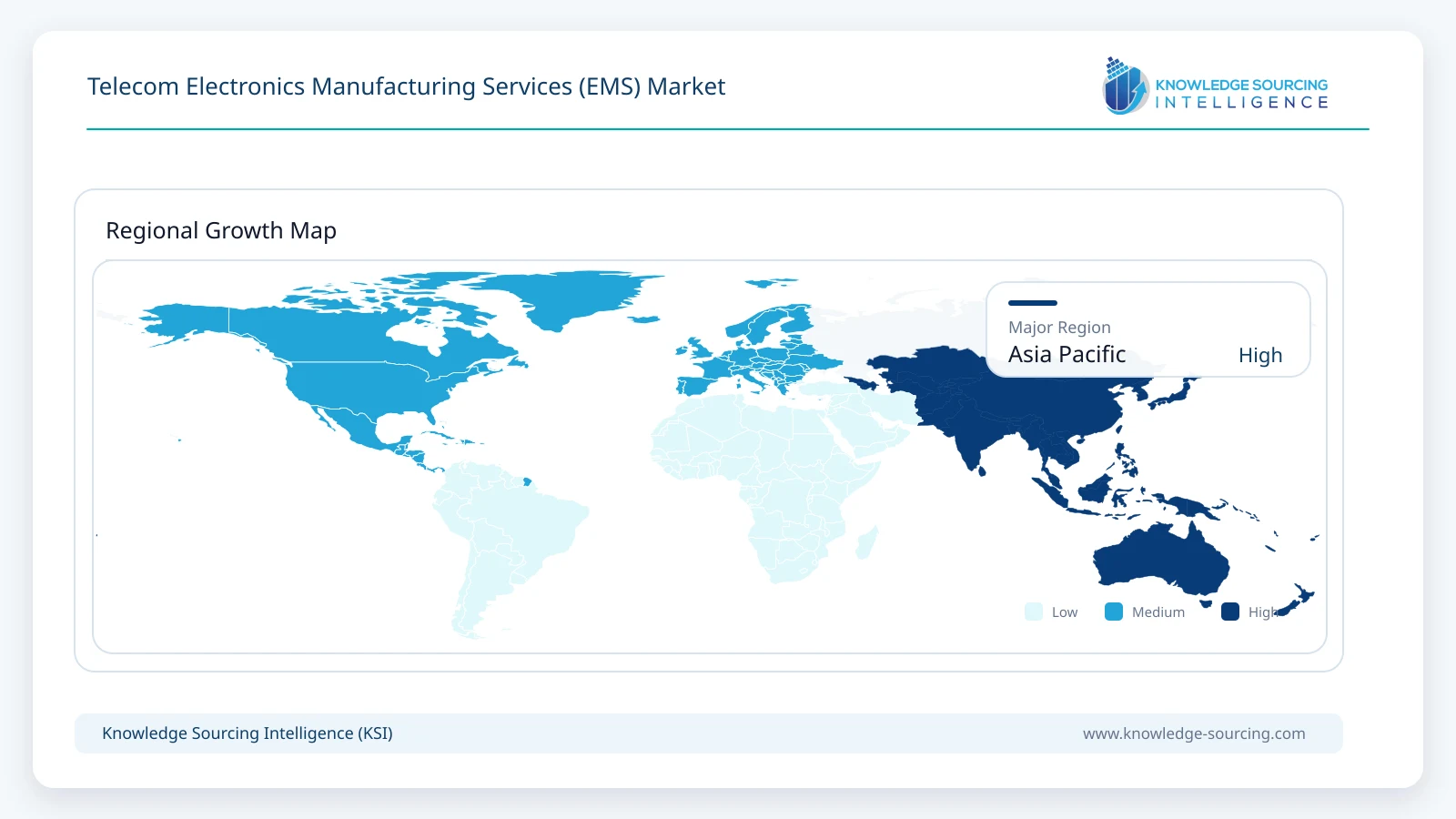
Asia Pacific is expected to remain the central production and consumption region for telecom electronics EMS. China combines enormous network infrastructure requirements with a mature electronics supply base. Japan and South Korea maintain advanced telecommunications and electronics ecosystems, while Taiwan remains important for semiconductor and electronics manufacturing capabilities.
India is becoming more important as both a telecom equipment manufacturing location and an end-market. Government incentives and procurement preferences support domestic production of telecom and networking products.
Southeast Asian economies, including Thailand and Indonesia, can benefit from manufacturing diversification as companies seek additional production locations. The principal constraint is that establishing qualified telecom production requires more than inexpensive labor. EMS providers need component ecosystems, engineering talent, automated assembly, testing infrastructure, logistics connectivity, and stable regulatory conditions.
Middle East and Africa
Middle Eastern demand is supported by national broadband programs, 5G deployment, smart-city infrastructure, cloud connectivity, enterprise networking, and government communications projects. Saudi Arabia and the United Arab Emirates have particularly strong infrastructure investment capabilities and are building communications capacity alongside broader technology and data-center programs.
Israel maintains advanced communications and electronics capabilities, including defense-related technology expertise. However, regional geopolitical conditions can affect logistics, procurement decisions, insurance costs, and project schedules.
For EMS companies, local partnerships and regional distribution capabilities can be important because some government and infrastructure programs place greater emphasis on domestic participation, service support, or security requirements.
South America
South America presents a more selective opportunity, with Brazil representing the largest addressable market due to its population, telecommunications base, enterprise connectivity requirements, and ongoing broadband investment.
Argentina and other South American countries provide additional demand, although macroeconomic volatility, currency fluctuations, import restrictions, and infrastructure financing can affect equipment procurement. EMS suppliers therefore need flexible inventory and sourcing strategies when serving this region.
The commercial opportunity is stronger for providers that can combine regional assembly or final configuration with centralized component procurement. This model can reduce logistics complexity while maintaining access to larger manufacturing ecosystems.
Competitive Landscape
The telecom EMS competitive environment is characterized by global providers that combine electronics manufacturing with engineering, procurement, logistics, testing, and system integration. The supplied competitive set comprises Benchmark Electronics, Flex, Jabil, Celestica, Compal Electronics, and Sanmina.
Competition is not based solely on factory capacity. Telecom customers require suppliers to manage complex bills of material, production qualification, testing, component sourcing, and delivery schedules. As a result, engineering and supply-chain capabilities can materially affect supplier selection.
Flex illustrates the importance of telecom-specific manufacturing breadth. Its communications portfolio covers 5G infrastructure, satellite, IP and optical networks, RAN, multi-access edge computing, telco cloud, and open RAN, alongside design, manufacturing, testing, integration, and fulfillment services.
Jabil competes through a broad manufacturing and engineering footprint. Its 2025 announcement of a planned $500 million investment in U.S. manufacturing capacity for cloud and AI data-center infrastructure also demonstrates how large EMS companies can align capital expenditure with infrastructure customers while expanding regional production.
Celestica has increased its exposure to networking and storage solutions, including a February 2025 partnership with EPS Global to expand distribution of its networking and storage products to enterprise customers. Such channel relationships can broaden access to customers while complementing manufacturing and systems capabilities.
Sanmina combines communications networks with cloud infrastructure and other complex industries. Its fiscal 2025 results identified communications networks and cloud and AI infrastructure as areas of strength, while its global manufacturing footprint supports customers across multiple regions.
Benchmark and Compal contribute additional manufacturing scale and geographic diversity. The competitive model therefore favors companies capable of balancing regional production, global sourcing, engineering support, and factory utilization across multiple end markets.
Over 2026–2031, differentiation is likely to center on manufacturing proximity, supply-chain resilience, advanced testing, optical and RF expertise, system-level integration, and the ability to transfer production between regions without lengthy requalification.
Recent Developments
July 2026: India’s Department of Telecommunications and Madhya Pradesh signed an MoU to establish a telecom manufacturing zone in Gwalior, attracting commitments from 14 manufacturers and strengthening localized telecom electronics production.
June 2026: Jabil inaugurated its advanced manufacturing facility in Ranjangaon, Pune, with capabilities spanning 5G technology, high-end networking equipment and precision electronics manufacturing for telecom applications.
April 2026: Celestica announced its DS6000-series 1.6TbE switches were available to order, advancing commercial production of high-speed networking hardware through its communications-focused design and manufacturing capabilities.
March 2026: Exicom inaugurated its ?216-crore integrated Hyderabad manufacturing facility, expanding production of power-electronics systems supporting telecom networks, data centers and other mission-critical infrastructure.
February 2025: Celestica partnered with EPS Global to expand distribution of its networking and storage products to enterprise customers in global markets. The development is relevant to telecom EMS because it connects manufacturing and product capabilities with broader enterprise networking demand, particularly for high-performance switches and storage platforms.
Regulatory and Policy Environment
Telecom EMS providers operate within a regulatory framework that combines manufacturing, product safety, radio-frequency, cybersecurity, environmental, trade, procurement, and national-security requirements.
In the United States, FCC equipment authorization and the Covered List framework can directly affect whether certain communications equipment receives authorization. The FCC has also examined the role of components within covered equipment, making component traceability and supplier visibility more important for EMS manufacturers.
The U.S. broadband infrastructure environment is also influenced by the BEAD program. The $42.45 billion program provides a major source of public investment in high-speed broadband infrastructure, while 2025 restructuring placed greater emphasis on technology neutrality, cost efficiency, and deployment outcomes.
India's telecom manufacturing policy provides another important example. The Department of Telecommunications' PLI framework supports production of telecom and networking products, while public-procurement preferences can favor qualifying domestic manufacturers. These policies influence factory-location decisions and can encourage international EMS providers to establish local production or partnerships.
Europe's regulatory environment places strong emphasis on secure and resilient communications infrastructure. The European Commission's Digital Decade framework targets broad 5G coverage by 2030, while European standards bodies continue to publish specifications supporting 5G, 5G-Advanced, and open network architectures.
Standards compliance has direct commercial consequences for EMS suppliers. Telecom products may require conformance testing, RF validation, environmental testing, electromagnetic compatibility assessment, cybersecurity controls, and documented manufacturing traceability. Suppliers that lack these capabilities may remain limited to lower-value assembly work.
Outlook and Strategic Implications
The Telecom Electronics Manufacturing Services Market is expected to remain closely tied to network infrastructure investment through 2031. The principal demand foundation will come from continued 5G deployment, fiber expansion, network modernization, optical capacity upgrades, enterprise connectivity, and communications requirements linked with cloud and edge infrastructure.
Procurement strategies are likely to place greater weight on regional manufacturing. Geopolitical tensions, trade measures, security concerns, and government incentives are encouraging OEMs and operators to reduce dependence on a single manufacturing geography. EMS suppliers with facilities across North America, Europe, and Asia Pacific can therefore offer customers greater flexibility in production allocation.
The economics of outsourcing will also move toward broader service packages. Manufacturing alone can remain price-sensitive, while design support, testing, supply-chain management, system integration, new product introduction, and aftermarket services provide opportunities for stronger customer relationships. This favors EMS companies capable of entering a program during product development rather than only after design completion.
Technology priorities will center on higher-speed networking, optical connectivity, advanced radio equipment, open network architectures, and increasingly complex system-level products. The continued development of 5G-Advanced standards and O-RAN specifications will require manufacturing suppliers to maintain engineering and test capabilities that can accommodate new product configurations.
Supply-chain management will remain a decisive factor. EMS companies will need to maintain visibility into semiconductor availability, alternate components, supplier concentration, inventory exposure, logistics routes, and regulatory restrictions. The ability to move production between facilities while maintaining quality and qualification requirements can become a major differentiator in large telecom programs.
The competitive environment will also reflect increasing overlap between telecom, cloud infrastructure, optical networking, and data-center hardware. Sanmina's expansion into ZT Systems' data-center infrastructure manufacturing business and Jabil's investment in U.S. cloud and AI infrastructure manufacturing illustrate how large EMS companies are allocating resources toward adjacent infrastructure markets.
For telecom OEMs, the strategic priority will be selecting EMS partners that can provide capacity without sacrificing product quality, cybersecurity, regulatory compliance, or supply continuity. For network operators and infrastructure providers, the emphasis will remain on dependable equipment availability, lifecycle support, and predictable total cost of ownership.
The principal risks through 2031 include prolonged component shortages, abrupt changes in telecom capital expenditure, trade restrictions, regulatory fragmentation, customer concentration, excess factory capacity, and qualification delays. Providers with diversified end-market exposure, geographically distributed production, strong supplier-management systems, and advanced testing capabilities will be better positioned to absorb these pressures.
The strongest commercial opportunities are likely to emerge where telecom infrastructure requires complex, high-value electronics rather than simple assembly. Optical networking equipment, advanced base-station systems, high-performance switches, telecom servers, and integrated network platforms can generate demand for engineering, testing, configuration, and supply-chain services in addition to manufacturing.
Overall, the market's trajectory will depend less on unit volumes alone and more on how telecom OEMs redesign their manufacturing networks around resilience, regionalization, engineering collaboration, and total supply-chain economics. EMS providers that combine manufacturing scale with telecom-specific technical capabilities can secure deeper roles in product development and infrastructure deployment, while customers can use outsourced manufacturing to control fixed costs and adapt production capacity to changing network investment cycles.
Telecom Electronics Manufacturing Services (EMS) Market Scope:
| Report Metric | Details |
|---|---|
| Total Market Size in 2026 | USD 266.55 million |
| Total Market Size in 2031 | USD 362.81 million |
| Forecast Unit | Million |
| Growth Rate | 6.36% |
| Study Period | 2021 to 2031 |
| Historical Data | 2021 to 2024 |
| Base Year | 2025 |
| Forecast Period | 2026 – 2031 |
| Segmentation | Devices, Services, End Users, Geography |
| Companies |
|
Market Segmentation
By Devices
- Routers
- Switches
- Servers
- Base Station Equipment
- Optical Networking Equipment
- Other Telecom Equipment
By Services
- Design and Engineering
- Manufacturing
- Assembly
- Testing
- Supply Chain Management
- New Product Introduction and System Integration
- Others
By End Users
- Telecom Equipment Manufacturers
- Network Operators
- Internet Service Providers
- Enterprise Communications Providers
- Government and Defense Organizations
- Others
By Geography
- North America
- United States
- Canada
- Mexico
- South America
- Brazil
- Argentina
- Others
- Europe
- Germany
- United Kingdom
- France
- Spain
- Others
- Middle East and Africa
- Saudi Arabia
- Israel
- United Arab Emirates
- Others
- Asia Pacific
- China
- Japan
- India
- Indonesia
- South Korea
- Thailand
- Taiwan
- Others
Table of Contents
1. INTRODUCTION
1.1. Market Overview
1.2. Market Definition
1.3. Scope of the Study
1.4. Market Segmentation
1.5. Currency
1.6. Assumptions
1.7. Base and Forecast Years Timeline
2. RESEARCH METHODOLOGY
2.1. Research Data
2.2. Sources
2.3. Research Design
3. EXECUTIVE SUMMARY
3.1. Research Highlights
4. MARKET DYNAMICS
4.1. Market Drivers
4.2. Market Restraints
4.3. Porter’s Five Forces Analysis
4.3.1. Bargaining Power of Suppliers
4.3.2. Bargaining Power of Buyers
4.3.3. Threat of New Entrants
4.3.4. Threat of Substitutes
4.3.5. Competitive Rivalry in the Industry
4.4. Industry Value Chain Analysis
5. TELECOM ELECTRONICS MANUFACTURING SERVICES (EMS) MARKET BY DEVICES
5.1. Introduction
5.2. Routers
5.3. Switches
5.4. Servers
5.5. Base Station Equipment
5.6. Optical Networking Equipment
5.7. Other Telecom Equipment
6. TELECOM ELECTRONICS MANUFACTURING SERVICES (EMS) MARKET BY SERVICES
6.1. Introduction
6.2. Design and Engineering
6.3. Manufacturing
6.4. Assembly
6.5. Testing
6.6. Supply Chain Management
6.7. New Product Introduction and System Integration
6.8. Others
7. TELECOM ELECTRONICS MANUFACTURING SERVICES (EMS) MARKET BY END USERS
7.1. Introduction
7.2. Telecom Equipment Manufacturers
7.3. Network Operators
7.4. Internet Service Providers
7.5. Enterprise Communications Providers
7.6. Government and Defense Organizations
7.7. Others
8. TELECOM ELECTRONICS MANUFACTURING SERVICES (EMS) MARKET BY GEOGRAPHY
8.1. Introduction
8.2. North America
8.2.1. United States
8.2.2. Canada
8.2.3. Mexico
8.3. South America
8.3.1. Brazil
8.3.2. Argentina
8.3.3. Others
8.4. Europe
8.4.1. Germany
8.4.2. United Kingdom
8.4.3. France
8.4.4. Spain
8.4.5. Others
8.5. Middle East and Africa
8.5.1. Saudi Arabia
8.5.2. Israel
8.5.3. United Arab Emirates
8.5.4. Others
8.6. Asia Pacific
8.6.1. China
8.6.2. Japan
8.6.3. India
8.6.4. Indonesia
8.6.5. South Korea
8.6.6. Thailand
8.6.7. Taiwan
8.6.8. Others
9. COMPETITIVE ENVIRONMENT AND ANALYSIS
9.1. Major Players and Strategy Analysis
9.2. Market Share Analysis
9.3. Mergers, Acquisitions, Agreements, and Collaborations
9.4. Vendor Competitiveness Matrix
10. COMPANY PROFILES
10.1. Benchmark Electronics, Inc.
10.2. Flex Ltd.
10.3. Jabil Inc.
10.4. Celestica Inc.
10.5. Compal Electronics, Inc.
10.6. Sanmina Corporation
LIST OF FIGURES
LIST OF TABLES
Navigate
Trusted by the world's leading organizations











