
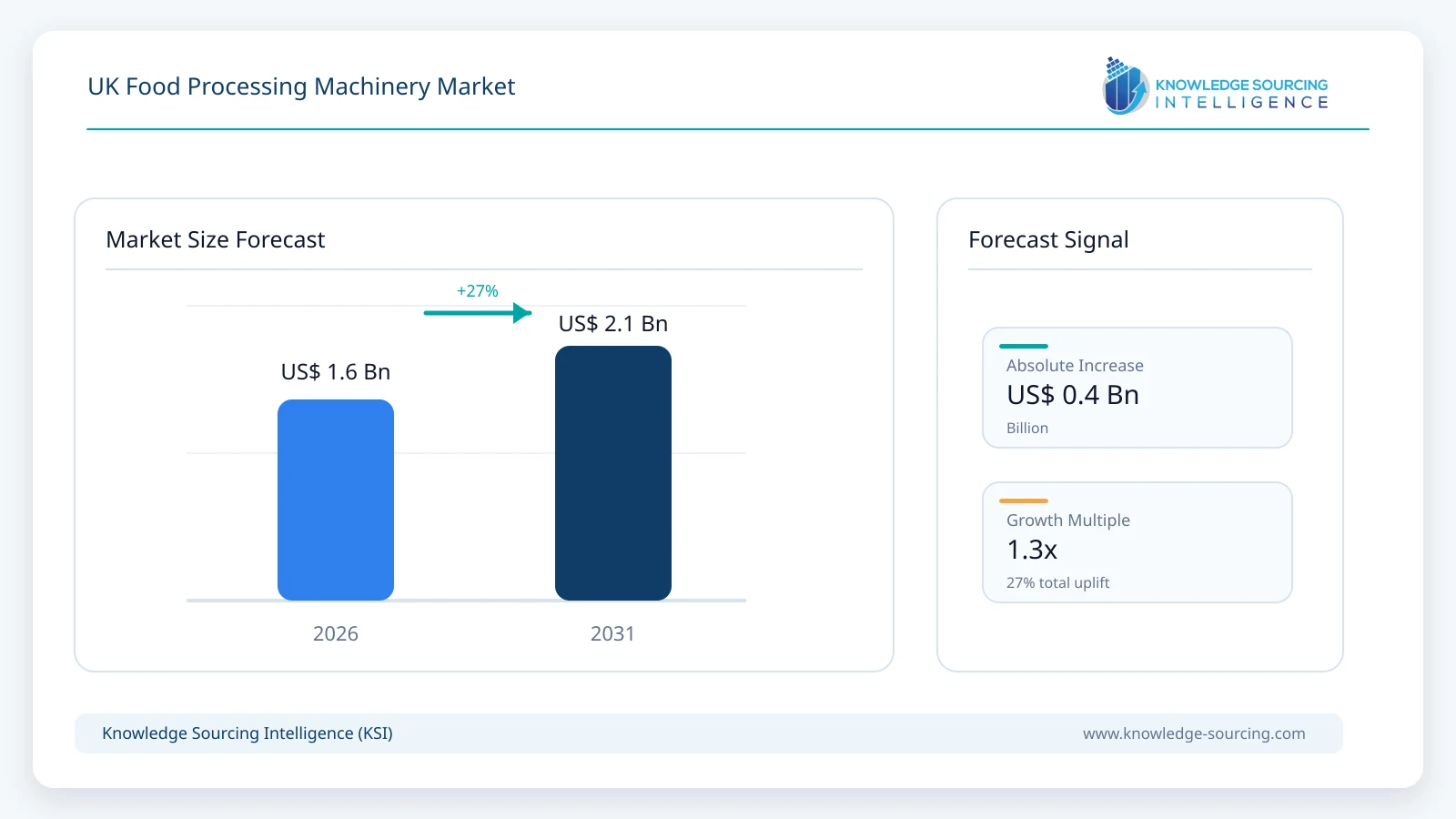
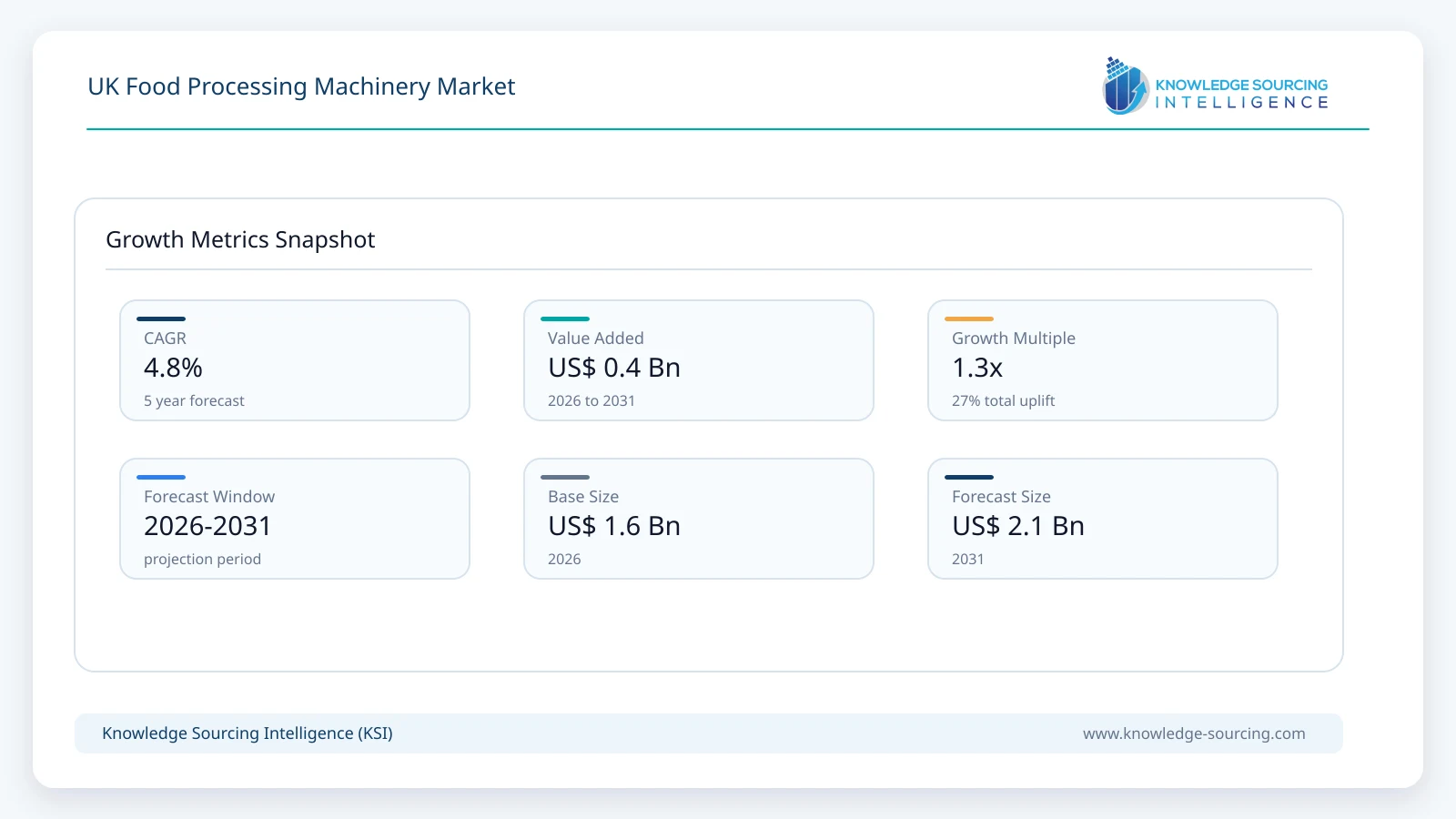
The UK Food Processing Machinery Market is estimated to grow at a CAGR of 4.8%, reaching USD 2.09 billion by 2031 from USD 1.65 billion in 2026.
Highlights:
- 1Processing equipment generates approximately USD 1.19 billion of UK market value in 2026.
- 2Automatic machinery is projected to expand at about 6.4% annually through 2031.
- 3Bakery and confectionery equipment represents roughly one-quarter of 2026 machinery demand.
- 4England accounts for approximately 81% of national food processing machinery demand in 2026.
- 5UK food and drink manufacturers recorded about GBP 4.8 billion of total business investment in 2025.
- 6More than two-fifths of small food manufacturers planned higher machinery and automation investment entering 2026.
The UK has one of Europe's largest food and drink manufacturing industries and therefore a substantial installed base of industrial processing equipment. The Food and Drink Federation reports sector turnover of about GBP 152 billion, total business investment of GBP 4.8 billion in 2025, and employment of roughly 484,750 people across more than 12,000 manufacturers. Office for National Statistics data separately show that food manufacturing remained the UK's largest manufacturing division in 2025, representing 22.9% of total manufacturers' product sales. This scale creates recurring demand for equipment replacement, debottlenecking, hygienic redesign, capacity additions and automation even when underlying food volumes grow only modestly.
Trade data illustrate the UK's continued reliance on imported specialist process technology alongside domestic capability in selected categories. World Bank WITS data show 2024 imports of approximately USD 123.5 million for other industrial food and drink preparation machinery under HS 843880, USD 94.1 million for meat and poultry machinery, USD 15.9 million for brewery machinery and USD 17.1 million for dairy machinery. Bakery, confectionery, fruit and vegetable machinery and equipment parts add further value. These customs categories do not capture every relevant thermal, separation, inspection, automation or line-integration system, so they represent only part of total machinery demand.
The demand environment is mixed. The Food and Drink Federation reported that 41% of manufacturers were scaling back or cancelling planned investment in early 2025 as tax, labour, energy and packaging-related costs increased. By the end of 2025, however, 74% of manufacturers expected to maintain or increase overall investment during the following year, while more than two-fifths of smaller businesses intended to increase spending on machinery and automation. The sector's vacancy rate reached 5.0% in the fourth quarter of 2025, well above manufacturing overall. This creates a strong productivity case for automation even when companies remain cautious about large greenfield projects.
Market Trends
Automation Is Moving From Individual Machines Toward Integrated Production Cells
UK processors are increasingly evaluating automation at line level rather than purchasing isolated high-speed machines. Labour scarcity, higher wage costs and the operational complexity of short production runs are encouraging investment in integrated cutting, portioning, mixing, cooking, inspection, robotic handling and digital production control. Greencore reported higher capital investment in FY2025 and continued spending on next-generation automation, including automated sushi rolling and vegetable slicing, while its FY2026 capital guidance rises further. Equipment suppliers are responding with common software environments, remote diagnostics and machine-level production data that allow operators to manage throughput, changeovers and maintenance across multiple assets rather than optimizing each machine separately.
Energy, Yield and Waste Reduction Are Becoming Core Procurement Criteria
Food manufacturers face pressure from energy costs, ingredients, labour and waste-disposal expenses at the same time that customers and regulators expect stronger environmental performance. Machinery selection is therefore increasingly based on total cost of ownership rather than purchase price alone. Heat recovery, lower-water cleaning cycles, improved separation yield, more accurate portioning and reduced product giveaway can materially improve project economics. Alfa Laval is expanding hygienic heat-transfer and separation technologies designed to reduce energy, water and raw-material intensity, while sorting, portioning and inspection suppliers increasingly quantify yield improvement as part of the equipment business case. For UK processors operating mature plants, retrofits that remove bottlenecks or reduce utilities can be easier to justify than entirely new lines.
Flexible Processing Is Gaining Value as Product Portfolios Become More Complex
The UK market has a large convenience-food, bakery, confectionery, chilled-meal and premium private-label base. These categories require machinery that can switch between recipes, pack sizes and short campaigns without long cleaning or setup periods. Processors are therefore placing greater value on modular systems, automated recipe control, quick-release tooling, clean-in-place design and vision-based quality control. Nestle's 2025 investment in a new mixing plant at Dalston illustrates the move toward higher recipe accuracy and more efficient ingredient handling, while UK convenience-food producers continue to invest in automation and process capability. The result is growing demand for flexible mid-capacity equipment alongside very high-throughput lines.
Market Drivers
Labour Shortages and Rising Employment Costs Strengthen the Automation Business Case
Food manufacturing remains labour-intensive in preparation, handling, inspection and end-of-line activities. The sector's vacancy rate stood at 5.0% in late 2025, more than twice the rate for manufacturing overall, while businesses also face higher payroll and employment costs. Automation can reduce dependence on repetitive manual tasks, improve consistency and redeploy workers toward maintenance, quality and supervision. This does not translate into immediate replacement of every manual process, particularly among SMEs, but it supports steady investment in automatic mixers, portioners, slicers, conveyors, robotic handling, automated cleaning and digital control. The strongest projects are those where labour savings are combined with higher throughput or lower waste.
A Large Installed Food-Manufacturing Base Sustains Replacement and Modernization Demand
The UK market does not depend on rapid expansion in food volumes because its existing manufacturing base is already large. ONS reported food as the country's largest manufacturing division by product sales in 2025, while FDF places sector turnover at about GBP 152 billion. Processing assets in meat, bakery, dairy, beverages, prepared foods and confectionery operate for many years but require periodic replacement, controls upgrades, safety improvements and changes to accommodate new recipes or packaging formats. Even during periods of weak confidence, this installed-base effect creates a recurring machinery market. Larger producers also continue to invest selectively: Nestle committed GBP 28 million to its Dalston factory in 2025, and Greencore increased FY2025 capital investment by 34% while guiding to higher investment in FY2026.
Market Restraint
High Capital Cost and Weak Manufacturer Confidence Delay Full-Line Replacement
The main constraint is not lack of technical need but the timing of capital approval. Food manufacturers have faced simultaneous increases in labour, energy, ingredients and regulatory costs, limiting the cash available for long-payback projects. FDF reported that 41% of businesses were cancelling or scaling back planned investment in early 2025. SMEs face the greatest challenge because custom food-processing lines can require substantial engineering, installation and commissioning expenditure in addition to the equipment price. Buyers are therefore more likely to phase modernization, retrofit automation to existing assets or prioritize projects with clear labour, yield or energy savings. This slows headline market growth even though the long-term direction remains toward more automated plants.
Segment Analysis
By Type - Processing Equipment
Processing equipment accounts for roughly seven-tenths of UK market value in 2026 because it captures the higher-value machinery used for mixing, blending, cutting, grinding, forming, extrusion, homogenization, cooking, baking, pasteurization and other transformation steps. These systems typically require greater process engineering, controls integration and hygienic design than basic preparation equipment. Thermal equipment is particularly important across bakery, ready meals, meat, beverages and dairy, while high-value cutting, portioning and forming systems are central to meat and convenience-food production. Pre-processing machinery for cleaning, grading, sorting and initial preparation remains a significant category but generally carries lower equipment value per line.
By Automation Level - Automatic Machinery
Automatic machinery represents an estimated 58% of UK market revenue in 2026. Penetration is highest in large bakery, meat, beverage, dairy and prepared-food plants where consistent throughput and quality justify the capital cost. Semi-automatic machinery remains important among SMEs because it offers greater product flexibility and lower upfront expenditure. The share of automatic systems is expected to increase through 2031 as processors add robotic handling, automated recipe management, machine vision and predictive maintenance. The transition is likely to occur through staged retrofits as often as through complete line replacement, reflecting the age and diversity of the UK installed base.
By Application - Bakery and Confectionery
Bakery and confectionery is the largest application area, accounting for roughly 24% of UK food processing machinery demand in 2026. The country has a dense base of industrial bread, biscuit, cake, chocolate and snack producers alongside strong domestic equipment capability through companies such as Baker Perkins. Machinery requirements span mixers, dough handling, forming, extrusion, ovens, cooling, enrobing and ingredient systems. Meat, poultry and seafood form the next major equipment pool, supported by demand for cutting, deboning, portioning, cooking and further-processing systems. Prepared and convenience foods are among the more automation-intensive applications because frequent changeovers and labour-heavy assembly create strong demand for flexible equipment.
By Region - England
England dominates national machinery demand because it contains most UK food and drink manufacturing employment, turnover and large processing sites. Demand is geographically distributed rather than concentrated in one city: Yorkshire and the Humber has major bakery, confectionery and prepared-food operations; the East Midlands is strong in meat, snacks and convenience foods; the North West has dairy, bakery and beverage processing; and the East of England contains significant fresh, vegetable and prepared-food capacity. Scotland remains a meaningful secondary market, contributing around one-tenth of UK food and drink manufacturing turnover and supporting substantial whisky, seafood, meat and bakery processing. Northern Ireland is disproportionately important in meat, dairy and poultry, while Wales has a smaller but diverse processing base.
Competitive Environment
The UK market combines global full-line suppliers with strong domestic specialists and application-focused engineering companies. GEA, JBT Marel, Tetra Pak, Buhler, Alfa Laval and Krones compete across large process categories and benefit from broad service networks, software platforms and multinational customer relationships. JBT's combination with Marel in January 2025 created a larger food-processing technology group spanning primary, secondary and further processing across poultry, meat, fish, prepared foods, fruit and vegetables and other applications.
Domestic and UK-based specialists remain important because many processors require custom engineering, trials and rapid local service. Baker Perkins is a major supplier of bakery, biscuit, confectionery, extruded-food and cereal systems. DC Norris focuses on industrial cooking, chilling and ready-meal processing, while BCH supplies confectionery, caramel, liquorice and related process equipment. Ishida Europe has a strong UK base in weighing, inspection and line integration, although packaging-only equipment is outside the core market definition used here. These suppliers compete not only on machine performance but also on application testing, commissioning, spare parts and process support.
Competitive differentiation is shifting toward lifecycle economics. Suppliers that can demonstrate reduced labour, lower product giveaway, easier hygienic cleaning, energy recovery, remote service and flexible changeovers can justify higher capital cost. Digital connectivity is becoming more important, but customers remain cautious about proprietary architectures that make future integration difficult. The strongest suppliers are therefore combining mechanical process expertise with software, open controls, condition monitoring and long-term service contracts.
Recent Developments
March 2026: Alfa Laval introduced the PureFerm 750 N high-speed separator for next-generation food and fermentation processes, expanding the equipment set available for higher-solids alternative-protein production.
November 2025: Nestle announced a GBP 28 million upgrade at its Dalston factory, including a GBP 17.5 million new mixing plant designed to improve recipe accuracy, ingredient handling and operating efficiency.
November 2025: Greencore reported FY2025 capital investment of GBP 43.4 million, up 34% year over year, including next-generation automation, and indicated a further step-up in FY2026 investment.
September 2025: Ishida Europe showcased automated weighing and inspection solutions at the PPMA Total Show in Birmingham, emphasizing higher throughput, reduced giveaway and lower manual intervention.
July 2025: DELI LITES announced a GBP 19 million investment in Northern Ireland, including GBP 12.8 million for production automation and expansion of sandwich and heat-to-eat capacity.
UK Food Processing Machinery Market Scope
| Report Metric | Details |
|---|---|
| Total Market Size in 2026 | USD 1.65 billion |
| Total Market Size in 2031 | USD 2.09 billion |
| Forecast Unit | Billion |
| Growth Rate | 4.8% |
| Study Period | 2021 to 2031 |
| Historical Data | 2021 to 2024 |
| Base Year | 2025 |
| Forecast Period | 2026 – 2031 |
| Segmentation | Type, Food Matter Type, Automation Level, Application |
| Companies |
|
Market Segmentation
By Type
Pre-Processing Equipment
Cleaning
Grading and Sorting
Peeling and Preparation
Processing Equipment
Mixing and Blending
Cutting and Grinding
Extrusion and Forming
Homogenization
Thermal Processing and Baking
Others
By Food Matter Type
Solid
Semi-Solid
Liquid
By Automation Level
Manual
Semi-Automatic
Automatic
By Application
Bakery and Confectionery
Meat, Poultry and Seafood
Dairy
Beverages
Prepared and Convenience Foods
Fruits and Vegetables
Others
By Nation
England
Scotland
Wales
Northern Ireland
Table of Contents
1. EXECUTIVE SUMMARY
2. MARKET SNAPSHOT
2.1. Market Overview
2.2. Market Definition
2.3. Market Segmentation
3. BUSINESS LANDSCAPE
3.1. Market Drivers
3.1.1. Labour Shortages and Rising Employment Costs Strengthen the Automation Business Case
3.1.2. A Large Installed Food-Manufacturing Base Sustains Replacement and Modernization Demand
3.2. Market Restraint
3.2.1. High Capital Cost and Weak Manufacturer Confidence Delay Full-Line Replacement
3.3. Market Opportunities
3.4. Porter's Five Forces Analysis
3.5. Industry Value Chain Analysis
3.6. Policies and Regulations
3.7. Strategic Recommendations
4. TECHNOLOGICAL OUTLOOK
4.1. Connected Production and Factory Software
4.2. Robotics and Automated Handling
4.3. Energy- and Water-Efficient Processing
4.4. Machine Vision and In-Line Quality Control
4.5. Advanced Thermal and Separation Systems
5. UK FOOD PROCESSING MACHINERY MARKET BY TYPE
5.1. Introduction
5.2. Pre-Processing Equipment
5.2.1. Cleaning
5.2.2. Grading and Sorting
5.2.3. Peeling and Preparation
5.3. Processing Equipment
5.3.1. Mixing and Blending
5.3.2. Cutting and Grinding
5.3.3. Extrusion and Forming
5.3.4. Homogenization
5.3.5. Thermal Processing and Baking
5.3.6. Others
6. UK FOOD PROCESSING MACHINERY MARKET BY FOOD MATTER TYPE
6.1. Introduction
6.2. Solid
6.3. Semi-Solid
6.4. Liquid
7. UK FOOD PROCESSING MACHINERY MARKET BY AUTOMATION LEVEL
7.1. Introduction
7.2. Manual
7.3. Semi-Automatic
7.4. Automatic
8. UK FOOD PROCESSING MACHINERY MARKET BY APPLICATION
8.1. Introduction
8.2. Bakery and Confectionery
8.3. Meat, Poultry and Seafood
8.4. Dairy
8.5. Beverages
8.6. Prepared and Convenience Foods
8.7. Fruits and Vegetables
8.8. Others
9. UK FOOD PROCESSING MACHINERY MARKET BY NATION
9.1. Introduction
9.2. England
9.3. Scotland
9.4. Wales
9.5. Northern Ireland
10. COMPETITIVE ENVIRONMENT AND ANALYSIS
10.1. Major Players and Strategy Analysis
10.2. Market Share Analysis
10.3. Mergers, Acquisitions, Agreements and Collaborations
10.4. Competitive Dashboard
11. COMPANY PROFILES
11.1. GEA Group AG
11.2. JBT Marel Corporation
11.3. Tetra Pak International S.A.
11.4. Buhler AG
11.5. Alfa Laval AB
11.6. Krones AG
11.7. Baker Perkins Ltd.
11.8. Ishida Europe Ltd.
11.9. DC Norris & Company Ltd.
11.10. Heat and Control, Inc.
11.11. The Middleby Corporation
11.12. SPX FLOW, Inc.
11.13. TOMRA Food
11.14. Provisur Technologies, Inc.
11.15. Handtmann Group
11.16. VEMAG Maschinenbau GmbH
11.17. FAM Stumabo
11.18. BCH Ltd.
12. APPENDIX
12.1. Currency
12.2. Assumptions
12.3. Base and Forecast Years Timeline
12.4. Key Benefits for Stakeholders
12.5. Research Methodology
12.6. Abbreviations
Navigate
Trusted by the world's leading organizations











