
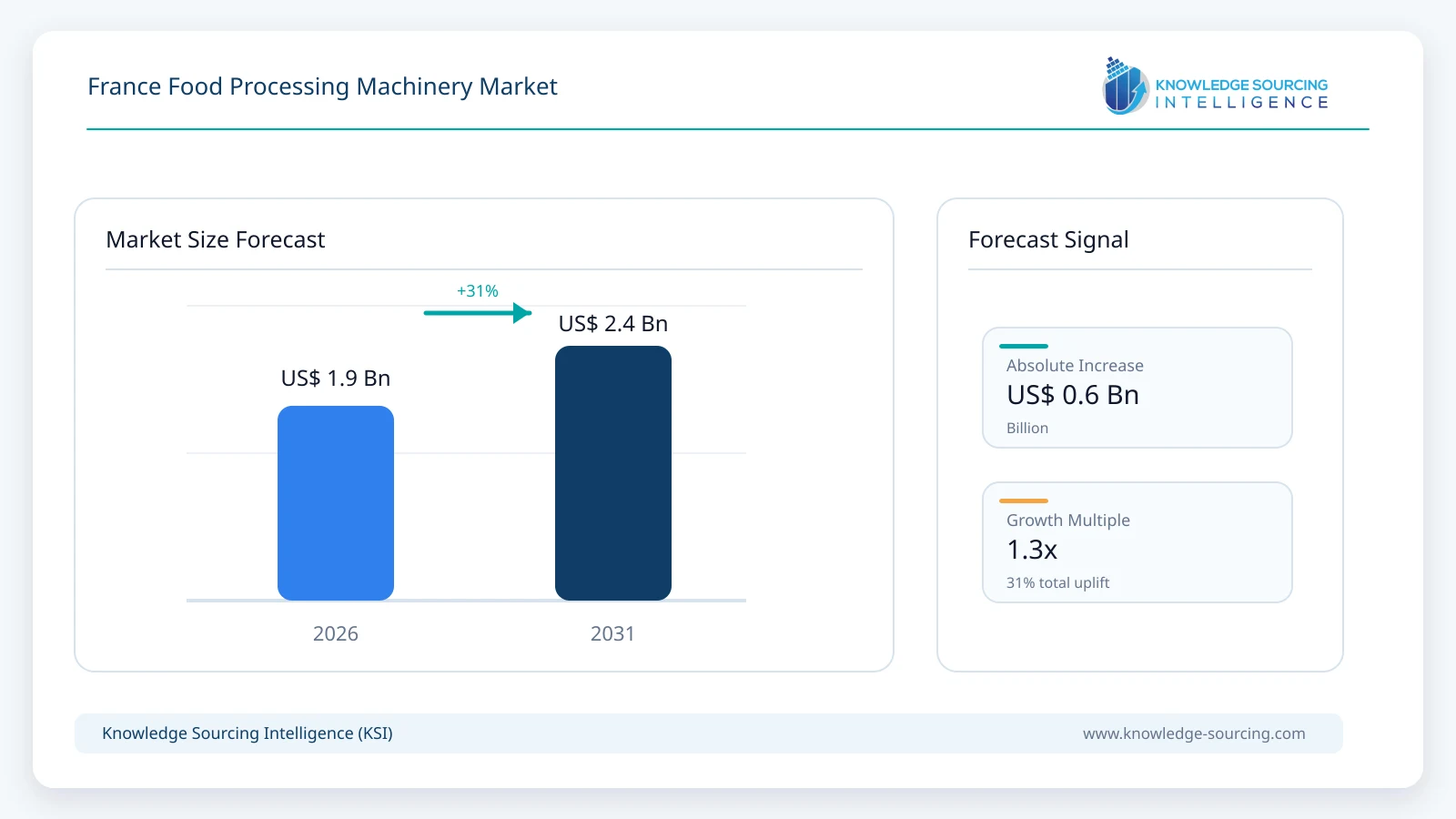
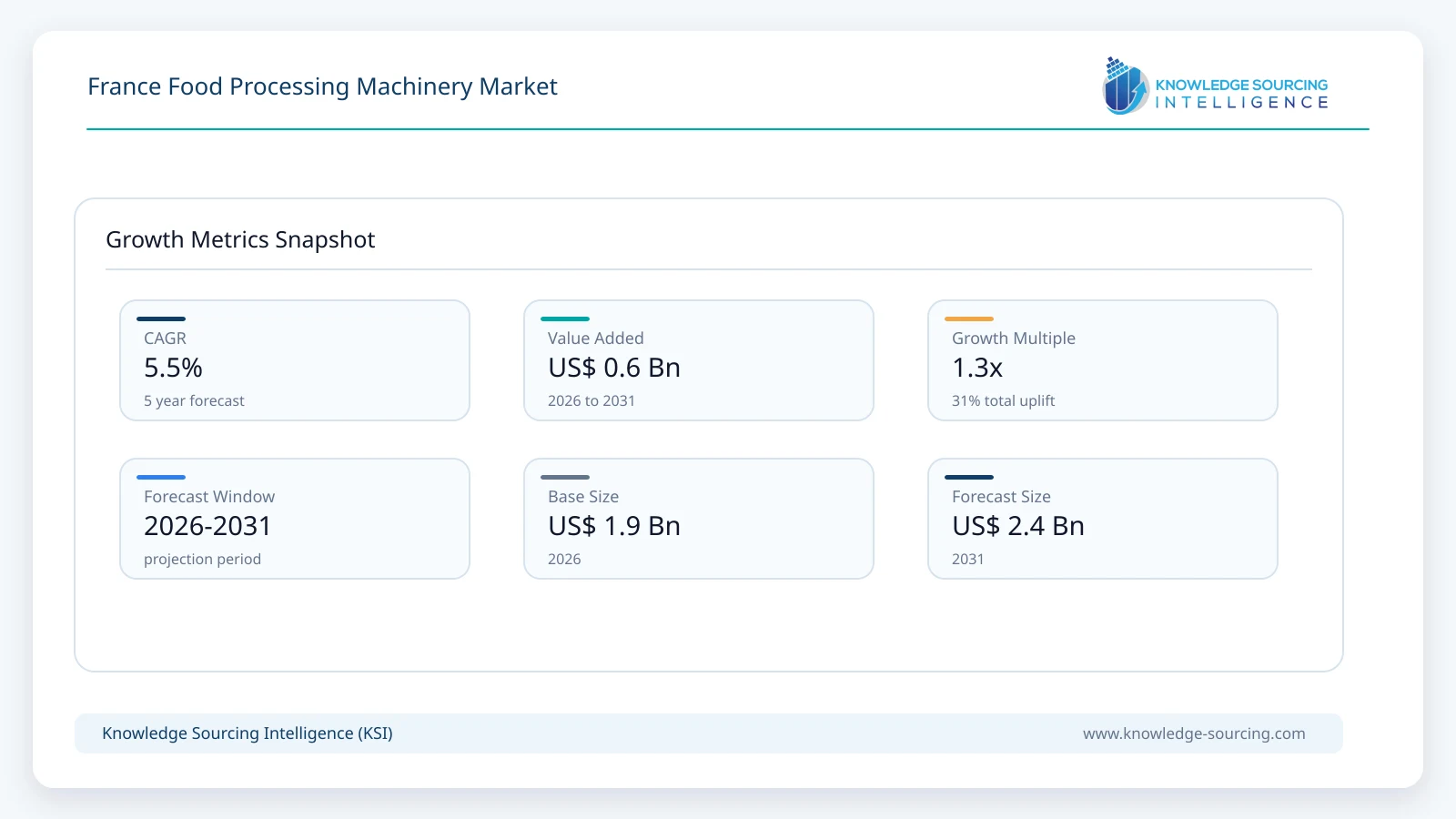
The France Food Processing Machinery market is forecast to grow at a CAGR of 5.5%, reaching USD 2.42 billion in 2031 from USD 1.85 billion in 2026.
Highlights:
- 1Processing equipment accounts for approximately 71% of France market revenue in 2026.
- 2Automatic machinery is projected to grow about 7.0% annually through 2031.
- 3Bakery and confectionery equipment generates approximately USD 466 million in 2026.
- 4Brittany and Pays de la Loire together represent roughly 30% of demand.
- 5France imported USD 553.8 million of HS 8438 food machinery in 2023.
- 6EU Machinery Regulation 2023/1230 becomes mandatory from 20 January 2027.
Market Overview
France's food and beverage manufacturing base provides a large installed market for process machinery. The Ministry of Agriculture reported 22,917 food-industry enterprises in 2023, employing 477,709 full-time-equivalent workers and generating EUR 246.3 billion in revenue and EUR 47.3 billion in value added. Food manufacturing represented close to one-fifth of French manufacturing revenue. This scale creates recurring demand for line replacement, debottlenecking, hygienic redesign, automation, energy-efficiency upgrades and capacity additions even when underlying food volumes grow slowly.
Trade data show that France is both a substantial importer and a meaningful producer of food machinery. World Bank WITS data recorded USD 553.8 million of French imports under HS 8438 in 2023. Category-level 2024 data show USD 116.6 million of meat and poultry machinery imports, USD 71.5 million of other food and beverage machinery, USD 40.2 million of fruit and vegetable machinery and USD 11.7 million of brewery machinery. Dairy processing machinery, classified separately under HS 843420, added USD 25.7 million of imports in 2024. These customs categories do not capture every relevant processing technology, but they establish a substantial imported-equipment floor for the market.
France also retains a significant domestic machinery base. GEPPIA, the French association for process and packaging equipment suppliers, reports 80 machine manufacturers with nearly 9,000 employees and combined revenue of EUR 1.8 billion, of which 45% is exported. The GEPPIA figure includes packaging and peripheral equipment and is therefore not used directly as the processing-market total, but it confirms the depth of French equipment production and export capability. Domestic specialists such as Clextral, Mecatherm and VMI compete alongside multinational suppliers including GEA, JBT Marel, Tetra Pak, Krones, Bühler and Alfa Laval.
Market Trends
Automation Investment Is Shifting From Stand-Alone Machines to Integrated Lines
French processors are moving from isolated machine automation toward connected production lines with common control, traceability and performance monitoring. Labour availability is one reason: France Travail continues to identify production, maintenance and automated-line roles as difficult-to-fill positions across the food industry. The technology response is visible in equipment portfolios. Tetra Pak launched Factory OS in November 2025 as an open platform connecting process equipment and factory data, while JBT Marel increasingly combines processing machinery with production-control software. French bakery specialist Mecatherm also incorporates digital line supervision, preventive maintenance and traceability into automated bakery systems. The investment case is therefore widening from labour substitution to throughput stability, quality control and predictive maintenance.
Water, Energy and Waste Reduction Are Becoming Equipment Selection Criteria
Resource efficiency is becoming a direct machinery-purchasing factor. Insee reported that French food manufacturers spent EUR 565 million on environmental investments and related studies in 2024, including EUR 518 million of investment expenditure. The sector is under pressure to reduce water use, energy intensity, cleaning losses and product giveaway. New processing lines increasingly use optimized Clean-in-Place cycles, heat recovery, high-efficiency motors, precise thermal control and digital monitoring. This favors equipment that can quantify utility consumption and product loss at line level rather than only deliver nominal throughput.
Replacement Demand Is Increasing Ahead of the 2027 EU Machinery Regulation
Regulation (EU) 2023/1230 becomes mandatory from 20 January 2027 and introduces updated machinery-safety requirements, including provisions relevant to safety-related software, cyber-safety and digital instructions. The regulation does not force every food processor to replace older compliant equipment, but it changes the specification of machinery newly placed on the EU market and raises requirements for connected and software-enabled systems. For French buyers, the near-term effect is greater attention to control-system integrity, documentation, remote-access security and lifecycle support when purchasing new automated lines.
Market Drivers
Food-Industry Modernization Programs Support New Production Capacity
Public and private investment continues to expand or modernize French food-processing capacity. By February 2025, France 2030 had supported more than 90 food-industry projects associated with EUR 1.1 billion of productive investment, and 32 additional projects were announced at the 2025 Salon International de l'Agriculture. In June 2026, Choose France announcements included EUR 60 million from Ferrero for two new production lines, more than EUR 100 million from Mars across several French sites and an additional EUR 25 million from Vicky Foods at its Fragnes-la-Loyere bakery plant. Only a portion of these project budgets is machinery, but they provide direct evidence of continued line investment.
Large and Diverse Processing Sectors Sustain Replacement Demand
France has substantial output across beverages, meat, dairy, bakery, confectionery and prepared foods, which reduces dependence on any single end market. Agreste reported EUR 164 billion of marketed food and beverage production in 2023. Beverages alone represented about EUR 32 billion of marketed output, while meat and dairy sales also increased during the year. This diversity supports a broad machinery mix ranging from cutting, forming and thermal systems to mixing, extrusion, bakery ovens, dairy processing and fruit and vegetable preparation. Replacement cycles are especially important because food-safety and cleaning requirements make obsolete equipment progressively more expensive to maintain.
Market Restraint
High Capital Cost and a Fragmented SME Customer Base Slow Full-Line Replacement
The main restraint is the mismatch between advanced automation costs and the financial capacity of smaller processors. France's food industry includes more than 22,000 enterprises, many of which are small businesses that cannot justify fully automated lines or large digitalization projects. Rising stainless-steel, electrical-control and service costs increase total project budgets, while installation can require production downtime and building modifications. Large multinational and cooperative groups can invest in integrated lines, but smaller processors often retrofit individual machines, extend asset life or purchase semi-automatic equipment. This limits the speed at which the installed base converts to high-end connected machinery.
Segment Analysis
By Type - Processing Equipment
Processing equipment is the largest type category, with an estimated 2026 value of about USD 1.31 billion. The category includes mixing and blending, cutting and grinding, forming, extrusion, homogenization, cooking, thermal processing, baking and other equipment that directly changes the food product. The segment is forecast to approach USD 1.74 billion by 2031 as processors invest in higher-capacity lines and digitally controlled equipment. Pre-processing machinery remains important for cleaning, grading, sorting, peeling and preparation, particularly in fruit, vegetable and primary meat applications, but accounts for a smaller share of total equipment value.
By Automation Level - Automatic Machinery
Automatic machinery represents an estimated USD 1.02 billion of the market in 2026 and is gaining share as processors seek consistent throughput with fewer manual interventions. Automatic systems are particularly established in industrial bakery, dairy, meat portioning, beverage processing and high-volume prepared foods. Semi-automatic systems remain relevant for SMEs and specialty producers because they require lower capital expenditure and can be adapted to shorter product runs. The fastest investment is occurring where robotics, in-line inspection, recipe management and process data can be integrated into one production-control environment.
By Application - Bakery and Confectionery
Bakery and confectionery remains the largest application area, representing roughly one-quarter of market revenue in 2026. France has a large industrial bakery, biscuit, pastry and confectionery base, and the segment requires a wide range of mixers, dividers, proofers, forming systems, ovens, cooling systems, enrobers and automated handling. Mecatherm's French operations illustrate the country's domestic capability in fully automated bakery lines, while VMI supplies industrial mixing and kneading systems. Meat and poultry processing is another major application, supported by sizeable 2024 machinery imports and a strong processing base in western France.
By Region - Brittany and Pays de la Loire
Brittany and Pays de la Loire form the largest combined regional equipment market, representing an estimated USD 555 million in 2026. Agreste reported that Brittany employed 58,600 food-industry workers and Pays de la Loire 47,900 in 2023, together accounting for more than one-quarter of national food-industry employment. Meat processing is particularly concentrated in the two regions, while dairy and bakery production are also important. Equipment demand therefore spans slaughtering and further-processing machinery, dairy systems, bakery lines, cleaning equipment and automation retrofits. Auvergne-Rhone-Alpes, Grand Est and Nouvelle-Aquitaine form the next major clusters through dairy, beverages and diversified food manufacturing.
Competitive Environment
The market combines multinational line suppliers with a strong group of French specialists. GEA, JBT Marel, Tetra Pak, Bühler, Alfa Laval and Krones compete across major process categories and benefit from broad service organizations, digital platforms and multinational customer relationships. JBT's combination with Marel, completed in January 2025, created a larger food-processing technology company spanning meat, poultry, fish, prepared foods, fruits and vegetables, inspection and software. GEA continues to expand high-throughput meat and prepared-food equipment, including new scanning and slicing systems introduced at IFFA 2025.
French equipment manufacturers are more concentrated by application. Clextral is a global specialist in twin-screw extrusion for snacks, cereals, plant proteins, ingredients and pet food and manufactures equipment in France. Mecatherm designs automated industrial bakery lines, while VMI focuses on mixing and kneading technologies. Serac is strong in dairy, beverage, oils and sauces filling systems, although packaging-only sales fall outside the core market definition used in this report. TOMRA Food competes in optical and X-ray sorting, while SPX FLOW, Heat and Control, Middleby and Hosokawa Micron participate in mixing, thermal processing, size reduction and specialty process applications.
Competition is increasingly service-led. Processors compare not only purchase price but also line availability, hygienic design, spare-parts access, energy consumption, remote diagnostics and retrofit capability. This benefits suppliers with installed bases and local service teams. At the same time, French specialists retain an advantage in high-value niches where process knowledge and product trials are more important than global scale.
Recent Developments
June 2026: Ferrero announced EUR 60 million for two new French production lines in Nieppe and Villers-Ecalles.
June 2026: Mars announced more than EUR 100 million of investment across several French food-production sites.
June 2026: Vicky Foods added EUR 25 million to its new Fragnes-la-Loyere bakery investment program.
November 2025: Tetra Pak launched Factory OS, an open digital platform for connected food and beverage factories.
January 2025: JBT completed its Marel transaction and began operating as JBT Marel Corporation.
France Food Processing Machinery Market Scope:
| Report Metric | Details |
|---|---|
| Total Market Size in 2026 | USD 1.85 billion |
| Total Market Size in 2031 | USD 2.42 billion |
| Forecast Unit | Billion |
| Growth Rate | 5.5% |
| Study Period | 2021 to 2031 |
| Historical Data | 2021 to 2024 |
| Base Year | 2025 |
| Forecast Period | 2026 – 2031 |
| Segmentation | Type, Food Matter Type, Automation Level, Application |
| Companies |
|
| Customization Scope | 15% Free Customization included with purchase — Request Custom Breakdown → |
| Sample & Data Access | PDF Sample, Excel Databook & Analyst Briefing — Download Free Sample → |
Market Segmentation
By Type
Pre-Processing Equipment
Cleaning
Grading and Sorting
Peeling and Preparation
Processing Equipment
Mixing and Blending
Cutting and Grinding
Extrusion and Forming
Homogenization
Thermal Processing and Baking
Others
By Food Matter Type
Solid
Semi-Solid
Liquid
By Automation Level
Manual
Semi-Automatic
Automatic
By Application
Bakery and Confectionery
Meat, Poultry and Seafood
Dairy
Beverages
Fruits and Vegetables
Others
By Region
Brittany
Pays de la Loire
Auvergne-Rhone-Alpes
Grand Est
Nouvelle-Aquitaine
Hauts-de-France
Other Regions
Table of Contents
1. EXECUTIVE SUMMARY
2. MARKET SNAPSHOT
2.1. Market Overview
2.2. Market Definition
2.3. Market Segmentation
3. BUSINESS LANDSCAPE
3.1. Market Drivers
3.1.1. Food-Industry Modernization Programs Support New Production Capacity
3.1.2. Large and Diverse Processing Sectors Sustain Replacement Demand
3.2. Market Restraint
3.2.1. High Capital Cost and a Fragmented SME Customer Base Slow Full-Line Replacement
3.3. Market Opportunities
3.4. Porter's Five Forces Analysis
3.5. Industry Value Chain Analysis
3.6. Policies and Regulations
3.7. Strategic Recommendations
4. TECHNOLOGICAL OUTLOOK
4.1. Connected Production and Factory Software
4.2. Robotics and Automated Handling
4.3. Energy- and Water-Efficient Processing
4.4. Non-Thermal and Advanced Thermal Processing
5. FRANCE FOOD PROCESSING MACHINERY MARKET BY TYPE
5.1. Introduction
5.2. Pre-Processing Equipment
5.2.1. Cleaning
5.2.2. Grading and Sorting
5.2.3. Peeling and Preparation
5.3. Processing Equipment
5.3.1. Mixing and Blending
5.3.2. Cutting and Grinding
5.3.3. Extrusion and Forming
5.3.4. Homogenization
5.3.5. Thermal Processing and Baking
5.3.6. Others
6. FRANCE FOOD PROCESSING MACHINERY MARKET BY FOOD MATTER TYPE
6.1. Introduction
6.2. Solid
6.3. Semi-Solid
6.4. Liquid
7. FRANCE FOOD PROCESSING MACHINERY MARKET BY AUTOMATION LEVEL
7.1. Introduction
7.2. Manual
7.3. Semi-Automatic
7.4. Automatic
8. FRANCE FOOD PROCESSING MACHINERY MARKET BY APPLICATION
8.1. Introduction
8.2. Bakery and Confectionery
8.3. Meat, Poultry and Seafood
8.4. Dairy
8.5. Beverages
8.6. Fruits and Vegetables
8.7. Others
9. FRANCE FOOD PROCESSING MACHINERY MARKET BY REGION
9.1. Introduction
9.2. Brittany
9.3. Pays de la Loire
9.4. Auvergne-Rhone-Alpes
9.5. Grand Est
9.6. Nouvelle-Aquitaine
9.7. Hauts-de-France
9.8. Other Regions
10. COMPETITIVE ENVIRONMENT AND ANALYSIS
10.1. Major Players and Strategy Analysis
10.2. Market Share Analysis
10.3. Mergers, Acquisitions, Agreements and Collaborations
10.4. Competitive Dashboard
11. COMPANY PROFILES
11.1. GEA Group AG
11.2. JBT Marel Corporation
11.3. Tetra Pak International S.A.
11.4. Bühler AG
11.5. Krones AG
11.6. Alfa Laval AB
11.7. SPX FLOW, Inc.
11.8. Clextral SAS
11.9. Mecatherm SAS
11.10. VMI Mixing
11.11. TOMRA Food
11.12. Heat and Control, Inc.
11.13. The Middleby Corporation
11.14. Hosokawa Micron Group
11.15. SERAC Group
11.16. Sidel Group
11.17. FAM Stumabo
11.18. ANKO Food Machine Co., Ltd.
12. APPENDIX
12.1. Currency
12.2. Assumptions
12.3. Base and Forecast Years Timeline
12.4. Key Benefits for Stakeholders
12.5. Research Methodology
12.6. Abbreviations





Frequently asked questions
What is the projected market size of France food processing machinery by 2031?
The France Food Processing Machinery Market is forecast to reach USD 2.42 billion by 2031.
What is the CAGR for the France food processing machinery market (2026-2031)?
The France Food Processing Machinery Market is forecast to grow at a CAGR of 5.5%.
Which equipment type holds the largest revenue share in the French market?
Processing equipment accounts for approximately 71% of market revenue.
Which French regions represent the most food processing machinery demand?
Brittany and Pays de la Loire together represent roughly 30% of demand.
What is a key investment trend in French food processing machinery?
Automation is shifting from stand-alone machines to integrated lines.
What was the revenue for bakery and confectionery equipment in France in 2026?
The France Food Processing Machinery Market generated approximately USD 466 million in 2026.
Cite this report
Knowledge Sourcing Intelligence. (Sep 2026). France Food Processing Machinery Market - Strategic Insights and Forecasts (2026-2031). https://www.knowledge-sourcing.com/report/france-food-processing-machinery-market