
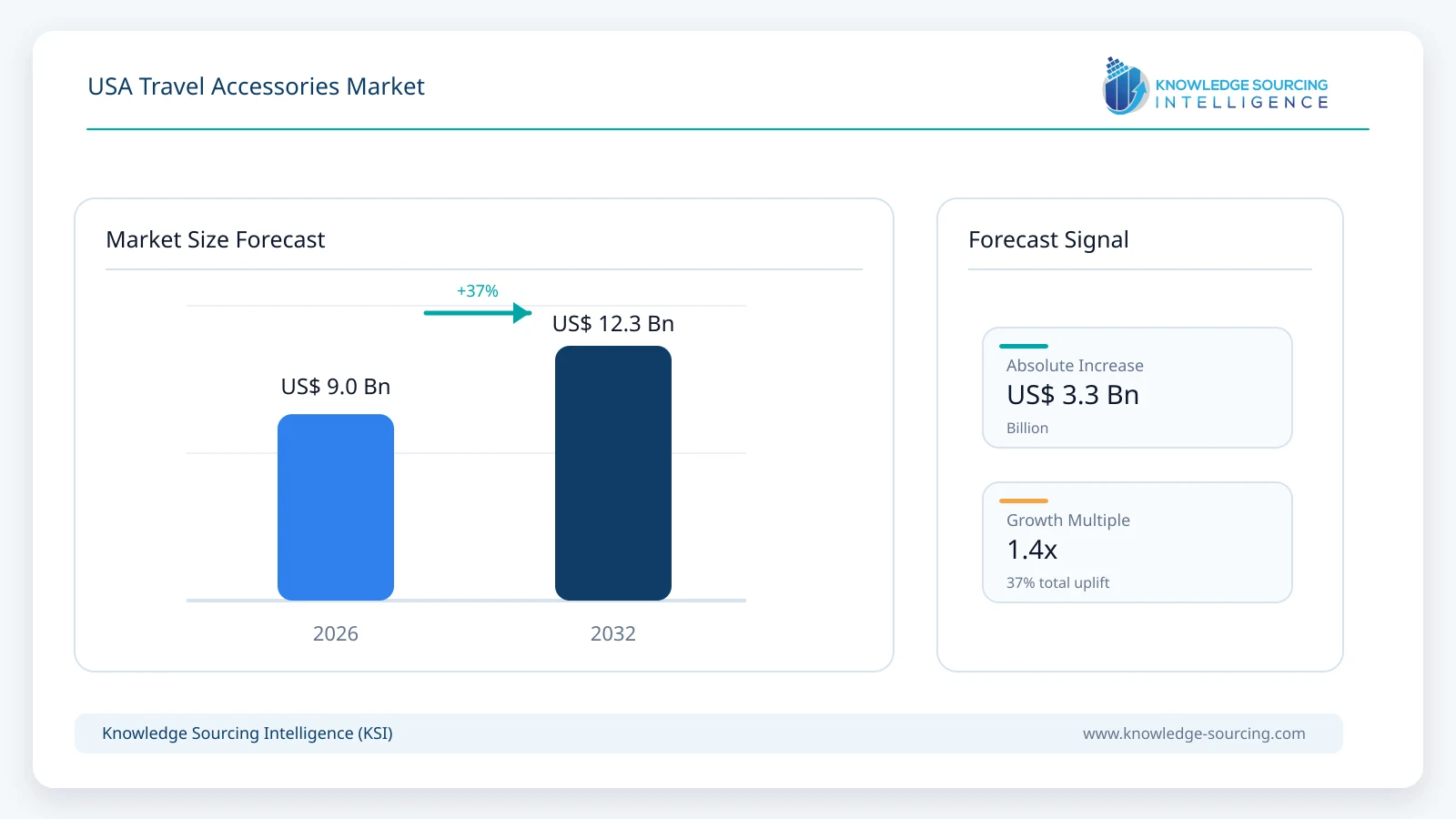
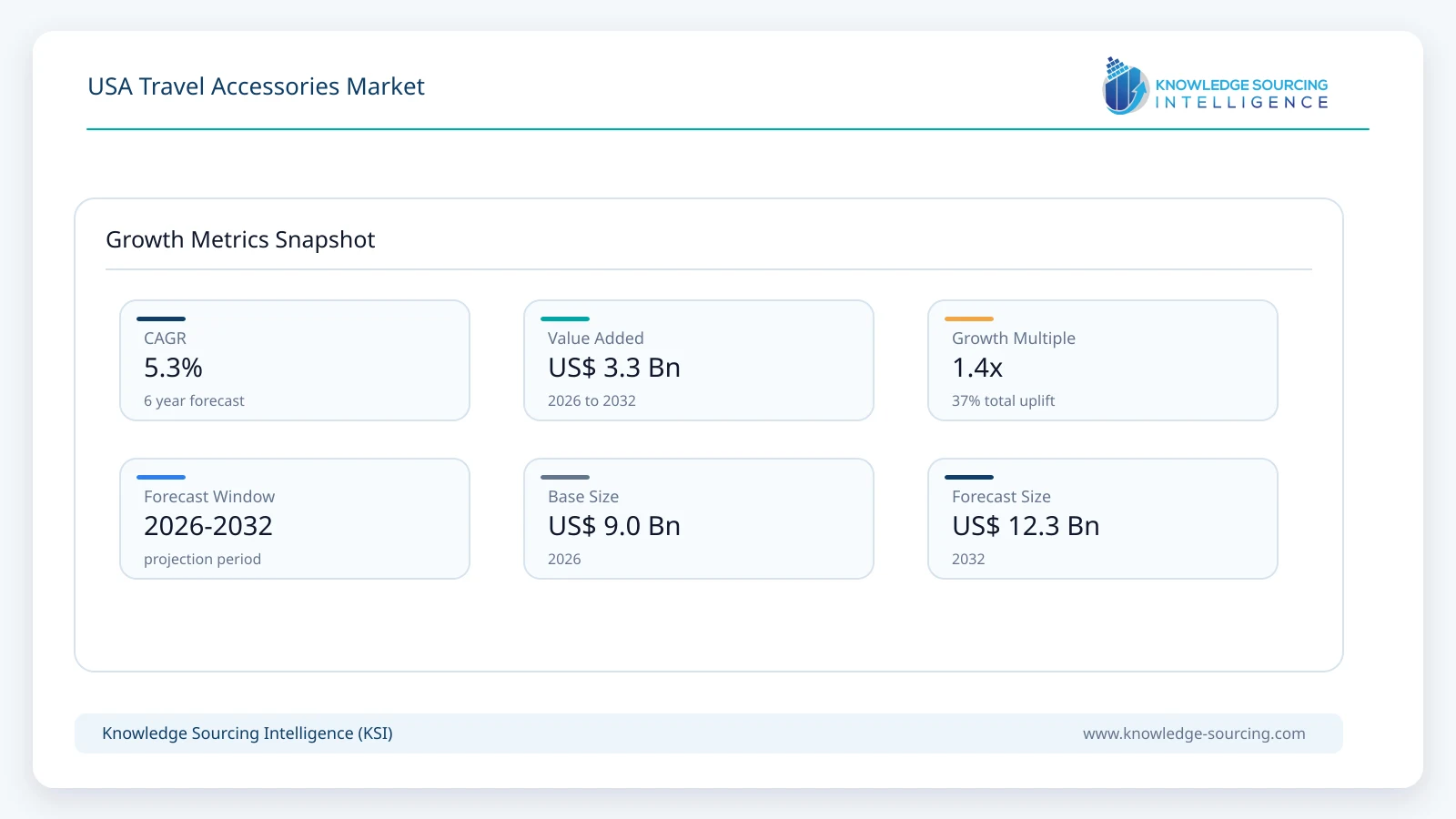
The USA travel accessories market is projected to expand at a CAGR of 5.3%, increasing from USD 9.0 billion in 2026 to USD 12.3 billion by 2032.
Highlights:
- 1Luggage and wheeled cases account for 43.63% of 2026 market revenue, reflecting higher unit prices and replacement purchases despite relatively long product lifetimes.
- 2Packing and toiletry organizers are projected to grow at 7.20% CAGR through 2032, supported by cabin-size restrictions, packing efficiency, and incremental attachment purchases.
- 3Travel-specific electronics reach an estimated US$793.17 million in 2032, as international adapters, compact travel power products, and dedicated travel-tech accessories gain adoption.
- 4Online retail strengthens its share, particularly for accessories with standardized specifications, customer reviews, and low fit risk; premium luggage continues to benefit from physical handling and assisted selling.
- 5California remains a leading consumer market, supported by substantial population, international gateways, and higher-value travel retail, while Texas and Florida offer additional demand from expanding populations and leisure travel.
Purchasing activity is shifting toward lightweight carry solutions, better packing organization, and specialized accessories that reduce inconvenience across air, rail, and road journeys. However, demand is not a simple function of trip numbers. Product replacement cycles, airline baggage policies, retailers' inventory commitments, brand positioning, and the distinction between general-purpose bags and travel-specific equipment are increasingly decisive in determining suppliers' revenue growth.
US suppliers face a market where travel volumes remain substantial but households are not replacing luggage after every vacation. A suitcase purchased during the recovery in travel can remain serviceable for years, while smaller organizers and device accessories may be purchased for successive journeys. This creates different revenue cycles for luggage, backpacks, packing systems, and comfort products. High-value luggage brands rely on material quality, warranty confidence, handling performance, and retail distribution. Smaller accessories compete through merchandising visibility, compatible product bundles, and short product-development cycles.
Market Dynamics
Travel intensity is supporting replenishment, not automatic luggage replacement
The US air-travel market provides a large installed base of potential travel-goods consumers, but passenger movements do not represent unique buyers. In a mature travel market, the number of journeys can rise without proportionate growth in new luggage purchases. The US Bureau of Transportation Statistics reported roughly 840 million enplaned passengers during the 12 months ending July 2026, slightly below the comparable earlier period. The Congressional Research Service also recorded a decline in inbound international arrivals in 2025. These indicators reinforce the importance of purchase conversion and replacement frequency rather than assuming that tourism activity directly converts into retail sales.
Luggage brands are responding by emphasizing durability, ergonomic handling, lighter shell construction, warranty service, and differentiated accessories. This competition is commercially significant because product improvement must persuade households to replace an existing suitcase instead of postponing the purchase. Larger retailers may also reduce orders when sell-through weakens, leaving suppliers with inventory and promotional exposure even where passenger throughput remains robust. Samsonite's 2025 results reflect these pressures, including a decline in US sales and more cautious wholesale purchasing.
Cabin restrictions and hybrid travel reshape basket composition
Airline size and weight restrictions increase the value of compact carry-ons, space-efficient packing cubes, compression organizers, and personal-item bags. Travellers increasingly assemble modular product combinations rather than purchase a single large case. Carry-on luggage, under-seat bags, toiletry organizers, and electronics pouches can therefore serve the same journey without competing for the same purchase budget. The commercial benefit accrues to suppliers that develop compatible sets and improve attachment sales during a luggage purchase.
This does not make every convenience accessory a premium product. Most organizers face limited design protection, numerous private-label alternatives, and low customer switching costs. Brands must defend prices through material quality, reliable zippers, attractive colors, and merchandising rather than broad claims of innovation. JanSport's 2026 Good Latitude launch, for example, places travel cubes, tech organizers, and toiletry accessories alongside core travel bags, making cross-selling central to the range.
Distribution economics are increasingly segmented
Online marketplaces give consumers immediate price comparisons, customer reviews, and inexpensive alternatives across accessories with standardized specifications. This benefits organizers, adapters, and security accessories but can compress gross margin for undifferentiated sellers. Direct-to-consumer brands can improve customer data ownership and merchandising flexibility, while bearing fulfillment, returns, marketing, and customer-service costs. Distribution strategy therefore affects realized profitability differently for a low-ticket neck pillow than for a premium carry-on.
Physical retail remains particularly relevant where wheel performance, handle movement, shell flexibility, interior design, and visual finish influence decisions. Department stores, luggage specialists, airport retailers, and brand-owned stores can support higher-priced ranges through demonstrations and immediate purchase convenience. Suppliers increasingly coordinate channel inventory and online promotions to avoid undermining retailer relationships during seasonal clearance periods.
Premiumization meets price sensitivity
A significant gap separates mass-market travel bags from premium luggage. Travelpro's 2026 Optima products occupy a mid-premium price tier, while Platinum Reserve carry-ons are listed above US$500. These price points cannot be applied to the entire US market, where discount retailers, marketplaces, and entry-level brands serve price-sensitive buyers. Nevertheless, they demonstrate willingness to pay for better wheels, materials, service, and design in selected customer groups.
Premium growth depends on whether tangible improvements justify the replacement decision. Lightweight construction and smooth mobility reduce handling friction, but additional features can raise unit costs and increase maintenance complexity. Suppliers that improve durability while keeping repair and warranty costs manageable can capture more value than competitors offering decorative upgrades with limited functional differentiation.
Market Segmentation Analysis
By Product Type: Luggage and Wheeled Cases
Luggage and wheeled cases remain the largest product category, with estimated revenue of US$3.93 billion in 2026. Demand covers checked luggage, cabin-size spinners, compact cases, and specialized luggage sets. The central purchasing question is no longer whether a traveller needs luggage, but when an existing product needs replacing and how a new design improves handling, capacity, or ownership value.
Unlike consumable travel goods, suitcases have a long and irregular replacement cycle. Household ownership established during the rebound in travel after 2021 continues to influence current demand. A consumer who bought a durable case in 2022 may not return to the market for several years, even while taking multiple trips annually. This makes marketing effectiveness, product failure rates, gift purchases, and changing trip requirements more relevant than headline passenger-growth figures. Brands must either earn replacement demand or reach new buyers entering the category.
Material selection and construction quality shape supplier economics. Hard-shell polycarbonate cases compete on weight, impact recovery, finish, and appearance. Soft-sided luggage can offer accessible pockets and flexibility, but fabric, frame, wheel, and zipper performance remain key determinants of durability. Manufacturers also face trade-offs between adding features and controlling shipping weight, repair requirements, and supplier costs. Premium consumers may accept higher initial prices when they believe a product will last longer and handling performance will remain consistent.
The airline environment adds another layer of differentiation. Carry-on size allowances vary by airline and ticket class, while gate-checking can expose cases designed primarily for cabin use to more demanding handling conditions. Cabin-size compatibility and structural performance therefore matter commercially. Brands that provide transparent dimensions and functional storage can reduce returns and customer dissatisfaction, particularly in online channels where buyers cannot assess physical fit before ordering.
Retailers are responding to these differences with more deliberate product ladders. Entry-level luggage faces direct price competition from private labels and marketplace sellers. Midmarket brands emphasize serviceable construction and broad distribution. Premium specialists focus on wheel systems, finishes, handles, coordinated sets, warranties, and the purchase experience. Travelpro's October 2026 Platinum Reserve launch illustrates this approach, using material and design upgrades to compete in a higher-value segment without relying on a generic increase in trip frequency.
Competitive positioning is also changing through brand consolidation. Samsonite Group's October 2026 acquisition of BÉIS adds a digitally established lifestyle-travel brand alongside its Samsonite, TUMI, and American Tourister portfolios. Such combinations can widen customer reach and cross-channel distribution. They also increase pressure on smaller brands to demonstrate distinct consumer identities and cost-efficient acquisition strategies.
The segment is projected to increase to US$5.07 billion by 2032, reflecting replacement demand, product upgrades, and changes in realized retail prices. Growth remains more restrained than in smaller accessories because buyers can defer major purchases when household budgets tighten. Stronger performance will depend on tangible product benefits, controlled inventory, and effective differentiation across price tiers.
By Product Type: Travel Backpacks and Duffels
Travel-specific backpacks, weekender bags, and duffels are expected to generate US$3.27 billion by 2032. Their flexibility across overnight trips, short leisure breaks, and blended work travel supports broader usage than conventional checked luggage. However, the category faces substantial scope overlap with everyday and school backpacks. Travel-oriented compartments, carry-on compatibility, luggage sleeves, and organized packing provide practical differentiation, while general-purpose backpacks belong outside this study.
By Product Type: Packing and Toiletry Organizers
Packing cubes, compression pouches, toiletry kits, and travel organization products offer frequent attachment opportunities at lower price points. New collections can be introduced with relatively modest tooling requirements, but competition is intense because functionality is readily copied. Suppliers with complementary luggage portfolios can defend average selling prices through coordinated materials, color ranges, and bundled purchases rather than selling organizers as isolated commodities.
By Product Type: Travel Electronics and Adapters
Dedicated international power adapters, travel charging organizers, and compact trip-specific power accessories represent a faster-moving niche. This segment is supported by device dependence during travel, but generic headphones, ordinary phone chargers, and general consumer electronics are not part of the category. Electrical certification, airline battery rules, and regional plug compatibility shape purchasing and product risk, making safety and reliability more important than decorative product differentiation.
By Product Type: Comfort, Security, and Other Accessories
Neck pillows, luggage locks, protective covers, RFID travel wallets, and security-related accessories compete at accessible price points. Consumers often purchase these products shortly before departure, increasing the role of airport retail, online search, promotional placement, and travel-goods bundles. Products that solve clear journey problems can earn higher attachment rates, while undifferentiated items remain vulnerable to discounting.
By Distribution Channel
The online channel benefits from direct comparison and high assortment depth, especially for organizers, electronics accessories, and standardized security products. Offline sales retain an important position in high-value luggage, where product handling and assisted selection justify store visits. The balance differs by category: consumers often evaluate a suitcase physically but are comfortable reordering compatible packing cubes online. Successful brands manage this distinction through channel-specific merchandising and pricing discipline.
By End User
Leisure travellers account for the largest end-user opportunity because domestic vacations, family visits, weekend travel, and international holidays generate varied equipment needs. Business travellers place greater emphasis on reliable mobility, compact packing, efficient laptop access, and predictable replacement policies. Other travel users, including students relocating temporarily and people travelling for specialized activities, create additional demand for particular carry systems without constituting an independent mass market.
USA Geographic Outlook
California
California combines major international gateways, substantial household spending, and established premium retail networks. It is an important market for both core luggage and smaller travel accessories, although local airport passenger totals include visitors and should not be equated with spending by California residents. Brand-owned stores, lifestyle retailers, and e-commerce fulfillment support a diverse product mix.
Texas
Texas benefits from a large and growing population, major air hubs, road-travel demand, and business-travel flows. Demand extends beyond compact air-travel equipment to wheeled luggage, duffels, and versatile short-trip bags. Local consumer purchases are influenced by household preferences and retail reach, not only passenger movements through Dallas-Fort Worth or Houston.
Florida
Florida's extensive leisure-tourism economy supports destination-related accessory purchases, but a distinction is necessary between travel spending by visitors in Florida and purchases made by Florida residents. Travel retail and specialty channels benefit from last-minute convenience products, while household retail demand includes products purchased for trips originating in the state. The distribution mix therefore matters as much as tourism volumes.
New York and Washington
New York supports premium luggage retail, frequent business travel, and international connectivity, creating opportunities for compact, durable bags and high-value carry systems. Washington's technology-intensive and affluent consumer base provides a complementary market for functional travel organizers and reliable luggage. Both markets also face strong competitive pressure from well-established online channels and nationally distributed brands.
Other States
The remaining states collectively account for a substantial share of US demand. The opportunity extends well beyond major international gateways, including suburban households, regional road-travel markets, university communities, and domestic leisure travellers. Broad retail distribution and value-oriented assortments remain commercially important outside the largest metropolitan areas.
Competitive Environment
Competition combines global luggage groups, specialist travel-goods manufacturers, digitally native brands, and travel-accessory suppliers. Samsonite Group operates several distinct brands across value, midmarket, premium, and lifestyle positions. Away, Travelpro, DELSEY, CALPAK, Monos, Briggs & Riley, and other specialists focus on different combinations of design, functionality, warranty coverage, and distribution. Accessory-focused suppliers compete through packing solutions, protective products, and organized travel systems rather than attempting to match the complete luggage portfolios of larger manufacturers.
The October 2026 addition of BÉIS to Samsonite Group changes the ownership structure of a prominent lifestyle travel brand. Competition should therefore be assessed at both group and brand level. Portfolio breadth can lower sourcing and distribution costs, but individual brands retain distinct customer propositions. A comparison based solely on parent-company revenue risks obscuring competitive differences among value cases, premium carry-ons, organizer systems, and accessories sold online.
Recent Developments
October 12, 2026: Travelpro introduced its premium Platinum Reserve hard-shell luggage collection with leather detailing and an emphasis on mobility performance.
October 1, 2026: Samsonite Group completed its acquisition of travel and lifestyle brand BÉIS, expanding its digitally native portfolio.
September 29, 2026: Away introduced its Series 3 luggage and Signature Bag collections, extending its coordinated travel-product range.
May 13, 2026: JanSport unveiled its Good Latitude Travel Collection, including packing cubes, a tech organizer, and a toiletry bag.
April 30, 2026: Travelpro introduced its Optima hard-shell luggage collection, positioned around durability and functional travel design.
USA Travel Accessories Market Scope
| Report Metric | Details |
|---|---|
| Total Market Size in 2026 | USD 9.0 billion |
| Total Market Size in 2032 | USD 12.3 billion |
| Forecast Unit | Billion |
| Growth Rate | 5.3% |
| Study Period | 2021 to 2032 |
| Historical Data | 2021 to 2024 |
| Base Year | 2025 |
| Forecast Period | 2026 – 2032 |
| Segmentation | Product Type, Distribution Channel, End User, State |
| Companies |
|
| Customization Scope | 15% Free Customization included with purchase — Request Custom Breakdown → |
| Sample & Data Access | PDF Sample, Excel Databook & Analyst Briefing — Download Free Sample → |
Market Segmentation
By Product Type
Luggage and Wheeled Cases
Travel Backpacks and Duffels
Packing and Toiletry Organizers
Travel Electronics and Adapters
Comfort and Security Accessories
Other Trip-Specific Accessories
By Distribution Channel
Online
Offline
Luggage and Specialty Stores
Department Stores and Mass Merchandisers
Airport and Travel Retail
Other Offline Channels
By End User
Leisure Travellers
Business Travellers
Other Travel Users
By State
California
Texas
Florida
New York
Washington
Other States
Table of Contents
1. EXECUTIVE SUMMARY
1.1. Market Snapshot and Key Findings
1.2. Market Size and Outlook, 2026–2032
1.3. Commercial Priorities
2. RESEARCH SCOPE AND METHODOLOGY
2.1. Market Definition and Inclusion Criteria
2.2. Historical Period and Forecast Timeline
2.3. Product Category Definitions
2.4. Estimation and Data Validation
3. USA TRAVEL ACCESSORIES MARKET OVERVIEW
3.1. Industry Structure and Retail Value Chain
3.2. Consumer Purchasing and Replacement Cycles
3.3. Price Tier and Product Mix
3.4. Supply Chain and Distribution
4. MARKET DYNAMICS
4.1. Market Drivers
4.1.1. Replacement and Upgrade Purchasing
4.1.2. Travel Frequency and Cabin Size Requirements
4.1.3. Pack Organization and Travel Efficiency
4.1.4. Travel Retail and E-Commerce
4.1.5. Product Design, Sustainability and Durability
4.2. Market Restraints
4.2.1. Long Luggage Replacement Cycles
4.2.2. Price Competition and Promotional Intensity
4.2.3. Import Dependence and Sourcing Costs
4.2.4. Retail Inventory Risk
4.2.5. Commodity Accessory Substitution
4.3. Market Opportunities
4.4. Porter's Five Forces
4.5. Industry Value Chain Analysis
5. USA TRAVEL ACCESSORIES MARKET BY PRODUCT TYPE
5.1. Introduction
5.2. Luggage and Wheeled Cases
5.3. Travel Backpacks and Duffels
5.4. Packing and Toiletry Organizers
5.5. Travel Electronics and Adapters
5.6. Comfort and Security Accessories
5.7. Other Trip-Specific Accessories
6. USA TRAVEL ACCESSORIES MARKET BY DISTRIBUTION CHANNEL
6.1. Introduction
6.2. Online
6.3. Offline
6.3.1. Luggage and Specialty Stores
6.3.2. Department Stores and Mass Merchandisers
6.3.3. Airport and Travel Retail
6.3.4. Other Offline Channels
7. USA TRAVEL ACCESSORIES MARKET BY END USER
7.1. Introduction
7.2. Leisure Travellers
7.3. Business Travellers
7.4. Other Travel Users
8. USA TRAVEL ACCESSORIES MARKET BY STATE
8.1. Introduction
8.2. California
8.3. Texas
8.4. Florida
8.5. New York
8.6. Washington
8.7. Other States
9. COMPETITIVE ENVIRONMENT AND ANALYSIS
9.1. Strategic Positioning and Price Tiers
9.2. Product Portfolio Comparison
9.3. Channel and Retailing Analysis
9.4. Mergers, Acquisitions and Collaborations
9.5. Competitive Dashboard
10. COMPANY PROFILES
10.1. Samsonite Group S.A.
10.2. Away
10.3. Travelpro Products, Inc.
10.4. DELSEY PARIS
10.5. CALPAK
10.6. Monos
10.7. Briggs & Riley
10.8. JanSport (VF Corporation)
10.9. Eagle Creek
10.10. Osprey Packs (Helen of Troy)
10.11. Thule Group
10.12. Travelon
10.13. Pacsafe
10.14. Peak Design
10.15. RIMOWA (LVMH)
11. APPENDIX
11.1. Definitions and Abbreviations
11.2. Currency and Unit Conventions
11.3. Historical and Forecast Year Timeline
11.4. Research Methodology
11.5. Sources and References





Frequently asked questions
What is the projected market size for USA travel accessories by 2031?
The USA Travel Accessories Market is projected to reach $12.3 billion by 2031, growing at 5.3% CAGR.
Which product segment accounts for the largest revenue share in 2026?
Luggage and wheeled cases accounted for 43.63% of 2026 market revenue.
What is the fastest-growing segment in the USA travel accessories market?
Packing and toiletry organizers are projected to grow at 7.20% CAGR through 2032.
Which US states are leading consumer markets for travel accessories?
California is a leading market, supported by Texas and Florida demand.
How is online retail impacting USA travel accessory sales?
Online retail strengthens its share, especially for standardized accessories.
What are the key drivers influencing USA travel accessory purchasing?
Replacement cycles, airline policies, and specialized accessories are key drivers.
Cite this report
Knowledge Sourcing Intelligence. (Oct 2026). USA Travel Accessories Market - Strategic Insights and Forecasts (2026-2032). https://www.knowledge-sourcing.com/report/usa-travel-accessories-market