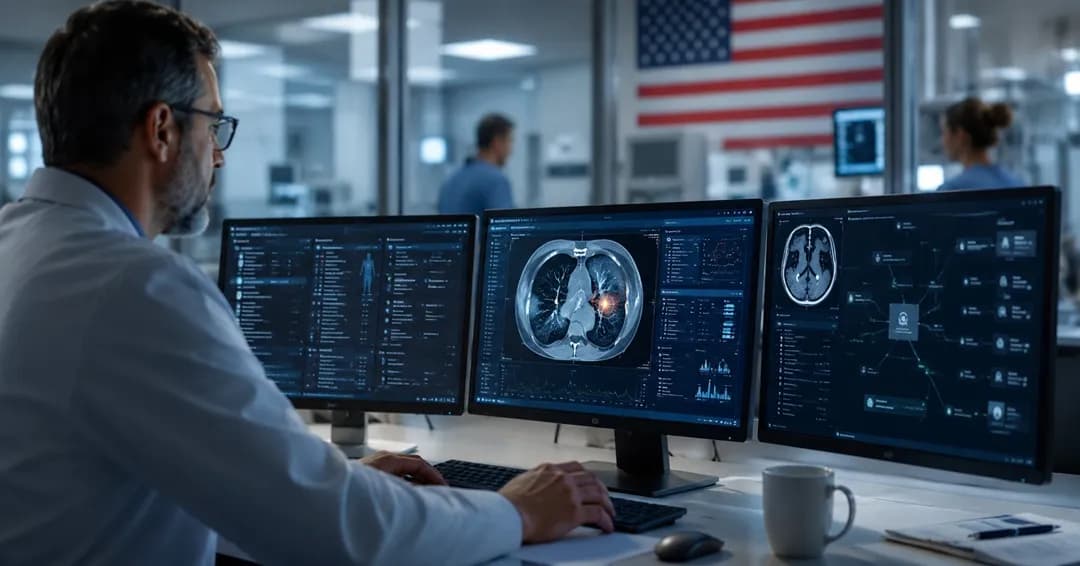
The U.S. clinical decision support diagnostic systems market is rapidly evolving as hospitals adopt AI-driven tools to manage rising diagnostic complexity, workforce shortages, and operational pressures. Growth is fueled by demand for faster, accurate diagnoses, workflow efficiency, interoperability, and value-based care, while physician trust, cybersecurity, and regulatory compliance increasingly determine long-term market success.
The market for clinical decision support diagnostic systems has evolved significantly from being just a small, specialized segment of hospital IT. In fact, it has come to represent a major part of the transformation that healthcare organizations are undergoing to address various challenges such as physician shortages, increased complexity in diagnostics, pressure from payers for reduced costs, and the sobering fact that modern medicine generates more data than doctors can handle effectively without assistance. In different healthcare settings like hospitals, imaging centers, integrated delivery networks, and specialty clinics, diagnostic support software is gradually being viewed more as a fundamental necessity to healthcare operations rather than as an optional feature. This change of mindset has been most apparent in the U.S. where provider organizations are confronted with a tough combination of very demanding patients, doctors getting exhausted, and lots of financial checks.
As per the Health Workforce Analysis released by the Health Resources and Services Administration (HRSA), the government officials forecast a lack of 78, 610 full-time RNs or Registered Nurses in 2025 and a lack of 63, 720 full-time RNs in 2030. In the United States, a shortage of 141, 160 full-time equivalent (FTE) physicians is expected across all physician specialties by 2038. Nonmetro areas will be more affected by physician shortages than metro areas.
The U.S. Market Is Expanding Because Diagnostic Complexity Has Changed Faster Than Clinical Workflows
The American healthcare system generates enormous volumes of diagnostic information every day. Imaging scans, pathology reports, genomic sequencing outputs, laboratory panels, wearable device data, and electronic health records all compete for physician attention. Yet the workflow surrounding diagnosis still often depends on fragmented interfaces and manual interpretation.
This mismatch has created fertile ground for clinical decision support diagnostic systems.
Hospitals are no longer purchasing these systems simply to comply with electronic health record modernization goals. They are investing because diagnostic inefficiency has become financially measurable. Missed findings in radiology, delayed sepsis recognition, unnecessary imaging utilization, and duplicated testing directly affect reimbursement, legal exposure, and patient retention.
The U.S. market is particularly aggressive because large health systems increasingly view diagnostic intelligence as a competitive advantage. A decade ago, healthcare executives focused heavily on digitization. Now the discussion is shifting toward interpretability, workflow orchestration, and predictive prioritization.
The extensive and closely linked U.S. hospital system is one of the major reasons behind the strong demand for clinical decision support diagnostic systems. The United States is home to about 6100 hospitals. Out of these, 5121 are community hospitals which, on an average, handle more than 33.5 million patient admissions a year. Just in community hospitals, there are over 775, 000 staffed beds. Therefore, use of AI-based diagnostic and workflow support tools is on the rise among healthcare providers as these help them increase efficiency and decrease the workload on clinicians. The number of rural hospitals, which primarily rely on decision support technologies to overcome their lack of specialists, is almost 1800. Whereas urban hospitals are focusing on getting advanced imaging analytics and predictive diagnostic platforms. Besides this, there are more than 3500 community hospitals which are part of larger health systems. This is another factor that is driving the use of integrated diagnostic software across centralized care networks in the United States.
That is an important distinction.
Clinical decision support platforms used to function like static rule engines. Modern systems increasingly behave like dynamic analytical layers sitting between clinical data and physician action. Many are incorporating machine learning models capable of identifying anomalies, flagging risk patterns, or suggesting diagnostic pathways based on historical patient outcomes.
The financial incentives are aligning rapidly. Under value-based care models, hospitals benefit when diagnoses are faster, more accurate, and less resource intensive. This is one reason why enterprise-wide adoption is moving beyond academic medical centers into regional provider networks across the United States.
Diagnostic Support Is Becoming More Specialized Rather Than Universal
One misconception surrounding the market is that healthcare providers are looking for one all-purpose diagnostic engine. In practice, the opposite is happening.
Clinical decision support diagnostic systems are fragmenting into highly specialized categories.
Radiology remains the most commercially mature segment because image-heavy workflows are well suited for algorithmic interpretation. AI-assisted detection systems for lung nodules, breast cancer screening, stroke assessment, and cardiac abnormalities have seen particularly strong traction in U.S. hospitals.
Pathology is following closely behind. Digital pathology platforms integrated with diagnostic decision support are becoming increasingly relevant as pathology labs struggle with workforce shortages. In several U.S. states, large hospital systems are already centralizing pathology operations and using AI-supported workflows to manage rising case volumes.
Emergency medicine is another fast-growing area. Hospitals are deploying real-time diagnostic support systems capable of identifying high-risk patients based on symptoms, lab results, and vitals before physicians complete full evaluations. Sepsis detection systems, in particular, have become a major investment category because delayed intervention carries substantial mortality and reimbursement implications.
Cardiology is evolving differently. Instead of replacing physicians, many cardiac diagnostic platforms are focusing on workflow acceleration, prioritizing abnormal electrocardiograms, improving echocardiogram interpretation, and supporting remote monitoring programs.
The broader implication is that the market is not converging around a single dominant platform architecture. It is diversifying according to clinical use case.
That creates opportunities for smaller innovation-focused companies, especially in the United States, where specialty care networks are highly developed.
AI Is Driving Growth, But Hospitals Are Still Cautious Buyers
The market conversation often overstates hospital enthusiasm for artificial intelligence. Healthcare executives may publicly celebrate AI adoption, but procurement teams remain skeptical.
There is a practical reason for this caution.
Diagnostic errors in healthcare carry legal, ethical, and reputational consequences that differ sharply from most industries. Hospitals cannot afford opaque algorithms producing inconsistent outputs. As a result, buyers increasingly demand systems that improve physician efficiency without fully removing human oversight.
This explains why many successful clinical decision support vendors position their products as augmentation tools rather than autonomous diagnostic engines.
The U.S. market strongly favors explainable systems.
Radiologists, for example, are more likely to trust platforms that visually identify suspicious regions in imaging studies while allowing clinicians to independently validate findings. Similarly, emergency medicine teams prefer risk stratification systems that show contributing variables instead of producing unexplained alerts.
Another challenge is alert fatigue.
Earlier generations of clinical decision support software often overwhelmed physicians with low-value notifications. Many hospitals still remember these failures. Vendors entering the market today must prove that their platforms reduce cognitive burden rather than add another layer of interruption.
This is one reason why workflow integration has become more commercially important than algorithm sophistication alone.
A technically brilliant diagnostic engine can still fail commercially if physicians perceive it as disruptive.
Philips is integrating patient monitoring and diagnostic solutions to carry out intelligent care based on platform at HIMSS26.
Royal Philips is a world leader in healthcare technology. It has demonstrated the role of open, interoperable platforms supported by AI in assisting healthcare systems connect patient monitoring continuously with diagnostic insights, in other words, bringing the story of the patient together through time and across different specialties. Connecting clinical signals to diagnostic information results in moving from disjointed data to a more continuous and actionable patient understanding, which Philips is doing.
The U.S. Regulatory Environment Is Quietly Shaping Market Winners
The Food and Drug Administration (FDA) has lately been exerting a significant impact on the competitive positions of clinical decision support diagnostic systems (CDS) in the market.
Obtaining the FDA clearance is increasingly viewed as a commercial trust signal, especially in the eyes of big U.S. hospital systems.
Since diagnostic providers want to be assured that the tools have been through rigorous validation, it means that a business with several FDA-cleared products is more likely to be chosen over a new company that depends exclusively on collaborations and pilot studies for its research.
The issue of the regulation is changing as well with the development of AI models that learn and adapt.
Regulatory approval of software in the past focused on systems that were not changing much. These days a platform that uses machine learning to diagnose keeps getting updated as the data improve. So the regulators have to develop ways that still permit innovation and not endanger the patients.
It doesn't have to be that the company with the most sophisticated technologies will win in this setting as usually it's the enterprises that can offer a product that excels in the clinic, is compliant with the law, has strong cybersecurity, and is easy to integrate that come out on top.
Therefore, that level of operational maturity carries great significance in the U.S. where hospital IT infrastructures are known to be very fragmented.
Cloud Adoption Is Accelerating, But Data Sovereignty Concerns Remain
A growing share of diagnostic decision support infrastructure is migrating toward cloud-based deployment models. Hospitals increasingly prefer cloud-native architectures because they reduce on-premise hardware costs and improve scalability across multi-site networks.
However, healthcare organizations remain cautious about sensitive patient data movement.
Cybersecurity threats targeting U.S. healthcare institutions have intensified considerably in recent years. Ransomware attacks against hospitals have heightened scrutiny around third-party software providers, especially those handling diagnostic imaging and patient records.
As a result, security certifications and compliance capabilities now influence purchasing decisions almost as heavily as clinical performance metrics.
Interestingly, many U.S. hospitals are adopting hybrid strategies rather than fully cloud-native systems. Critical diagnostic data may remain locally controlled while AI inference layers operate through secure cloud environments.
This hybridization trend could persist longer than many software vendors initially anticipated.
Workforce Shortages Are Becoming One of the Market’s Biggest Growth Drivers
The clinical labor shortage in the United States is doing more to accelerate adoption than many technology trends.
Radiologists face rising imaging volumes. Pathologists are aging out of the workforce. Rural hospitals struggle to recruit specialists. Emergency departments continue dealing with staffing instability.
Clinical decision support diagnostic systems are increasingly viewed as operational multipliers.
Hospitals are not necessarily expecting these tools to replace physicians. Instead, they want clinicians to manage larger patient volumes with reduced cognitive overload.
This is especially important in rural and mid-sized health systems that lack extensive specialist coverage.
Teleradiology networks illustrate the point clearly. AI-assisted triage systems can help prioritize critical scans, enabling remote radiologists to focus attention where urgency is highest. That workflow improvement may appear incremental, but across large imaging networks it significantly affects turnaround times.
The same principle applies to pathology and emergency medicine.
The U.S. healthcare workforce problem is structural rather than temporary, which means demand for diagnostic efficiency tools will likely remain strong for years.
Interoperability Remains One of the Market’s Most Frustrating Bottlenecks
Despite years of healthcare digitization efforts, interoperability remains inconsistent across the United States.
Electronic health record fragmentation still creates major barriers for diagnostic decision support deployment. Hospitals often operate multiple legacy systems acquired through mergers, regional expansions, or departmental purchasing decisions made years apart.
This creates integration headaches for vendors.
A diagnostic support platform may perform exceptionally well in controlled environments but struggle commercially if implementation timelines become excessive.
Some companies are responding by emphasizing vendor-neutral architectures and API-driven integration strategies. Others are forming direct partnerships with major EHR providers to reduce deployment friction.
The market is gradually rewarding interoperability specialists.
Healthcare executives increasingly prioritize systems capable of fitting into existing workflows rather than forcing infrastructure redesigns.
That sounds mundane compared with AI marketing narratives, but operational simplicity often determines real-world adoption.
Major U.S. Companies Shaping the Clinical Decision Support Diagnostic Systems Market
GE HealthCare
GE HealthCare has strengthened its position in diagnostic decision support by integrating AI-enabled imaging analytics into radiology workflows across U.S. hospital networks. The company benefits from its enormous installed imaging equipment base, allowing it to embed software solutions directly into existing clinical environments rather than forcing providers to adopt entirely new ecosystems. Its Edison platform has gained attention for enabling scalable AI application deployment across imaging operations. GE HealthCare’s strategy appears less focused on standalone algorithms and more centered on enterprise workflow orchestration. That approach aligns well with large American hospital systems seeking operational continuity. The company is particularly influential in stroke detection, oncology imaging support, and cardiovascular diagnostics. Its long-standing relationships with academic medical centers also give it valuable clinical validation advantages compared with smaller AI-native startups.
Epic Systems Corporation
Epic occupies a uniquely powerful position because clinical decision support increasingly depends on electronic health record integration. Many U.S. hospitals already rely heavily on Epic infrastructure, allowing the company to expand diagnostic support capabilities directly inside physician workflows. Rather than competing purely as an AI vendor, Epic benefits from controlling clinical context and patient data continuity. Its diagnostic alerting, predictive analytics, and risk-scoring capabilities are becoming more sophisticated, especially in emergency care and inpatient deterioration monitoring. The company’s influence extends beyond software functionality; Epic effectively shapes how physicians interact with diagnostic intelligence during routine care delivery. That embedded presence gives it structural advantages that pure-play diagnostic software firms may struggle to replicate.
Aidoc
Aidoc has emerged as one of the more commercially visible AI-driven radiology decision support companies in the United States. The company focuses heavily on acute care imaging workflows, particularly stroke, pulmonary embolism, intracranial hemorrhage, and other time-sensitive conditions. What distinguishes Aidoc is its emphasis on workflow prioritization rather than simple image interpretation. Its systems help clinicians identify critical findings faster, improving emergency response coordination. U.S. hospitals appear increasingly interested in platforms that reduce diagnostic bottlenecks without fundamentally altering physician authority. Aidoc’s expansion strategy reflects that reality. The company has also benefited from strong FDA clearance momentum, which has become increasingly important for enterprise-scale hospital procurement decisions.
Viz.ai
Viz.ai represents a newer generation of clinical decision support companies focused on care pathway acceleration rather than isolated diagnostic events. The company initially gained prominence through stroke detection and neurovascular coordination platforms but has expanded into cardiology and pulmonary care workflows. Its strength lies in connecting diagnostic insights directly to physician communication and treatment activation systems. That operational linkage matters in the U.S. healthcare environment, where delays often emerge from coordination inefficiencies rather than diagnostic uncertainty alone. Viz.ai’s mobile-first clinician communication infrastructure has proven particularly valuable for distributed hospital networks. The company’s growth also reflects a broader industry shift toward integrated clinical workflow ecosystems instead of narrowly focused diagnostic applications.
Product Innovation Snapshot (U.S.-Focused)
Company | Product/Platform | Development Focus | U.S. City |
GE HealthCare | Edison AI Platform | Expanded AI orchestration for radiology workflow optimization and imaging analytics integration | Chicago, Illinois |
Epic Systems Corporation | Cognitive Computing & Early Warning Systems | Enhanced predictive clinical decision support integrated into hospital EHR environments | Verona, Wisconsin |
Aidoc | aiOS Platform | AI-driven acute care imaging triage for stroke and emergency diagnostics | New York City, New York |
Viz.ai | Viz Platform | Real-time diagnostic communication and neurovascular workflow coordination | San Francisco, California |
Oracle Health | Clinical AI Agent Initiatives | AI-assisted physician workflow and diagnostic data integration expansion | Nashville, Tennessee |
Philips Healthcare | HealthSuite Imaging AI Solutions | Cloud-connected imaging diagnostics and remote care decision support | Cambridge, Massachusetts |
Hospitals Are Becoming More Selective About ROI Expectations
Healthcare providers in the United States have entered a more disciplined purchasing phase.
Several years ago, hospitals experimented aggressively with pilot AI projects. Many of those initiatives failed to scale because they lacked measurable operational benefits.
That experience changed procurement behavior.
Today, clinical decision support vendors are increasingly expected to demonstrate tangible metrics such as reduced turnaround times, improved diagnostic accuracy, lower readmission rates, or enhanced clinician productivity.
Financial justification matters more than technological novelty.
Hospital executives are especially interested in systems capable of improving throughput without increasing staffing costs. Radiology remains a prime example because imaging demand continues rising faster than specialist availability.
Vendors unable to demonstrate workflow efficiency gains may struggle even if their algorithms perform well academically.
Consolidation Is Likely Across the U.S. Market
The clinical decision support diagnostic systems market still contains a large number of specialized vendors. That fragmentation probably will not last indefinitely.
Major healthcare technology firms are increasingly acquiring smaller AI-focused companies to strengthen diagnostic portfolios. The logic is straightforward, hospitals prefer integrated ecosystems over disconnected point solutions.
This creates pressure on independent startups.
Some will succeed by dominating highly specialized diagnostic niches. Others may become acquisition targets for larger imaging, EHR, or enterprise healthcare software providers.
The United States is likely to remain the center of this consolidation activity because it represents the world’s most commercially attractive healthcare IT environment.
Private equity interest is also growing. Investors see diagnostic support infrastructure as a long-duration healthcare technology category with recurring revenue potential and expanding clinical dependence.
The Market’s Future Will Depend Less on AI Hype and More on Clinical Trust
Ultimately, the long-term success of clinical decision support diagnostic systems will depend on a less important factor than algorithm complexity, namely physician trust.
Healthcare professionals are the ones that decide adoption outcomes.
Systems that naturally fit into clinical workflows, lessen documentation burden, promote patient prioritization, and offer interpretable recommendations stand a better chance of sustaining traction. In other words, products that are seen as disruptive, not transparent, or administratively burdensome may have a hard time, no matter how technically advanced they are.
The U.S. market is increasingly focusing on practical AI deployment rather than experimental installations.
This maturing, in fact, is quite healthy for the industry.
Hospitals are starting to recognize the difference between technologies capable of generating headlines and those that improve operational performance daily, quietly. Clinical decision support diagnostic systems are indeed more clearly part of the latter category. During the next few years, the market, likely, will stop resembling a software race and instead become a structural redevelopment of diagnostic medicine itself. The players in this space who will be able to combine the elements of clinical credibility, workflow intelligence, cybersecurity resilience, and measurable economic value will be the ones who lead the next phase of American healthcare infrastructure.
Have questions?
More Blogs
Top U.S. Healthcare Industry Trends to Watch in 2026 for the Global Healthcare Market
The global healthcare industry in 2026 is shifting toward AI-driven efficiency, stronger cybersecurity, outpatient care expansion, and domestic pharmaceutical manufacturing. U.S. healthcare leaders are prioritizing workforce support, operational resilience, value-based care, and integrated digital systems to improve patient outcomes while controlling costs.
How AI Is Reshaping the American Healthcare Industry
The U.S. healthcare industry is rapidly integrating artificial intelligence across clinical, administrative, and pharmaceutical operations. AI is improving diagnostics, automating workflows, reducing clinician burden, accelerating drug discovery, and enhancing personalized care. With strong adoption by hospitals and tech companies, AI is transforming healthcare delivery while driving the U.S. AI healthcare market toward significant growth by 2031.
Top Companies Leading the Silicon-Based Capacitor Revolution
Introduction: The Rise of Silicon-Based Capacitors: Electronic circuits use basic capacitors as storage devices to handle three essential tasks including filtering, decoupling, and signal coupling. High-performance silicon capacitors h...