Report Overview
The Adaptive AI market is anticipated to expand at a high CAGR over the forecast period.
Highlights:
- 1Continuous learning capabilities are expanding demand across industries where operating conditions change frequently.
- 2Software platforms remain commercially important because enterprises prioritize scalable AI lifecycle management.
- 3North America maintains a strong position due to enterprise AI investment, cloud infrastructure, and technology vendor concentration.
- 4Decision intelligence and autonomous enterprise workflows are increasing investment in adaptive AI platforms.
- 5AI governance regulations are making explainability, transparency, and model monitoring important procurement requirements.
- 6Competition increasingly depends on ecosystem integration, industry-specific solutions, and enterprise-grade governance capabilities.
The Adaptive AI market represents a specialized segment of enterprise artificial intelligence focused on systems capable of continuously learning from new data, changing operational conditions, and user feedback without requiring complete model redevelopment. Unlike static machine learning models that depend on periodic retraining, adaptive AI continuously refines predictions, recommendations, and automation decisions through feedback mechanisms, reinforcement learning, transfer learning, and automated model monitoring. The technology has become commercially important as organizations operate in environments where customer behavior, cyber threats, financial risks, supply chain conditions, and regulatory requirements change frequently.
Demand is primarily generated by enterprises seeking to improve decision accuracy while reducing the operational burden associated with maintaining conventional AI models. Financial institutions deploy adaptive AI to identify new fraud patterns that traditional rules fail to detect. Healthcare organizations use adaptive learning models to support diagnostic assistance and patient risk assessment as clinical datasets expand. Manufacturers apply adaptive algorithms to predictive maintenance and production optimization, while retailers employ continuously updated recommendation engines that reflect changing purchasing preferences and inventory conditions.
Commercial adoption is influenced by measurable business outcomes rather than experimentation alone. Buyers increasingly evaluate adaptive AI platforms based on model governance, explainability, integration with existing enterprise software, cybersecurity capabilities, scalability across hybrid cloud environments, and compliance with emerging AI regulations. Procurement decisions typically involve collaboration between chief information officers, data science teams, cybersecurity leaders, compliance departments, and business-unit executives because deployment affects operational processes across multiple functions.
The industry's commercial structure combines foundation model developers, cloud infrastructure providers, enterprise software vendors, AI platform specialists, and analytics companies. Software platforms generate a substantial share of revenue because enterprises increasingly seek reusable AI development environments instead of isolated applications. Consulting, integration, lifecycle management, and model monitoring services remain important revenue contributors since many organizations lack sufficient internal expertise to operationalize adaptive AI across business units.
Cloud deployment continues to account for a large proportion of new implementations because organizations require elastic computing resources, centralized model management, and integration with cloud-native analytics services. Nevertheless, regulated industries such as banking, defense, and healthcare continue investing in private infrastructure and on-premises deployments where data sovereignty and security policies limit cloud adoption.
Market Drivers
One of the strongest demand drivers is the growing requirement for AI systems that remain accurate despite changing business conditions. Traditional machine learning models often experience model drift as customer behavior, fraud techniques, or operational variables change over time. Organizations therefore seek adaptive AI platforms capable of continuously monitoring data quality, retraining models, and adjusting predictions without prolonged development cycles. Vendors are expanding automated model management capabilities to reduce operational costs while maintaining performance.
The expansion of enterprise automation is creating another important source of demand. Organizations increasingly automate customer service, financial operations, manufacturing processes, procurement, and logistics. Adaptive AI improves automation by allowing systems to respond to changing inputs rather than relying on fixed decision rules. Buyers prioritize platforms that combine workflow orchestration with adaptive learning because they improve productivity while reducing manual intervention.
Growing investment in cloud infrastructure and AI computing resources also supports market expansion. Public cloud providers continue expanding AI services, specialized accelerators, and managed machine learning environments that lower deployment barriers for enterprises. Businesses can therefore implement adaptive AI without making large upfront investments in computing infrastructure. This purchasing model has broadened adoption among medium-sized enterprises alongside large corporations.
Cybersecurity requirements are also contributing to demand. Threat actors continuously modify attack methods, making static detection systems less effective. Adaptive AI enables cybersecurity platforms to recognize emerging attack patterns through continuous behavioral analysis. Organizations operating critical infrastructure, financial systems, telecommunications networks, and government services increasingly value adaptive detection capabilities because they improve resilience against evolving cyber risks.
Market Restraints and Challenges
Data governance remains one of the primary adoption challenges. Adaptive AI systems require continuous access to high-quality operational data, yet many organizations maintain fragmented information across legacy systems. Inconsistent data standards reduce model reliability and increase implementation complexity. Enterprises frequently invest in data integration, master data management, and governance frameworks before achieving full commercial benefits.
Regulatory uncertainty presents another challenge. Governments continue introducing legislation governing AI transparency, accountability, privacy, and risk management. Organizations operating across multiple jurisdictions must demonstrate model explainability, document decision processes, and maintain audit trails. These requirements increase implementation costs and lengthen procurement cycles, particularly in regulated industries.
The shortage of specialized AI professionals also affects deployment. Successful implementation requires expertise spanning machine learning engineering, data engineering, cybersecurity, governance, cloud architecture, and business process optimization. Many organizations continue relying on external consulting and managed service providers, increasing total implementation costs while extending deployment timelines.
Operational trust represents an additional obstacle. Business leaders remain cautious about allowing continuously learning systems to make high-impact decisions involving lending, healthcare, insurance, or public services without sufficient human oversight. Vendors increasingly address this concern through explainable AI, human-in-the-loop workflows, automated validation, and governance dashboards that improve confidence in adaptive decision-making.
Major Segment Analysis
Software represents the most commercially important component because it forms the operational foundation of adaptive AI deployment across industries. Enterprises increasingly invest in integrated software platforms that combine model development, deployment, monitoring, governance, data management, and continuous retraining within a unified environment.
Demand is particularly strong among organizations operating multiple AI applications across different departments. Rather than purchasing isolated predictive models, buyers seek standardized software capable of supporting fraud detection, customer analytics, predictive maintenance, recommendation systems, and decision intelligence through common infrastructure. This reduces operational complexity while improving governance consistency.
Purchasing decisions increasingly emphasize interoperability with existing enterprise resource planning systems, customer relationship management platforms, cybersecurity infrastructure, and cloud services. Software providers compete through application programming interfaces, low-code development environments, automated model lifecycle management, explainability features, and industry-specific libraries. Subscription licensing and cloud-native delivery models further strengthen recurring revenue opportunities while supporting long-term customer relationships.
Regional Analysis
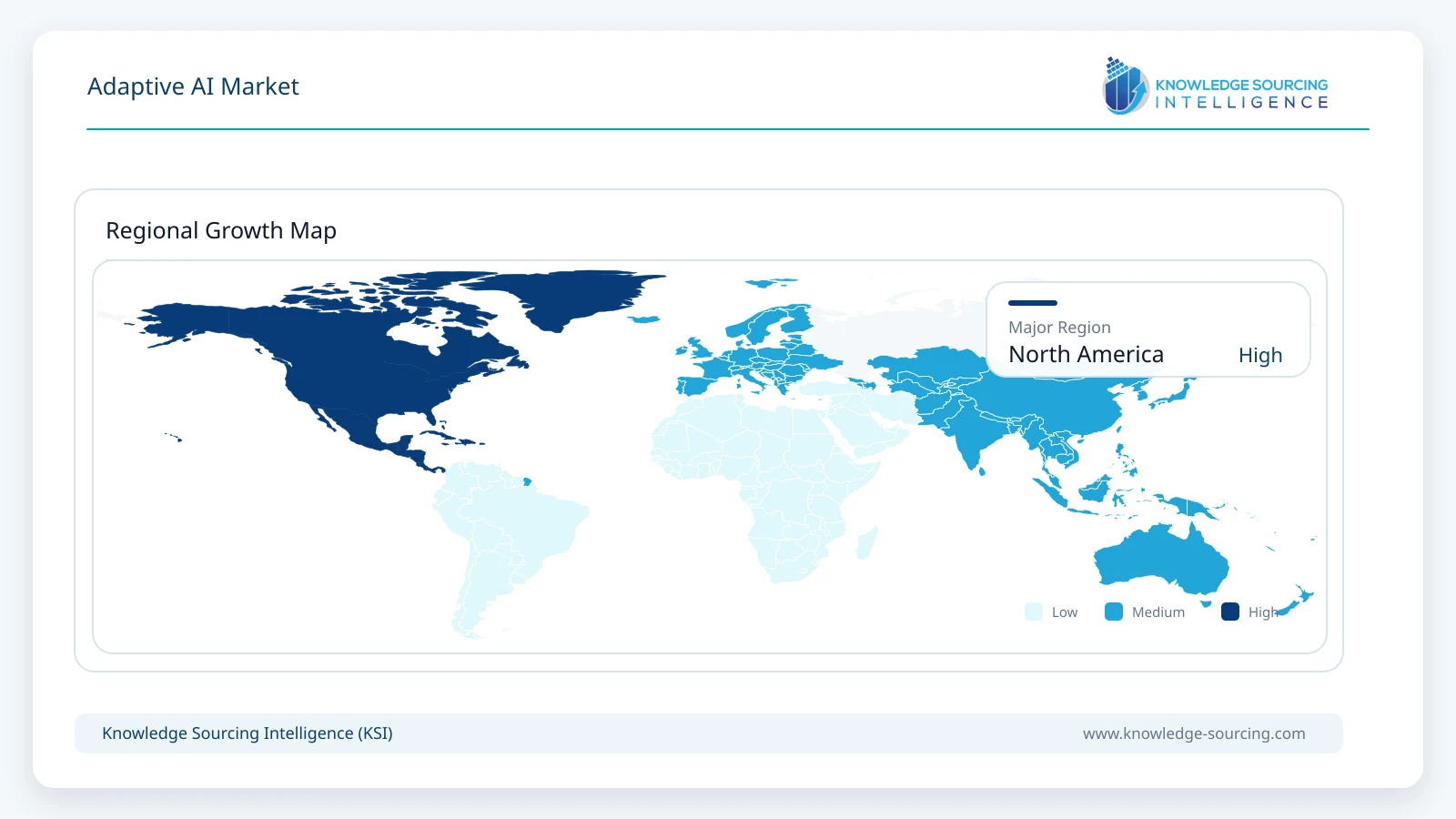
North America remains the largest regional market due to substantial enterprise AI investment, mature cloud infrastructure, extensive venture capital activity, and the concentration of leading technology companies. Financial services, healthcare, defense, and technology sectors continue expanding adaptive AI deployments to improve operational efficiency and risk management. Government support for AI research and semiconductor investment further strengthens regional competitiveness.
Europe demonstrates steady adoption supported by industrial automation, advanced manufacturing, healthcare digitization, and financial technology modernization. The region places considerable emphasis on responsible AI development and regulatory compliance. Organizations increasingly invest in governance capabilities to align adaptive AI deployments with evolving regulatory frameworks while maintaining competitiveness.
Asia Pacific is expected to experience strong adoption as governments and enterprises continue investing in digital infrastructure, smart manufacturing, financial technology, and intelligent public services. China, Japan, India, South Korea, and Australia continue expanding AI capabilities through national strategies, cloud infrastructure investment, and enterprise modernization programs. Growing digital commerce and industrial automation also stimulate commercial demand.
The Middle East and Africa continue expanding AI investment through national digital development initiatives, smart city programs, and public sector modernization. Financial services, energy, government administration, and telecommunications represent leading adoption sectors. Infrastructure limitations and workforce availability remain important constraints in certain markets.
South America is witnessing gradual adoption as organizations modernize banking, retail, logistics, and manufacturing operations. Brazil accounts for a substantial share of regional investment owing to its large enterprise base and expanding cloud ecosystem. Economic uncertainty and uneven digital infrastructure continue influencing purchasing decisions across several countries.
Competitive Landscape
The Adaptive AI market exhibits a competitive structure combining hyperscale cloud providers, enterprise software companies, AI platform developers, and specialized analytics vendors. Competition extends beyond algorithm performance toward complete enterprise ecosystems supporting development, deployment, governance, security, and lifecycle management.
Companies including Microsoft Corporation, Alphabet Inc. (Google), Amazon Web Services, IBM Corporation, Oracle Corporation, SAP SE, Salesforce, NVIDIA Corporation, C3 AI, DataRobot, Palantir Technologies, SAS Institute, and OpenAI compete by integrating adaptive AI capabilities into broader enterprise platforms. Strategic partnerships between cloud providers, semiconductor companies, enterprise software vendors, and foundation model developers continue expanding solution portfolios. Product differentiation increasingly depends on governance capabilities, industry-specific applications, scalability, security certifications, and compatibility with existing enterprise infrastructure.
Recent Developments
June 2026: IBM joined the OpenAI Daybreak Cyber Partner Program, integrating frontier AI capabilities into enterprise security operations to enable adaptive, AI-driven cyber defense against rapidly evolving machine-speed threats.
June 2026: Microsoft announced its MAI-Thinking-1 reasoning model and six additional enterprise AI models at Build 2026, expanding adaptive AI capabilities for enterprise applications with commercially licensed training data and advanced reasoning functions.
June 2026: NVIDIA and Microsoft introduced the RTX Spark platform and Windows-native AI agents for next-generation personal AI computing, enabling adaptive, context-aware AI workloads across enterprise and edge devices.
May 2026: SAP introduced its Autonomous Enterprise strategy alongside a unified Business AI Platform with expanded partnerships including NVIDIA, Microsoft, Google Cloud, AWS, and Palantir. The announcement reinforces enterprise demand for adaptive and agent-based AI systems.
February 2026: Microsoft and OpenAI reaffirmed and updated their long-term partnership, maintaining deep collaboration while supporting broader enterprise AI deployment strategies. The agreement strengthens infrastructure availability for adaptive AI solutions.
Regulatory and Policy Environment
The regulatory environment is becoming increasingly influential as adaptive AI systems assume greater responsibility in operational decision-making. The European Union's AI Act establishes risk-based obligations covering transparency, governance, documentation, and human oversight for applicable AI systems. Organizations deploying adaptive AI in regulated sectors must demonstrate appropriate monitoring, recordkeeping, and risk management.
Privacy legislation, including the General Data Protection Regulation (GDPR), California Consumer Privacy Act (CCPA), and comparable national frameworks, continues influencing data collection, processing, and model training practices. Financial regulators, healthcare authorities, and cybersecurity agencies increasingly expect organizations to maintain auditability and accountability for AI-assisted decisions.
Government investment programs supporting semiconductor manufacturing, cloud infrastructure, cybersecurity, and AI research also contribute to broader ecosystem development. Procurement standards increasingly emphasize explainability, fairness, cybersecurity resilience, and lifecycle governance as prerequisites for enterprise AI adoption.
Outlook and Strategic Implications
Enterprise procurement is expected to shift from isolated AI applications toward integrated adaptive AI platforms capable of managing complete operational lifecycles. Investment priorities will increasingly emphasize governance, model monitoring, automated retraining, cybersecurity integration, and interoperability with enterprise software ecosystems.
Organizations are expected to allocate greater resources toward AI infrastructure, high-performance computing, specialized accelerators, and data management capabilities supporting continuous learning. Buyers will increasingly favor vendors capable of combining foundation models, industry expertise, cloud services, and governance within unified platforms rather than fragmented point solutions.
Competitive positioning will increasingly depend on ecosystem partnerships, vertical specialization, regulatory compliance capabilities, and enterprise integration expertise. Vendors able to demonstrate measurable operational improvements, transparent governance, and lower total ownership costs are likely to strengthen long-term customer relationships. While regulatory complexity, data quality, and skilled workforce shortages will remain important risks, adaptive AI is expected to become an increasingly important element of enterprise decision-making, operational automation, and intelligent business process management over the coming five years.
Adaptive AI Market Scope
| Report Metric | Details |
|---|---|
| Forecast Unit | Billion |
| Study Period | 2021 to 2031 |
| Historical Data | 2021 to 2024 |
| Base Year | 2025 |
| Forecast Period | 2026 – 2031 |
| Segmentation | Component, Deployment, Application, End-User Industry, Geography |
| Geographical Segmentation | North America, South America, Europe, Middle East and Africa, Asia Pacific |
| Companies |
|
Market Segmentation
By Component
- Software
- Platform
- Services
By Deployment
- Cloud
- On-Premises
By Application
- Predictive Analytics
- Intelligent Process Automation
- Fraud Detection
- Recommendation Systems
- Autonomous Systems
- Decision Intelligence
- Others
By End-User Industry
- BFSI
- Healthcare
- Retail and E-commerce
- Manufacturing
- IT and Telecommunications
- Automotive
- Government and Defense
- Energy and Utilities
- Others
By Geography
- North America
- United States
- Canada
- Mexico
- Others
- South America
- Brazil
- Argentina
- Others
- Europe
- Germany
- United Kingdom
- France
- Italy
- Spain
- Others
- Middle East and Africa
- Saudi Arabia
- UAE
- Israel
- South Africa
- Others
- Asia Pacific
- China
- Japan
- India
- South Korea
- Australia
- Indonesia
- Thailand
- Others
Geographical Segmentation
North America, South America, Europe, Middle East and Africa, Asia Pacific
Table of Contents
1. INTRODUCTION
1.1. Market Overview
1.2. Market Definition
1.3. Scope of the Study
1.4. Market Segmentation
1.5. Currency
1.6. Assumptions
1.7. Base and Forecast Years Timeline
1.8. Key Benefits for Stakeholders
2. RESEARCH METHODOLOGY
2.1. Research Design
2.2. Research Process
3. EXECUTIVE SUMMARY
3.1. Key Findings
4. MARKET DYNAMICS
4.1. Market Drivers
4.2. Market Restraints
4.3. Porter’s Five Forces Analysis
4.3.1. Bargaining Power of Suppliers
4.3.2. Bargaining Power of Buyers
4.3.3. Threat of New Entrants
4.3.4. Threat of Substitutes
4.3.5. Competitive Rivalry in the Industry
4.4. Industry Value Chain Analysis
4.5. Analyst View
5. ADAPTIVE AI MARKET BY COMPONENT
5.1. Introduction
5.2. Software
5.3. Platform
5.4. Services
6. ADAPTIVE AI MARKET BY DEPLOYMENT
6.1. Introduction
6.2. Cloud
6.3. On-Premises
7. ADAPTIVE AI MARKET BY APPLICATION
7.1. Introduction
7.2. Predictive Analytics
7.3. Intelligent Process Automation
7.4. Fraud Detection
7.5. Recommendation Systems
7.6. Autonomous Systems
7.7. Decision Intelligence
7.8. Others
8. ADAPTIVE AI MARKET BY END-USER INDUSTRY
8.1. Introduction
8.2. BFSI
8.3. Healthcare
8.4. Retail and E-commerce
8.5. Manufacturing
8.6. IT and Telecommunications
8.7. Automotive
8.8. Government and Defense
8.9. Energy and Utilities
8.10. Others
9. ADAPTIVE AI MARKET BY GEOGRAPHY
9.1. Introduction
9.2. North America
9.2.1. By Component
9.2.2. By Deployment
9.2.3. By Application
9.2.4. By End-User Industry
9.2.5. By Country
9.2.5.1. United States
9.2.5.2. Canada
9.2.5.3. Mexico
9.2.5.4. Others
9.3. South America
9.3.1. By Component
9.3.2. By Deployment
9.3.3. By Application
9.3.4. By End-User Industry
9.3.5. By Country
9.3.5.1. Brazil
9.3.5.2. Argentina
9.3.5.3. Others
9.4. Europe
9.4.1. By Component
9.4.2. By Deployment
9.4.3. By Application
9.4.4. By End-User Industry
9.4.5. By Country
9.4.5.1. Germany
9.4.5.2. United Kingdom
9.4.5.3. France
9.4.5.4. Italy
9.4.5.5. Spain
9.4.5.6. Others
9.5. Middle East and Africa
9.5.1. By Component
9.5.2. By Deployment
9.5.3. By Application
9.5.4. By End-User Industry
9.5.5. By Country
9.5.5.1. Saudi Arabia
9.5.5.2. UAE
9.5.5.3. Israel
9.5.5.4. South Africa
9.5.5.5. Others
9.6. Asia Pacific
9.6.1. By Component
9.6.2. By Deployment
9.6.3. By Application
9.6.4. By End-User Industry
9.6.5. By Country
9.6.5.1. China
9.6.5.2. Japan
9.6.5.3. India
9.6.5.4. South Korea
9.6.5.5. Australia
9.6.5.6. Indonesia
9.6.5.7. Thailand
9.6.5.8. Others
10. COMPETITIVE ENVIRONMENT AND ANALYSIS
10.1. Major Players and Strategic Analysis
10.2. Market Share Analysis
10.3. Mergers, Acquisitions, Agreements, and Collaborations
10.4. Competitive Dashboard
11. COMPANY PROFILES
11.1. Microsoft Corporation
11.2. Alphabet Inc. (Google)
11.3. Amazon Web Services, Inc.
11.4. IBM Corporation
11.5. Oracle Corporation
11.6. SAP SE
11.7. Salesforce, Inc.
11.8. NVIDIA Corporation
11.9. C3 AI, Inc.
11.10. DataRobot, Inc.
11.11. Palantir Technologies Inc.
11.12. SAS Institute Inc.
11.13. OpenAI
Navigate
Trusted by the world's leading organizations











