NTN enables connectivity in areas that were formerly inaccessible by terrestrial networks, regardless of whether it be over terrain, or deserts, among others. It accomplishes this by using satellites as well as non-terrestrial vehicles. The capacity to operate in disaster zones and drive potential t...
- Current Types Of Satellite-Based NTN Systems
Satellite-Based NTN Platform Types
|
Platforms |
Altitude Range (in Km) |
Typical Beam Footprint Size (in Km) |
|
LEO |
300 - 1,500 | 100 - 1,000 |
|
MEO |
7,000 - 25,000 |
100 - 1,000 |
| GEO | 35,786 |
200 - 3,500 |
- 5G NTN Spectrum
5G NTN Spectrum (FR1 and FR2)
| Band | Uplink | Downlink | Duplex | |
| First 3GPP NTN FR1 bands for L-Band and S-Band (IoT) | n255 | 1626.5 – 1660.5 MHz | 1525.0 – 1559.0 MHz | FDD |
| n256 | 1980.0 – 2010.0 MHz | 2170.0 – 2200.0 MHz | FDD | |
| Existing 3GPP FR2-1 Bands | n257 | 26.50 – 29.50 GHz | 26.50 – 29.50 GHz | TDD |
| n258 | 24.25 – 27.50 GHz | 24.25 – 27.50 GHz | TDD | |
| n259 | 39.50 – 43.50 GHz | 39.50 – 43.50 GHz | TDD | |
| n260 | 37.00 – 40.00 GHz | 37.00 – 40.00 GHz | TDD | |
| n261 | 27.50 – 28.35 GHz | 27.50 – 28.35 GHz | TDD | |
| n262 | 47.20 – 48.20 GHz | 47.20 – 48.20 GHz | TDD | |
| Proposed 3GPP NTN FR2-0/FR2-1 bands * for K-Band and KA-Band (VSAT) | n510 | 17.70 – 20.20 GHz | 27.50 – 28.35 GHz | FDD |
| n511 | 17.70 – 20.20 GHz | 28.35 – 30.00 GHz | FDD | |
| n512 | 17.70 – 20.20 GHz | 27.50 – 30.00 GHz | FDD |
- Vast 5G NTN Use Cases
- Satellite-Based Connectivity
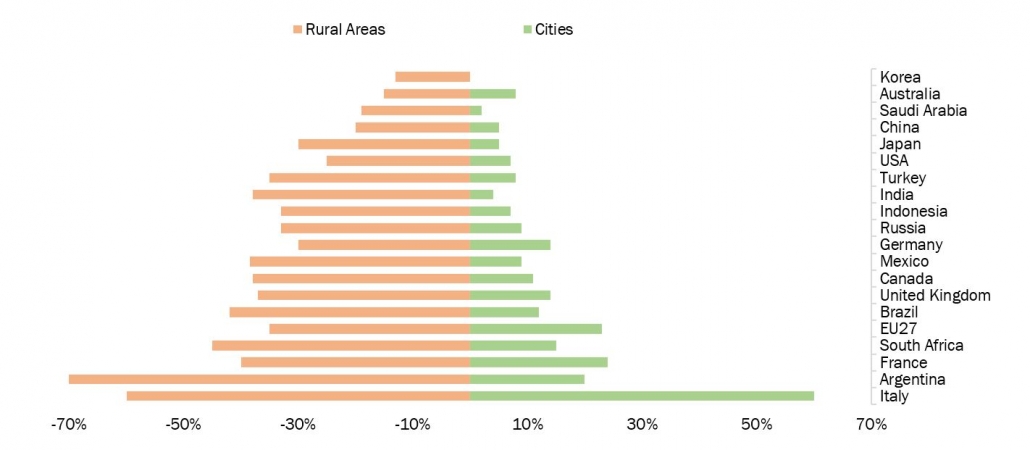
Digital Divide As Measured By Fixed Broadband Download Speeds (Q4,2020)
 Source: OECD
Consequently, the use of satellite-based connectivity could be crucial in utilizing existing communication networks to provide 5G capabilities in the coming years and narrow the digital gap. For instance, Coverage Above and Beyond, a ground-breaking new proposal to offer cell phone service anywhere, was unveiled by T-Mobile and SpaceX in August 2022. T-Mobile intends to offer nearly full coverage in the majority of locations in the United States, including many of the remotest regions that were previously inaccessible by conventional cell signals. It aims to accomplish this by utilizing Starlink, SpaceX's LEO satellites, and T-Mobile's sector-leading wireless network.
Source: OECD
Consequently, the use of satellite-based connectivity could be crucial in utilizing existing communication networks to provide 5G capabilities in the coming years and narrow the digital gap. For instance, Coverage Above and Beyond, a ground-breaking new proposal to offer cell phone service anywhere, was unveiled by T-Mobile and SpaceX in August 2022. T-Mobile intends to offer nearly full coverage in the majority of locations in the United States, including many of the remotest regions that were previously inaccessible by conventional cell signals. It aims to accomplish this by utilizing Starlink, SpaceX's LEO satellites, and T-Mobile's sector-leading wireless network.
- Leading Players
- Space X - In 2022, the international satellite-to-cellular network initiative "Coverage and Above and Beyond," a joint venture between SpaceX and T-Mobile, was launched. The firms presented strategies for extending 5G coverage using second-generation Starlink satellites to eliminate mobile dead zones, such as in remote locations in the middle of the ocean. The two businesses announced recently that they will start piloting 5G connectivity in the latter half of 2023.
Major Broadband and Satellite Providers, 2023
|
Operator |
Satellite system (deployed) | Spectrum | Operational | Services |
|
Space X (Starlink) |
12,000+ (3,580) | Ku-band | Yes | Broadband |
| Kuiper | 3236 (0) | Ka band | Estimated 2024 |
Broadband |
|
Echostar |
10 GEO (10) | Ku, Ka, S bands | Yes | Broadband |
| HughesNet | 3 GEO (2) | Ka band | Yes |
Broadband |
| Inmarsat | 14 GEO (14) | TBD | TBD |
Broadband to IoT |
- Kuiper Systems LLC - Amazon's Project Kuiper aims to provide global internet access to users using a fleet of LEO satellites. In 2024, Amazon is anticipated to launch its first batch of satellites, and later that year, it is expected to start offering service to its first clients. It is yet unknown where Project Kuiper will launch its internet service and how much it will cost consumers.
- EchoStar Corporation - In February 2023, satellite provider EchoStar stated it would begin constructing a constellation of 28 LEO satellites around the world alongside supplier Astro Digital. These satellites will broadcast signals using the business's S-band spectrum ownership. For IoT applications, the system will at first support the LoRa protocol, but EchoStar claimed that this move is a component of a long-term plan to create "a worldwide non-terrestrial 5G network."
- Inmarsat - To deliver ultra-reliable, two-way satellite connectivity for smartphones, IoT devices, cars, and other sectors, MediaTek and Inmarsat strengthened their alliance as of April 2023. The two major players in the industry are working to make it possible for mobile carriers, smartphone makers, and additional device manufacturers to deliver satellite offerings, such as two-way text messaging, disaster communications, device monitoring, and surveillance, amongst other features. The MediaTek/Inmarsat partnership offers the industry a very practical strategy by utilizing tried-and-tested 5G NTN guidelines, current chipsets, and the most dependable universal satellite infrastructure, enabling a speedy rollout of new NTN services.
- 5G Network Security Market: https://www.knowledge-sourcing.com/report/5g-network-security-market
- 5G Network And Service Assurance Market: https://www.knowledge-sourcing.com/report/5g-network-and-service-assurance-market
- Global 5G Device Market: https://www.knowledge-sourcing.com/report/global-5g-device-market
Have questions?
More Thought Articles
How EV Charger Manufacturers Can Capitalize on India’s Home Charging Revolution
India’s residential EV charging opportunity is expanding as policy support, EV adoption, and private parking infrastructure develop. Manufacturers can capture value beyond AC chargers through installation, smart charging, load management, solar integration, software, and after-sales services. Housing societies, automakers, and property developers offer scalable routes to residential charging customers.
Second-Life EV Battery Market in India: What Is Driving Demand from Manufacturers?
India’s second-life EV battery market is gaining relevance as electric vehicle adoption expands and batteries retain useful capacity after automotive service. Growing stationary-storage demand, battery data, refurbishment capabilities, EPR obligations, and critical-mineral policies are encouraging manufacturers to extend battery value through reuse before eventual recycling within India’s emerging circular battery ecosystem.
The Rise of Locally Manufactured Battery Separators in India’s EV Ecosystem
India’s battery industry is progressing from pack assembly toward domestic cell and material manufacturing, creating opportunities for lithium-ion battery separators. Policy support, ACC capacity expansion and R&D initiatives are strengthening the ecosystem. However, technical complexity, manufacturing yields, qualification requirements and economics mean localisation will likely advance gradually through coatings, testing and finishing.