
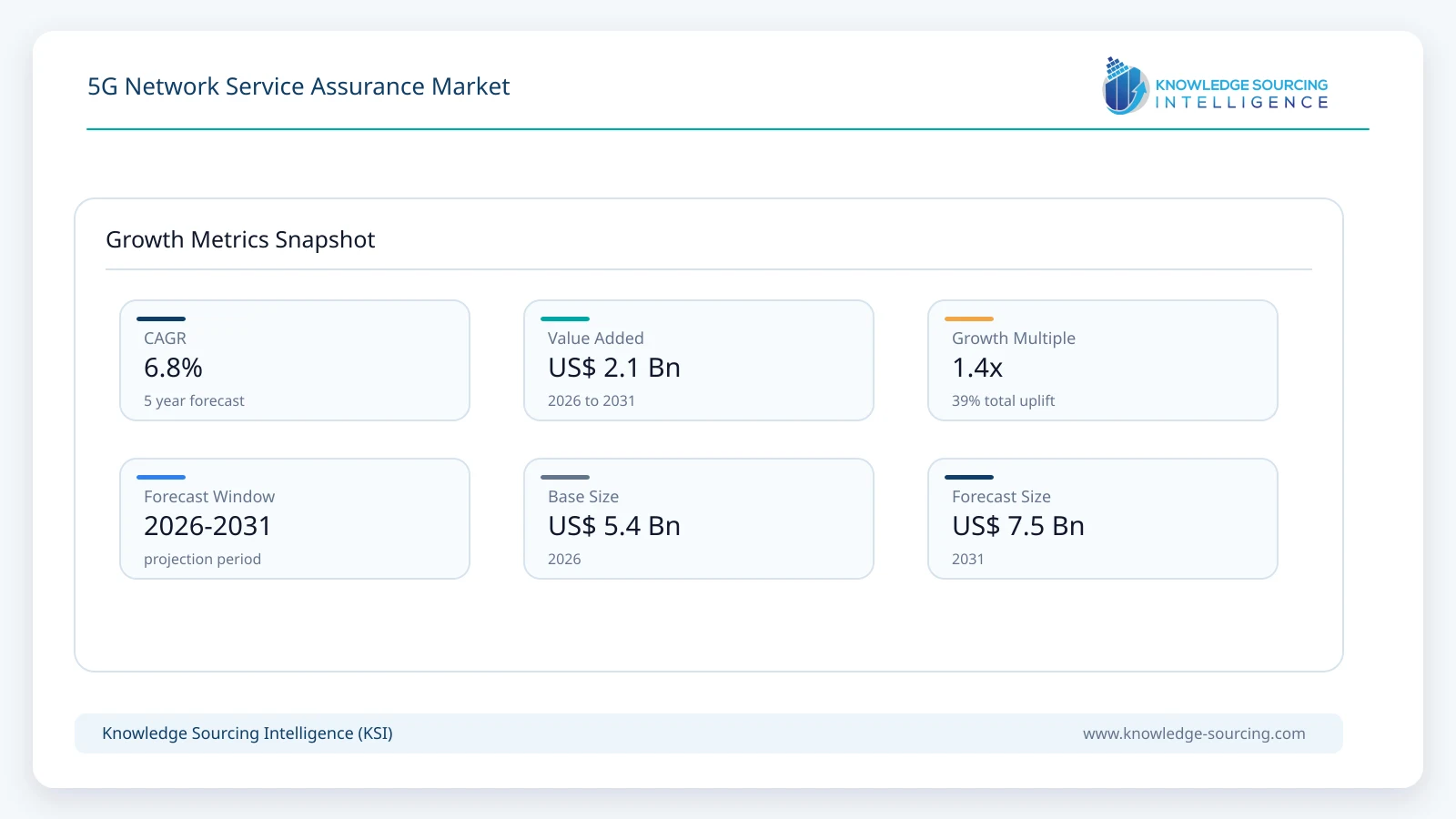
The global 5G network and service assurance market is forecast to grow at a CAGR of 10.7%, reaching USD 9.3 billion in 2031 from USD 5.6 billion in 2026.
Highlights:
- 1Network performance and QoS assurance accounts for an estimated 34.0% of global market revenue in 2026remaining the largest individual assurance function.
- 2RAN-focused assurance represents approximately 42.0% of 2026 revenuesupported by radio-network complexity, densification, Massive MIMO, Open RAN and the need to correlate subscriber experience with radio conditions.
- 3Cloud and hybrid-cloud assurance deployments account for an estimated 40.0% of market revenue in 2026and are expected to gain substantial share through 2031.
- 4Asia Pacific represents approximately 32.0% of global market revenue in 2026, supported by large 5G subscriber bases, continuing Standalone deployments and extensive network modernization.
- 53.1 billion in Q1 2026Global 5G subscriptions exceeded , while Ericsson reports that approximately 390 service providers have launched commercial 5G and more than 90 have launched 5G Standalone.
- 665 to 84 in six monthsCommercial 5G SA network-slicing offerings increased from , creating greater requirements for per-slice performance measurement and SLA assurance.
- 7subscriber-aware analytics, AI-driven anomaly detection, cross-domain observability and closed-loop remediationAssurance investment is shifting toward rather than expanding conventional alarm-management platforms.
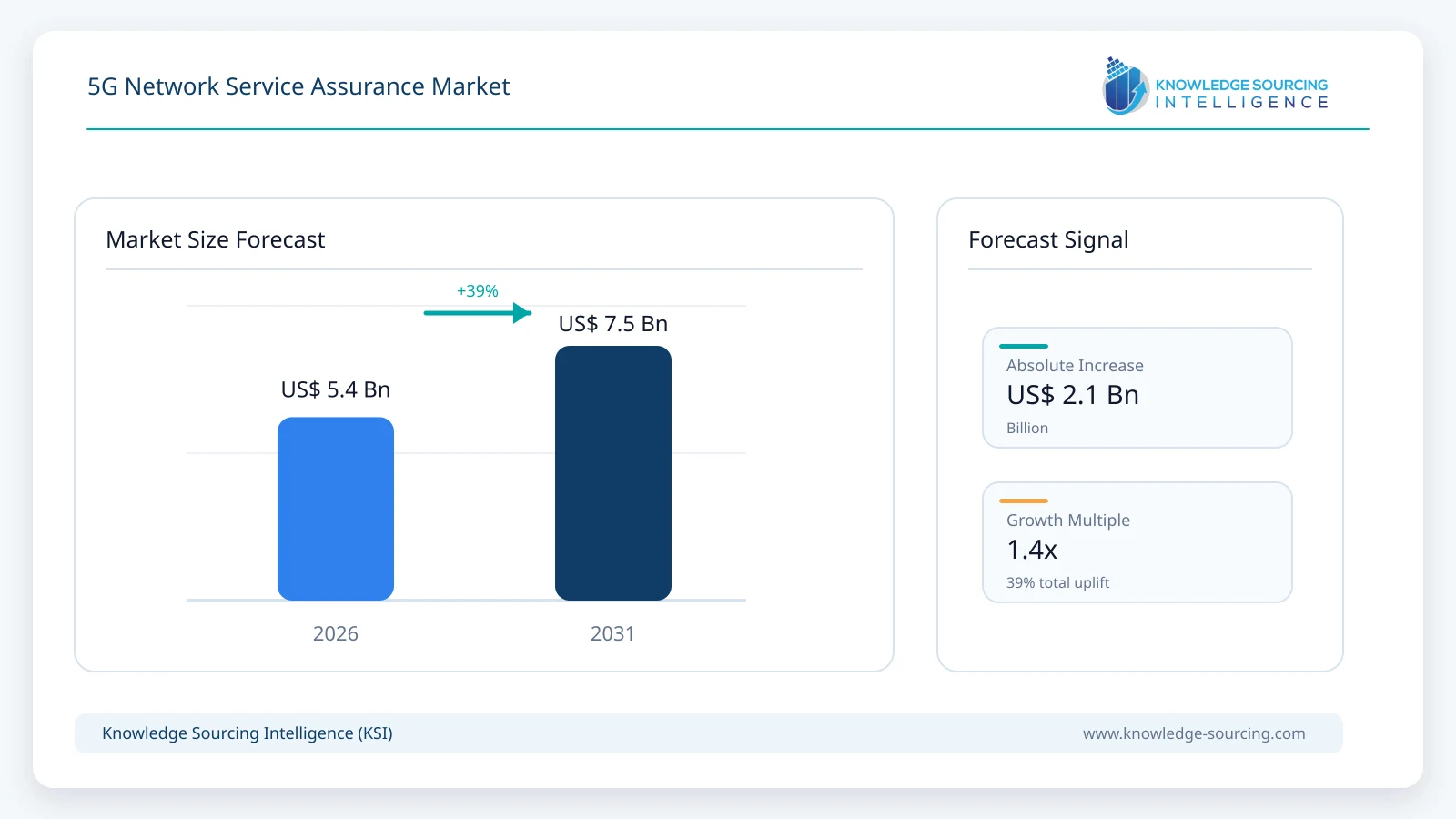
Growth is being supported by wider 5G Standalone deployment, commercial network slicing, cloud-native network functions, increasingly distributed RAN and core architectures, and operators’ movement from reactive fault monitoring toward AI-assisted and increasingly closed-loop network operations.
5G network and service assurance comprises software and associated services used to observe network behaviour, correlate faults, measure service quality, monitor subscriber experience, verify service-level commitments and identify the root causes of performance degradation across 5G networks. The market includes assurance across the RAN, transport, edge and core domains and increasingly covers end-to-end services spanning several network domains simultaneously.
The scope includes network performance and QoS monitoring, fault and incident assurance, subscriber and service-experience assurance, SLA monitoring, network-slice assurance, configuration and change assurance, observability, anomaly detection and assurance analytics. Standalone cybersecurity platforms, general-purpose enterprise observability products, laboratory-only network testing equipment, and conventional OSS functions without an assurance component are excluded.
Market Overview
5G changes the assurance requirement because the network itself becomes substantially more distributed and programmable. Traditional mobile assurance was largely organized around relatively fixed RAN and core infrastructure. 5G adds cloud-native network functions, edge computing, network slicing, virtualized and Open RAN components, private networks and multiple service classes that can have very different performance requirements.
The operational challenge is therefore moving from determining whether a physical network element is functioning toward determining whether a specific subscriber, application or enterprise service is receiving the performance that was promised. A fault may originate in the radio layer, transport network, cloud infrastructure, 5G Core, or service configuration and may affect only selected users or network slices. Assurance platforms increasingly need to correlate information across those layers in real time.
This becomes more important as 5G carries a greater proportion of mobile traffic. Ericsson estimates that approximately 48% of global mobile data traffic was already transported over 5G at the end of 2025 and expects the proportion to reach 85% by 2031. Global 5G subscriptions are forecast to increase to 6.4 billion over the same period. The commercial importance of network failures consequently rises as a larger share of consumer, enterprise and critical connectivity is placed on 5G infrastructure.
Standalone architecture creates another layer of complexity. More than 90 operators have launched 5G SA, while hundreds of operators still primarily use Non-Standalone architecture. SA introduces cloud-native core functions, network slicing and more sophisticated policy control. Assurance platforms consequently need to monitor signalling, user-plane traffic, slice performance and subscriber experience across rapidly changing software infrastructure rather than only physical telecom equipment.
Commercial activity during 2026 shows that operators are beginning to replace legacy assurance platforms with cloud-native and AI-based systems. CETIN Networks selected RADCOM in August 2026 to replace its incumbent assurance platform as it moves toward 5G Standalone and Voice over New Radio. The new system spans RAN and core and applies real-time signalling correlation, machine learning and subscriber-aware analytics.
Market Drivers
5G Standalone increases the number of network domains that must be assured together
Non-Standalone 5G continues relying significantly on existing LTE core infrastructure. Standalone introduces a cloud-native 5G Core with independently scalable software functions, service-based interfaces, network slicing and more dynamic resource allocation.
This architecture improves network flexibility but creates more potential sources of performance degradation. Assurance platforms need to correlate events across containerized applications, underlying cloud infrastructure, signalling, RAN behaviour and individual services. The commercial transition remains at an early enough stage to support meaningful growth through 2031, with more than 90 SA operators compared with approximately 390 operators providing commercial 5G overall.
Operators also need to manage 4G, 5G NSA and 5G SA simultaneously. Assurance platforms capable of providing one subscriber and service view across these environments have an advantage over tools designed around one network generation.
Commercial network slicing requires measurable SLA assurance
Network slicing changes assurance from primarily an internal network-management activity into a commercial requirement. Operators selling differentiated connectivity to enterprises need to demonstrate that individual slices meet specified throughput, latency, availability or reliability commitments.
Ericsson identified 84 commercially available differentiated-connectivity offerings based on 5G SA network slicing by mid-2026, compared with 65 only six months earlier. Europe accounted for approximately 41% of these commercial offerings and Asia Pacific for around 24%.
NETSCOUT introduced dedicated 5G slicing observability capabilities in January 2026 that provide end-to-end visibility from RAN through core and enable operators to monitor performance and auditable SLA metrics for individual network slices.
As slicing moves from trial to monetized service, assurance becomes part of revenue protection. Failure to meet contracted performance can directly affect enterprise SLAs rather than simply resulting in a weaker consumer experience.
Agentic AI is changing assurance from diagnosis toward autonomous action
Traditional assurance systems collect alarms, counters, and traces and then present them to network operations teams for investigation. AI and machine learning increasingly perform anomaly identification, correlation and root-cause analysis automatically.
RADCOM launched its Neura AI agent suite on February 24, 2026, specifically to move service assurance toward autonomous, intent-driven network operations. The system combines real-time customer-experience data with specialized agents used across network operations, assurance and customer care.
The next step is closed-loop assurance. Instead of simply identifying an anomaly, an assurance system can recommend or trigger corrective action through orchestration and network-management systems. Ericsson’s work with autonomous networks similarly emphasizes intent-driven operations in which networks sense, reason and act while remaining within operator-defined policies and guardrails.
AI therefore increases both the strategic importance of assurance data and the value of high-quality network telemetry. An autonomous system cannot make reliable changes if its underlying view of service performance is incomplete or fragmented.
Cross-domain visibility becomes essential as 5G networks disaggregate
5G increasingly separates radio software, baseband functions, cloud infrastructure, transport, edge computing and core-network functions. Open RAN can introduce additional vendors into the radio environment while cloud-native cores may run across geographically distributed computing infrastructure.
A service failure can consequently appear as a symptom in one domain while originating elsewhere. RAN congestion can resemble an application problem, transport latency can affect slice performance and cloud-resource constraints can reduce network-function responsiveness.
This drives demand for platforms that correlate packet, signalling, RAN, cloud and subscriber information instead of maintaining separate monitoring silos. Cross-domain and end-to-end assurance is consequently projected to be one of the fastest-growing parts of the market, expanding at approximately 22.6% annually through 2031.
Private 5G creates a smaller but faster-growing assurance opportunity
Private 5G networks introduce telecom-grade infrastructure into enterprises that often have limited internal cellular-network operations expertise. Manufacturers, ports, utilities and logistics companies increasingly expect connectivity suppliers to provide ongoing performance visibility as part of a managed service.
VIAVI expanded its XEdge assurance platform on January 14, 2026 with additional sensors specifically designed for private 4G, 5G and Wi-Fi environments. The system provides continuous visibility into device connectivity and network performance using distributed sensors and centralized cloud analytics.
Private-network assurance remains much smaller than public mobile assurance in 2026 but is projected to grow at approximately 20.0% annually through 2031 as enterprise deployments move from trials toward production networks.
Market Restraints and Challenges
Telecom operators continue scrutinizing assurance expenditure
Service assurance is essential to network operations, but operators face continuous pressure to reduce operating expenses. New assurance platforms therefore often need to replace multiple legacy tools or demonstrate measurable reductions in troubleshooting time rather than simply adding another monitoring layer.
NETSCOUT indicated in February 2026 that service-provider investment in 5G-related initiatives remained measured as operators balanced network expenditure against monetization opportunities. Network slicing and fixed wireless were identified as potential revenue catalysts, but broader 5G expenditure remained selective.
This creates a preference for consolidation. Platforms capable of covering several generations and network domains can receive investment while isolated monitoring tools face increasing pricing pressure.
Telecom telemetry is large, fragmented and expensive to process
5G networks generate enormous volumes of packets, signalling events, counters, traces and infrastructure telemetry. Capturing everything continuously can require substantial compute, storage and network resources.
Sampling reduces infrastructure costs but risks missing short-duration or subscriber-specific problems. Vendors are therefore competing on their ability to process network information efficiently while retaining enough granularity for root-cause analysis and AI training.
The economics of data ingestion become increasingly important as assurance moves toward real-time AI because the value of an algorithm depends heavily on the quality and completeness of the information provided to it.
Multi-vendor environments complicate root-cause analysis
Operators increasingly combine network equipment, cloud platforms and software from different suppliers. Open RAN can further increase the number of independent components within one service path.
Individual vendors can expose different counters, data models and telemetry formats. Assurance systems need to normalize this information before operators can correlate performance across domains.
Open APIs and standardized information models improve interoperability, but deeply integrated multi-vendor assurance remains technically difficult. Large incumbent telecom vendors can therefore retain an advantage where assurance is bundled with network infrastructure, while independent assurance suppliers differentiate through vendor neutrality.
AI-generated recommendations require operational trust
AI can identify patterns that conventional threshold-based systems miss, but operators remain cautious about allowing algorithms to change live production networks automatically.
A false diagnosis could trigger unnecessary configuration changes and affect millions of subscribers. Closed-loop automation consequently requires explainability, guardrails, validation and clear rollback processes.
The market therefore progresses incrementally from AI-assisted recommendations toward higher levels of network autonomy rather than switching immediately to fully autonomous operation.
Standalone security products create scope overlap
Assurance platforms increasingly incorporate security-related network visibility because the same packet and signalling information can reveal both performance and malicious behaviour. However, standalone DDoS protection, network-security gateways, threat-intelligence systems and dedicated 5G security products constitute separate markets.
Suppliers need to integrate security context without turning service-assurance deployments into duplicate security platforms. Clear scope becomes particularly important when operators consolidate observability, assurance and security data into common operational systems.
Major Segment Analysis
By Assurance Function
Network performance and QoS assurance remains the largest functional category, accounting for an estimated 34.0% of 2026 revenue. The segment covers throughput, latency, availability, congestion and service-quality monitoring across mobile infrastructure.
Its share gradually declines as assurance moves closer to individual subscribers and commercial services. Conventional KPI monitoring is increasingly embedded within broader platforms and experiences stronger pricing pressure than newer assurance functions.
Fault and incident management remains essential but similarly grows below the overall market. AI-driven correlation reduces the number of alarms presented to engineers and places greater emphasis on root-cause identification rather than alarm collection.
Customer and service-experience assurance records stronger growth and is projected to expand at approximately 16.0% annually through 2031. Operators increasingly need to understand service performance from the subscriber’s perspective and correlate degradation with individual applications, locations, devices and network slices.
Configuration, change and SLA assurance becomes particularly relevant to programmable 5G networks. As operators introduce differentiated connectivity, the ability to verify that configurations produce the promised service outcome gains commercial importance.
By Network Domain
RAN remains the largest individual assurance domain in 2026 because radio conditions directly influence user experience and because Massive MIMO, densification and multi-vendor RAN architectures generate extensive operational complexity.
Its relative share decreases through 2031 as end-to-end platforms become more important. Core assurance remains substantial as operators move toward cloud-native 5G SA and VoNR.
Transport and edge assurance grows above the overall market because distributed computing and network slicing make latency across intermediate network layers more commercially significant.
Cross-domain and end-to-end assurance is projected to increase from approximately 12% of revenue in 2026 to 20% by 2031. The segment benefits from operators’ need to correlate RAN, transport, core, cloud and service information within one operational view rather than diagnose individual domains separately.
By Deployment Environment
Telco private cloud and conventional on-premises deployments remain the largest category in 2026 because many operators maintain sensitive network data within infrastructure under direct operational control.
Public and hybrid cloud deployments grow considerably faster as assurance software becomes containerized and operators adopt distributed cloud architecture. The category is projected to account for the majority of new incremental expenditure by the end of the forecast period.
RADCOM’s September 2026 VNPT contract illustrates this movement. The operator selected a cloud-native assurance platform deployed across multiple cloud environments to provide subscriber-aware visibility and AI-based anomaly detection for roaming services.
By Customer Type
Public communications service providers continue to account for the overwhelming majority of expenditure because national networks generate the greatest volumes of telemetry and have the most complex assurance requirements.
Private and enterprise 5G represents a smaller but faster-growing segment. Enterprise customers often consume assurance through managed-network contracts rather than purchasing large independent assurance platforms, making partnerships between equipment suppliers, operators and assurance vendors particularly important.
Regional Analysis
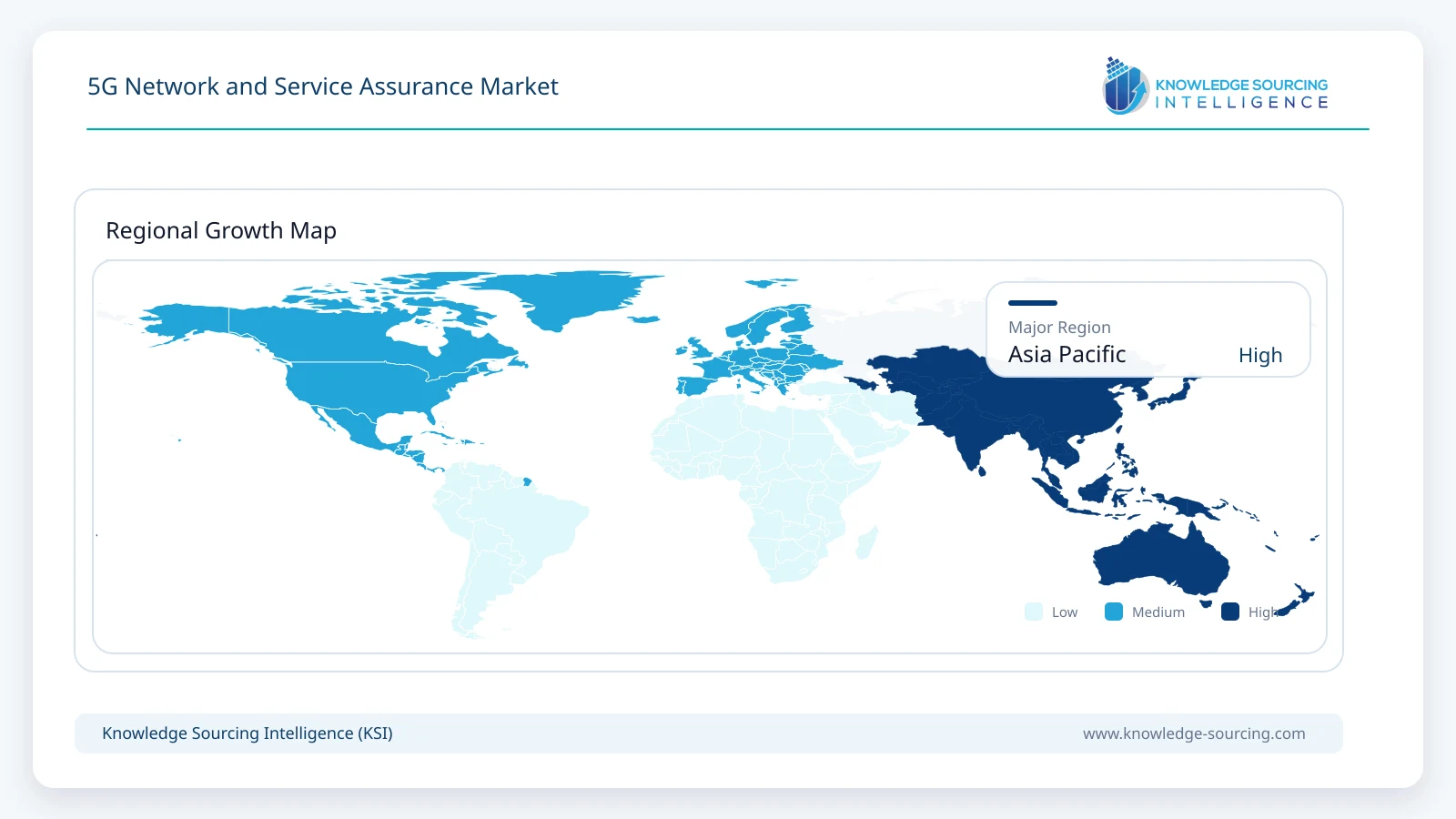
Asia Pacific accounts for approximately 32.0% of global market revenue in 2026 and is projected to grow faster than North America and Europe. The region combines mature 5G networks in China, South Korea and Japan with substantial continuing expansion in India and Southeast Asia.
CETIN Networks’ August 2026 RADCOM deployment in Slovakia demonstrates the continuing European shift toward cloud-native assurance as operators implement 5G SA. In Asia Pacific, RADCOM’s September 2026 selection by VNPT provides another indication that operators are replacing legacy assurance systems with AI-native alternatives.
North America remains a major value market because of widespread 5G deployment, large operator networks and comparatively early adoption of network slicing and automation. NETSCOUT’s dedicated 5G network-slice observability capabilities are particularly relevant to operators selling SLA-backed differentiated services.
Europe maintains a large assurance market because operators manage complex multi-country, multi-vendor and multi-generation infrastructure. Growing commercial network-slicing activity provides additional requirements for SLA and experience assurance.
Middle East and Africa record above-market percentage growth as Gulf operators expand 5G SA and advanced service offerings while African operators gradually increase 5G coverage. South America develops more gradually, led principally by Brazil and other major national mobile markets.
Technology Outlook
Agentic Assurance and Closed-Loop Operations
Assurance systems are moving from dashboards toward software agents capable of detecting anomalies, investigating likely causes and recommending or initiating corrective actions.
RADCOM Neura demonstrates this shift through specialized agents operating across assurance, network operations and customer care. The commercial distinction increasingly lies in how accurately agents can reason from real-time network data and how safely they can interact with live orchestration systems.
End-to-End Network-Slice Assurance
Network slicing requires assurance at the service level rather than merely the infrastructure level. Operators need to verify latency, throughput, availability and other KPIs separately for individual logical networks sharing the same physical infrastructure.
NETSCOUT’s January 2026 5G slicing observability announcement reflects this requirement, providing RAN-to-core visibility and auditable SLA performance for individual slices.
The technology becomes increasingly important as differentiated connectivity moves into paid enterprise and consumer services.
Digital Twins and Predictive Assurance
Digital network twins allow operators to model expected network behaviour and compare it with live conditions. The approach can help forecast congestion, evaluate planned changes and identify likely failures before customer experience deteriorates.
NETSCOUT identifies digital twins and AIOps as an emerging operating model for complex 5G and dynamic slicing environments where operators need to move from real-time visibility toward prediction.
Predictive assurance is expected to become increasingly integrated with closed-loop automation, allowing networks to act before conventional fault thresholds are crossed.
Recent Developments
August 11, 2026: CETIN Networks selected RADCOM under a multi-year agreement to deploy AI-driven end-to-end service assurance across its Slovak mobile network, replacing the incumbent assurance platform. The solution spans RAN to core and directly supports CETIN’s rollout of 5G Standalone and VoNR.
June 22, 2026: RADCOM launched its Analytics Designer Module, enabling telecom network analysts to define and deploy datasets, KPIs and alarms in real time without waiting for vendor software-release cycles. The module operates within RADCOM ACE, its assurance platform for 5G and other mobile networks.
May 13, 2026: Ericsson, China Mobile and OPPO completed China Mobile’s first live commercial-network verification of UE-level and application-level 5G SA slicing, using AI-powered service recognition and differentiated QoS. Ericsson described the trial as a breakthrough in 5G experience assurance, with AI-glasses testing recording at least a 30% reduction in air-interface round-trip latency compared with conventional connectivity.
February 24, 2026: RADCOM launched Neura, an AI-agent suite designed to integrate service-assurance data with agentic-AI ecosystems. The agents operate across network operations, service assurance and customer care and are designed to move assurance from reactive monitoring toward autonomous network operation.
January 20, 2026: NETSCOUT announced enhanced 5G Standalone network-slice observability, providing end-to-end visibility from RAN through core and real-time monitoring of SLA performance for individual network slices.
January 14, 2026: VIAVI Solutions expanded its XEdge private-network monitoring and assurance platform with additional sensor options supporting private 4G, 5G and Wi-Fi networks. The platform combines unattended edge sensors, centralized cloud dashboards and automated analytics for continuous network-performance monitoring.
Competitive Landscape
The market includes specialist assurance vendors, test-and-observability suppliers and large telecom equipment companies. Independent suppliers differentiate primarily through multi-vendor visibility because they can monitor infrastructure from several equipment providers without being tied to one RAN or core stack.
NETSCOUT maintains a substantial carrier-service-assurance business based on packet-level observability, RAN analytics and end-to-end network visibility. Its 5G portfolio increasingly focuses on network slicing, subscriber experience and AI-ready network data. The company reported in August 2026 that its Service Assurance offering contributed to strong first-quarter fiscal 2027 performance.
RADCOM concentrates heavily on cloud-native mobile-network assurance and provides RAN-to-core subscriber analytics. Its 2026 CETIN win, Neura agentic-AI launch and Analytics Designer introduction demonstrate a strategy centered on replacing legacy operator assurance stacks with AI-native platforms.
VIAVI combines network assurance with extensive testing and measurement capabilities. Its portfolio expanded after completion of its October 2025 acquisition of selected former Spirent high-speed Ethernet, network-security and channel-emulation businesses. Keysight separately completed its acquisition of the remainder of Spirent Communications, incorporating Spirent’s network automation and service-assurance assets into a larger communications-test portfolio.
EXFO competes across service assurance, active testing and network analytics, while Elisa Industriq’s Polystar business provides subscriber and customer-experience assurance across networks extending from 2G through 5G SA.
Ericsson, Nokia, Huawei and ZTE can integrate assurance functions directly with their wider RAN and core portfolios. Their infrastructure relationships provide deep network-domain knowledge but independent vendors retain an advantage where operators require vendor-neutral observability.
Amdocs and Comarch participate from the OSS and service-management side, while Cisco has expanded its observability capabilities through acquisitions and integration of network intelligence into broader service-provider architectures.
The market is therefore unlikely to consolidate around one assurance model. Tier-1 operators increasingly combine specialist packet and subscriber analytics, vendor-specific network intelligence and overarching orchestration platforms, with competitive advantage determined by the ability to correlate these data sources efficiently.
Analyst View
The most important shift in 5G assurance is the movement from network-element health toward service outcomes. Knowing that a radio, router or core function is technically operational is no longer sufficient when operators sell differentiated connectivity with explicit performance characteristics.
Network slicing makes this commercial rather than merely technical. Each slice can carry its own latency, throughput and availability expectations, requiring operators to observe performance continuously and identify which underlying network domain is responsible when an SLA deteriorates.
AI changes the economics of this process. Networks generate more telemetry than human operations teams can investigate manually, making machine-led correlation increasingly necessary. However, the strategic advantage will not come from attaching a generic AI model to an alarm database. It will come from supplying AI systems with reliable, subscriber-aware, cross-domain network data and allowing them to take controlled action within defined operational guardrails.
This favors platforms capable of correlating RAN, core, transport, cloud and subscriber information rather than products optimized for a single network domain. Cross-domain assurance should therefore capture a disproportionate share of incremental spending even though domain-specific monitoring remains important.
Private 5G provides a different commercial model. Most enterprises will not build large internal network-operations organizations comparable with national operators. Assurance is therefore more likely to be embedded into managed connectivity or network-as-a-service offerings, increasing the importance of cloud-delivered platforms and automated remediation.
Conventional fault monitoring becomes progressively less differentiated. The highest-value parts of the market are shifting toward customer-experience assurance, network-slice SLA monitoring, predictive analytics and closed-loop operations. Vendors that remain focused primarily on collecting alarms face greater pricing pressure, while suppliers capable of converting network telemetry into operational decisions become more deeply embedded in operator automation strategies.
5G Network and Service Assurance Market Scope:
| Report Metric | Details |
|---|---|
| Total Market Size in 2026 | USD 5.6 billion |
| Total Market Size in 2031 | USD 9.3 billion |
| Forecast Unit | USD Billion |
| Growth Rate | 10.7% |
| Study Period | 2021 to 2031 |
| Historical Data | 2021 to 2024 |
| Base Year | 2025 |
| Forecast Period | 2026 – 2031 |
| Segmentation | Assurance Function, Network Domain, Deployment Environment, Customer Type |
| Companies |
|
Market Segmentation
By Assurance Function
· Network Performance & QoS Assurance
· Fault & Incident Assurance
· Service & Customer Experience Assurance
· Configuration, Change & SLA Assurance
By Network Domain
· Radio Access Network
· Core Network
· Transport & Edge
· Cross-Domain & End-to-End Assurance
By Deployment Environment
· Telco Private Cloud & On-Premises
· Public & Hybrid Cloud
By Customer Type
· Communications Service Providers
· Private & Enterprise 5G Networks
By Geography
North America
· United States
· Canada
· Mexico
South America
· Brazil
· Argentina
· Others
Europe
· United Kingdom
· Germany
· France
· Italy
· Spain
· Others
Middle East and Africa
· Saudi Arabia
· UAE
· South Africa
· Nigeria
· Others
Asia Pacific
· China
· India
· Japan
· South Korea
· Indonesia
· Vietnam
· Others
Table of Contents
1. EXECUTIVE SUMMARY
2. MARKET SNAPSHOT
2.1. Market Overview
2.2. Market Definition and Scope
2.3. Scope Exclusions
2.4. Market Segmentation
2.5. Key Market Indicators
3. BUSINESS LANDSCAPE
3.1. Market Drivers
3.2. Market Restraints and Challenges
3.3. Market Opportunities
3.4. 5G Standalone and Network-Slicing Outlook
3.5. Mobile Traffic and Network Complexity Analysis
3.6. Assurance Data and Telemetry Architecture
3.7. Network Autonomy and Closed-Loop Operations
3.8. Porter’s Five Forces Analysis
3.9. Strategic Recommendations
4. TECHNOLOGY OUTLOOK
4.1. Agentic Assurance and Closed-Loop Operations
4.2. End-to-End Network-Slice Assurance
4.3. Digital Twins and Predictive Assurance
5. 5G NETWORK & SERVICE ASSURANCE MARKET BY ASSURANCE FUNCTION
5.1. Introduction
5.2. Network Performance & QoS Assurance
5.3. Fault & Incident Assurance
5.4. Service & Customer Experience Assurance
5.5. Configuration, Change & SLA Assurance
6. 5G NETWORK & SERVICE ASSURANCE MARKET BY NETWORK DOMAIN
6.1. Introduction
6.2. Radio Access Network
6.3. Core Network
6.4. Transport & Edge
6.5. Cross-Domain & End-to-End Assurance
7. 5G NETWORK & SERVICE ASSURANCE MARKET BY DEPLOYMENT ENVIRONMENT
7.1. Introduction
7.2. Telco Private Cloud & On-Premises
7.3. Public & Hybrid Cloud
8. 5G NETWORK & SERVICE ASSURANCE MARKET BY CUSTOMER TYPE
8.1. Introduction
8.2. Communications Service Providers
8.3. Private & Enterprise 5G Networks
9. 5G NETWORK & SERVICE ASSURANCE MARKET BY GEOGRAPHY
9.1. Introduction
9.2. North America
9.2.1. United States
9.2.2. Canada
9.2.3. Mexico
9.3. South America
9.3.1. Brazil
9.3.2. Argentina
9.3.3. Others
9.4. Europe
9.4.1. United Kingdom
9.4.2. Germany
9.4.3. France
9.4.4. Italy
9.4.5. Spain
9.4.6. Others
9.5. Middle East and Africa
9.5.1. Saudi Arabia
9.5.2. UAE
9.5.3. South Africa
9.5.4. Nigeria
9.5.5. Others
9.6. Asia Pacific
9.6.1. China
9.6.2. India
9.6.3. Japan
9.6.4. South Korea
9.6.5. Indonesia
9.6.6. Vietnam
9.6.7. Others
10. COMPETITIVE ENVIRONMENT AND ANALYSIS
10.1. Competitive Positioning
10.2. RAN-to-Core Assurance Capability
10.3. Subscriber & Experience Analytics
10.4. AI and Automated Root-Cause Analysis
10.5. Network-Slice and SLA Assurance
10.6. Cloud-Native Deployment Capability
10.7. Strategic Developments
10.8. Competitive Dashboard
11. COMPANY PROFILES
11.1. NETSCOUT Systems, Inc.
11.2. RADCOM Ltd.
11.3. VIAVI Solutions Inc.
11.4. Keysight Technologies, Inc.
11.5. EXFO Inc.
11.6. Nokia Corporation
11.7. Ericsson
11.8. Huawei Technologies Co., Ltd.
11.9. ZTE Corporation
11.10. Elisa Industriq / Polystar
11.11. Amdocs Limited
11.12. Comarch S.A.
11.13. Cisco Systems, Inc.
11.14. Anritsu Corporation
11.15. Oracle Corporation
12. ANALYST VIEW
13. APPENDIX
13.1. Research Methodology
13.2. Market Estimation and Assumptions
13.3. Scope and Double-Counting Controls
13.4. Definitions and Abbreviations
Navigate
Trusted by the world's leading organizations











