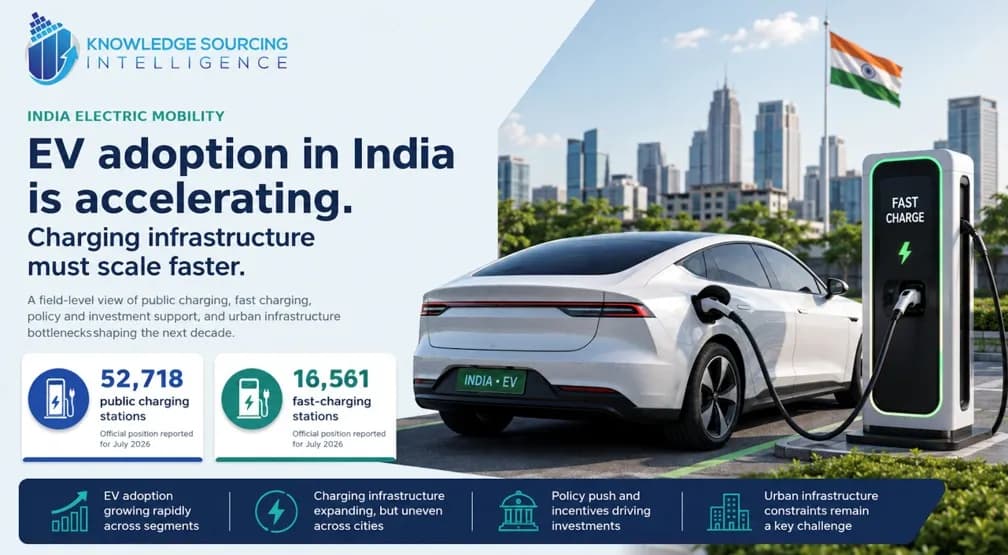
The reported numbers are encouraging, but they do not yet present a satisfactory charging experience. India has moved from a small EV base to more than two million annual sales, while the public charging network has expanded eightfold since early 2023. The next phase is less about proving demand and more about ensuring EV charging infrastructure is reliable where people actually park: apartment compounds, workplaces, markets, and highway stops.
EV sales have outpaced charging infrastructure
India’s electric-vehicle transition is no longer confined to demonstration fleets or premium passenger cars. Official figures put EV sales at about 2.08 million units in 2024 and roughly 2.30 million in 2025, compared with only around 50,000 in 2016. That rise has been led by electric scooters, motorcycles, three-wheelers, delivery fleets and a growing number of Public and Private transport buses.
That composition of electric vehicles also matters in determining the penetration of charging infrastructure. A delivery rider may charge a removable or compact battery near a depot, while an e-rickshaw can depend on a neighborhood charging point. Also, a private car may spend the night in a basement without a dedicated socket, and a bus operator needs scheduled high-power charging and enough electrical capacity to avoid disrupting service. Treating all of these vehicles as one charging market produces impressive national totals but weak local planning.
The practical test is therefore not whether India can sell more electric vehicles, but whether the places in which those vehicles spend time can supply electricity safely and predictably at a price that keeps the operating case attractive. Charging equipment is only one part of that system, with parking rights, distribution capacity, software, maintenance, access hours and payment playing equally important roles.

EV sales milestones illustrate the change in market scale; the figures are rounded official totals rather than a complete annual series.
A larger charging network, but not yet a uniformly usable one
India reported 52,718 public charging stations in July 2026, including 16,561 facilities equipped with fast chargers for cars. The expansion is substantial: the national count stood at 6,586 in March 2023, 12,146 in February 2024 and 29,151 in December 2025. This demand has been contributed due to private investments, OMC sites, favorable government policies, and surging demand from fleet operators.
However, the number of stations do not define daily charging capacity. One site may offer several connectors while another has a single outlet. A charger can appear on an app but be inaccessible behind a gate, occupied by a non-EV, out of service, restricted to a fleet or incompatible with the arriving vehicle.
The coverage also remains uneven, as large states, metropolitan areas and important highway corridors attract more capital because utilization is more predictable. Smaller cities and urban districts can be left with long gaps or isolated installations. Even inside major cities, a driver may find several chargers in one commercial cluster and almost none near dense residential neighborhoods.
The quality gap is now becoming more visible than the quantity gap. Operators that keep chargers online, publish accurate status information, maintain lighting and security, and resolve payment failures are preferred more, while poorly maintained sites will continue to remain underutilized despite occupying prime locations.

Public charging deployment has accelerated, while access, uptime and local approvals remain the principal urban delivery risks.
What the national charging figures do and do not show
Indicator | Latest position | What it confirms | What still needs checking |
Public charging stations | 52,718 (Jul 2026) | The network has expanded rapidly | Ports per site, access hours and uptime |
Fast-charging facilities | 16,561 (Jul 2026) | Coverage for cars and corridor travel is growing | Grid capacity, tariff and utilisation |
PM E-DRIVE charging allocation | Rs. 2,000 crore | Public support has moved from pilots to scale | Local execution and maintenance |
Urban readiness | Uneven | Some cities have established clusters | Apartment access, parking and approvals |
Fast charging is important, but it cannot carry the whole system
DC fast charging receives the most attention because it resembles the speed and convenience expected at a fuel station. It is essential for taxis, inter-city travel, commercial fleets and drivers who cannot charge at home. It is also the most demanding form of infrastructure as equipment costs are higher, electrical connections can be slower to secure, and peak demand can make operating economics difficult when utilisation is still low.
Slow and medium-speed charging are better suited to places where vehicles naturally remain parked. Apartment buildings, offices, hotels, shopping areas and public car parks can provide energy over several hours with lower equipment and grid costs.
India’s standards framework recognises several AC and DC formats. CHAdeMO remains relevant for parts of the existing vehicle fleet and for legacy installations, but its strategic role is narrowing as newer passenger-car platforms increasingly use CCS2. Operators still need to support vehicles already on the road; abrupt removal would make otherwise serviceable vehicles harder to use. At the same time, installing large numbers of new single-standard CHAdeMO chargers would risk low future utilisation. Hence, multi-standard locations, selective retention and connector upgrades offer a more sensible transition.
The Government Policy support is broad but relies excessively on local execution
India now supports the EV transition on several fronts. PM E-DRIVE carries an outlay of Rs. 10,900 crore and includes RS. 2,000 crore for charging infrastructure. The programme proposes support for charging points for electric two-wheelers, three-wheelers, cars and buses, with priority locations including cities, highways, transport nodes, fuel outlets and public parking areas. FAME-II provided the earlier demand and infrastructure base, including RS. 912.5 crore allocated for public charging.
Industrial policy is strengthening the supply side of the demand. The Production Linked Incentive scheme for automobiles and auto components has an outlay of Rs. 25,938 crore, while the Advanced Chemistry Cell battery programme is intended to build domestic manufacturing capacity. Lower GST on electric vehicles and charging equipment, state incentives and public-transport procurement have helped make the sector more profitable.
The remaining barriers are often outside the scope of a central incentive. A municipal corporation controls parking concessions and roadside space. A distribution company processes the electrical connection and determines whether a transformer upgrade is required. A housing association decides whether a resident can route a cable from a meter to a bay. In addition, fire authorities, building departments and landowners influence approval timelines, and in turn determining the certainty of the charging station infrastructure.
This is why the next policy gains are likely to come from routine administrative changes rather than another headline subsidy alone. These include standard application forms, approval times, common technical drawings, clear fire-safety rules, transparent parking contracts and enforceable service-level obligations.
Policy and investment architecture
Programme | Financial scale | Primary role | Charging relevance |
PM E-DRIVE | Rs. 10,900 crore | Vehicle incentives, buses and charging | Rs. 2,000 crore dedicated to charging infrastructure |
FAME-II | Rs. 11,500 crore total support | Earlier demand and infrastructure platform | Rs. 912.5 crore allocated for public charging |
PLI-Auto | Rs. 25,938 crore | Domestic advanced automotive manufacturing | Supports EV and power-electronics supply chains |
PLI-ACC | Rs. 18,100 crore | Advanced battery-cell manufacturing | Improves local battery ecosystem and supply security |
Why adoption still feels slower than the ambition
For many households, the decisive obstacle is not the vehicle but the absence of an assigned place to charge it. Indian cities contain large numbers of older apartments, rented homes, mixed-use buildings and informal parking arrangements. Residents may park on the street or in a rotating bay. Extending a private cable can create safety concerns, metering disputes and objections from neighbours. Public charging does not fully solve this problem when the nearest station requires a separate trip and an uncertain wait.
Land economics add another constraint. A charger needs a bay that remains available while energy is delivered. In busy commercial areas, the same space can generate higher and more predictable revenue through conventional parking. Footpaths, service lanes and public land are already contested. Without clear enforcement, charging bays are occupied by non-EVs or used as long-term parking, reducing throughput and frustrating drivers.
The business case can be fragile in the early years. Fast-charging operators pay for equipment, civil works, power connections, software, maintenance, rent and customer support before demand reaches a stable level. Low utilisation pushes up the cost per session; high tariffs then discourage use. Fleet contracts can provide a dependable base load, but they may not translate into a broad public network in residential areas.
Vehicle-level concerns have not disappeared either. Buyers compare purchase price, financing, real-world range, battery warranty, resale value and access to service. Smaller-city customers may have fewer trained technicians and less confidence in public charging availability. Seasonal heat, monsoon exposure and inconsistent maintenance can amplify doubts about reliability even when the underlying technology is improving.
Municipal capacity is perhaps the least discussed factor. Many urban bodies do not yet have teams dedicated to electric mobility. Charging is divided across parking, engineering, electricity, transport, estate and fire-safety functions. Projects slow down when no single office owns the outcome.
What should improve between now and 2036
Over the next few years, India’s charging network should become noticeably denser as PM E-DRIVE projects, oil-company sites, highway facilities, fleet depots and private charging networks add more locations. Longer vehicle range will also improve the practical usefulness of the network by giving drivers more flexibility. However, the value of this expansion will depend on whether operators can keep chargers working, accurate availability, simplified payment systems, and maintain safe and accessible sites. A large installed base will mean little if chargers are frequently offline, blocked, difficult to locate or tied to separate apps and wallets. By the end of the decade, reliability may matter more than the number of pins shown on a network map, with better operators differentiating themselves through transparent tariffs, responsive support, interoperable payments and consistent uptime.
A larger share of charging will also have to move into homes, offices and public parking facilities. New residential and commercial buildings can be designed with spare electrical capacity, conduit routes, load management and charging-ready bays, while older buildings will need workable rules for common meters, resident billing and shared parking. Municipal corporations can support this shift by opening public car parks, metro stations, markets and transport terminals through concessions and enforcement against non-EV vehicles occupying charging spaces. Fast chargers will support corridors, fleets and drivers without private parking, and battery swapping will remain relevant for some high-use two- and three-wheelers. The objective is to place the right charging option for drivers where vehicles are parked most of the time.
A city-level charging playbook
Cities do not need to begin with an expensive universal network. They can start by mapping where vehicles already dwell and where the electrical system can support additional load. Apartment clusters, office districts, markets, hospitals, railway stations, metro parking, bus terminals and freight nodes each present different dwell times and vehicle mixes. Matching charger power to those patterns prevents costly fast chargers from being installed where a lower-power unit would provide more useful energy over the day.
The first practical step is to combine parking and power data. Municipalities know the location and contractual status of public parking, while distribution companies know feeder constraints and planned upgrades. A joint map can identify sites that are both accessible and electrically feasible. Tenders can then specify the number of bays, operating hours, minimum uptime, payment methods, lighting, security and the treatment of vehicles that remain parked after charging is complete.
Residential charging needs a separate process. Model rules should allow a resident with an assigned bay to obtain a metered connection or use a managed common supply, subject to safety checks and transparent cost sharing. Housing societies should not have to design the arrangement from scratch. Standard diagrams, approved equipment lists and a defined response period can turn a recurring dispute into a routine building service. For older colonies without private bays, neighbourhood charging zones can be placed at community centres, local markets or municipal lots.
Finally, city authorities should publish performance rather than only installation figures. Useful indicators include charger uptime, successful sessions, average waiting time, energy delivered, complaints resolved and the share of bays blocked by non-charging vehicles. Public reporting makes it easier to distinguish a functioning network from an inventory of installed equipment. It also gives operators a commercial reason to maintain sites after the initial launch.
Conclusion: the next constraint is urban execution
India has already crossed the point at which electric mobility can be dismissed as a niche experiment. Sales have reached multi-million-unit scale, charging investment is rising and the policy framework now covers demand, manufacturing, batteries, public transport and infrastructure. The direction of travel is clear.
The difficult work is becoming more local and more operational. A charger must have a usable bay, sufficient electrical capacity, working software, visible pricing and someone accountable for maintenance. Apartment residents need permission and metering arrangements. Municipalities need consistent parking rules. Distribution companies need predictable connection procedures. These details decide whether an EV feels convenient after the purchase.
Over the next decade, progress should be judged less by the number of chargers announced and more by the number of dependable charging sessions delivered. India’s network will improve as buildings become charging-ready, municipal sites are tendered with service standards, payment becomes interoperable and charging formats are matched to actual vehicle use. The transition is likely to remain uneven, but the remaining barriers are increasingly identifiable and therefore solvable.
Explore More EV Reports: https://www.knowledge-sourcing.com/industry/automotive/electric-vehicles
Have questions?
More Thought Articles
How EV Charger Manufacturers Can Capitalize on India’s Home Charging Revolution
India’s residential EV charging opportunity is expanding as policy support, EV adoption, and private parking infrastructure develop. Manufacturers can capture value beyond AC chargers through installation, smart charging, load management, solar integration, software, and after-sales services. Housing societies, automakers, and property developers offer scalable routes to residential charging customers.
Second-Life EV Battery Market in India: What Is Driving Demand from Manufacturers?
India’s second-life EV battery market is gaining relevance as electric vehicle adoption expands and batteries retain useful capacity after automotive service. Growing stationary-storage demand, battery data, refurbishment capabilities, EPR obligations, and critical-mineral policies are encouraging manufacturers to extend battery value through reuse before eventual recycling within India’s emerging circular battery ecosystem.
The Rise of Locally Manufactured Battery Separators in India’s EV Ecosystem
India’s battery industry is progressing from pack assembly toward domestic cell and material manufacturing, creating opportunities for lithium-ion battery separators. Policy support, ACC capacity expansion and R&D initiatives are strengthening the ecosystem. However, technical complexity, manufacturing yields, qualification requirements and economics mean localisation will likely advance gradually through coatings, testing and finishing.