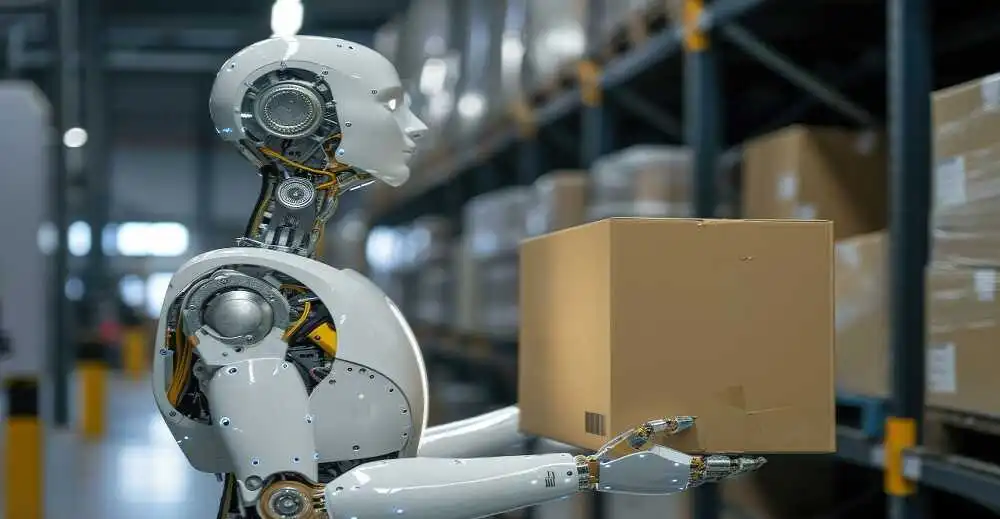
Material handling tasks require a significant amount of effort in the manufacturing industries. The desire for material handling products to lessen labour, save time, and lower expenses in this activity has noticeably increased as a result. In the past, conventional manipulation technologies have be...
- Autonomous vehicles & robots
- Computer vision
- Natural language processing
- Conversational interfaces
- Machine learning
- Supply chain management & improved customer experience
 Source: World Robotics 2023
2. Computer vision
Computer vision refers to the section of AI that interprets visual data from cameras. An example is that autonomous robots use computer vision to avoid collisions and recognize their environment while robot pickers use it to differentiate between different types of objects through sight.
Additional uses include automating quality control processes with visual inspection of the goods. This technology can be used to remove defective or damaged goods from shipments when paired with autonomous vehicles and robotic picking equipment. It also has the potential to be used in inventory management, where AI-powered visual assessments of shelves can log stock levels and availability.
3. Natural language processing
NLP technology is a component of what IBM refers to as "cognitive automation," which is the intelligent, autonomous management of back-office administrative tasks achieved through the combination of AI and robotic process automation (RPA) software.
Further, by automating documentation and paperwork-related tasks, natural language processing (NLP) enables computer systems to understand and utilize the "unstructured" data found in text documents. This is crucial for companies that handle shipments to and from various sources and must cross-reference massive amounts of paperwork because it means that documents like invoices and order forms can be processed and examined for anomalies in a matter of seconds.
4. Conversational interfaces
The ability of natural language processing and interpretation (NLP) technology to process spoken language also leads to the development of conversational interfaces. Conversational interfaces are being added to warehouse management systems to act as a point of contact between human workers and machines, much as our homes are becoming more and more equipped with voice-activated devices. Exchanges of information between humans and machines can become much richer and more natural, with commands not limited to a short list of keywords and automated systems capable of speaking comprehensive answers to inquiries instead of just producing data tables.
Moreover, executives are enthusiastic about the potential for increased efficiency with conversational interfaces, but employees are also open to the idea; 60% of workers said they could see themselves receiving assistance from a conversational robot coworker.
5. Machine learning
The technology that powers each of the aforementioned AI use cases is machine learning. Machine Learning is the area of artificial intelligence that optimizes and modifies automation's performance through the use of algorithms that can change and adapt their outputs over time based on interpreting patterns in data.
As a result, machine learning is what enables material handling in a warehouse to continuously recalculate the best route for navigation and picking orders to generate small but steady efficiency gains. By analyzing end-to-end system data, machine learning also makes it possible for picking robots, visual inspection devices, and document processing RPAs to not only identify anomalies rapidly but also independently ascertain their causes.
6. Supply chain & improved customer experience
Artificial intelligence (AI) could revolutionize supply chain management by optimizing several facets of the chain and providing real-time insight. By analyzing data from various sources such as suppliers, transportation links and markets, artificial intelligence (AI) algorithms can identify potential disruption and propose mitigation strategies. This means that organizations can manage risks better, respond faster to demand changes and achieve smooth inwards-outwards supply chains from the supplier down to the consumer level.
Further, AI additionally increases consumer satisfaction owing to efficient order execution [order processing]. For instance, with AI-powered chat-bots or virtual assistants, one can obtain fast customer responses regarding their inquiries about an item they purchased online including delivery dates etc., while these systems also provide constant updates on their order status as well. Artificial Intelligence improves client satisfaction levels through improved accuracy and enhanced efficacity in warehouse operations.
In conclusion, material handling systems comprise AI and robotics which bring about a revolution thereby increasing productivity, ensuring security and enabling on-time decision making. As these technologies develop, they will further improve the abilities of material handling systems making them more intelligent, adaptable and responsive to modern industrial needs. The future of material handling is based on incessant development of robotics and artificial intelligence (AI) with lots of room for creativity and very significant benefits.
Source: World Robotics 2023
2. Computer vision
Computer vision refers to the section of AI that interprets visual data from cameras. An example is that autonomous robots use computer vision to avoid collisions and recognize their environment while robot pickers use it to differentiate between different types of objects through sight.
Additional uses include automating quality control processes with visual inspection of the goods. This technology can be used to remove defective or damaged goods from shipments when paired with autonomous vehicles and robotic picking equipment. It also has the potential to be used in inventory management, where AI-powered visual assessments of shelves can log stock levels and availability.
3. Natural language processing
NLP technology is a component of what IBM refers to as "cognitive automation," which is the intelligent, autonomous management of back-office administrative tasks achieved through the combination of AI and robotic process automation (RPA) software.
Further, by automating documentation and paperwork-related tasks, natural language processing (NLP) enables computer systems to understand and utilize the "unstructured" data found in text documents. This is crucial for companies that handle shipments to and from various sources and must cross-reference massive amounts of paperwork because it means that documents like invoices and order forms can be processed and examined for anomalies in a matter of seconds.
4. Conversational interfaces
The ability of natural language processing and interpretation (NLP) technology to process spoken language also leads to the development of conversational interfaces. Conversational interfaces are being added to warehouse management systems to act as a point of contact between human workers and machines, much as our homes are becoming more and more equipped with voice-activated devices. Exchanges of information between humans and machines can become much richer and more natural, with commands not limited to a short list of keywords and automated systems capable of speaking comprehensive answers to inquiries instead of just producing data tables.
Moreover, executives are enthusiastic about the potential for increased efficiency with conversational interfaces, but employees are also open to the idea; 60% of workers said they could see themselves receiving assistance from a conversational robot coworker.
5. Machine learning
The technology that powers each of the aforementioned AI use cases is machine learning. Machine Learning is the area of artificial intelligence that optimizes and modifies automation's performance through the use of algorithms that can change and adapt their outputs over time based on interpreting patterns in data.
As a result, machine learning is what enables material handling in a warehouse to continuously recalculate the best route for navigation and picking orders to generate small but steady efficiency gains. By analyzing end-to-end system data, machine learning also makes it possible for picking robots, visual inspection devices, and document processing RPAs to not only identify anomalies rapidly but also independently ascertain their causes.
6. Supply chain & improved customer experience
Artificial intelligence (AI) could revolutionize supply chain management by optimizing several facets of the chain and providing real-time insight. By analyzing data from various sources such as suppliers, transportation links and markets, artificial intelligence (AI) algorithms can identify potential disruption and propose mitigation strategies. This means that organizations can manage risks better, respond faster to demand changes and achieve smooth inwards-outwards supply chains from the supplier down to the consumer level.
Further, AI additionally increases consumer satisfaction owing to efficient order execution [order processing]. For instance, with AI-powered chat-bots or virtual assistants, one can obtain fast customer responses regarding their inquiries about an item they purchased online including delivery dates etc., while these systems also provide constant updates on their order status as well. Artificial Intelligence improves client satisfaction levels through improved accuracy and enhanced efficacity in warehouse operations.
In conclusion, material handling systems comprise AI and robotics which bring about a revolution thereby increasing productivity, ensuring security and enabling on-time decision making. As these technologies develop, they will further improve the abilities of material handling systems making them more intelligent, adaptable and responsive to modern industrial needs. The future of material handling is based on incessant development of robotics and artificial intelligence (AI) with lots of room for creativity and very significant benefits.Have questions?
More Thought Articles
How EV Charger Manufacturers Can Capitalize on India’s Home Charging Revolution
India’s residential EV charging opportunity is expanding as policy support, EV adoption, and private parking infrastructure develop. Manufacturers can capture value beyond AC chargers through installation, smart charging, load management, solar integration, software, and after-sales services. Housing societies, automakers, and property developers offer scalable routes to residential charging customers.
Second-Life EV Battery Market in India: What Is Driving Demand from Manufacturers?
India’s second-life EV battery market is gaining relevance as electric vehicle adoption expands and batteries retain useful capacity after automotive service. Growing stationary-storage demand, battery data, refurbishment capabilities, EPR obligations, and critical-mineral policies are encouraging manufacturers to extend battery value through reuse before eventual recycling within India’s emerging circular battery ecosystem.
The Rise of Locally Manufactured Battery Separators in India’s EV Ecosystem
India’s battery industry is progressing from pack assembly toward domestic cell and material manufacturing, creating opportunities for lithium-ion battery separators. Policy support, ACC capacity expansion and R&D initiatives are strengthening the ecosystem. However, technical complexity, manufacturing yields, qualification requirements and economics mean localisation will likely advance gradually through coatings, testing and finishing.