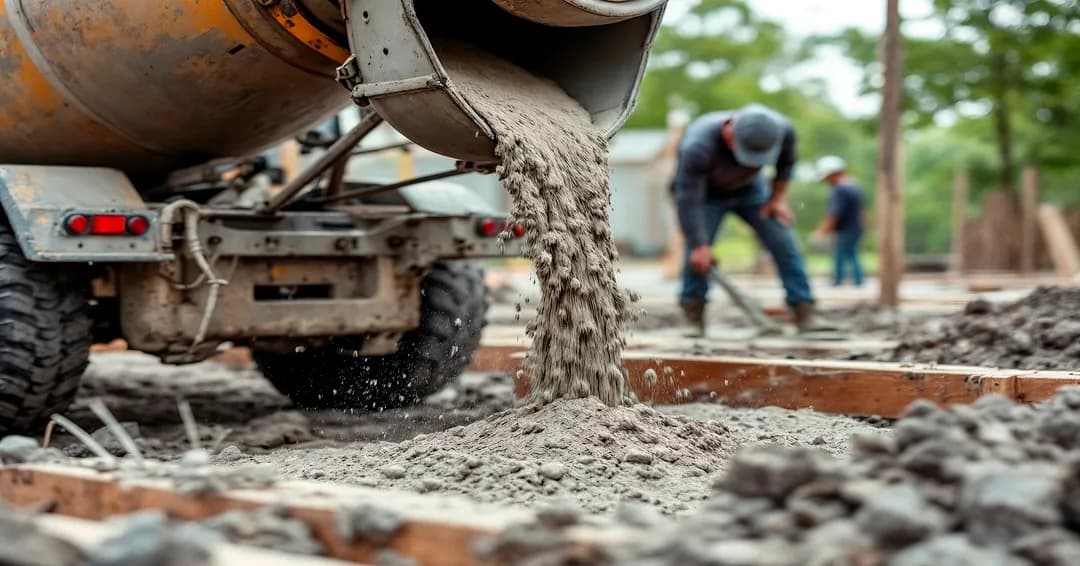
Concrete admixtures are becoming increasingly important as infrastructure development, urbanization, sustainability requirements, and high-performance concrete applications expand globally. The market is supported by government infrastructure programs, low-carbon construction, ready-mix and precast adoption, and advances in PCE superplasticizers, digital dosing, durability enhancement, and other technologies that improve concrete performance.
Introduction
Concrete admixtures, chemical additives used to modify the performance, workability, setting, strength, and durability of concrete, form one of the most critical segments within modern construction chemicals. With the growing construction activity in the world as a result of rapid urbanization, expansion of infrastructure, and the demand to design in a sustainable manner, admixtures are in demand like never before. The materials enable contractors and engineers to attain performance targets that would not have been attained in traditional concrete without sacrificing time, cost, or durability. The trend in the world towards high-performance and low-carbon concrete has enhanced the use of advanced admixture systems.
According to the Knowledge Sourcing Intelligence report, the Global Concrete Admixtures Market is expected to expand with a CAGR of 6.2% in the forecast period, starting with USD 24.7 billion in the year 2025, to USD 33.3 billion in 2031.
Simultaneously, governments across the globe have initiated large-scale infrastructure and resilience efforts such as the U.S. Infrastructure Investment and Jobs Act (IIJA), the National Infrastructure Pipeline (NIP) in India, the EU Green Deal, and the Belt and Road Initiative (BRI) in China. Such programs not only raise the total concrete consumption, but also provide higher performance and environmental requirements, and consequently directly affect the admixture technologies selected to be implemented at large scale. Suppliers of admixtures with strong product lines, a powerful regional base, and rigorous R&D streams are thus taking centre stage in the global construction strategy. The article discusses the major worldwide manufacturers of concrete admixtures, their market leaders, the government and economic pressures influencing the market, and future trends that will provide the demand in the next ten years.
Global Market Dynamics and Demand Drivers
The global concrete admixtures market is expanding steadily due to multiple structural drivers:
Urbanization and Infrastructure Modernization
High rates of economic growth in Asia, the Middle East, and Africa have resulted in high demand for roadways, bridges, tunnels, urban railways, airports, and houses. Such projects are usually associated with concrete mixes that are high in advanced concrete mixes that can be transported over long distances, have high early strength, and are resistant to adverse environmental conditions. Ready-mix and precast concrete systems are among the applications that cannot be done without admixtures, and governments tend to favor them more.
For instance, the data from Global Infrastructure Outlook, a G20 initiative, reported that the forecasted global investment in infrastructure is $3 trillion in 2026, which is expected to grow to $3.4 trillion by 2032 and $3.8 trillion by 2040. Moreover, the estimated investment required by 2030 is predicted to be $3.9 trillion, and $4.6 trillion by 2040 globally. Moreover, the U.S. Census Bureau reported that the country's total construction spending was USD 2,139,110 million in July 2025, which included total private investment of USD 1,623,269 million and total public investment of USD 515,842 million.
Similarly, China remains the largest construction market globally, with a forecasted value of around USD 4.82 trillion in 2025, according to the International Trade Administration (ITA). Concrete admixtures can optimize the performance of concrete while reducing material waste. This not only lowers costs but also accelerates construction timelines. As a result, they are critical in meeting the global demand for resilient and eco-friendly built environments.
Sustainability and Low-Carbon Construction
With the growing intensity of climate obligations, the need to mitigate the carbon intensity of concrete, which is mainly due to cement, has become a requirement all over the world. Admixtures also allow replacement of cement with supplemental cementitious materials (SCMs) like fly ash, slag, or calcined clays, without compromising or reducing performance. This greatly reduces embodied carbon in concrete mixes.
Green and hardy building is also becoming a trend, leading to the need to use water-saving admixtures, as well as energy-conserving ones. In addition, government investment in the modernization of infrastructure and other aging structures provides impetus to the use of admixtures throughout the industry. For example, the Joint Centre for Housing Studies of Harvard University (JCHS) published a report in March 2023, under the title Improving America Housing 2023, which stipulated that the US remodelling industry was developing at an alarming pace, and in 2022, an investment of USD 567 billion had been made in remodelling old houses. Therefore, this increased investment in the building and renovation business of the United States is expected to drive the market in the next few years.
Shift Toward High-Performance Concrete
There is a growing demand for self-compacting concrete (SCC), ultra-high-performance concrete (UHPC), and high-strength grades (M60 and above). It requires infrastructure work with strict tolerances, low vibration, better pumpability, and less shrinkage and cracking, which are all achieved better by contemporary superplasticizers, viscosity modifiers, and shrinkage suppressors. Superplasticizers based on polycarboxylate ether (PCE) are preferred because they have excellent dispersion and slump retention properties.
Expanding Ready-Mix and Precast Industries
Radical shift to ready-mix concrete, gradual replacement of site-mixed concrete, and the increased importance of precast construction are significant demands. The two industries are highly dependent on admixtures to maintain uniform quality and high turnover. Automated dosing equipment suppliers, plant-level digital controls, and mix-optimization assistance are emerging as preferred suppliers for larger RMC and precast operators.
Government Initiatives Accelerating Demand
United States - Infrastructure Investment and Jobs Act (IIJA)
The U.S. Infrastructure Investment and Jobs Act (IIJA), which was signed into law in November 2021, to date continues to support the demand for concrete, concrete admixtures, and higher-performance concrete technologies with their large scale investments in roads, bridges, rail, water, energy, as well as other infrastructure. Under this act, the legislation authorized approximately USD$ 1.2 trillion in infrastructure spending, which further includes about US$ 550 billion in federal investments.
The impact of IIJA has witnessed an increasing shift from authorization towards project execution. According to the U.S. Department of Transportation, as of June 30, 2026, approximately US$545.7 billion in adjusted IIJA funding was available across DOT programs, of which US$510.8 billion had been announced as grants, US$402.3 billion had been obligated, and US$244.7 billion had been outlayed. These changes indicate that a substantial portion of infrastructure funding is now translating into active project development and construction activity.
One more major source of demand is bridge rehabilitation and replacement. The IIJA-established Bridge Formula Program provided US$5.5 billion annually in FY2022–FY2026, supporting the replacement, rehabilitation, preservation, protection, and construction of highway bridges. These projects have played an important role in favoring concrete formulation designs for durability, freeze-thaw resistance, corrosion protection, and even an extended service life.
India - National Infrastructure Pipeline (NIP) & PM Gati Shakti
India’s NIP outlines thousands of projects across transportation, logistics, water systems, energy, and housing. PM Gati Shakti integrates digital planning to accelerate implementation, requiring enormous volumes of concrete, particularly for expressways, metro expansions, freight corridors, ports, and industrial parks. In the same way, the Indian Ministry of Statistics and Programme Implementation reported that by 2030 there will be 40 percent of India's population in India population being urbanized, and this will also contribute significantly to the GDP of the country. Nevertheless, high rates of urbanization create a problem in terms of infrastructure development and service provision. Smart Cities Mission: one of the major projects of the country, which attempts to overcome these issues effectively, is the completion of which is 91 percent complete, and investment amounts to approximately 1.47 Lakh Crore as of December 2024. As a result, growing residential housing requirements will be closely correlated with increasing acceptance and product innovation in concrete admixtures, which represents their critical role in the current construction process.
European Union - Green Deal & Renovation Wave
The EU Green Deal requires new regulations to cut the emissions of buildings by a significant margin, and therefore, its Renovation Wave initiative focuses on energy and structural renovations of millions of buildings. Embodied carbon metrics are now being integrated into the public procurement guidelines, promoting the use of low-carbon concrete, which is provided by admixtures that enhance SCM compatibility. Durability-focused admixtures, corrosion inhibitors, and shrinkage-reducing solutions play key roles in extending the service life of rehabilitated structures under EU renovation programs. Housing units are anticipated to rise in the market, and this may, in turn, increase the need for concrete admixtures. These are important in enhancing concrete characteristics such as workability, durability, and strength, which are essential to meet the new dynamism of construction projects. For instance, Homes England started 11,530 housing units in England outside of London between April 1 and September 30, 2023, for all programs except GLA (Greater London Authority) programs, whereas housing completion stood at 11,297. Furthermore, the Housing Finance Directorate General of the Ministry of Public Works and Public Dwelling apprehends that based on the calculation of population growth, Indonesia is forecast to need 30 million dwelling units in 2025.
China - Belt and Road Initiative (BRI)
The majority of the infrastructure projects by the BRI, including ports, highways, rail, and power plants, are yet to be opened, creating a massive demand for high-performance concrete technologies. These projects have varying geographical sites and environmental conditions, and admixtures are needed to accommodate the workability, durability, and slump sustainability of the mixture to be transported over long distances. In agreement with this, one of the highest rates of urbanization is witnessed in China. As per the American Institute of Architects (AIA Shanghai, the projects that will be built by the year 2025 will be one hundred times the size of New York-sized cities in China. As per China’s 14th Five-Year Plan, the Ministry of Housing and Urban-Rural Development (MOHURD has announced plans to implement urban renewal measures by 2020. Even though the urbanization level of China stands at 66 percent in 2024, the government is in the process of developing its urban regeneration plan, including the Smart City initiative of the Ministry of Housing and Urban-Rural Development (MOHURD), to ensure that the cities become green and efficient in its endeavor to enhance the living standards in the cities.
Middle East Mega-Projects
Middle Eastern countries that continue to invest in large-scale construction that requires the utilization of highly sophisticated admixtures to resist the impact of excessive heat, hostile soils, saline environments, and rapid project schedules include Saudi Arabia (NEOM, Red Sea Project), UAE, and Qatar.
4. Leading Global Concrete Admixture Suppliers and Their Flagship Products
The section provides an overview of the key players in the world who dominate the admixture market with their product lines, technological advancements, and strengths.
Company Name | Competitive Positioning | Geographical Presence |
Sika AG | Strong global construction-chemicals supplier with significant exposure to concrete admixtures | Extensive global manufacturing network across the Americas, Europe, Middle East, Africa, and Asia-Pacific |
MAPEI | Diversified construction-chemicals supplier with strong integration across building-material applications | 96 subsidiaries in 57 countries and 93 manufacturing plants in 36 countries |
Master Builder Solutions | Specialist construction-solutions supplier with strong concrete-admixture and technical-service capabilities | 47 production sites worldwide |
Sika AG (Switzerland)
Sika’s competitive advantage is linked with its geographic localization as well as its manufacturing proximity. The company has focused on expanding regional manufacturing rather than relying solely on centralized production. For instance, in 2025, Sika launched three new manufacturing investments in China, Brazil, and Morocco with the aim of reinforcing its commitment to serving customers with local production, global expertise, and sustainable innovation.
Flagship Products:
Sika® ViscoCrete — superplasticizers made using PCE, which offer high water reduction, enhanced flow, and extended slump life.
Sika® Retarder / Plastiment — set-controlling admixtures to suit hot climates and long -haul transportation.
SikaControl® — these are durable industrial floor admixtures that reduce shrinkage.
SikaRapid® — precast and fast-track construction accelerators.
Strengths and Strategy: The global presence of Sika in its manufacturing portfolio, technical services centres, and investment in research and development are what make it the best option among ready-mix and precast manufacturers. Its local product policy helps it with quick delivery and tailor-made formulations.
MAPEI (Italy)
MAPEI is regarded as competing through a broad construction-chemical portfolio along with a large international manufacturing network. The company’s concrete-admixture portfolio is supported by products that address different concrete performance requirements, while its broader product portfolio enables the company to cross-sell admixtures with mortars, waterproofing, adhesives, and other construction solutions. The company's 2025 investment in a 30,000-m² Egyptian plant further demonstrates its strategy of localizing production close to construction markets.
Flagship Products:
MAPEFLUID® R104, N200: A high-range water reducer and retarder in ready-mix and precast.
MAPECURE®: curing products enhancing strength development.
Strengths and Strategy: MAPEI incorporates admixtures with adhesives, grouts, and mortars, which is appealing to those contractors who need multi-material solutions to work together. It invests in local labs, which increases testing on cement compatibility.
Fosroc (UK)
Fosroc is a British-heritage construction chemicals company with a particularly strong geographic position in India, the Middle East and Asia-Pacific. The company has an extensive network of offices and manufacturing locations across Europe, Africa, the Middle East, India, and North, South and East Asia, giving it a strong localized supply and technical-support footprint.
Additionally, Fosroc has a broad concrete-admixture portfolio covering superplasticizers, plasticizers, accelerators, corrosion inhibitors, viscosity-modifying admixtures, and integral waterproofing admixtures.
Flagship Products:
Conplast SP430, SP435: Popular HRWRs in infrastructure applications.
AURA® series: Auxiliary, high-performance concrete superplasticizers.
STRUCTURO®: Admixtures- precast strength-enhancing solutions.
Strengths and Strategy: Fosroc has been known to be very popular in the Middle East, India, and Southeast Asia because of its experience in extreme climatic conditions, waterproofing integration, and bespoke technical service.
GCP Applied Technologies (USA)
GCP Applied Technologies brings significant global expertise in concrete admixtures, cement additives, and infrastructure-related construction chemicals. Before its acquisition by Saint-Gobain, GCP generated approximately US$1 billion in revenue in 2021, employed around 1,800 people and operated 50 production sites across 38 countries.
Flagship Products:
ADVA® 405, ADVA® 845, ADVA Cast®: PCE super-plasticizers in SCC and precasts segments.
DARACCEL®: Accelerators improving early strength.
Darex® Air: Air-entraining systems that increase freeze-thaw lifespan.
Strengths and Strategy: GCP possesses good experience in high-Performance concrete in bridges, tunnels, precast buildings, and architectural works.
Chryso (Saint-Gobain Group)
Chryso is a major construction-chemicals brand specializing in concrete admixtures, cement additives, and solutions designed to improve concrete performance and support decarbonization.
Flagship Products:
CHRYSO®Quad: Sand-conditioning admixtures, variable quality of aggregate.
CHRYSO®Optima: High-performance mixes of the next generation.
Specialized finishing and durability enhancers.
Strengths and Strategy: Chryso has the advantages of vertical integration in the Saint-Gobain ecosystem, which provides bundled solutions of concrete, mortars, and finishing materials.
5. Technology Trends in Admixture Innovation
Next-Generation PCE Superplasticizers
Admixtures based on PCE have modernized and given a chance to control the molecular architecture in order to maximize slump retention, viscosity, and cement compatibility. To make PCE system dosing simpler, suppliers are also coming up with multifunctional devices.
Low-Carbon Concrete Solutions
There is a demand for admixtures to allow SCM-rich mixes (40-60% replacement). Customized retarders, accelerators, and dispensers assist in adapting to slower hydration and irregular quality of SCMs.
Digital Dosing & Automated Quality Control
Suppliers are now providing smart dosing systems, real-time predictive slump devices, and cloud-based mix control applications on the cloud to provide uniformity to the batching facilities.
Durability Enhancement
Guidelines are being applied to bridges, coastal structures, and wastewater plants with corrosion inhibitors, permeability reducers, shrinkage controllers, and rheology modifiers.
Market Challenges
Raw Material Price Volatility
Ethylene oxide derivatives, polymers, and surfactants are admixing components that are susceptible to changes in the price of petrochemicals. These include price volatility from suppliers and project costs.
Rising Regulatory Scrutiny
Antitrust scrutiny of the admixture industry in the large markets has resulted in stricter compliance, legal regulations, and cost changes.
Regional Cement Variability
The admixture performance is also influenced by different clinker chemistries, levels of fineness, and proportions of SCM, and this necessitates extensive R&D and regional laboratory testing.
Workforce Skill Gaps
Trained admixture operators and quality engineers are needed to effectively use admixtures. Adequacy of skills in developing markets may decrease the efficiency of admixtures.
Procurement Strategies and Best Practices
Organizations engaged in large-scale construction are increasingly adopting advanced procurement strategies:
Performance-Based Specifications
Specifying target properties, slump retention, strength gain, and rheology, rather than prescriptive admixture types, allows suppliers to innovate and optimize mixes.
Multi-Supplier Models
To minimize supply risk and price volatility, many contractors maintain secondary suppliers for non-critical admixtures.
Mandatory Field Trials
Preconstruction trials ensure compatibility with local materials and climatic conditions. Suppliers with robust technical teams provide on-site support.
Sustainability Scoring in Bids
Public-sector projects increasingly evaluate bidders based on embodied carbon, durability, and lifecycle performance, favoring suppliers with strong sustainability data.
Future Outlook
Over the next decade, admixture demand will be shaped by:
Aggressive Global Infrastructure Programs
Government spending in India, the U.S., Europe, China, and emerging economies will continue to drive demand. Admixture use per cubic meter of concrete will increase as specifications shift toward performance- and durability-based criteria.
Low-Carbon Transition
Admixtures will be central to next-generation concretes using calcined clays, limestone calcined clay cement (LC3), geopolymer binders, or carbon-cured concrete.
Integration with Digital Construction
Digital twins, automated batching, and real-time monitoring will rely on admixtures with predictable rheology.
Consolidation of Suppliers
M&A activity will likely continue as global players seek to expand geographic presence and product portfolios.
Conclusion
Concrete admixtures cease to be an option but rather a necessary part of new infrastructure, city building, and sustainable construction. The industry is moving ahead through sophisticated chemistry, regional technical service, and integrated solutions, led by giants in the supply business, Sika, Master Builders Solutions, MAPEI, Fosroc, GCP Applied Technologies, Chryso, and local powerhouses such as CICO. Governmental programs like U.S. IIJA, NIP and Gati Shakti (India), the EU Green Deal, and BRI (China) have increased the demand for high-performance concretes, which are not achievable without state-of-the-art admixtures. With increasing performance demands and a more sustainable setting, sustainability has become an undeniable goal; admixture technologies will continue to become more complex, more critical, and more strategic to contractors, ready-mix manufacturers, and public agencies across the world. Suppliers who manage to integrate innovation, sustainability, compliance, and regional responsiveness will mark the next chapter in concrete construction in this changing environment.
Explore More Reports:
Have questions?
More Thought Articles
From Data Centers to EV Charging: Where Low-Voltage DC Distribution Is Making an Impact
Low-voltage DC distribution is gaining relevance as AI data centers, EV charging hubs, solar systems, and battery storage increase demand for efficient power architectures. The article examines 800 VDC standardization, conversion losses, protection challenges, and greenfield opportunities, highlighting why hybrid AC/DC systems could become increasingly important across high-power infrastructure applications.
How EV Charger Manufacturers Can Capitalize on India’s Home Charging Revolution
India’s residential EV charging opportunity is expanding as policy support, EV adoption, and private parking infrastructure develop. Manufacturers can capture value beyond AC chargers through installation, smart charging, load management, solar integration, software, and after-sales services. Housing societies, automakers, and property developers offer scalable routes to residential charging customers.
Second-Life EV Battery Market in India: What Is Driving Demand from Manufacturers?
India’s second-life EV battery market is gaining relevance as electric vehicle adoption expands and batteries retain useful capacity after automotive service. Growing stationary-storage demand, battery data, refurbishment capabilities, EPR obligations, and critical-mineral policies are encouraging manufacturers to extend battery value through reuse before eventual recycling within India’s emerging circular battery ecosystem.