
Travel Management Software Travel Management is an application that helps businesses manage bookings, and track and analyse the company’s travel processes. It simplifies travel management, further saving time and money for the company. Some of the various features that are includ...
- Business Intelligence: empowers the company with timely business information, helping the company control overall spending.
- Service Administration: delegates system oversight by controlling day-to-day service maintenance, implementing new service features, employee updates, and many others.
- Expense Report Auditing: allows the company to enforce policies, cut excessive business costs, and catch misuse, all while saving time.
- Invoice Management: automates the process of collecting, tracking, submitting, and paying supplier invoices and cheque requests.
- User Support Desk: provides reliable user support 24x7.
- Locate and Alert: allows the company to keep in touch with the employees while they are in the process of travelling by communicating with them during any urgent situations, no matter where the employees are.
- Salesforce Integration: integrated Salesforce into Concur, further providing visibility and ease of use.
- Slow and Steady Recovery: as per the Q3 earnings of Delta Airless in 2023, strong travel demand continued to increase during the summer, with the major players being international travel and business travel. American Express also has stated the increase in business travel, events and meetings.
- Small and medium-sized companies drive the growth of business travel: various small and medium-scale enterprises continue to drive transient business recovery and have increased focus on business travel. This provided an opportunity for various companies to evolve their products to cater to the needs of these small and medium-scale businesses.
- Return to office boost: several corporations have stated an increase in the number of workers returning to the office, specifically in the urban areas, boosting the demand for business travel in the companies.
- Business leisure growth: an estimated 46% of the global employees have displayed an interest in travelling for business in 2024, which includes more than a third of GenZ and millennial business travellers who plan to have an extended business trip to enjoy their leisure activities after or before their work obligations of the company.
- Flexible work management: many business travellers have opted to maximise their time on the road by implementing opportunities for work, friends, family, and leisure, further boosting the demand for extended-stay hotels due to the blended travel trend. Hilton has stated an increase of 15% compared to 2019 in business travellers.
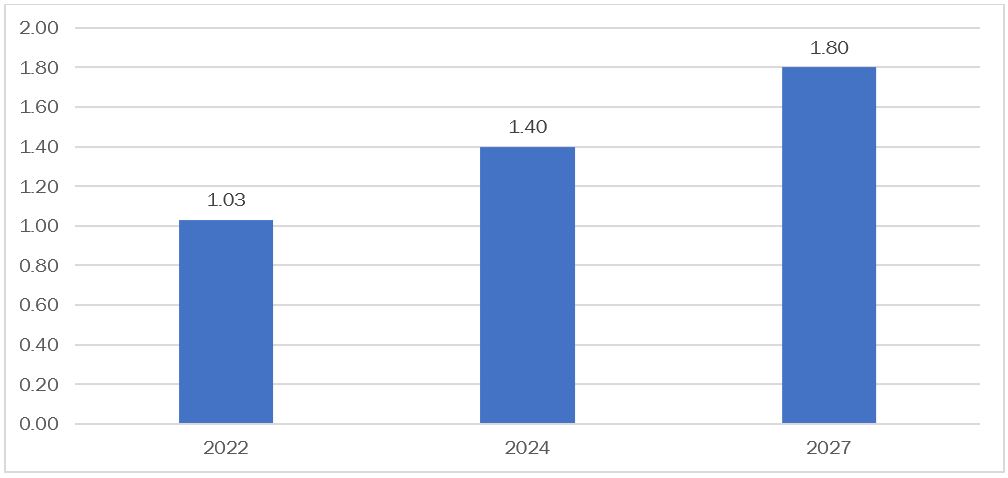 Source: Global Business Travel Association
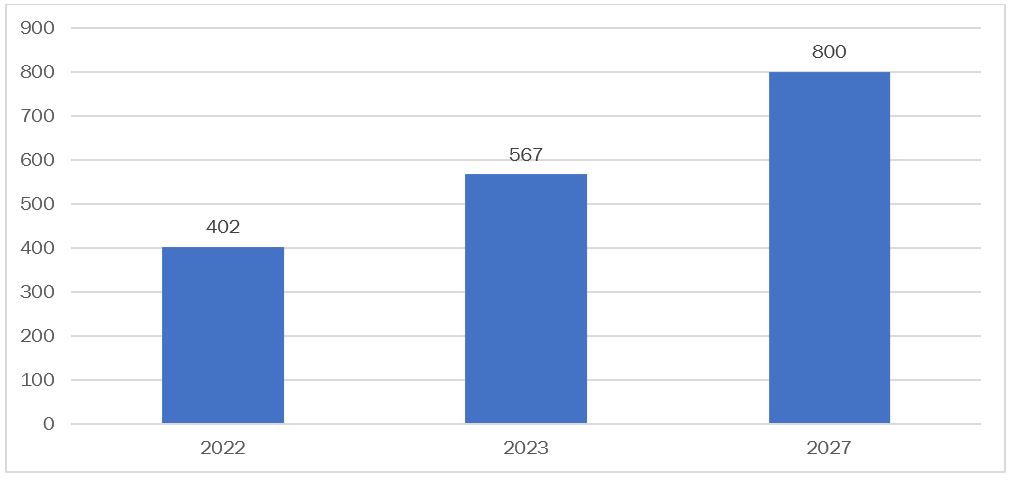
Furthermore, the Asia Pacific region is expected to witness significant growth in the upcoming years. Some of the major players include Japan, South Korea, Australia, Singapore, Hong Kong, and Malaysia. As per the Global Business Travel Association, regional travel spending accounted for an increase of 41% in 2023, accounting for an estimated US$567 billion, and is expected to increase to reach $800 billion by 2027. It has also been stated that the regional business travel spending in 2023 was expected to reach 92% of the travel spending of 2019, which accounts for an estimated $616 billion. The Asia Pacific region also accounts for 39% of the global total business travel spending, which accounts for an estimated $402 billion in 2022.
Figure 2: Increase in Business Travel Spendings, in USD Trillions, Asia Pacific, 2022 to 2027
 Source: Global Business Travel Association
Key Developments:
October 2023: Citi announced the launch of the first complete travel and expense system for Citi Commercial Bank Clients in collaboration with Navan, a leading modern travel and expense management solution. This solution allows integration of the innovative card link technology of Navan Connect, further creating a seamless digital experience for Citi Commercial Bank cardholders. The system was announced to be only available to US-based Citi Commercial Bank clients, due to the solution being their first complete end-to-end corporate Travel and Expense (T&E) management collaboration of this scale.
February 2022: Coupa Software announced the release of their Travel & Expense (T&E) management solution dubbed Coupa Travel & Expense. This solution consists of seamless travel booking, unified expense management, live on-the-road traveller support, and a complete integrated mobile application, further optimizing real-time travel spending and enhancing the traveller experience.
Find some of our related studies:
- Travel Retail Market: https://www.knowledge-sourcing.com/report/travel-retail-market
- Global Travel Insurance Market: https://www.knowledge-sourcing.com/report/global-travel-insurance-market
- Online Travel Market: https://www.knowledge-sourcing.com/report/online-travel-market
Have questions?
More Thought Articles
From Data Centers to EV Charging: Where Low-Voltage DC Distribution Is Making an Impact
Low-voltage DC distribution is gaining relevance as AI data centers, EV charging hubs, solar systems, and battery storage increase demand for efficient power architectures. The article examines 800 VDC standardization, conversion losses, protection challenges, and greenfield opportunities, highlighting why hybrid AC/DC systems could become increasingly important across high-power infrastructure applications.
How EV Charger Manufacturers Can Capitalize on India’s Home Charging Revolution
India’s residential EV charging opportunity is expanding as policy support, EV adoption, and private parking infrastructure develop. Manufacturers can capture value beyond AC chargers through installation, smart charging, load management, solar integration, software, and after-sales services. Housing societies, automakers, and property developers offer scalable routes to residential charging customers.
Second-Life EV Battery Market in India: What Is Driving Demand from Manufacturers?
India’s second-life EV battery market is gaining relevance as electric vehicle adoption expands and batteries retain useful capacity after automotive service. Growing stationary-storage demand, battery data, refurbishment capabilities, EPR obligations, and critical-mineral policies are encouraging manufacturers to extend battery value through reuse before eventual recycling within India’s emerging circular battery ecosystem.