
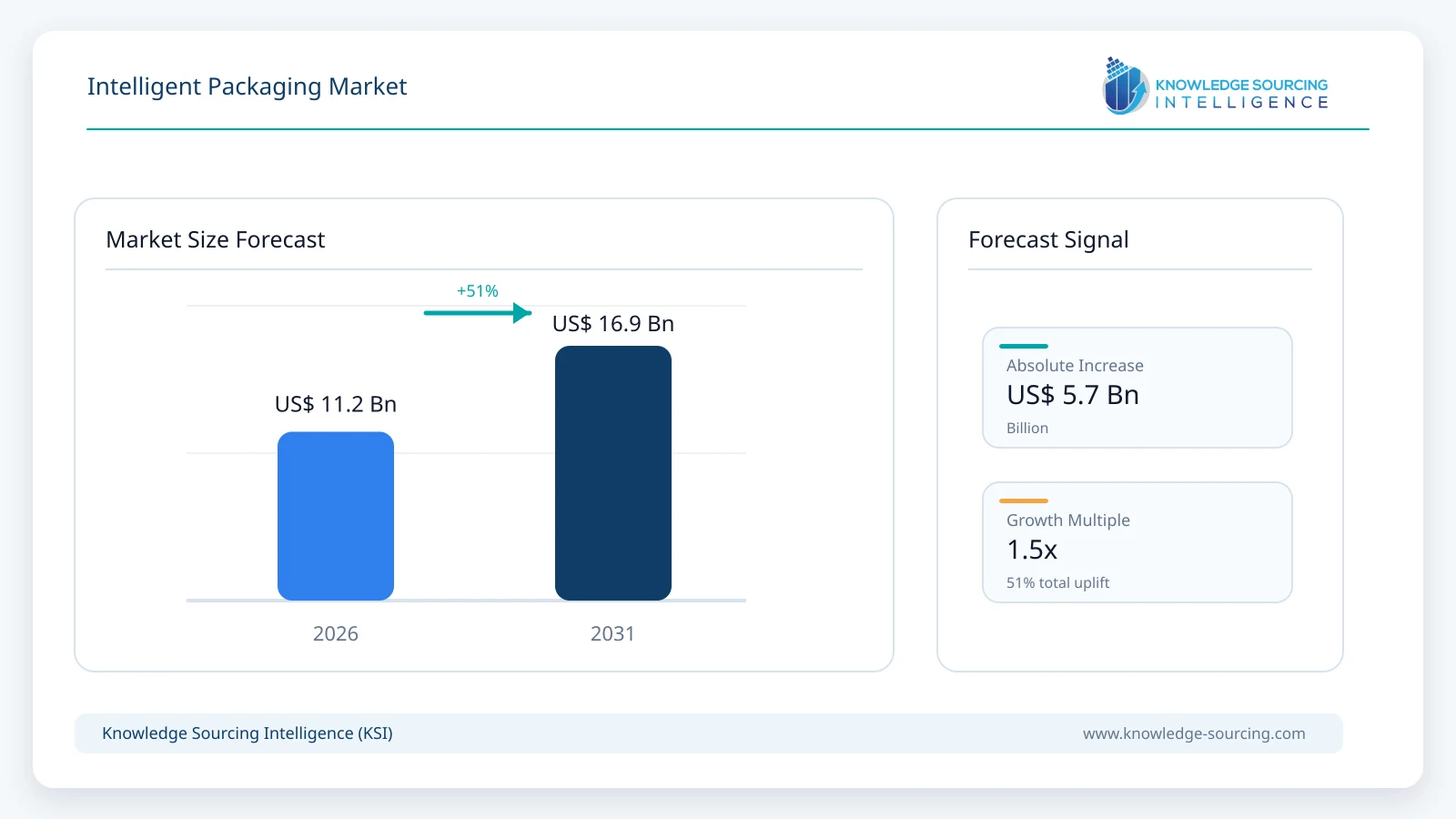
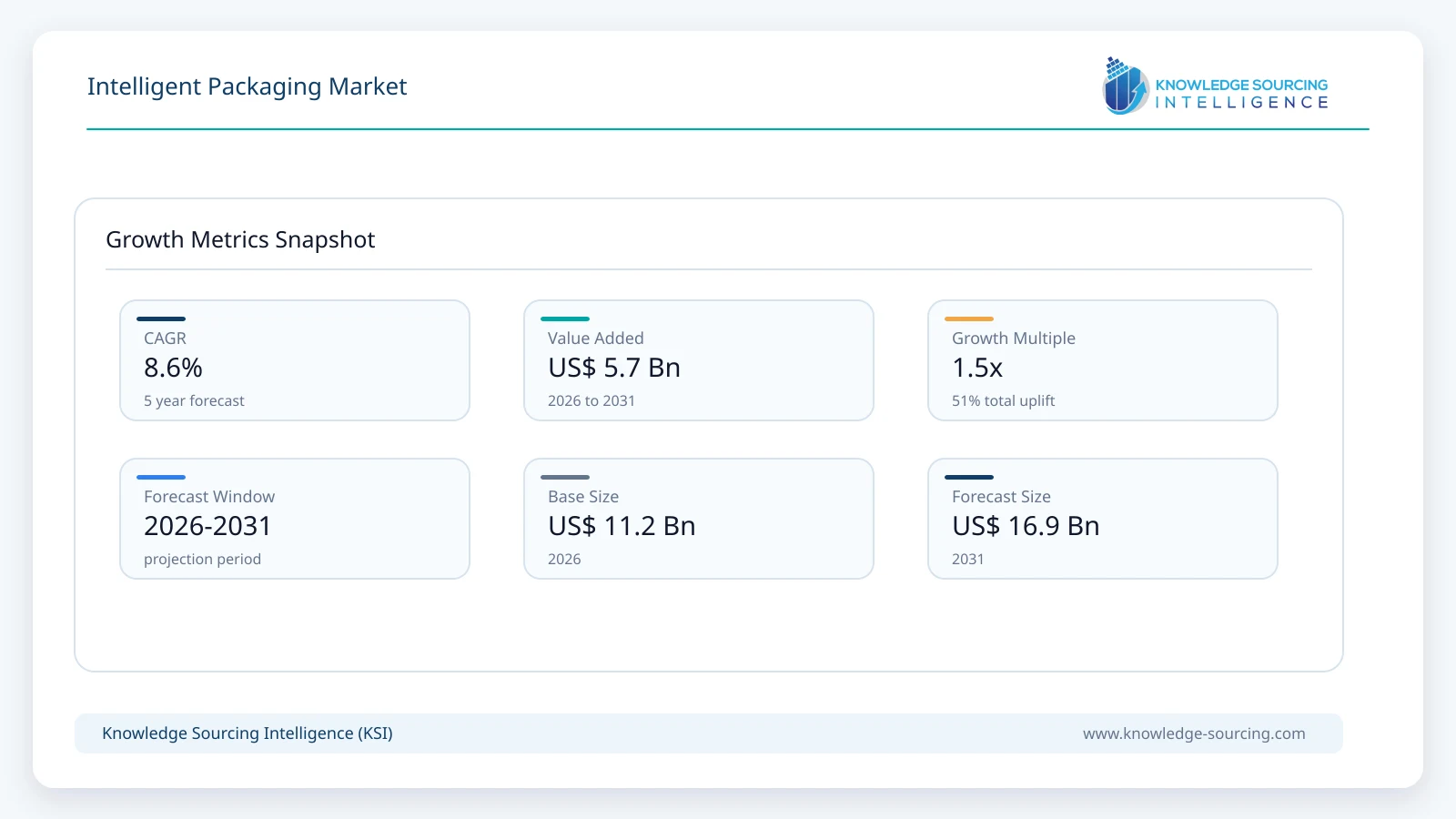
The intelligent packaging market is expected to grow at a CAGR of 8.6%, reaching a market size of USD 16.9 billion in 2031 from USD 11.2 billion in 2026.
Highlights:
- 1RFID-based intelligent packaging accounts for an estimated 37.8% of market revenue in 2026, supported by automatic item-level identification across food, pharmaceutical, retail and logistics applications.
- 2Food and beverage represents an estimated 43.6% of market demand in 2026, reflecting the commercial value of freshness management, inventory visibility, expiry control and traceability.
- 3North America accounts for approximately 34.6% of global market revenue in 2026, supported by developed retail infrastructure, pharmaceutical serialization, food traceability investment and large-scale adoption of digital identification technologies.
- 42D barcodes by the end of 2027GS1’s industry-wide objective is for retail point-of-sale systems to support defined standards-based , creating a global infrastructure layer for digitally connected packaging.
- 5July 20, 2028FDA enforcement of the Food Traceability Rule will not begin before , slowing immediate regulatory adoption while retaining the longer-term requirement for interoperable lot-level traceability.
- 6Flexible semiconductor technologies are lowering the cost and physical profile of NFC, making package-level authentication and tamper detection more practical beyond premium products.
- 7Intelligent packaging is increasingly shifting from consumer-marketing applications toward operational functions such as inventory accuracy, anti-counterfeiting, cold-chain monitoring, recall readiness and waste reduction.
The market includes packaging and package-integrated labels capable of identifying, sensing, recording, or communicating information about a product or its surrounding conditions. Technologies covered include RFID, NFC, GS1-compatible 2D/QR identifiers, time-temperature indicators, freshness and condition indicators, and other sensor-based packaging. The scope excludes conventional printed barcodes used only for basic product identification, general-purpose asset tracking tags that are not associated with packaging, and active packaging systems that preserve products without providing any monitoring, identification, or communication function.
Market Overview
The intelligent packaging market is moving from specialist applications toward a broader digital infrastructure role within product supply chains. Earlier adoption was concentrated in high-value products, pharmaceuticals, and promotional connected packaging because sensor and RFID costs were difficult to justify for high-volume consumer goods. That constraint is gradually weakening as RFID integration becomes easier, QR and GS1 Digital Link solutions provide low-cost digital identities, and flexible semiconductor technologies reduce the cost and thickness of NFC-enabled packaging.
The existing KSI page correctly identifies traceability, pharmaceutical compliance, supply-chain visibility and sustainability as major market themes, and these remain valid. However, the market structure has advanced beyond the old segmentation of RFID tags, temperature indicators and freshness indicators. Connected packaging based on standards-compliant 2D barcodes and NFC now represents a sufficiently distinct technology pathway to warrant separate consideration. QR-based systems can provide serialized product identities and web connectivity with virtually no electronic component cost, while NFC provides stronger authentication and consumer interaction, and RFID enables automated reading without line-of-sight scanning.
Food applications are becoming particularly important because intelligent packaging can now solve measurable operational problems rather than serve primarily as a marketing feature. Avery Dennison’s AD IdentiFresh platform, introduced in 2026 using Impinj technology, targets bakery, meat, deli and produce categories that historically presented RFID read-performance challenges because of moisture, cold conditions and dense product stacking. Automated product-level visibility can improve freshness rotation, inventory accuracy, and waste management, strengthening the business case for RFID even in relatively low-value grocery products.
The pharmaceutical market provides another important demand base. Package-level serialization and anti-tampering requirements have already created extensive digital identification infrastructure across major regulated markets. Additional growth comes from temperature-sensitive therapies, biologics and home-delivered medicines, where package-level condition indicators can provide information that warehouse-level monitoring cannot capture. Intelligent packaging therefore increasingly sits between packaging, supply-chain software and digital product identity rather than operating as a stand-alone packaging technology.
Market Drivers
RFID is becoming economically viable in fresh food and other difficult product categories
RFID has historically been strongest in apparel and higher-value retail products because the economic benefit of automatic inventory counting could more easily justify tag cost. Food categories presented additional technical challenges because water, meat and dense product configurations interfere with conventional radio-frequency performance. Avery Dennison’s 2026 AD IdentiFresh series uses redesigned RFID inlays specifically for bakery, meat, deli and produce applications and is intended to work within existing label formats. Improvements in read reliability change the commercial equation because retailers can use RFID to identify ageing inventory, locate products and reduce manual stock checks. If adoption expands across supermarket fresh departments, food could become one of the most important incremental intelligent-packaging applications through 2031.
Global migration toward 2D barcodes expands low-cost connected packaging
The transition from conventional linear barcodes to standards-based 2D codes is one of the largest infrastructure changes affecting intelligent packaging. GS1’s Ambition 2027 targets global retail point-of-sale capability to process defined 2D barcodes by the end of 2027. These codes can carry lot numbers, expiry dates or other product data and can also link directly to web-based information through GS1 Digital Link. The significance for intelligent packaging is that connectivity no longer requires an electronic component. Brands can provide product identity, authenticity information, instructions, recycling guidance or consumer content through an identifier already printed on the package. This creates a lower-cost entry point into connected packaging and substantially broadens the potential adoption base.
Pharmaceutical serialization supports persistent package-level identity
Pharmaceutical supply chains increasingly require package-level identification and traceability. The U.S. Drug Supply Chain Security Act establishes interoperable electronic tracing requirements at package level, while the EU Falsified Medicines Directive requires safety features including unique identifiers and anti-tampering devices on relevant medicine packaging. These systems create an installed infrastructure for intelligent packaging because packages already need serialized digital identities that can be verified against supply-chain records. Intelligent packaging can extend this framework through NFC authentication, temperature indicators or condition monitoring where the additional information materially improves product integrity.
Anti-counterfeit and tamper-detection applications are becoming easier to scale
Conventional anti-counterfeit packaging typically relies on holograms, printed security elements or other physical features that can become increasingly difficult for consumers to distinguish from sophisticated imitations. NFC provides a digital verification layer because users can authenticate products using a smartphone. Pragmatic Semiconductor launched NFC Protect PR1311 in June 2026, combining a persistent digital identity with electronic tamper detection in a flexible chip designed for integration into packaging. The technology targets pharmaceuticals, beauty products, wine and spirits, baby food and other categories where opening, refilling or substitution creates material brand or safety risk. Lower-cost flexible electronics can move digital tamper detection beyond ultra-premium products.
Cold-chain complexity supports package-level condition monitoring
Cold-chain infrastructure commonly measures conditions at the vehicle, warehouse or container level, but individual packages can still experience local temperature variations. Time-temperature indicators provide an inexpensive way of recording whether a specific product has experienced a potentially damaging excursion. Time-strip, for example, provides irreversible indicators covering pharmaceutical, food, blood and logistics applications and has continued expanding electronic and reusable indicator formats. Growth in biologics, specialty medicines, food delivery and direct-to-patient distribution strengthens the value of package-level condition information where product quality cannot be determined through visual inspection alone.
Market Restraints and Challenges
Additional package cost remains the primary barrier to mass-market electronic adoption
Intelligent packaging competes with extremely low-cost conventional labels and packaging components. Even relatively inexpensive RFID or NFC technologies can materially increase the unit cost of products sold at high volumes and low margins. Suppliers therefore need to demonstrate a measurable economic return through reduced labor, lower inventory loss, better traceability, authentication or improved product recovery. This is why 2D printed identifiers are likely to expand more broadly than electronic packaging in the near term. RFID, NFC and sensor technologies will penetrate selectively where they solve operational problems that justify the added cost rather than becoming universal across every package.
Intelligent components can complicate recycling
Electronic labels, antennas, conductive inks, chips and batteries can conflict with packaging-recycling objectives when they cannot be easily separated from the primary material. The EU Packaging and Packaging Waste Regulation, applying from August 2026, increases pressure on suppliers to ensure that advanced packaging functions do not undermine recyclability. This creates an engineering challenge because intelligent packaging needs to become more sophisticated while packaging structures simultaneously become simpler. Thin, removable, low-material and battery-free technologies have an advantage because they reduce the amount of additional material introduced into the package.
Connected packaging is only valuable when digital systems are integrated
A serialized code or RFID tag provides limited value unless the associated data can move into warehouse, manufacturing, traceability or customer-engagement systems. Scantrust, for example, integrates product identities with ERP, warehouse, authentication and analytics systems because the physical identifier is only one component of the overall solution. Implementation therefore requires software integration, data governance and process redesign in addition to packaging conversion. These requirements can slow adoption among small manufacturers even when the physical code or tag itself is inexpensive.
The FDA traceability extension reduces immediate regulatory urgency
The FDA Food Traceability Rule was originally scheduled for compliance in January 2026, but Congress subsequently directed the agency not to enforce the rule before July 20, 2028. This delay gives food companies additional implementation time and reduces the probability of a sharp compliance-driven spending surge during 2026–2027. It does not remove the long-term requirement for lot-level traceability, but it shifts a greater portion of implementation activity toward the second half of the forecast period. This is one reason the revised KSI model assumes stronger market growth later in the 2026–2031 window rather than applying one constant annual growth rate.
Sensor reliability needs to support the commercial decision being made
Freshness indicators and temperature-monitoring technologies influence decisions about whether products can be sold, released or discarded. Inaccurate alerts can create unnecessary waste, while failure to detect genuine excursions can create safety and liability risks. Indicators therefore require application-specific calibration and validation. A sensor suitable for vaccines may not be appropriate for fresh meat, while a general temperature indicator does not automatically measure remaining shelf life. This restricts purely generic solutions and increases development requirements for suppliers targeting regulated or high-risk applications.
Major Segment Analysis
By Packaging Technology
RFID remains the largest technology group and is projected to reach approximately USD 7.0 billion by 2031. Growth is being supported by improvements in high-moisture food performance, easier label-converter integration and increasing use of RFID for automated inventory and traceability. Avery Dennison’s AD Fusion program launched in August 2026 further reduces converter barriers by supplying materials with pre-inserted RFID inlays that can be processed using existing presses rather than requiring dedicated insertion equipment.
2D/QR connected packaging grows strongly from a lower revenue base because implementation costs are substantially below those of electronic technologies. NFC is also expected to expand faster than the overall market as flexible chips reduce integration cost and allow tamper detection, digital product passports and authentication to be embedded into smaller packages. Temperature and freshness indicators remain important in food and healthcare but expand at a steadier pace because their applications are more product-specific.
By Application
Food and beverage is projected to reach approximately USD 7.6 billion by 2031. Intelligent packaging addresses inventory rotation, traceability, freshness, cold-chain monitoring and food-waste reduction, creating several different adoption pathways rather than reliance on one technology. RFID has particular potential in grocery operations, while QR and 2D identifiers provide lower-cost traceability and consumer information.
Pharmaceutical and healthcare remain another substantial market because digital identifiers, anti-tampering systems and condition-monitoring technologies can directly support patient safety and regulatory compliance. Cosmetics and personal care increasingly use NFC and secure QR codes for authentication and digital engagement, while electronics applications focus more heavily on traceability, environmental exposure and logistics integrity.
Regional Analysis
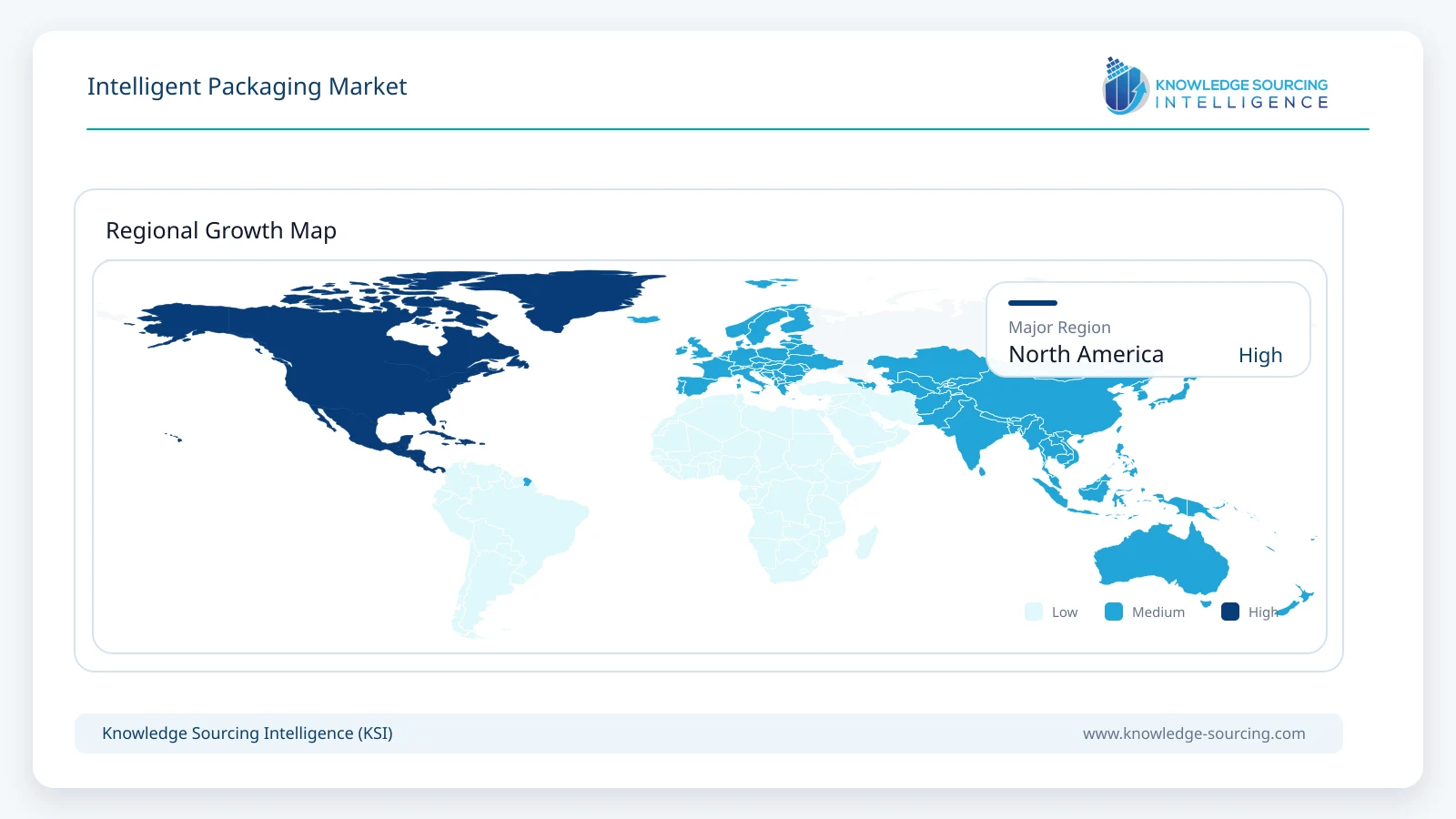
North America remains the largest regional market through 2031 and is projected to reach approximately USD 5.7 billion. The United States combines advanced retail RFID adoption, package-level pharmaceutical tracing, significant cold-chain distribution and food traceability investment. The delayed FDA Food Traceability Rule moderates short-term regulatory acceleration but does not change the longer-term requirement for better lot-level data exchange.
Asia Pacific is projected to record the strongest major regional growth, at approximately 10.6% annually through 2031. The region combines major RFID and semiconductor manufacturing capacity with large retail, pharmaceutical and e-commerce markets. China, Japan and South Korea support advanced electronics and identification technologies, while India and Southeast Asia provide faster growth in packaged food, pharmaceuticals and organized retail.
Europe remains a major intelligent-packaging market and benefits from pharmaceutical serialization, sophisticated food supply chains and increasing use of digital identities. At the same time, the PPWR increases pressure to ensure that tags, sensors and connected components do not compromise recyclability. This should favor thin, removable or low-material intelligent labels and accelerate the integration of digital product information with sustainability requirements.
Technology Outlook
Flexible NFC and Battery-Free Electronics
Flexible semiconductor technology is reducing the physical and economic barriers associated with electronic packaging. Pragmatic Semiconductor’s NFC Protect technology combines an ultra-thin flexible chip with tamper detection and smartphone verification, while Avery Dennison’s investment in Wiliot strengthens development of battery-free sensing. These technologies can extend intelligent packaging into applications that cannot economically support conventional silicon chips or powered data loggers.
Standards-Based Digital Product Identity
GS1-compatible 2D barcodes provide a scalable route toward connecting physical packaging with online product information and supply-chain data. The same identifier can support point-of-sale processing, lot information, expiry dates, recycling guidance, product authentication and consumer engagement. Because the technology relies primarily on printing rather than electronic hardware, it can reach substantially larger packaging volumes than RFID or sensors.
Package-Level Condition Intelligence
Time-temperature and freshness indicators are evolving from simple threshold indicators toward richer condition data. Low-cost visual devices remain appropriate for many applications, while electronic and battery-free sensors expand where continuous information or integration with software platforms is required. The technology is particularly relevant to biologics, vaccines, specialty pharmaceuticals, fresh foods and high-value perishable products.
Recent Developments
August 2026: Avery Dennison launched AD Fusion, providing label and packaging converters with materials containing pre-inserted RFID inlays. The system is designed to reduce the capital and workflow barriers associated with entering RFID label production.
June 2026: Pragmatic Semiconductor introduced NFC Protect PR1311, a flexible NFC chip that provides product identity and electronic tamper detection through standard smartphones. Target applications include pharmaceuticals, beauty products, wine and spirits and other products exposed to counterfeiting or refilling.
April 2026: Avery Dennison announced a USD 75 million minority investment in Wiliot, deepening its involvement in battery-free ambient IoT technologies capable of providing item-level product and condition information.
February 2026: Avery Dennison introduced AD IdentiFresh, an RFID inlay family designed specifically for fresh-food categories including meat, bakery, produce and deli products and built around Impinj M800-series technology.
Competitive Landscape
The competitive environment spans packaging companies, label manufacturers, semiconductor suppliers, software providers and specialist sensor companies. Avery Dennison occupies a central position in RFID and digital identification and is expanding into fresh-food RFID, flexible NFC and battery-free sensing. Impinj provides RFID endpoint chips and platform technology used across intelligent label ecosystems, while NXP Semiconductors and Pragmatic Semiconductor provide semiconductor technologies for RFID and NFC applications.
Tetra Pak integrates unique digital identities directly into packaged-food systems, while CCL Industries, SML Group and Schreiner Group participate through labels, RFID and pharmaceutical packaging solutions. Scantrust, Digimarc and Kezzler provide digital identity, QR-based connected packaging, authentication and traceability platforms. Wiliot focuses on battery-free ambient IoT, while Timestrip and Ynvisible address monitoring and visual indicator technologies.
Traditional packaging companies also participate where digital features are incorporated into broader packaging structures. Amcor and Sealed Air increasingly combine functional packaging with digital identification and automation. Competition through 2031 is therefore likely to remain fragmented by technology, with partnerships between packaging converters, semiconductor manufacturers, digital-platform providers and brand owners becoming more important than vertical integration by any single company.
Analyst View
Intelligent packaging is increasingly becoming a digital product infrastructure market rather than simply a specialist packaging market. The package is one of the few physical objects that remains attached to a product through manufacturing, distribution, retail and consumption. Giving that package a persistent digital identity allows companies to connect supply-chain events, authentication, inventory information and consumer interaction to the same physical item.
The largest near-term opportunity is not necessarily sophisticated sensing. Standards-based 2D barcodes have the potential to connect billions of packages at very low incremental cost as global point-of-sale infrastructure becomes compatible with GS1-standard formats. This provides a foundational layer on which companies can add RFID, NFC or sensing where the economics justify additional functionality.
RFID represents the strongest electronic technology opportunity because inventory automation produces a measurable operational return. Fresh food is particularly significant because technical improvements are overcoming some of the categories that previously performed poorly with RFID. If supermarkets can reliably identify high-moisture products and automate expiry and rotation management, the market becomes considerably broader than its historical apparel and durable-goods base.
NFC and flexible electronics represent a different opportunity centered on authentication, tamper detection and smartphone interaction. Flexible chips reduce cost and thickness, making digital tamper evidence more commercially practical in pharmaceuticals, cosmetics, food and spirits. However, adoption will remain selective because adding electronics to every low-value consumer package is still economically unrealistic.
Intelligent Packaging Market Scope:
| Report Metric | Details |
|---|---|
| Total Market Size in 2026 | USD 11.2 billion |
| Total Market Size in 2031 | USD 16.9 billion |
| Forecast Unit | Billion |
| Growth Rate | 8.6% |
| Study Period | 2021 to 2031 |
| Historical Data | 2021 to 2024 |
| Base Year | 2025 |
| Forecast Period | 2026 – 2031 |
| Segmentation | Packaging Technology, Application, Geography |
| Companies |
|
Market Segmentation
By Packaging Technology
· RFID Tags
· NFC-Enabled Packaging
· 2D/QR & Serialized Connected Packaging
· Time-Temperature Indicators
· Freshness & Condition Indicators
· Other Sensor-Based Packaging
By Application
· Food & Beverage
· Pharmaceutical & Healthcare
· Cosmetics & Personal Care
· Electronics
· Wine, Spirits & Premium Consumer Goods
· Others
By Geography
North America
· United States
· Canada
· Mexico
South America
· Brazil
· Argentina
· Others
Europe
· United Kingdom
· Germany
· France
· Italy
· Spain
· Others
Middle East and Africa
· UAE
· Saudi Arabia
· South Africa
· Others
Asia Pacific
· China
· Japan
· India
· South Korea
· Indonesia
· Others
Table of Contents
1. EXECUTIVE SUMMARY
2. MARKET SNAPSHOT
2.1. Market Overview
2.2. Market Definition and Scope
2.3. Scope Exclusions
2.4. Market Segmentation
2.5. Key Market Indicators
3. BUSINESS LANDSCAPE
3.1. Market Drivers
3.2. Market Restraints and Challenges
3.3. Market Opportunities
3.4. Intelligent Packaging Value Chain
3.5. Regulatory and Traceability Environment
3.6. Technology Cost and Adoption Analysis
3.7. Porter’s Five Forces Analysis
3.8. Strategic Recommendations
4. TECHNOLOGY OUTLOOK
4.1. Flexible NFC and Battery-Free Electronics
4.2. Standards-Based Digital Product Identity
4.3. Package-Level Condition Intelligence
5. INTELLIGENT PACKAGING MARKET BY PACKAGING TECHNOLOGY
5.1. Introduction
5.2. RFID Tags
5.3. NFC-Enabled Packaging
5.4. 2D/QR & Serialized Connected Packaging
5.5. Time-Temperature Indicators
5.6. Freshness & Condition Indicators
5.7. Other Sensor-Based Packaging
6. INTELLIGENT PACKAGING MARKET BY APPLICATION
6.1. Introduction
6.2. Food & Beverage
6.3. Pharmaceutical & Healthcare
6.4. Cosmetics & Personal Care
6.5. Electronics
6.6. Wine, Spirits & Premium Consumer Goods
6.7. Others
7. INTELLIGENT PACKAGING MARKET BY GEOGRAPHY
7.1. Introduction
7.2. North America
7.2.1. United States
7.2.2. Canada
7.2.3. Mexico
7.3. South America
7.3.1. Brazil
7.3.2. Argentina
7.3.3. Others
7.4. Europe
7.4.1. United Kingdom
7.4.2. Germany
7.4.3. France
7.4.4. Italy
7.4.5. Spain
7.4.6. Others
7.5. Middle East and Africa
7.5.1. UAE
7.5.2. Saudi Arabia
7.5.3. South Africa
7.5.4. Others
7.6. Asia Pacific
7.6.1. China
7.6.2. Japan
7.6.3. India
7.6.4. South Korea
7.6.5. Indonesia
7.6.6. Others
8. COMPETITIVE ENVIRONMENT AND ANALYSIS
8.1. Competitive Positioning
8.2. RFID and Digital Identity Capability Analysis
8.3. NFC, Sensor and Condition-Monitoring Benchmarking
8.4. Market Share Analysis
8.5. Partnerships and Strategic Developments
8.6. Competitive Dashboard
9. COMPANY PROFILES
9.1. Avery Dennison Corporation
9.2. Impinj, Inc.
9.3. NXP Semiconductors N.V.
9.4. Pragmatic Semiconductor Ltd.
9.5. Tetra Pak International S.A.
9.6. CCL Industries Inc.
9.7. SML Group
9.8. Schreiner Group GmbH & Co. KG
9.9. Scantrust SA
9.10. Wiliot Ltd.
9.11. Digimarc Corporation
9.12. Kezzler AS
9.13. Timestrip UK Ltd.
9.14. Ynvisible Interactive Inc.
9.15. Zebra Technologies Corporation
9.16. Identiv, Inc.
9.17. Antares Vision Group
9.18. Markem-Imaje
9.19. impacX
9.20. Amcor plc
10. ANALYST VIEW
11. APPENDIX
11.1. Research Methodology
11.2. Market Estimation and Assumptions
11.3. Scope and Double-Counting Controls
11.4. Definitions and Abbreviations
Navigate
Trusted by the world's leading organizations











