
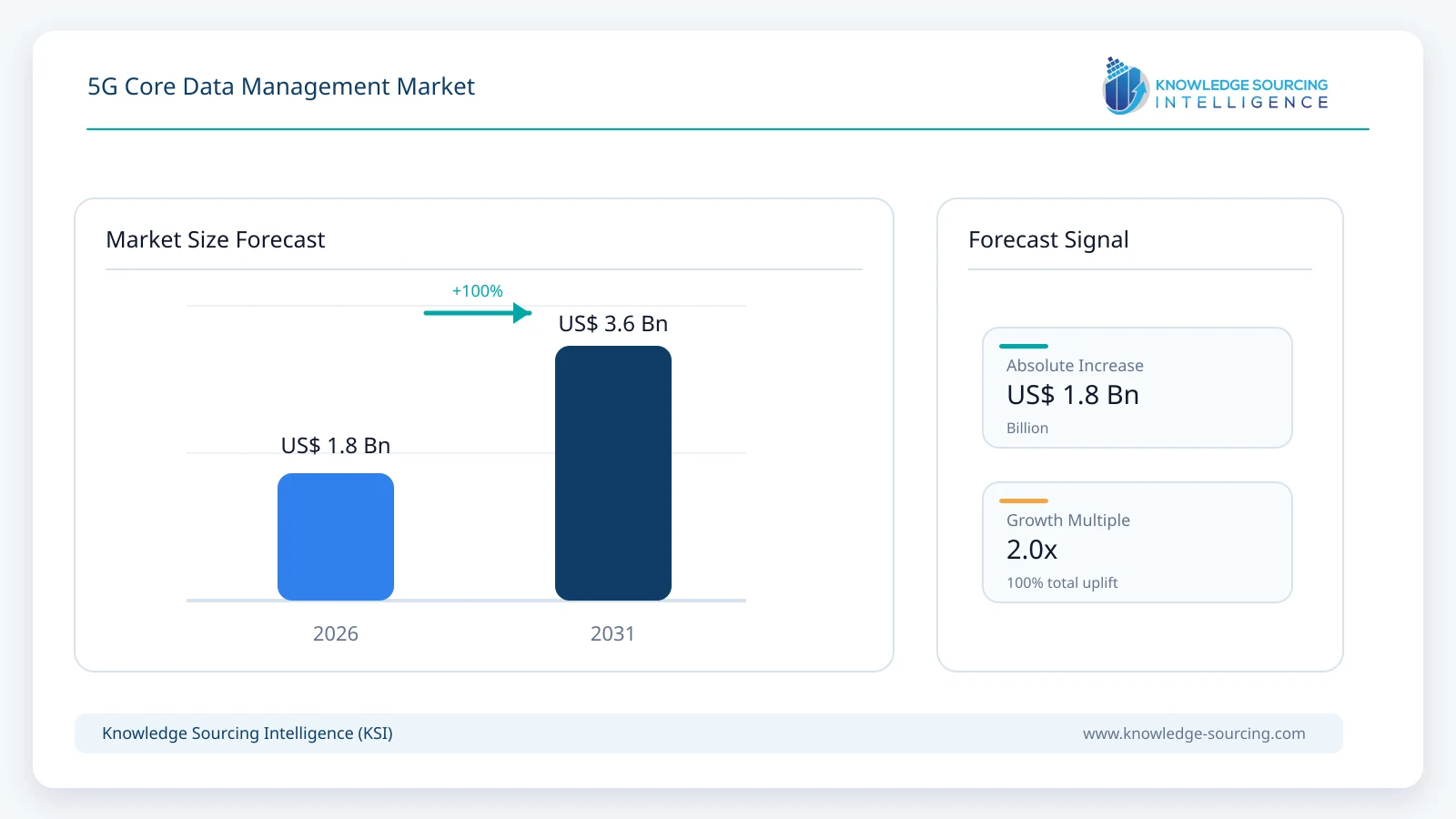
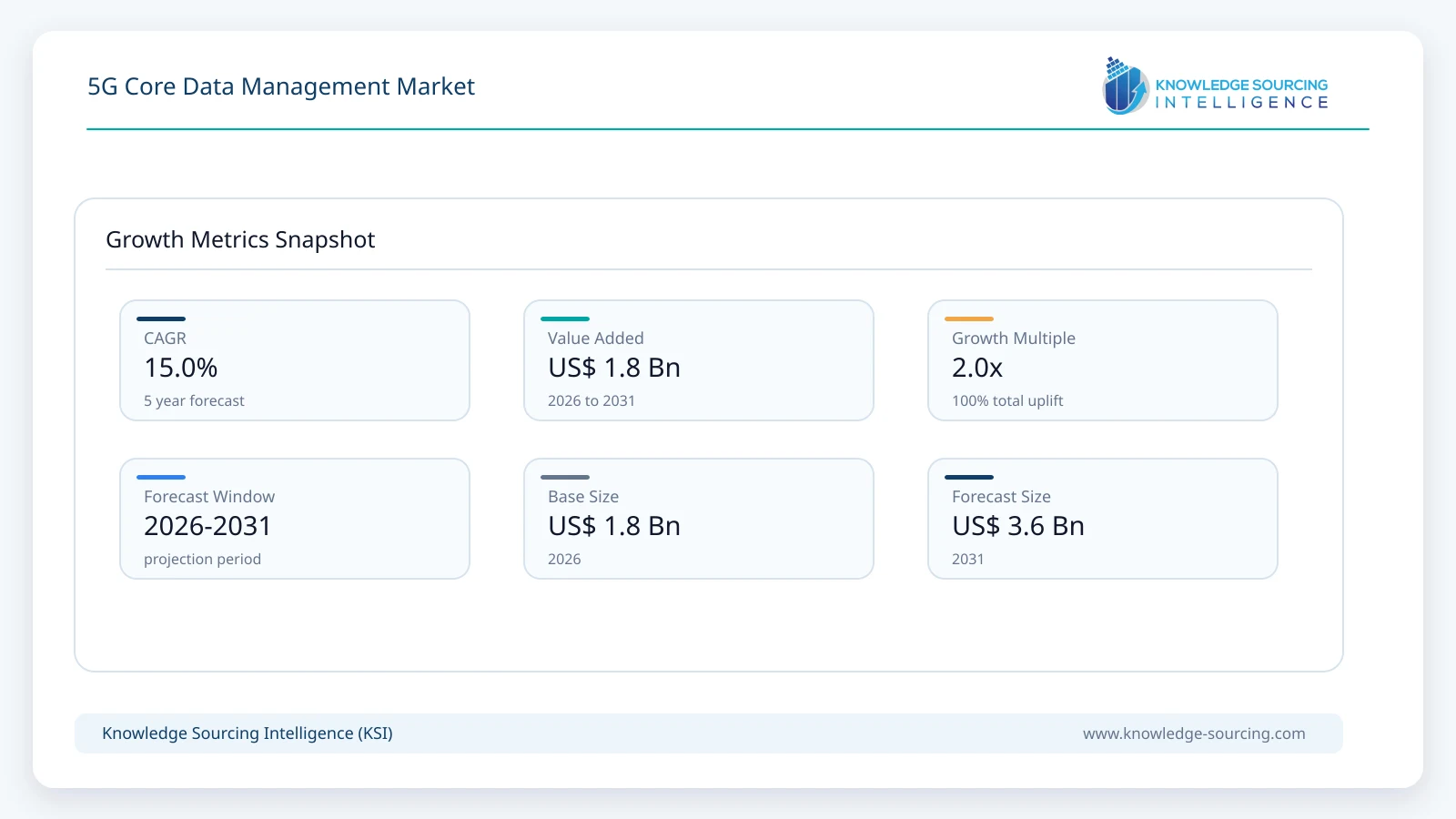
The 5G Core Data Management Market is forecast to grow at a CAGR of approximately 14.9%, reaching USD 3.6 billion in 2031 from USD 1.8 billion in 2026.
Highlights:
- 1Unified Data Management accounts for approximately 34% of global market value in 2026, reflecting its central role in subscriber identity, authorization, registration and subscription management.
- 2Software represents approximately 74% of market value in 2026, supported by cloud-native network functions and repository platforms deployed on standardized compute infrastructure.
- 3Public cloud deployment is projected to grow at approximately 19% annually through 2031, as operators expand hybrid and hyperscaler-supported core architectures.
- 4Mobile network operators account for approximately 89% of market value in 2026, reflecting the scale and complexity of national public 5G networks.
- 5Europe is projected to grow at approximately 17.5% annually through 2031, supported by accelerating commercial 5G Standalone deployment.
5G Core data management includes the network functions, software and directly associated services required to manage structured and unstructured data within a cloud-native 5G Core. The principal components include Unified Data Management (UDM), Unified Data Repository (UDR), Unstructured Data Storage Function (UDSF), Authentication Server Function (AUSF) and related common data-layer capabilities. These functions manage subscription information, authentication data, policy information, session state and application data required by multiple network functions within the 5G Service-Based Architecture.
UDR provides a common structured-data repository that can be used by network functions including UDM and PCF, while UDSF enables stateless network functions to store and retrieve unstructured session or state information. UDM manages subscriber identification, authorization, registration and subscription-related procedures, while AUSF supports authentication. The architecture enables network operators to separate data persistence from processing functions, allowing individual network functions to scale independently and reducing duplication across the core.
Demand is increasing as 5G Standalone deployment expands. GSMA reported in February 2026 that only around one-quarter of operator groups worldwide had deployed 5G SA at scale, leaving a substantial migration opportunity. Dell'Oro reported that 5G Mobile Core revenue continued to grow at double-digit rates outside China during the first quarter of 2026, while European operators accelerated commercial SA launches during the second quarter. The shift from NSA networks relying on 4G EPC toward standalone 5G Core increases demand for UDM, UDR, authentication, repository and data-migration capabilities.
Cloud-native deployment is also changing the economics of core data management. Containerized network functions can be deployed on standardized telecom cloud infrastructure and increasingly across hybrid environments. Operators can scale processing and storage independently, add geographic redundancy and consolidate multiple network databases into common data layers. These capabilities become more important as 5G subscriber numbers increase and network slicing, RedCap, IoT, FWA and enterprise services generate a wider range of subscriber, policy and session-data transactions.
Market Trends
Core Network Functions Are Separating Processing From Persistent Data
Cloud-native 5G architecture increasingly separates network-function processing from persistent data storage. UDM can operate as a front-end function while structured subscription, authentication, policy and related data are maintained within UDR. UDSF provides a separate mechanism for storing unstructured session or application-specific state, enabling selected network functions to operate in a more stateless manner.
The architecture improves scalability because operators can increase processing capacity without maintaining a separate database within every network function. Oracle's current Cloud Native Core UDR implementation supports application, subscription, authentication, service authorization, policy, session-binding and application-state data, while Nokia's subscriber-data-management platform combines UDR and UDSF with UDM, AUSF and multi-generation subscriber-management capabilities.
This architectural separation becomes more important as operators operate increasingly distributed 5G cores. Geo-redundant repositories can support network functions across several sites while maintaining consistent subscriber and policy information, helping operators scale core infrastructure without reproducing data silos at every location.
Common Data Layers Are Replacing Siloed Network Databases
Mobile operators traditionally accumulated separate subscriber and service databases across HLR, HSS, policy, charging and application environments. 5G provides an opportunity to consolidate a greater proportion of this information within shared data architectures that serve several network functions simultaneously.
Nokia's data-management architecture uses a centralized subscriber data layer that supports both legacy and 5G network functions, while Enea's Stratum platform provides structured and unstructured data capabilities across 4G and 5G environments. The approach allows operators to migrate gradually rather than replace every legacy database in one step.
Common data layers can reduce duplicated subscriber records, simplify provisioning and allow new network functions to access authoritative subscriber or session information through standardized interfaces. This is particularly important during the long transition period in which operators simultaneously support LTE, IMS and 5G SA services.
Hybrid and Public Cloud Deployment Is Expanding
5G Core workloads have traditionally been deployed on dedicated operator-controlled infrastructure because authentication, subscriber information and session data require high availability, security and predictable performance. Public-cloud infrastructure is increasingly becoming a viable option for selected core deployments, testing environments, enterprise networks and distributed service domains.
Operator architectures are consequently becoming more heterogeneous. National-scale critical workloads can remain in private telecom cloud infrastructure while other network functions operate across public cloud, edge and hybrid environments. Mavenir's 2025 operator survey found that a large majority of respondents expected to separate the cloud infrastructure stack from the 5G Core network-function layer, supporting greater portability between infrastructure environments.
Data-management platforms therefore need to support distributed deployment, automated scaling, redundancy and consistent state across infrastructure boundaries. This favors cloud-native repository platforms rather than databases tied tightly to individual network appliances.
Core Data Is Becoming More Dynamic
Subscriber data management historically focused heavily on relatively persistent information such as subscriber profiles, authentication credentials and service entitlements. 5G Core architectures increasingly require management of rapidly changing session, policy, application and network state as well.
Network slicing, differentiated connectivity, IoT and distributed applications increase both the number and variety of data interactions across the core. Structured information remains essential for subscription and policy functions, while UDSF and distributed data layers support temporary state required by stateless network functions.
The commercial importance of core data management therefore extends beyond storing subscriber identities. Performance increasingly depends on the ability to provide secure, low-latency and highly available access to different types of network data across a large number of interconnected cloud-native functions.
Market Drivers
5G Standalone Deployment Is Expanding
5G NSA enabled operators to introduce 5G radio services while retaining an existing LTE EPC, limiting the immediate need for a completely new core architecture. Standalone deployment introduces the cloud-native 5G Core and its service-based network functions, creating a direct requirement for UDM, UDR, AUSF and related data-management capabilities.
Commercial deployment remains at an intermediate stage globally. GSMA reported in February 2026 that approximately one-quarter of operator groups had deployed 5G SA at scale, meaning a substantial proportion of mobile operators still need to undertake full core transformation.
Dell'Oro reported that 5G SA reached an important commercial inflection point in 2025 and that 5G Core revenue continued increasing outside China during 2026. Each additional SA network creates requirements for subscriber migration, authentication, repository capacity and integration with existing operational and business systems, supporting market growth through 2031.
Network Slicing Is Increasing Data Complexity
Network slicing allows operators to provide different connectivity characteristics to consumers, enterprises and applications using the same physical network infrastructure. Each slice can require specific subscriber authorization, service entitlements, policies, performance parameters and session information.
This increases interaction between UDM, UDR, policy functions and other core network elements. Data must remain synchronized as subscribers move between locations, devices and service environments while still receiving the connectivity conditions associated with their authorized slice.
Commercial network-slicing activity is increasing as operators move beyond basic consumer mobile broadband into differentiated connectivity. The expansion increases the importance of scalable repositories and data APIs capable of supporting more dynamic relationships between subscriber identities, policies and network services.
Data Consolidation Supports Core Modernization
Legacy mobile networks can contain multiple copies of subscriber and device information distributed across different network functions and application environments. Maintaining these databases separately increases provisioning complexity, operating costs and the risk of inconsistent information.
5G data-management architectures allow operators to consolidate a larger proportion of this information into common structured and unstructured repositories. The migration requires database transformation, provisioning interfaces, testing, synchronization and staged cutovers, creating service revenue alongside software licensing.
The ability to maintain interoperability across network generations is particularly important because operators cannot migrate entire subscriber bases simultaneously. Solutions capable of supporting 4G and 5G data during the transition have a stronger commercial position than platforms designed exclusively for greenfield networks.
Increasing 5G Service Diversity Raises Transaction Requirements
The growth of RedCap devices, IoT, private cellular networks, FWA, enterprise applications and differentiated connectivity increases the number of device and service profiles processed within 5G networks. Market growth is therefore influenced not only by total subscriber numbers but also by the number of transactions and service relationships associated with each subscriber or device.
Subscriber registration, authentication, service authorization, policy retrieval, network-slice access and application-state management can generate repeated interactions with the data layer. Large operators therefore require platforms capable of scaling horizontally while maintaining carrier-grade availability and low response times.
Market Restraints
5G Standalone Migration Remains Complex
Migration to 5G SA requires substantially more than installing a new core platform. Operators need to integrate the new environment with existing subscriber databases, charging systems, OSS/BSS platforms, IMS, roaming systems and operational processes while maintaining uninterrupted service.
GSMA identifies technology maturity and integration complexity as major historical constraints on SA deployment. Subscriber and authentication databases are particularly sensitive because failures can prevent customers from registering, accessing services or roaming.
Operators consequently use long testing and staged-migration programs before transferring large subscriber populations. This extends procurement and deployment cycles even where the long-term investment case for 5G SA is established.
Higher Infrastructure Costs Can Delay Core Transformation
Cloud-native core software requires substantial compute, storage and memory capacity, particularly where operators maintain multiple geographic sites for resilience. Data-management functions also require replication and high availability because subscriber and authentication information must remain accessible continuously.
Dell'Oro reported in July 2026 that higher server costs were contributing to delays in selected operator core-transformation projects. Infrastructure economics can therefore affect the timing of software deployments even where operators have already committed strategically to 5G SA.
Data Consolidation Can Reduce the Number of Separate Platforms
One objective of common data-layer architecture is to remove duplicated repositories. A single scalable UDR or shared data layer can support multiple network functions that previously relied on separate databases.
This creates a different revenue pattern from conventional traffic-driven infrastructure markets. Data transactions can increase rapidly without requiring an equivalent increase in the number of software platforms because existing repositories can be expanded through additional capacity.
Vendors therefore increasingly compete around scalability, licensing, availability and multi-function integration rather than simply the number of database instances deployed.
Segment Analysis
By Network Function: Unified Data Management
Unified Data Management is projected to generate approximately USD 1.15 billion by 2031, remaining the largest individual network-function segment. UDM manages subscriber identity, authorization, registration, subscription information and other procedures required for subscribers to access 5G services. It also interacts closely with AUSF for authentication and retrieves structured subscription information from UDR.
The function becomes increasingly important as operators migrate subscriber populations from HSS-based LTE environments into cloud-native 5G SA architectures. Nokia, Ericsson, Oracle, Enea, Mavenir and other vendors provide UDM within broader subscriber-data or 5G Core portfolios, frequently combining it with authentication and repository functions.
UDM's share of overall market value moderates gradually as UDR, UDSF and common data-layer investment grows, but it remains central to operator 5G subscriber management throughout the forecast period.
By Offering: Software
Software revenue is projected to reach approximately USD 2.75 billion by 2031 as UDM, UDR, UDSF, AUSF and related data-layer capabilities are increasingly implemented as cloud-native software rather than proprietary hardware appliances.
Operators deploy these functions on standardized compute infrastructure across private telecom clouds, distributed data centers and, increasingly, hybrid environments. This separates network-function value from the underlying server platform and enables vendors to commercialize capacity through software licensing, subscription and consumption-oriented models.
Professional and managed services remain important because database migration, systems integration and subscriber cutover are complex, but recurring software value increases as operators expand capacity, add locations and introduce new network functions without replacing the underlying data-management platform.
By Deployment: Public Cloud
Public cloud-hosted 5G Core data-management deployments are projected to reach approximately USD 0.78 billion by 2031. The segment expands from a relatively small base as operators become more comfortable running selected telecom workloads on hyperscaler infrastructure while maintaining critical national-scale functions on operator-controlled cloud platforms.
Public cloud adoption is strongest where operators require rapid scalability, geographic expansion or lower infrastructure-management requirements. Private 5G and enterprise deployments can also use public cloud more readily than national mobile networks because subscriber populations and regulatory requirements are generally less complex.
Hybrid deployment is likely to remain common, with data-management software designed to operate consistently across operator cloud, edge and public-cloud environments rather than requiring one infrastructure model.
By End User: Mobile Network Operators
Mobile network operators are projected to generate approximately USD 3.1 billion in market revenue by 2031 and remain the dominant end-user group. National operator networks require significantly larger subscriber repositories, authentication capacity, geographic redundancy and transaction throughput than most private cellular deployments.
Public operators also carry the greatest migration burden because subscriber information must remain accessible across LTE, IMS and 5G during the transition to Standalone architecture. This increases expenditure on integration, synchronization and data-migration services in addition to UDM and repository software.
Private 5G networks expand from a smaller base and contribute progressively greater demand, particularly across manufacturing, logistics, utilities and other enterprise environments, but their smaller user populations keep average data-management contract values below those of national public networks.
By Geography: Europe
Europe is projected to generate approximately USD 0.9 billion in 5G Core Data Management revenue by 2031, supported by accelerating migration toward commercial 5G Standalone networks.
Dell'Oro reported that EMEA 5G Mobile Core revenue increased by more than 30% in the second quarter of 2026 and that most operators launching consumer 5G SA during the first part of the year were European. These deployments create demand for UDM, UDR, authentication and subscriber-migration capabilities.
European operator environments also tend to involve complex combinations of existing network generations, operating companies and vendors. Data-sovereignty requirements and extensive existing telecom-cloud investments favor private and hybrid architectures, generating opportunities for data-management software capable of operating across multi-vendor environments while maintaining centralized subscriber and policy information.
Competitive Environment and Analysis
The 5G Core Data Management market includes established mobile-core equipment vendors, telecom software specialists and cloud-native network suppliers. Ericsson and Nokia maintain large installed subscriber-management bases and provide migration paths from HLR and HSS toward UDM, UDR and cloud-native subscriber-data architectures. Huawei and ZTE similarly integrate data-management functions within broader 5G Core portfolios.
Oracle provides UDM and UDR as part of its Communications Cloud Native Core platform, combining telecom network functions with distributed database capabilities. Enea competes through Stratum and its subscriber-data-management portfolio, emphasizing vendor-neutral structured and unstructured data layers. Mavenir provides UDM and authentication capabilities within its cloud-native 5G Core platform, while Alepo offers UDR and other subscriber-management components for public and private networks.
Competition increasingly focuses on scalability, cloud portability, multi-generation interoperability, live migration capability and resilience. Operators frequently operate network functions from multiple suppliers, increasing the importance of standards-based APIs and vendor-neutral data layers. Suppliers capable of consolidating several legacy databases while supporting both existing LTE services and new 5G SA functions are positioned strongly during the migration period.
Recent Developments
August 2026: Dell'Oro reported that EMEA 5G Mobile Core revenue increased by more than 30% during the second quarter of 2026, supported by an acceleration in European 5G Standalone launches.
July 2026: Dell'Oro reported that cumulative carrier expenditure on 5G Standalone core functions had reached more than twice the comparable spending on 4G core functions at the same stage of the technology cycle.
May 2026: Mavenir supported Deutsche Telekom's commercial deployment of a 5G Standalone network-slicing use case for video telephony, demonstrating expanding commercial use of dynamic subscriber and service policies within SA networks.
2026: Oracle continued development of its Cloud Native Core UDR platform, supporting structured subscription, authentication, policy, session-binding and application-state information through standardized service-based interfaces.
Market Outlook
The global 5G Core Data Management market is forecast to increase as a larger share of mobile operators migrate from NSA architectures toward fully cloud-native 5G Standalone networks.
UDM remains the largest individual network function, while UDR and shared data-layer architectures gain importance as operators separate persistent information from network-function processing and consolidate legacy databases. Software continues to represent the majority of market revenue because core data functions are increasingly deployed as containerized software across standardized infrastructure.
Mobile network operators remain the principal customer group through 2031, although enterprise and private 5G deployments create an additional market for smaller cloud-native cores. Public and hybrid cloud deployments expand as telecom software becomes more portable, but operator-controlled infrastructure remains central to large national networks because of resilience, latency, security and sovereignty requirements.
Europe records strong growth as 5G SA deployment accelerates, while Asia Pacific retains a substantial installed core base through China, India, Japan and South Korea. North America continues to generate demand through capacity expansion, slicing and cloud modernization.
The market therefore moves from initial 5G Core deployment toward a broader phase of subscriber migration, common data-layer consolidation, software expansion and real-time network-data management through 2031.
5G Data Management Market Scope:
| Report Metric | Details |
|---|---|
| Total Market Size in 2026 | USD 1.8 billion |
| Total Market Size in 2031 | USD 3.6 billion |
| Forecast Unit | USD BilBillionlion |
| Growth Rate | 15.0% |
| Study Period | 2021 to 2031 |
| Historical Data | 2021 to 2024 |
| Base Year | 2025 |
| Forecast Period | 2026 – 2031 |
| Segmentation | Network Function, Offering, Deployment, End User, Geography |
| Companies |
|
Market Segmentation
By Network Function
Unified Data Management (UDM)
Unified Data Repository (UDR)
Authentication Server Function (AUSF)
Unstructured Data Storage Function (UDSF)
Others
By Offering
Software
Services
By Deployment
Operator / Private Cloud
Public Cloud
Hybrid and Distributed Cloud
By End User
Mobile Network Operators
Private 5G and Enterprise Network Operators
Others
By Geography
North America
United States
Canada
Others
South America
Brazil
Others
Europe
Germany
United Kingdom
France
Italy
Spain
Others
Middle East and Africa
Saudi Arabia
UAE
South Africa
Others
Asia Pacific
China
India
Japan
South Korea
Australia
Others
Table of Contents
1. INTRODUCTION
1.1. Market Overview
1.2. Market Definition
1.3. Inclusion and Exclusion Criteria
1.4. Scope of the Study
1.5. Market Segmentation
1.6. Currency
1.7. Assumptions
1.8. Base and Forecast Years
1.9. Key Benefits to Stakeholders
2. RESEARCH METHODOLOGY
2.1. Research Design
2.2. Secondary Research
2.3. Primary Research
2.4. Market Estimation
2.5. 5G Core Revenue Reconciliation
2.6. Network Function Modelling
2.7. Data Triangulation and Validation
3. EXECUTIVE SUMMARY
3.1. Key Findings
3.2. 5G Core Data Management Market Size, 2026-2031
3.3. Network Function Outlook
3.4. Deployment Outlook
3.5. Regional Opportunity Summary
3.6. Analyst View
4. MARKET DYNAMICS
4.1. Market Drivers
4.2. Market Restraints
4.3. Market Opportunities
4.4. Porter’s Five Forces Analysis
4.5. Industry Value Chain Analysis
4.6. 5G Standalone Deployment Outlook
4.7. Cloud-Native Core Architecture Outlook
4.8. Core Data Migration and Consolidation
5. TECHNOLOGY OUTLOOK
5.1. Service-Based Architecture
5.2. Stateless Network Functions and Shared Data Layers
5.3. Distributed and Geo-Redundant Data Storage
5.4. Core Data Exposure and APIs
5.5. Core Automation and Real-Time Data Streaming
5.6. 5G Advanced Data Management
6. 5G CORE DATA MANAGEMENT MARKET BY NETWORK FUNCTION
6.1. Introduction
6.2. Unified Data Management (UDM)
6.3. Unified Data Repository (UDR)
6.4. Authentication Server Function (AUSF)
6.5. Unstructured Data Storage Function (UDSF)
6.6. Others
7. 5G CORE DATA MANAGEMENT MARKET BY OFFERING
7.1. Introduction
7.2. Software
7.3. Services
8. 5G CORE DATA MANAGEMENT MARKET BY DEPLOYMENT
8.1. Introduction
8.2. Operator / Private Cloud
8.3. Public Cloud
8.4. Hybrid and Distributed Cloud
9. 5G CORE DATA MANAGEMENT MARKET BY END USER
9.1. Introduction
9.2. Mobile Network Operators
9.3. Private 5G and Enterprise Network Operators
9.4. Others
10. 5G CORE DATA MANAGEMENT MARKET BY GEOGRAPHY
10.1. North America
10.1.1. United States
10.1.2. Canada
10.1.3. Others
10.2. South America
10.2.1. Brazil
10.2.2. Others
10.3. Europe
10.3.1. Germany
10.3.2. United Kingdom
10.3.3. France
10.3.4. Italy
10.3.5. Spain
10.3.6. Others
10.4. Middle East and Africa
10.4.1. Saudi Arabia
10.4.2. UAE
10.4.3. South Africa
10.4.4. Others
10.5. Asia Pacific
10.5.1. China
10.5.2. India
10.5.3. Japan
10.5.4. South Korea
10.5.5. Australia
10.5.6. Others
11. COMPETITIVE ENVIRONMENT AND ANALYSIS
11.1. Major Players and Strategy Analysis
11.2. Market Share Analysis
11.3. Mergers, Acquisitions, Agreements, and Collaborations
11.4. Competitive Dashboard
12. COMPANY PROFILES
12.1. Telefonaktiebolaget LM Ericsson
12.2. Nokia Corporation
12.3. Oracle Corporation
12.4. Huawei Technologies Co., Ltd.
12.5. ZTE Corporation
12.6. Mavenir Systems, Inc.
12.7. Enea AB
12.8. Alepo Technologies Inc.
12.9. Amdocs Limited
12.10. NEC Corporation
12.11. Cisco Systems, Inc.
12.12. Samsung Electronics Co., Ltd.
12.13. Microsoft Corporation
12.14. Hewlett Packard Enterprise
12.15. NetNumber, Inc.
12.16. Comarch S.A.
Navigate
Trusted by the world's leading organizations











